Marketing Agency Growth Model: Building Scalable Revenue and Client Relationships

Turn this article into takeaways for your work.


Each assistant summarizes the article only for you and suggests best practices for your work.
Here's the hard truth about agency growth: 80% of marketing agencies never break $5 million in annual revenue. Not because there's no demand for their services, but because they hit a wall that founders can't scale past. They're stuck in a cycle where the founder sells everything, delivers everything, and becomes the bottleneck for everything.
The agencies that break through this barrier don't just work harder. They build systems that generate revenue without requiring the founder to be in every meeting. They create repeatable processes for client acquisition, delivery, and retention. They make strategic choices about specialization, pricing, and team structure.
This guide shows you how to build that scalable agency model. We'll cover the fundamentals of agency economics, client acquisition strategies, service delivery systems, and the financial management practices that separate thriving agencies from struggling ones.
The agency growth challenge
Most agencies start the same way: a talented founder with strong skills lands a few clients through their network. Revenue grows to $500K, then $1M. Things feel good. Then they hire their first few employees, and suddenly margins shrink. Client work consumes all the founder's time, so new business development stops. Revenue plateaus.
The problem is structural. Agencies are people businesses with limited leverage. You can't 10x productivity like a software company. If you want 10x revenue, you need roughly 10x more people, which means 10x more management complexity, overhead, and operational challenges.
The economics tell the story. Most agencies operate at 20-35% net margins on gross revenue. Specialized agencies with strong positioning can hit 40-50%. But generalist agencies competing on price often operate at 10-15% margins, barely sustainable.
Here's what this looks like in practice:
- $1M agency with 30% margins = $300K profit, usually all going to the founder
- $5M agency with 25% margins = $1.25M profit, split among partners or reinvested
- $10M agency with 20% margins = $2M profit, but now you're managing 40-60 people
The path from $1M to $10M requires completely different systems than what got you to $1M. That's the transition most agencies fail to make.
Agency business model fundamentals
Before you can scale, you need clarity on what kind of agency you're building. The business model choices you make here determine everything else.
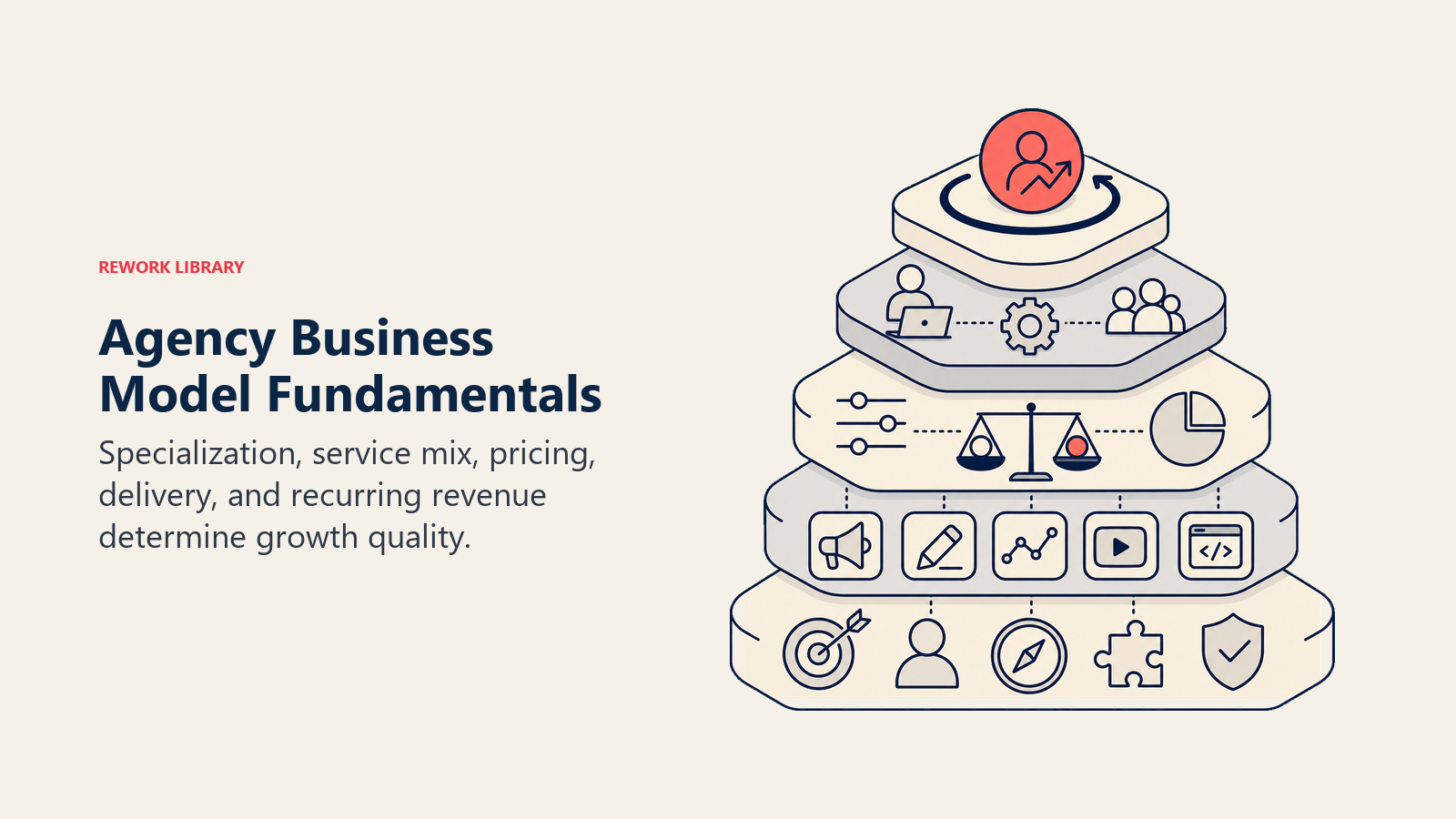
Service lines and specialization strategy: You can't be everything to everyone. Agencies grow faster when they specialize. The question is what to specialize in. For a detailed look at building your service portfolio, see service line strategy.
You could focus on an industry vertical - healthcare marketing, SaaS marketing, fintech marketing. Or specialize by service type - content marketing only, paid media only, brand strategy only. Some agencies pick a buyer type (B2B vs B2C, enterprise vs SMB). Others own a channel like SEO, social media, or email marketing.
Generalist agencies can survive, but they grow slower and face constant pricing pressure. Specialists command premium pricing because they develop deep expertise that's genuinely valuable.
Revenue models: How you charge affects everything from cash flow to client relationships. Four primary models:
Retainer: Monthly recurring revenue for ongoing services. This is the gold standard because it's predictable. You can forecast revenue, plan hiring, and build long-term client relationships. Typical retainers range from $5K/month for small clients to $100K+/month for enterprise accounts. The challenge is managing scope creep and maintaining value perception over time.
Project-based: Fixed-price deliverables like website redesigns, campaign launches, or brand identity projects. Projects create lumpy revenue but allow you to scale up and down without long-term commitments. They're also easier to price at premium rates if you have a strong portfolio. Range: $20K for small projects to $500K+ for major initiatives.
Performance-based: Compensation tied to results like leads generated, sales closed, or revenue driven. This model aligns incentives perfectly but requires sophisticated tracking and puts significant risk on the agency. Works best for direct-response marketing where attribution is clear. Usually combines a smaller retainer with performance bonuses.
Hybrid: Most successful agencies mix models. Core services on retainer for stability, projects for growth opportunities, and performance incentives for alignment. A client might pay $20K/month retainer plus a $100K website project plus 10% of attributed revenue over baseline.
Client types and ideal customer profile: Not all clients are created equal. Your ideal client has budget to pay fair rates - agencies targeting Fortune 500 companies work with different economics than those serving startups. They have a long-term need for services. Product companies need ongoing marketing. Event companies are seasonal and harder to build recurring revenue around.
Look for decision-making clarity. Working with one decision-maker beats committee-based approval hell. You want clients with a strategic mindset who value expertise, not commodity buyers shopping purely on price. And cultural fit matters. Collaborative clients who trust your process are worth more than micromanagers who second-guess every decision.
Market positioning: generalist vs specialist: This isn't just marketing. It's economic reality. Specialists can charge 2-3x more than generalists for the same work because they have relevant case studies and industry knowledge. They speak the client's language and understand their challenges. They provide strategic insight, not just execution. And they're perceived as experts, not vendors.
A generalist agency might charge $125/hour for social media management. A specialist B2B SaaS social media agency charges $200/hour for the same work because their expertise is worth more to their specific audience.
Client acquisition strategies
You can't scale an agency without consistent new business. Most agencies rely on referrals and luck. Growing agencies build systematic acquisition processes.
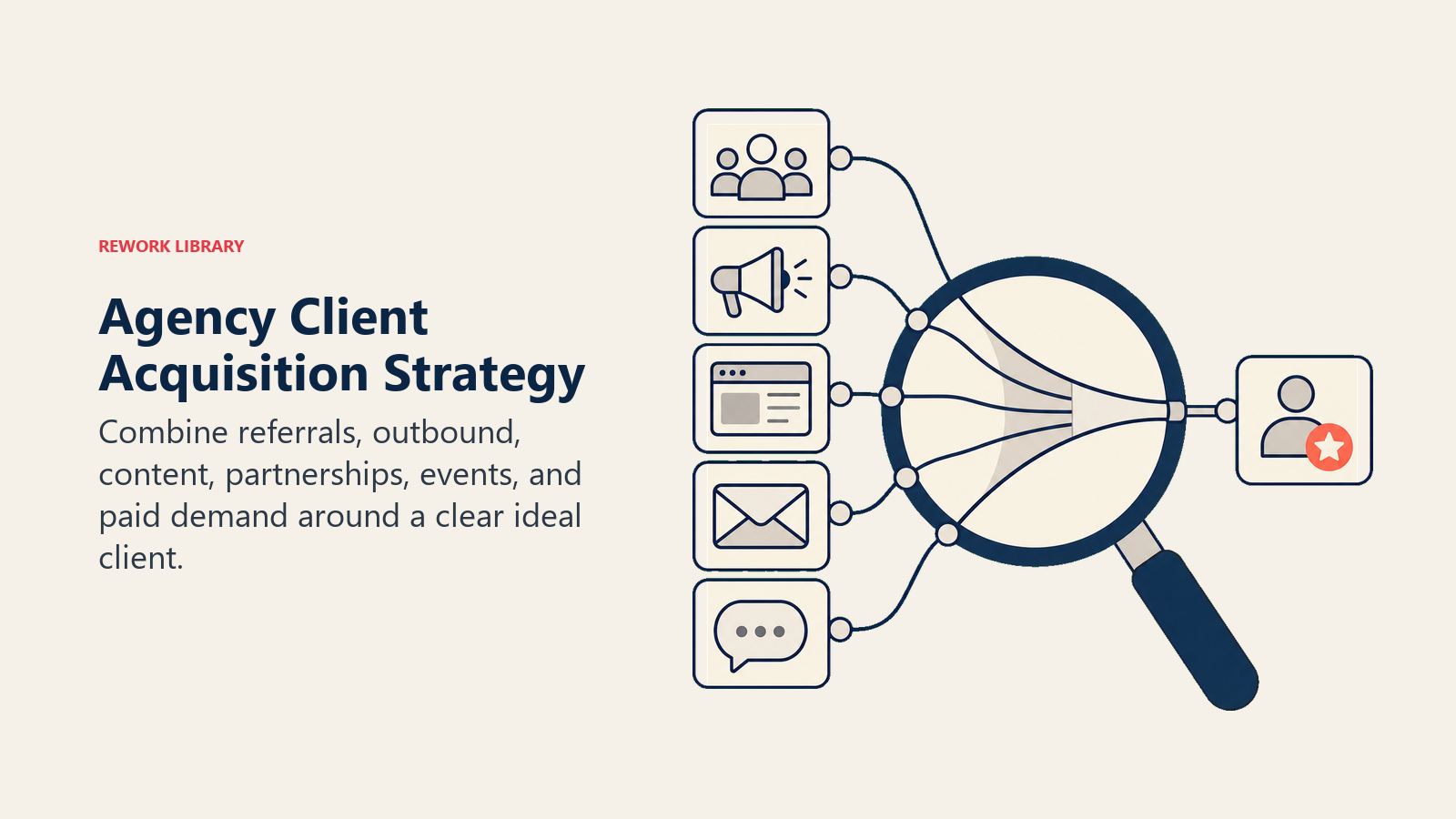
Inbound marketing and thought leadership: The founder's personal brand is your most powerful acquisition tool in the early days. When you're known for specific expertise, clients seek you out. This means:
- Publishing insights on LinkedIn, industry blogs, or your own site
- Speaking at conferences and industry events
- Building a podcast or video series
- Sharing case studies and results publicly
- Creating educational content that demonstrates expertise
The ROI here is slow but compounding. It might take 12 months of consistent content before you see meaningful inbound leads. But once it works, it's the highest-quality pipeline you'll have.
Outbound prospecting and business development: For faster results, you need outbound. This works best when tightly targeted. Instead of "we help companies with marketing," try "we help Series B SaaS companies generate enterprise pipeline through ABM campaigns."
Effective outbound requires:
- Well-defined ICP (ideal customer profile)
- Targeted prospect lists (not spray and pray)
- Personalized outreach that demonstrates relevant expertise
- Multi-touch sequences across email, LinkedIn, and phone
- Quick response to inbound signals (website visits, content downloads)
Expect 1-2% response rates on cold outreach. That's fine if you're reaching the right people with a relevant message.
Referral and word-of-mouth systems: Most agencies get 40-60% of new business from referrals. But they treat it passively. Active referral systems include:
- Client referral programs with incentives
- Partner referral agreements with complementary service providers
- Alumni programs (former employees send business)
- Regular "who should I know?" conversations with your network
- Case study approval process that asks "can we talk to potential clients about this?"
The best referral source is delivering exceptional results for clients who know other potential buyers.
Strategic partnerships and alliances: Find businesses that serve your ideal clients but don't compete with you. For a B2B marketing agency, this might be:
- Management consultants who advise on growth strategy
- Software vendors who sell to your target market
- PR firms who need marketing execution partners
- Private equity firms who need portfolio company support
Build relationships where you can refer business both ways. A formal partnership agreement can create steady deal flow.
RFP and pitch process management: If you're targeting mid-market or enterprise clients, RFPs are inevitable. Most agencies lose money on pitches. For a complete breakdown, see our guide on the agency pitch process. Winning agencies:
- Qualify hard before investing time (do we have a real chance?)
- Develop templated pitch decks that can be customized efficiently
- Showcase specific relevant results, not generic capabilities
- Propose strategic POV, not just "we'll do what you asked"
- Follow up aggressively post-pitch (most deals are lost in follow-up)
Track your pitch win rate. If you're below 30%, you're either pitching poorly or pursuing the wrong opportunities.
Portfolio and case study development: Your work has to sell your next client. Document everything:
- Results achieved (quantified metrics, not vague "increased brand awareness")
- Client testimonials and video interviews
- Before/after examples
- Process and strategy explanations
- Challenges overcome
Make case studies accessible on your site, in pitch decks, and in nurture sequences. Prospects buy based on proof you can deliver.
Agency new business pipeline
Having acquisition channels is one thing. Managing them systematically is another.
Lead generation and qualification: Track every lead source and conversion rate. You need to know:
- Which channels generate the most leads?
- Which generate the highest-quality leads?
- What's the cost per lead by source?
- How long does it take from lead to qualified opportunity?
Qualification criteria might include budget, timeline, decision authority, and strategic fit. Disqualify fast so you can focus energy on real opportunities.
Pitch and proposal process: Standardize your pitch approach:
- Discovery call to understand needs and qualify fit
- Detailed needs assessment (sometimes free, sometimes paid)
- Strategic proposal with recommended approach
- Pitch presentation with key stakeholders
- Negotiation and contract finalization
The best agencies charge for discovery work. It filters tire-kickers and sets a consulting tone vs vendor mindset.
Scoping and pricing strategies: This is where most agencies leave money on the table. Price based on value delivered, not hours worked. If your SEO work will drive $500K in new revenue for a client, charging $100K is fair even if it only takes 200 hours of work.
Pricing models:
- Value-based: Price based on the client's ROI or strategic impact
- Fixed-fee: Set price for defined deliverables
- Hourly: Time and materials (avoid this except for small scope changes)
- Retainer: Monthly fee for ongoing services at defined capacity
Always provide pricing ranges in proposals ($50K-75K depending on scope) so you have negotiation room.
Win rate optimization: Track your pitch-to-close ratio. If you're winning less than 25% of qualified opportunities, you have a problem. Common issues:
- Pitching the wrong prospects (qualification problem)
- Weak differentiation (positioning problem)
- Poor case study relevance (portfolio problem)
- Misaligned pricing (too high for value demonstrated, or too low triggering quality concerns)
- Losing to incumbent agencies (relationship and risk aversion problem)
Analyze lost deals. What was the stated reason vs the real reason? Pattern recognition helps you improve.
Sales cycle management: Know your average sales cycle by client size. SMB clients might decide in 2-4 weeks. Enterprise deals take 3-6 months. Manage your pipeline accordingly.
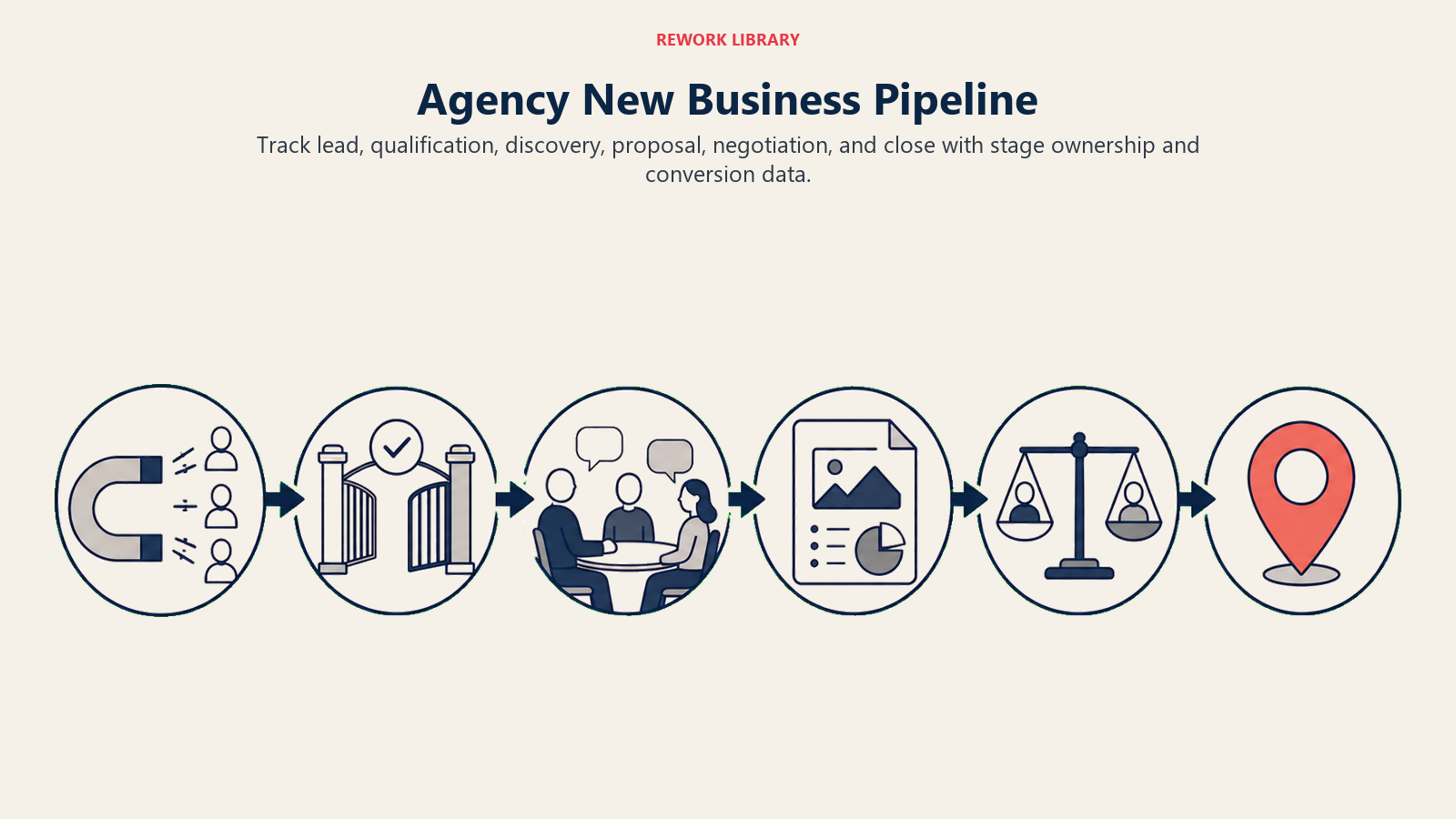
Create a clear stage-based pipeline:
- Lead (initial interest)
- Qualified (meets ICP, has budget/timeline)
- Discovery (active needs assessment)
- Proposal (submitted proposal)
- Negotiation (discussing terms)
- Closed-won or Closed-lost
Forecast revenue based on stage probabilities. Discovery stage might be 20% likely to close. Proposal stage might be 50%.
Conversion metrics and tracking: Measure everything:
- Lead-to-qualified conversion rate
- Qualified-to-proposal conversion rate
- Proposal-to-close win rate
- Average deal size
- Average sales cycle length
- Pipeline velocity (how fast deals move through stages)
These metrics tell you where to optimize. Low lead-to-qualified might mean poor targeting. Low proposal-to-close might mean pricing or positioning issues.
Service delivery and client management
Winning the client is step one. Keeping them and delivering profitably is the real challenge.
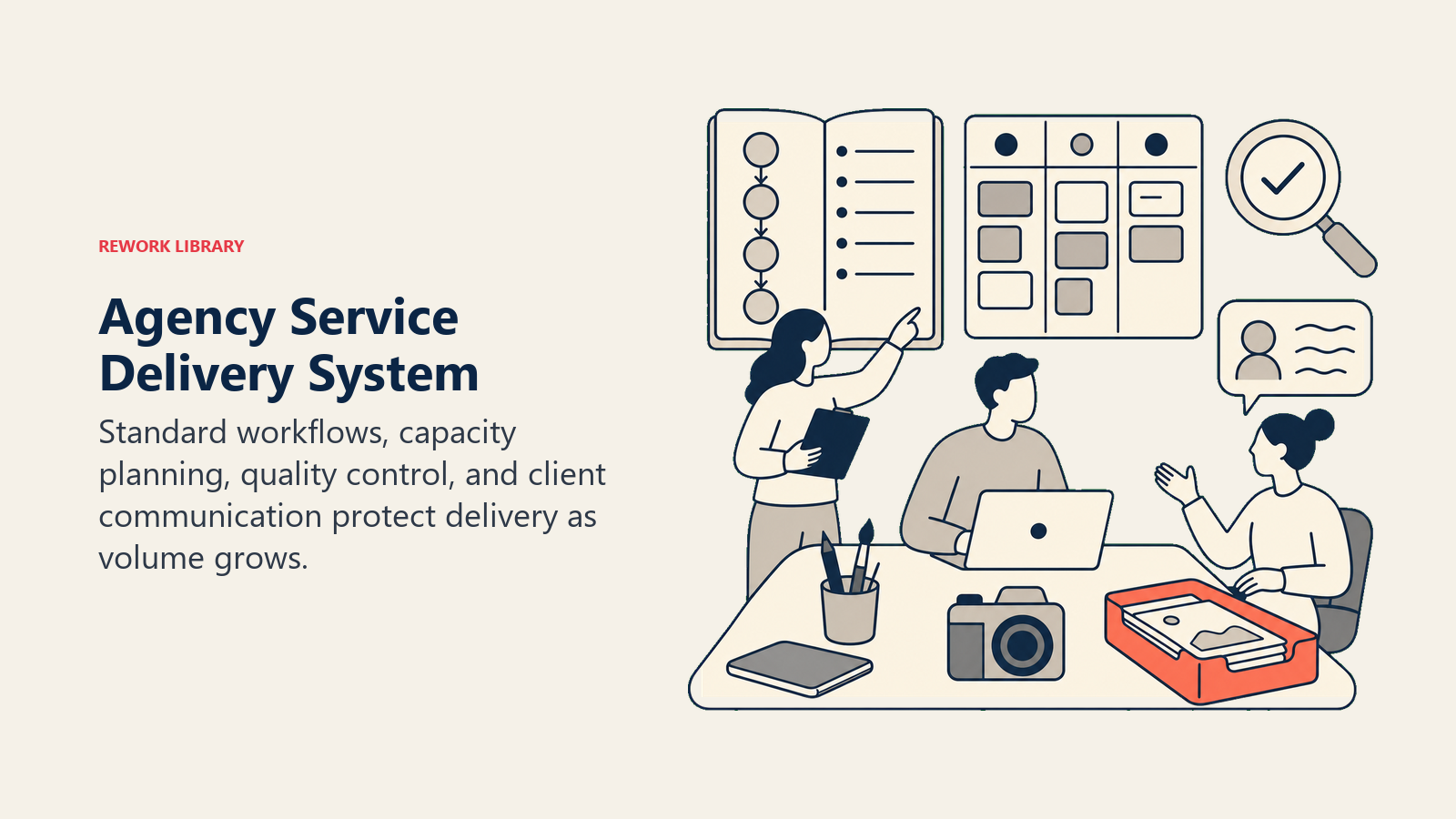
Project management and workflow: Agency chaos kills profitability. You need systems:
- Standardized onboarding process for new clients
- Project management tools (Asana, Monday, ClickUp) that everyone uses consistently
- Clear workflows for recurring deliverables
- Template libraries for common outputs
- Milestone-based delivery schedules
- Internal review processes before client deliverables
The goal is repeatability. If every project is custom from scratch, you can't scale. Create templates and frameworks that can be customized efficiently.
Quality assurance and creative review: Bad work loses clients fast. Build quality checkpoints:
- Internal creative reviews before client presentations
- Strategic lead reviews major deliverables
- Peer review for specialized work
- Client feedback loops built into the process
- Testing and QA for anything that launches
Quality issues usually stem from rushing, poor briefing, or junior staff working unsupervised. Fix the process, not just the output.
Client communication and reporting: Clients need to see value consistently. Communication cadence matters:
- Weekly status updates for active projects
- Monthly performance reports for ongoing retainers
- Quarterly business reviews for strategic planning
- Real-time alerts for issues or opportunities
- Clear escalation paths when problems arise
Create templated reporting that's easy to produce but provides real insight. Focus on results and business impact, not vanity metrics. See campaign results reporting for detailed guidance on demonstrating value.
Scope management and change orders: This is where agencies bleed profit. Clients ask for "one more thing" that turns into five more things. Your process needs:
- Clearly defined scope in the contract
- Written approval required for scope changes
- Formal change order process with pricing
- Time tracking to identify scope creep early
- Regular scope reviews with clients
Don't be afraid to say "that's outside our current scope, but we can do it for $X." Protecting scope protects profitability.
Results tracking and measurement: You can't prove value if you don't measure results. For every client, define:
- What success looks like (KPIs tied to business outcomes)
- How you'll measure it (analytics, attribution, surveys)
- Baseline metrics before your work
- Target metrics you're trying to hit
- Regular reporting cadence to show progress
When you can say "we drove 47% more qualified leads this quarter," renewal conversations are easy.
Client satisfaction management: Check in regularly on how things are going. Don't wait for annual renewals to ask about satisfaction. Use:
- Quarterly NPS surveys
- Regular check-in calls with decision-makers
- Post-project retrospectives
- Informal feedback during weekly syncs
Address issues immediately. A client who's unhappy but doesn't tell you will churn. A client who's unhappy but sees you fix it will stay.
Retainer vs project revenue model
The mix of retainer and project work determines your financial stability and growth potential.
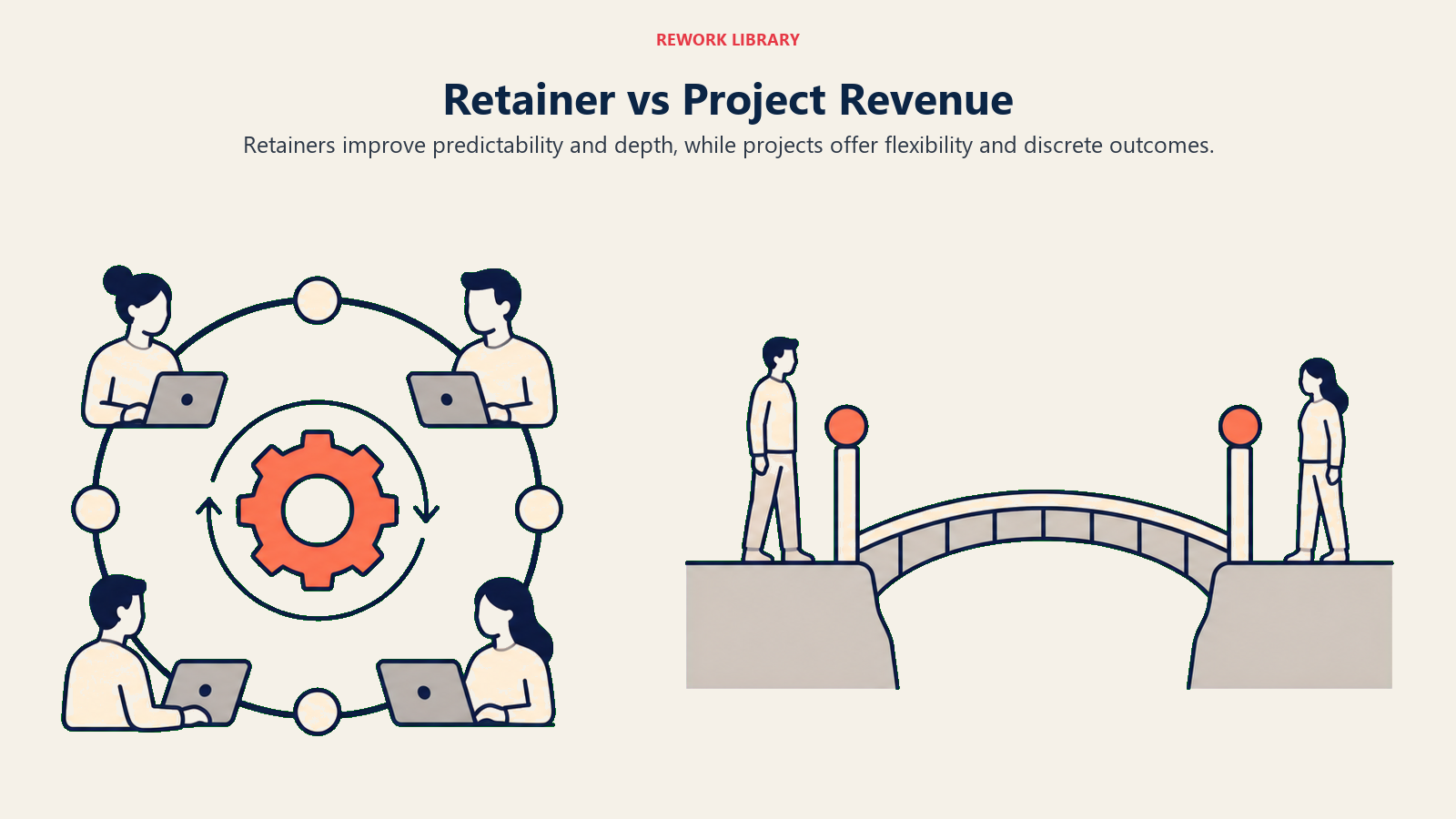
Retainer benefits: Recurring monthly revenue is the foundation of agency stability. For a detailed comparison, see our complete guide to retainer vs project models:
- Predictable cash flow for planning and hiring
- Deeper client relationships over time
- Ability to invest in strategic thinking vs just execution
- Better team utilization (steady work vs feast-famine)
- Higher lifetime value per client
Agencies with 70%+ retainer revenue can plan hiring six months out. Agencies with 20% retainer revenue are always in reactive mode.
Project benefits: One-off projects provide growth fuel:
- Higher total revenue per client (big launches supplement retainers)
- Portfolio diversity (interesting work that showcases capabilities)
- Ability to scale up without long-term commitments
- Premium pricing for specialized expertise
- Gateway to retainer relationships
Many agencies land projects first, prove value, then convert to retainers.
Optimal mix by agency size and goals: What works depends on your situation:
- Small agencies (<$2M): 50% retainer, 50% project works well. Projects fund growth, retainers provide stability.
- Growing agencies ($2-10M): Push toward 60-70% retainer. You need predictability to hire aggressively.
- Mature agencies ($10M+): 70-80% retainer is ideal. Projects are add-ons to existing relationships.
If you're below 40% retainer at any size, you're on a revenue rollercoaster.
Converting projects to retainers: The best new business is existing clients. After a successful project:
- Propose ongoing optimization and management
- Show the gap between one-time work and sustained results
- Package retainer services that build on project foundations
- Make it easy to say yes (start small if needed)
Example: "We rebuilt your website. Now let's drive traffic with a $10K/month SEO and content retainer."
Retainer pricing and scope management: The challenge with retainers is avoiding scope creep. Structure retainers with clear capacity limits:
- Hour-based: "$15K/month gets you 75 hours of work"
- Deliverable-based: "$10K/month includes 8 blog posts, 12 social posts, and monthly analytics reports"
- Hybrid: Core deliverables plus up to 20 hours of ad hoc requests
When clients exceed the scope, discuss expanding the retainer or moving work to project pricing.
Client retention and expansion
It's 5-7x more expensive to acquire a new client than to retain an existing one. Retention and expansion should be your primary growth lever once you hit $2M+.
Retention strategies and churn reduction: Track churn monthly. If you're losing more than 10% of clients annually, you have a problem. Retention tactics:
- Deliver consistent results (obvious but overlooked)
- Maintain communication cadence so you're always top of mind
- Be proactive about issues before clients raise them
- Celebrate wins together
- Make it easy to work with you (responsiveness, flexibility, clarity)
The biggest churn driver is changing client circumstances (budget cuts, new leadership, strategic pivots). You can't prevent all of this, but you can see it coming with good communication.
Account growth and cross-selling: Your existing clients are the easiest upsell. If you're doing great SEO work, propose paid ads. If you're managing social media, propose content marketing. The trust is already there.
Upsell strategies:
- Annual or quarterly strategic planning sessions that identify new opportunities
- Performance reviews that show results and recommend next steps
- Pilot programs for new services at reduced rates
- Bundling related services with pricing incentives
Track revenue per client over time. Growing accounts are healthier than static ones.
Client success programs: Don't just deliver services. Own client outcomes. This means:
- Understanding their business goals, not just marketing objectives
- Regular strategic advice beyond your contracted scope
- Proactive recommendations based on industry trends
- Connecting them with valuable resources or contacts
- Celebrating their success publicly (case studies, testimonials)
When clients see you as a strategic partner, not a vendor, they stick around.
Regular business reviews: Quarterly business reviews (QBRs) are retention insurance:
- Review results from the past quarter against goals
- Analyze what's working and what needs adjustment
- Present strategic recommendations for next quarter
- Align on priorities and resource allocation
- Discuss any concerns or challenges openly
QBRs give you visibility into client satisfaction and opportunities to course-correct before problems become churn.
Value demonstration and reporting: Your work might be great, but if clients don't perceive the value, they'll leave. Make value visible:
- Tie every metric to business impact (not just vanity metrics)
- Compare results to baseline or benchmarks
- Quantify ROI when possible
- Share wins regularly, not just in formal reports
- Use client language, not agency jargon
The CEO might not care about 50% more Instagram followers. They care that it drove 100 qualified leads worth $500K in pipeline.
Client advocacy and referral programs: Happy clients are your best salespeople. Formalize this:
- Ask satisfied clients for referrals (with incentives if appropriate)
- Request testimonials and case study participation
- Invite them to speak at your events or contribute to content
- Feature them as success stories publicly
- Create a formal referral bonus program (discounts, gift cards, donations to their favorite charity)
The referrals you get from clients close at 2-3x the rate of cold outbound.
Team structure and talent management
People are your only real asset. Getting the team right determines everything else.
Agency org structure: Typical structure evolves as you grow:
- Solo to 5 people: Founder does everything, hires generalists
- 5-15 people: Split into account management, creative/execution, and strategy
- 15-40 people: Specialized roles (SEO specialist, paid media specialist, content lead)
- 40+ people: Department structure with directors of client services, creative, strategy, operations
Account structure varies:
- Pod model: Small cross-functional teams assigned to client groups
- Functional model: Specialists organized by discipline (all SEO people together)
- Hybrid: Account leads coordinate cross-functional specialists
The right structure depends on your service mix and client needs.
Hiring and onboarding processes: Bad hires destroy agencies. Good hiring means:
- Clear role definitions (not "we need a marketing person")
- Skill assessments and work samples (not just resume reviews)
- Cultural fit evaluation (you'll be in the trenches together)
- Trial projects or contract-to-hire when possible
- Reference checks that go deep
Onboarding should be systematic:
- Week 1: Tools, processes, client context, shadowing
- Week 2-4: Supervised work on real client projects
- Month 2-3: Ramping to full productivity with regular check-ins
Don't just throw new hires into client work and hope for the best.
Freelancer and contractor management: Most agencies use a mix of full-time staff and freelancers for flexibility. Freelancers work well for:
- Specialized skills needed occasionally (videography, web development)
- Overflow capacity during busy periods
- Testing new service lines before hiring full-time
Build a reliable freelancer bench so you're not scrambling when you need help. Pay fairly and treat them well so they prioritize your work.
Career development and retention: Good people leave when they stop learning or feel undervalued. Retention strategies:
- Clear career paths (junior to mid-level to senior to director)
- Professional development budgets
- Regular feedback and growth conversations
- Challenging work and skill-building opportunities
- Competitive compensation reviews annually
- Recognition and appreciation culture
Replacing a good employee costs 6-12 months of their salary. Retention is cheaper than recruiting.
Utilization and capacity planning: Agencies live and die by utilization rates. You need team members billing clients 60-75% of their time. The rest goes to internal work, training, and admin.
Track utilization weekly. If someone's at 40%, you have a capacity problem (not enough client work). If they're at 90%, you have a burnout problem. Use utilization data to inform hiring decisions.
See Utilization & Capacity Planning for detailed guidance.
Culture and team satisfaction: Agency work is demanding. Culture matters:
- Work-life balance (don't glorify 80-hour weeks)
- Transparent communication from leadership
- Collaborative vs competitive environment
- Celebration of wins
- Psychological safety to raise issues
Run regular team surveys. High turnover destroys client relationships and institutional knowledge.
Financial management
Great creative work doesn't matter if you go bankrupt. Financial discipline separates successful agencies from failed ones.
Pricing strategies: How you price determines profitability:
Hourly rates: Simple but problematic. You're capping revenue based on hours available. Typical agency hourly rates: $100-300/hour depending on seniority and specialization. The problem is you're incentivized to be inefficient.
Value-based pricing: Price based on the outcome, not the effort. If your work will drive $1M in new revenue, charging $150K is justified even if it takes 300 hours. This requires understanding client economics and being able to articulate ROI.
Performance-based pricing: Compensation tied to results. Works best when attribution is clear (lead generation, e-commerce revenue). Usually combines a lower base fee with performance bonuses. Risk: you take on execution risk beyond your control (client's sales team, product quality, market conditions).
Fixed-fee projects: Set price for defined deliverables. Profitable if you estimate scope accurately. Risky if scope creeps or you underestimate effort.
The best agencies use a mix: retainers for core work, value-based pricing for strategic projects, and performance bonuses for alignment.
Profitability by client and service type: Not all revenue is equal. Track gross margin by:
- Client (some clients are high-maintenance and low-margin)
- Service line (paid media might be 40% margin while content is 25%)
- Team member (expensive senior people on junior-level work kills margins)
Prune low-margin clients unless they provide strategic value (referrals, case studies, learning opportunities). Double down on high-margin work.
Cash flow management: Agencies often have cash flow problems despite being profitable. Why? Clients pay 30-60 days after invoicing, but you pay employees and contractors every two weeks.
Cash flow management tactics:
- Bill monthly in advance for retainers
- Require 50% deposit on projects
- Net-30 payment terms strictly enforced
- Late payment fees in contracts
- Cash reserve of 2-3 months operating expenses
If you're growing fast, you're hiring before you collect revenue from the work that pays for those hires. Plan accordingly.
Revenue forecasting and planning: You need 3-6 month revenue visibility to make smart hiring decisions. Build forecasts from:
- Existing retainer revenue (known)
- Expected project work from existing clients (high probability)
- Pipeline conversion (weighted by stage probability)
- Historical seasonal patterns
Update forecasts monthly. If projections show a revenue dip in Q3, don't hire in Q2.
Expense management and overhead control: Operating expenses kill agency profitability. Major expense categories:
- Payroll and benefits (typically 50-60% of revenue)
- Contractors and freelancers (10-20%)
- Office and facilities (5-10%, or near zero for remote agencies)
- Technology and tools (3-5%)
- Marketing and business development (5-10%)
If your total operating expenses exceed 80% of revenue, you have margin problems. Review expenses quarterly and cut ruthlessly.
Scaling challenges and solutions
Breaking through growth plateaus requires different capabilities at each stage.
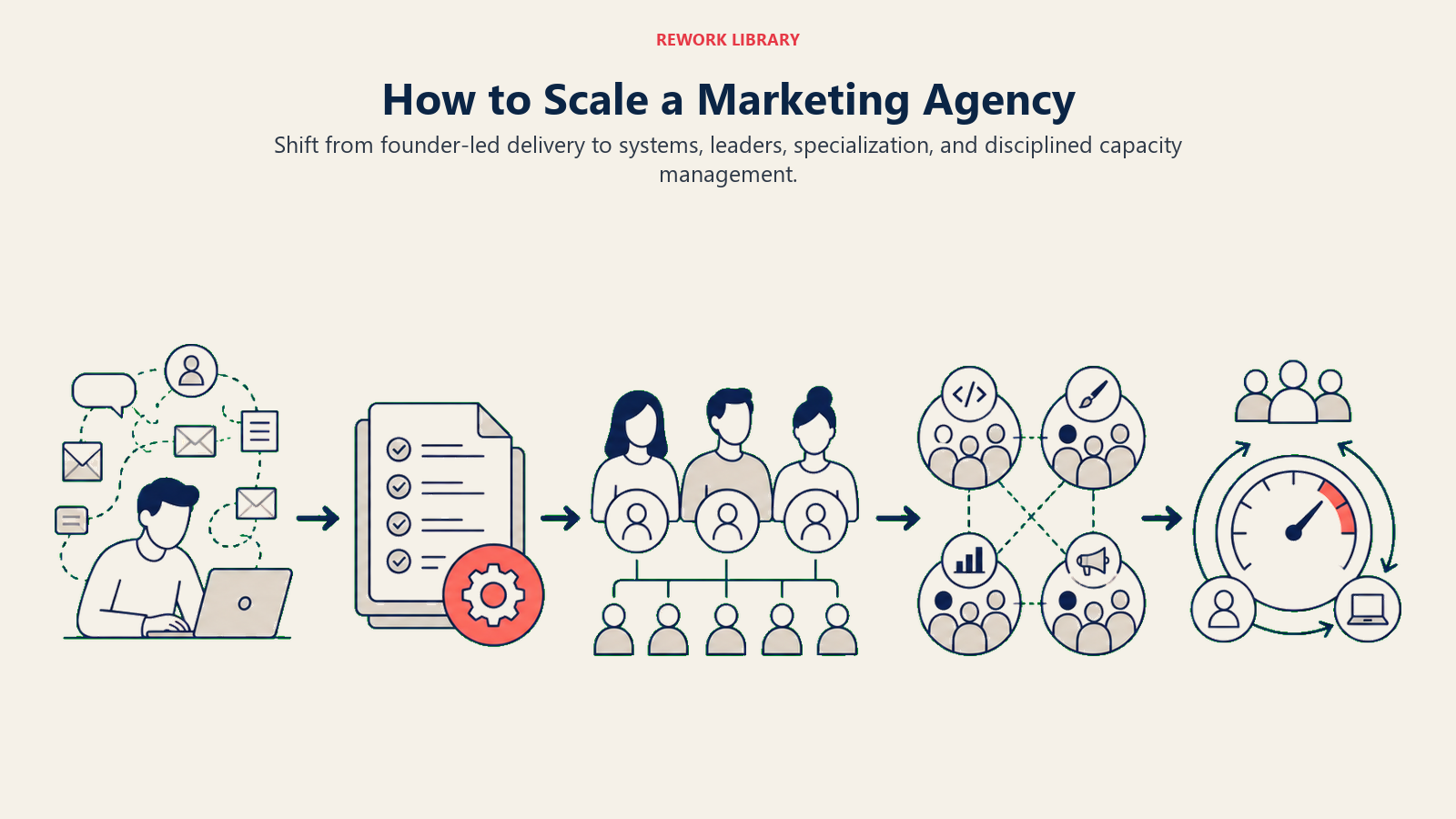
Moving from founder-led to team-led delivery: This is the biggest barrier to scaling. When you're the founder and the best practitioner, every client wants you. But you can't deliver for 20 clients personally.
The transition requires:
- Hiring senior people who can deliver at your level
- Building trust with clients that your team is excellent
- Creating processes that ensure consistent quality
- Stepping back from execution into strategy and oversight
- Accepting that work will be different, not worse
This is emotionally hard. Your identity is tied to the work. But if you can't make this shift, you cap agency growth at whatever you can personally deliver.
Building repeatable processes and systems: Scale requires systematization. Document:
- Client onboarding workflows
- Service delivery playbooks for each offering
- Quality control processes
- Reporting templates
- Pitch and proposal frameworks
When every client engagement is custom, you can't train people efficiently or maintain quality. Templates and processes create consistency that enables growth.
Specialization vs generalization decision: Generalist agencies grow slower but have more flexibility. Specialist agencies grow faster but have more risk if their niche declines.
The decision depends on market size and your differentiation:
- Large addressable market + strong positioning = specialize
- Small niche market = too risky to specialize fully
- Weak positioning in competitive market = specialization helps you stand out
You can also specialize within a generalist frame. Offer full-service marketing but only to one industry vertical.
Geographic expansion considerations: Should you open offices in other cities? Usually no. Remote work has eliminated most reasons for geographic expansion. Exceptions:
- Clients require local presence (government contracts, regional regulations)
- Talent pools in specific locations (tech in SF, finance in NYC)
- International markets with language or cultural requirements
Remote-first agencies have lower overhead and access to better talent than geo-restricted agencies.
Technology and tooling investments: Agencies need the right stack:
- Project management (Asana, Monday, ClickUp)
- Time tracking and resource planning
- Client communication (Slack, email, video)
- Marketing execution tools specific to your services
- Financial systems (accounting, invoicing, expense management)
Don't over-invest in tools early. But as you scale, the right systems create efficiency and visibility.
Quality maintenance during growth: Fast growth strains quality. You're hiring quickly, onboarding clients quickly, and pushing team members beyond capacity. Quality suffers.
Protect quality by:
- Hiring ahead of demand (so people aren't overwhelmed)
- Maintaining review processes even when busy
- Saying no to clients when you're at capacity
- Investing in training and skill development
- Tracking quality metrics (client satisfaction, revision rates, missed deadlines)
One bad client experience can destroy your reputation. Slow, sustainable growth beats chaotic rapid growth.
Common agency growth pitfalls
Learn from others' mistakes. These patterns kill agencies:
Taking on wrong-fit clients for revenue: When cash is tight, any client with a check looks good. But wrong-fit clients are poison:
- They don't value your expertise, so they negotiate on price
- They micromanage and complain because expectations are misaligned
- They generate bad case studies that attract more wrong-fit clients
- They drain team morale with difficult interactions
Saying no to bad-fit clients is hard. But chasing revenue without strategy leads to an agency full of clients you don't want.
Underpricing services and eroding margins: Competing on price is a race to the bottom. If your only differentiation is being cheap, you'll attract price-sensitive clients who leave the moment someone cheaper appears.
Underpricing also creates a vicious cycle:
- Low prices → low margins → can't afford senior talent → lower quality work → can't charge premium prices
Break this by focusing on value, results, and specialization. Charge what you're worth.
Poor project scoping leading to overruns: Underestimating project complexity destroys profitability. A project priced at $50K that takes twice as long as estimated costs you money.
Fix this by:
- Building contingency into estimates (add 20-30% buffer)
- Getting detailed requirements before pricing
- Using time tracking data from past projects to improve estimates
- Having scope change processes to capture additional work
Founder bottleneck in sales and delivery: If you're the only one who can sell or deliver, you've built a job, not a scalable business. Delegation is hard but necessary:
- Train team members on sales (or hire a business development person)
- Hire senior practitioners who can deliver at your level
- Build brand and content so inbound leads aren't dependent on you
- Step into strategic oversight vs hands-on execution
Weak financial management and cash flow: Creative people often avoid financial discipline. But ignorance doesn't prevent cash flow crises. You need:
- Monthly financial reviews (P&L, cash flow, AR aging)
- Cash flow forecasting
- Profitability analysis by client and service
- Expense controls and budget management
Hire a part-time CFO or financial consultant if this isn't your strength.
Neglecting team development and culture: Agencies are people businesses. When your team burns out or leaves, you lose institutional knowledge, client relationships, and momentum. Invest in:
- Competitive compensation
- Professional development
- Manageable workloads
- Career growth opportunities
- Positive culture
Retention is cheaper than replacement.
Where to go from here
Building a scalable marketing agency requires strategic clarity, operational discipline, and financial management. The agencies that break through the $5M barrier do a few things consistently:
- They specialize enough to command premium pricing
- They build systems for client acquisition, delivery, and retention
- They hire and develop talented people
- They manage finances tightly
- They transition from founder-led to team-led delivery
Start with the fundamentals. Get clear on your Professional Services Growth Model. Build a systematic approach to client acquisition through Consultative Business Development. Track the metrics that matter with Professional Services Metrics.
The path from $1M to $10M is hard. But it's not mysterious. Agencies that build systems, specialize strategically, and invest in their teams can scale sustainably. The question is whether you're willing to make the changes needed to get there.
Growth isn't about working harder. It's about building better systems and making smarter strategic choices. That's what separates thriving agencies from struggling ones.

Sales Director
On this page
- The agency growth challenge
- Agency business model fundamentals
- Client acquisition strategies
- Agency new business pipeline
- Service delivery and client management
- Retainer vs project revenue model
- Client retention and expansion
- Team structure and talent management
- Financial management
- Scaling challenges and solutions
- Common agency growth pitfalls
- Where to go from here