Legal Practice Area Marketing: Positioning and Promoting Specialized Legal Services
 Here's the uncomfortable truth about legal marketing: most law firms sound identical. They all claim "extensive experience," "client-focused service," and "proven results." Their websites read like compliance documents written by committee. And then they wonder why potential clients can't tell them apart from the firm down the street.
Turn this article into takeaways for your work.


Each assistant summarizes the article only for you and suggests best practices for your work.
The problem isn't that lawyers can't market. They're trapped between two competing pressures. On one side, you need aggressive marketing to stand out in saturated markets. On the other, bar association ethics rules restrict what you can say and how you can say it. Most firms play it so safe they disappear into the background noise.
But there's a better approach. Specialized practice area marketing lets you build real differentiation and attract higher-quality clients without crossing ethical lines. This guide shows you how to position, market, and promote specific legal services in a way that generates results while staying compliant.
Why legal marketing is different
Legal services marketing operates under constraints that don't exist in other industries. You can't make guarantees. You can't show dramatic case results without context. You can't use client testimonials in some jurisdictions. And you definitely can't use aggressive sales tactics that work in B2B software or consulting.
These restrictions exist for good reasons. Legal marketing rules protect clients from misleading claims and maintain professional standards. But they create a challenge: how do you compete when you can't promise outcomes or showcase results the way other businesses can?
The answer is specialization and authority. Instead of claiming you're "the best" (which is subjective and potentially unethical), you demonstrate expertise in specific areas through education, content, and credibility signals. Instead of testimonials, you build authority through thought leadership, publications, and recognized credentials.
This shift from promotional marketing to educational marketing works better for legal services anyway. People hiring lawyers are making high-stakes decisions. They're not swayed by flashy ads or aggressive sales pitches. They want to know you understand their specific problem and have deep expertise solving it.
The specialization advantage in legal services
Every lawyer knows generalists struggle to command premium rates. But the benefits of practice area specialization go beyond pricing. Higher conversion rates: When someone needs an employment discrimination attorney and finds a firm that only does employment law, the qualification process is already half done. You've pre-selected yourself as relevant. This mirrors the client qualification framework used across professional services.
Better SEO performance: Ranking for "lawyer near me" is nearly impossible. Ranking for "ERISA litigation attorney Boston" is achievable because the competition is narrower and the intent is clearer.
Improved referral quality: Other attorneys refer specialized work to specialists. If you're known as the ERISA person, you get those referrals. Generalists get whatever's left over. This feeds directly into broader law firm business development.
Premium positioning: Specialists can justify higher rates because expertise has clear value. When you've handled 200 cases in a specific area, you're worth more than someone who's handled 5.
The depth versus breadth decision matters more in law than most professions. A solo practitioner can't credibly claim expertise in corporate M&A, criminal defense, family law, and immigration. You have to pick. Larger firms can maintain multiple specialized practice areas, but even then, each group needs its own positioning and marketing approach.
Bar association ethics and advertising compliance
Before you write a single piece of marketing content, you need to understand the ethical boundaries. Every state has Model Rules of Professional Conduct (based on ABA guidelines), but they vary by jurisdiction. Core principles that apply everywhere:

- No false or misleading statements about services or results
- No guarantees of outcomes
- Communications must include firm name and contact information
- Specialization claims require certification in most jurisdictions
- Client confidentiality applies to marketing materials
- No direct solicitation of specific accident victims or people in distress
Common restriction areas:
Testimonials and endorsements: Some states prohibit them entirely. Others allow them with disclaimers that results aren't guaranteed. Check your jurisdiction's specific rules before using any client feedback.
Case results: You usually can't cite specific settlement amounts or verdicts without context about case difficulty and disclosures that past results don't guarantee future outcomes. Generic statements like "secured favorable outcome" are safer.
Specialization claims: Calling yourself a "specialist" or using terms like "expert" may require formal certification through your state bar or specialty organization. "Focused on" or "concentrating in" are usually acceptable alternatives.
Comparisons: Saying you're "better than" competitors or "the best" is typically prohibited as unverifiable. You can state objective facts like "largest employment law practice in the region" if true and provable.
Digital-specific issues: Every email, social media profile, and website needs to identify you as an attorney and include your physical location. Sponsored content and native advertising must be clearly labeled. LinkedIn recommendations might qualify as testimonials depending on your jurisdiction.
The safest approach: create a compliance checklist based on your specific state rules and run every piece of marketing content through it before publishing. Many firms have a managing partner or compliance person review materials. Some use outside ethics counsel for major campaigns.
Building your practice area positioning
Positioning answers three questions: Who do you serve? What problem do you solve? Why are you different from other options? Define your ideal client profile: Get specific beyond "businesses" or "individuals." What size company? What industry? What type of legal issue at what stage? A corporate attorney might focus on venture-backed SaaS companies handling Series A-B financings. An employment attorney might specialize in executive-level wrongful termination cases involving non-compete disputes.

The more specific your ICP, the easier everything else becomes. Your content addresses precise pain points. Your SEO targets exact search intent. Your networking focuses on specific referral sources.
Identify your differentiation: This is hard because legal services are largely commodified. You're all using the same laws and court procedures. But differentiation exists in:
- Specific expertise depth: You've handled 150 wage and hour class actions vs someone who's done 10
- Industry knowledge: You understand healthcare compliance because you worked in hospital administration before law school
- Process efficiency: Your immigration practice uses technology to handle routine filings faster and cheaper
- Relationship approach: Your family law practice emphasizes collaborative divorce over litigation
- Results track record: You've won summary judgment in 80% of your defense cases (stated carefully with appropriate disclaimers)
The key is making your differentiation provable and specific. "We care about clients" means nothing because everyone claims it. "Our employment attorneys average 18 years of experience and we maintain a 15:1 client-to-attorney ratio" is concrete and verifiable.
Create your messaging framework: This translates positioning into actual language you'll use across all marketing.
Core positioning statement (internal use, not client-facing): "We represent mid-market technology companies in complex commercial litigation, with particular expertise in software IP disputes and SaaS contract litigation."
Client-facing headline (website, LinkedIn): "Commercial Litigation for Technology Companies"
Value proposition (what you lead with): "We help software and SaaS companies protect their IP, enforce contracts, and resolve disputes without derailing growth. Our attorneys have technology backgrounds and understand your business model, not just the law."
Proof points (how you back it up): "We've represented over 200 technology companies in the past decade, with a track record of favorable outcomes in software IP cases. Our lead attorneys include former developers and product managers who understand technical issues in dispute."
This messaging framework keeps your marketing consistent while avoiding prohibited claims.
Content marketing strategy for legal practice areas
Content marketing is the foundation of modern legal practice development. It serves multiple purposes: demonstrates expertise, improves SEO, educates potential clients, and supports thought leadership. Content types that work for legal marketing:

Blog posts and articles: Explain legal issues, recent case law changes, regulatory updates, and practical implications. These drive organic traffic and establish expertise. A tax attorney writes about new IRS guidance. An employment lawyer explains recent Supreme Court decisions on arbitration.
Keep these practical and accessible. Legal writing defaults to complex, jargon-heavy prose. Marketing content should explain concepts clearly without dumbing them down. You're educating smart people who don't have law degrees.
Practice area guides: Comprehensive resources that walk through entire processes. "Guide to Buying or Selling a Business: Legal Considerations for $5M-$50M Transactions" or "Employment Law Compliance for Startups: What You Need to Know Before Hiring." These are lead magnets that demonstrate depth.
Case studies (where permitted): Describe how you've handled specific types of matters without identifying clients or disclosing confidential information. Focus on the approach, strategy, and type of outcome rather than specific dollar amounts. "How We Helped a SaaS Company Defend Against a Trade Secret Claim" tells a story without ethical issues.
Video content: Short explanatory videos perform well on LinkedIn and YouTube. Record answers to common client questions. Explain recent legal changes. Walk through what to expect in specific legal processes. Video builds trust faster than text because people see you as a person, not just a firm name.
Interactive tools: Calculators, decision trees, and assessment tools provide value while capturing leads. A family law firm might offer a child support estimator. An estate planning practice could provide an estate tax calculator. These tools require email registration and generate qualified leads.
Webinars and CLE presentations: Educational sessions position you as an expert while generating leads. Offer CLE credit where appropriate to attract other attorneys who become referral sources.
Content creation workflow with compliance:
- Identify topics based on client questions, search data, and legal developments
- Create content outline and draft
- Review for accuracy and completeness
- Compliance review for ethics issues (especially if making any claims about outcomes or expertise)
- SEO optimization
- Publish and promote
- Monitor engagement and update as law changes
The compliance step is non-negotiable. One prohibited claim can trigger bar complaints and damage reputation. Build review into your workflow rather than treating it as an afterthought.
SEO strategy for legal practice areas
Legal services SEO is brutally competitive but highly valuable. A top ranking for "employment attorney Los Angeles" is worth hundreds of thousands in client value. Keyword research approach:
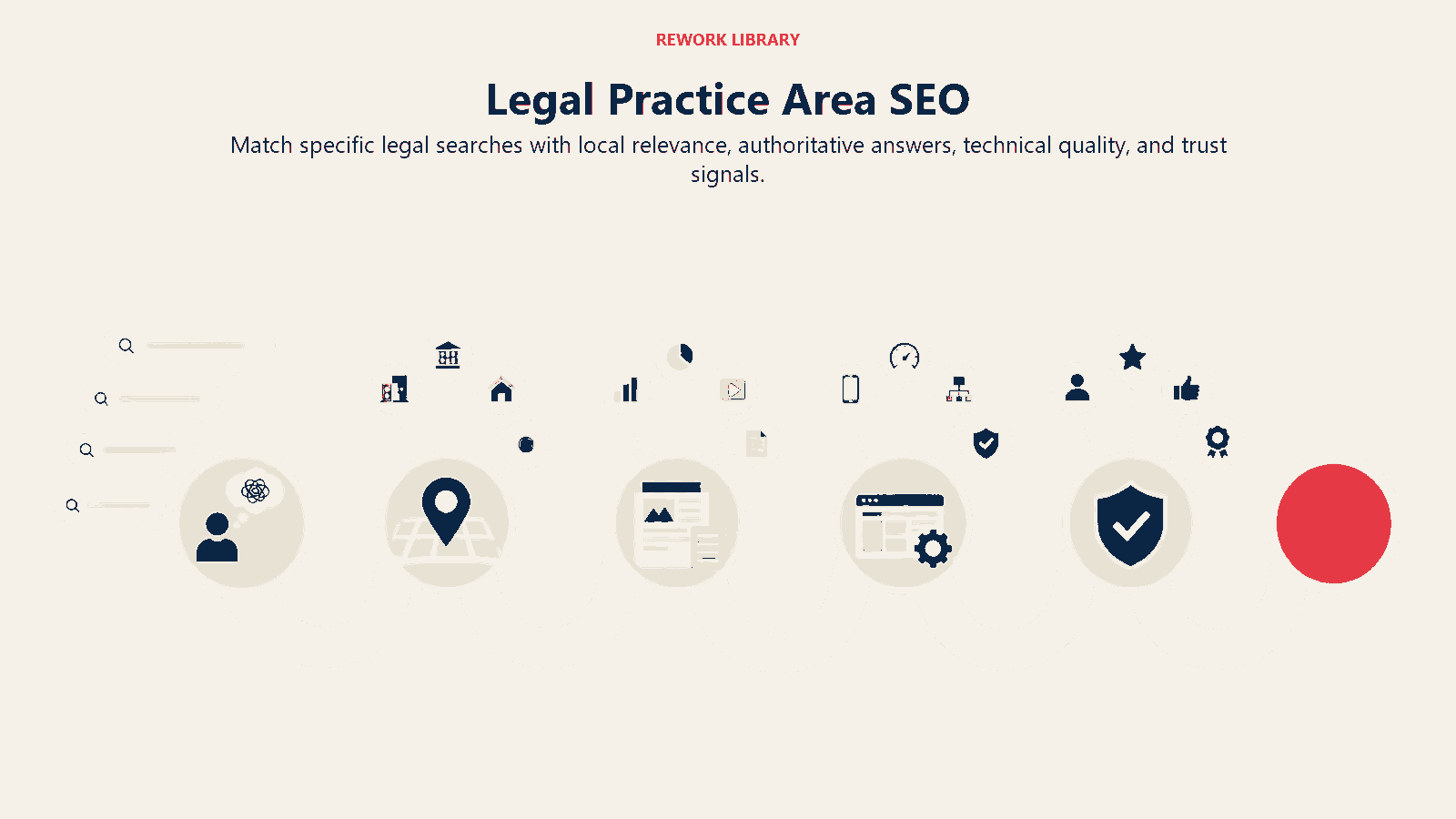
Start with three categories of keywords:
Service-based keywords: "[practice area] lawyer [location]", "business attorney Chicago", "estate planning attorney Austin". These have high intent but high competition.
Problem-based keywords: Search queries that indicate need without using legal terminology. "My employer won't pay overtime", "how to dissolve an LLC", "what happens if I die without a will". These often have less competition and catch people earlier in their research.
Local keywords: Combine practice area with specific neighborhoods, suburbs, or nearby cities. "Estate planning attorney Naperville" instead of just "Chicago" reduces competition while targeting specific geographic areas you serve.
Use tools like Ahrefs, SEMrush, or even Google's keyword planner to identify volume and competition. But also track keywords you're already ranking for (Google Search Console) and prioritize improving those positions.
On-page SEO structure:
Practice area pages: Each major practice area needs its own page with comprehensive content. Don't just list what you do. Explain the legal issues, what clients should know, how the process works, and why expertise matters in this area.
Structure these pages with:
- Clear H1 heading with target keyword
- Overview of the practice area and types of matters
- Who needs these services (signals ICP)
- Your approach and differentiation
- Credentials and experience specific to this practice area
- Frequently asked questions
- Call to action (consultation offer)
Attorney bio pages: Individual attorney pages should emphasize practice area focus, specific experience, credentials, publications, and speaking. These pages rank for "[attorney name] lawyer" and "lawyer [city]" + practice area combinations.
Location pages: If you serve multiple cities or regions, create location-specific pages that aren't just template duplicates. Include actual local content: local court information, jurisdiction-specific rules, community involvement.
Case result pages (where permitted): If your jurisdiction allows result descriptions with proper disclaimers, these pages can rank for very specific case types. They answer "what happened in [type of case] in [location]" queries.
Local SEO tactics:
Legal services are inherently local. Even if you handle matters nationally, clients want to know you're licensed and located where they need help.
Google Business Profile optimization: Claim and fully optimize your profile. Choose the most specific practice area categories. Add photos of your office, attorneys, and team. Post regular updates about legal developments or firm news. Respond to all reviews professionally.
Citation building: Get your firm listed in legal directories (Avvo, Justia, FindLaw, Martindale-Hubbell), local business directories, and chamber of commerce sites. Consistency matters more than quantity - make sure your firm name, address, and phone number (NAP) are identical everywhere.
Review generation: Reviews influence both rankings and conversion. Develop a systematic process to request reviews from satisfied clients. Make it easy by sending direct links. Respond to all reviews, positive and negative, professionally.
Some bar associations have specific rules about requesting reviews or how you respond to them. Check your jurisdiction's guidance.
Technical SEO fundamentals:
Most law firm websites have basic technical issues that hurt rankings:
- Slow page speed (especially on mobile)
- Poor mobile responsiveness
- Missing or duplicate title tags and meta descriptions
- Broken links
- Missing schema markup for local business and legal service
- No SSL certificate (insecure site warning)
Run your site through Google PageSpeed Insights and fix the critical issues. Implement schema markup so search engines understand you're a legal service provider in specific practice areas at specific locations.
Content clusters for practice areas:
Create hub-and-spoke content structures. Your main practice area page is the hub. Spoke articles dive deep into specific subtopics and link back to the hub.
Example for employment law:
- Hub: Employment Law Services page
- Spokes: Wrongful termination, Wage and hour disputes, Discrimination claims, Non-compete agreements, FMLA compliance, Executive employment contracts
This structure helps you rank for both broad and specific queries while building topical authority.
Digital marketing channels for legal services
Website optimization:
Your website is your most important marketing asset. It needs to do three things: establish credibility, educate visitors, and convert them to consultations.
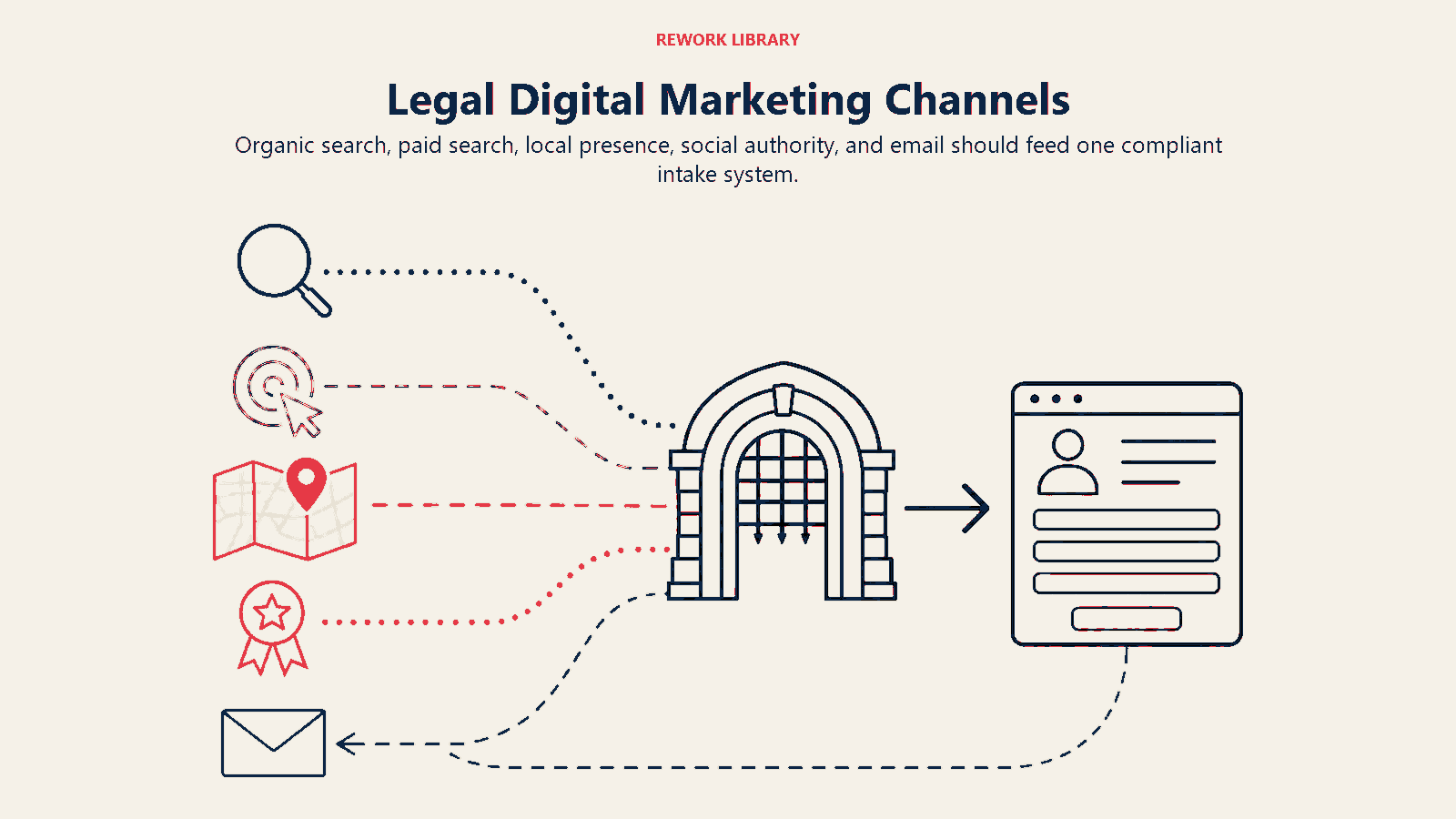
Credibility signals:
- Attorney credentials and bar admissions
- Years of experience and case volume in specific practice areas
- Awards, recognitions, certifications (only legitimate ones)
- Affiliations with bar associations and professional organizations
- Published articles, speaking engagements, media mentions
- Office photos and team bios (makes you real people, not just a corporate entity)
Educational content:
- Practice area pages that explain legal issues thoroughly
- Resource library with guides, checklists, FAQs
- Blog with practical legal insights
- Video content explaining processes
Conversion elements:
- Clear calls to action on every page
- Easy contact forms with minimal required fields
- Click-to-call buttons for mobile visitors
- Live chat option (even if handled by staff, not attorneys)
- Consultation scheduling tool
- Free resources offered in exchange for email (lead magnets)
Most law firm websites fail at conversion because they're built like brochures, not lead generation tools. Every page should guide visitors toward a next step.
LinkedIn strategy for attorneys:
LinkedIn is the most effective social platform for legal marketing. It's professional, allows detailed thought leadership content, and is where your potential clients and referral sources spend time.
Profile optimization: Your personal attorney profile should emphasize practice area focus, showcase publications and speaking, include recommendations (if permitted in your jurisdiction), and use a professional photo. Your headline should state your specialization clearly: "Employment Litigation Attorney | Helping Companies Navigate Complex Workforce Disputes" not just "Partner at Smith & Jones LLP."
Content strategy: Post regularly about legal developments in your practice areas. Share insights on recent cases. Explain regulatory changes and what they mean for businesses or individuals. Comment on industry news with legal perspective.
The goal isn't to go viral. It's to stay visible to your network and demonstrate expertise consistently. Two or three thoughtful posts per week beats daily generic content.
For more detailed LinkedIn strategies, see LinkedIn for Professional Services.
Email marketing:
Build an email list of past clients, referral sources, and prospects. Send regular updates about legal developments that affect them.
Segment your list by practice area interest. Employment law updates go to HR professionals and business owners. Estate planning content goes to individuals and financial advisors who refer estate work.
Keep emails educational, not promotional. The goal is to stay top of mind so when someone has a legal need, they think of you first. Include a clear call to action but make the primary value the information itself.
Paid advertising (Google Ads and LinkedIn):
Paid search can work for legal services but requires careful management. Cost per click for legal keywords is extremely high ($50-$300+ in competitive markets) because the client lifetime value is high.
When paid ads make sense:
- You have high-value practice areas (PI, complex litigation, corporate work)
- You can afford significant monthly budgets ($5K-$20K+)
- You have capacity to handle increased lead volume
- Your conversion process is dialed in so you're not wasting leads
When to avoid paid ads:
- Your practice area has low case values
- You can't afford to test and optimize over months
- You don't have someone managing campaigns actively
- Your website conversion rate is poor (fix that first)
LinkedIn ads work better for B2B legal services (corporate, employment, IP for businesses). Target by job title, company size, and industry. Use sponsored content to promote your best educational articles rather than direct "hire us" ads.
Legal directory and review strategy:
Directories like Avvo, Justia, FindLaw, Martindale-Hubbell, and Super Lawyers matter for legal marketing. They provide backlinks for SEO, show up in search results, and influence client decisions.
Free vs paid directory listings: Most directories offer free basic profiles. Paid enhancements might include priority placement, extended profiles, or featured positioning. The ROI varies widely by practice area and market.
Start with free listings on all major directories. Track which ones actually generate inquiries (use unique phone numbers or contact forms for each). Invest in paid enhancements only for directories that deliver results.
Review platforms: Reviews matter enormously in legal services because trust is the primary purchase factor. Someone hiring an attorney is taking a risk on a high-stakes decision. Reviews provide social proof.
Build a systematic review generation process:
- Identify matters that concluded positively
- Wait appropriate time (not immediately after settlement/judgment)
- Request review via email with direct links to Google, Avvo, or your preferred platforms
- Make it easy - don't require multiple steps
- Follow up once if they don't respond
- Thank everyone who leaves a review
Never offer incentives for reviews (violates most platform policies and potentially bar rules). Don't write fake reviews or have staff/family post them. Don't try to bury negative reviews by generating dozens of fake positive ones. These tactics backfire spectacularly when discovered.
Building authority and thought leadership
Marketing attracts attention. Authority converts it. When potential clients research you, they're looking for proof that you actually know what you're doing. Publishing strategy:
Write for legal publications, industry journals, and mainstream media. Getting published in your state bar journal, the National Law Journal, or industry publications your clients read establishes credibility.
Start with practitioner-focused publications (easier to get published) then work toward more prestigious platforms. Every published article is a credential you can cite and share.
Republish your articles on your website blog (check publication rights first) to get SEO value and make your content accessible to clients.
Speaking opportunities:
Present at bar association CLEs, industry conferences, client seminars, and webinars. Speaking positions you as an expert and generates direct leads from attendees.
Create standardized presentations on your core practice area topics that you can deliver repeatedly with minor customization. "Recent Developments in Employment Law" or "Contract Drafting Mistakes That Lead to Litigation" are perennial topics that stay relevant with annual updates.
Record your presentations (with permission) and use them as video content for marketing.
Awards and recognition:
Legitimate awards matter. Super Lawyers, Best Lawyers, Chambers rankings, and local "Top Attorneys" recognitions provide third-party validation. Don't pay for fake awards or directory placements that mean nothing.
Apply for awards that require peer review or case evaluation. Win rates increase with multiple applications over years as you build track record.
Display awards prominently on your website and LinkedIn but don't overdo it. A few prestigious recognitions are more impressive than twenty mediocre ones.
Expertise demonstration:
Board certifications: Get certified as a specialist through your state bar or recognized specialty organizations (if available in your practice area). This lets you use "specialist" language that's otherwise prohibited.
CLE teaching: Teaching other attorneys builds credibility. Bar associations and CLE providers are always looking for instructors. This positions you as an expert among experts.
Legal scholarship: Writing law review articles or practice guides demonstrates deep expertise. These rarely generate direct client leads but establish academic credibility that enhances reputation.
Media relations:
Position yourself as a media source for legal commentary in your practice area. Reporters need expert sources for legal stories. Being quoted in the Wall Street Journal or local news provides massive credibility.
Create a media kit with your bio, practice areas, and sample topics you can comment on. Reach out to legal reporters at publications your clients read. Use services like HARO (Help A Reporter Out) to respond to journalist queries.
When media opportunities arise, respond quickly and provide clear, quotable insights. Being helpful and reliable leads to repeat citations.
For more on building visibility through publishing and speaking, see Speaking and Publishing Strategy and Thought Leadership Strategy.
Client generation and conversion process
Marketing creates awareness. Lead generation captures interest. Conversion turns interest into clients. Each stage needs its own strategy. Lead generation by practice area:

Different practice areas generate leads through different channels.
Transactional work (corporate, real estate, estate planning): Leads come from referrals, networking, content marketing, and SEO. These are planned legal needs, not emergencies. The sales cycle is longer and relationship-based.
Litigation (employment, commercial, PI): Leads come from attorney referrals, online search, and directories. These often involve immediate problems requiring quick response. Speed of contact matters enormously.
Compliance and advisory (tax, employment compliance, regulatory): Leads come from thought leadership, speaking, publishing, and professional networking. Buyers are sophisticated and vet expertise carefully.
Match your lead generation tactics to how clients actually find attorneys in your practice area. Don't spend heavily on Google Ads for estate planning if 90% of your business comes from financial advisor referrals.
Initial consultation process design:
The consultation is where marketing meets sales. You need to qualify the opportunity, demonstrate expertise, and convert interest to engagement.
Pre-consultation preparation: Collect basic information before the meeting. What type of legal matter? What's the timeline? What's their desired outcome? This lets you prepare relevant questions and show you're taking them seriously.
Consultation structure:
- Understand their situation and legal issue (ask questions, listen more than talk)
- Explain the legal framework and process
- Discuss potential approaches and outcomes (with appropriate disclaimers about uncertainty)
- Explain your experience with similar matters
- Outline next steps and what engagement would look like
- Discuss fees and billing structure
- Ask for the engagement or explain decision timeline
Qualification during consultation: Not every prospect is a client you want. Assess:
- Is this a matter in your practice area and within your expertise?
- Is the client realistic about outcomes and process?
- Can they afford your fees?
- Are there conflicts of interest or ethical issues?
- Do you actually want to work with this person?
Don't be afraid to decline representation if it's not a fit. Referring to another attorney maintains goodwill and often generates reciprocal referrals.
For more on client qualification, see Client Qualification Framework.
Conversion rate optimization:
Most law firms focus entirely on generating more leads and ignore conversion. But doubling your conversion rate from 20% to 40% has the same impact as doubling lead volume, and it's usually easier and cheaper.
Track conversion metrics:
- Website visitor to inquiry conversion rate
- Inquiry to consultation conversion rate
- Consultation to engagement conversion rate
- Overall visitor to client conversion rate
Test different approaches:
- Response time to inquiries (same-day vs next-day)
- Who handles initial contact (attorney vs paralegal vs receptionist)
- Consultation format (phone vs video vs in-person)
- Fee structures and payment options
- Follow-up cadence if prospect doesn't commit immediately
Small improvements compound. Increasing website conversion from 2% to 3%, consultation booking from 50% to 60%, and engagement from 30% to 40% more than doubles your overall conversion rate.
Practice area-specific marketing strategies
Different legal practice areas require different marketing approaches based on client type, case economics, and buying behavior.
Corporate and M&A: Relationship-based marketing to CEOs, CFOs, and corporate development executives. Network through industry associations, serve on boards, publish in business journals, speak at industry conferences. Long sales cycles, high lifetime value, referral-driven.
Litigation (commercial, employment, IP): Focus on attorney-to-attorney referrals and demonstrating trial capabilities. Publish case analysis, speak at bar events, maintain active trial calendar, showcase victories (within ethics rules). Both direct client generation and referral cultivation.
Tax: Thought leadership is critical. CPA relationships drive significant business. Write for tax journals, speak at accounting conferences, explain regulatory changes, maintain expertise in niche areas. Position as specialist consultants, not generalists. Tax attorneys often work closely with accounting firms as referral partners.
Intellectual Property: Technical expertise matters enormously. Industry-specific focus (biotech vs software vs manufacturing). Content marketing showing you understand technology. Speaking at industry conferences where engineers and product people attend, not just legal events.
Real Estate: Local market expertise and relationship development with brokers, developers, lenders. High transaction volume means speed and efficiency differentiate. SEO for local commercial or residential real estate terms.
Employment Law: Split between employer-side (relationship marketing to HR executives and business owners) and employee-side (advertising, online presence, directories). Very different tactics for each side.
Family Law: Heavy competition, often price-sensitive except for high-net-worth divorce. Local SEO critical. Reviews matter enormously. Educational content about divorce, custody, support processes. Collaborative divorce positioning as differentiator.
Adapt your marketing mix to match how clients in your practice area actually make hiring decisions.
Performance measurement and attribution
You can't improve what you don't measure. Legal marketing requires tracking both leading indicators (activity) and lagging indicators (results). Key marketing metrics:
Traffic and visibility:
- Organic search traffic by practice area
- Keyword rankings for target terms
- Directory profile views
- Social media engagement and follower growth
Lead generation:
- Total inquiries per month by source
- Lead quality scores (does inquiry match ICP?)
- Cost per lead by channel
- Lead response time
Conversion:
- Inquiry to consultation rate
- Consultation to engagement rate
- Overall conversion rate by practice area
- Average time from inquiry to engagement
Economic outcomes:
- New client acquisition cost by channel
- Average matter value by practice area
- Client lifetime value (for relationship clients with multiple matters)
- Marketing ROI by channel
Attribution challenges:
Legal services typically have long, complex buyer journeys with multiple touchpoints. Someone might:
- Find you through Google search
- Read three blog posts
- Download a guide
- See you speak at a conference
- Get your name from a referral
- Finally call to schedule a consultation
Which channel gets credit for that client? The answer matters because it determines where you invest marketing budget.
Use multi-touch attribution models:
- First touch: What introduced them to you?
- Last touch: What triggered them to contact you?
- All touches: What touchpoints occurred along the way?
Ask every new client "How did you hear about us?" but recognize the answer is often incomplete. They might say "Google" but neglect to mention they also read your articles and heard you speak.
Track this in your CRM:
- Initial source (first known touchpoint)
- All marketing touchpoints before engagement
- Final conversion trigger
- Referral source if applicable
Practice area profitability analysis:
Marketing spending should align with practice area economics. Calculate:
- Average matter value by practice area
- Profit margin by practice area (after direct costs and allocated overhead)
- Client acquisition cost by practice area
- Acceptable CAC as percentage of matter value
If your average employment litigation matter is worth $50K and you have 40% margin ($20K profit), you can afford to spend $2K-$5K to acquire that client. If estate planning matters average $3K with 60% margin ($1,800 profit), your acceptable CAC is $200-$500.
This tells you which practice areas justify aggressive marketing investment and which need more efficient, lower-cost approaches.
Common legal marketing mistakes
Ethical violations: Making prohibited claims about results, guaranteeing outcomes, making comparisons you can't substantiate, failing to include required disclaimers. These mistakes damage reputation and can trigger bar complaints. When in doubt, err on the side of caution and get ethics review.
Overreaching claims: Calling yourself an "expert" or "specialist" without proper certification. Using superlatives like "best" or "most successful" that can't be objectively proven. Claiming achievements you don't have. Be accurate and conservative with credentials.
Neglecting local SEO: Failing to optimize Google Business Profile, not building citations, ignoring reviews. Local visibility matters enormously for legal services. Most lawyers serve specific geographic markets. Show up when people search for attorneys in your area.
Generic positioning: Marketing that could apply to any law firm. "We provide excellent service and fight for our clients" is meaningless because everyone says it. Specific differentiation based on measurable factors beats generic claims every time.
Ignoring mobile experience: More than 60% of legal searches happen on mobile devices. If your website is slow or difficult to use on phones, you're losing half your potential clients. Make sure contact forms work smoothly on mobile and click-to-call buttons are prominent.
Poor lead follow-up: Taking days to respond to inquiries, making prospects fill out long forms, requiring multiple steps to schedule consultations. Speed and simplicity matter. Competitors who respond in minutes beat those who respond in days.
No attribution tracking: Spending marketing budget without knowing what generates results. Continuing ineffective tactics because you don't measure outcomes. Implement tracking and make data-driven decisions. The professional services metrics framework can help establish proper measurement systems.
Inconsistent effort: Marketing heavily for a few months, then stopping when busy. Leads dry up six months later and you wonder why. Marketing is a continuous process, not a campaign you turn on and off.
Building sustainable practice area visibility
Legal marketing works when you combine compliant positioning with consistent effort across the right channels.
Start with clear practice area focus. You can't market effectively if you're trying to be everything to everyone. Pick areas where you have genuine expertise and client demand exists.
Build your marketing foundation: a strong website with comprehensive practice area pages, local SEO optimization, presence in relevant directories, and a review generation process.
Layer in content marketing: regular blog posts, guides, and resources that demonstrate expertise while improving SEO. Make sure everything goes through ethics review before publishing.
Develop thought leadership: publish in legal and industry journals, speak at relevant conferences, build media relationships. This establishes authority that converts prospects.
Implement systematic lead management: fast response, smooth consultation process, conversion optimization, and proper attribution tracking.
Measure results and optimize: focus investment on channels that deliver qualified clients at acceptable cost. Cut tactics that don't work.
The firms that win at legal marketing aren't the ones with the biggest advertising budgets. They're the ones that combine ethical positioning, genuine expertise, and systematic execution over years. Marketing is a long game, but the compounding returns are substantial.
Start with foundational tactics that work across practice areas, then customize based on your specific client acquisition patterns. For more on inbound legal marketing strategies, see Inbound Lead Generation. For networking approaches that complement digital marketing, see Professional Networking. And for overall content strategy, review Content Marketing for Services.
The legal market is competitive, but specialization, expertise, and smart marketing create real differentiation. Focus on building authority in your practice areas rather than trying to out-spend competitors on advertising. That's how sustainable legal practices grow.

Sales Director
On this page
- Why legal marketing is different
- The specialization advantage in legal services
- Bar association ethics and advertising compliance
- Building your practice area positioning
- Content marketing strategy for legal practice areas
- SEO strategy for legal practice areas
- Digital marketing channels for legal services
- Building authority and thought leadership
- Client generation and conversion process
- Practice area-specific marketing strategies
- Performance measurement and attribution
- Common legal marketing mistakes
- Building sustainable practice area visibility