Cross-Sell Strategy: Expanding Account Revenue Through Strategic Service Bundling

Turn this article into takeaways for your work.


Each assistant summarizes the article only for you and suggests best practices for your work.
Here's a number that should change how you think about growth: acquiring a new client costs 5-10x more than selling to an existing one. Yet most professional services firms chase new logos while sitting on a goldmine of expansion revenue right in front of them.
The math is simple. You already have trust. You already understand the client's business. You already have a relationship with decision-makers. Selling a second or third service to someone who's already happy with your first one should be easier than convincing a stranger to take a chance on you.
But most firms get cross-selling wrong. They treat it like an afterthought - a "hey, did you know we also do X?" conversation that feels awkward and transactional. Or they push services that don't fit, damaging the relationship they worked so hard to build.
This guide shows you how to build a systematic cross-sell approach that expands account value naturally, through service offerings that genuinely solve additional client problems. Combined with client penetration strategies, cross-selling becomes one of the most efficient growth engines available to professional services firms.
What cross-sell actually means (and what it's not)
Let's start with definitions, because people confuse these terms constantly. Cross-sell is selling a different service to an existing client. If you're doing tax compliance for a client and you start doing their audit work, that's cross-sell. You're selling across your service portfolio.
Upsell is selling more of the same service. If you expand that tax compliance work to cover more entities or add more complex tax planning, that's upsell. Same service, bigger scope. For strategies on growing existing engagements, see upsell and scope expansion.
Expansion is a broader term that covers both. The client is spending more with you, whether through cross-sell, upsell, or both.
This distinction matters because the strategies are different. Upselling requires demonstrating value in your current service and showing why more of it makes sense. Cross-selling requires introducing a new capability, building trust in that capability, and connecting it to problems the client actually has.
Cross-sell is harder. You're not just saying "let's do more of what's working." You're saying "we're also good at this other thing, and you should trust us with it." That requires different conversations, different proof points, and different internal coordination.
Why cross-sell works in professional services
Professional services have a unique advantage when it comes to cross-selling: you're already inside the business. You see things prospects can't see until after they hire you. Information advantage: Through your current work, you learn about the client's challenges, priorities, and gaps. If you're doing their accounting, you see financial patterns that might indicate HR complexity or technology needs. If you're managing their IT, you see data that points to security or compliance gaps. You have context that makes your recommendations relevant rather than random.
Trust foundation: The client has already vetted you once. They've seen your work quality, communication style, and reliability. Introducing a new service isn't starting from zero - you're leveraging existing credibility. If they trust your tax team, they're inclined to believe your audit team is also competent.
Relationship access: You already have meetings scheduled. You already have their team's phone numbers and Slack channels. Getting time with decision-makers isn't a cold outreach challenge. You're a known entity, not an interruption.
Integration value: When multiple services come from one firm, the integration is smoother. Shared context, aligned teams, consistent processes. The client doesn't have to onboard a new vendor, explain their business again, or manage another relationship. That convenience has real value.
But here's the catch: these advantages only help if the new service is actually relevant. Trust works both ways. If you push a service the client doesn't need just to hit your revenue target, you damage the relationship and reduce future cross-sell opportunities. Cross-sell has to be client-benefit first, firm-benefit second.
Prerequisites for effective cross-selling
Not every client relationship is ready for cross-sell. You need these foundations in place:
Current service satisfaction: If the client is unhappy with what you're already doing, selling them more is tone-deaf. Fix the quality issue first. Cross-sell works when you're selling from strength, not when you're trying to make up for mediocre performance.
Relationship depth: You need more than a transactional vendor relationship. Do you understand their business priorities? Do they see you as a strategic partner or just a service provider? Can you have candid conversations about their challenges? If you're not at that level yet, work on client relationship strategy before you push cross-sell.
Delivery capacity: Can you actually deliver the new service well? Cross-selling a capability you can't execute properly is worse than not cross-selling at all. Make sure your service line is ready before you start selling it aggressively.
Client readiness: Does the client have the budget, bandwidth, and organizational readiness for another project? Timing matters. A client going through a major transition might not be ready to add new initiatives, even if the service is relevant.
Stakeholder coverage: Do you have relationships beyond your current service's direct contacts? Cross-sell often involves different decision-makers. If you only know the CFO and you're trying to sell HR consulting, you need paths to the CHRO.
If these prerequisites aren't met, your cross-sell efforts will feel pushy and fail. Build the foundation first.
Mapping your service portfolio for cross-sell
You can't cross-sell strategically if you don't understand your own portfolio. Start by mapping what you offer and how services connect. Service inventory: List all services you provide. Group them into logical categories - not by internal department structure, but by client problem areas. Tax, audit, advisory, valuation, consulting, implementation, training, fractional roles - whatever applies to your firm. Natural bundles: Which services frequently go together? In accounting, tax and audit are classic pairs. In IT consulting, infrastructure and security often bundle. In marketing, strategy and execution naturally link. Identify these patterns because they're your easiest cross-sell pathways.
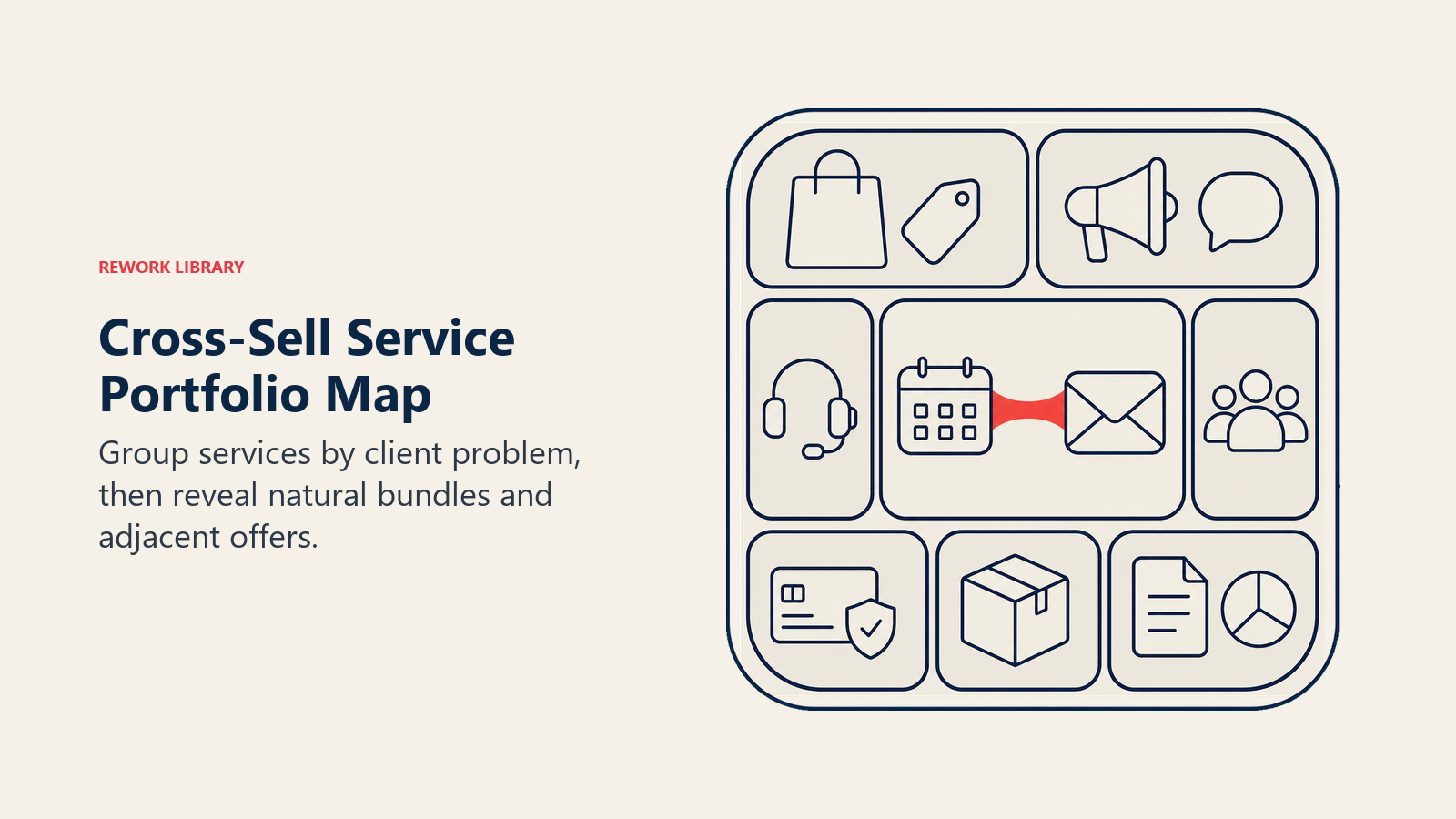
Sequential services: Some services naturally follow others in a logical progression. You might do a strategic assessment, which leads to implementation support, which leads to training and enablement. These sequential relationships are gold for cross-sell because the need for the next service emerges organically from the first one's outcomes.
Complementary services: These solve related problems even if they're not direct sequences. If you're doing financial planning, estate planning is complementary. If you're doing IT infrastructure, change management consulting might fit. The connection is thematic rather than procedural.
Client segment fit: Not all services fit all clients. Small businesses need different things than enterprises. VC-backed startups have different priorities than family businesses. Map which services align with which client types, so you're not trying to sell audit readiness to a 5-person company.
Create a visual matrix: services on one axis, client segments on the other, with indicators of fit strength. This becomes your cross-sell opportunity map.
Building cross-sell pathways by entry service
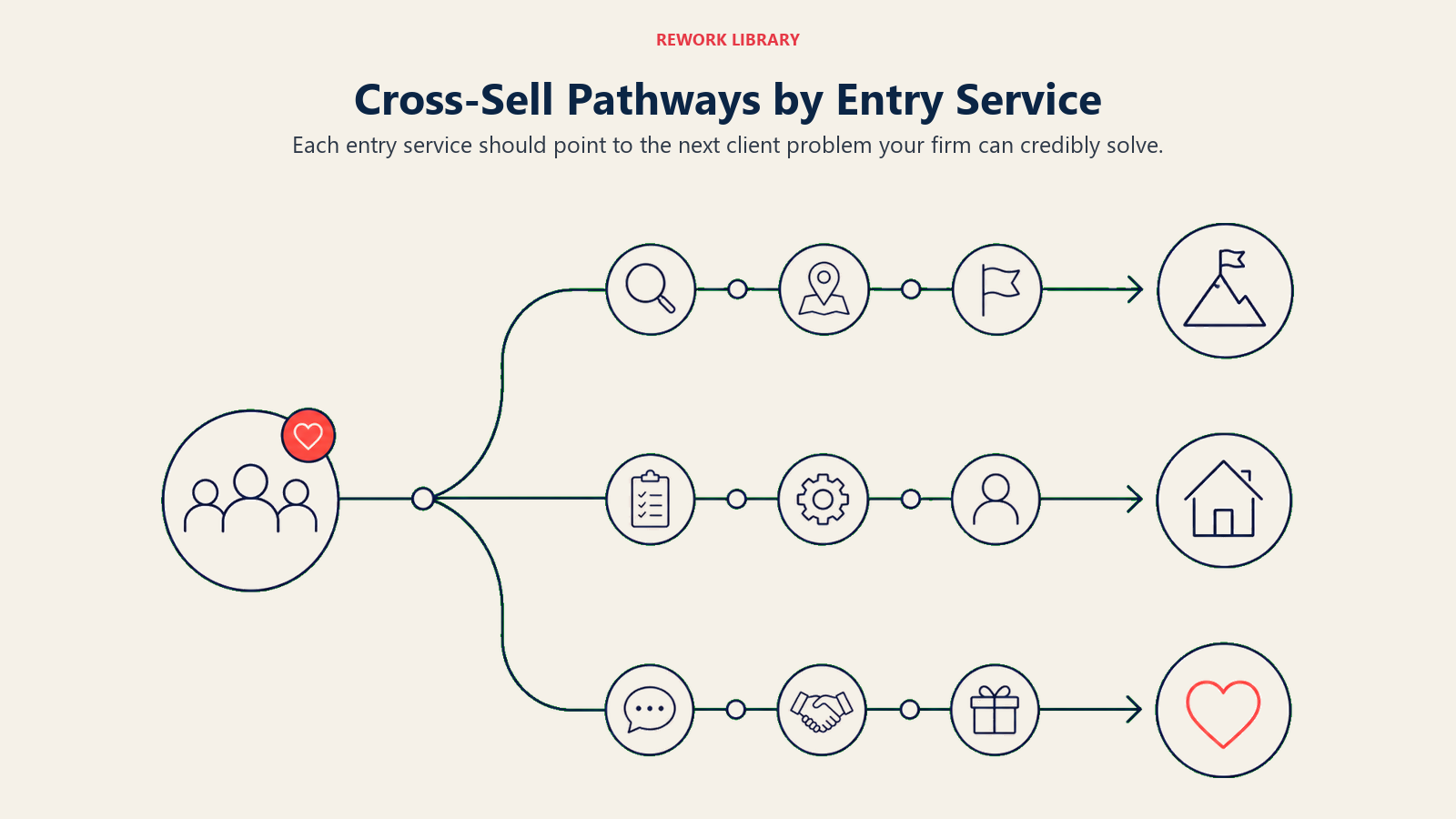
Every service you provide is a potential entry point to other services. The question is: what's the logical next sale? Think about it from the client's perspective. If they hired you for Service A, what problem might they encounter that Service B solves? What insight does Service A give you that reveals the need for Service C? Example pathways for accounting firms:
- Tax compliance → Tax planning (deeper engagement)
- Tax compliance → Audit (regulatory requirement or growth milestone)
- Audit → Transaction advisory (if they're considering M&A)
- CFO advisory → Full outsourced accounting (if they're overwhelmed)
- Business valuation → Succession planning (natural next question)
Example pathways for IT consulting:
- Infrastructure setup → Security audit (once systems are in place)
- Security audit → Ongoing managed security (if gaps are found)
- Cloud migration → Training and adoption support (to maximize ROI)
- Technology assessment → Implementation services (natural execution step)
Example pathways for management consulting:
- Strategy development → Execution support (bridge from plan to action)
- Organizational design → Change management (to implement the new structure)
- Process improvement → Technology implementation (to scale improvements)
- Executive coaching → Team development (expand from individual to group)
For each service you offer, document the typical cross-sell pathways. This isn't about pushing services randomly - it's about understanding the natural progression of client needs so you can spot and respond to them proactively.
Understanding total addressable wallet
Cross-sell strategy starts with knowing how much the client could potentially spend with you across all services. This is their total addressable wallet - the full scope of work they need that you could provide. Most firms only capture a fraction of this. You're doing one or two services while the client spends 5-10x that amount with other providers on services you could deliver. That's the opportunity. Wallet analysis process:
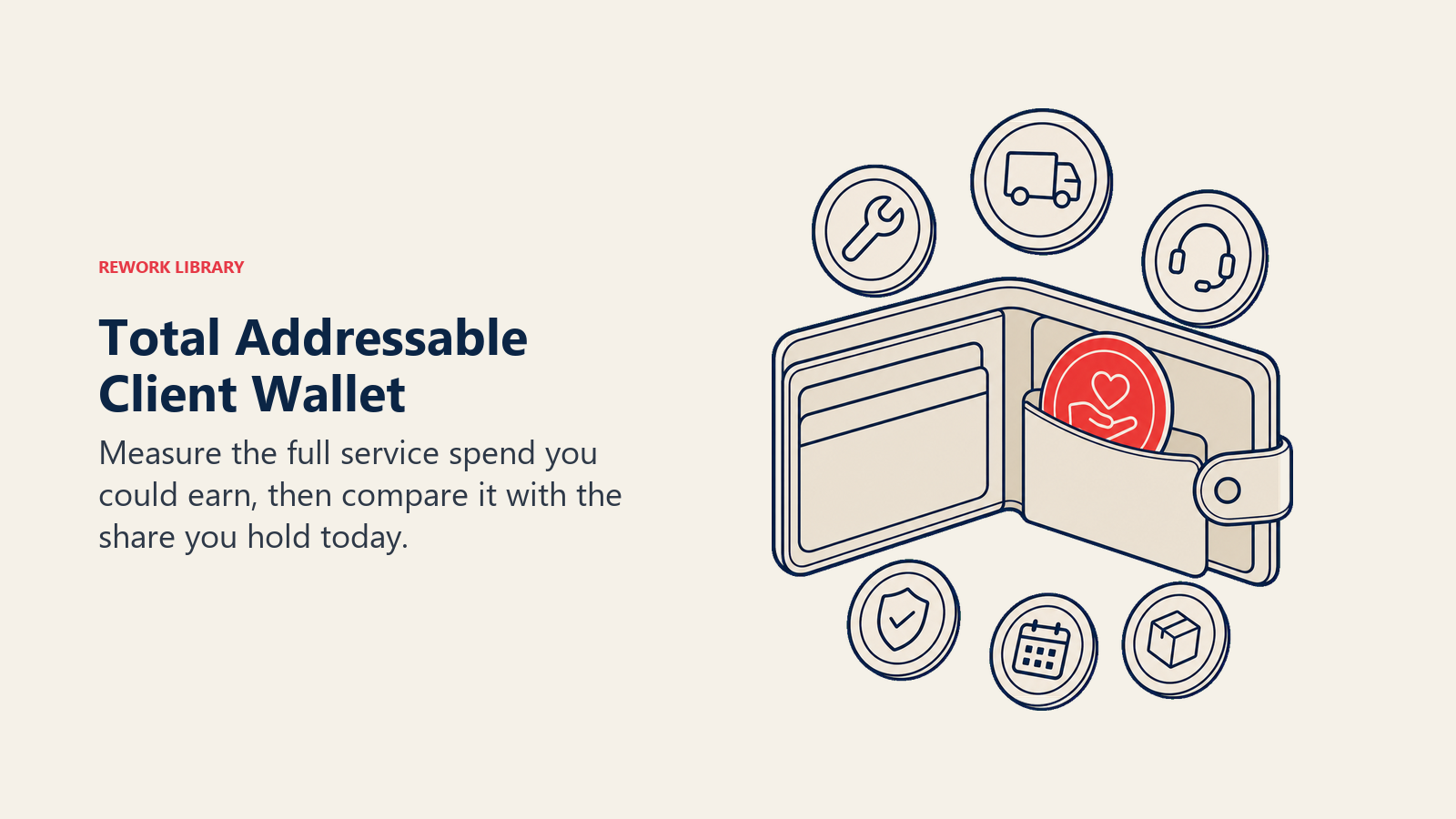
Start by listing all services the client currently uses across their full business operation. This includes work they're doing with competitors, in-house capabilities they've built, and needs they're ignoring or handling poorly.
For each service area, estimate the annual spend. You don't need perfect numbers - rough ranges are enough to prioritize. A $500K opportunity is worth more pursuit than a $20K one.
Identify which services you currently provide, which you could provide, and which are outside your capability. Be honest about fit. If you don't have the expertise to credibly deliver a service, don't count it as part of your addressable wallet.
Calculate your wallet share: what percentage of their relevant spend flows through you versus competitors? If they spend $2M annually on services you could provide and you're capturing $300K, your wallet share is 15%. That means 85% is opportunity.
Example wallet analysis:
Mid-size manufacturing client, $50M revenue:
- Audit services: $150K (you provide)
- Tax compliance: $80K (you provide)
- Tax planning: $60K (competitor provides)
- R&D tax credits: $40K (not currently done, opportunity)
- Transfer pricing: $50K (competitor provides)
- M&A advisory: $200K intermittently (various providers)
- Fractional CFO: $120K (in-house, struggling)
- Financial systems consulting: $100K (ignored need)
Total addressable wallet: ~$800K annually Current wallet share: $230K (29%) Expansion opportunity: $570K (71%)
This analysis tells you where to focus. The fractional CFO and financial systems consulting might be the highest-value cross-sell targets if you can demonstrate value in those areas. This systematic approach to wallet analysis forms the foundation of white space analysis, which helps you identify all untapped opportunities within an account.
Client intelligence and opportunity identification
Cross-sell opportunities don't announce themselves. You have to develop systems for spotting them. Systematic discovery questions: Build discovery into your regular client interactions. Not in a sales-y way, but as natural curiosity about their business. Questions like:
- "What are your top 3 priorities for the next year?"
- "What's keeping you up at night right now?"
- "What challenges are you facing that are outside our current scope?"
- "Who else are you working with on [related area]?"
- "How are you handling [adjacent need]?"
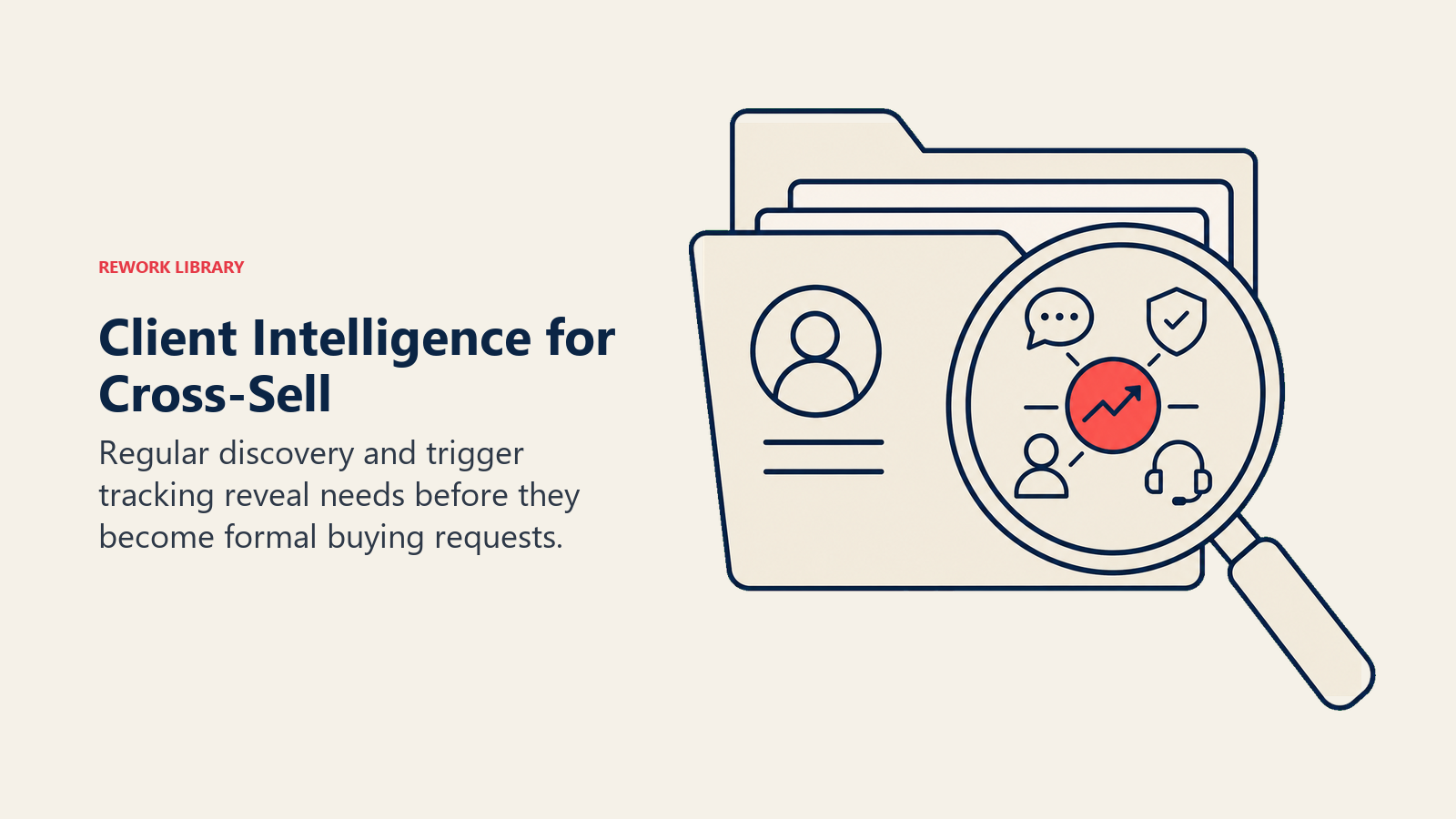
These questions surface problems you might be able to solve. If a client mentions they're struggling with cash flow management and you offer CFO advisory, that's a potential cross-sell.
Trigger events: Certain events create natural cross-sell moments. Watch for:
- Growth milestones: Crossing revenue thresholds often triggers audit requirements, tax complexity, or HR needs
- Funding rounds: VC backing creates need for board support, financial controls, strategic planning
- Leadership changes: New CFO or CEO often reevaluates service providers and priorities
- Regulatory changes: New compliance requirements create service needs
- Technology implementations: ERP or CRM changes create consulting and integration opportunities
- Geographic expansion: New locations trigger tax, legal, HR complexity
- M&A activity: Buying or selling creates transaction advisory, integration, valuation needs
Set up alerts for these trigger events. If you see in a client update that they just raised Series B, that's your cue to explore expansion services.
White space analysis: Systematically review what services the client needs but you're not providing. This is white space analysis - identifying gaps between what you could deliver and what you currently sell them.
Do this quarterly for key accounts. Map the full scope of services they use, identify which you could credibly deliver, and prioritize based on relationship strength, service margin, and strategic value.
Team-based intelligence gathering: Your delivery team sees and hears things that sales doesn't. Create systems for capturing these insights. When a team member mentions "the client said they're frustrated with their current [X] provider," that's a cross-sell lead. Make it easy for delivery teams to flag opportunities without feeling like they're being forced to sell.
Assessing cross-sell opportunities
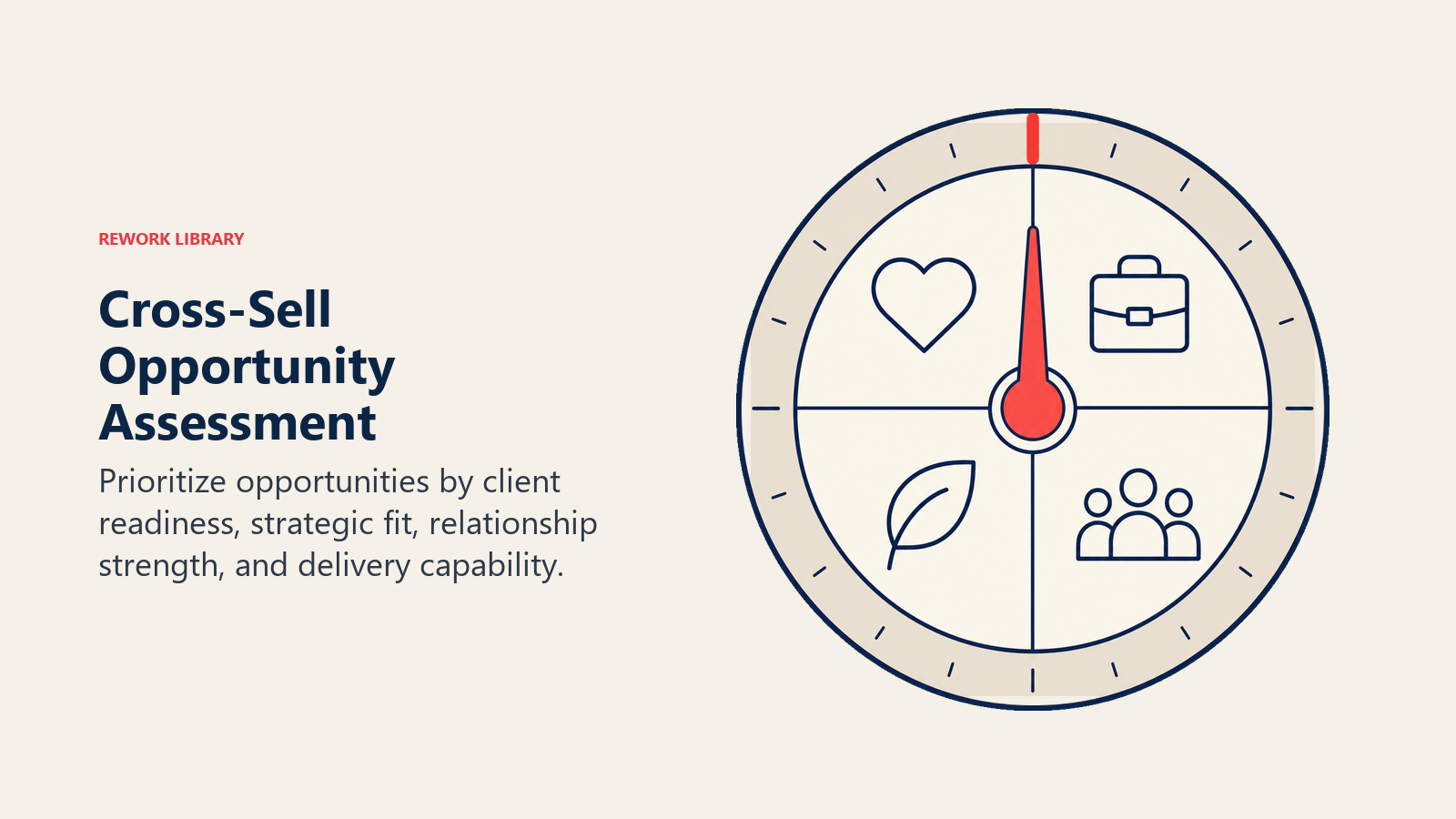
Not every potential cross-sell is worth pursuing. You need a framework to evaluate opportunities systematically. Client fit and readiness:
- Do they have the budget and authority to make this decision?
- Is the timing right, or are they overwhelmed with other priorities?
- Do we have relationships with the decision-makers for this service?
- What's their satisfaction level with our current work? (Strong performance = easier cross-sell)
- Have they expressed pain points that this service addresses?
Service applicability:
- Does this service genuinely solve a problem they have?
- Is the need urgent, or just "nice to have"?
- What's the ROI or value proposition for them?
- Are there any conflicts or complications with our current service?
- Would this service enhance our current relationship or distract from it?
Internal capability and capacity:
- Do we have the expertise to deliver this service well?
- Do we have the capacity to take on this work without compromising current commitments?
- What's the margin profile of this service?
- Does this align with our strategic priorities and growth areas?
Competitive positioning:
- Who currently provides this service to them (if anyone)?
- How strong is that incumbent relationship?
- What would make them consider switching to us?
- What's our competitive advantage for this particular service?
- What's the switching cost for the client?
Score opportunities on a simple scale: High/Medium/Low for each dimension. A High/High/High/High opportunity (high fit, high applicability, high capability, high competitive position) is your top priority. A Low on any dimension means slower pursuit or pass entirely.
Building the cross-sell pipeline
Cross-sell can't be opportunistic and hope-driven. You need a pipeline that tracks opportunities systematically, just like new business development. Pipeline stages for cross-sell:
- Identified: Potential need spotted through discovery, trigger event, or white space analysis. Not yet discussed with client.
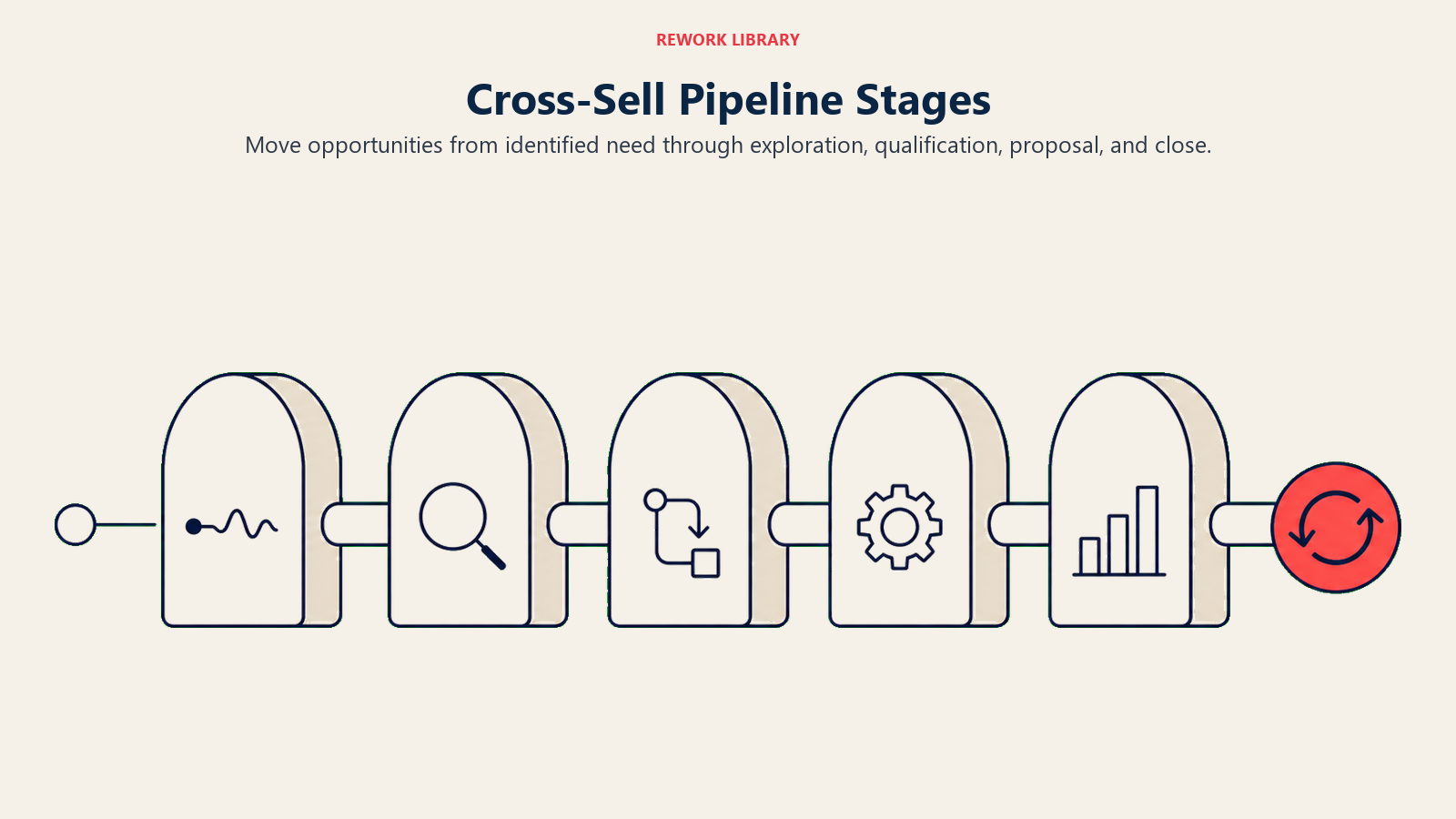
Exploring: Initial conversation started. You've mentioned the potential service or asked discovery questions. Client has shown some interest or at least openness.
Qualified: Client has confirmed the need exists, budget is available (or could be found), and they're open to considering you for it. Timing and decision process are understood.
Proposed: Formal proposal or scope presented. Client is actively evaluating. This might be a formal RFP or a more casual scoping conversation, depending on your relationship.
Negotiating: Terms and pricing being finalized. Legal and procurement might be involved. You're working through the details.
Closed-Won: Contract signed, project kicking off. Or Closed-Lost if they chose another path.
Track cross-sell opportunities through these stages separately from new client acquisition. The dynamics are different enough that they deserve their own pipeline view.
Qualification criteria: Before you invest significant effort in pursuing a cross-sell, make sure it meets minimum thresholds:
- Minimum deal size (maybe $25K for smaller firms, $100K+ for larger)
- Client relationship strength score (maybe 7+ on a 10-point scale)
- Service delivery confidence (can we actually execute this well?)
- Strategic value (does this open future cross-sell pathways or is it a one-off?)
Don't chase low-value cross-sells that distract from bigger opportunities.
Prioritization framework: You can't pursue every cross-sell opportunity at once. Prioritize based on:
- Expected revenue size
- Probability of winning (relationship strength + fit)
- Strategic value (does this deepen the relationship long-term?)
- Timeline (when will they make a decision?)
- Resource intensity (how much effort to close vs deliver?)
Focus on the opportunities that score highest across these dimensions. A $500K cross-sell with 70% win probability is probably more valuable than a $100K opportunity with 90% probability.
Revenue forecasting: Build cross-sell into your forecast separately from new business. Track metrics like:
- Cross-sell pipeline value by stage
- Average cross-sell deal size
- Cross-sell conversion rate by stage
- Average time from identification to close
- Cross-sell revenue as % of total revenue
These metrics help you understand if your cross-sell motion is healthy and predictable.
Execution: Introducing new services naturally
The way you introduce a cross-sell opportunity matters as much as the opportunity itself. Done well, it feels like helpful advice. Done poorly, it feels like a sales pitch that damages trust. Relationship-first approach: The conversation should start from genuine concern for the client's success, not your revenue target. Instead of "We also do X, want to buy it?" the frame is "I noticed you're dealing with Y challenge. Have you thought about how to address it?"
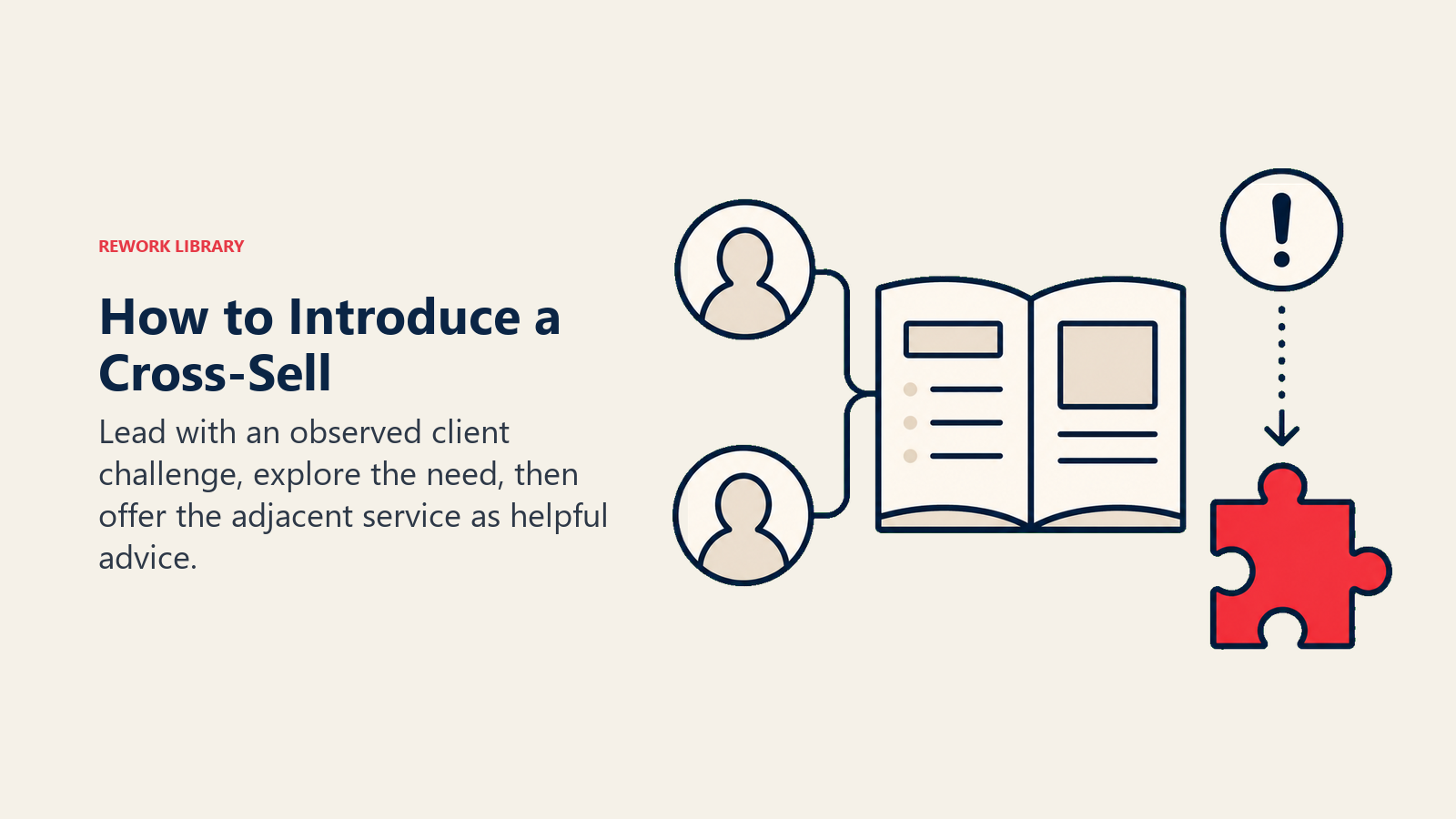
You're opening a conversation about their problem before you position your solution. This requires patience and real curiosity about their situation.
Education before selling: Many clients don't fully understand what a service does or why they need it. If you're trying to cross-sell cybersecurity consulting to a client who thinks "we have antivirus, we're fine," you need to educate before you propose.
Share insights, case studies, or frameworks that help them understand the problem and potential solutions. Position yourself as a teacher, not a salesperson. "Here's how companies like yours typically approach this. Here are the risks of not addressing it. Here's what good looks like."
This builds credibility and demand simultaneously. When they understand the problem better, the solution becomes more obvious. This educational approach aligns with additional services introduction principles, where you build awareness and understanding before proposing new services.
Demonstration and proof concepts: If possible, show rather than tell. Offer a free assessment, a pilot project, or a limited engagement that demonstrates value. This is especially powerful when cross-selling a service that's new to the client or where you're displacing an incumbent.
A 2-week security assessment that reveals actual vulnerabilities is more convincing than a proposal promising you'll find vulnerabilities. A financial analysis that shows $200K in tax savings opportunities is more persuasive than claiming you could find savings.
Leveraging current service delivery: The best cross-sell conversations happen organically during existing work. Your delivery team is reviewing financial statements and notices operational inefficiencies. Your audit team spots internal control weaknesses. Your IT team sees technology gaps.
These observations create natural segues: "As part of our current work, we noticed [issue]. This is outside our current scope, but it's something we could help with through [service]. Would it be valuable to explore that?"
You're not cold-calling them about a random service. You're responding to something you've observed in the course of delivering value.
Stakeholder navigation: Cross-sell often requires engaging new people beyond your current contacts. If you're trying to sell HR consulting but your relationship is with the CFO, you need a path to the CHRO.
The best approach is through your existing champion: "Based on what we're seeing, it might make sense to loop in your HR lead. Would you be open to introducing us so we can share some observations and see if there's a fit?"
You're asking your contact to facilitate, not going around them. This respects the relationship and increases success rates.
Proposal development for cross-sell
Cross-sell proposals should be different from new business proposals. You're building on an existing relationship, not establishing one from scratch.
Leverage existing context: You don't need to explain your firm's credentials or prove you're competent. The client already knows that. Focus the proposal on the specific service, how it addresses their specific situation, and the expected outcomes.
Reference your current work where relevant: "Through our work on your tax compliance, we've observed patterns that suggest opportunity in R&D tax credits. Here's what we've seen and what we propose."
Integrated value proposition: Show how the new service enhances or protects the value from your existing service. If you're proposing audit services to a tax client, the pitch isn't just "we also do audits." It's "an integrated approach where our audit and tax teams collaborate will help you avoid surprises, optimize planning, and reduce your total time investment because we're working from the same understanding of your business."
The integration is a feature, not just a convenience.
Pricing and packaging considerations: You have flexibility with cross-sell pricing that you don't have with new clients. You might offer:
- Bundle discounts: Reduced rates when clients buy multiple services
- Relationship pricing: Better rates for existing clients than new ones
- Pilot pricing: Discounted first engagement to prove value, with standard pricing on renewals
- Retainer additions: Adding the new service to existing retainer arrangements
The goal is to make expansion feel like a logical, valuable next step rather than a separate, expensive decision. But don't discount so heavily that the work becomes unprofitable - you're leveraging relationship, not giving work away.
Risk mitigation: Address the "what if this goes badly?" concern directly. If the client is happy with your current service, they might worry that adding another service could complicate things or create problems.
Offer assurances: separate teams so there's no conflict, clear communication protocols, trial periods, or performance guarantees. Make it low-risk for them to say yes.
Team coordination for cross-sell success
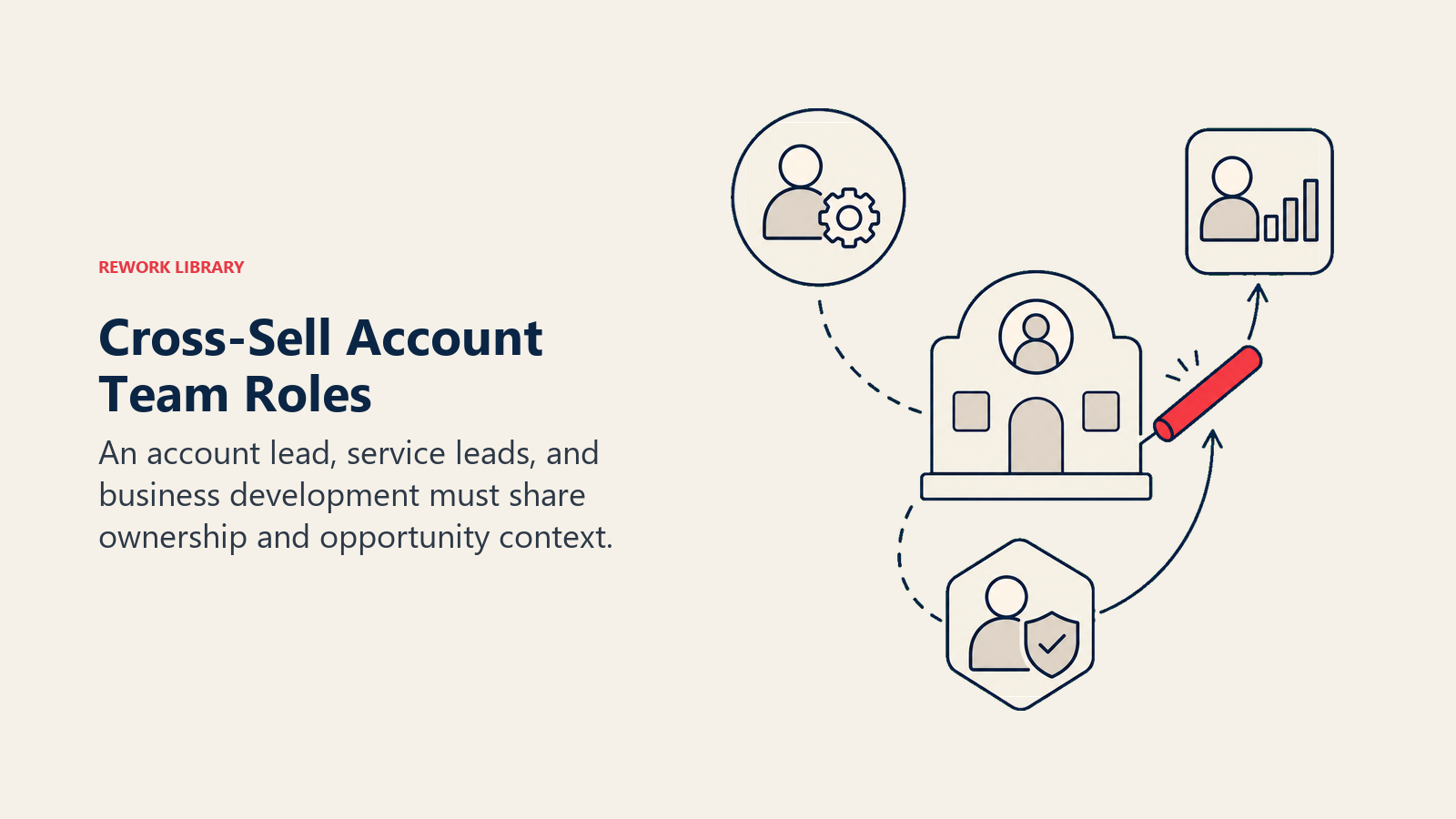
Cross-sell requires collaboration across service lines, and that's where many firms struggle. Siloed teams, competing incentives, and communication gaps kill opportunities. Account team structure: For key accounts, establish a clear account team with defined roles:
- Account Lead: Overall relationship owner, coordinates cross-sell strategy
- Service Leads: Leaders of each service line currently or potentially working with the client
- Business Development: Supports opportunity identification and pursuit This team meets regularly (monthly or quarterly) to review the account, share intelligence, identify opportunities, and coordinate approach.
Service line specialist involvement: When pursuing a cross-sell, involve the specialist team early. Don't have the account lead try to sell a service they don't deeply understand. Bring in the subject matter expert to have technical conversations, build credibility, and scope the work properly.
This transition - from account lead identifying opportunity to specialist closing and delivering - needs to be smooth. The client should feel like they're getting the right people at the right time, not being handed off.
Handoffs and integration: If a cross-sell succeeds, how do the teams work together? Who's the primary contact? How do you avoid the client feeling like they're managing multiple vendor relationships even though it's one firm?
Define integration points: shared communication channels, coordinated planning meetings, aligned delivery schedules. The client should experience seamless collaboration, not separate teams that happen to work at the same company.
Revenue sharing and incentives: This is where cross-sell often breaks down. If the tax partner gets no credit for referring an audit opportunity, they won't bother. If the audit partner is worried about losing "ownership" of the client, they'll resist collaboration.
Structure compensation to reward cross-sell:
- Origination credit: The person who identifies and facilitates the opportunity gets credit (maybe 20-30% of margin)
- Delivery credit: The team delivering the service gets primary credit (70-80%)
- Account team bonuses: Shared incentives for overall account growth, not just individual service line performance
The exact split matters less than the principle: everyone wins when cross-sell succeeds, so nobody has reason to block it. For deeper guidance on structuring long-term client relationships that support sustained cross-sell, explore multi-year engagements.
Communication and coordination rhythms: Set up regular communication cadences:
- Weekly: Delivery teams share client interactions and observations
- Monthly: Account team reviews opportunities and coordinates pursuit
- Quarterly: Leadership reviews account strategy and resource allocation
Don't rely on ad-hoc communication. Make cross-sell coordination a systematic process.
Overcoming cross-sell challenges
Even with a great strategy, you'll hit obstacles. Here are the common ones and how to handle them.
Client resistance and status quo bias: The client is comfortable with their current setup. Even if they have a problem, switching providers or adding services feels like effort and risk. They'd rather stick with what they know.
Overcome it by: Making the change feel small and safe. Pilot projects, phased approaches, or starting with a limited scope that proves value before expanding. And by demonstrating that the cost of inaction exceeds the effort of change.
Budget and timing constraints: The client agrees they need the service but doesn't have budget allocated or capacity to take on another project right now.
Overcome it by: Understanding their budget cycles and planning cross-sell conversations around them. If they budget annually in Q4, have the value conversation in Q3. Or find ways to tie the new service to existing budget - if it saves money in one area, it can fund itself from those savings.
Competitive incumbents: They're already working with someone else for this service, and that relationship is solid. You're asking them to fire a good provider to hire you.
Overcome it by: Not competing head-to-head on the same scope. Instead, look for adjacent or complementary work the incumbent isn't doing. Or wait for a natural transition point - contract renewal, team changes, service issues. And focus on the integration value - you can collaborate with their existing service teams in ways an outside firm can't.
Internal silos and misalignment: Your own firm's structure makes cross-sell hard. Service lines operate independently, compensation isn't aligned, or there's cultural resistance to collaboration.
Overcome it by: Leadership commitment to cross-sell as a strategic priority. Change the incentive structure. Create account team processes that force collaboration. Share success stories that make cross-sell feel normal and valued, not exceptional.
Capacity and delivery concerns: You spot a great cross-sell opportunity, but your service line is at capacity or you're not confident you can deliver at the quality level the relationship requires.
Overcome it by: Being honest about constraints. If you can't deliver well right now, don't force it. Either build capacity first or pass on the opportunity. Protecting the core relationship is more important than chasing every revenue possibility. And consider whether you can bring in partners or augment capacity rather than turning down work entirely.
Technology and tools for cross-sell
You can't manage cross-sell at scale without systems. Here's what you need:
CRM cross-sell tracking: Your CRM (Salesforce, HubSpot, whatever you use) should track:
- Services currently provided to each client
- Services the client uses but you don't provide
- Cross-sell opportunities in pipeline with stages and probability
- White space analysis results
- Relationships mapped by service line and stakeholder
This gives you visibility into where opportunities exist and how they're progressing.
Opportunity scoring: Build algorithms (or manual scoring frameworks) that rank cross-sell opportunities based on relationship strength, service fit, revenue potential, and strategic value. This helps teams focus on the highest-probability, highest-value opportunities rather than spreading effort too thin.
Account planning tools: For key accounts, use structured account planning frameworks (often built into CRMs or standalone tools like Altify, Revegy). These force systematic thinking about account strategy, stakeholder relationships, opportunity identification, and execution plans.
Collaboration platforms: Use shared workspaces (like Slack channels or Teams groups for each account) where delivery and business development teams can share observations, coordinate on opportunities, and avoid duplicate outreach.
Intelligence gathering: Set up Google Alerts, news monitoring, or tools like ZoomInfo or LinkedIn Sales Navigator to track trigger events - funding announcements, leadership changes, expansion news - that create cross-sell moments.
Dashboards and reporting: Build visibility into cross-sell performance:
- Cross-sell pipeline value and conversion rates
- Services per client (are accounts expanding or staying flat?)
- Revenue growth from existing clients vs new clients
- Account penetration (wallet share metrics)
- Team performance on cross-sell (who's good at identifying and closing opportunities?)
These dashboards keep cross-sell top of mind and drive accountability. For comprehensive guidance on what metrics to track across your practice, see professional services metrics.
Metrics and performance management
You can't improve what you don't measure. Track these metrics to understand cross-sell effectiveness: Cross-sell penetration rate: What percentage of clients buy multiple services from you? If you have 100 clients and 35 buy more than one service, your penetration rate is 35%. Higher is better - it indicates you're successfully expanding relationships. Average services per client: Across your client base, how many services does each client buy on average? If you offer 10 services but the average client only buys 1.3, there's massive expansion opportunity. Track this over time - is it increasing?

Revenue per client: How much does the average client spend with you annually? More importantly, how does this change over time? You want to see average client value increasing, driven by cross-sell and upsell. Segment this by client cohort (clients acquired in 2023 vs 2024 vs 2026) to see if newer clients are expanding faster.
Cross-sell win rate: Of identified cross-sell opportunities, what percentage close successfully? If you identify 50 opportunities and close 15, your win rate is 30%. Track this by service line to see which services cross-sell more successfully.
Time to cross-sell: How long from initial client acquisition to first cross-sell? If it takes 18 months on average, think about how to accelerate that. Earlier cross-sell strengthens relationships and increases lifetime value.
Expansion revenue as % of total: What percentage of your revenue comes from existing clients vs new clients? Healthy firms typically see 30-50% of revenue from expansion (cross-sell + upsell). If you're below 20%, you're leaving money on the table or not retaining clients well enough.
Wallet share by account: For key accounts, track your share of their total relevant spend. If this increases from 25% to 45% over two years, your cross-sell strategy is working. If it stays flat or decreases, competitors are winning.
Set targets for each metric and review monthly or quarterly. Use the data to identify what's working (double down on it) and what's not (fix it or stop doing it).
Best practices for sustainable cross-sell
Relationship-first, always: Never sacrifice client relationship for short-term revenue. If a cross-sell push would feel aggressive or misaligned with client needs, don't do it. The long-term relationship is worth more than any individual sale.
Value demonstration over pitching: Show the value through insights, analysis, or pilot projects rather than just talking about what you could do. Proof beats promises.
Natural integration: Cross-sell should emerge organically from your current work, not feel like a separate sales motion. The best cross-sells happen when clients ask "Can you help with this too?" because you've already demonstrated expertise and built trust.
Systematic process, not opportunistic: Don't rely on random conversations or lucky timing. Build cross-sell into your account management process systematically - regular white space reviews, trigger event monitoring, team coordination meetings.
Team collaboration over individual heroics: Cross-sell at scale requires team effort. Account teams, service line specialists, and leadership all need to be aligned and incentivized properly.
Patience and timing: Not every opportunity is ready today. If the client isn't ready, nurture the relationship and wait for the right moment. Forced cross-sell fails.
Quality delivery on current services: This is the foundation. If you're delivering mediocre work on Service A, you have no business trying to sell Service B. Excellence creates cross-sell opportunities; mediocrity kills them.
Where to go from here
Cross-sell is one component of a broader account growth strategy. To maximize effectiveness, integrate it with:
- Client Relationship Strategy - Build the relationship foundation that makes cross-sell possible
- Service Line Strategy - Ensure you have services worth cross-selling
- White Space Analysis - Systematically identify expansion opportunities
- Upsell & Scope Expansion - Combine cross-sell with upsell for full expansion strategy
Start small. Pick 5-10 key accounts where you have strong relationships and clear expansion potential. Map the white space, identify the 2-3 highest-value cross-sell opportunities, and execute focused pursuit. Learn what works, refine your approach, then scale it across your broader client base.
The goal isn't to sell every service to every client. It's to systematically identify where you can deliver additional value, and build the relationships and processes to capture those opportunities when timing and fit align.
That's how you turn a client base into a growth engine.

Sales Director
On this page
- What cross-sell actually means (and what it's not)
- Why cross-sell works in professional services
- Prerequisites for effective cross-selling
- Mapping your service portfolio for cross-sell
- Building cross-sell pathways by entry service
- Understanding total addressable wallet
- Client intelligence and opportunity identification
- Assessing cross-sell opportunities
- Building the cross-sell pipeline
- Execution: Introducing new services naturally
- Proposal development for cross-sell
- Team coordination for cross-sell success
- Overcoming cross-sell challenges
- Technology and tools for cross-sell
- Metrics and performance management
- Best practices for sustainable cross-sell
- Where to go from here