Geographic Expansion: Strategic Planning and Execution for Multi-Location Growth

Turn this article into takeaways for your work.


Each assistant summarizes the article only for you and suggests best practices for your work.
Here's a number that should make you nervous: 60% of professional services firms that open new offices in different cities underperform their projections in the first three years. That's not a rounding error. It's a pattern.
Why? Because geographic expansion sounds simpler than it is. You've got a successful practice in Chicago, so why wouldn't you replicate it in Denver? Turns out, your network doesn't travel. Your reputation doesn't automatically transfer. And your Chicago team can't effectively serve Denver clients from 900 miles away.
Geographic expansion isn't just about signing a lease and hiring a few people. It's about building local market presence while maintaining operational coherence across locations. It's about deciding when physical presence matters and when remote delivery works fine. And it's about not bleeding cash for two years while you figure it out.
This guide gives you the frameworks to make smart expansion decisions, choose the right entry strategy, and actually make multi-location operations work.
The geography paradox: Why location still matters
We work in the era of Zoom, cloud collaboration, and virtual everything. So why open physical offices at all? Can't you just service clients from anywhere?
Sometimes yes, often no. Here's the paradox: technology has made remote delivery easier, but it hasn't eliminated the value of local presence. In many professional services markets, proximity still matters.
Relationship-driven work needs face time. If you're a consulting firm helping a manufacturing company through an operational transformation, you can't do that entirely over video calls. Complex, high-trust engagements often require being there. Not every week, maybe, but regularly enough that "fly in from headquarters" becomes expensive and exhausting.
Local networks drive business development. A law firm's Cleveland office gets work because partners have relationships with Cleveland executives, belong to Cleveland business groups, and have built reputation in the Cleveland legal community. You can't replicate that network from your Columbus office, no matter how good your video setup is.
Clients prefer local providers for many services. When companies hire accounting firms or marketing agencies, they often want someone who understands their regional market, can meet in person when needed, and feels like part of the community. The "big firm from elsewhere" sometimes works, but local firms have a built-in advantage.
But here's the tension: opening new locations dramatically increases your operational complexity. One office is simple. Three offices mean coordinating schedules, standardizing processes, managing different markets, and maintaining consistent culture across distance. You're trading simplicity for market access, and that trade isn't always worth it.
What is geographic expansion, really?
Let's get clear on what we're talking about. Geographic expansion is the strategic decision to establish a presence in a market where you don't currently operate. That presence can take many forms.
Physical office expansion means opening a real office with local staff in a new city or region. This is the traditional model: you put people on the ground, build local relationships, and deliver services locally.
Remote market entry means serving clients in new geographies without physical presence there. Your team works from existing offices but takes on clients in different cities or regions. You're expanding your market reach without expanding your footprint.
The distinction between market entry and market presence matters. Market entry is about accessing clients in new geographies. Market presence is about being perceived as a local player in those geographies. You can enter markets without presence (remote delivery), but building presence almost always requires some level of local investment.
And here's what most firms discover: it's easier to serve existing clients who expand to new locations than to win brand new clients in new markets. If you've got a Seattle client who opens a Portland office and wants you to support them there, that's market entry with a built-in relationship. If you're trying to win Portland clients who've never heard of you, that's much harder.
Market attractiveness analysis: Where should you expand?
Before you start looking at office space, you need to evaluate whether a market is actually worth entering. Not every city with potential is the right city for your firm.

Market size and growth: How many potential clients are in this market? Is it growing or stagnant? A medium-sized but fast-growing market might be more attractive than a large but mature one.
For professional services, "market size" isn't just population. It's the number of companies in your target segments with the kinds of problems you solve. A city with lots of tech startups might be great for an M&A advisory firm but terrible for a manufacturing consultancy.
Competitive landscape: Who's already there and how strong are they? A market with one dominant incumbent might offer opportunity if you can differentiate. A market with five strong competitors all fighting for the same clients is harder to crack.
Look for gaps. Maybe the big firms in that market focus on enterprise clients and there's an opening for mid-market work. Maybe they specialize in certain industries and you could own a different vertical. Competition isn't disqualifying, but you need a reason clients would choose you.
Client concentration: Do you already have clients or strong prospects in this market? This is the biggest predictor of expansion success. Firms that expand into markets where they already have a few clients have way higher success rates than firms trying to build from zero.
Even one significant client relationship can justify expansion. If you've got a $500K/year client in Austin and they're growing, that might anchor your Austin office while you build additional business there.
Economic and industry dynamics: What's the business climate? Are companies hiring or cutting? Are the industries you serve well-represented? A city might look attractive demographically but have the wrong industry mix for your services.
For example, if you're a fintech consulting firm, Charlotte makes more sense than Portland. If you specialize in entertainment industry marketing, Los Angeles matters more than Kansas City. Match your expertise to local industry strengths.
Regulatory and logistical factors: Are there state-specific licensing requirements? Tax complications? Legal structures you'd need to navigate? These aren't usually dealbreakers, but they add complexity and cost.
Some services (legal, accounting, engineering) have jurisdiction-specific requirements that make geographic expansion more complicated. Factor that into your decision.
Assessing your firm's readiness to expand
Just because a market looks attractive doesn't mean you're ready to enter it. Geographic expansion requires resources, systems, and bandwidth that many firms overestimate.

Financial capacity: Can you absorb 12-18 months of losses? Because that's often how long it takes for a new office to break even. You need enough cash and profitability in existing operations to fund the expansion without jeopardizing the core business.
A rough rule of thumb: expect a new office to cost $200K-$500K before it's self-sustaining, depending on market and service type. Can you afford that investment while maintaining service quality elsewhere?
Leadership bandwidth: Who's going to run the new location? You need someone who can build a practice, not just deliver services. That person either comes from your existing team (which means taking a top performer out of current operations) or gets hired externally (which means trusting someone new with a big bet).
The "fly in once a week" model where a senior partner tries to oversee the new office from headquarters rarely works. You need committed local leadership.
Operational maturity: Do you have documented processes, standardized deliverables, and systems that can scale across locations? If your current operation runs on tribal knowledge and personal relationships, replicating it elsewhere is nearly impossible.
Geographic expansion forces you to systematize things you've been doing informally. That's actually valuable, but it's work you need to do before or during expansion, not after.
Cultural clarity: Can you articulate what makes your firm different? What values drive your work? If you can't clearly define your culture, you can't transplant it to a new location. And cultural drift between offices is one of the biggest expansion failures.
Service line stability: Are your core offerings proven and profitable? Expanding geographically while also trying to build new service lines is a recipe for chaos. You want one dimension of your business to be stable while you add complexity in another.
Geographic expansion strategies: Five models
There isn't one right way to expand. Your strategy should match your service type, client needs, and firm capabilities.
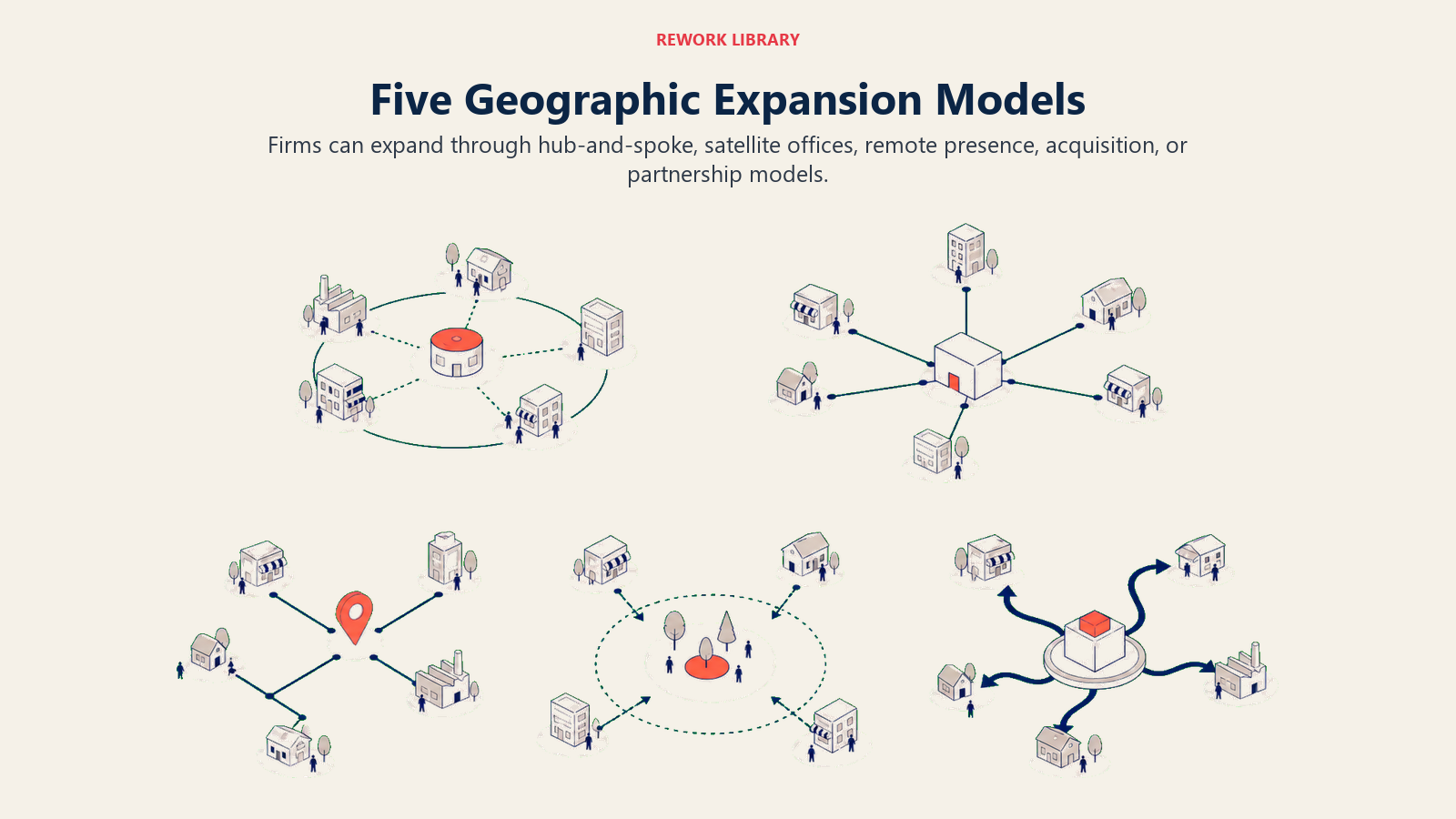
Strategy 1: Hub-and-Spoke Model
Open a headquarters office that anchors operations, then establish smaller satellite offices in nearby markets. The hub office houses most leadership, specialized expertise, and centralized functions. Satellite offices have client-facing teams who tap into hub resources.
When it works: Services that need some local presence but can centralize expertise. Professional services firms with specialized technical capabilities that don't need to be replicated everywhere.
Example: A consulting firm with a major office in Atlanta and smaller offices in Charlotte, Nashville, and Birmingham. Complex strategy work happens in Atlanta, implementation teams work from the satellites.
Financial model: Lower overhead in satellite offices (smaller footprint, fewer support staff) but travel costs to bring hub resources to clients. Works when you can charge enough to justify the inefficiency.
Strategy 2: Autonomous Local Office Model
Each office operates as its own profit center with full capability to deliver services independently. Offices share brand, methodology, and back-office systems, but build their own client bases and manage their own P&Ls.
When it works: Services where local market knowledge and relationships are critical. Firms large enough to replicate full teams in multiple locations. Markets different enough that centralized delivery doesn't make sense.
Example: A law firm with offices in major cities, each with its own corporate practice, litigation practice, and client portfolio. Partners in each office build local relationships and serve local clients.
Financial model: Higher fixed costs per location (need full teams) but better margins on local work since you're not coordinating across distance. Each office needs to hit its own utilization and revenue targets.
Strategy 3: Strategic Partnership/Alliance Model
Instead of opening your own office, partner with an established local firm. You maintain your brand and client relationships but leverage their local presence and delivery capacity.
When it works: Testing new markets without major investment. Services where expertise is specialized but delivery can be standardized. Situations where you have occasional need for local presence but not enough to justify an office.
Example: A specialized technology consultancy based in Silicon Valley partners with regional consulting firms in other cities. When their clients need help in those markets, they bring in local partners who work under their methodology.
Financial model: Revenue sharing with partners (typically 50-70% to your firm, 30-50% to local partner). Lower risk, lower reward. Good for opportunistic expansion.
Strategy 4: Remote/Distributed Delivery Model
No physical offices in new markets. You serve clients remotely from centralized locations or distributed team members who work from home offices.
When it works: Services that can be delivered virtually. Clients who are comfortable with remote relationships. Cost-sensitive markets where overhead matters. Highly specialized expertise where being "local" is less important than being "the best."
Example: A data analytics consultancy that serves clients across the country from a team split between two offices and several remote consultants. They fly in for kickoffs and critical meetings but do most work remotely.
Financial model: Lower overhead, potentially lower rates, but you're competing against local firms on price. Margins depend on utilization and your ability to price based on expertise rather than presence.
Strategy 5: Acquisition-Based Expansion
Buy an existing firm in the target market instead of building from scratch. You acquire their client base, team, reputation, and local knowledge all at once.
When it works: Markets with fragmented competition where acquisition targets exist. Firms with capital to invest. Situations where speed matters and you can't wait 2-3 years to build organically.
Example: A regional accounting firm acquires smaller firms in adjacent markets to quickly establish presence and client bases in those cities.
Financial model: Higher upfront cost, potentially faster path to profitability if integration works. But cultural integration is hard and many acquisitions underperform due to talent departure or client attrition.
Location selection: Choosing the right city and office
Once you've picked a strategy, you need to pick a specific location. Where exactly do you set up shop?
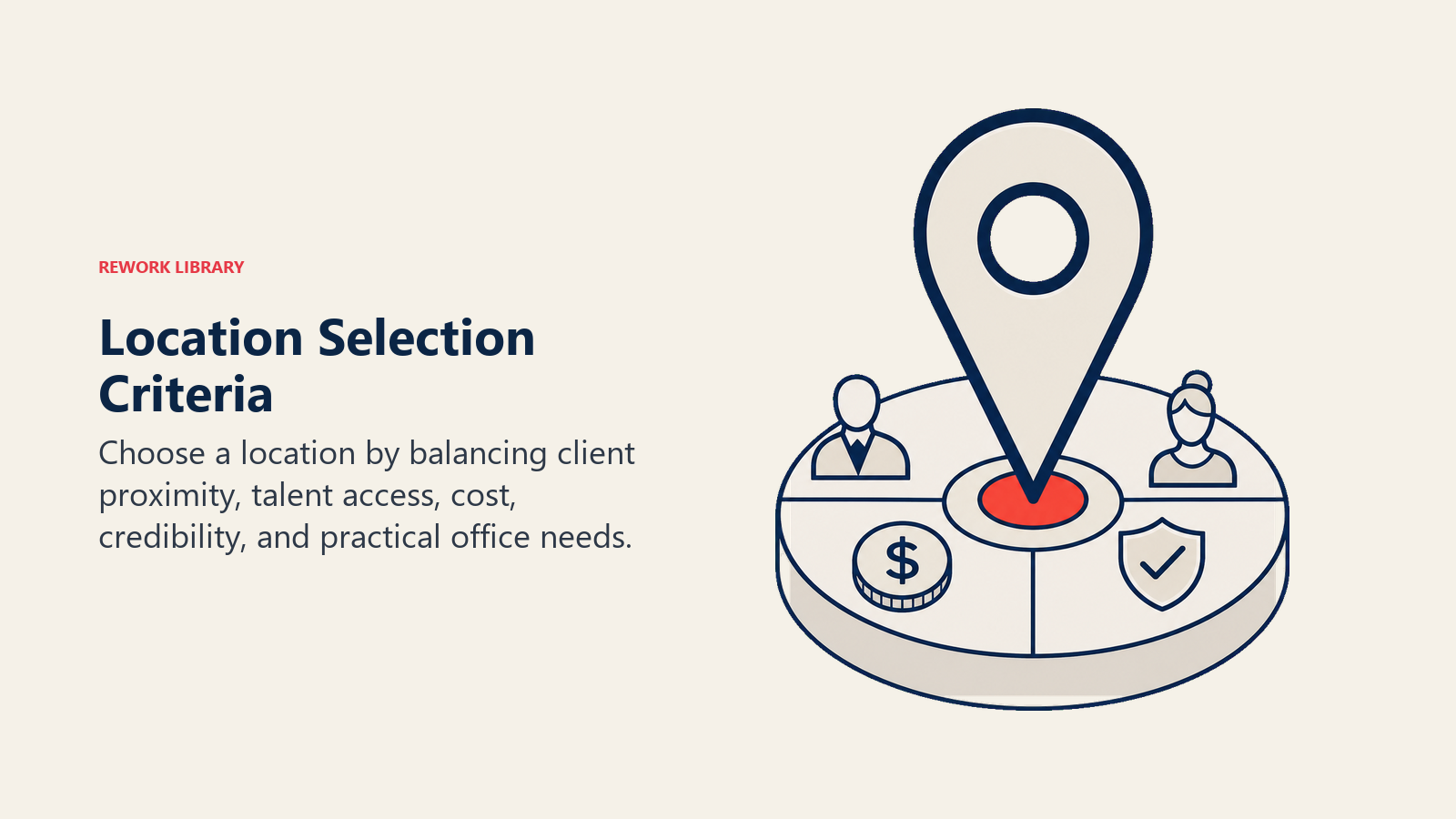
Client proximity: Where are your target clients located? Not just in the metro area, but in specific neighborhoods or business districts. If you're targeting professional services firms, you want to be near their offices, not in a suburban office park 20 minutes away.
Talent availability: Can you recruit the people you need in this location? Is there a pool of professionals with relevant experience? What's the competitive market for talent like? You're not just thinking about who you'll hire initially, but whether you can build a full team over time.
Office economics: What's the commercial real estate market like? Can you start with a small footprint and expand? Are there flexible lease options or co-working spaces that reduce early commitment?
Don't overbuild. A small, well-located office is better than a large space in the wrong place. Many firms make the mistake of taking more space than they need because the per-square-foot price is attractive, then they're stuck paying for empty desks.
Accessibility: How easy is it for team members to get there? For clients to visit? For partners from other offices to fly in? Proximity to airports, public transit, and major highways matters more than you think.
Market signaling: Does the location signal the right thing about your firm? Being downtown in a major market signals established player. Being in a suburban executive suite signals scrappy startup. Neither is wrong, but they send different messages.
Building local market presence and reputation
The hardest part of geographic expansion isn't opening the office. It's being taken seriously as a local player when you're new to the market.
Local business development strategy: You need a plan for how you'll actually win clients in the new market. "We'll do what we do in our home market" isn't a plan. Your home market advantages (network, reputation, referrals) don't exist yet in the new market.
Start with concentrated effort on a specific segment or industry. Don't try to be everything to everyone. Pick a niche where you can build reputation quickly and expand from there.
Local hiring and team building: Your first hires in a new market make or break the expansion. You need people who have local credibility and relationships. That usually means hiring away from competitors, which is expensive but necessary. Your staffing and resource allocation strategy must account for the unique challenges of building teams in new geographies.
The mistake is hiring junior people to save money. You need someone senior enough to open doors and win business, not just deliver work. Think of it as buying market access through talent.
Brand building activities: Join local business organizations. Sponsor events. Publish content about local market issues. Get partners speaking at local conferences. It's all the stuff you probably did to build your home market presence, but compressed into an accelerated timeline because you're playing catchup.
Expect this to take 18-24 months before you're seen as a legitimate local player. That's just how long it takes to build recognition and trust in a new market.
Timeline for market recognition: Year one is about establishing presence and building initial relationships. Year two is about converting those relationships into client work. Year three is about becoming known beyond your immediate network. If you expect to be a recognized brand in a new market within 12 months, you'll be disappointed.
Managing multi-location operations
Running multiple offices is fundamentally different from running one office. The coordination and management overhead increases exponentially.
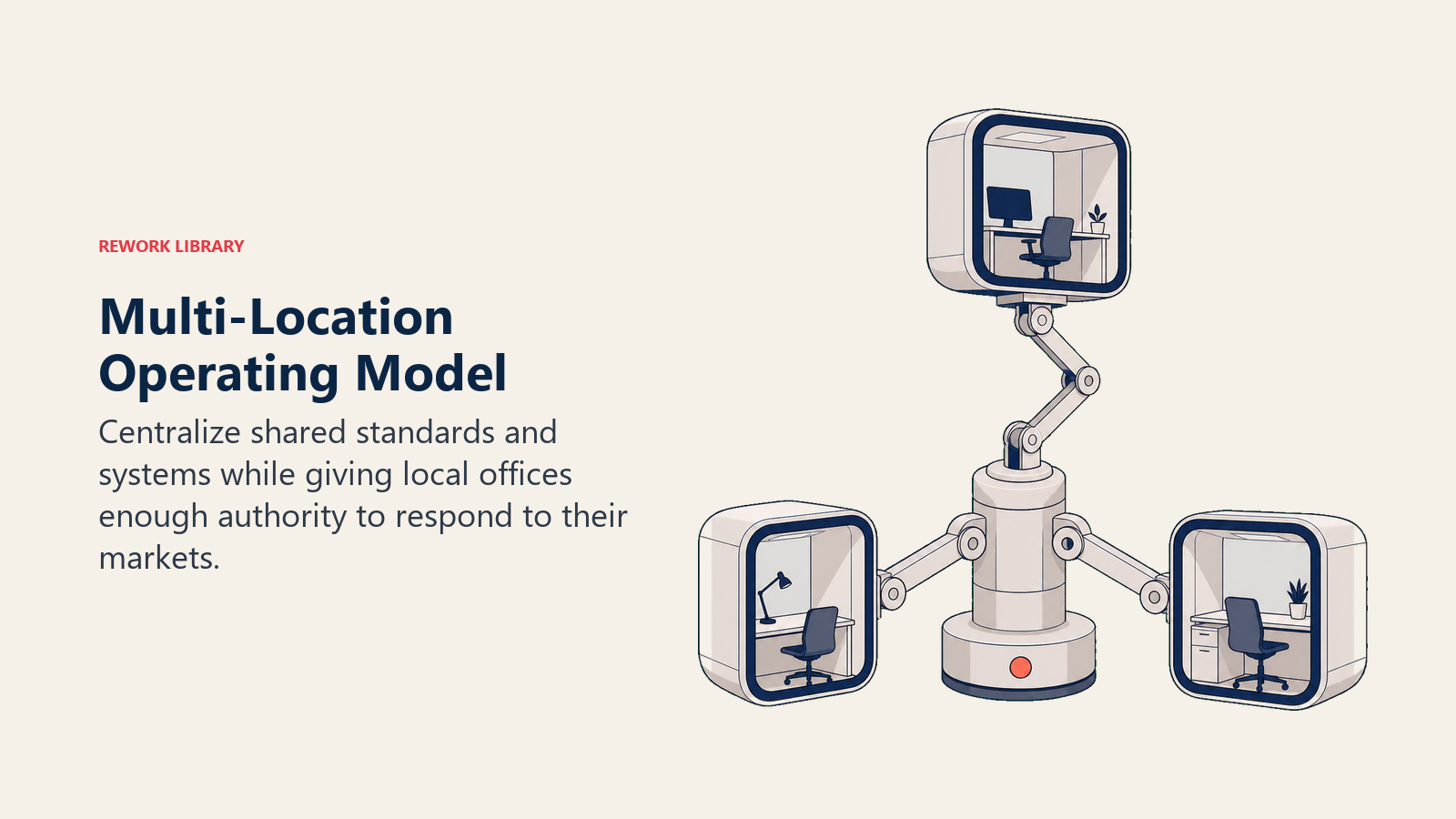
Centralized vs decentralized governance: You need to decide what gets controlled centrally and what's delegated to local offices. There's no perfect answer, but most successful multi-location firms centralize brand, methodology, pricing frameworks, and key systems while decentralizing client relationships, staffing decisions, and tactical execution.
Too much centralization and local offices can't adapt to their markets. Too much decentralization and you lose consistency and economies of scale. The balance shifts as you grow - early multi-location firms often need more centralization to maintain coherence.
Operational systems and standardization: You need shared systems for client management, project delivery, financial reporting, and knowledge sharing. If each office uses different tools and processes, coordination becomes impossible and you can't benchmark performance across locations.
This doesn't mean identical execution everywhere, but it means standardized frameworks and data. Everyone tracks utilization the same way, even if their targets differ by market.
Organizational structure for multi-location firms: How do reporting relationships work? Are local office leaders true P&L owners or functional managers? Do service line leaders have authority across all offices or just their home office?
Common models include:
- Geographic structure: Each office has a managing partner who oversees all services and clients in that location
- Practice group structure: Each service line has a national leader who coordinates delivery across all offices
- Matrix structure: Both local leaders and practice leaders, with dual reporting lines
The right structure depends on whether your primary differentiation is local market knowledge (favors geographic structure) or specialized expertise (favors practice structure).
Communication and coordination: You need regular touchpoints across locations. Weekly leadership calls. Monthly all-hands meetings. Quarterly in-person gatherings. Without deliberate communication, offices drift apart and become separate businesses wearing the same logo.
Financial management across locations: Each location should have its own P&L visibility, but you also need consolidated reporting. You're trying to answer: Which locations are profitable? Where are we over or under-investing? How do utilization and margins compare across offices?
Shared services (marketing, finance, IT) need cost allocation approaches. Are they borne centrally or allocated to offices based on headcount or revenue? There's no perfect method, but you need consistency.
Cultural continuity across locations
Here's what kills many multi-location firms: each office develops its own culture, and eventually you're not one firm anymore, you're several loosely affiliated businesses.
Maintaining firm culture in distributed teams: Culture transmission happens through shared experiences, mentorship, and reinforcement of values. That's hard when people are in different cities working with different clients.
You need intentional culture-building: Regular cross-office collaboration on projects. Rotation programs where people work in different offices for 3-6 months. Firm-wide initiatives that bring everyone together around common goals.
Preventing silos and isolation: Offices naturally become insular. They focus on their own clients, their own challenges, their own wins. Before you know it, people in different offices barely know each other.
Counter this with forced integration: Cross-office project teams. Communities of practice that span locations. Internal knowledge sharing where people present their work to colleagues in other offices.
Leadership visibility and engagement: Senior leaders need to be present in all locations, not just headquarters. That means regular travel, participation in local office meetings, and relationship-building with teams everywhere.
If people in your satellite offices only see headquarters leadership twice a year, they won't feel connected to the broader firm. Visibility matters.
Multi-location financial and operational metrics
You can't manage what you don't measure. Multi-location firms need metrics that work at both the firm level and the office level.
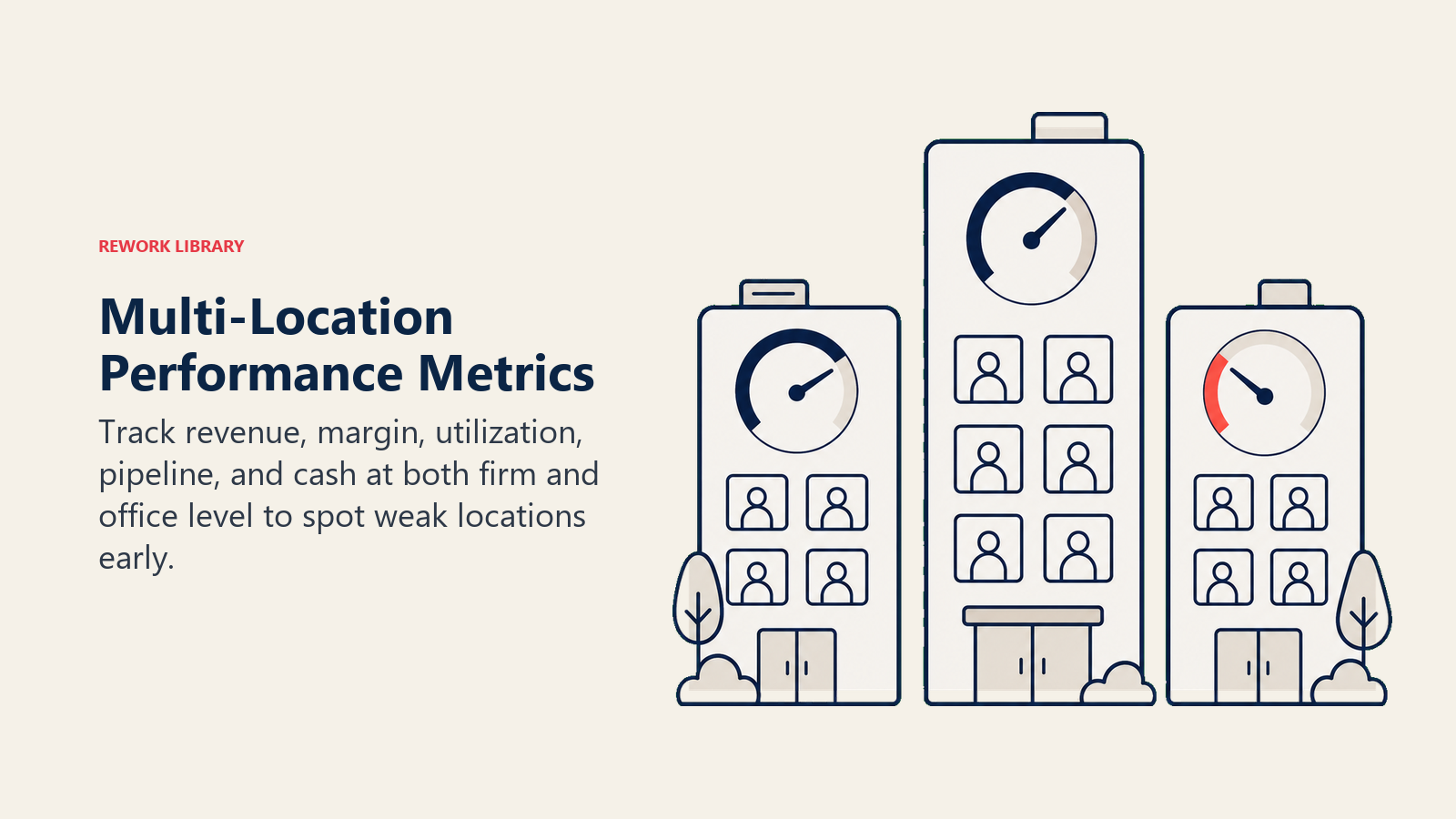
Profitability analysis by location: Track revenue, direct costs (salaries of people in that office), allocated costs (shared services), and contribution margin for each location. Some offices will be more profitable than others based on maturity, market conditions, and service mix.
Early-stage offices might be intentionally unprofitable as you invest in growth. That's fine, but you need to know the trajectory and have a plan for when they'll break even.
Operational metrics by location: Utilization rates, average billing rates, win rates, client concentration, and employee turnover should all be tracked by office. This helps you spot problems (why is turnover so high in the Dallas office?) and opportunities (why is utilization in Boston consistently higher than everywhere else?).
Scaling metrics: As you grow, watch metrics that indicate whether scaling is working:
- Revenue per employee across all locations (should be consistent or improving)
- Overhead as percentage of revenue (should stay flat or decrease with scale)
- Cross-office collaboration rate (what percentage of projects involve multiple offices?)
- Leadership span of control (how many direct reports do office leaders have?)
Common geographic expansion challenges
Let's talk about what actually goes wrong, because it's remarkably consistent across firms.
Financial underperformance: New offices almost always take longer to become profitable than projected. Budget for 18-24 months to break even, and you'll probably hit 20-30 months. The revenue ramp is slower than you think because building a client base from scratch is hard.
Talent attraction and retention: Good people have options. Why would they join your new office instead of staying at their current firm? You need a compelling story and often higher compensation. Then, once you hire them, you need to keep them engaged while the practice is still small and scrappy. A strong talent development program helps you attract and retain people even in a new market.
First-year turnover in new offices is often 30-40% as people realize the reality doesn't match the pitch.
Operational complexity: Everything that was simple with one office becomes complicated with multiple offices. Scheduling projects across offices. Coordinating sales and delivery. Managing cross-office conflicts over clients or resources. It's exhausting.
Many firms underestimate how much management overhead increases. You need more structure, more process, more communication just to maintain the same level of coordination.
Cultural and integration issues: Offices develop their own personalities, norms, and ways of working. What starts as healthy local adaptation can become fragmentation. Different offices make inconsistent client commitments, use different pricing approaches, or deliver variable quality.
Market penetration lag: You thought you'd be closing significant deals in month 6. You're in month 14 and still building pipeline. Local market penetration just takes time, and there's no shortcut other than acquiring an established firm.
Geographic expansion implementation framework
Here's a realistic timeline for opening a new office, assuming you're building organically rather than acquiring.
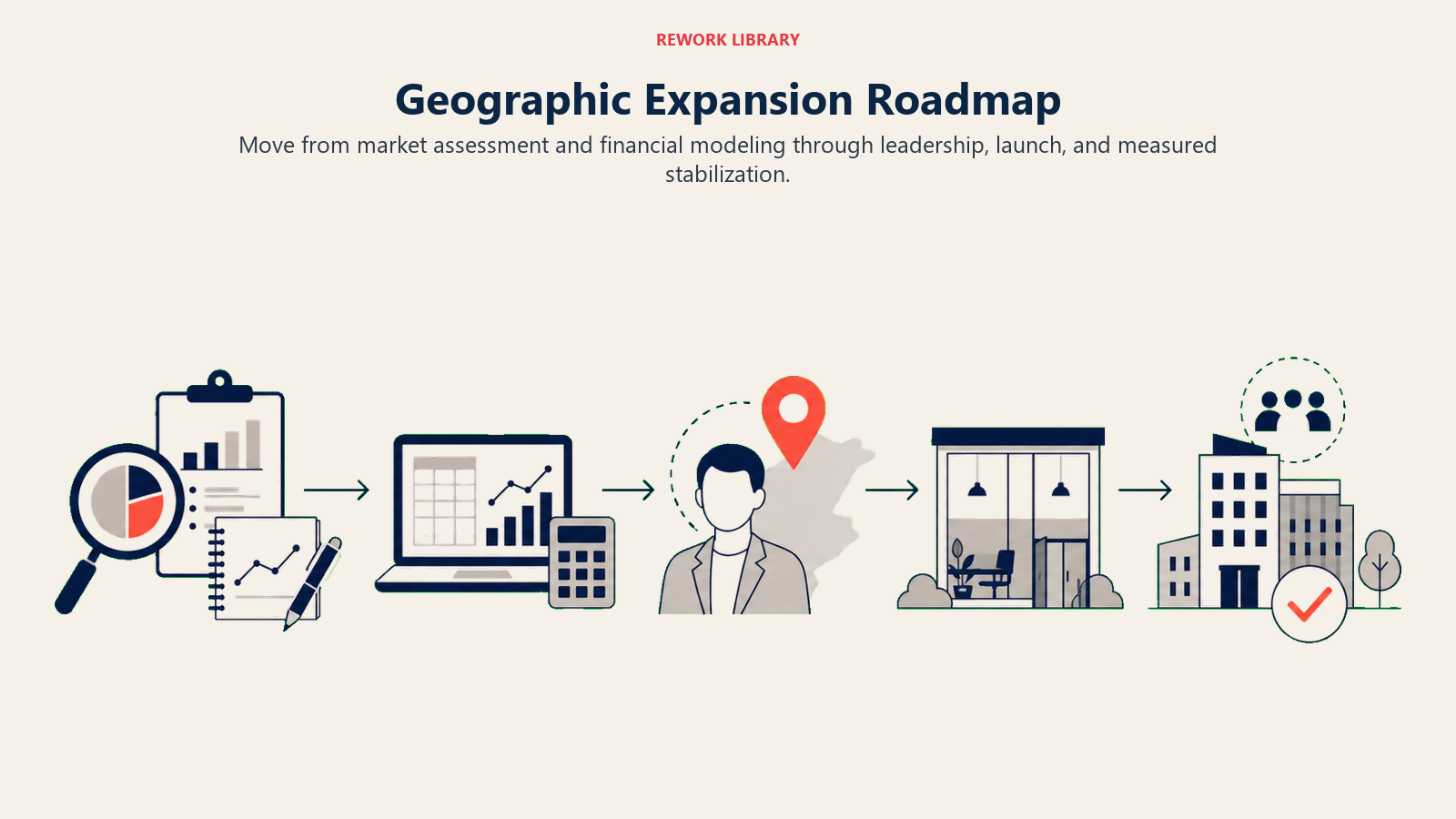
Phase 1: Exploration and Planning (3-6 months)
Market assessment: Evaluate potential markets, analyze competition, assess client opportunity. This isn't theoretical research, this is talking to potential clients, local professionals, and people in your network about the market.
Financial modeling: Build a 3-year financial projection for the new office. What will it cost to set up? How many people do you need? What's the revenue ramp? When do you hit break-even?
Strategy selection: Pick your expansion model based on your assessment. Decide on initial service offerings and target clients.
Leadership identification: Find the person who will run the new office. This often takes longer than expected because you need someone who's both capable and willing to take the risk.
Phase 2: Foundation Building (2-3 months)
Legal and structural setup: Establish any necessary legal entities, get required licenses, set up tax and accounting infrastructure for the new location.
Office space and infrastructure: Sign lease (or co-working agreement), set up IT and communications, establish basic operations.
Initial hiring: Recruit your founding team. Depending on the strategy, this might be 2-5 people initially.
System and process deployment: Implement your core systems in the new location. CRM, project management, financial systems need to work from day one.
Phase 3: Soft Launch (1-2 months)
Relationship building: Start networking, joining organizations, reaching out to prospects. You're not aggressively selling yet, you're building awareness and relationships.
Initial projects: Ideally, seed the new office with some work from existing clients who have presence in that market, or projects that existing offices can support. You want some revenue coming in and some client success stories to talk about.
Brand presence: Update website, issue press release, get listed in local business directories, start local content marketing.
Phase 4: Ramp-Up (6-12 months)
Business development acceleration: Active selling in the local market. Proposal development, pitch meetings, networking events. This is when you need to start converting relationships into revenue.
Team building: Hire additional team members as revenue comes in and you can justify the cost. Don't hire ahead of demand unless you're sure the pipeline will convert.
Client delivery and success: Make sure your early clients get exceptional service. Their references and testimonials are critical for winning the next wave of business.
Process refinement: Learn what works in this market and adjust your approach. Maybe your pricing needs to be different. Maybe your service packaging needs adaptation. Stay flexible.
Phase 5: Optimization (months 12-36)
Market positioning refinement: Based on what you've learned, double down on what's working and adjust what isn't. You might have thought you'd focus on one industry but discovered opportunity in another.
Scaling and efficiency: As revenue grows, optimize operations. Improve utilization, refine delivery processes, build more efficient sales motion.
Cultural integration: Make sure the new office is fully integrated into the broader firm. Cross-office projects, knowledge sharing, participation in firm-wide initiatives.
Financial sustainability: By the end of this phase (month 24-36), the office should be self-sustaining and contributing positively to firm profitability.
Geographic expansion decision framework
Before you commit to expansion, run through this decision checklist.
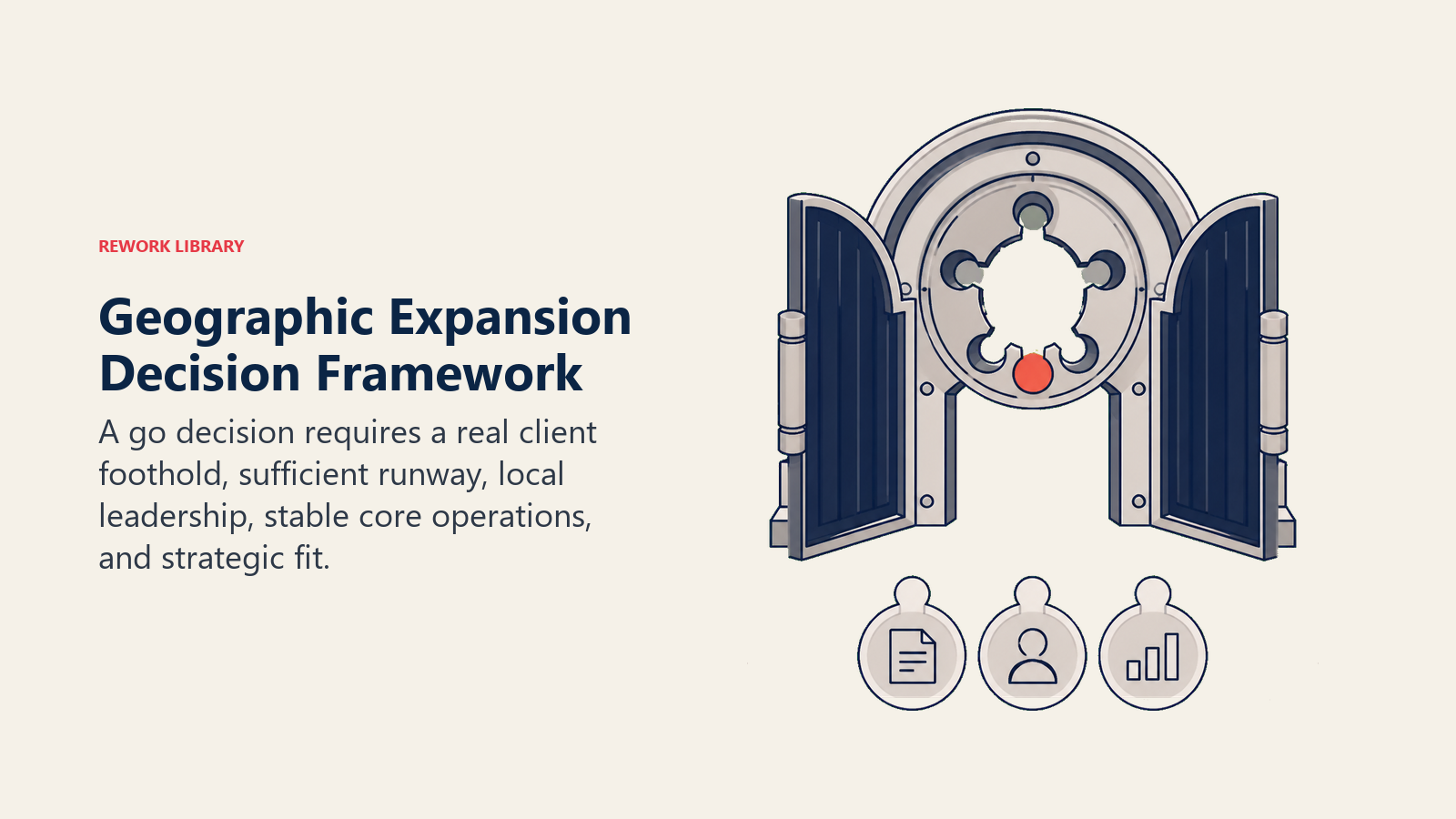
Go/No-Go criteria:
- Do we have at least one significant client or strong prospect in the target market?
- Can we commit $300K-$500K and 18-24 months to make this work?
- Do we have or can we hire credible local leadership?
- Are our core operations stable enough to handle the added complexity?
- Does this market align with our strategic growth priorities?
If you can't answer yes to all of these, you're not ready to expand.
Expansion sequencing: If you're planning multiple expansions, which order makes sense? Generally:
- Start with markets where you have existing client relationships
- Choose markets where talent pools are strong
- Pick markets that are operationally manageable (not too far, not radically different time zones)
- Build proof points before attempting more ambitious expansions
Contingency planning: What if it doesn't work? How long do you give it before you pull the plug? What are the exit costs? Many firms fail to think through the downside scenario.
Set clear milestones: by month 12, we should have X clients and $Y revenue. By month 24, we should be break-even. If you miss those by more than 25%, you need to seriously reassess.
Integration with broader growth strategy
Geographic expansion is one lever for growth. It needs to work with your other growth strategies, not compete with them.
Alignment with service line strategy: Are you expanding to offer the same services in new markets, or using new markets as a way to introduce new services? The latter is much harder.
Relationship to other growth levers: You can grow by expanding services to existing clients, winning new clients in existing markets, or entering new markets. Geographic expansion is that third lever, and it's often the hardest. Make sure you're not neglecting easier growth opportunities.
Growth model implications: Your firm's growth model (professional services growth model) should guide expansion decisions. If you're a high-specialization firm, expanding to new markets might not make sense. If you're a local market generalist, expanding to similar markets might be your only path to scale.
Post-expansion evaluation
After 12-24 months, do an honest assessment of how the expansion is going.
Success metrics assessment:
- Revenue vs projection
- Profitability vs plan
- Client acquisition and retention rates
- Employee satisfaction and retention
- Market reputation indicators
Learning and continuous improvement: What worked? What didn't? What would you do differently on the next expansion? Document these lessons while they're fresh.
Many firms discover that their second and third office openings go much better than the first because they learned from early mistakes. That only works if you actually capture and apply those lessons.
The bottom line on geographic expansion
Geographic expansion can be a powerful growth strategy for professional services firms, but it's expensive, complex, and risky. Most firms would be better off maximizing their current market before expanding to new ones.
If you do expand, do it strategically. Pick markets where you have real advantages, invest enough to do it right, and plan for it to take longer and cost more than you think. The firms that succeed with multi-location operations are the ones that treat it as a multi-year investment, not a quick growth hack.
And remember: being in more cities doesn't make you more successful if those offices are unprofitable or drain resources from your core business. Better to be excellent in three markets than mediocre in ten.
Related resources
For more on firm growth and operations:
- Professional Services Growth Model - Understand the complete framework for firm growth
- Utilization & Capacity Planning - Manage resource allocation across multiple locations
- Professional Services Metrics - Track performance across your firm
- Service Line Strategy - Align service offerings with expansion plans

Sales Director
On this page
- The geography paradox: Why location still matters
- What is geographic expansion, really?
- Market attractiveness analysis: Where should you expand?
- Assessing your firm's readiness to expand
- Geographic expansion strategies: Five models
- Strategy 1: Hub-and-Spoke Model
- Strategy 2: Autonomous Local Office Model
- Strategy 3: Strategic Partnership/Alliance Model
- Strategy 4: Remote/Distributed Delivery Model
- Strategy 5: Acquisition-Based Expansion
- Location selection: Choosing the right city and office
- Building local market presence and reputation
- Managing multi-location operations
- Cultural continuity across locations
- Multi-location financial and operational metrics
- Common geographic expansion challenges
- Geographic expansion implementation framework
- Phase 1: Exploration and Planning (3-6 months)
- Phase 2: Foundation Building (2-3 months)
- Phase 3: Soft Launch (1-2 months)
- Phase 4: Ramp-Up (6-12 months)
- Phase 5: Optimization (months 12-36)
- Geographic expansion decision framework
- Integration with broader growth strategy
- Post-expansion evaluation
- The bottom line on geographic expansion
- Related resources