Fit vs Misfit Identification: Recognizing Good and Bad Client Opportunities
Turn this article into takeaways for your work.


Each assistant summarizes the article only for you and suggests best practices for your work.
Here's a truth most professional services firms learn the hard way: bad clients cost you 2-3 times more than good ones, pay you less, and burn out your team faster. Yet most firms don't have a systematic way to spot these disasters before signing the contract.
You know the clients I'm talking about. The ones with unrealistic timelines who change their minds every week. The ones who nickel-and-dime every invoice while demanding unlimited revisions. The ones who treat you like an order-taker instead of the expert you are.
The irony? Selective firms grow faster than firms that take every opportunity walking through the door. When you focus your capacity on clients who value your work, pay fairly, and actually implement your recommendations, your profitability jumps, your team stays engaged, and your reputation grows.
This guide gives you frameworks to identify ideal clients, spot red flags early, and gracefully decline opportunities that aren't worth your time.
The Hidden Cost of Bad-Fit Clients
Before we get into identification frameworks, let's talk about what's at stake. Profitability destruction: A bad-fit client might pay the same fee as a good-fit client, but they'll consume 2-3x the hours. Scope creep, endless revisions, emergency meetings, hand-holding through basic concepts, it all adds up. Your effective hourly rate tanks.
Opportunity cost: Every hour you spend managing a difficult client is an hour you're not spending on a great client. When your team is tied up putting out fires, you can't pursue strategic opportunities or deliver exceptional work that builds your reputation.
Team burnout: Your best people didn't join your firm to deal with disrespectful clients or no-win projects. Bad clients drive good employees away. The cost of turnover in professional services is massive.
Reputation risk: Bad-fit clients are more likely to be unhappy even when you do good work, because the fundamental mismatch means you can't meet their (often unrealistic) expectations. Unhappy clients don't refer others and sometimes actively damage your reputation.
Resource drain: These clients monopolize partner time, create internal conflict about how to handle them, and force you to create special processes that don't scale.
The math is simple: turning down a $50K project that would lose money and burn out your team is better business than taking it. Your capacity is your most valuable asset. Protect it.
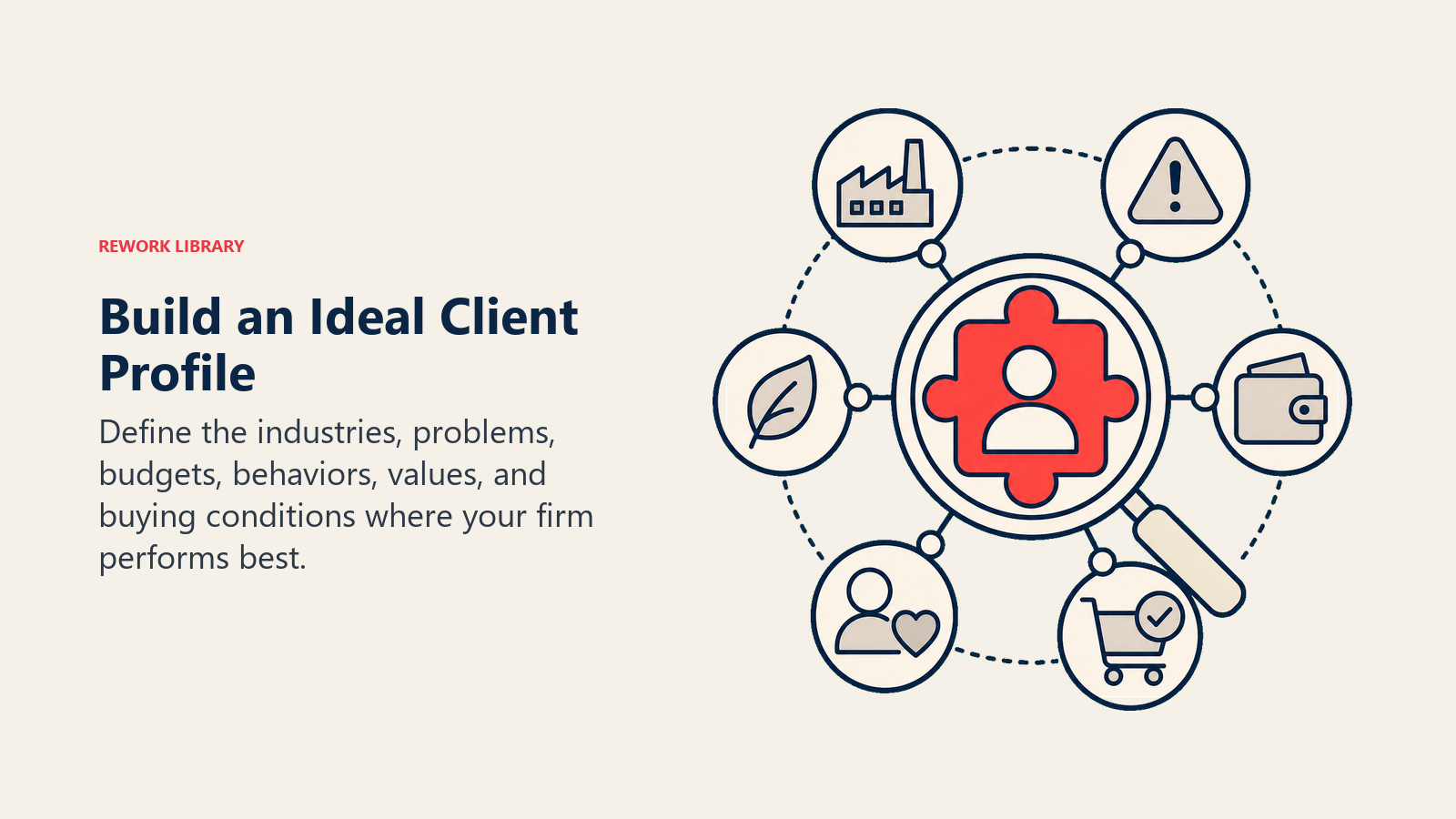
Building Your Ideal Client Profile
You can't identify misfits if you don't know what good fit looks like. Start by analyzing your best existing clients.
Strategic Fit
Industry alignment: Which industries do you serve best? Where do you have the deepest expertise and the best results? If you're a strategy consultant who specializes in healthcare, a retail client might be a misfit even if they've got budget.
Look at your conversion data too. If financial services prospects convert at 40% but manufacturing prospects convert at 10%, that's telling you something about fit.
Problem complexity match: Your firm has a sweet spot in terms of problem complexity. If you're set up to handle sophisticated transformation projects, a basic process optimization engagement might be a misfit. If you excel at tactical execution, a complex strategy project might stretch you too thin.
Growth potential: Is this the type of client who typically needs ongoing work? Can the relationship expand? A one-time project with no expansion potential might not be worth the acquisition cost and ramp-up time.
Values compatibility: Do they operate with integrity? Do they value expertise? Are they committed to implementation or just looking for a scapegoat? Values misalignment leads to miserable engagements.
Financial Fit
Budget adequacy: Can they afford to solve their problem properly? If they have a $500K problem but only $50K to spend, the engagement is set up to fail. You can't do $500K worth of work for $50K and have anyone be happy.
Financial stability: Are they financially sound enough to pay you on time and complete the engagement? A client in financial distress will cut your project first when cash gets tight.
Value understanding: Do they understand that professional services deliver value, not just hours? Clients who see you as a commodity rather than an investment are exhausting to work with.
Realistic ROI expectations: Can you actually deliver the return they're expecting? If they think your $100K project will somehow generate $10M in value in six months, they're going to be disappointed even if you do great work.
Operational Fit
Clear decision processes: Do they have a defined way of making decisions? Who's involved? What's the timeline? Chaotic decision-making leads to chaotic projects.
Reasonable timelines: Are their expectations about timing realistic given the scope? A client who wants a six-month transformation in six weeks is setting everyone up for failure.
Collaboration resources: Will they make the right people available when you need them? Professional services projects require client participation. If they can't commit resources, the project will stall.
Services experience: Have they worked with consultants, agencies, or other professional service providers before? Clients who have never bought services often don't understand how engagements work, which creates friction.
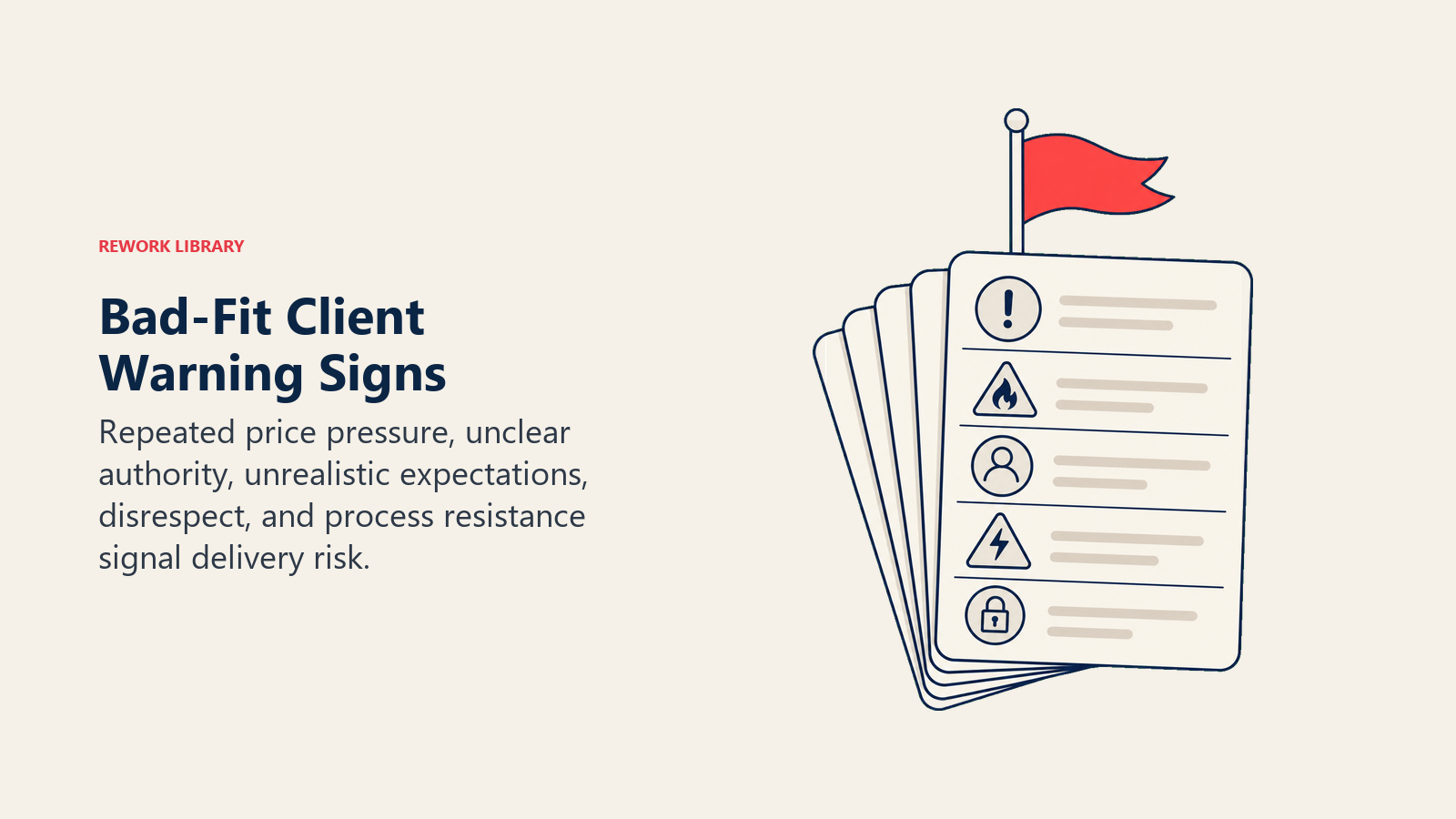
Red Flags and Warning Signs
Pay attention to these signals during your qualification process. One red flag might not disqualify a prospect, but multiple flags should make you think twice.
Financial Red Flags
Extreme price sensitivity: If every conversation comes back to price before you've even discussed scope or value, they're probably not going to be a good client. Yes, price matters. But obsessive focus on the lowest possible cost suggests they don't value expertise.
Spec work requests: "Can you show us what you'd do before we hire you?" Legitimate discovery is one thing, but asking for free consulting or detailed proposals before committing is a bad sign. It suggests they don't value your time or might be collecting ideas with no intention to hire anyone.
Payment issues in their past: If they mention disputes with previous consultants over billing or tell stories about refusing to pay, believe them. You'll be the next one fighting for payment. These signals are critical in your budget and timeline discovery conversations.
Unrealistic budget for scope: They want comprehensive strategy work for the price of a basic audit. They're either naive about what things cost or hoping to squeeze you down. Either way, it's a problem.
Operational Red Flags
Unclear objectives: They can't articulate what success looks like or what they're trying to achieve. "We need help with strategy" isn't an objective. And if they don't know where they're going, you can't get them there.
Unrealistic timelines: They need a six-month engagement done in three weeks because they already promised results to their board. The timeline was set before they understood the work required.
Committee decisions without authority: You're meeting with eight people but none of them can actually make decisions. Everyone has veto power but no one has approval authority. This leads to endless cycles of "we need to run it by a few more people."
Consultant turnover: They've had three different consulting firms working on this problem in the last year, and none of them worked out. Either they're impossible to please or they won't implement recommendations. Probably both.
Cultural Red Flags
Disrespect: They're rude to your team, dismissive of your expertise, or condescending in early meetings. If they treat you poorly before they've hired you, it'll get worse once you're working together.
Political dysfunction: Their organization is a mess of competing factions and power struggles. You're being brought in as a pawn in someone's internal battle, not to actually solve problems.
Values conflicts: They want you to do work you consider ethically questionable, or their business practices clash with your values. This creates tension that undermines the engagement.
Communication incompatibility: They won't respond to emails for weeks, then expect instant responses when they finally engage. Or they want 24/7 availability. Communication mismatches create frustration on both sides.
Strategic Red Flags
Outside your core competency: They need expertise you don't have. Sure, you could figure it out, but you'll be inefficient and they won't get your best work.
Commodity treatment: They're treating this as a procurement exercise, getting bids from five firms and picking the cheapest. They don't care who does the work as long as it's cheap. These clients don't value differentiation.
Guaranteed outcome expectations: They want you to guarantee specific business results that depend on factors outside your control. "We'll only pay you if revenue increases 20%" sounds like results-based pricing, but it's really risk-shifting.
Band-aid seeking: They want a quick fix for a systemic problem. They're not willing to address root causes or make real changes. Your recommendations will sit in a drawer.
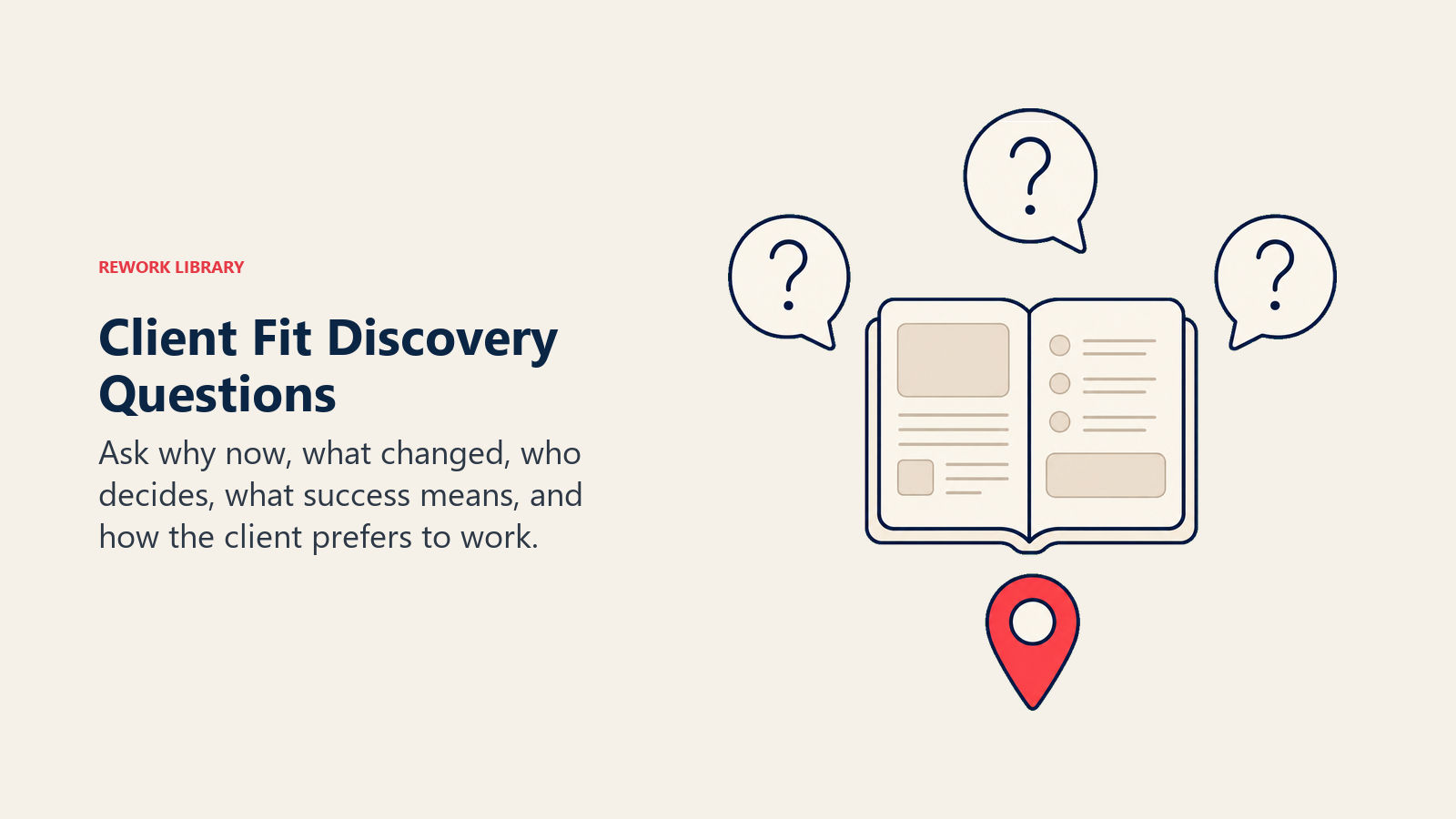
Discovery Questions for Fit Assessment
You can't spot red flags if you don't ask the right questions. Here's how to uncover fit information during initial conversations.
Strategic Discovery
"Why are you looking for external help now?" This reveals the catalyst. Is there a real problem that's hit a breaking point, or are they just casually exploring? Urgency suggests real need.
"What have you tried before?" If they've attempted to solve this internally or with other consultants, you learn about their commitment to implementation and what hasn't worked.
"Where does this sit among your company's priorities?" Is this a top-three strategic initiative or item #47 on someone's list? Priority determines the resources and attention you'll get.
"How will you define success?" If they can articulate clear success metrics, they've thought this through. If they waffle or give vague answers, they're not ready.
Process Discovery
"Who's involved in the decision to hire a firm?" Maps out the decision-making process and helps you identify whether you're talking to the right people.
"What's your process for selecting a partner?" Reveals whether this is a thoughtful selection or a low-bid procurement exercise.
"How will you measure our success?" Different from overall project success - this is about how they'll evaluate your performance. Gives you insight into their expectations and whether they're realistic.
"What's your experience working with consultants/agencies/advisors?" New buyers often have unrealistic expectations. Experienced buyers might be jaded from bad experiences. Either way, you need to know.
Resource Discovery
"What internal resources can you commit to this project?" Will they actually participate, or do they think you can do everything without their involvement?
"How much time can your key stakeholders dedicate?" Specific time commitments reveal whether they're serious. "We'll make people available as needed" is code for "we haven't really thought about this."
"What's your budget range for solving this problem?" Not "what's the least you could pay" but "what are you prepared to invest to solve this properly?" The framing matters. Learn more about navigating these conversations in our guide to needs assessment and discovery.
"How do you typically handle scope changes?" Tells you whether they understand that changes cost money and time, or whether they expect infinite flexibility for a fixed price.
Culture Discovery
"How do you prefer to work with external partners?" Some clients want weekly check-ins, others want monthly. Some want you embedded on-site, others want minimal interaction. Preference alignment matters.
"Tell me about your best experience with a consulting firm." What they valued tells you what they'll value in you. If they describe a firm that let them direct every detail, they want order-takers, not advisors.
"Tell me about your worst experience." What went wrong and why? More importantly, listen to how they describe it. Do they own any responsibility, or do they blame everything on the firm?
"How do you handle disagreements when the consultant recommends something your team disagrees with?" Reveals whether they're actually open to outside perspective or just looking for validation.
Fit Assessment Framework
Turn your gut feelings into a systematic evaluation. Score prospects across five dimensions, with each dimension worth 0-10 points for a total of 50.
Scoring Dimensions
Strategic Alignment (0-10)
- 9-10: Perfect industry match, problem is your sweet spot, high referral potential
- 7-8: Good industry fit, problem is within your expertise, reasonable fit
- 5-6: Adjacent industry, problem is doable but not ideal, moderate fit
- 3-4: Stretch industry, problem is at edge of capability, poor fit
- 0-2: Wrong industry, problem outside expertise, fundamental misalignment
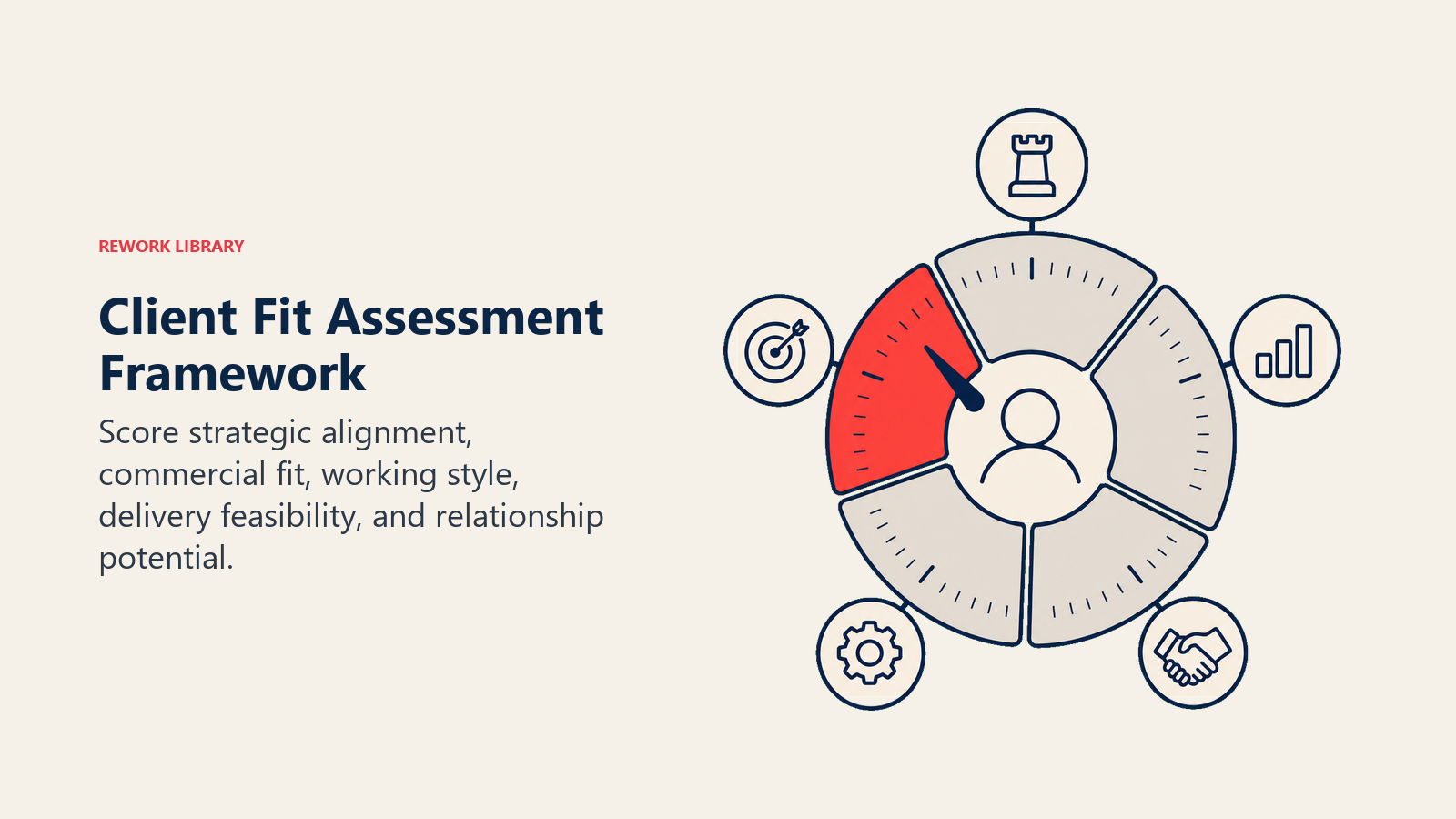
Financial Viability (0-10)
- 9-10: Strong budget, excellent financial health, realistic ROI expectations, values expertise
- 7-8: Adequate budget, stable finances, reasonable expectations
- 5-6: Tight budget but doable, some financial concerns, modest expectations
- 3-4: Inadequate budget, financial stress, unrealistic expectations
- 0-2: Can't afford proper solution, payment risk, delusional expectations
Operational Compatibility (0-10)
- 9-10: Clear decision process, realistic timeline, committed resources, experienced buyer
- 7-8: Defined process, workable timeline, adequate resources, some experience
- 5-6: Fuzzy process, tight timeline, limited resources, new to buying services
- 3-4: Chaotic process, unrealistic timeline, minimal resources, no experience
- 0-2: No clear process, impossible timeline, no resources committed, unrealistic expectations
Cultural Fit (0-10)
- 9-10: Respectful, collaborative, values expertise, strong communication, shared values
- 7-8: Professional, cooperative, respects expertise, good communication
- 5-6: Transactional, somewhat cooperative, adequate communication, minor friction
- 3-4: Difficult, adversarial tendencies, poor communication, value conflicts
- 0-2: Disrespectful, hostile, terrible communication, fundamental value conflicts
Growth Potential (0-10)
- 9-10: Significant expansion opportunity, strategic account potential, strong referral likelihood
- 7-8: Good expansion potential, possible referrals, could grow over time
- 5-6: Some expansion possible, unlikely to refer, limited growth
- 3-4: One-time project, no expansion, won't refer
- 0-2: One-time with problems, might damage reputation, negative growth
Score Interpretation
40-50 Points (Ideal Client): Pursue aggressively. This is what you built your firm to do. Invest in winning this opportunity and deliver exceptional work.
30-39 Points (Acceptable Client): Good opportunity if capacity allows. Not perfect, but workable. Set clear boundaries and expectations from the start.
20-29 Points (Marginal Client): Only take this if you've got capacity and can't afford to be selective right now. Structure the engagement carefully with protective terms. Monitor closely.
Below 20 (Misfit Client): Decline. The risk outweighs the potential reward. You'll regret taking this on.
Disqualifying Factors
Some things should automatically disqualify a prospect regardless of score:
- Ethical concerns: They want you to do something questionable or their business practices violate your values
- Unrealistic fundamental expectations: They expect guaranteed results you can't control or deliverables that are impossible
- Payment risk: Strong signals they won't pay or will fight every invoice
- Outside expertise: The work requires skills you genuinely don't have and can't acquire quickly enough
When you hit a disqualifier, stop. Don't try to convince yourself it'll be okay. It won't be.
Gracefully Declining Wrong-Fit Opportunities
Saying no is a skill. Done well, you maintain the relationship and preserve your reputation. Done poorly, you burn bridges.
When to Decline
Early recognition is best: As soon as you spot fundamental misalignment, decline. Don't lead them on through discovery calls and proposals if you already know it won't work.
Before significant investment: If you're going to decline, do it before you invest hours in proposals or presentations. Your time is valuable, and they deserve a quick answer.
When red flags cluster: One red flag might be manageable. Three or four? That's a bad fit. Trust your assessment.
When your gut says no: Sometimes you can't articulate exactly why, but something feels off. Trust that instinct, especially after you've been doing this for a while.
Decline Scripts
Best fit approach: "After learning more about your needs, I don't think we're the best fit for this project. You need someone with deeper expertise in [specific area], and we'd be doing you a disservice to take this on."
Why it works: Frames the decline as being in their best interest, not about them being difficult or unable to afford you.
Expertise alignment: "This is a great opportunity, but it's outside our core expertise. We focus specifically on [your specialty], and your project requires [what they need]. I wouldn't be able to deliver the quality of work you deserve."
Why it works: Positions you as honest and selective about where you can add value.
Capacity focus: "We're at capacity with clients in our target markets, and I want to make sure we can give our clients the attention they deserve. I don't have the bandwidth to take on new work right now."
Why it works: Not about them, about your commitment to existing clients. Also signals you're in demand.
Resource requirements: "Based on what you're describing, this project would require [resources/timeline/budget] to do properly. If those constraints can't shift, I'm not the right partner for this."
Why it works: Clear about the gap between requirements and resources without being judgmental.
Maintaining the Relationship
Just because they're not right now doesn't mean they won't be right later. Or they might refer someone who is a perfect fit.
Offer alternatives: "This isn't a fit for us, but I know a firm that specializes in exactly this type of work. Would it be helpful if I introduced you?"
Provide educational resources: "I can't take on the project, but here's an article that might help you think through the approach" or "This framework might help you evaluate other firms."
Stay connected: "I appreciate you thinking of us. Let's stay in touch. If your needs shift or you have different challenges down the road, I'd be happy to talk again."
Leave the door open: "Our focus is on [X type of work], but if you have needs in that area in the future, please reach out."
Referral Strategy
Build a network of complementary providers so you can refer prospects who aren't right for you. This ties into your broader professional networking strategy. Referrals serve multiple purposes:
Helps prospects: They get connected to someone who can actually help them.
Builds referral karma: When you send quality referrals to other firms, they'll send referrals back to you.
Preserves relationships: The prospect remembers that you tried to help them even though you couldn't work with them.
Enhances reputation: Being selective and helpful builds your credibility more than taking every opportunity.
Maintain a short list of firms you trust in adjacent specialties or market segments. When you decline a prospect, you can immediately suggest a better alternative.
Converting Borderline Prospects
Sometimes a prospect scores in the marginal range but has potential. Here's when and how to try to improve the fit.
Recalibration Approaches
Value education: If the main issue is that they don't understand the value of professional services or have unrealistic budget expectations, invest some time in educating them. Share case studies, explain your methodology, quantify the ROI.
Sometimes prospects just need help understanding what proper solutions cost and why. If they're willing to learn, the relationship can work.
Scope adjustment: Maybe they're asking for too much too fast. Can you phase the work? Start with a diagnostic or pilot project that fits their budget and builds confidence?
A smaller initial engagement can prove value and lead to a longer-term relationship.
Phased approach: "You're trying to solve problems 1, 2, and 3. Let's start with problem 1, deliver results, and then decide whether to tackle the others." This reduces their risk and yours.
Trial project: "Let's do a defined 4-week engagement to address [specific issue]. This gives us both a chance to see how we work together before committing to the larger initiative."
Trial projects are especially useful with prospects who are new to buying services and nervous about big commitments.
When to Invest in Conversion
Don't try to convert every marginal prospect. Be selective about where you invest this effort.
Strategic value: Is this a brand-name client or a key account that opens doors to a market segment you want to enter? Strategic value might justify the extra work.
Learning opportunity: Does this engagement teach you new capabilities you want to develop? If it's an investment in skill-building, the ROI math changes.
Referral potential: Is this prospect connected to a network of ideal clients? One challenging engagement might lead to multiple perfect-fit referrals.
Addressable concerns: Are the fit issues things you can actually influence? You can educate someone about budget, but you can't fix a dysfunctional culture.
Setting Clear Boundaries
If you decide to move forward with a marginal prospect, protect yourself with clear boundaries:
Scope definition: Document exactly what's included and what's not. Be more detailed than you would with an ideal client. Every detail you don't specify is an opportunity for scope creep.
Communication protocols: Define how often you'll meet, who's involved, response time expectations. Don't leave this to chance.
Decision authority: Get clarity on who can approve deliverables and sign off on phases. Put it in writing.
Payment terms: Shorter payment cycles, deposits, or milestone-based payments. Protect your cash flow.
The added structure might feel heavy-handed with ideal clients. But with marginal clients, it's necessary protection.
Building a Qualification System
One-off assessments are better than nothing, but systematic qualification is what separates consistently profitable firms from ones that yo-yo between great and terrible clients.
Create a Consistent Evaluation Process
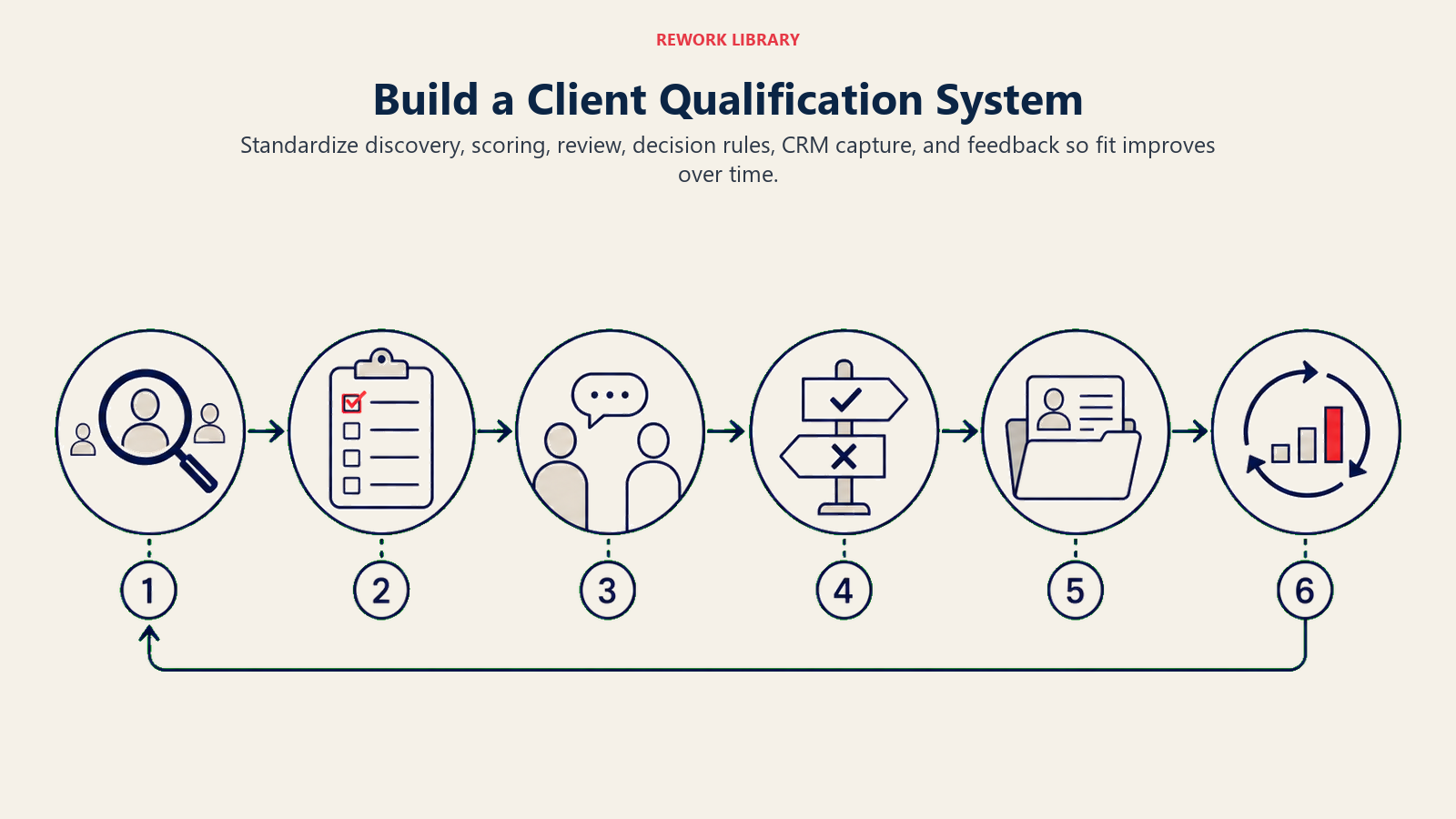
Standard discovery calls: Use the same question set with every prospect. This creates comparable data and ensures you don't skip important areas.
Structured scoring: After every prospect conversation, take five minutes to score them using your framework. Don't rely on memory or gut feel alone.
Team calibration: If multiple people are qualifying prospects, get together quarterly to discuss scoring. Make sure everyone's applying the framework consistently.
Decision thresholds: Set team-wide standards. "We only pursue opportunities scoring 30 or higher" or "Anything below 35 requires partner approval." Having clear thresholds prevents justifying bad decisions.
Train Your Team
Everyone who talks to prospects should understand what you're looking for and what to avoid.
Share the framework: Don't keep the scoring system secret. Help your team understand what makes a good fit.
Discuss examples: Review real prospects (confidentially) as a team. "Here's why we declined this opportunity. Here's why we pursued this one." Learning from real cases builds judgment.
Practice questions: Role-play discovery conversations. Help people get comfortable asking the hard questions about budget, authority, and expectations.
Empower them to decline: Give your team permission and language to politely decline bad-fit opportunities. They shouldn't have to escalate every prospect they know is wrong.
Document and Refine
Your qualification criteria should evolve based on experience.
Track outcomes: Did the clients who scored 40+ actually turn out to be great? Were there misfit clients who scored well? What did your framework miss?
Review declines: When you turn down an opportunity, note why. Look for patterns. Are you consistently declining for the same reasons?
Analyze regrets: Every firm takes on clients they shouldn't. When that happens, go back to the assessment. What red flags did you miss or ignore? How can you catch them next time?
Update criteria: As your firm evolves, so does your ideal client profile. What made sense five years ago might not fit your capabilities today. Review and update your framework annually.
The Profitability Impact
Let's make this concrete with numbers. Imagine your firm has capacity for 10 clients at a time. Scenario A: No selectivity
- You take every client that can pay
- 4 are ideal clients, 4 are acceptable, 2 are misfits
- Ideal clients generate 150% of target profitability
- Acceptable clients generate 100% of target profitability
- Misfits generate 40% of target profitability (after all the extra time and headaches)
- Average profitability: 108% of target
Scenario B: Selective qualification
- You decline misfits and marginal prospects
- You might only fill 8 slots initially, but they're all solid
- 5 ideal clients, 3 acceptable clients
- Average profitability: 131% of target
- Plus you have capacity to say yes when a great opportunity appears
Over time, Scenario B fills all 10 slots with ideal and acceptable clients because your team can focus on business development instead of firefighting. Meanwhile, Scenario A stays stuck in a cycle of taking anyone who'll pay, always scrambling to replace revenue from churned misfit clients.
The math is clear: selectivity drives profitability.
Where to Go from Here
Fit identification is the foundation of effective client qualification. Once you can reliably spot ideal clients and misfits, everything else gets easier:
- Client Qualification Framework helps you systematically evaluate prospects
- Project Scope Assessment ensures you understand what you're signing up for
- Budget & Timeline Discovery digs into financial and timeline fit
- Initial Consultation Process structures your discovery conversations
- Consultative Business Development positions you as a trusted advisor, not a vendor
Start by documenting your ideal client profile. Look at your best current clients and your worst ones. What patterns do you see? Build your scoring framework based on those patterns.
Then practice declining. It feels uncomfortable at first, especially if you're used to saying yes to everything. But you'll quickly see the benefits: less stress, better work, happier team, stronger profits.
Remember: your capacity is finite. Every hour you spend on a wrong-fit client is an hour you can't spend on a right-fit client. Being selective isn't arrogant, it's strategic. It's how you build a sustainable, profitable firm that you actually enjoy running.
The best firms don't work with everyone. They work with the clients they can genuinely help. That's the real path to growth.
Learn More
Deepen your client selection capabilities with these related resources:
- Client Qualification Framework - Systematic approach to evaluating every opportunity
- Budget & Timeline Discovery - Master the financial conversation
- RFP Response Strategy - Apply selectivity to RFP opportunities
- Inbound Lead Generation - Attract better-fit prospects from the start
- Proposal Development - Win the opportunities worth pursuing

Sales Director
On this page
- The Hidden Cost of Bad-Fit Clients
- Building Your Ideal Client Profile
- Strategic Fit
- Financial Fit
- Operational Fit
- Red Flags and Warning Signs
- Financial Red Flags
- Operational Red Flags
- Cultural Red Flags
- Strategic Red Flags
- Discovery Questions for Fit Assessment
- Strategic Discovery
- Process Discovery
- Resource Discovery
- Culture Discovery
- Fit Assessment Framework
- Scoring Dimensions
- Score Interpretation
- Disqualifying Factors
- Gracefully Declining Wrong-Fit Opportunities
- When to Decline
- Decline Scripts
- Maintaining the Relationship
- Referral Strategy
- Converting Borderline Prospects
- Recalibration Approaches
- When to Invest in Conversion
- Setting Clear Boundaries
- Building a Qualification System
- Create a Consistent Evaluation Process
- Train Your Team
- Document and Refine
- The Profitability Impact
- Where to Go from Here
- Learn More