Service Productization: Transforming Custom Services into Scalable, Profitable Products
Turn this article into takeaways for your work.


Each assistant summarizes the article only for you and suggests best practices for your work.
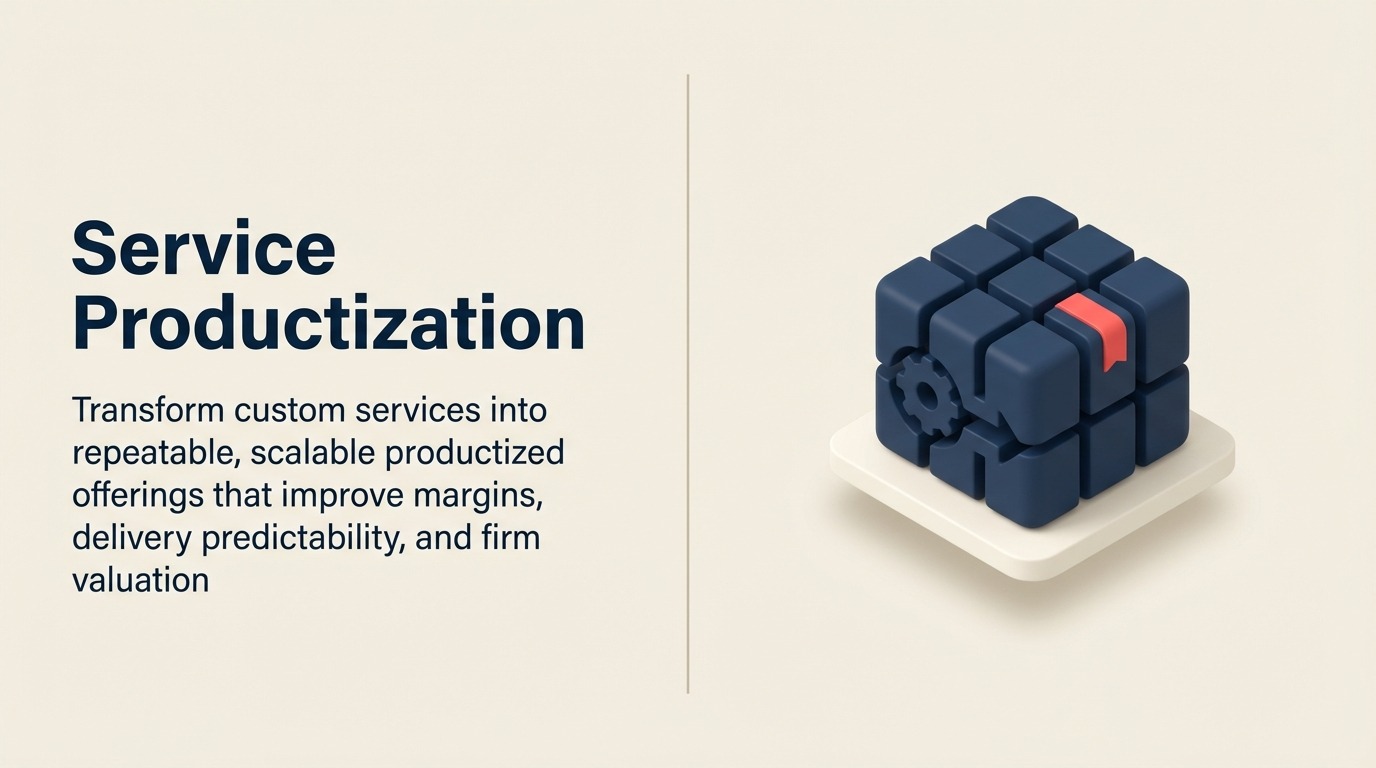
Service productization is the agency growth move that breaks the revenue-equals-headcount trap. You take services you already deliver repeatedly and standardize the scope, pricing, and delivery into repeatable packages. Done well, it lifts gross margins 20-40%, makes delivery predictable, shortens sales cycles, and raises firm valuation because buyers pay more for recurring, scalable revenue.
Here's a painful reality most professional services firms face: the harder you work, the less profitable you become. You land a great client, deliver exceptional custom work, and earn solid revenue. Then another client wants something similar but different. So you customize again. And again. Before you know it, you're running ten variations of the same service, each one requiring unique scoping, custom delivery, and unpredictable margins.
You're stuck in the productivity trap. Revenue grows linearly with headcount, margins compress as you compete on price, and scaling means hiring more people to do more custom work. Your best consultants spend their time reinventing solutions you've already built five times before.
The firms that break out of this trap all do one thing: they productize. They take their best custom work and turn it into repeatable, scalable offerings with defined scopes, fixed pricing, and predictable delivery. The result? Margins improve by 20-40%, delivery becomes more efficient, and firm valuation jumps 30-50% because buyers love predictable revenue.
This guide shows you how to identify productization opportunities, design packaged services, price them for profit, and transition from custom chaos to scalable growth.
What Service Productization Actually Means
Productization doesn't mean turning your consulting firm into a software company. It means taking the services you already deliver repeatedly and standardizing them enough to make delivery predictable while maintaining the quality that made them valuable in the first place. Think of it as a spectrum. On one end, you have pure custom services where every engagement is unique, scoped from scratch, and delivered with no two projects looking alike. On the other end, you have pure products - software, templates, or tools that are identical for every customer with zero customization.
Productized services sit in the middle. They're still services requiring human expertise, but they have defined parameters:
- A clear target customer and problem
- Standardized scope and deliverables
- Predictable timeline and resource requirements
- Fixed or tiered pricing (not hourly)
- Repeatable delivery methodology
A law firm that offers "Contract Review Service" for $5,000 with a defined process, turnaround time, and deliverable has productized. A marketing agency that sells "Website Launch Package" with set phases, templates, and outcomes has productized. They're still delivering expertise, but they've removed the variability that makes custom services hard to scale.
The Economics That Make Productization Worth It
The financial benefits of productization are compelling, and they're not magic. They come from specific operational improvements that directly impact your bottom line. Margin improvement: Custom services typically run 30-45% gross margins because every project has unknowns that eat time. Productized services hit 50-65% margins because you've done it before, you know exactly what it takes, and you've optimized the delivery. That 20-point margin improvement means a $100K project generates $20K more profit with productization.
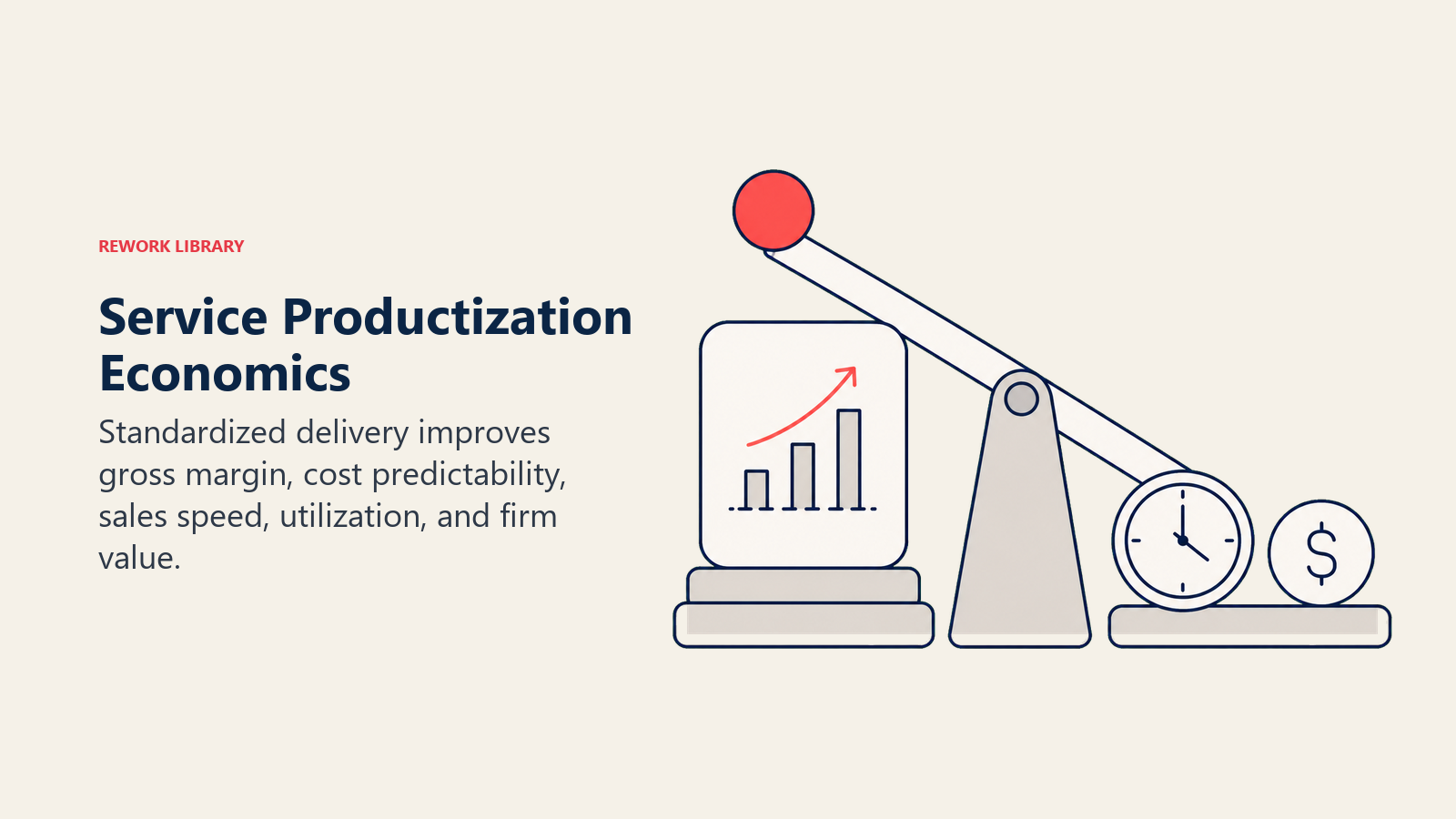
Delivery cost predictability: Custom work has cost overruns. You estimate 40 hours but it takes 65 because the scope wasn't clear or the client needed extra revisions. Productized services have fixed delivery costs because you've standardized the work. If you know a package takes exactly 32 hours to deliver, you can price it with confidence and staff it efficiently.
Scaling without linear headcount growth: This is the big one. Custom services require one consultant per project. Productization lets you leverage junior staff, templates, and processes so senior people aren't doing repetitive work. This ties directly to your leverage model optimization strategy. One senior consultant can oversee three productized engagements simultaneously while junior team members execute the standardized components.
Time-to-profitability acceleration: New hires delivering custom services take 6-9 months to become profitable because they're learning different approaches on every project. With productized services, they follow a playbook and become profitable in 2-3 months.
Client acquisition cost optimization: Selling custom services requires educating prospects on your approach, building custom proposals, and extended sales cycles. Productized services have clear value propositions, standard pricing, and faster close rates. Your customer acquisition cost drops while win rates increase.
Lifetime value multiplication: Productized services create natural expansion paths. A client who buys your "Compliance Assessment Package" is a perfect candidate for your "Ongoing Compliance Management Service." You've built the relationship with a low-friction initial purchase, then expanded from there.
The math is straightforward: if you can deliver the same value in less time with higher margins and sell it more efficiently, your profitability per project jumps significantly. Scale that across your portfolio and you've transformed your business model.
Identifying Which Services to Productize
Not every service you offer should be productized. Some custom work is valuable because it's bespoke. The key is identifying the services where standardization creates more value than customization. Start by analyzing what you're already doing repeatedly. Pull project data from the last 12-24 months and look for patterns:
Volume indicators: Which services do you deliver at least 8-10 times per year? That's enough volume to justify the investment in productization. If you're only doing something twice a year, keep it custom.
Client-requested patterns: What do prospects ask for by name? If three different clients in three different industries all ask for "security audit" or "go-to-market strategy," there's a market for a productized version.
Delivery team feedback: Your consultants know which projects feel repetitive. Ask them: "Which engagements follow a similar pattern every time?" That's your productization candidate list.
High-value IP and methodologies: You've probably developed frameworks, templates, or processes that differentiate your work, the output of deliberate capability development. If you have a proprietary methodology for something, that's the foundation for a productized service.
Scope creep analysis: Look at projects where you estimated 40 hours but delivered 60. If the extra work is the same across multiple clients, that scope should be included in a productized offering rather than handled as an exception every time.
Once you've identified candidates, prioritize them with this decision matrix:
| Factor | Weight | Scoring Criteria |
|---|---|---|
| Market demand | High | How often are you asked for this? |
| Differentiation | High | Do you do this better than competitors? |
| Margin potential | High | Can standardization improve profitability? |
| Repeatability | Medium | How similar are engagements? |
| Implementation ease | Medium | How hard to standardize delivery? |
| Strategic fit | Medium | Does this align with growth goals? |
Score each candidate 1-10 on these factors, apply weights, and rank them. Focus on the top 2-3 opportunities rather than trying to productize everything at once.
Service Productization Frameworks
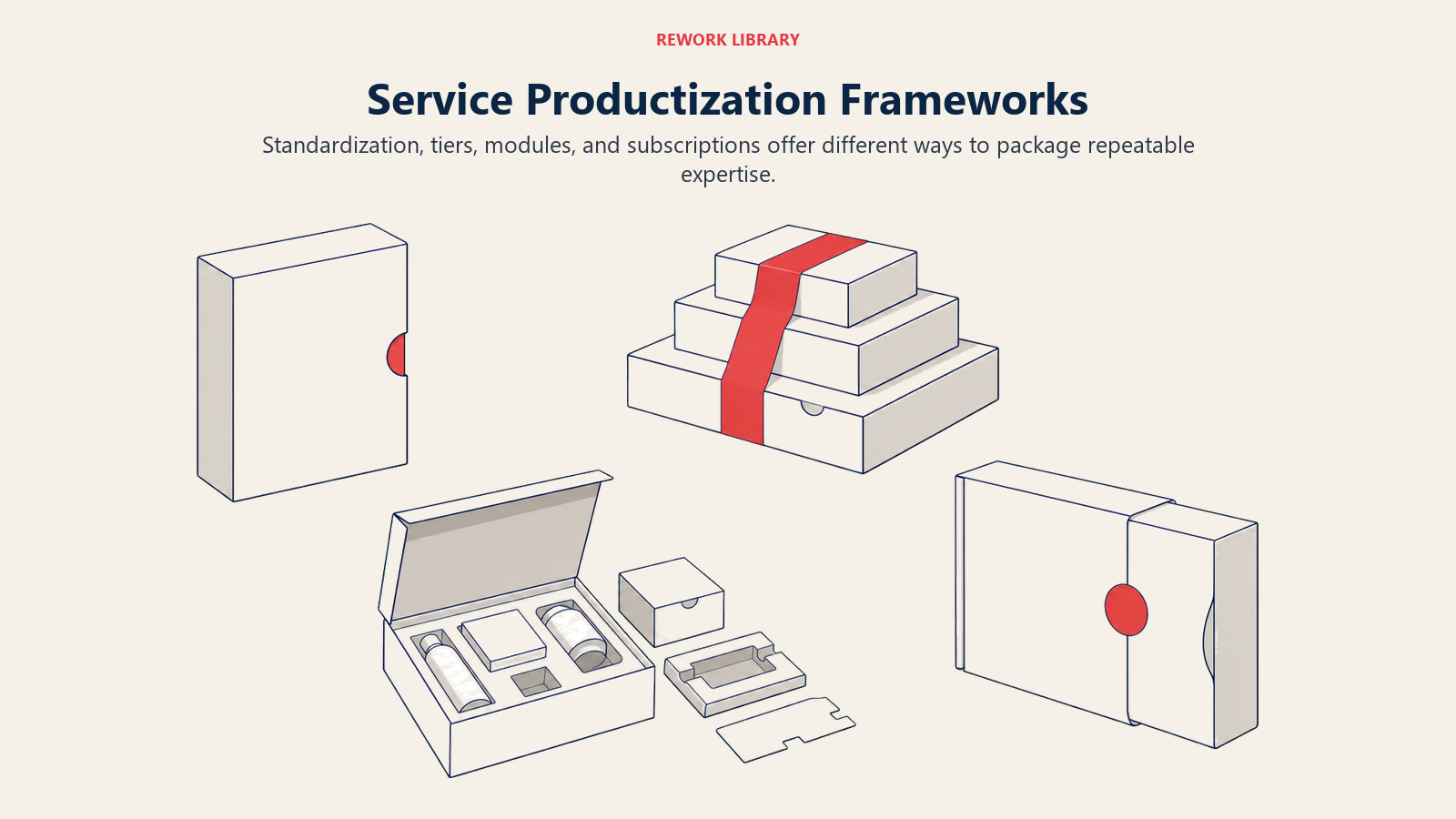
There are several ways to structure productized services. The right framework depends on your service complexity and market needs. Framework 1: Standardization Model Take a service you already deliver and create one fixed offering with no variations. Same scope, same deliverables, same price for everyone.
Example: "Financial Model Review" - 5-day engagement, delivers standardized report, checks 47 specific criteria, costs $8,500.
This works when the customer need is consistent and doesn't require customization. The benefit is maximum efficiency and simplicity. The risk is turning away clients who need something slightly different.
Framework 2: Tiered Product Model Offer three versions of the same core service at different price points: Basic, Professional, Enterprise.
Example:
- Basic: Core deliverables, 2-week turnaround, $5,000
- Professional: Core + advanced analysis, 1-week turnaround, $12,000
- Enterprise: Professional + implementation support, 3 days turnaround, $25,000
This captures more market by letting clients self-select based on budget and needs. It also creates price anchoring where the middle tier looks attractive. The complexity is managing three delivery models instead of one.
Framework 3: Modular Service Model Build a base service and offer add-on modules clients can purchase separately.
Example:
- Core Package: "Marketing Strategy Development" - $15,000
- Add-on Modules: "+Channel Planning" ($5,000), "+Campaign Execution" ($8,000), "+Performance Tracking" ($3,000/month)
This provides flexibility while maintaining standardization. Each module is productized individually, so you're not doing custom work. Clients can mix and match to fit their needs and budget. The challenge is ensuring modules integrate well and don't create delivery inefficiencies.
Framework 4: Methodology-Based Model Productize your approach rather than specific deliverables. Clients buy access to your proprietary process applied to their situation.
Example: "Market Entry Assessment using the [Your Firm] 8-Phase Framework" - delivered over 6 weeks, follows standard methodology, produces defined outputs.
This works well when your differentiation is how you work, not just what you deliver. It maintains strategic positioning while standardizing the process. The trick is ensuring the methodology is robust enough to apply consistently across different client situations.
Most firms use a combination. You might have tiered packages with modular add-ons, or standardized services that follow a proprietary methodology.
Designing Your Productized Service
Once you've chosen what to productize, you need to define it precisely. Vague service descriptions lead to scope creep and margin erosion. Here's what to nail down: Define core offering scope: What exactly is included and what's explicitly excluded? Be specific. Not "strategy development" but "competitive analysis of 5 competitors, market sizing for 3 segments, positioning recommendations, and 12-month roadmap."
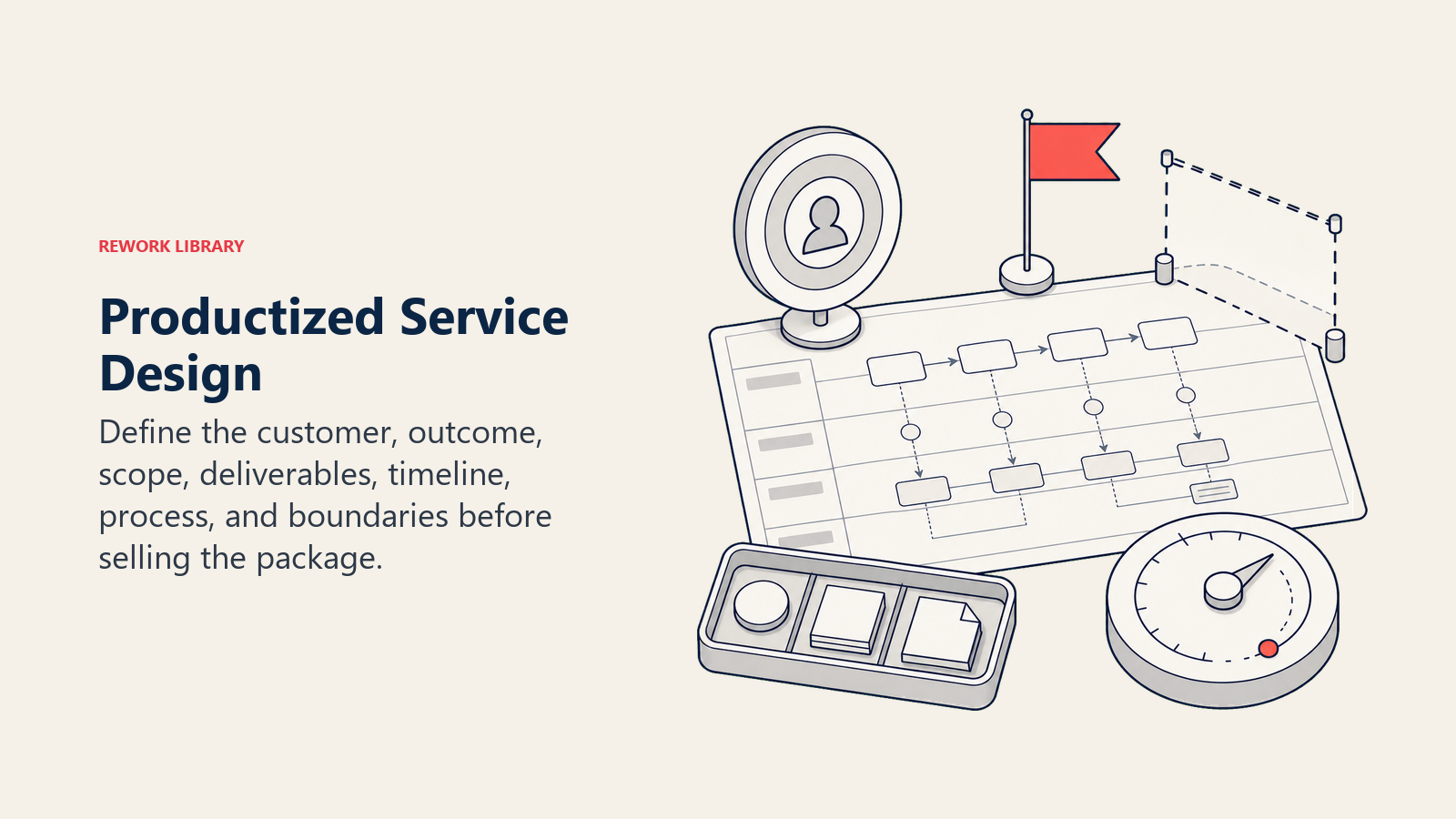
Customer archetype development: Who is this for? Not "B2B companies" but "Series A SaaS companies with $2-10M ARR entering their second market segment." The narrower your target, the more effectively you can productize because you're solving a specific problem for a specific customer.
Ideal project parameters: What's the size and scope of client situations where this service works perfectly? Company size, industry, maturity stage, problem severity. You're creating boundaries so you can confidently say "this is a fit" or "this is outside our productized scope."
Success criteria and outcomes: What does success look like? Not vague goals like "improved strategy" but measurable outcomes: "Completed financial model with 3-year projections, risk assessment covering 8 categories, funding readiness score with gap analysis."
Standard deliverables and quality standards: List every document, report, presentation, or tool the client receives. Define quality standards so delivery is consistent. Use templates and checklists to ensure nothing is missed and quality doesn't vary by team member.
Engagement timeline and milestones: Break the engagement into phases with clear milestones. "Week 1: Discovery and data collection. Week 2: Analysis and framework development. Week 3: Draft deliverables. Week 4: Revisions and final presentation." This sets expectations and creates accountability.
Support and maintenance model: What happens after delivery? Is there a warranty period? Do clients get follow-up calls? What support is included vs. what costs extra? Define this upfront to avoid margin leakage from unlimited free support.
Create a service design document that answers all these questions in detail. This becomes your internal reference and the foundation for sales materials, delivery playbooks, and quality control.
Packaging and Positioning Strategy
How you package and position your productized service determines whether clients see it as a commodity or a premium offering.
Create a compelling service name: Not "Consulting Services Package A" but something that communicates value. "Market Entry Accelerator" or "Compliance Readiness Assessment" or "Growth Diagnostic." The name should tell prospects what they get without needing to read fine print.
Clear value proposition statement: One or two sentences that explain who it's for, what problem it solves, and what outcome they get. "For Series A SaaS companies entering enterprise markets, our Market Entry Accelerator delivers a validated go-to-market strategy in 6 weeks, eliminating 6-12 months of trial and error."
Target customer segment definition: Be explicit about who this serves. The more specific you are, the more attractive it becomes to that audience. "Perfect for..." helps prospects self-identify while also helping your sales team qualify faster.
Competitive positioning analysis: How does this compare to alternatives? What do clients typically do instead - hire full-time staff, use different consultants, or try to figure it out themselves? Position against those alternatives, not just direct competitors.
Messaging and communication strategy: Develop a consistent narrative around the service. What's the problem story? What's unique about your approach? What results have you delivered? Create messaging that sales and marketing can use consistently across all channels.
Marketing collateral development: Build dedicated materials - landing pages, one-pagers, presentations, proposal templates. These should explain the service clearly enough that prospects understand it without needing a custom explanation every time.
Case study and ROI documentation: Nothing sells productized services like proof. Document results from delivery: "Typical clients see X outcome in Y timeframe" or "93% of clients achieve Z within 90 days." Quantify the ROI so prospects can justify the investment.
Your positioning should emphasize predictability and proven results. That's what productization offers that custom services can't - clients know exactly what they're getting and what it'll cost, with confidence it'll deliver because you've done it successfully before.
Pricing Productized Services for Profit
Pricing is where many firms stumble. They productize the service but keep hourly pricing, which defeats the purpose. Productized services need value-based or fixed pricing to capture the margin opportunity. Start with value, not cost: What's the outcome worth to the client? If your service helps them avoid a $500K mistake or capture a $2M opportunity, pricing it at $50K is justifiable even if your delivery cost is only $15K. Think about client ROI, not just your hours. For a deeper dive into this shift, see Billable Hour vs Value-Based Pricing.
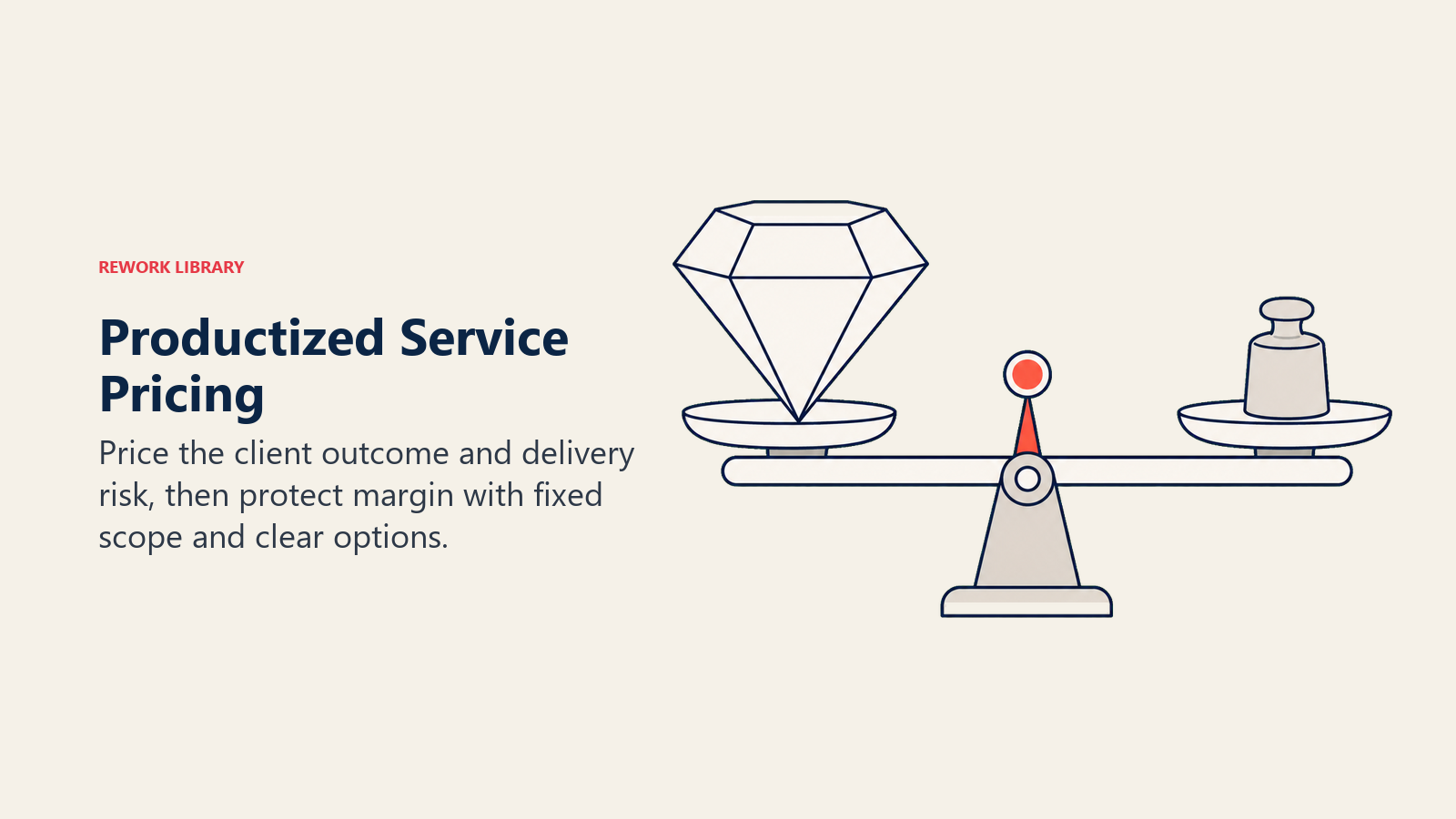
Market-rate analysis: Research what competitors charge for similar services. You don't need to match their pricing, but you need to understand market expectations. If the market rate is $15-25K and you're pricing at $60K, you better have strong differentiation to justify it.
Set gross margin targets: Work backwards from your margin goals. If you want 60% margins and know delivery costs $20K in labor and expenses, price at $50K minimum. Build in a buffer for exceptions and scope variations.
Fixed-fee vs variable pricing models: Most productized services use fixed pricing because it's simple and aligns with the productization concept. But you can offer tiered fixed prices based on company size or complexity. "Up to 50 employees: $X. 51-200 employees: $Y. 200+: $Z."
Tiered pricing psychology: When offering three tiers, most buyers choose the middle option. Price accordingly - put your target margin in the mid-tier, make the base tier profitable but basic, and make the premium tier highly profitable for clients who want the best.
Price anchoring: Show the custom alternative. "If we scoped this as custom consulting, it would be $85K. Our productized package delivers the same value for $50K with faster delivery." You've just made $50K look like a bargain.
Annual increase strategy: Build in price increases from the start. "Our 2026 pricing is $X, increasing to $Y in 2026." This creates urgency and lets you capture margin improvements as you optimize delivery over time.
Don't underprice to win initial clients. If you prove the value at $50K, raising to $75K later is hard. Better to start at the right price and offer early-client incentives or bonuses if you need to de-risk the purchase.
Standardizing Your Delivery Process
Productization only works if you can deliver consistently. That requires documented processes, not just senior consultants who know how to do it. Workflow documentation and process mapping: Map every step from kickoff to final delivery. Not high-level phases but specific tasks: "Day 1: Send welcome email and data request template. Day 3: Schedule kickoff call. Day 5: Receive completed data. Day 7: Begin analysis using Template X."
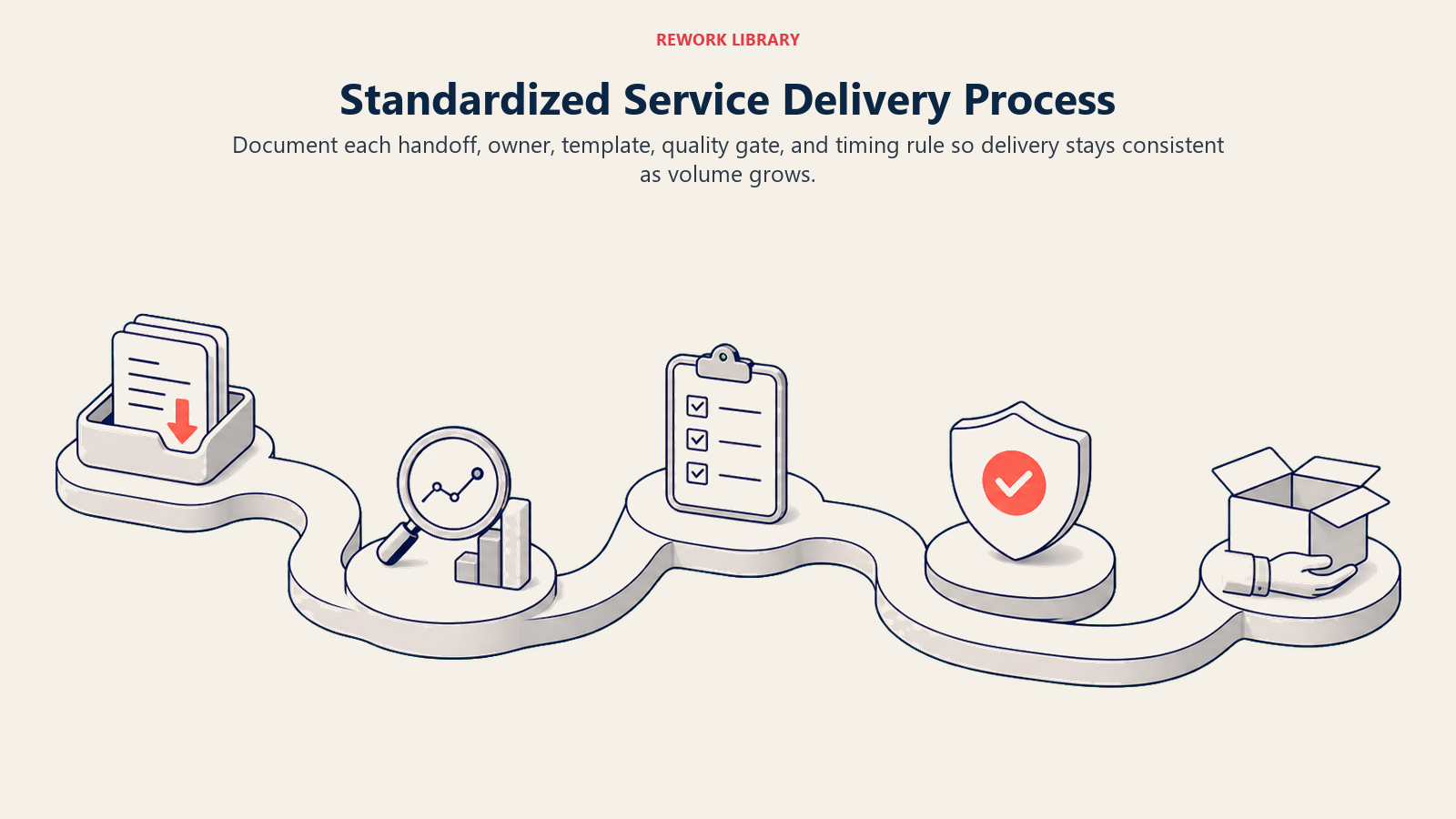
Resource allocation and staffing model: Define who does what. Maybe senior consultants handle discovery and strategy, while analysts do data collection and research, and project managers coordinate delivery. This leverages your team efficiently and keeps senior people focused on high-value work.
Tools and technology stack: Standardize the tools you use. The same templates, the same analysis software, the same project management system. When everyone uses the same tools, knowledge transfer is easier and quality is more consistent.
Quality assurance and testing procedures: Build in review checkpoints. "All client deliverables reviewed by senior consultant before delivery. Client presentations rehearsed internally before scheduling." QA catches errors and ensures consistency.
Knowledge management and playbooks: Create detailed playbooks for each productized service. Include templates, example deliverables, common questions and answers, troubleshooting guides. New team members should be able to deliver quality work by following the playbook.
Escalation and exception handling: Define what to do when something doesn't fit the standard model. When do you escalate to a senior partner? When do you offer custom pricing? Having clear criteria prevents junior staff from making promises you can't deliver profitably.
Performance measurement: Track key metrics for each delivery - actual hours vs. planned, margin by engagement, client satisfaction scores, on-time delivery rate. Use this data to optimize the process over time.
The goal is to remove dependency on individual expertise. Any trained consultant should be able to deliver your productized service at a consistent quality level by following your documented process.
Building Your Internal Capability
Your team needs different skills for productized delivery than for custom consulting.
Skills required for productized delivery: Process discipline, template usage, quality consistency, efficient execution. Custom consulting rewards creativity and client-specific problem-solving. Productized services reward efficiency and adherence to proven approaches.
Training and certification programs: Develop internal training that teaches your productized methodology. Include certification so team members must demonstrate competency before delivering client work. This maintains quality as you scale.
Hiring profiles: Look for people who are comfortable working within defined frameworks rather than always reinventing. Consultants who thrive on "every project is different" will struggle with productization. You want people who can execute excellently within guardrails.
Career paths: Create progression paths specific to productized services. Junior consultants execute delivery, senior consultants manage multiple engagements and train juniors, principals optimize the methodology and develop new productized offerings. Make it clear that productized delivery is a valued career track, not a lesser path than custom consulting.
Knowledge transfer systems: As you optimize delivery and learn what works, capture that knowledge. Weekly retrospectives where teams share what they learned. Documentation updates based on real engagement experiences. Continuous improvement loops that make the service better over time.
Performance metrics and accountability: Measure team members on delivery efficiency, quality scores, margin performance, not just utilization. If someone takes 50 hours to deliver a productized service that should take 32 hours, that's a coaching opportunity. Align incentives with productized delivery success.
Managing Customization Requests
Clients will ask for customization. "Can you also include X?" or "We need this but with Y instead." How you handle these requests determines whether productization succeeds or degrades back into custom chaos.
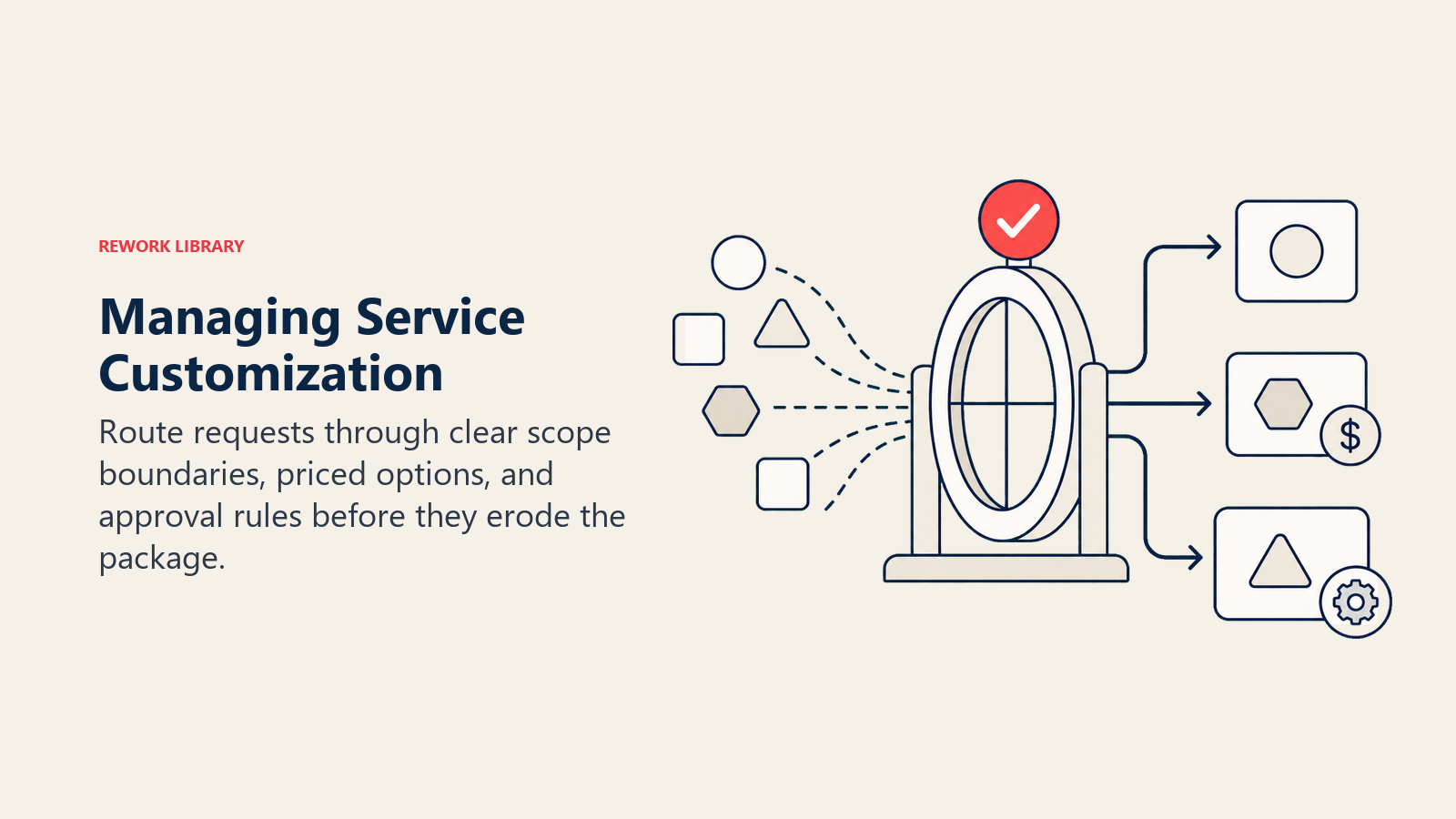
Set clear scope boundaries: Make it explicit what's included and what's not. In your sales process, in your agreements, in your kickoff meetings. "Our productized package includes A, B, and C. It does not include X, Y, or Z. If you need those, we can discuss a custom engagement."
Define customization types and pricing: Some modifications are minor (changing the number of stakeholder interviews from 5 to 7). Some are major (adding an entirely new phase). Create a framework:
- Minor customizations: Add 20% to base price
- Moderate customizations: Add 50% to base price
- Major customizations: This becomes a custom engagement, priced separately
Assess impact before agreeing: When a client requests a change, evaluate how it affects delivery. Does it require different resources? Does it increase risk? Does it break your standard process? If the modification forces you back into custom mode, either price it accordingly or decline.
Use customization as product feedback: If five clients all ask for the same customization, that's a signal. Either add it to your standard offering (and raise the base price), create it as an add-on module, or develop a new tier that includes it. Your customization requests tell you how to evolve your productized services.
Know when to say no: Protecting your productized offering sometimes means turning down business. If a client wants so much customization that delivery costs would destroy margins, walk away or redirect them to a custom engagement. Not every opportunity is a good opportunity.
Document everything: When you do allow customization, document it clearly. Change the SOW, adjust the price, note the modifications in your project management system. Don't deliver custom work at productized pricing just to win the deal.
The Productization Maturity Model
Productization isn't binary. There's a progression from fully custom to fully productized, and most firms move through stages. Stage 1: Ad-Hoc Every engagement is custom. Scoped individually, delivered uniquely, priced by estimating hours. This is where most professional services firms start.
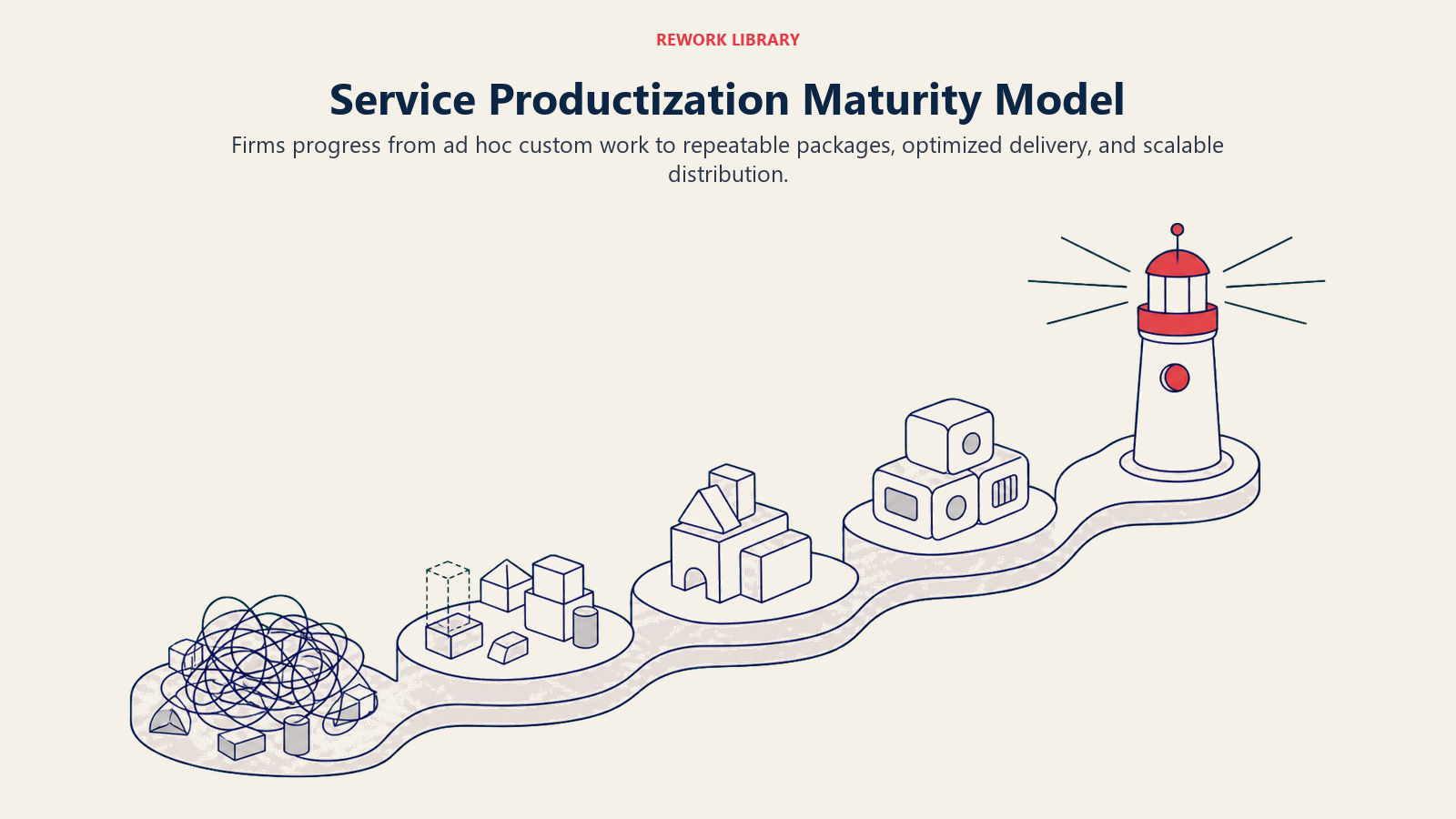
Stage 2: Defined You've identified repeating patterns and created loose frameworks. You have templates and processes, but they're guides rather than requirements. Delivery still varies significantly by consultant and client.
Stage 3: Repeatable You have productized offerings with clear scopes and fixed pricing. Delivery follows standardized processes most of the time. You're tracking metrics and refining the approach. You can train people to deliver consistently.
Stage 4: Scalable Multiple productized services generate predictable revenue and margins. Delivery is so standardized that mid-level consultants can execute with minimal senior oversight. You've built leverage into the model and can scale without proportional headcount growth.
Stage 5: Platform Your productized services have become a platform that others can leverage. You license your methodology to partners, offer white-label versions, or have built technology that accelerates delivery. Your services are assets that create value beyond direct delivery.
Most firms plateau at Stage 3, which is fine. Not every firm needs to reach Stage 5. The key is progressing from Stage 1 to Stage 3, where productization actually improves margins and scalability. Moving to Stage 4 and 5 is about strategic ambition, not operational necessity.
Common Productization Challenges
Productization sounds great in theory but hits real obstacles in practice.
Over-standardization losing competitive advantage: If you standardize so much that your service becomes generic, you've lost differentiation. The balance is standardizing delivery while maintaining the expertise and insight that make you valuable. Your process should be proprietary, not commodity.
Insufficient scoping creating margin bleed: You productize a service, price it fixed, then realize you didn't include something essential. Now you're delivering extra work for free to maintain quality. Prevent this by tracking delivery hours closely on early engagements and adjusting the scope or price when you find gaps.
Team resistance to process constraints: Senior consultants who've built careers on bespoke problem-solving often resist productization. They see it as limiting their creativity or reducing them to assembly-line workers. Address this by involving them in designing the productized approach and showing them how it frees them from repetitive work to focus on higher-value strategy.
Sales adoption and reversion to custom selling: Your sales team defaults to custom proposals because that's what they know. They're uncomfortable saying "here's our package, take it or leave it." Train them on the productized value proposition and give them talking points that position fixed offerings as premium solutions, not limitations.
Market fit issues: You productize something based on what you've done, but it doesn't match what the market actually wants to buy. Test with a small number of clients before fully committing. Be willing to pivot the scope or positioning based on market feedback.
Scaling costs growing faster than revenue: You expected productization to improve margins, but somehow costs are still growing proportionally with revenue. This usually means delivery isn't actually standardized - you're still doing custom work, just calling it productized. Audit your actual delivery hours and processes to find where the inefficiency is hiding.
Your Transition Roadmap: From Custom to Productized
Making the shift requires a phased approach, not a sudden flip. Phase 1: Validation (2-3 months) Identify your productization candidate from current services. Document how you've delivered it in the past - what was consistent, what varied, what worked well. Interview past clients to understand what they valued and what they would've paid for a fixed-scope version. Develop a prototype service design and test the positioning with a small group of prospects or existing clients. Goal: Confirm there's demand for a productized version.
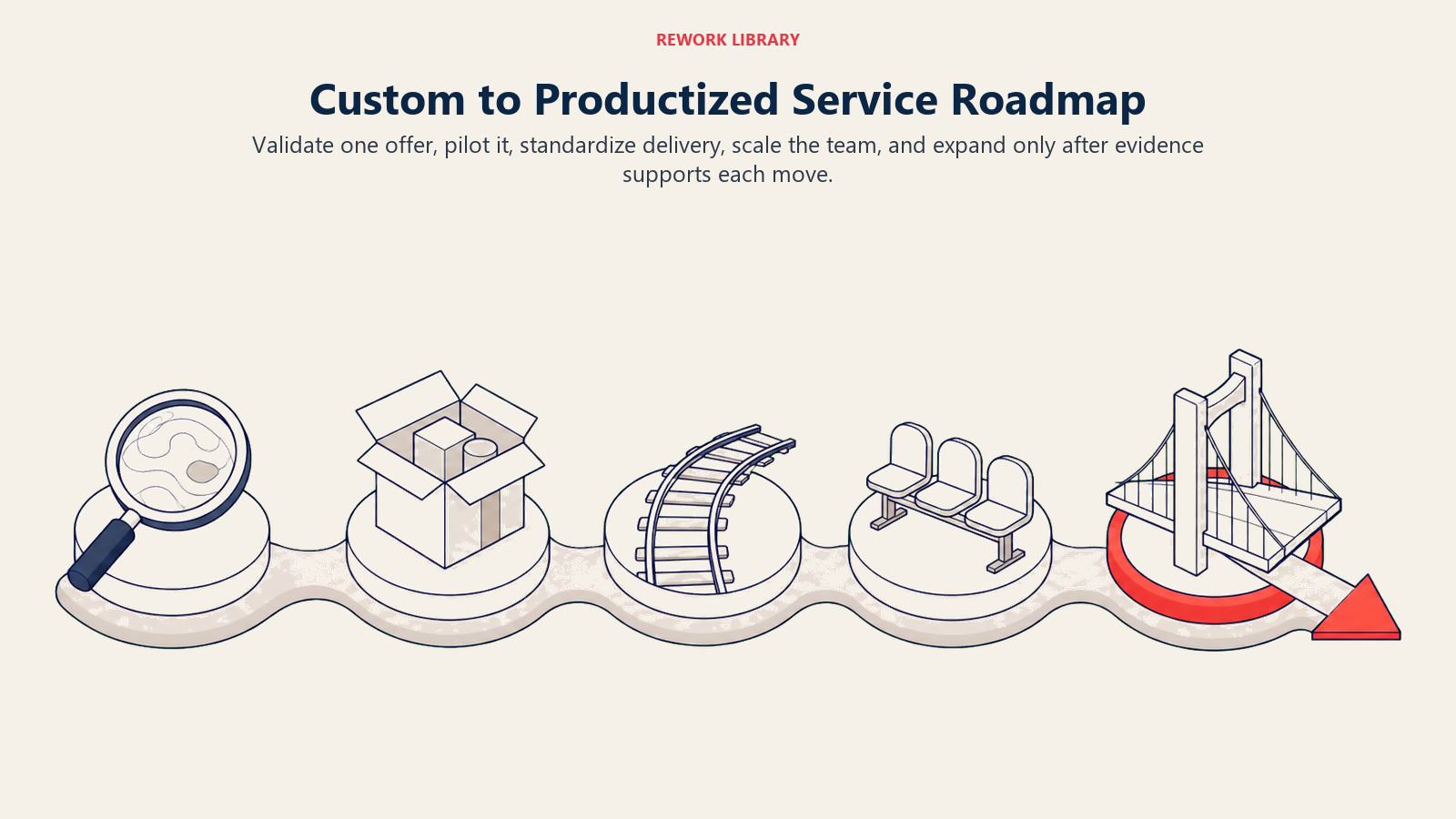
Phase 2: Design (3-4 months) Build out the complete service design - scope, deliverables, timeline, pricing. Create delivery playbooks, templates, and quality standards. Develop marketing materials and sales enablement content. Train a core delivery team on the methodology. Price the service and create tiering or module options if appropriate. Goal: Have a fully documented productized offering ready to sell and deliver.
Phase 3: Pilot (2-3 months) Sell the productized service to 3-5 clients. Deliver it following your standardized process but track everything - actual hours, deviations from the plan, client feedback, margin performance. After each engagement, debrief with the team and update the playbook based on what you learned. Collect testimonials and case studies. Goal: Prove the model works and refine it based on real delivery experience.
Phase 4: Market Launch (ongoing) Roll out the productized service broadly. Train your full sales team, promote it through marketing, add it to your website and proposal templates. Track performance metrics and continue optimizing. As you gain confidence and volume, consider developing additional productized offerings using the same approach. Goal: Scale the productized service and make it a core part of your business model.
Don't try to productize everything at once. Master one service first, prove the approach works, then expand to additional offerings.
Measuring Success: Key Metrics
You need specific metrics to know if productization is working. Gross margin by service: Track margin for productized vs. custom services. You should see 15-25 point improvement in productized margins within the first year. If you're not hitting that, your pricing or delivery efficiency needs adjustment.
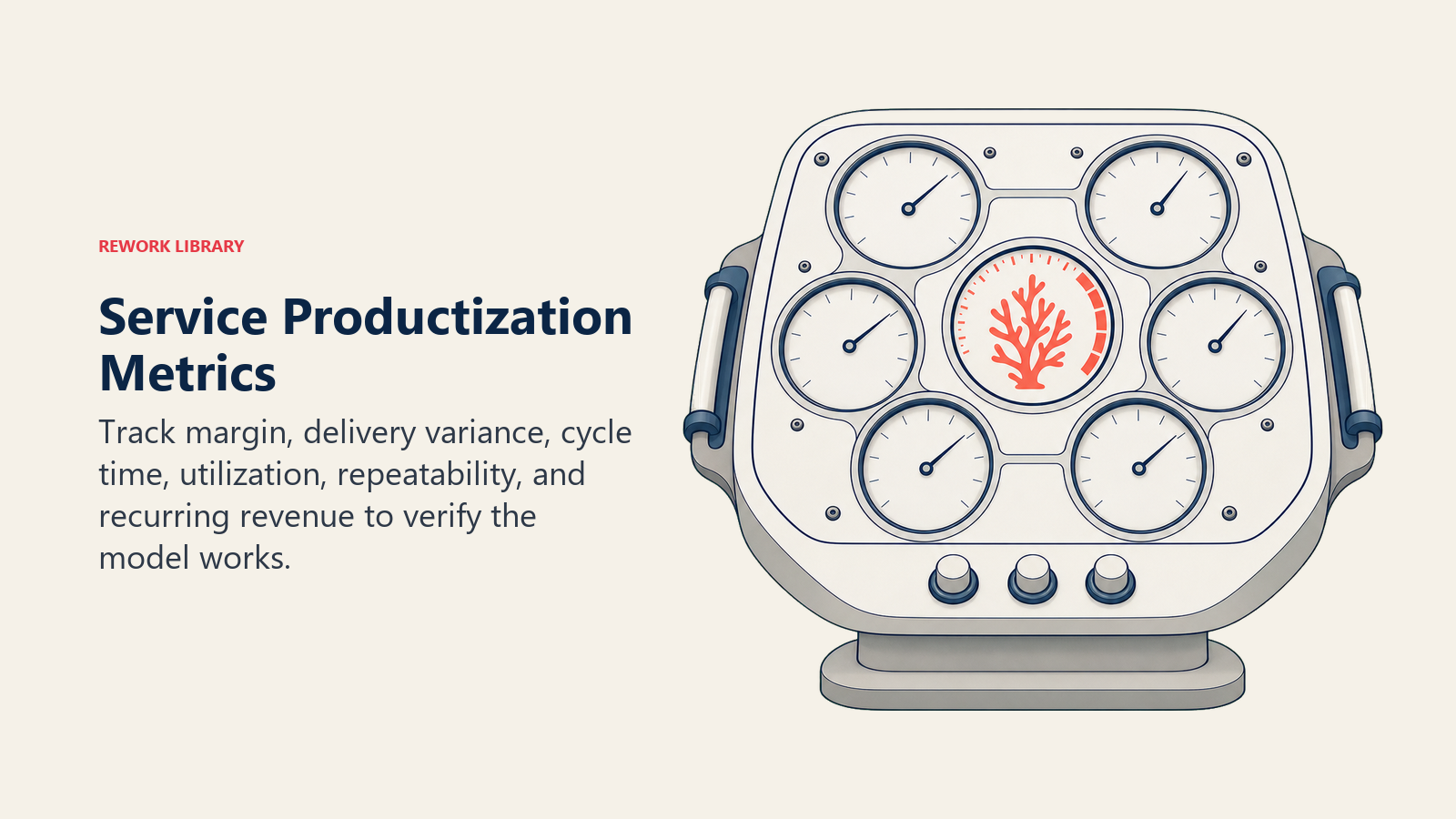
Delivery cost variance: Measure actual delivery hours vs. planned hours. In custom work, +/- 30% variance is normal. Productized services should be within +/- 10% after you've delivered it 5-10 times. Tight variance means your scoping is accurate and delivery is consistent.
Scope creep rate: What percentage of productized engagements require scope changes or customization? Target should be under 20%. If you're above 30%, your productized scope isn't comprehensive enough or your sales team is overselling.
Sales cycle length: Productized services should sell faster than custom work because there's less scoping and proposal development. If your average custom sale takes 45 days, productized should be 20-30 days. Longer cycles suggest your positioning isn't clear or the market doesn't understand the value.
Team utilization and productivity: How many engagements can one consultant manage simultaneously? With custom work, it's usually 1-2. With productized services, senior consultants should oversee 3-5 engagements. This leverage is how you scale without linear headcount growth.
Client satisfaction and Net Promoter Score: Productization shouldn't reduce quality. Track NPS and satisfaction scores for productized vs. custom work. They should be equal or higher because clients appreciate predictability and clear deliverables.
Repeat purchase rate: How many clients who buy one productized service come back for another or expand into custom work? This measures whether productization is creating effective client relationships or feeling too transactional.
Win rate: Your close rate on productized proposals should exceed custom proposals. Fixed pricing and clear deliverables make buying easier. If productized win rates are lower, your pricing might be wrong or the market doesn't see the value.
Review these metrics monthly for the first year, then quarterly once productized services are established. Use the data to continuously refine pricing, scope, and delivery.
Business Model Implications
Productization changes your firm in ways that go beyond individual service delivery. Impact on firm valuation: Professional services firms typically sell for 0.5-1.5x revenue. Firms with significant productized revenue sell for 1.0-2.5x revenue. Why? Predictable margins, repeatable delivery, and reduced dependency on key individuals make the business more valuable. If you're planning an eventual exit, productization is one of the highest-ROI investments you can make.
Recurring revenue potential: Some productized services naturally lead to recurring revenue. If you productize "Annual Compliance Review" or "Quarterly Strategic Planning," you can sell annual contracts with predictable monthly or quarterly delivery. Recurring revenue further improves valuation and cash flow predictability. For more on building recurring revenue models, see Professional Services Metrics.
Financial forecasting and predictability: When you know productized Service A generates $X margin and takes Y hours to deliver, and you have Z in your pipeline, forecasting becomes mathematical instead of guesswork. This lets you plan hiring, invest in growth, and manage cash flow with confidence.
Risk mitigation: Custom services create concentration risk - if you lose a major client, you lose significant custom revenue that's hard to replace quickly. Productized services diversify your revenue across more clients with lower individual impact. If you lose one, your productized pipeline can replace them faster than rebuilding custom relationships.
Partnership and licensing opportunities: Once you've productized a service, you can license it to partners who want to deliver your methodology under their brand. This creates new revenue streams without proportional delivery costs. White-label and reseller models only work if you've truly standardized the offering.
Strategic positioning: Firms known for productized services are seen as more sophisticated and innovative than pure custom consultancies. This attracts better clients, higher-value engagements, and opportunities to participate in larger deals where repeatability and proven approaches matter.
Partnership and Distribution Strategies
As your productized services mature, you can expand distribution beyond your direct delivery team.
Licensing to strategic partners: Other consulting firms, agencies, or service providers might want to deliver your productized methodology to their clients. License your playbooks, templates, and brand for a revenue share or fixed licensing fee. This extends your reach without requiring your delivery capacity.
White-label and reseller models: Larger firms or technology platforms might want to offer your service under their brand. You deliver the service, they own the client relationship and charge their markup. This provides volume but at lower margins. Only works if your delivery is truly standardized so you can execute efficiently.
Strategic partnerships and integrations: Partner with complementary service providers. If you've productized "Financial Due Diligence," partner with M&A advisors who can refer clients. If you've productized "Go-to-Market Strategy," partner with marketing agencies who handle execution. These partnerships create mutual referral streams.
Channel development and support: If you're licensing or partnering, you need channel support - training partners on your methodology, providing them sales and marketing materials, maintaining quality standards. Build this infrastructure before you scale partnerships, or quality will suffer.
Revenue sharing models: Define how revenue splits in partnership arrangements. Common models: 30/70 split where the partner keeps 30% for sales and client management while you keep 70% for delivery. Or fixed licensing fees per engagement regardless of what they charge their client.
Quality control and brand protection: The risk with partnerships is losing control of quality. Build contract terms that let you audit delivery, require certification for people delivering your service, and terminate partners who damage your brand. Your reputation is attached to work you don't directly control, so protect it aggressively.
Partnerships can accelerate growth, but they also add complexity. Start with direct delivery until you've proven and refined the productized service, then selectively add partners as an expansion strategy.
Strategic Considerations
Productization isn't just an operational change - it's a strategic choice that affects your entire firm.
Balance productized services with custom work: You probably shouldn't productize everything. High-value custom work for sophisticated clients can be more profitable than productized services and often leads to strategic relationships. The balance depends on your growth goals, target market, and competitive positioning. Many successful firms run 40-60% productized, 40-60% custom. Understanding your service line strategy helps determine this balance.
Impact on competitive positioning: Productization can be a differentiator - "we've solved this problem 100 times and codified the approach" - or it can be seen as commodification - "they're not customizing to our unique needs." Position productized services as premium solutions with proven results, not as budget alternatives.
Brand and market perception: How does productization fit your brand? If you're positioned as a boutique bespoke consultancy, productization might confuse your market. If you're known for efficiency and results, productization reinforces that positioning. Make sure your productization strategy aligns with your brand promise.
Organizational structure: Productized services might need different organizational structure. Some firms create dedicated productized service teams separate from custom consulting. Others integrate productization into existing practice areas. Consider what structure best supports both delivery models without creating internal conflict.
Culture implications: Productization changes how consultants work. Some thrive on the efficiency and predictability. Others feel constrained and miss the variety of custom work. Be intentional about culture change management. Celebrate productization wins, train people on the approach, and address resistance directly rather than pretending it doesn't exist.
Getting Started With Service Productization
Productization is one of the highest-leverage strategies for professional services growth. It improves margins, enables scaling, and increases firm value without requiring you to completely reinvent your business.
Start small. Pick one service you deliver repeatedly, design a productized version, test it with a handful of clients, and refine based on real experience. Don't try to transform your entire firm overnight.
The firms that succeed with productization are the ones that commit to discipline - clearly defined scopes, standardized delivery, fixed pricing, and continuous improvement. It requires letting go of the "every client is unique" mindset and embracing the idea that repeatability creates value for both you and your clients.
Your clients don't want custom for the sake of custom. They want results, delivered predictably, at a fair price. Productization gives them that while giving you the margins and scalability to build a more valuable firm.
Frequently Asked Questions
What is service productization? Service productization is taking custom services you deliver repeatedly and standardizing them into packaged offerings with a defined scope, fixed or tiered pricing, set deliverables, and a repeatable delivery process. The work still requires human expertise, but the variability that makes custom services hard to scale is removed.
How does productization improve agency margins? Custom services typically run 30-45% gross margins because every project carries unknowns. Productized services reach 50-65% margins because the scope is known, delivery is optimized, and junior staff can execute standardized components while senior people oversee multiple engagements. That leverage is how firms scale without linear headcount growth.
Which services should an agency productize first? Productize services you deliver at least 8-10 times a year, that clients request by name, and where you already have proprietary frameworks or templates. Score candidates on market demand, differentiation, margin potential, and repeatability, then focus on the top 2-3 rather than productizing everything at once.
How should productized services be priced? Price on value, not hours. Anchor against the outcome the client gets and the cost of the custom alternative, set a gross margin target (often 60%), and use fixed or tiered pricing. Tiered pricing works because most buyers pick the middle option, so put your target margin there.
Will productization make my firm look like a commodity? Not if you position it as proven expertise. Frame productized services as premium solutions backed by a method you have run dozens of times, not budget alternatives. Most successful firms run a 40-60% productized, 40-60% custom mix so they keep high-value bespoke work alongside scalable packages.
Related Resources
Expand your understanding of professional services growth and productization strategies:
- Service Line Strategy - Build a portfolio of related services
- Billable Hour vs Value-Based Pricing - Transition from time-based to value pricing
- Professional Services Metrics - Track the metrics that matter for growth
- Utilization & Capacity Planning - Optimize team utilization and capacity

Sales Director
On this page
- What Service Productization Actually Means
- The Economics That Make Productization Worth It
- Identifying Which Services to Productize
- Service Productization Frameworks
- Designing Your Productized Service
- Packaging and Positioning Strategy
- Pricing Productized Services for Profit
- Standardizing Your Delivery Process
- Building Your Internal Capability
- Managing Customization Requests
- The Productization Maturity Model
- Common Productization Challenges
- Your Transition Roadmap: From Custom to Productized
- Measuring Success: Key Metrics
- Business Model Implications
- Partnership and Distribution Strategies
- Strategic Considerations
- Getting Started With Service Productization
- Frequently Asked Questions
- Related Resources