Client Renewal Process: Strategic Contract Renewals and Engagement Extensions
 Here's what keeps professional services partners up at night: a major client's contract expires in 30 days, nobody's talked pricing or scope, and the procurement team just sent over a price reduction request. Sound familiar?
Turn this article into takeaways for your work.


Each assistant summarizes the article only for you and suggests best practices for your work.
Most firms treat renewals like they're inevitable until suddenly they're not. You assume the relationship is solid because the work's going well, then get blindsided by budget cuts, scope reductions, or worse, a competitor who's been quietly positioning for months.
Renewals aren't just important, they're the foundation of sustainable growth. For mature professional services firms, renewals represent 60-75% of annual revenue. Understanding these dynamics is essential to the professional services growth model. The difference between a 90% renewal rate and 75% is millions in lost revenue and the constant pressure to backfill with new client acquisition.
This guide shows you how to manage renewals strategically, starting 12-18 months before expiration, not 30 days. We'll cover the systems, conversations, and value documentation that turn renewals from nail-biters into predictable revenue.
Understanding renewals in professional services
Before we get tactical, let's clear up some terminology because "renewal" means different things to different firms. Contract renewal: The extension of an existing agreement, typically maintaining similar scope and terms. Your annual retainer with a client expires December 31st and you negotiate a new agreement starting January 1st.
Engagement extension: Continuing work beyond the original timeline, often with adjusted scope. A 6-month implementation project extends for another 3 months to complete additional deliverables.
Renegotiation: Substantial changes to terms, pricing, or scope that go beyond simple extension. This might involve moving from hourly billing to value-based pricing, or expanding from advisory to implementation services.
The types of renewable engagements vary by service line:
- Ongoing retainers: Monthly or quarterly retainers for advisory, fractional executive services, or continuous support
- Multi-year contracts: Annual renewals within longer-term framework agreements common in consulting and technology services
- Project-based renewals: Sequential engagements where one project leads to the next
- Subscription services: Fixed-fee recurring services like managed services, compliance support, or ongoing creative work
Each type has different renewal dynamics, but the core principle is the same: the best time to start planning a renewal is the day after you close the initial engagement.
Why renewal management matters more than you think
Let's talk economics. Acquiring a new client costs 5-7x more than renewing an existing one. You've already absorbed the business development costs, the risk assessment, the relationship building. A renewal is pure margin improvement. But it's not just about cost savings. Renewals create predictable revenue that lets you plan capacity, invest in talent development, and say no to marginal new business. When 70% of next year's revenue is already locked in through renewals, you can be selective about what new work you take on.
There's also a direct correlation between renewal rates and profitability. High-performing firms (85%+ renewal rate) average 25% higher profitability than firms with renewal rates below 70%. Why? Because they're not constantly churning through expensive new client acquisition to replace lost revenue.
And here's what most firms miss: strategic renewals unlock expansion opportunities. When you're renewing at the right time with the right preparation, you're not just maintaining current scope, you're identifying new problems you can solve and services you can cross-sell. The best renewals include 15-30% revenue expansion.
Building your renewal calendar and tracking system
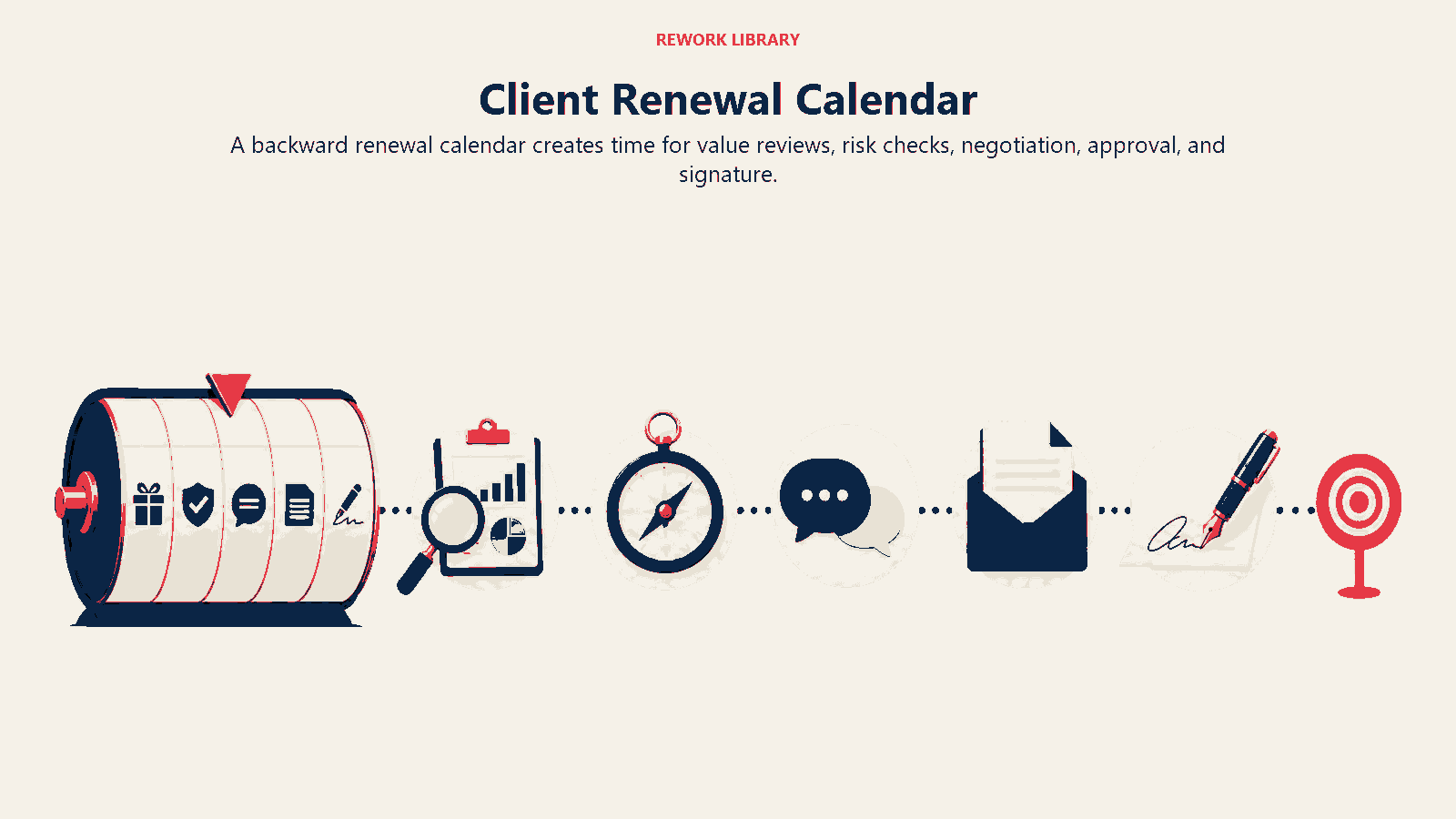
You can't manage what you don't track. The first step is creating visibility into your renewal universe 12-24 months out. Start with a simple spreadsheet or CRM view that lists every renewable engagement with these key fields:
- Client name and primary relationship owner
- Service type and current annual contract value (ACV)
- Contract start and end dates
- Renewal probability (green/yellow/red status)
- Last renewal discussion date
- Next action and owner
- Notes on renewal risks or opportunities
This gives you forward visibility. Every month, you should review:
- Contracts expiring in the next 6-12 months (renewal planning mode)
- Contracts expiring in 3-6 months (active renewal discussions)
- Contracts expiring in 0-3 months (closure mode)
The mistake most firms make? They only track renewals in the final 90 days. By then, you're in reactive mode. The client's already having internal budget discussions without your input, or a competitor's been positioning for months.
The tracking system should integrate with your other business systems. Your project management tool should flag upcoming contract end dates. Your invoicing system should alert you when a client is approaching their contract spend limit. Your CRM should prompt relationship owners to schedule renewal check-ins.
Renewal process timeline template:
| Timeframe | Activity | Owner |
|---|---|---|
| 12-18 months out | Initial renewal planning; identify potential risks | Relationship Manager |
| 9-12 months out | Value documentation begins; quarterly business reviews scheduled | Delivery Lead |
| 6-9 months out | Renewal conversation initiated; gather renewal intelligence | Relationship Manager |
| 4-6 months out | Formal renewal proposal developed | Proposal Team |
| 2-4 months out | Active negotiations; address objections | Partner/Relationship Manager |
| 0-2 months out | Finalize terms; execute new agreement | Partner/Legal |
| Post-renewal | Kick off renewed engagement; quick wins identified | Delivery Team |
Documenting and demonstrating value continuously
Here's the hard truth: if you wait until renewal time to articulate your value, you've already lost. Value reinforcement should happen throughout the engagement, not as a last-minute sales pitch. Start documenting delivered value from day one. Create a running value log that captures:
Quantifiable outcomes: Cost savings, revenue increases, efficiency gains, risk mitigation. "Our process redesign reduced their order-to-cash cycle from 45 days to 28 days, improving cash flow by $2.3M annually."
Strategic impact: Market positioning, competitive advantages, capabilities built. "The new go-to-market strategy opened three new verticals and generated $8M in pipeline within six months."
Problem resolution: Issues prevented or solved. "Our audit identified compliance gaps that would have resulted in $500K in penalties under new regulations."
Organizational transformation: Skills transferred, culture shifts, structural improvements. "Trained 45 managers on the new framework; 89% report higher team productivity."
The best firms assign someone specifically to capture these throughout the engagement. After every major milestone or deliverable, document the outcome and impact. This becomes your renewal ammunition.
But don't just collect data, create compelling narratives. Numbers matter, but stories stick. Your renewal pitch shouldn't be a spreadsheet of outputs ("we delivered 47 reports"). It should be a narrative of transformation ("when we started, your sales team was missing 40% of quota and didn't know why; now they're exceeding targets with a repeatable forecasting process").
Value documentation worksheet structure:
- Challenge/Initial State: What problem were we hired to solve? What was the cost of the problem?
- Our Approach: What did we do differently? What was our unique methodology or insight?
- Delivered Outcomes: Specific, measurable results (quantified wherever possible)
- Client Testimonial: Direct quote from stakeholder about impact
- Next Chapter: What opportunities does this unlock? What's the natural next step?
Build these narratives quarterly during the engagement, not when the renewal conversation starts.
Assessing renewal readiness and risk
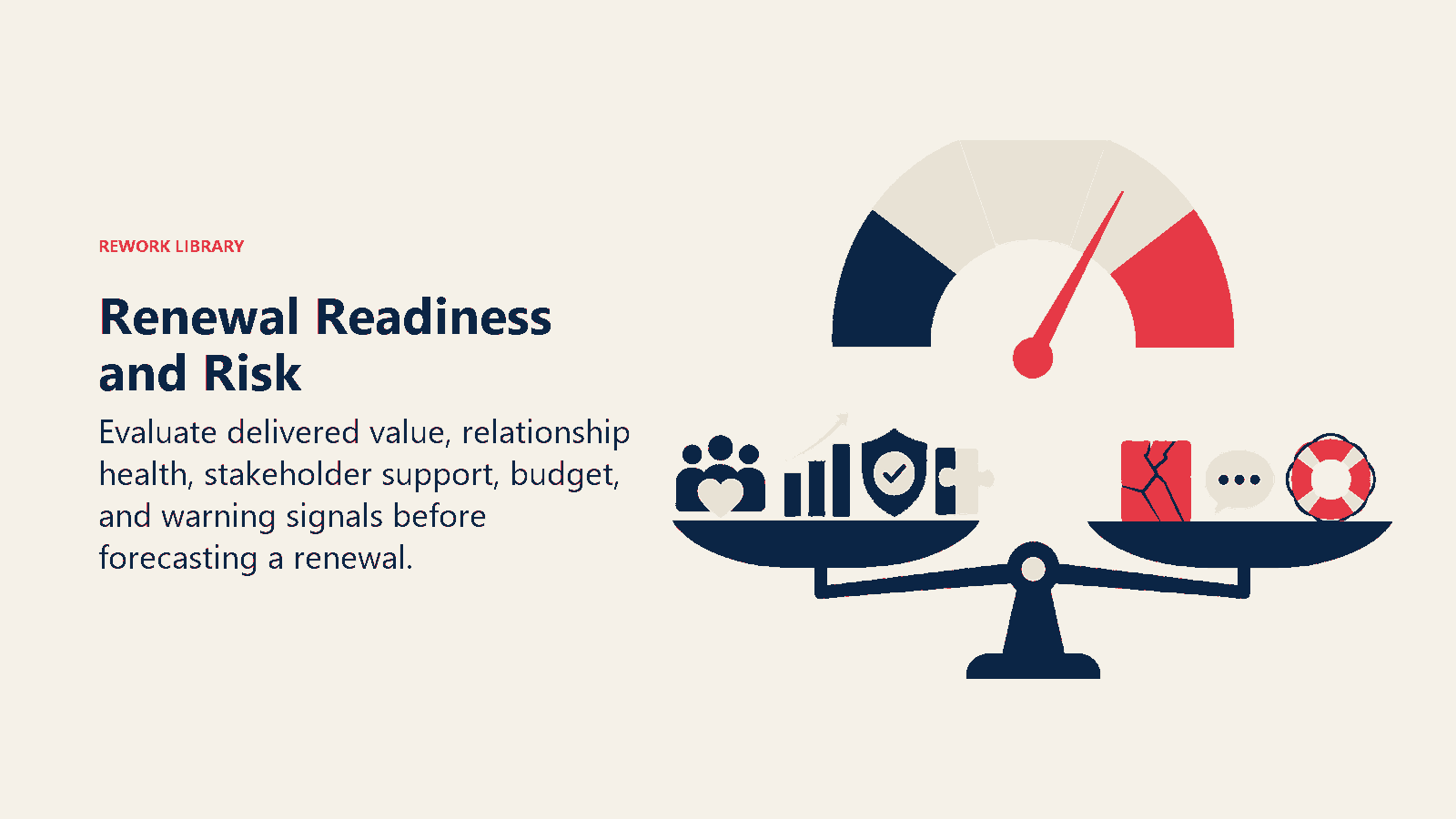
Not all renewals are created equal. Some clients are locks; others require serious work. You need to identify renewal risk early so you can address issues before they become deal-breakers. Run a renewal readiness assessment 9-12 months before expiration. Use a scoring framework across four dimensions:
Relationship Health (0-25 points):
- Executive sponsor satisfaction and engagement
- Working-level relationship strength
- Responsiveness and collaboration quality
- Renewal discussions welcomed or avoided
- Your access to key stakeholders
Satisfaction & Value Perception (0-25 points):
- Recent QBR scores or client feedback
- Unsolicited positive feedback or testimonials
- Complaints or issues raised
- Client's articulation of value received
- Willingness to provide referrals or references
Organizational & Stakeholder Risk (0-25 points):
- Stability of leadership team
- Budget authority changes
- Org restructuring or strategic shifts
- Champion turnover or role changes
- Internal priorities alignment with your services
Competitive & Market Risk (0-25 points):
- Known competitor activity or RFPs
- Market conditions affecting client's business
- Pricing pressure or budget constraints
- Alternative solutions being evaluated
- Industry trends affecting service relevance
Score each dimension, then categorize:
- 75-100 points: Green, high confidence renewal
- 50-74 points: Yellow, moderate risk, proactive management needed
- 0-49 points: Red, significant risk, immediate intervention required
For yellow and red accounts, create a specific risk mitigation plan. If you've identified executive sponsor turnover as a risk, your plan might include expanding relationships to other executives and documenting value more frequently.
The key insight: most renewal losses aren't sudden. They're the result of small issues that compound over time. Catching a yellow account at 9 months gives you time to fix relationship gaps, address service issues, or reposition your value. Discovering a red account at 30 days leaves you negotiating from weakness.
Initiating renewal conversations early
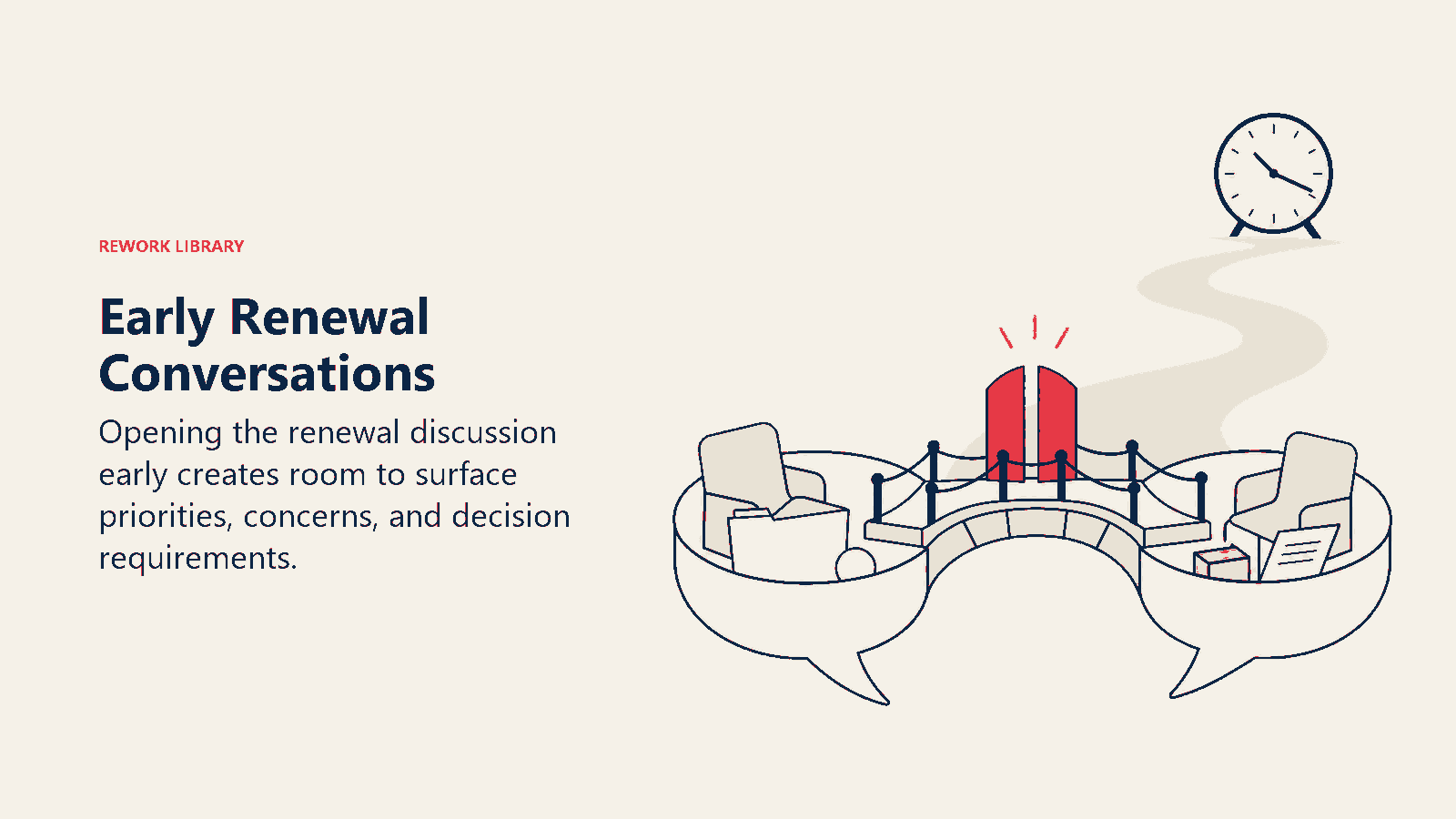
The biggest mistake in renewal management? Waiting for the client to bring it up. By the time they do, they've already had internal discussions, set budget expectations, and maybe talked to competitors. You should initiate the renewal conversation 6-9 months before contract expiration. Not a formal negotiation, an exploratory dialogue about what's working, what could be better, and what the next chapter looks like.
The opening conversation framework:
"Sarah, I wanted to touch base about our engagement. We're about seven months from our current contract end date, and I want to make sure we're planning thoughtfully for continuation rather than scrambling at the last minute. Before we get into any formal renewal discussions, I'd love to get your perspective on a few things..."
Then ask questions designed to gather renewal intelligence:
- "How are you thinking about our engagement going forward? What would success look like for the next phase?"
- "What's been most valuable about our work together? What could we be doing better?"
- "How does this engagement fit into your broader strategic priorities for next year?"
- "What budget considerations should I be aware of as we think about next year?"
- "Who else should be involved in the renewal conversation? What's your internal approval process?"
- "Are you evaluating any alternative approaches or considering bringing any of this work in-house?"
Listen more than you pitch. Your goal is to understand:
- What they value most (so you can emphasize it)
- What concerns exist (so you can address them)
- What the decision process looks like (so you can navigate it)
- What opportunities exist for expansion (so you can propose them)
One conversation isn't enough. Plan for 3-4 touchpoints between initial discussion and formal proposal:
- Initial exploration (6-9 months out)
- Value review and options discussion (4-6 months out)
- Formal proposal presentation (3-4 months out)
- Negotiation and finalization (1-3 months out)
This cadence keeps you top of mind, demonstrates proactive partnership, and gives you multiple opportunities to adjust your approach based on what you're learning.
Renewal pricing strategy and economics
Pricing renewals is tricky. You want to increase price to reflect value and market rates, but you don't want to give clients sticker shock that prompts them to go to market. Start with a pricing philosophy. Most professional services firms follow one of these approaches:
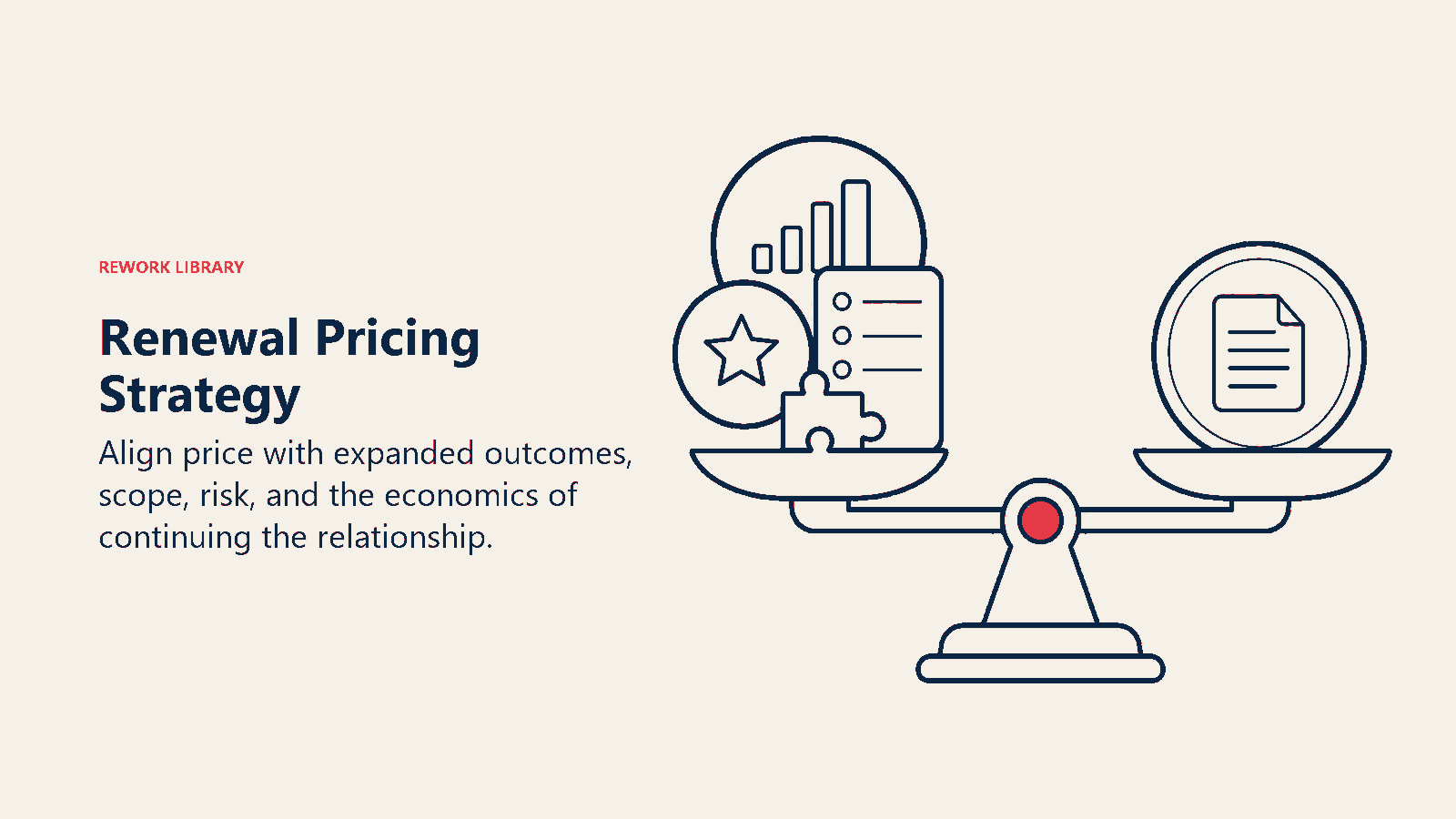
Annual escalation model: Built-in 3-5% annual increases tied to inflation, market rates, or scope expansion. This should be in your original contract as an expectation-setter.
Value-based adjustment: Price increases tied to demonstrated value and outcomes. If you've delivered $5M in measurable impact, asking for a 15% fee increase to $650K is easier to justify.
Scope-based pricing: Keep base fees stable but price new services, expanded scope, or additional team members at current market rates.
Benchmark alignment: Show that your current pricing is below market rates for similar services, then propose adjustment toward market.
Whatever approach you use, lead with value justification, not just "costs have gone up." Your renewal proposal should remind them what they're getting:
"Over the past year, our team delivered $4.2M in measurable cost savings through process optimization, helped you enter two new markets that generated $12M in revenue, and built internal capabilities that reduced your reliance on external consultants by 40%. We're proposing to continue this partnership at $625K annually, a 12% increase that reflects the expanded scope and market value of these services."
Alternative pricing models for renewals:
If budget constraints are an issue, don't just drop your price. Restructure the engagement:
- Tiered service levels: Offer "core" and "premium" options with different service levels and pricing
- Hybrid staffing: Mix senior consultants with junior associates to manage costs while maintaining quality
- Risk-sharing models: Performance-based fees or success bonuses that align your compensation with outcomes
- Multi-year commitments: Offer pricing stability in exchange for 2-3 year commitments
- Phased approach: Start with critical services now, add additional services as budget becomes available
The goal isn't to win every renewal at any price. Sometimes a client's budget reality doesn't match the value of your services, and that's okay. What you want to avoid is leaving money on the table with clients who'd happily pay more for the value they're receiving.
Managing renewal discussions and negotiations
Renewal negotiations are different from new business negotiations. You have history, relationship, and demonstrated value, use them.
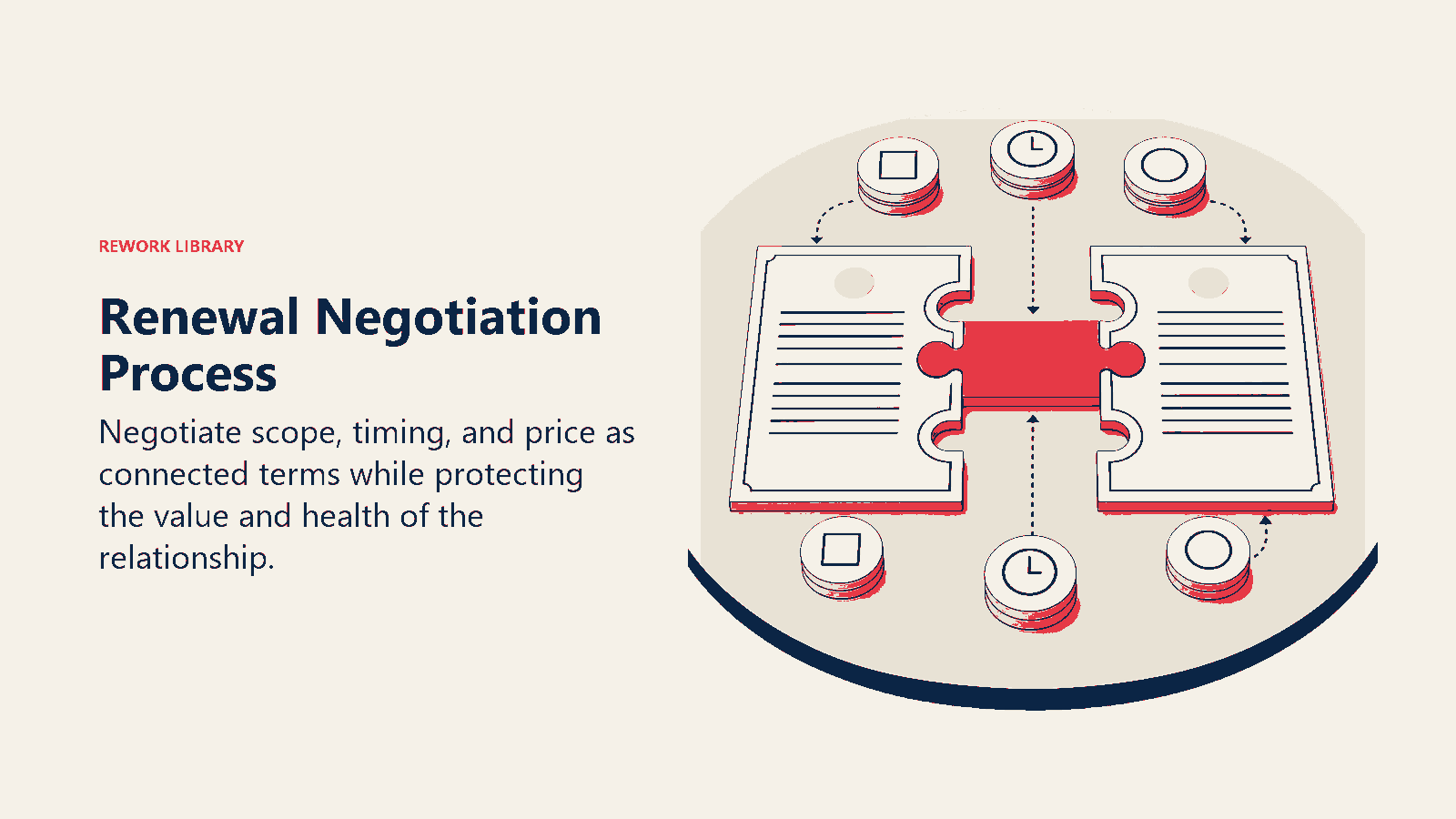
The renewal discussion structure:
Anchor on delivered value: Start by reviewing what you've accomplished together, not by presenting your proposal. Walk through the value documentation you've built.
Present future vision: Before you talk price, paint a picture of what the next phase could accomplish. What new opportunities exist? What problems could you solve?
Introduce the proposal: Position pricing in the context of future value and past results, not as a standalone number.
Address objections directly: Don't dodge pricing concerns or scope questions. Lean into them with data and options.
Common renewal objections and responses:
"Your price is higher than last year": "That's true, we're proposing a 12% increase to $625K. This reflects the expanded scope we discussed, including the new strategic advisory services, and brings us in line with market rates. More importantly, it's still a fraction of the $4M+ in value we documented this year. What specific concerns do you have about the increase?"
"Budget is tight next year": "I understand budget constraints are real. Let's talk about what's most critical to continue and what could be phased differently. Would it make sense to look at a tiered approach where we focus on the core services at $500K, with the option to add strategic initiatives as budget becomes available mid-year?"
"We're thinking about bringing this work in-house": "That's a strategic decision you should make based on what's best for your organization. Let's talk through what that would require, the team, the capabilities, the timeline, so you can make an informed comparison. And if you do decide to go that direction, we can design a transition plan that sets your internal team up for success."
"We need to go to market to compare options": "I respect that you need to validate value and ensure you're getting the best solution. We're confident in the value we deliver, and we're happy to participate in a competitive process. To help you evaluate fairly, what specific criteria matter most? And would it be useful for us to share what differentiates our approach so you can assess whether other firms offer similar capabilities?"
The key to negotiation is options, not just price defense. If they push back on price, offer scope adjustments, staffing changes, or timeline modifications. Give them ways to say yes that work within their constraints.
But know your walk-away point. Not every client is worth keeping at any price. If a renewal would require pricing so low that it's unprofitable or would set bad precedent with other clients, it's okay to lose it.
Closing the renewal and contract execution
You've had the discussions, negotiated terms, and reached verbal agreement. Now you need to actually get it signed, and this is where deals often stall.
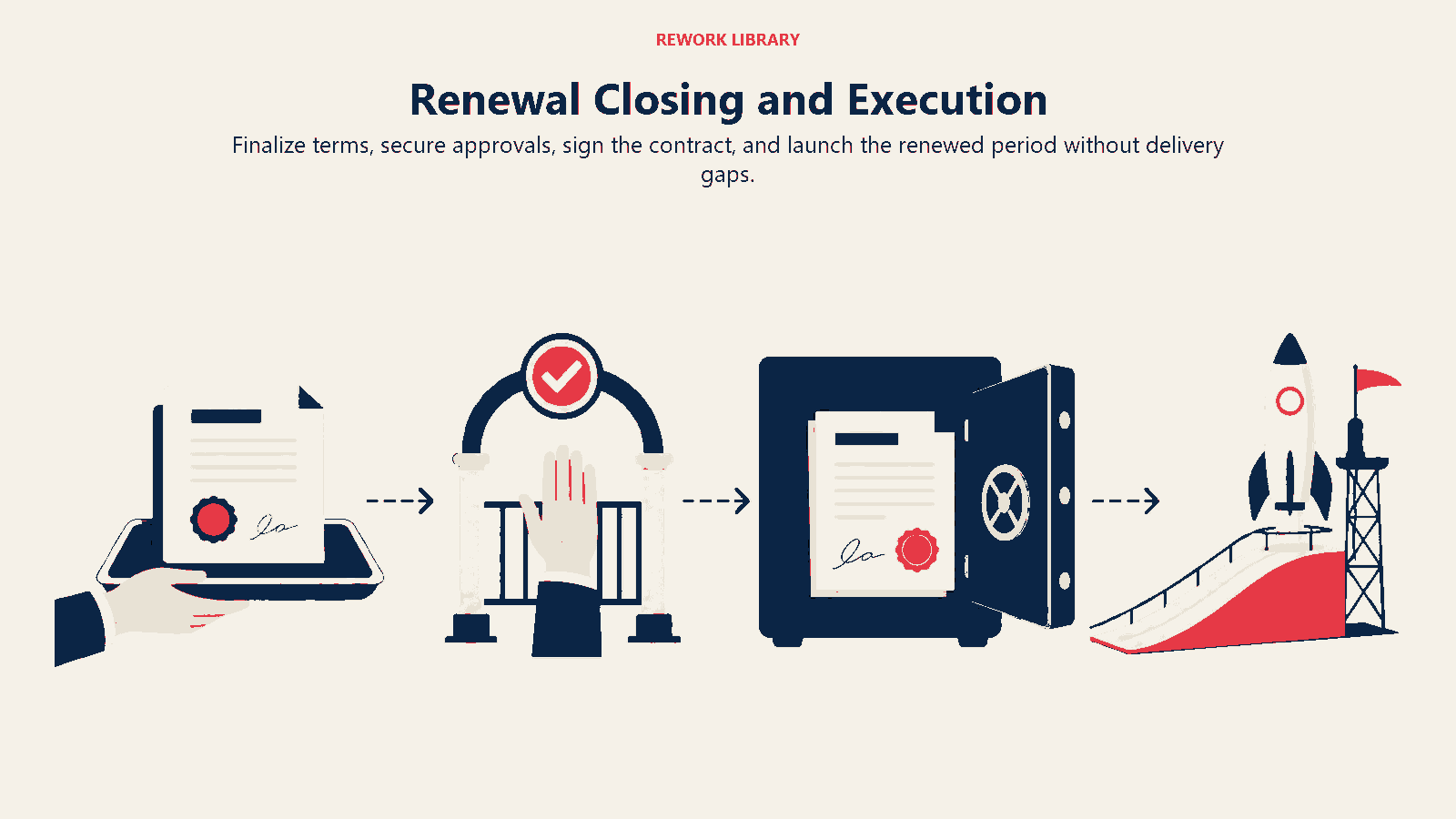
Legal and procurement processes: Assume this will take longer than you want. Large organizations have procurement cycles, legal reviews, and approval chains. Build this time into your renewal timeline.
Get ahead of it by asking early: "What's your internal process for finalizing the renewal? What approvals are needed, and what's the typical timeline?" Then work backwards from contract expiration to ensure you're not scrambling.
If you're dealing with procurement, understand their goals. They're measured on cost savings and favorable terms, not relationship continuity. Come prepared with benchmarking data, value justification, and clear scope definitions. Make it easy for them to justify the renewal internally.
Executive alignment: Even if you've been working with middle management, renewals often require executive sign-off. Don't wait until the last minute to engage executives. Include them in key milestones, value reviews, renewal proposals, major scope discussions.
When executives do get involved, they often ask different questions: "How does this fit our strategic priorities? What's the benchmark for these fees? What would we lose if we didn't renew?" Be ready with executive-level answers, not operational details.
Celebrate and communicate: When you close a renewal, especially a large one, celebrate it. Thank the team, acknowledge client partners, and communicate the win internally. This reinforces that renewals matter and recognizes the effort that went into securing them.
Plan the account transition: The work doesn't stop when the contract is signed. Plan the transition into the renewed engagement:
- Kick-off meeting to align on updated scope and expectations
- Introduction of any new team members
- Updated project plans and deliverable schedules
- Quick wins identified for the first 90 days
The renewal should feel like a new beginning, not just paperwork.
Delivering on promises and building momentum
The worst thing you can do after a renewal? Coast. The client just committed to another year (or more) with you. Now prove they made the right decision.
First 90 days focus: Plan specific deliverables and wins for the first quarter of the renewed engagement. This could be:
- Launch of a new initiative discussed during renewal
- Quick-hit improvements that generate immediate value
- Deeper strategic work that builds on prior success
The goal is momentum. You want the client thinking "this was absolutely the right decision" within 90 days, not questioning whether they should have gone with a competitor.
Validate the renewal decision: Schedule a 30-60 day check-in after renewal to ensure alignment. "We've been back into the engagement for six weeks now. I wanted to touch base on how things are tracking against your expectations and address anything that needs adjustment."
This shows you're accountable to the commitments you made during renewal and gives you early warning if expectations aren't aligned.
Plan for the next renewal: Yes, you just closed one renewal. Start planning for the next one. Update your renewal calendar, document early wins, and maintain the value tracking discipline you built. The next renewal starts now.
Tracking renewal metrics that matter
You can't improve what you don't measure. Track these renewal metrics to understand performance and identify improvement opportunities: Renewal rate: Percentage of contracts up for renewal that actually renew. Healthy professional services firms run 80-90%+ renewal rates. Below 75% indicates systemic issues with service delivery, relationship management, or client selection.
Calculate both by client count and by revenue. You might have a 90% renewal rate by count but only 70% by revenue if you're losing your largest clients.
Renewal timing: How far in advance are you closing renewals? If most renewals happen in the final 30 days before expiration, you're operating reactively. Target average of 60-90 days before expiration.
Revenue retention: Total renewed revenue as percentage of expiring contract value. This accounts for downgrades, upsells, and scope changes. 100%+ retention means you're growing accounts at renewal; below 90% means you're losing ground.
Expansion rate: Percentage of renewals that include increased scope or fees. Top-performing firms expand 30-50% of renewals. This is where the real revenue growth happens.
Churn analysis: For renewals you lose, track why. Budget constraints? Competitive losses? Dissatisfaction? Relationship changes? Understanding loss patterns helps you address root causes.
At-risk identification accuracy: How good are you at predicting which renewals are at risk? Compare your 6-month-out risk assessments to actual renewal outcomes. If you're marking accounts "green" that end up churning, your risk assessment process needs work.
Renewal velocity: Average time from first renewal discussion to signed contract. Long cycles might indicate complex decision processes, pricing misalignment, or insufficient urgency.
Review these metrics monthly or quarterly, depending on your renewal volume. Use them to identify trends, spot problems early, and recognize what's working.
Common renewal challenges and how to address them
Even with great processes, renewals hit snags. Here's how to handle the most common challenges: Renewal delays and slippage: Client keeps pushing meetings, procurement is slow, or internal approvals are stuck. Your contract expires before renewal is finalized.
Solution: Build in contract extension language from the start. Your original agreement should include terms for automatic extension at current rates if renewal negotiations are ongoing. This protects both parties and reduces pressure to rush a bad deal.
Price resistance: Client loves your work but balks at pricing, especially increases.
Solution: Decouple value from price. Show what they'd lose if the engagement ended, what it would cost to rebuild that capability internally or with another firm, and what the opportunity cost is of delays. Also, offer alternatives, different scope, staffing, or timeline, rather than just defending price.
Scope creep eroding value: Over the course of the engagement, scope expanded without corresponding fee increases. Now renewal pricing looks like a big jump.
Solution: Prevent this with disciplined scope creep management during the engagement. But if you're here, acknowledge it: "Over the past year, our scope expanded to include X, Y, and Z. Our renewal pricing reflects this expanded scope at market rates. If we want to reduce fees, we should also clarify which elements of scope to remove."
Competitive renewal situations: Client is using renewal as an opportunity to test the market or leverage competitors for better pricing.
Solution: Don't panic. You have incumbent advantage, relationship, context, and demonstrated results. Lean into differentiation, not just price defense. What can you do that competitors can't? What context would a new firm lack? What's the risk and transition cost of switching? Make them do the math on total cost of change, not just fee comparison.
Leadership changes: Your champion left, the new executive wants to "review all vendors," or strategic priorities shifted with new leadership.
Solution: This is why you build relationships across multiple levels, not just with one champion. When leadership changes, move quickly to establish relationships with new stakeholders. Offer to brief them on what you've been doing, where value has been created, and how your work aligns with their priorities (which you should research before the meeting).
Budget constraints: Real organizational budget cuts that affect all external spend.
Solution: Explore alternatives beyond price cuts, phased approaches, multi-year deals with current pricing locked in, success-based fees, or scope reductions that preserve core value. If budget constraints are temporary, propose a bridge period at reduced scope with expansion planned when budget frees up.
The common thread: most renewal challenges are solvable if you catch them early and have options to offer.
Building organizational renewal capability
Individual renewals are important, but institutional renewal capability is what separates good firms from great ones.
Process standardization: Document your renewal process so it's not dependent on individual relationship managers' judgment. Create templates, playbooks, and checklists that ensure consistency.
This includes:
- Standard renewal timeline and touchpoint schedule
- Value documentation templates for each service line
- Renewal proposal templates
- Negotiation playbooks with common objections and responses
- Risk assessment frameworks
Training and enablement: Teach your team how to manage renewals strategically. This includes:
- Value articulation and storytelling training
- Negotiation skills specific to renewals
- Risk identification and mitigation
- Pricing and packaging options for renewals
Many professional services professionals are great at delivery but uncomfortable with commercial discussions. Give them the tools and training to succeed. Approaches from consultative business development can help frame renewals as collaborative conversations rather than sales pitches.
Tools and infrastructure: Invest in systems that make renewal management easier:
- CRM workflows that track renewal stages and prompt actions
- Automated alerts for upcoming renewal milestones
- Value tracking dashboards that compile engagement outcomes
- Reporting that gives leadership visibility into renewal pipeline
You don't need expensive software, but you do need systems that prevent renewals from falling through cracks.
Continuous improvement: Treat renewals as a discipline you're constantly refining. After every renewal (won or lost), conduct a brief retrospective:
- What went well? What can we replicate?
- What could we have done better?
- What did we learn about this client or market segment?
- How can we improve our process?
Share lessons learned across the firm. The insights from one tricky negotiation can help colleagues navigate similar situations.
Leadership accountability: Make renewal performance a key metric for relationship managers and partners. If your comp plan only rewards new client acquisition, don't be surprised when renewals get neglected.
Balance your incentives between new business and renewals. Some firms allocate 60-70% of variable comp weight to renewals and retention, recognizing their economic importance.
Industry-specific renewal strategies
While core principles apply across professional services, different industries have unique renewal dynamics:
Management consulting: Often project-based with natural expansion opportunities. Focus on positioning the "next chapter" during current engagement. Use project closeouts to plant seeds for follow-on work. Common renewal path: diagnostic → strategy → implementation → optimization.
Technology services: Multi-year contracts with annual renewals are common. Build in technology roadmaps that extend beyond current contract term. Use architectural decisions to create natural lock-in (done ethically, through value creation, not artificial dependencies). Emphasize total cost of ownership and switching costs.
Legal services: Retainer relationships or panel positions often renew annually. Focus on demonstrating efficiency gains, risk mitigation, and strategic value beyond just legal execution. Track matters handled, outcomes achieved, and relationship breadth across firm. Emphasize continuity value and matter-specific knowledge.
Accounting firms: Strong seasonality with tax and audit. Renewal discussions often happen during or right after busy season when relationships are strained. Schedule renewal planning in slower periods. For tax clients, focus on year-round value-add services beyond compliance. For audit, emphasize continuity and institutional knowledge of client's business.
Marketing agencies: Fight commoditization by documenting campaign performance obsessively. Build attribution models that connect your work to client revenue. Move conversations from "what did we do" (outputs) to "what results did you get" (outcomes). Common challenge: scope expansion without fee increases. Address this with quarterly scope reviews and clear change order processes.
Each industry has its own renewal rhythm, competitive dynamics, and client expectations. Adapt the core framework to your specific context.
Where to go from here
Renewal management isn't a standalone activity, it's the culmination of everything you do throughout the client relationship.
To build a strong renewal practice, strengthen these foundational capabilities:
- Client Satisfaction Management - Regular feedback loops that identify issues before they become renewal risks
- Client Success Reviews - Structured value documentation and stakeholder alignment
- Cross-Sell Strategy - Expansion opportunities that increase renewal value
- Contract & Engagement Letters - Original agreements that set up renewals for success
- Pricing Justification - Value articulation skills that support renewal pricing
- Professional Services Metrics - Track renewal rates and revenue retention alongside other KPIs
Start by building visibility into your renewal pipeline 12-24 months out. You can't manage what you can't see. Then focus on the accounts expiring in the next 6-9 months, initiate conversations, document value, and assess risk.
Remember: renewals aren't about convincing clients to stay. They're about making the decision to continue working together so obvious that it's not really a decision at all. That only happens when you're delivering exceptional value and communicating it consistently throughout the engagement.
The firms that master renewal management don't just retain clients, they grow them. That's the foundation of sustainable professional services growth.

Sales Director
On this page
- Understanding renewals in professional services
- Why renewal management matters more than you think
- Building your renewal calendar and tracking system
- Documenting and demonstrating value continuously
- Assessing renewal readiness and risk
- Initiating renewal conversations early
- Renewal pricing strategy and economics
- Managing renewal discussions and negotiations
- Closing the renewal and contract execution
- Delivering on promises and building momentum
- Tracking renewal metrics that matter
- Common renewal challenges and how to address them
- Building organizational renewal capability
- Industry-specific renewal strategies
- Where to go from here