Project Scope Assessment: Evaluating Fit, Complexity, and Feasibility
Turn this article into takeaways for your work.


Each assistant summarizes the article only for you and suggests best practices for your work.
Here's a stat that should make you nervous: 47% of project failures stem from inadequate scope definition. Not poor execution, not technical problems, not client issues. The failure starts before you even sign the contract, when you agree to a project you don't fully understand.
Professional services firms face a tough choice with every potential engagement. Say yes, and you might be committing to a nightmare project that bleeds resources and damages your reputation. Say no, and you might be walking away from a perfectly good opportunity. The difference comes down to how well you assess scope before making that decision.
This isn't about being pessimistic or avoiding tough projects. It's about knowing what you're getting into. When you accurately assess project requirements, evaluate complexity, and determine if it's a good fit for your capabilities, you make smarter decisions about where to invest your energy.
Why scope assessment determines success before you start
Most firms treat scope assessment as a sales activity. "Tell me about your project so I can write a proposal." But that's backwards. Scope assessment is a qualification tool first, sales activity second. Think about what happens when you skip thorough assessment. You discover the client has legacy systems you've never worked with. Or the timeline is impossible but they won't budge. Or there are twelve stakeholders who all need sign-off and half of them hate each other. By the time you learn this, you've already invested hours in proposals and presentations.
Good scope assessment answers three questions before you commit resources:
Can we actually do this? - Do you have the expertise, capacity, and capabilities to deliver what they need?
Should we do this? - Does it align with your strategic direction, ideal client profile, and service line strategy?
Will this be profitable? - Can you deliver quality results within the client's budget and timeline constraints while maintaining healthy margins?
If the answer to any of these is "no" or "we're not sure," you need to dig deeper or walk away. Saying no to the wrong projects is just as valuable as saying yes to the right ones.
Initial scope discovery: asking the right questions early
You can't assess what you don't understand. Before you can evaluate complexity or feasibility, you need to know what the client actually wants to accomplish. Start with project objectives and desired outcomes. Not what they want you to do, but what they want to achieve. "Implement a new CRM" is a task. "Increase sales team productivity by 20% and improve forecast accuracy" is an outcome. The difference matters because outcomes reveal whether you're solving the right problem. Ask about their current state. What's working? What's broken? What have they tried before? If they've had three consultants take a crack at this problem and none succeeded, that's a red flag. Either the problem is harder than it looks, or the organization isn't ready to change.
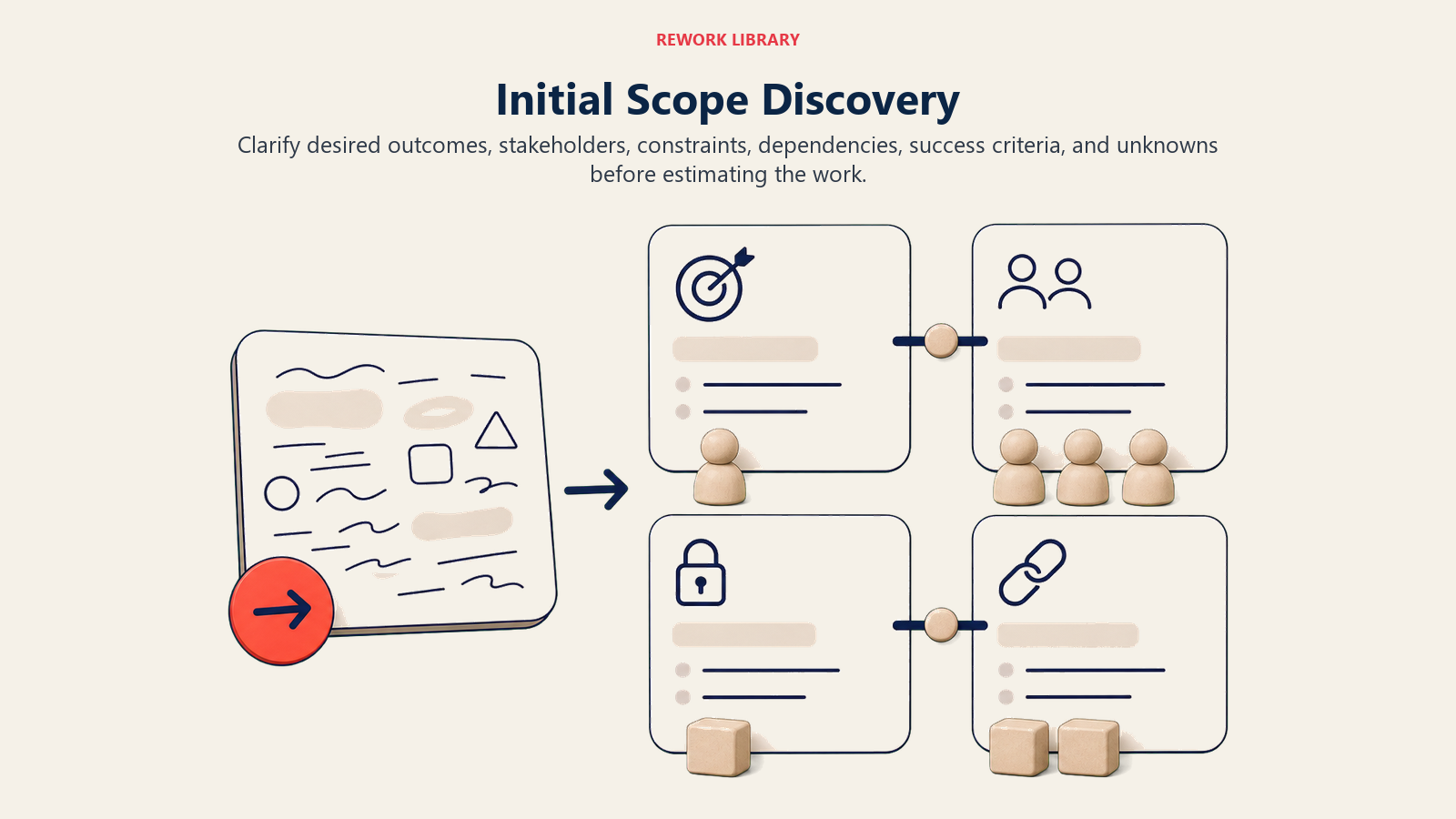
Map the stakeholder landscape. Who cares about this project? Who has decision authority? Who can kill it? Professional services projects rarely fail because of technical problems. They fail because of politics, competing priorities, and stakeholder conflict. If you can't get clarity on who matters and what they want, you can't assess feasibility.
Timeline expectations tell you how realistic this is. "We need this done by end of quarter" might be achievable or might be fantasy. You won't know until you understand the work involved, but timeline constraints affect everything from pricing to team composition.
Budget range and procurement process separate real opportunities from tire-kickers. Some prospects have $100K allocated and ready to spend. Others are "exploring options" with no approved budget. Both might ask for proposals, but they're not the same opportunity.
Success criteria and measurement approach reveal whether you'll be judged fairly. If the client can't articulate how they'll measure success, or if their criteria are vague or subjective, you're setting yourself up for disputes about whether you delivered value.
Questions that uncover what's really going on
Most clients don't volunteer the messy details. They present the sanitized version: clear objectives, reasonable timeline, cooperative stakeholders. Your job is to dig past that surface.
For business context: "What triggered this project now? Why not six months ago or six months from now?" Timing reveals urgency and political dynamics.
For technical requirements: "Walk me through your current environment. What systems, tools, and processes are involved?" Don't settle for "we use standard tools." Get specifics.
For stakeholder dynamics: "Who's most excited about this project? Who's most skeptical? What happens if those skeptics don't come around?" This uncovers political landmines before they explode.
For constraints: "What constraints are absolutely fixed, and where do you have flexibility?" Some clients say everything is fixed. That usually means they haven't thought it through.
For past attempts: "Have you tried to solve this before? What happened?" If they hedge or change the subject, press gently. Failed past attempts aren't disqualifying, but you need to understand why they failed.
Assessing complexity before it bites you
Not all projects are created equal. Some look straightforward on the surface but hide layers of complexity that only emerge halfway through. Others seem daunting but are actually manageable once you break them down. Your job is to spot the difference. You need to evaluate complexity from several angles, and each one matters. Technical complexity covers the hard skills side. Are you working with technologies you know well or learning on the fly? Are there integrations with multiple systems? Is the data clean or a mess? Technical complexity isn't inherently bad if you have the expertise to handle it, but if you're guessing at solutions, that's a problem.
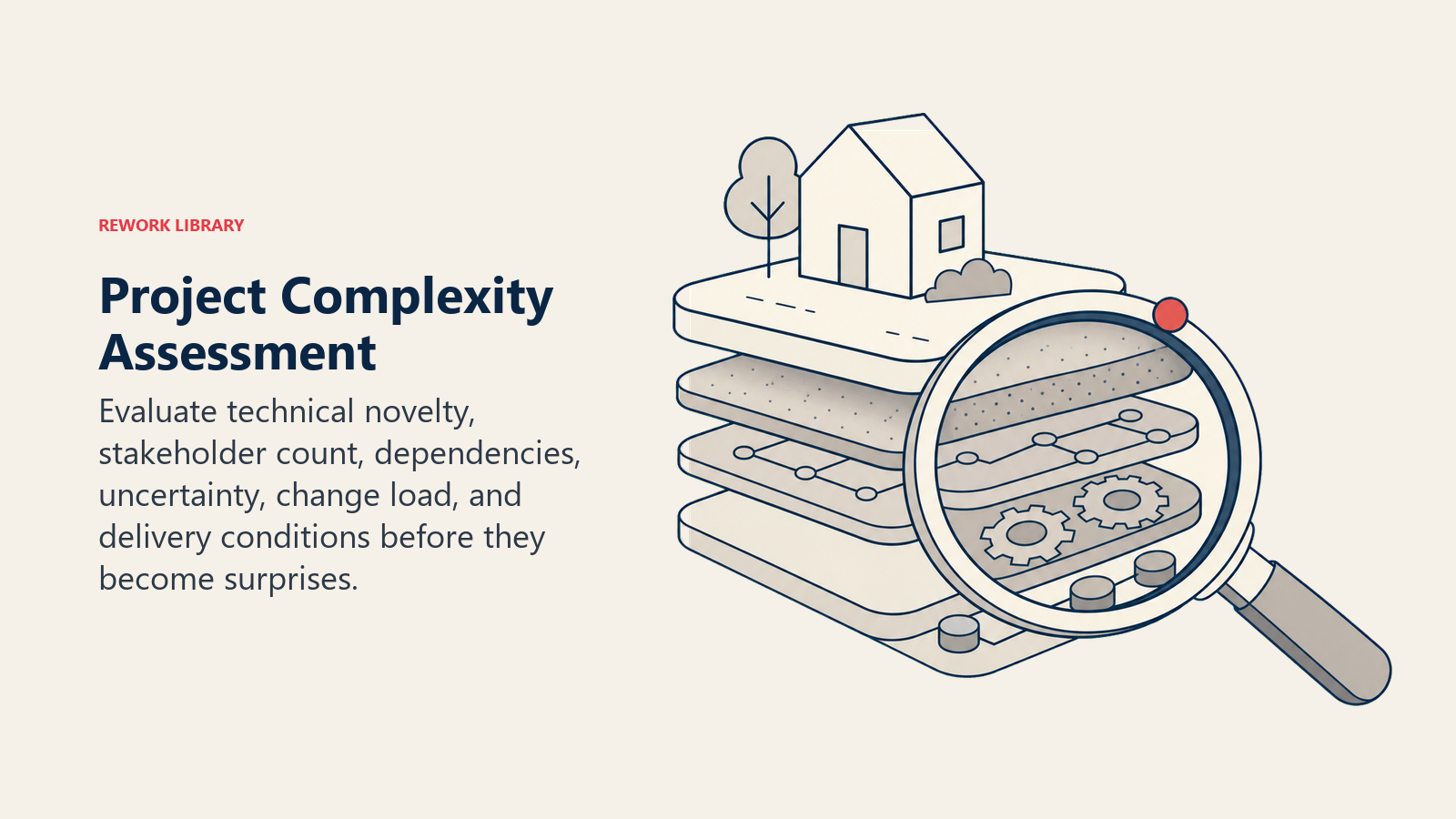
Organizational complexity kills more projects than technical challenges. How many stakeholders are involved? Do they agree on objectives? Is there executive sponsorship? Is the organization going through other major changes? A technically simple project can become a nightmare when you're dealing with fifteen decision-makers who can't agree on anything.
Process complexity involves how work gets done. Are you redesigning workflows that affect multiple departments? Are there dependencies on other projects or teams? Are there regulatory requirements you need to navigate? Process complexity means more coordination, more approvals, and more opportunities for delays.
Scale matters too. Building a solution for ten users is different from building for ten thousand. A single location is simpler than fifty. Simple math, but it affects timeline, testing, training, and risk.
Red flags that signal excessive complexity
Some complexity indicators are deal-breakers. If you see multiple red flags, walk away or demand significant risk premium in your pricing.
The client can't describe the current state clearly. This means they don't understand their own environment, which means you'll be discovering problems throughout the project.
There's no clear decision-maker or approval process. "We'll figure that out as we go" is code for "this will get stuck in committee hell."
The timeline is driven by arbitrary deadlines, not realistic assessment. "The CEO wants this done by conference in three months" is a setup for failure if the work actually takes six months.
They've had multiple failed attempts with other firms, but they blame those firms rather than examining why projects keep failing. The common denominator might be them.
Requirements keep changing during the discovery phase. If scope is shifting before you've even proposed, imagine what happens during delivery.
Budget and scope are wildly misaligned. They want enterprise-level transformation but have budget for a basic implementation. Someone's expectations need adjusting.
Evaluating whether you can actually deliver this
Complexity is one thing. Whether you can handle that complexity is another. Be honest with yourself here, not optimistic. Start with skill set mapping. Break down the project into the major components and phases. For each, what expertise do you need? Do you have people with that expertise available? If not, can you hire or subcontract?
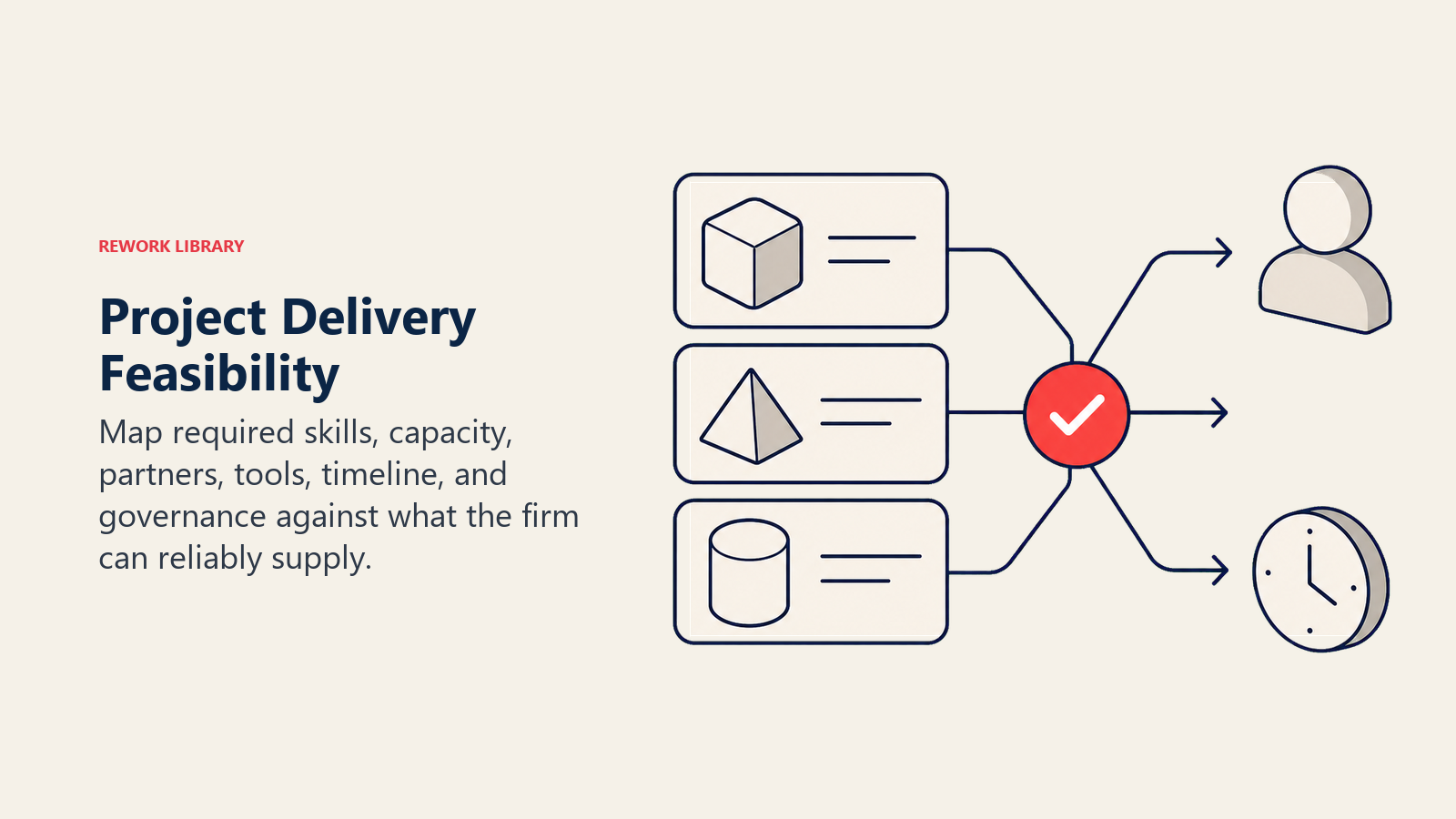
Experience level requirements vary by project phase. Maybe junior resources can handle routine implementation work, but you need senior people for architecture decisions and client-facing strategy discussions. Map out which roles you need at what level.
Time and duration estimates get tricky. How many hours will each resource type need to invest? Over what timeline? Past project data is invaluable here. If you don't have it, you're guessing. Educated guessing perhaps, but still guessing.
Availability constraints and scheduling matter more than firms usually admit. You might have the right expertise on paper, but if your best person is booked solid for the next six months, you can't staff this project properly. Be realistic about who's actually available when.
External dependencies and third-party needs add risk. If project success depends on a vendor delivering integration support, or the client's IT team completing infrastructure work, or regulatory approval that might take months, factor that in.
Knowledge transfer and training requirements affect both timeline and staffing. If you need to get the client's team up to speed to sustain the solution after you leave, that's additional work that often gets underestimated.
Strategic fit: should you even want this project?
Just because you can do something doesn't mean you should. Strategic fit determines whether this project moves you in the right direction or is just revenue chasing. Does this client match your target client profile? If your sweet spot is mid-market manufacturing companies and this is a small retail business, you might be able to serve them, but you'll be less efficient and effective than in your wheelhouse.
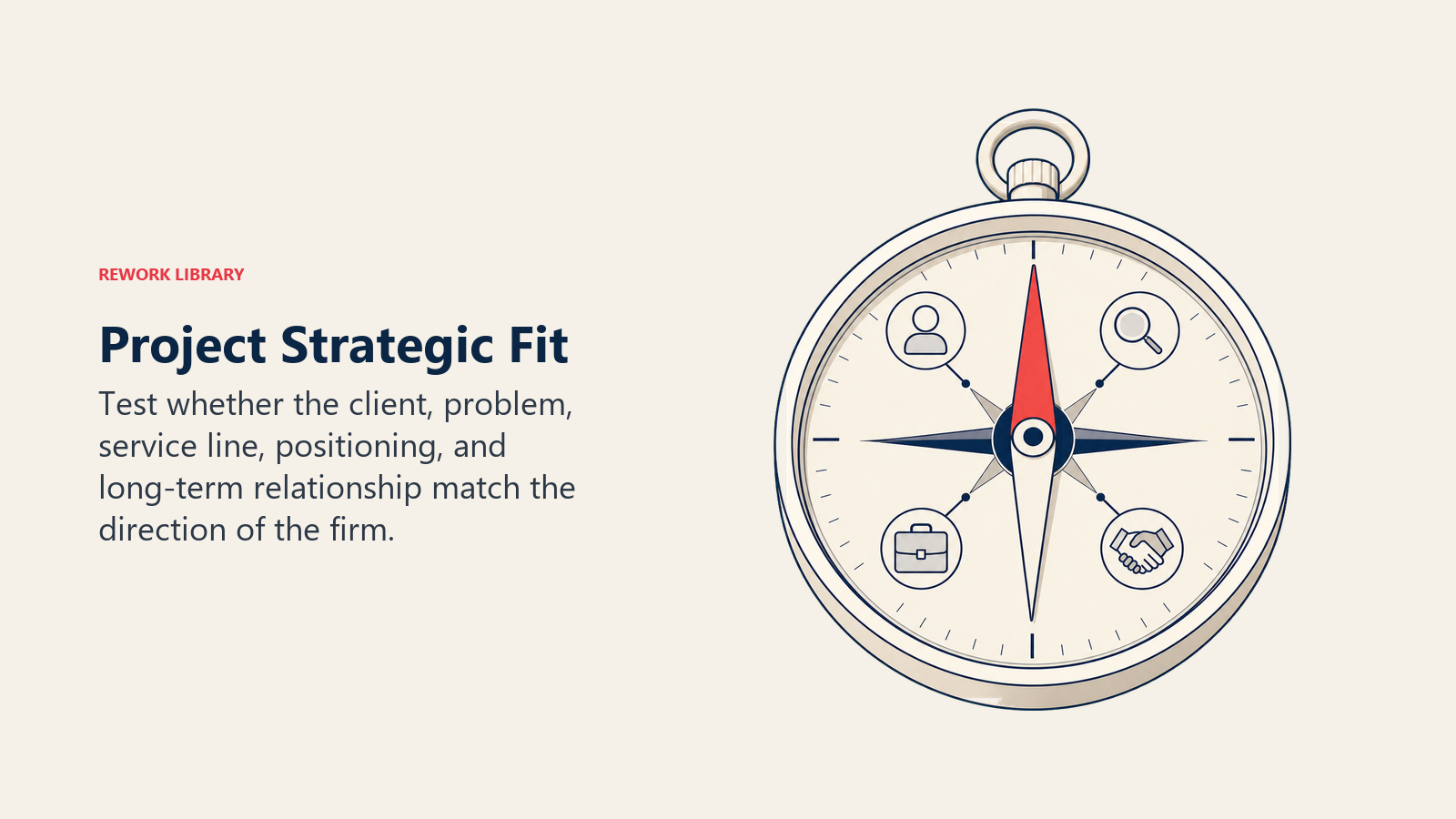
How does this position within your service line strategy? Are you building depth in a core service area or getting distracted by one-off work that doesn't leverage your expertise? Your decisions here should align with your broader professional services growth model.
Portfolio diversification matters, but in both directions. Too much concentration in one client or industry is risky. But too much random diversity means you're not building replicable expertise either.
Reference and case study value can justify projects that are otherwise marginal. A high-profile client or innovative solution might be worth accepting lower margins if it opens doors to bigger opportunities.
Relationship and upsell potential turns a small project into a foot in the door. If this $50K engagement could lead to $500K in follow-on work, the strategic value exceeds the immediate revenue.
Brand and reputation implications cut both ways. A prestigious client might boost your credibility. But a project in a controversial industry or with a client known for difficult behavior might not be worth the association.
Financial viability: will this actually make money?
You're running a business, not a charity. Every project needs to generate acceptable margins or there's no point. Start with margin projection at preliminary scope. Based on what you know, what's the likely revenue and what will it cost to deliver? If your target is 40% margin and early estimates suggest 20%, either the pricing is wrong or the scope is harder than it looks.
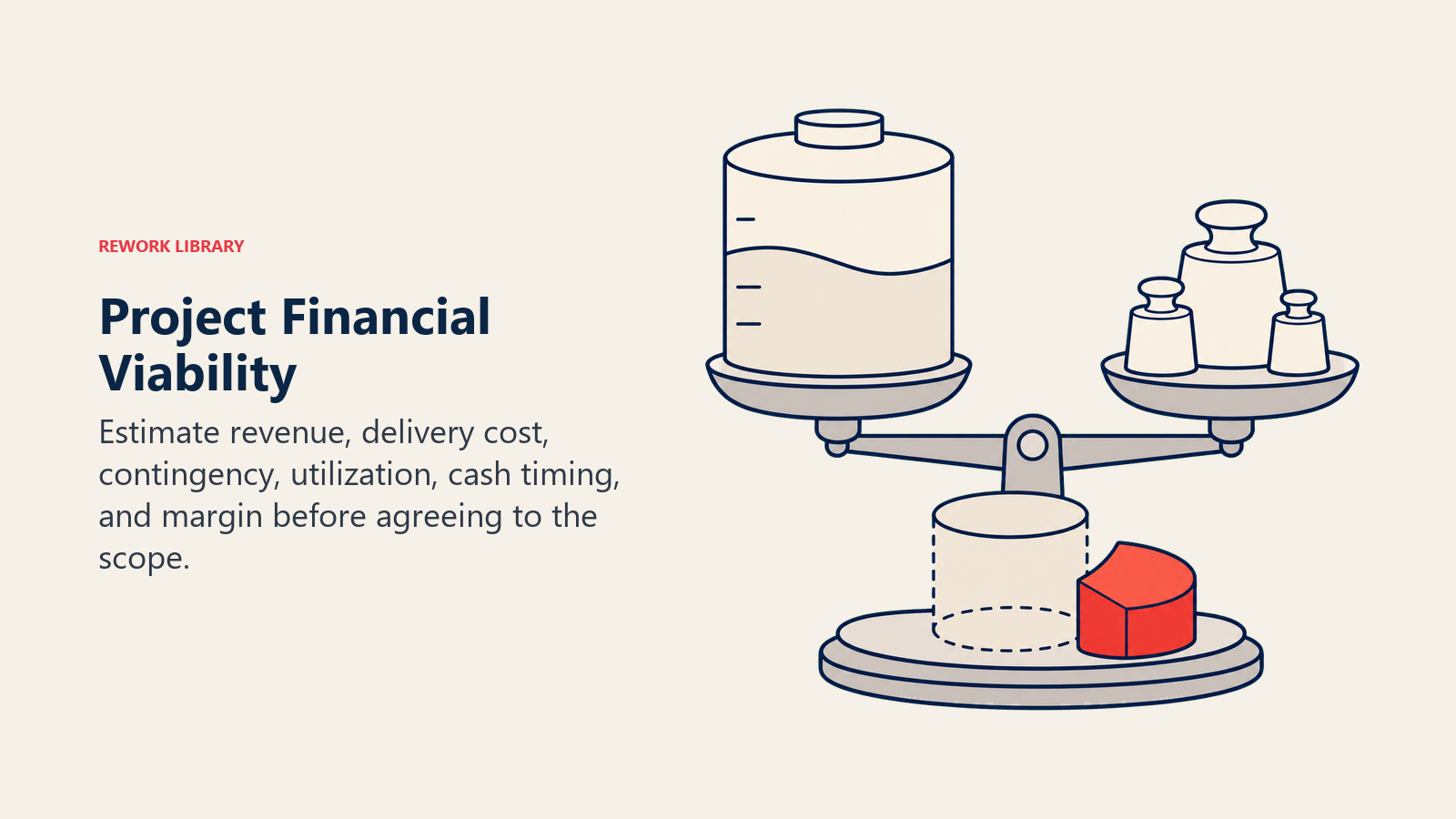
Factor in investment required for presales and ramp-up. Complex deals might require substantial proposal effort, proof-of-concept work, or team training before billable work begins. Those costs eat into margins.
Payment terms and cash flow implications matter, especially for smaller firms. Net 60 terms on a six-month project means you're financing the client's work. Can you afford that? Will it constrain your ability to take other projects?
Risk-adjusted value calculation accounts for probability. A $200K project with 30% win probability and high delivery risk isn't worth the same as a $100K project with 80% win probability and low risk.
Opportunity cost vs other pursuits is the hidden factor. Every hour spent pursuing or delivering this project is an hour you can't spend on something else. If you're choosing between a marginal project and pursuing better opportunities, the marginal one costs you more than you think.
Making the go/no-go decision systematically
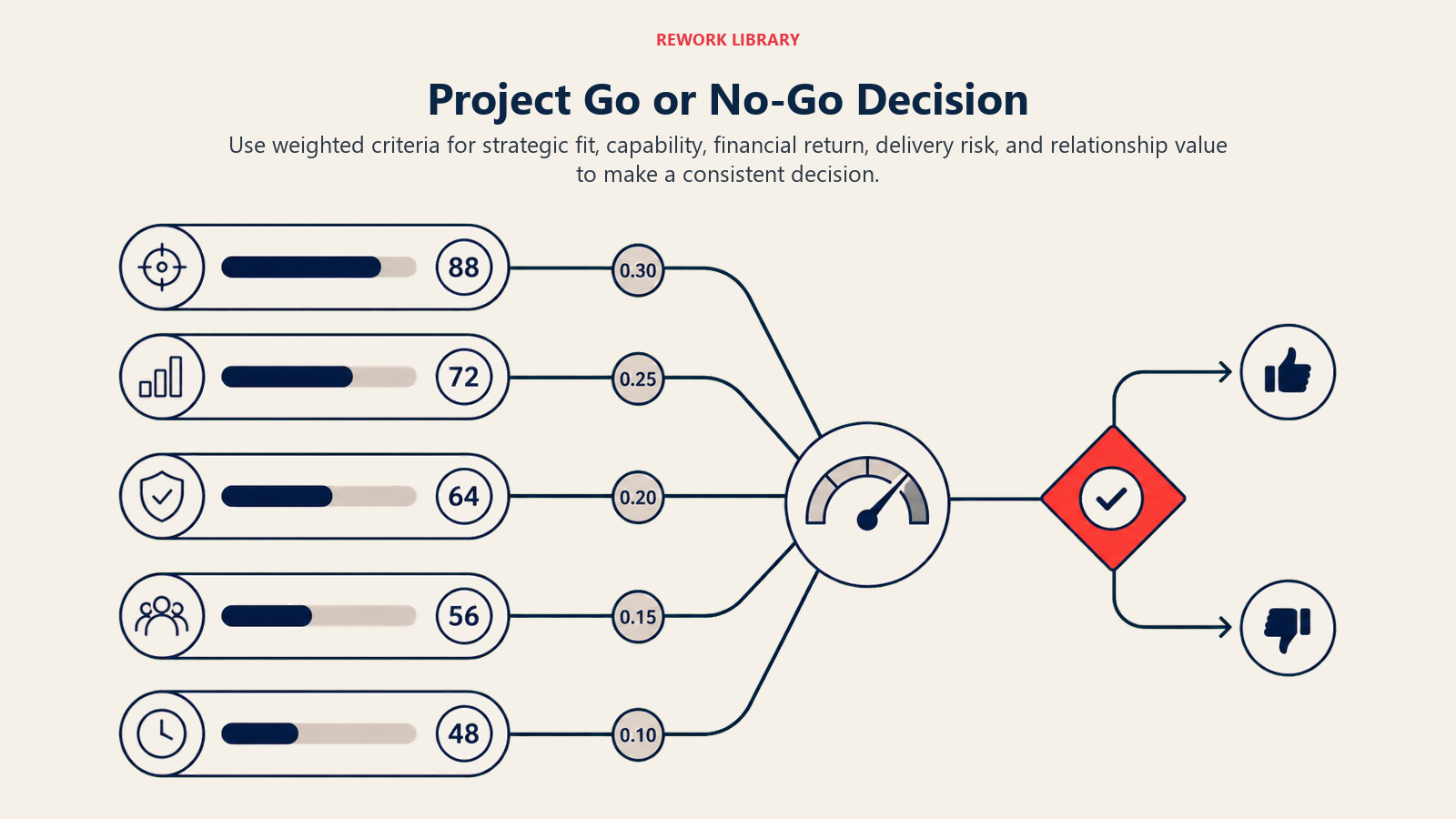
Gut instinct has value, but systematic evaluation catches things intuition misses. Build a scoring framework that quantifies assessment dimensions. Create a simple scorecard with weighted criteria: Strategic Fit (20%)
- Alignment with ICP and service lines
- Portfolio and capability development value
- Brand and relationship potential
Capability Match (25%)
- Technical expertise availability
- Resource capacity and timing
- Past experience with similar projects
Complexity and Risk (25%)
- Technical, organizational, and process complexity
- Red flag count and severity
- Dependency and integration risks
Financial Attractiveness (20%)
- Margin projection and investment required
- Payment terms and cash flow impact
- Opportunity cost vs alternatives
Client Readiness (10%)
- Clear decision process and authority
- Budget approval and timeline realism
- Stakeholder alignment and sponsorship
Score each dimension 1-10, apply weightings, and set a threshold for pursuit. Projects scoring 7.5+ are strong yes. Below 6 is probably no-go. 6-7.5 requires deeper evaluation or risk mitigation before proceeding.
But don't let the scorecard override obvious red flags. If there are fundamental issues like misaligned expectations, missing budget approval, or capability gaps you can't fill, the total score doesn't matter.
When to escalate borderline decisions
Not every decision is clear-cut. For borderline cases, escalation paths matter.
If it's a large deal or strategic client, get leadership involved early. They might see angles you don't or be willing to accept risks you're not comfortable with.
If it requires capabilities you're building, not proven, that's a leadership decision about whether to stretch.
If it's financially marginal but strategically valuable, weigh trade-offs explicitly. "This breaks our margin threshold but gives us entry to a target industry. Worth it?"
Document the concerns and get alignment. If you proceed despite red flags, everyone needs to understand the risks they're accepting.
Declining gracefully when it's not a fit
Saying no is a skill. Done well, it preserves relationships and might lead to better opportunities later.
Be direct but respectful. "Based on what we've learned about your requirements, we don't think we're the best fit for this project" is clear without being insulting.
Explain why without oversharing. "The timeline is tighter than we can commit to given our current workload" is enough. You don't need to list all the red flags you found.
Offer alternatives when possible. Refer them to another firm that specializes in their needs. Suggest a phased approach that makes the project more manageable. Propose revisiting in a few months when timing might work better.
Leave the door open. "We'd love to explore future opportunities that align better with our capabilities" signals you're not rejecting them permanently.
Some prospects will respect the honesty. Others will be annoyed. That's fine. The ones who respect honest assessment are better clients anyway.
Common mistakes that lead to bad scope assessments
Even experienced firms fall into predictable traps. Inadequate discovery before committing resources is the most common error. You spend hours on a proposal before really understanding the project. By the time you realize it's a mess, you've invested too much to walk away easily.
Optimism bias in complexity estimation makes everything seem manageable. "How hard could it be?" turns into "why is this taking three times longer than expected?" Challenge your assumptions. Ask what could go wrong.
Ignoring red flags because you need the revenue happens when you're under pressure to hit targets. A bad project still beats no project, right? Wrong. A bad project costs more than the revenue it generates when you factor in team burnout, opportunity cost, and reputation damage.
Scope creep during assessment phase is insidious. The prospect keeps adding "just one more thing" to the requirements as you're trying to scope it. Each addition changes the complexity and feasibility, but by the end you've lost track of what you're really agreeing to.
Assuming the client is ready when they're not means you skip validation of their preparation. But if they don't have resources allocated, stakeholders aligned, or data accessible, the project will stall regardless of your capabilities.
Forgetting that people changes are harder than technology changes is a classic consultant error. You scope the technical work but forget that changing how people work is often harder than changing systems. If you're not accounting for change management, training, and adoption, your estimates are wrong.
Documenting scope for clarity and protection
Once you've assessed scope and decided to pursue, document everything. Preliminary scope documents serve multiple purposes. They create shared understanding with the client. "Here's what we heard, here's what we're proposing." Misalignment surfaces now instead of during delivery.
They provide basis for pricing and proposals. You can't price accurately if scope is fuzzy.
They establish boundaries early. "This is included, this is not included" sets expectations.
They protect you if scope disputes arise later. "The original assessment covered X, this request is Y, which is different."
Use clear formats and language. Avoid jargon where possible. Be specific about what's in and out of scope.
Assumptions section is critical. "We're assuming you'll provide data in CSV format. We're assuming stakeholders are available for weekly meetings. We're assuming your IT team handles server configuration." If those assumptions prove wrong, scope changes.
Exclusions section is equally important. "This does not include custom integration with your legacy system. This does not include on-site training. This does not include post-launch support beyond 30 days." Explicit exclusions prevent "I thought that was included" arguments.
Validate and confirm with the client. Walk through the scope document together. Ask them to point out anything that doesn't match their understanding. Get written acknowledgment before proceeding to proposal stage.
Setting boundaries before scope creep starts
Scope creep doesn't begin during delivery. It begins during assessment when you're too vague about boundaries.
Be clear about what triggers scope change. "If you need additional integrations, that's a separate effort. If new stakeholders join who weren't part of initial planning, we'll need to reassess timeline and budget."
Establish a change process early. "Here's how we'll handle requests for scope changes. We'll document the request, assess impact on timeline and budget, and get your approval before proceeding." This isn't being rigid. It's being professional.
Manage scope evolution during sales carefully. Prospects often refine requirements as they better understand possibilities. That's fine, but track what's changing and update estimates accordingly. Don't let "quick additions" accumulate into a completely different project.
Signal when scope is shifting significantly. "We've added quite a bit since our initial conversation. Let's pause and reassess what we're really committing to before we proceed." Better to reset expectations now than surprise the client with a much higher price later.
Where to go from here
Effective scope assessment is the foundation of profitable professional services delivery. When you accurately evaluate fit, complexity, and feasibility before committing resources, you make better decisions about which opportunities to pursue.
This connects to your broader consultative business development approach. Scope assessment is part of consultative selling because you're helping prospects understand what they really need, not just what they asked for.
It feeds into your qualification process. If prospects don't pass basic client qualification, you won't invest in deep scope assessment. And scope assessment provides data for final go/no-go decisions.
It sets up proposal development. With thorough scope assessment complete, you can create accurate proposals that reflect real requirements, not guesswork.
And it shapes delivery success. Projects that start with clear, realistic scope assessment have higher success rates because everyone understands what they're getting into.
Start by documenting your current approach to scope assessment. What questions do you ask? What evaluation criteria do you use? What's working and what's not? Then build a more systematic framework that fits your firm's needs. You don't need perfect assessment. You need good enough to make better decisions than you're making now.
The goal isn't to eliminate all risk or only pursue slam-dunk projects. It's to go into every engagement with eyes wide open, clear on what you're committing to and confident you can deliver. That's how you build a sustainable professional services practice instead of lurching from one difficult project to the next.
Learn More
Strengthen your project assessment and qualification capabilities with these related resources:
- Client Qualification Framework - Systematic approach to evaluating client fit
- Budget & Timeline Discovery - Master the financial conversation
- Fit vs Misfit Identification - Recognize good and bad opportunities
- Needs Assessment & Discovery - Deep dive into understanding client needs
- Scope Creep Management - Protect your projects from expanding scope

Sales Director
On this page
- Why scope assessment determines success before you start
- Initial scope discovery: asking the right questions early
- Questions that uncover what's really going on
- Assessing complexity before it bites you
- Red flags that signal excessive complexity
- Evaluating whether you can actually deliver this
- Strategic fit: should you even want this project?
- Financial viability: will this actually make money?
- Making the go/no-go decision systematically
- When to escalate borderline decisions
- Declining gracefully when it's not a fit
- Common mistakes that lead to bad scope assessments
- Documenting scope for clarity and protection
- Setting boundaries before scope creep starts
- Where to go from here
- Learn More