RFP Response Strategy: Winning High-Value Professional Services Contracts
Turn this article into takeaways for your work.


Each assistant summarizes the article only for you and suggests best practices for your work.
An RFP response strategy is a disciplined go/no-go process for deciding which bids to pursue and how to position the ones you choose. The single biggest lever is selectivity: top firms decline 70% or more of RFPs because each response costs $25,000 to $50,000 and the average win rate is only 15-20%. Score every opportunity before you commit, then invest hard in the few you can actually win.
Here's a number that should make you uncomfortable: responding to an RFP costs between $25,000 and $50,000 when you factor in partner time, proposal development, and opportunity cost. And the average win rate? About 15-20%.
Do the math. If you respond to 10 RFPs a year at $35K each, you're spending $350K to win maybe 1-2 contracts. That's expensive. And here's the thing that really hurts: top professional services firms decline 70% or more of the RFPs they receive.
They're not being picky for fun. They've figured out something crucial - RFP response is a strategic capability, not a reflex. The decision to respond matters as much as what you write in the proposal. Maybe more.
The RFP Dilemma: Why Volume Kills Profitability
When an RFP hits your inbox, there's immediate pressure to respond. Someone sent this to us! They're looking for what we do! We could win this!
But that instinct destroys value. Because not all RFPs are created equal. Some are genuine competitive opportunities where the best proposal wins. Others are compliance exercises where a decision has already been made. Some are fishing expeditions to validate existing vendor pricing. And some are completely unrealistic about budget, timeline, or what's actually possible.
When you respond to everything, you're:
- Burning resources on unwinnable opportunities
- Diluting attention from real prospects
- Training your team to write generic proposals
- Competing on price because you have no relationship
- Building a culture of reactive sales instead of strategic business development
The firms that win consistently don't chase every RFP. They make strategic decisions about which opportunities deserve investment.
Understanding the RFP Landscape
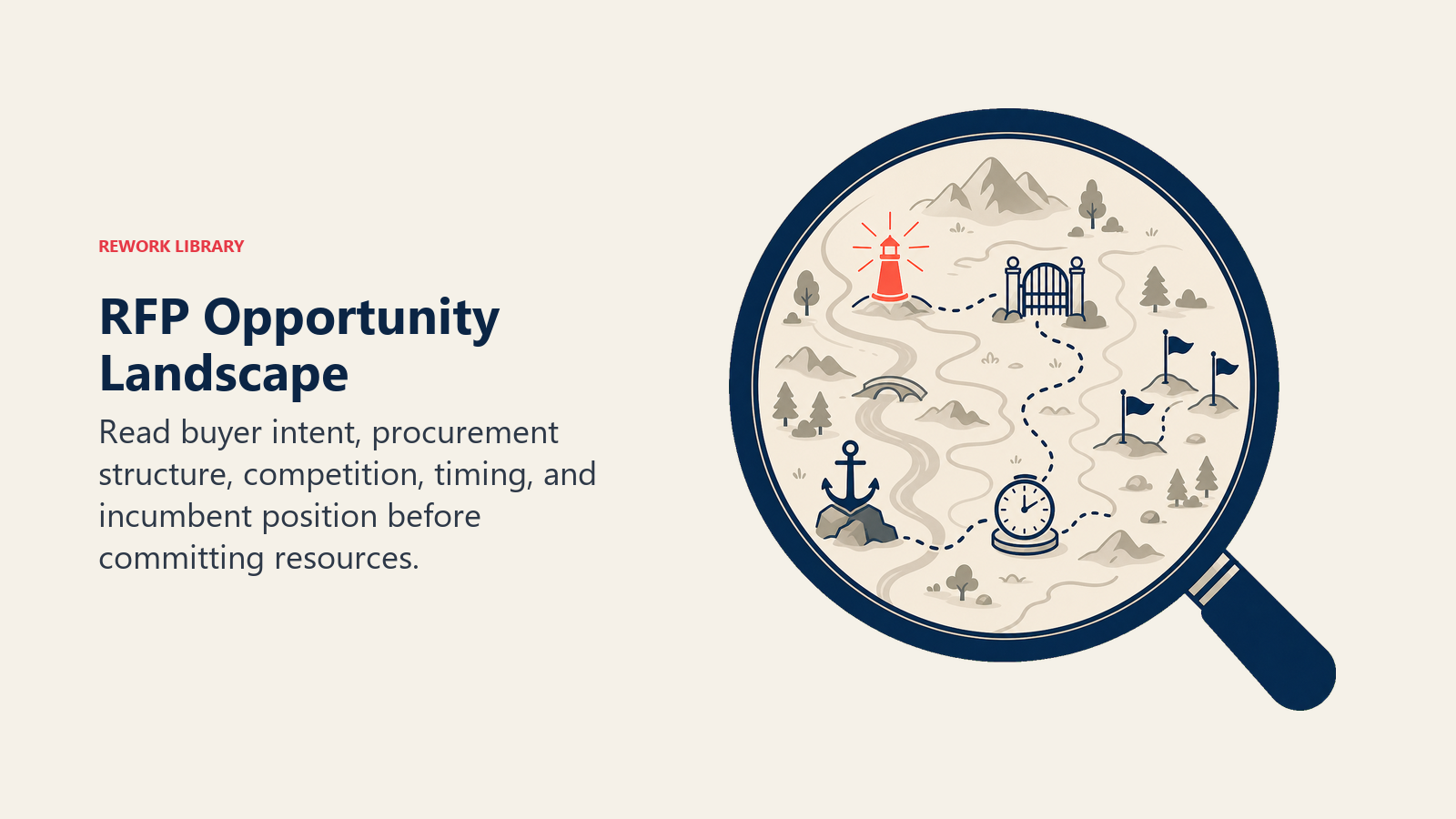
Before you can decide whether to respond, figure out what you're actually dealing with. RFPs come in different flavors, and recognizing the type helps you predict your odds.
Genuine competitive bids are what everyone imagines an RFP should be. The buyer has a real problem, a realistic budget, and they're evaluating multiple qualified vendors. They haven't made up their minds yet. These are winnable if you have the right approach and qualifications.
Compliance exercises happen when procurement rules require multiple bids even though the buyer already knows who they want. You're being used to satisfy a policy. Signs: unrealistic timeline, overly specific requirements that match one vendor, or you hear through back channels that someone's already been chosen.
Incumbent tests occur when a current vendor's contract is up for renewal and the buyer wants to validate they're getting good value. The incumbent has massive advantage. They know the real needs, the stakeholders, the politics. You're fighting uphill unless the incumbent seriously dropped the ball.
Price-shopping exercises are when a buyer uses the RFP to beat down their preferred vendor's pricing. They collect proposals, take your pricing ideas to their current vendor, and negotiate a better deal. You do the work, someone else gets the benefit.
Research projects happen when someone doesn't actually have budget or authority but wants to learn about the market. They're gathering information, not making a purchase decision. Common with junior staff who were told to "look into solutions."
Understanding which type you're facing changes everything about your go/no-go decision.
The Go/No-Go Decision Framework
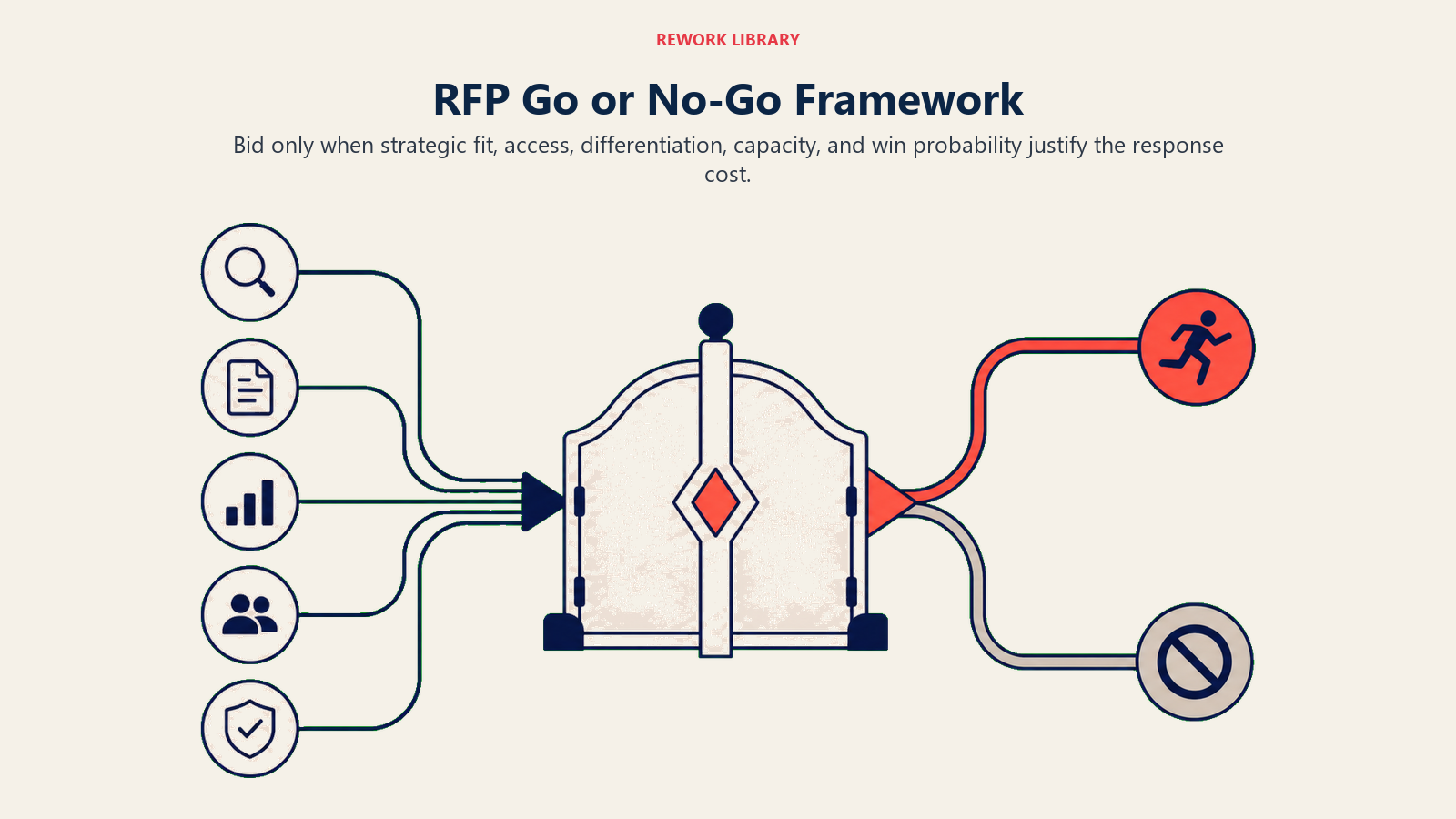
Discipline matters here. Before you commit resources, use a structured framework to evaluate each opportunity.
Strategic Fit Assessment
Start with the basics: does this opportunity align with what you're trying to build?
Service line match: Is this within your core expertise or are you stretching? RFPs outside your wheelhouse rarely go well. The buyer senses uncertainty, you underprice because you don't know the work, and delivery becomes a nightmare.
Target client profile: Does this client match your ideal customer? If you've been moving upmarket and this is a small company, winning might actually hurt. You'll tie up senior resources on work that doesn't build the portfolio you need.
Strategic priorities: Sometimes a project fits your services but doesn't advance your strategy. If you're trying to build a healthcare practice and this is a one-off in manufacturing, winning pulls you sideways.
Reference value: Even if you don't make much margin, will this client become a strong reference? A logo that opens doors? Experience in a new sector you're targeting? Sometimes that changes the whole calculation.
Win Probability Analysis
Be honest about your chances. Optimism doesn't win RFPs.
Existing relationship advantage: This is the big one. If you have an existing relationship with the buyer (past work, consulting conversations, introductions from mutual contacts), your odds jump by 30-40%. If you've never talked to them before the RFP arrived, you're probably losing to someone who has.
Incumbent status: Are you the incumbent defending the business? That's a 60-70% win rate if you haven't screwed up. Are you challenging an incumbent? Win rate drops to 10-15% unless you know why they're dissatisfied.
Requirements alignment: Do the stated requirements match your strengths, or do they favor someone else's approach? If the RFP asks for specific methodologies or credentials you don't have, that's a signal.
Competitive intelligence: Who else is bidding? If you know three strong competitors are responding and you don't have a differentiation angle, your odds are 25% at best. If you're one of two qualified firms, odds improve dramatically.
Economic Viability Evaluation
Even if you can win, should you want to?
Estimated project value: Is this worth the investment to pursue? A $50K project doesn't justify a $25K proposal effort. As a rule, if the RFP response cost exceeds 10% of project value, walk away unless there's strategic upside.
Profitability potential: Based on the scope and likely pricing pressure, can you make reasonable margin? RFPs often create price competition that destroys margins. If you're going to win at 5% margin when your target is 30%, that's a problem.
Resource availability: Do you have the team to deliver if you win? Winning an RFP then scrambling to staff it creates operational chaos and quality problems.
Payment terms and risk: Government and large enterprise RFPs often include terrible payment terms, liability caps that don't protect you, and IP provisions that aren't acceptable. Read the boilerplate before you invest in responding.
Risk Assessment
What could go wrong?
Scope clarity: Is the RFP clear about what they want, or is it vague and likely to create scope creep? Vague RFPs become troubled projects.
Procurement vs end user: Is this written by procurement people who don't understand the work, or by the people who'll actually use your services? Procurement-driven RFPs often optimize for price over fit.
Budget realism: Do they have realistic budget for what they're asking? If not, either they'll be disappointed with what you can deliver, or you'll lose to someone who overpromises and underdelivers.
Timeline feasibility: Can they actually make a decision in their stated timeline, or is this going to drag out for months?
The Go/No-Go Decision Matrix
Put it all together in a simple scoring system:
| Criteria | Weight | Score (1-5) | Weighted Score |
|---|---|---|---|
| Strategic Fit | 20% | ||
| Win Probability | 30% | ||
| Economic Value | 25% | ||
| Resource Fit | 15% | ||
| Risk Level | 10% |
If your total weighted score is below 3.5 out of 5, seriously consider declining. Between 3.5 and 4.0, proceed with caution and a lean response. Above 4.0, invest appropriately to win.
And here's the important part: make this decision before you spend serious time. Do the analysis within a few hours of receiving the RFP, then commit or decline. Don't drift into half-hearted responses that waste time without winning.
Pre-RFP Response Strategy
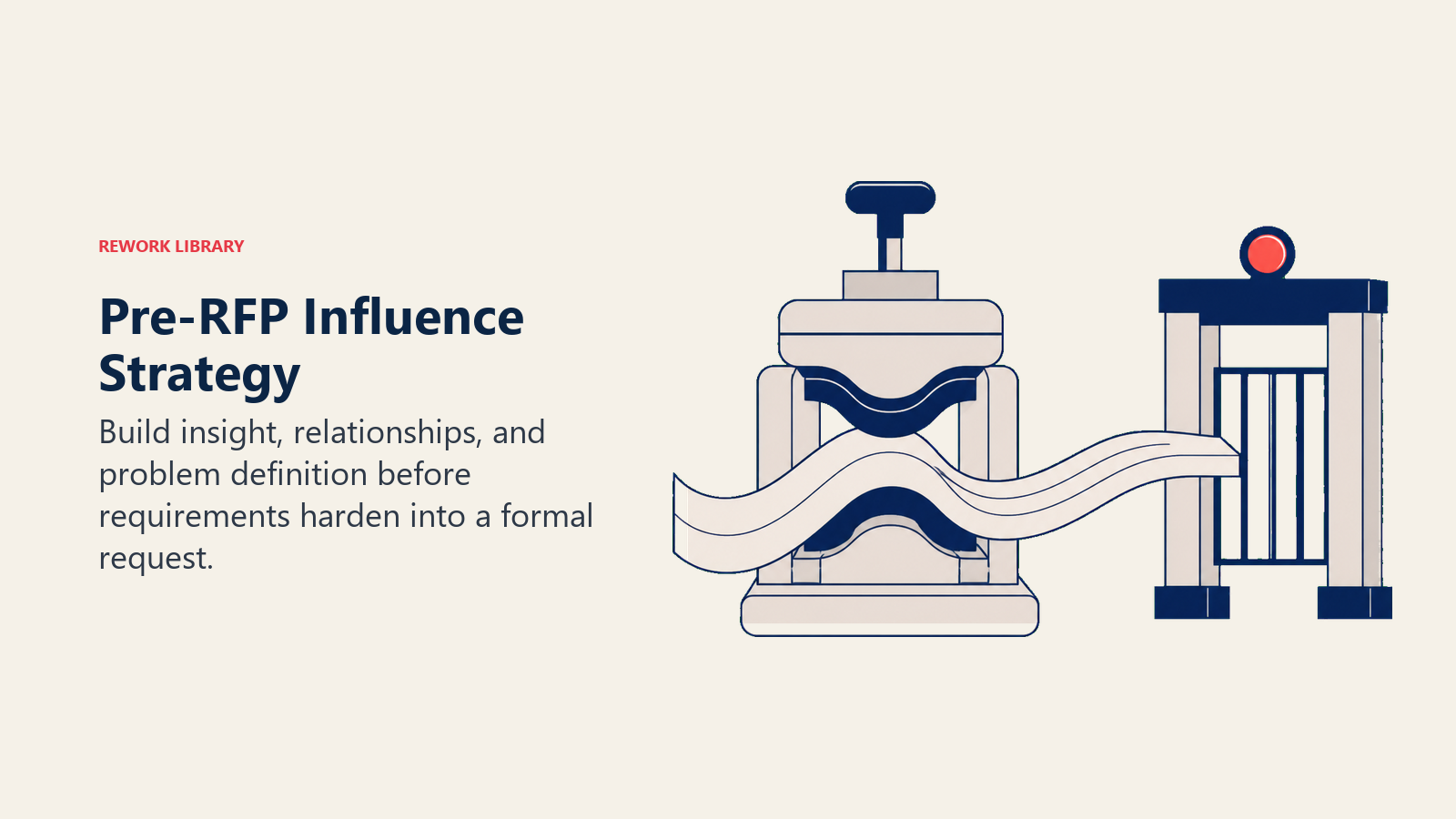
If you decide to respond, the quality of your intelligence determines your odds more than the quality of your writing.
Intelligence Gathering
Start by understanding:
The buyer's real problem: What they write in the RFP and what they actually need are often different. The RFP says "we need a new CRM" but the real problem might be "sales and marketing don't work together." If you can talk to stakeholders before responding, dig for the real issue. This is similar to the discovery work you'd do in needs assessment and discovery.
Stakeholder map: Who's involved in the decision? Who's the economic buyer? Who are the influencers? Who might block you even if everyone else likes your proposal? Understanding the people matters as much as understanding the requirements.
Budget reality: The stated budget range and the actual budget are often different. If you can learn the real number, you can price strategically instead of guessing.
Evaluation criteria and weighting: Some RFPs tell you how they'll score proposals. Most don't. If you can learn that technical approach counts 40%, price counts 30%, and past performance counts 30%, you know where to focus your effort.
Decision timeline: The RFP might say decision in 60 days, but internal politics might mean it'll actually take four months. Knowing the real timeline helps you manage resources and follow-up.
Relationship Building Before RFP
The best time to respond to an RFP is before it's released. If you're building relationships with target clients through consultative business development, you often get early visibility into upcoming RFPs.
Even better, you can shape the requirements. Not in a sleazy way, but by helping the buyer think through what they actually need. When your conversations inform how they write the RFP, the requirements naturally favor your approach.
And relationship-building creates trust. When the buyer knows you, has talked through their challenges with you, and respects your expertise, your proposal gets read differently than one from a complete stranger.
Clarification and Questions
Most RFPs allow questions. Use them strategically, not just to fill gaps in your understanding.
Ask questions that:
- Demonstrate you've done your homework and understand the nuances
- Subtly highlight your differentiators ("Will you be evaluating approaches that integrate X methodology with Y framework?")
- Uncover information other bidders might not think to ask
- Create conversation with the buyer, building familiarity
But don't ask questions that reveal you haven't read the RFP carefully or don't understand their business. That hurts more than it helps.
RFP Response Development Process
Once you're committed to responding, treat it like a project.
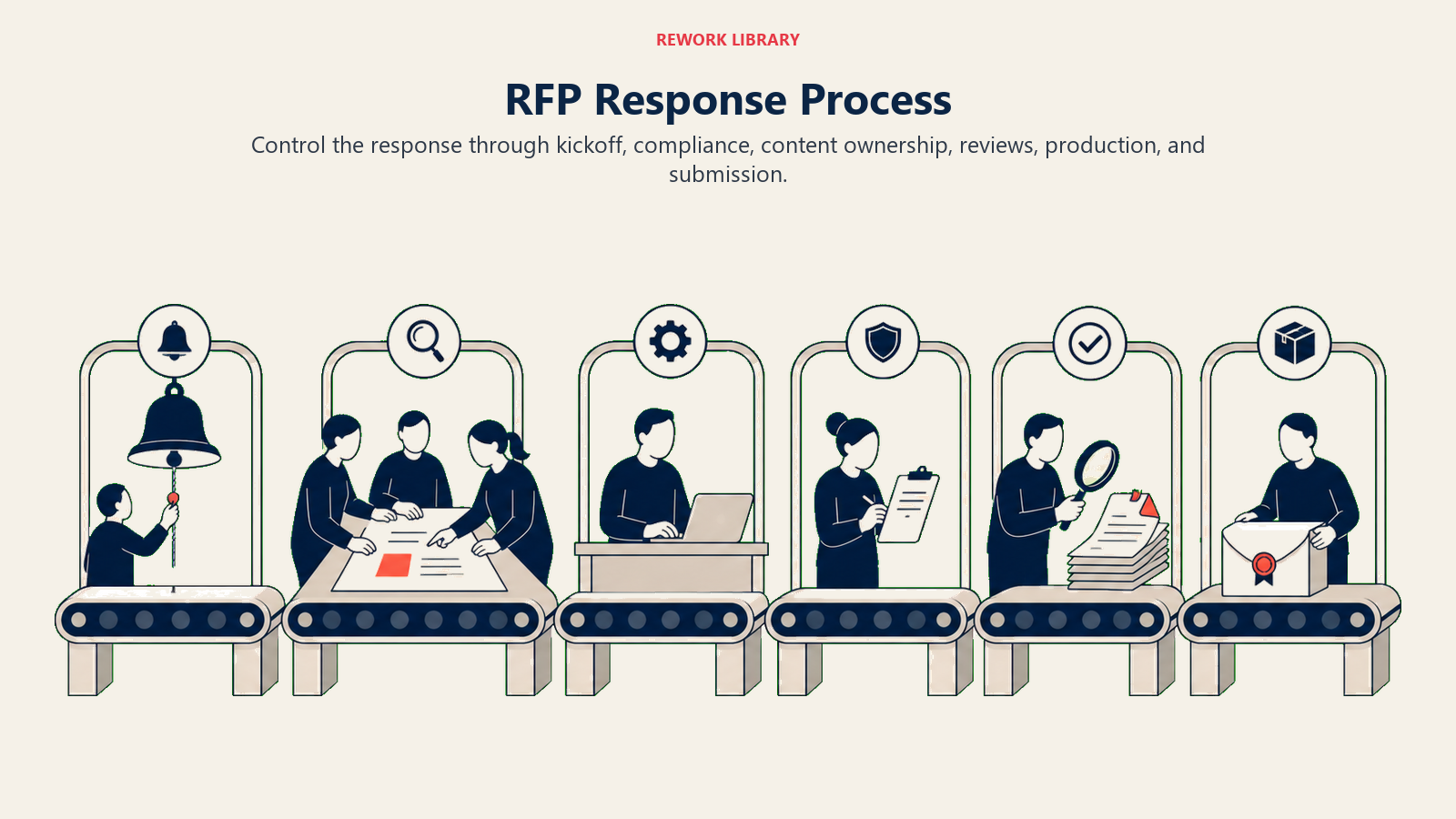
Project Planning and Team Formation
Assign a proposal manager: Someone needs to own the timeline, coordinate contributors, and drive completion. This can't be a side-of-desk responsibility. It needs focus.
Form the core team: Who's writing which sections? Who's doing pricing? Who's reviewing? Who has final approval? Decide upfront.
Build the timeline: Work backward from the deadline. Leave buffer for reviews, edits, and unexpected issues. Plan to finish 2-3 days early so you can review with fresh eyes.
Hold a kickoff meeting: Get everyone aligned on win strategy, key themes, and how you're differentiating from likely competitors.
Compliance and Requirements Analysis
Before you write a word, create a compliance matrix. List every requirement, question, and evaluation criterion from the RFP. Assign each one to a section of your proposal. Check off each one as you address it.
This sounds tedious, but proposals get disqualified for missing requirements all the time. "They didn't answer question 7" is an easy reason to eliminate a proposal without even evaluating quality.
Win Themes and Strategy Development
Win themes are the 3-4 core messages that differentiate you from competitors and align with what the buyer values.
Good win themes are:
- Specific to this buyer's situation (not generic)
- Tied to business outcomes (not just features)
- Defensible with evidence (not just claims)
- Difficult for competitors to copy
Weak theme: "We have deep expertise in your industry."
Strong theme: "Our healthcare practice has helped five health systems through similar EHR transitions, reducing implementation time by 30% and avoiding the revenue cycle disruption that affects 80% of implementations."
See the difference? The strong theme is specific, outcome-focused, backed by data, and hard for generalists to match.
Your win themes should thread through every section of the proposal. They're not stated once in the executive summary, they're reinforced repeatedly with evidence.
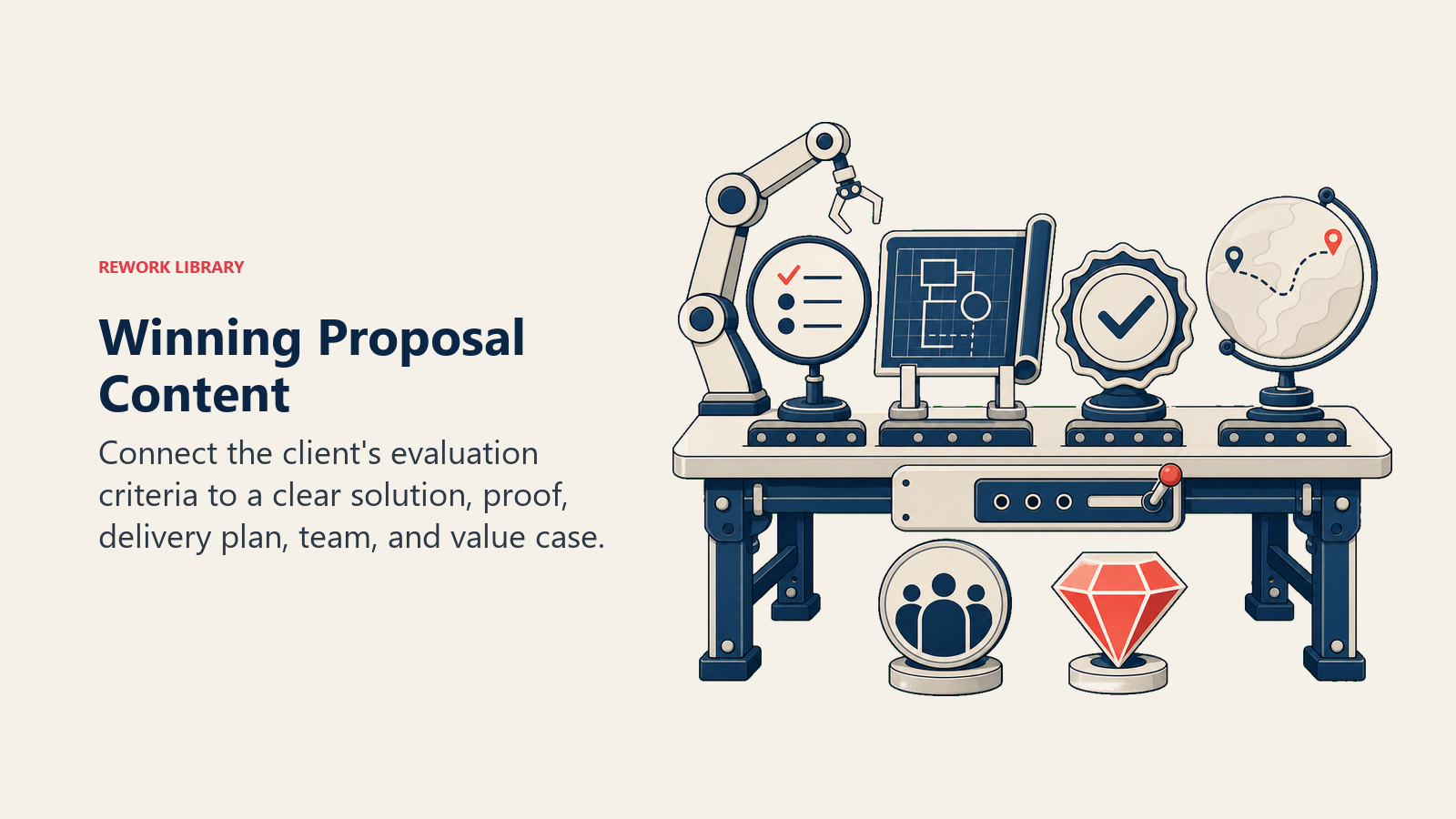
Proposal Content Development
Now you're ready to write. Each section has a job to do.
Executive Summary Excellence
This is the most important section because it might be the only section decision-makers read fully. Yet most executive summaries are terrible - generic, boring, and focused on the vendor instead of the buyer.
Here's what works:
Start with their problem (1 paragraph): Show you understand their situation and what's at stake. Use their language from the RFP, but add insight that shows you've thought deeper than they wrote.
Present your recommended approach (2-3 paragraphs): How you'll solve the problem and why this approach fits their specific situation. This isn't methodology detail, it's strategic direction.
Explain why you (1-2 paragraphs): What makes you uniquely qualified to do this work for this client? This is where win themes appear. Evidence, not claims.
Summarize the value (1 paragraph): What outcomes will they see? What risks will you mitigate? Why is this worth the investment?
Provide your pricing (1 sentence or table): Don't make them hunt for the number.
Keep it to 2 pages maximum. Every word should earn its place. This is not the section where you dump your company history and list of services.
Technical Approach and Methodology
This section proves you can do the work. The structure depends on the type of engagement, but generally:
Demonstrate understanding: Restate the challenge with enough depth to show you get the nuances, the constraints, and the context.
Present your approach: How you'll tackle the work, broken into clear phases or workstreams. This needs to be specific to their situation, not your standard methodology with their name swapped in.
Explain your methodology: What frameworks, tools, or processes you'll use and why they fit this situation. This is where you can differentiate if you have proprietary methods or unique approaches.
Show the work plan: Timeline, milestones, deliverables, decision points. Make it concrete so they can visualize the engagement.
Address risks and mitigation: What could go wrong and how you'll handle it. This builds confidence and shows mature thinking.
The mistake most proposals make is explaining what you'll do without explaining why. The buyer needs to understand not just your plan, but why this plan works for their specific situation.
Team Qualifications and Experience
People buy professional services from people. This section introduces who'll do the work and why they're the right team.
Key team members: Photo, title, role on this project, relevant experience. Focus on what makes them qualified for this specific work, not their entire career history.
Team structure: Who leads what? How do they work together? What's the communication plan with the client?
Relevant project experience: Case examples of team members doing similar work. Specific outcomes, not just descriptions.
One thing that works: have each team member write a short paragraph directly to the client. "I'm looking forward to working with you on this project because..." Personal connection matters.
Past Performance and Case Studies
Prove you've done this before. The best case studies are:
- Similar client profile (size, industry, challenge)
- Similar project scope and approach
- Specific, quantified outcomes
- Client testimonial or reference contact
Structure each case study as Challenge / Approach / Results. Skip the flowery narrative, get to the substance.
Don't have perfectly analogous case studies? Use component examples. "While we haven't done exactly this combination before, we brought methodology X to a similar client with these results, and approach Y to a different client with these results."
Pricing Strategy and Justification
Pricing in competitive RFPs is tricky. You need to be competitive, but you can't just be the cheapest. That signals low quality or unsustainable delivery.
Your approach depends on what you learned in intelligence gathering:
If you know the budget: Price within it but don't leave too much money on the table. If budget is $500K, pricing at $350K makes them question if you understand the scope. Pricing at $480K shows you maximized the value within their constraint.
If you don't know the budget: Price based on your standard approach and rates, with clear justification. Then offer options or phases so they can flex the scope to their budget.
If evaluation criteria weights price heavily: You might need to sharpen your pencil, but don't sacrifice delivery quality. Better to lose than win unprofitably.
If evaluation criteria weights other factors more: Price for value, not for winning on cost. Focus your effort on technical and qualifications sections.
Always include a pricing narrative that explains what's included, what drives cost, and why this represents fair value. Your pricing justification skills matter enormously in competitive RFP situations.
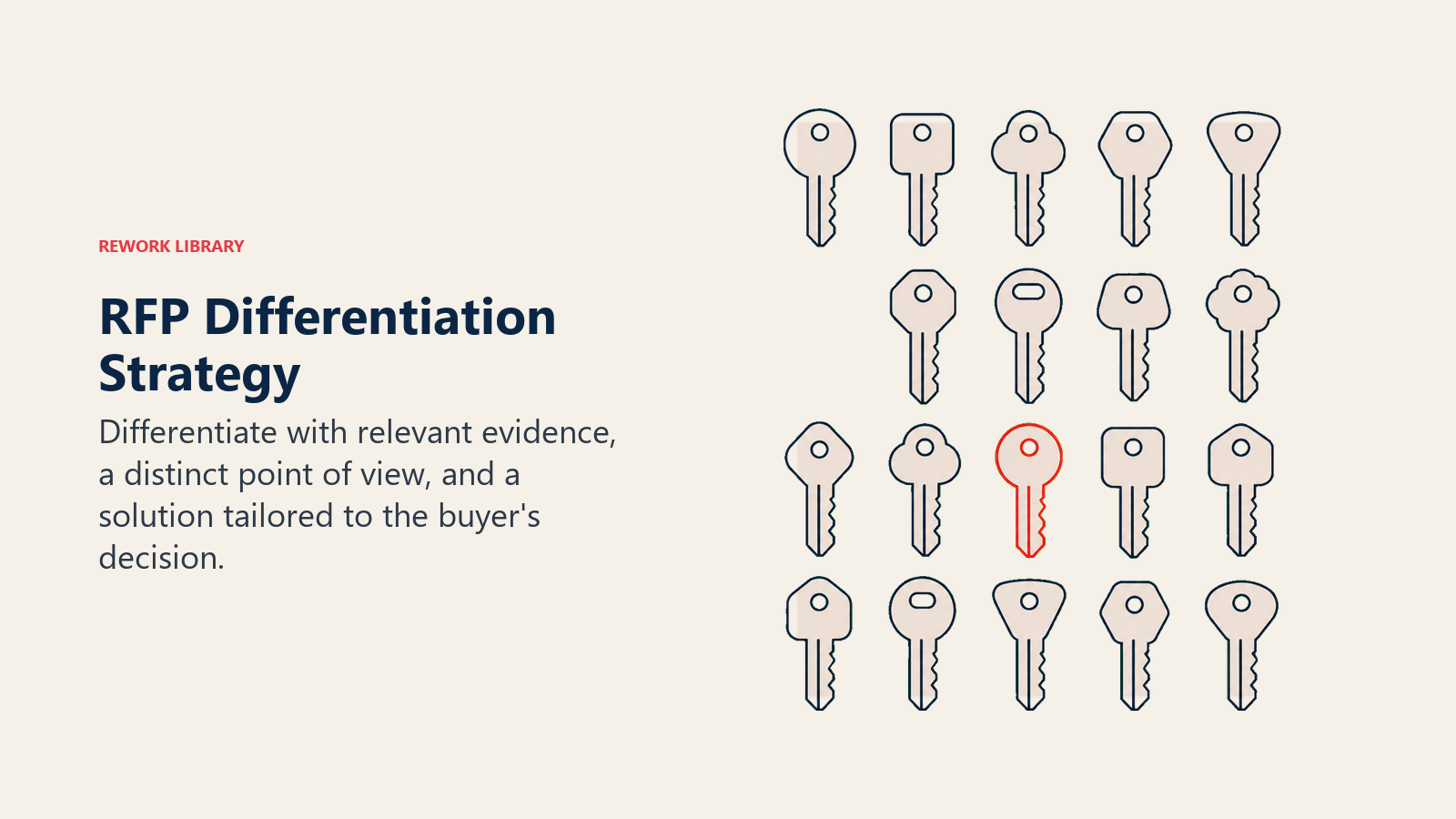
Competitive Differentiation Strategies
Strategy separates winners from also-rans.
Ghosting Competitors
"Ghosting" means implicitly raising doubts about competitor approaches without naming them. You do this by:
- Highlighting risks of common alternative approaches
- Explaining why certain methodologies fail in situations like theirs
- Asking evaluation questions that favor your strengths
Example: If you know competitors will propose offshore delivery, you might write: "While offshore resources can reduce cost, projects requiring deep client collaboration and rapid iteration often struggle with time zone gaps and communication overhead. Our approach uses local teams who can meet on-site within 24 hours and attend weekly working sessions."
You didn't say "Competitor X's offshore model sucks," but you planted doubt.
Creating Unequal Comparison
Make it hard for buyers to compare you to competitors on simple dimensions like hourly rate. Do this by:
- Proposing a different project structure than they specified
- Offering value-adds that change the equation
- Pricing by outcome or value instead of hours
- Bundling services in ways that competitors can't match
Example: If the RFP asks for hourly rates and 6 months of work, you might propose a fixed-price engagement with performance bonuses tied to outcomes. Now your $500K proposal isn't directly comparable to someone's $800/hour rate.
Risk Reversal
Professional services are risky for buyers. You're asking them to trust you with important work before you've proven yourself. Risk reversal shifts some of that risk to you. Ways to do this:
- Phased engagement with decision points ("Complete phase 1, then decide whether to continue")
- Performance guarantees ("If we don't reduce cycle time by 20%, we'll refund 25% of fees")
- Pilot projects ("Let's run a 6-week pilot with your west region before committing to the full rollout")
- Delayed payment tied to milestones
Risk reversal isn't appropriate for every situation, but when you're fighting an incumbent or skepticism about your capability, it can shift the decision in your favor.
Proposal Writing Best Practices
Good content can be killed by bad writing. A few rules that matter:
Use client-focused language: "You'll reduce time-to-market" not "We'll implement our process." Make them the hero.
Be specific over generic: "Reduce customer onboarding time from 14 days to 6 days" beats "improve efficiency."
Use active voice: "Our team will conduct interviews" not "Interviews will be conducted."
Break up text: Use headers, bullets, tables, diagrams. Long paragraphs don't get read.
Repeat key points: Win themes should appear in executive summary, technical approach, team qualifications, and conclusion.
Use visuals: Process diagrams, timelines, org charts, outcome frameworks. A good visual can communicate what takes three paragraphs to write.
Proofread ruthlessly: Typos signal carelessness. If you can't proofread a proposal, why should they trust you with their project?
Common Mistakes to Avoid
Ignoring the question: RFPs often have specific questions. Answer them directly before adding context. Don't make evaluators hunt for your answer.
Generic boilerplate: Reusing standard company descriptions and service overviews makes your proposal forgettable. Customize everything.
Feature dumping: Listing capabilities without connecting them to client value. Nobody cares that you have 47 offices globally unless that solves a problem they have.
Weak differentiation: Saying "we're experienced and client-focused" is useless. Everyone says that. What's actually different about you?
Poor coordination: When multiple people write sections, it shows. Inconsistent terminology, contradictory statements, redundant content. Someone needs to edit for coherence.
Missing the why: Explaining what you'll do without explaining why it works. Buyers need to understand your reasoning.
Presentation and Orals Strategy
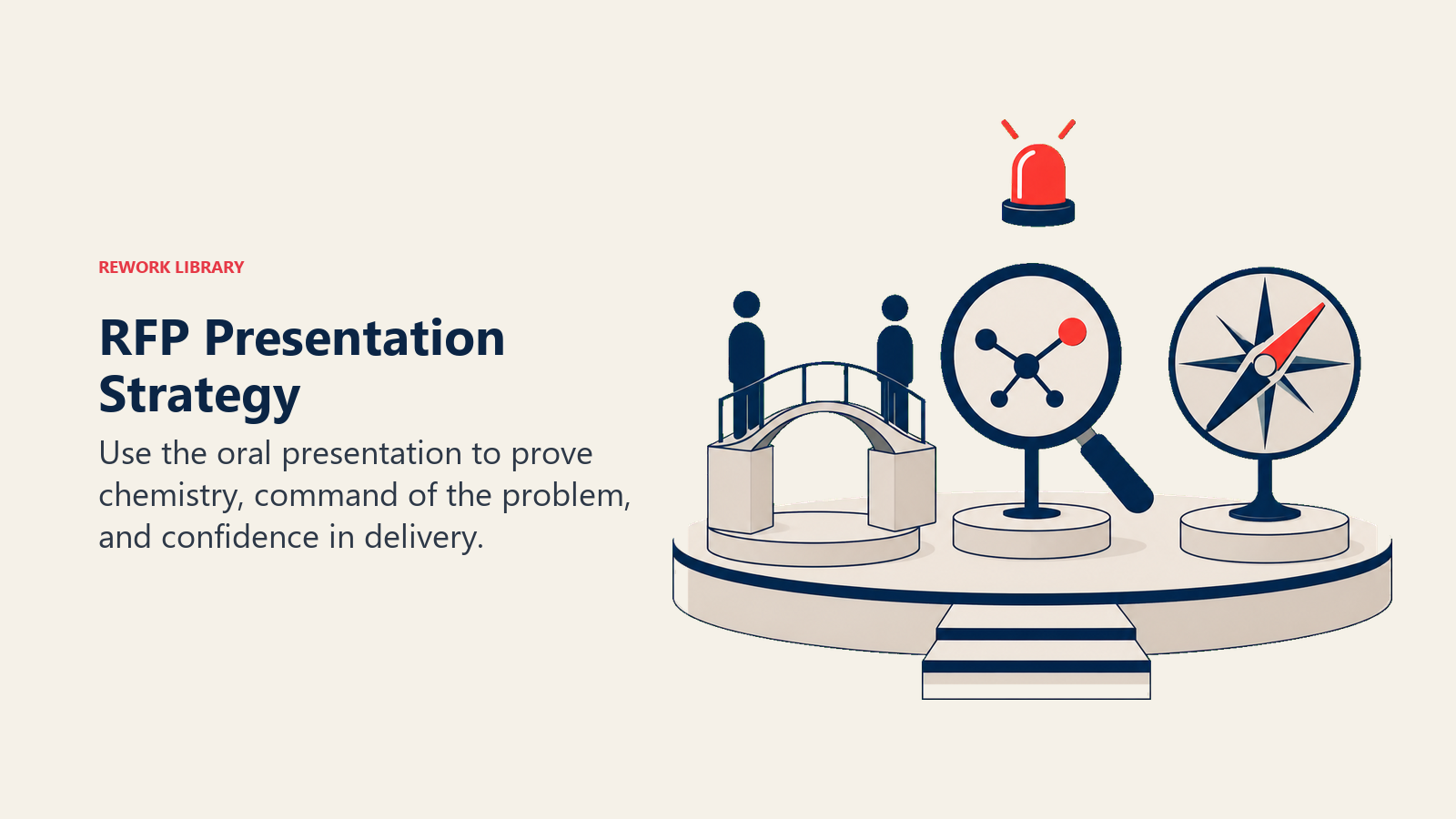
Many high-value RFPs include a presentation or oral interview with finalists. This is your chance to differentiate beyond the written document.
Team Selection
Who presents matters as much as what you present. Pick people who:
- Will actually work on the project (not just senior rainmakers)
- Communicate clearly and confidently
- Have relevant experience to discuss
- Represent diversity of thought and background
- Have chemistry as a team
Don't send six people if the buyer's team is three. Match or slightly exceed their numbers.
Presentation Preparation
Structure around their priorities: If they said they want to understand your approach to change management, make that 40% of your presentation.
Prepare for questions: Anticipate tough questions about pricing, resource availability, timeline, risks. Have clear answers ready.
Rehearse together: Run through the full presentation at least twice. Work out transitions, timing, who answers what.
Prepare leave-behinds: One-pagers that summarize your approach, team, and pricing. Make it easy for them to remember you.
Limit slides: You're selling a relationship and expertise, not a slide deck. 10-15 slides maximum for a 60-minute session.
Execution Tips
Start with connection: First 2 minutes should acknowledge something specific about their situation or reference prior conversations. Show you're not on autopilot.
Make it conversational: Don't just read slides. Engage the audience. Ask if they want you to go deeper on anything. React to their body language.
Tell stories: Case examples with specific client challenges and outcomes. Stories stick, bullet points don't.
Show your thinking: Walk through how you'd approach a specific challenge they mentioned. Let them see how you work.
End with clarity: Summarize your key differentiators and next steps. Make it easy for them to choose you.
Managing the RFP Sales Cycle
Submitting the proposal isn't the end. Now you're in waiting mode, but that doesn't mean being passive.
Timeline Management
Track your internal deadlines and theirs. When they said "decision in 45 days," put a reminder in your calendar to follow up if you haven't heard. Many RFPs run over timeline. Don't assume silence means rejection.
Stakeholder Communication
If you have contacts at the organization, stay connected without being annoying. A check-in every 2-3 weeks is reasonable: "Wanted to see if you need any clarification on our proposal or if there are additional questions we can answer."
This keeps you top of mind and sometimes surfaces information about the process.
Competitive Intelligence
If you hear competitors are being asked for references or doing presentations, that tells you timing. If you haven't been asked, you might be out. Worth a polite inquiry about your status.
Post-Submission Activities
Follow-Up Strategy
After submission:
- Send a thank-you note acknowledging the submission
- Confirm they received everything (especially if submitted electronically)
- Reiterate your interest and availability for questions
- Provide a single point of contact for any follow-up
If you make finalist round:
- Respond immediately to any requests
- Over-prepare for presentations
- Make yourself available for site visits or reference calls
- Continue relationship building with stakeholders
Debriefing and Learning
Whether you win or lose, request a debrief. Most buyers will provide at least some feedback. What to ask:
- What were the key factors in your decision?
- How did our proposal score across evaluation criteria?
- What could we have done better?
- Were there any concerns about our approach or team?
- Would you be open to working with us on future opportunities?
This intelligence helps you improve your response process and sometimes creates future opportunities.
Gracious Losing
When you lose (and you will lose more than you win), respond professionally:
- Congratulate the winner
- Thank them for the opportunity to propose
- Express interest in future opportunities
- Ask for feedback
- Stay in touch
The buyer might come back to you if the winner doesn't work out. Or they might have a different project. Don't burn bridges.
Common Mistakes That Kill RFP Success
Responding to every RFP: Volume doesn't equal results. Strategic selectivity does.
Generic proposals: Using templates without customization. Buyers can tell.
Weak differentiation: Not clearly explaining why you instead of someone else.
Poor coordination: Team working in silos instead of collaborating.
Missing deadlines: If you can't deliver a proposal on time, why should they trust you with their project?
Ignoring questions: Not answering what they asked because you'd rather talk about something else.
Pricing without strategy: Random numbers instead of thoughtful positioning.
No relationship building: Treating RFPs as purely transactional instead of relationship-based.
Failure to follow up: Submitting and hoping instead of actively managing the process.
Building RFP Response Capabilities
If RFPs are important to your business, build systematic capability instead of scrambling each time.
Response Infrastructure
Proposal library: Keep updated content libraries for common sections (company overview, methodologies, team bios, case studies). Don't start from scratch every time.
Template library: Proposal templates, presentation decks, pricing models. Standardize what can be standardized so you can focus customization where it matters.
Past proposal repository: Save all proposals (win and loss) so you can learn from what worked and reuse good content.
Graphics and visuals: Professional diagrams, process flows, frameworks. Invest in making these look good once, then reuse.
Team Development
Assign proposal specialists: Don't make everyone a proposal writer. Develop a few people who get really good at this.
Train on persuasive writing: Proposal writing is different from technical writing. Invest in training.
Create playbooks: Document your process, win themes by service line, competitive intelligence, pricing strategies. Make it repeatable.
Measurement and Optimization
Track your RFP performance:
- Number of RFPs received
- Number you responded to
- Win rate overall and by type/size
- Average proposal cost
- Revenue won through RFPs
- ROI by RFP type
Use this data to refine your go/no-go criteria and improve your response quality.
The Bottom Line
RFP response is expensive, time-consuming, and often frustrating. But for many professional services firms, it's a necessary part of business development, especially for large clients and government work.
The difference between firms that profit from RFPs and firms that lose money on them comes down to strategic selectivity and systematic execution.
Be ruthless about which opportunities deserve response. Build relationships before RFPs drop. Invest appropriately in the ones you choose to pursue. Make it hard for buyers to compare you to generic competitors. And learn from every response, win or lose.
The goal isn't to win every RFP. The goal is to win the right RFPs at profitable prices while building the capabilities that make your firm increasingly competitive.
That's what separates strategic RFP response from the expensive distraction that most firms practice.
Frequently Asked Questions
How much does responding to an RFP cost? A full response typically costs $25,000 to $50,000 once you account for partner time, proposal development, and opportunity cost. With an average win rate of 15-20%, firms that respond to everything spend heavily to win only one or two contracts a year. That math is why selectivity matters more than writing quality.
What is a good RFP win rate for professional services? Across all bids, 15-20% is the industry average. The number swings on positioning: defending incumbents win 60-70%, firms with an existing buyer relationship lift their odds 30-40%, and firms challenging an incumbent cold often sit at 10-15%. Track your win rate by RFP type to see where to focus.
When should a firm decline an RFP? Decline when the weighted go/no-go score falls below 3.5 out of 5, when response cost exceeds 10% of project value, or when signals point to a compliance exercise, incumbent test, or price-shopping bid. Walking away from poor-fit RFPs protects margin and frees senior time for winnable pursuits.
How do you increase RFP win rates? Build the buyer relationship before the RFP drops, gather intelligence on the real problem and decision criteria, develop 3-4 specific win themes tied to outcomes, and make direct comparison harder by reframing scope or pricing. Disciplined selectivity plus relationship-led positioning beats volume every time.
Learn More
Strengthen your RFP capabilities and overall sales process with these related resources:
- Client Qualification Framework - Determine which prospects deserve your pursuit
- Consultative Business Development - Build relationships that lead to invitations
- Proposal Development - Master the art of compelling proposals
- Pricing Justification - Defend your value in competitive situations
- Fit vs Misfit Identification - Know when to walk away from poor-fit opportunities

Sales Director
On this page
- The RFP Dilemma: Why Volume Kills Profitability
- Understanding the RFP Landscape
- The Go/No-Go Decision Framework
- Strategic Fit Assessment
- Win Probability Analysis
- Economic Viability Evaluation
- Risk Assessment
- The Go/No-Go Decision Matrix
- Pre-RFP Response Strategy
- Intelligence Gathering
- Relationship Building Before RFP
- Clarification and Questions
- RFP Response Development Process
- Project Planning and Team Formation
- Compliance and Requirements Analysis
- Win Themes and Strategy Development
- Proposal Content Development
- Executive Summary Excellence
- Technical Approach and Methodology
- Team Qualifications and Experience
- Past Performance and Case Studies
- Pricing Strategy and Justification
- Competitive Differentiation Strategies
- Ghosting Competitors
- Creating Unequal Comparison
- Risk Reversal
- Proposal Writing Best Practices
- Common Mistakes to Avoid
- Presentation and Orals Strategy
- Team Selection
- Presentation Preparation
- Execution Tips
- Managing the RFP Sales Cycle
- Timeline Management
- Stakeholder Communication
- Competitive Intelligence
- Post-Submission Activities
- Follow-Up Strategy
- Debriefing and Learning
- Gracious Losing
- Common Mistakes That Kill RFP Success
- Building RFP Response Capabilities
- Response Infrastructure
- Team Development
- Measurement and Optimization
- The Bottom Line
- Frequently Asked Questions
- Learn More