Client Success Reviews: Strategic Quarterly Business Reviews for Client Retention
Turn this article into takeaways for your work.


Each assistant summarizes the article only for you and suggests best practices for your work.
Here's a hard truth about professional services: 68% of clients leave not because of poor work quality, but because they don't feel you care about their success. They stop seeing value. They wonder what you've done for them lately. And when renewal time comes, they're already halfway out the door. This makes QBRs essential to your client relationship strategy.
Quarterly Business Reviews (QBRs) solve this problem by creating structured moments to demonstrate value, strengthen relationships, and align on future priorities. But most QBRs are terrible. They're glorified status reports that feel like homework for both sides. Nobody wants to be there. Nothing changes afterward.
This guide shows you how to design client success reviews that actually matter. The kind where executives clear their calendars to attend, where real strategic conversations happen, and where expansion opportunities emerge naturally because you've earned the right to discuss them.
What makes a QBR strategic vs administrative
The difference between a good QBR and a waste of time comes down to what you're trying to accomplish.
Administrative QBRs are backward-looking status updates. You show what you did last quarter, list deliverables completed, maybe share some metrics. The client nods along politely while checking email under the table. These meetings don't strengthen relationships. They're obligations.
Strategic QBRs are forward-looking partnership discussions. You show the business impact of your work, connect it to their strategic goals, and collaborate on what's next. The client brings their challenges to you because they trust you'll have valuable input. These meetings deepen relationships and create stickiness.
The shift happens when you stop reporting on tasks and start contributing to their business strategy. You're not just their vendor who implements projects. You're their advisor who helps them win.
Types of client success reviews and when to use them
QBRs are the most common format, but different situations call for different review types.
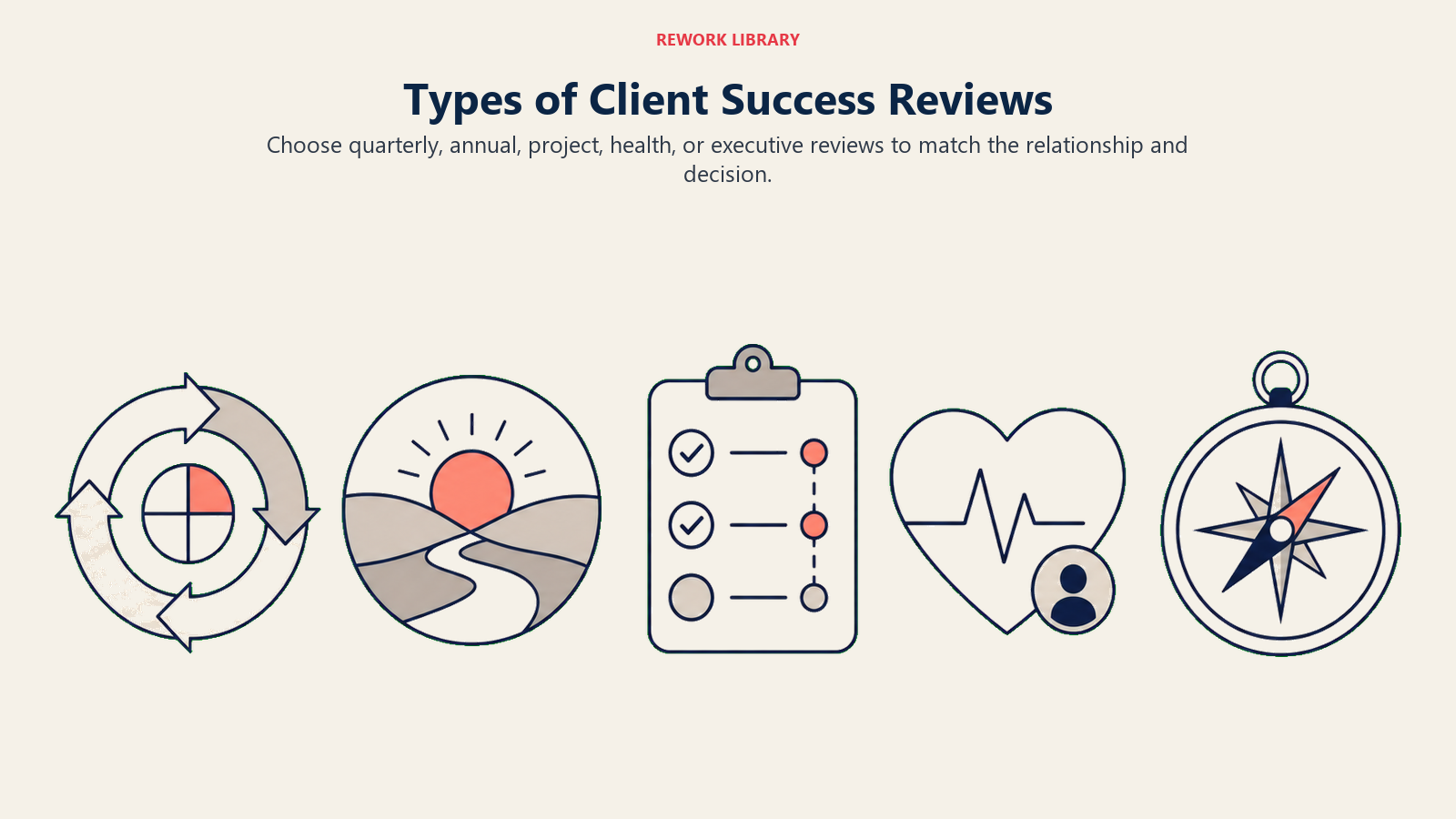
Quarterly Business Reviews: The standard rhythm for ongoing client relationships. 60-90 minutes, happens every quarter, includes stakeholders from both sides. This is your main tool for retention and expansion.
Best for clients where you have ongoing engagements, retainer relationships, or multi-project pipelines. If the relationship is transactional or project-based with clear endpoints, QBRs might feel forced.
Annual Strategic Planning Sessions: More intensive, half-day or full-day sessions focused on the year ahead. You're helping clients set strategy, prioritize initiatives, and plan resource allocation.
Use these with your top-tier clients where you're deeply embedded. These sessions often happen in December or January and set the stage for next year's budget conversations.
Mid-Engagement Check-ins: Lighter touchpoints during active projects, usually 30-45 minutes. You're validating that you're on track, surfacing issues early, and maintaining alignment.
Schedule these at natural project milestones, not on a fixed calendar. After completing discovery, before moving to implementation, at the halfway point of delivery.
Post-Project Retrospectives: After wrapping a significant engagement, you step back and review what worked, what didn't, and what you learned together.
These create closure and set you up for the next opportunity. They also give you testimonial-quality feedback when things went well.
Executive Steering Committees: For large, complex engagements with multiple workstreams. These bring together senior leaders to make decisions, remove blockers, and ensure strategic alignment.
These aren't optional when you're running enterprise transformations or multi-million dollar programs. Governance matters.
The format you choose depends on relationship depth, engagement complexity, and what decisions need to be made. But the principles are the same: demonstrate value, align on strategy, move forward together.
The QBR framework that actually works
Let me give you the structure we use that consistently gets clients asking "when's the next one?"
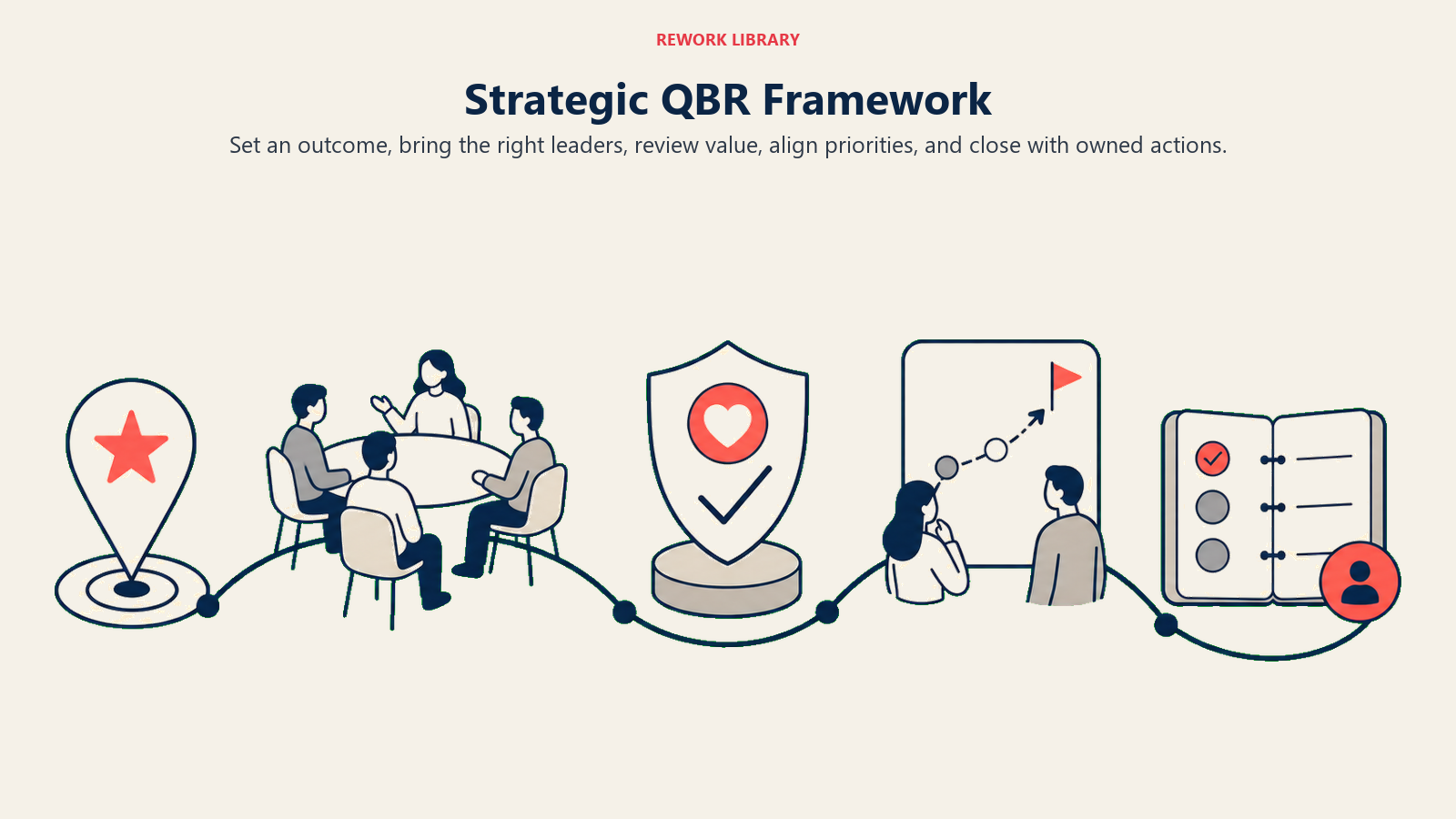
Purpose and objectives: Be clear about why you're meeting. Not "to review the quarter" but "to validate business impact, align on Q2 priorities, and explore opportunities in the marketing function." Specific outcomes make meetings productive.
Cadence and timing: Quarterly is the sweet spot for most relationships. Monthly feels like overkill unless you're in crisis mode. Semi-annually gives too much time for drift. Schedule them at least 3-4 weeks out so you're not fighting for calendar space.
Timing within the quarter matters. If you meet in the last week of Q1, nobody's thinking about Q1 anymore. They're already in Q2 fire-drills. Schedule for weeks 2-3 of the new quarter when you have complete data but people are still interested.
Participants and roles: From your side, bring the relationship owner and a subject matter expert who can answer technical questions. From their side, you want the economic buyer plus key stakeholders who use your services.
If only junior people show up from their side, your relationship is weaker than you think. Push to get decision-makers in the room, even if it means rescheduling.
Meeting agenda template: Here's the structure that works:
- Opening (5 min): Agenda review, objectives for the meeting
- Looking Back (20 min): Wins, business impact, challenges addressed
- Performance Review (15 min): Metrics, KPIs, trend analysis
- Looking Forward (20 min): Their upcoming priorities, industry insights, how you can help
- Strategic Discussion (20 min): Deep dive on one strategic topic they care about
- Action Items & Next Steps (10 min): Clear commitments from both sides
Total: 90 minutes. The strategic discussion section is what transforms this from a status meeting into a partnership conversation.
Duration and format: 90 minutes is ideal. 60 minutes works if you've got tight alignment and simple scope. 2 hours only makes sense for annual planning sessions or when you have multiple business units involved.
In-person is always better if feasible. Video is fine for established relationships. Never do these as conference calls without video. You need to see people's reactions.
Pre-meeting preparation that sets you up for success
The meeting itself is only 10% of the work. The preparation determines whether it's valuable or generic.
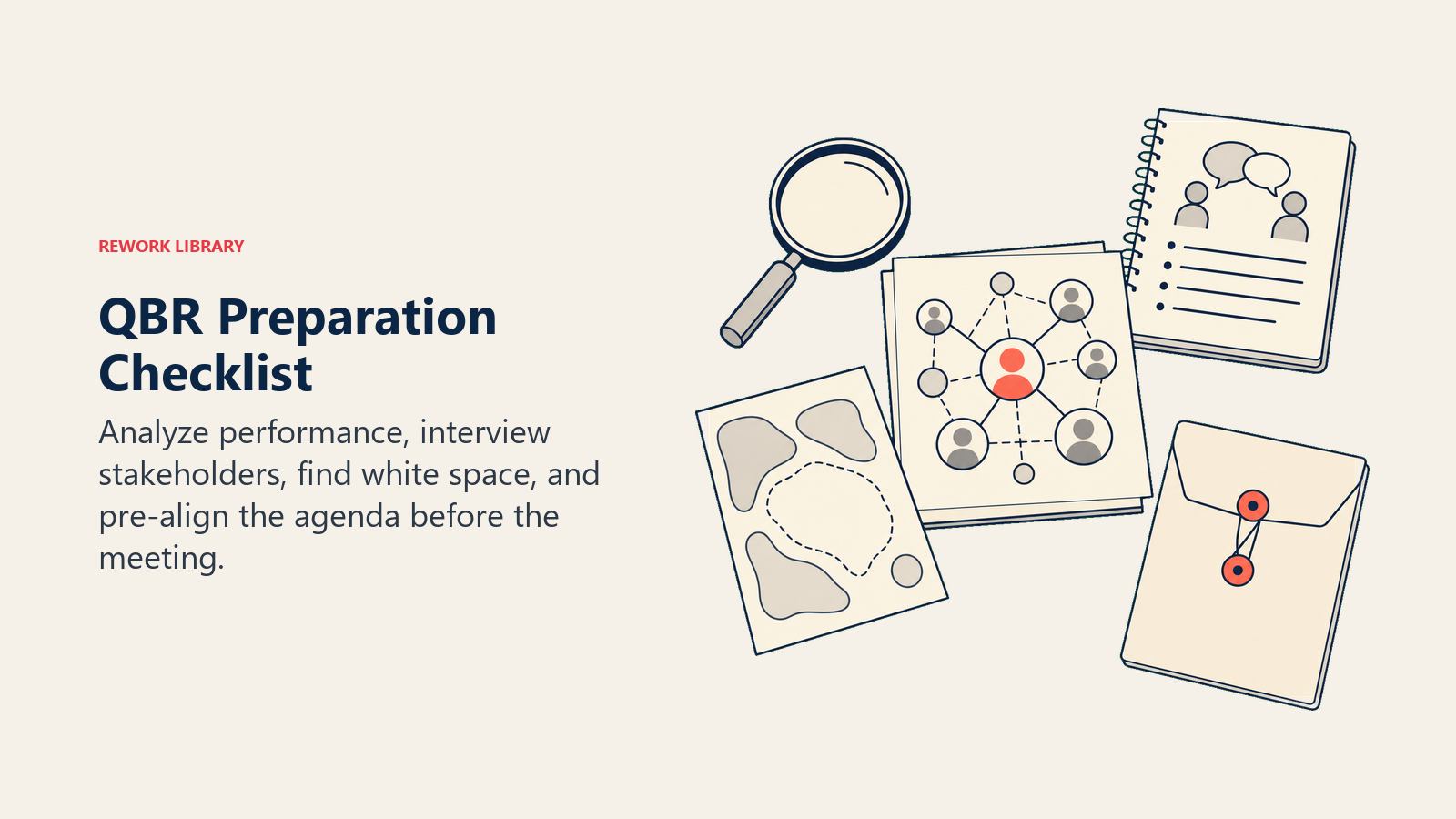
Data gathering and analysis: Pull everything. Project status, deliverables completed, hours invested, tickets resolved, whatever metrics matter. But don't just compile numbers. Analyze them. What trends do you see? What changed quarter-over-quarter? What stands out?
If you implemented a new process and response times dropped 40%, that's your headline. If adoption plateaued, you need to understand why before the meeting.
Stakeholder interviews: Talk to 3-5 people on their team before the formal review. Ask what's working, what's frustrating them, what's keeping them up at night. This gives you real intelligence that won't come up in the group meeting.
These conversations also help you identify champions (people who'll defend you in budget discussions) and detractors (people who need more attention from you). This informal feedback becomes part of your broader client feedback systems.
Performance metrics compilation: Create a dashboard view of the metrics that matter to them. Not just your operational metrics, but business impact metrics. If you're managing their infrastructure, they care about uptime and incident frequency. But they also care about whether IT is enabling growth or slowing it down.
Connect your work to their OKRs when possible. If their Q1 goal was "launch in 3 new markets" and your work enabled that, make the connection explicit.
Success stories and wins: Identify 2-3 concrete examples where your work created business value. Not "we completed the migration" but "the migration reduced database costs by $15K/month and improved page load times by 60%, which contributed to the 12% increase in mobile conversions."
Specificity matters. Stories matter. Numbers without stories are boring. Stories without numbers are fluff. You need both.
Challenge identification: Be honest about what didn't go perfectly. If you had a service disruption, missed a deadline, or struggled with scope creep, address it proactively. Explain what you learned and what you've changed.
Clients respect honesty. They lose trust when you pretend everything's perfect when they know it wasn't.
Opportunity analysis: Look for white space. Where are they solving problems without your help that you could address? What new initiatives did they mention in stakeholder interviews? What adjacent services make sense given what you already do for them?
Don't come in planning to pitch. Come in having identified where you might be able to help, and be ready to discuss if they express interest.
Review content that demonstrates strategic partnership
What you present and how you present it sends a message about what kind of partner you are.
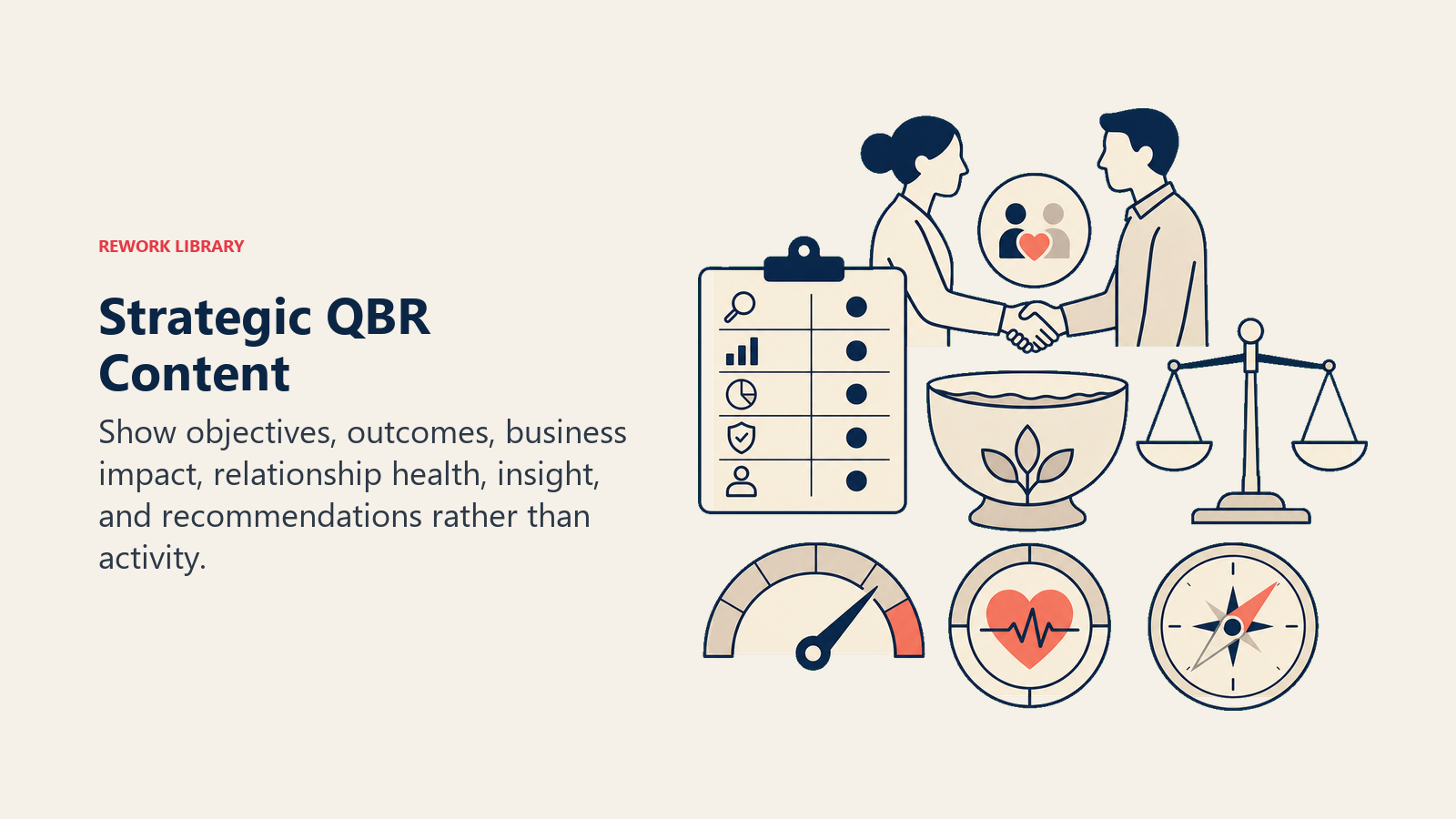
Performance against objectives: Start by revisiting what you agreed to accomplish. If you set goals at the last QBR or in the SOW, show progress against those specific commitments. Green/yellow/red status indicators work well for quick visual assessment.
If you exceeded goals, celebrate that. If you missed them, explain why and what you're doing differently. Accountability builds trust.
Value delivered and ROI: This is where most firms fall short. They report activities instead of outcomes. "We completed 47 support tickets" doesn't tell the client anything about value. "We resolved 47 incidents with an average resolution time of 2.3 hours, preventing an estimated $180K in lost productivity" tells a story.
Calculate ROI when possible. If they're paying you $10K/month and you've helped them avoid $50K in waste or generate $100K in new revenue, that math matters.
Key achievements and wins: Highlight the things you're proud of. Product launches that went smoothly. Problems you solved creatively. Risks you identified and mitigated before they became issues.
Use before/after comparisons. "Before we implemented the new workflow, invoice processing took 14 days. Now it takes 3 days, and your team has reallocated those 40 hours/month to strategic analysis."
Challenges and how you addressed them: Transparency about challenges actually strengthens relationships. If a key resource left your team and you brought in someone senior to backfill without disruption, that shows how you handle adversity.
If the client threw you a curveball and you adapted, walk through how you adjusted plans and why you made those choices. Your issue resolution process should be part of the story you tell.
Industry insights and trends: Share what you're seeing across your client base (without violating confidentiality). "Three of our healthcare clients are dealing with similar compliance changes. Here's how they're approaching it." This positions you as a strategic advisor, not just an implementer.
Bring them intelligence they don't have access to. That's valuable.
Upcoming initiatives: Ask about their Q2 and Q3 priorities. What's on the roadmap? What's keeping leadership up at night? What would they love to accomplish if they had the resources?
This isn't a sales conversation yet. It's genuine interest in their success. But it naturally creates opportunities to say "we could help with that" when it's relevant.
Expansion opportunities: If your preparation identified white space and the conversation has been going well, introduce expansion topics carefully. "You mentioned you're struggling with X. We've helped other clients solve similar problems with [approach]. Would it be worth exploring?"
Read the room. If they're budget-constrained or the relationship isn't strong, don't push. Plant seeds and follow up later.
Presentation and facilitation techniques
Content matters, but delivery matters just as much.
Executive summary deck: Create a polished presentation, but keep it visual. Dense slides full of text put people to sleep. Use charts, graphs, screenshots, and minimal bullet points.
Your deck should support the conversation, not be the conversation. If you're just reading slides, you've failed.
Data visualization: Turn numbers into visuals. Line charts for trends, bar charts for comparisons, gauges for KPIs against targets. The human brain processes visuals 60,000 times faster than text.
Use color purposefully. Green for good, red for problems, gray for context. Don't get fancy with 3D charts or weird fonts. Clean and clear wins.
Storytelling with metrics: Every significant metric needs a story. "Support ticket volume increased 23% quarter-over-quarter. That correlates with your launch of the new product line. Here's how we're scaling to accommodate that growth."
Context turns data into insight.
Facilitating discussions: Don't present at people for 90 minutes. Present for 40, discuss for 50. Ask questions. "Does this align with what you're seeing?" "What would success look like for you next quarter?" "Is this the right metric to track or should we adjust?"
The best QBRs feel like collaborative working sessions, not performances.
Action item capture: Designate someone (usually not the presenter) to capture action items in real-time. Who's doing what by when. Project them on screen so everyone sees the list building.
Send the action item summary within 24 hours while it's fresh. This shows you're serious about follow-through.
Value demonstration methods that create stickiness
Clients renew when they understand the value you deliver. Here's how to make that crystal clear.
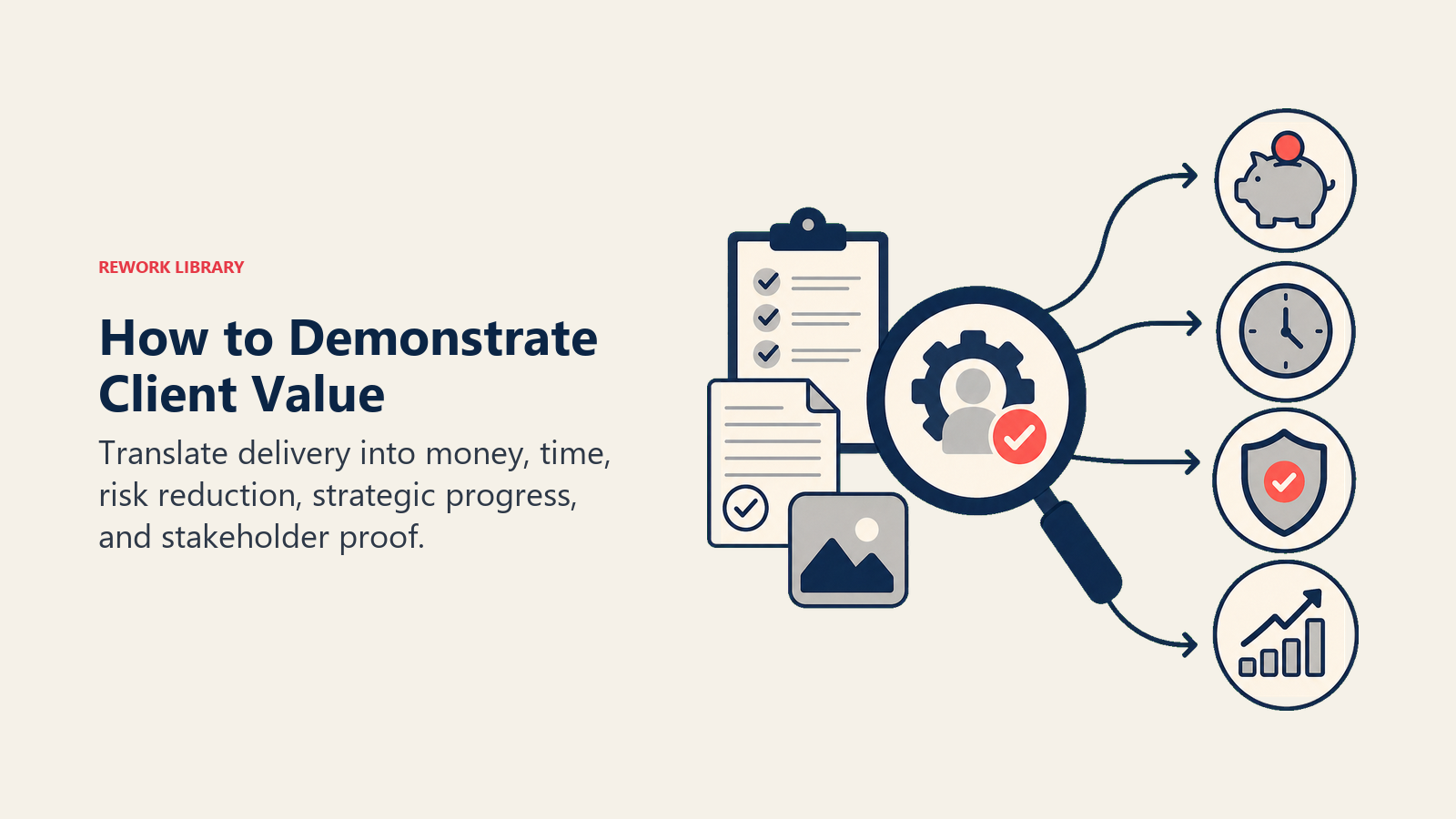
Quantifying business impact: Translate your work into their language, which is usually money or time. Cost savings, revenue generated, time recovered, risks avoided. Put dollar figures on things when possible.
If you can't quantify directly, estimate conservatively. "Based on industry benchmarks, reducing vendor onboarding time from 6 weeks to 2 weeks likely saves 160 hours of staff time per vendor, which at your loaded labor rates is roughly $8K per vendor. You onboarded 12 vendors this quarter."
Before/after comparisons: Visual comparisons are powerful. Show what the process looked like before your engagement and what it looks like now. Screenshots, workflow diagrams, performance graphs.
"Last year at this time, your customer support backlog was 340 tickets with an average age of 9 days. Today it's 45 tickets with an average age of 18 hours. Here's how we got there."
Benchmarking: If you have data across clients, show them where they stand. "Your incident response time is in the top quartile of companies your size. Your mean time to resolution has room for improvement compared to industry benchmarks."
Be careful with this. Some clients love competitive benchmarking. Others find it stressful or irrelevant. Know your audience.
Testimonials and feedback: Include quotes from their team members who use your services daily. "Sarah in Finance said the new reporting dashboard cut her month-end close process from 3 days to 1 day." Real voices from their organization carry weight.
If you have NPS or satisfaction survey data, include it. But explain what you're doing about detractors. QBRs are also excellent opportunities to identify candidates for formal client testimonials and case studies.
Strategic planning component
This is what separates good QBRs from great ones. You're not just reviewing the past. You're helping them think through the future.
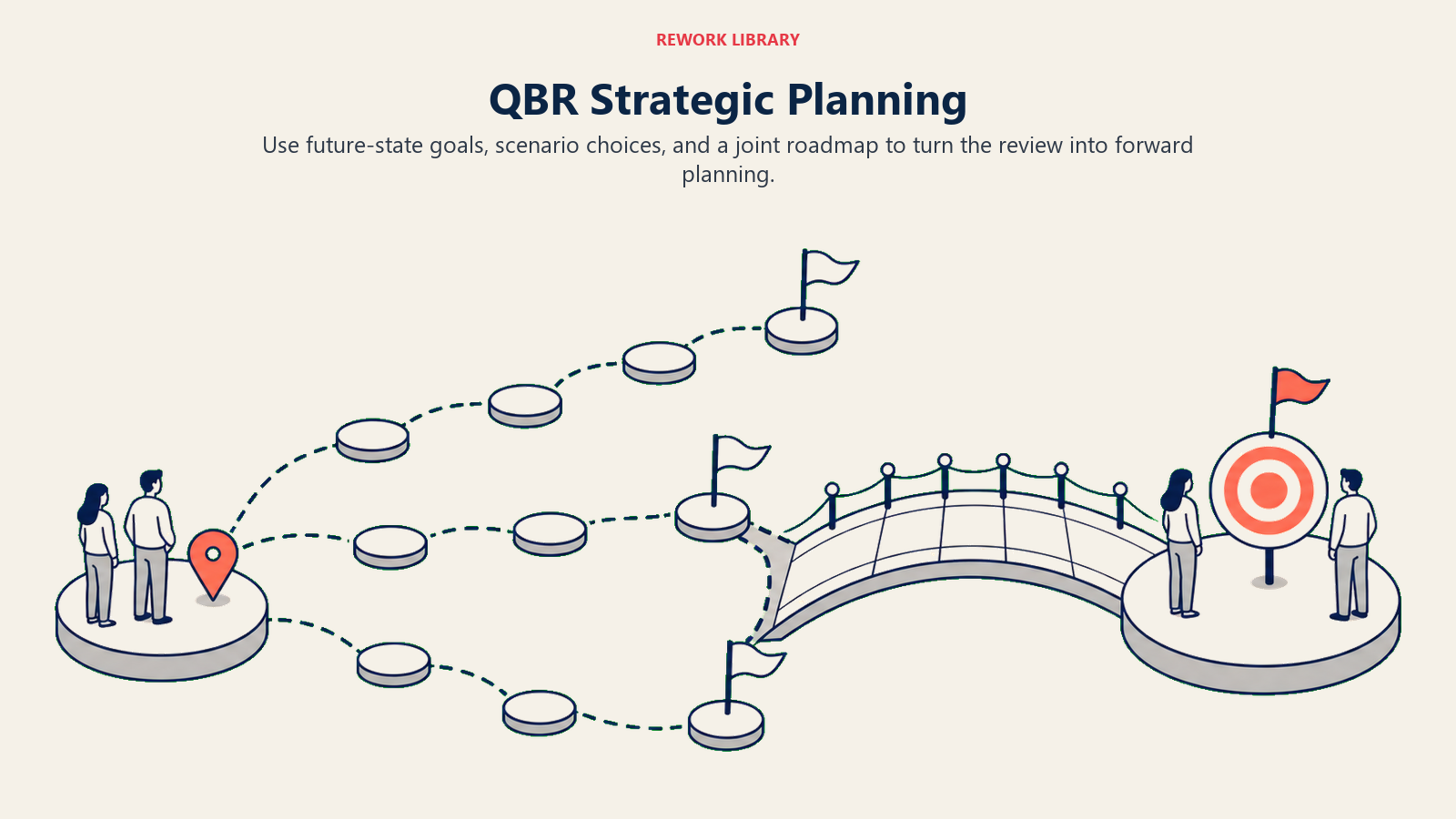
Future state visioning: Ask where they want to be in 12 months. What would success look like? What capabilities would they need? What problems would be solved?
This isn't about what you'll deliver. It's about their business goals. Understanding that lets you position your services as enablers of their vision.
Goal setting: Help them articulate specific, measurable goals for the next quarter or two. If they say "we want to improve customer satisfaction," work with them to define what that means. "Increase NPS from 42 to 50? Reduce support ticket resolution time by 30%?"
Clear goals create clear value demonstrations later.
Resource planning: Talk about capacity and constraints. Do they have the internal resources to execute their plans? Where are the bottlenecks? How do staffing changes affect timelines?
This is where you can naturally discuss how augmenting their team with your resources solves specific problems.
Initiative prioritization: If they have 10 things they want to accomplish and resources for 5, help them think through prioritization. What delivers the most value? What's most urgent? What's foundational for other initiatives?
You're acting as a strategic advisor here. This builds trust and positions you as a thought partner, not just a vendor.
Expansion integration that feels natural
Here's what most firms get wrong about expansion: they treat it like a sales pitch tacked onto the end of the meeting. That feels transactional and breaks rapport.
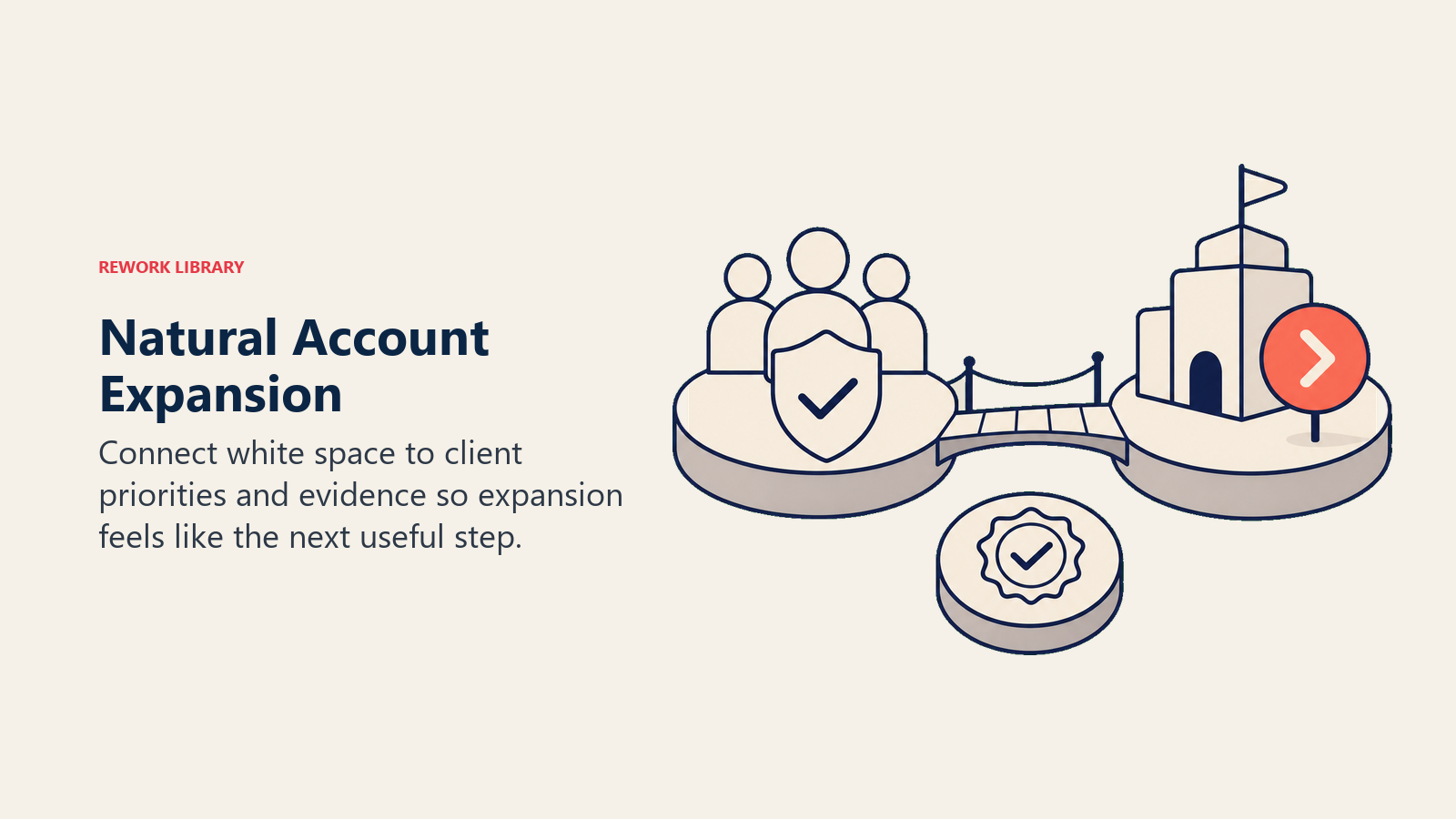
Identifying white space: Through stakeholder interviews and the strategic discussion, you should have identified areas where they need help that you're not currently providing. These are natural expansion opportunities.
The key is identifying needs they've expressed, not needs you're inventing to hit your growth targets.
Introducing new services: When relevant, mention how you've helped similar clients solve similar problems. "A few clients have asked us to help with [adjacent service]. We've built some capabilities there. If that's interesting, we could explore it."
Plant seeds, don't pitch. If they're interested, they'll ask for more information. If not, you've planted awareness for later.
Scope expansion discussions: Sometimes expansion isn't a new service, it's doing more of what you already do. "We're currently supporting your North American operations. As you expand into EMEA, you mentioned you'll need similar infrastructure. We could extend our support to cover those regions."
This is an obvious extension, not a stretch.
ROI justification: If expansion conversations get serious, help them build the business case. "Based on what we've seen with similar clients, investing in this capability typically pays back in 6-9 months through [specific benefits]. Want to model it out?"
You're making their decision easier by doing the analysis work.
The golden rule: only discuss expansion if you've earned the right. If the current engagement isn't going well, fix that before asking for more. If the relationship is strong and you've demonstrated value, expansion conversations happen naturally.
Post-review follow-up that maintains momentum
The meeting ends, but the real work starts.
Action item tracking: Within 24 hours, send a summary email with the action items captured during the meeting. Include who owns each item and the agreed timeline.
Create a shared tracker if the action list is substantial. Update it regularly so both sides can see progress.
Commitments: If you committed to delivering something, delivering a proposal, or following up on a specific topic, do it on time. Every kept commitment builds trust. Every missed one erodes it.
Set internal deadlines earlier than client-facing ones so you have buffer.
Follow-up communications: Don't go silent until the next QBR. Send periodic updates on action items, share relevant articles or insights, check in when you know they have major initiatives happening.
The goal is continuous engagement, not quarterly check-ins with radio silence in between.
Next review scheduling: Before you leave the meeting, schedule the next QBR. Get it on calendars while everyone's there. If you wait, you'll spend weeks playing calendar tetris.
Technology and tools that streamline the process
You don't need fancy software, but a few tools make this much easier.
Presentation software: PowerPoint, Google Slides, Keynote - whatever works. Keep templates consistent so you're not reinventing the wheel each quarter. Build a master template with your standard sections, then customize content.
Dashboards: If you're tracking metrics ongoing, a live dashboard is better than static screenshots. Tools like Tableau, Looker, Power BI, or even Google Data Studio let clients see real-time data.
Share dashboard access so they can check in between QBRs. Transparency builds trust.
CRM: Your CRM should track QBR schedules, action items from past meetings, topics discussed, and expansion opportunities identified. If you're using Salesforce, HubSpot, or similar, create a QBR record type.
Document what happened so anyone on your team can read the history and understand the relationship.
Collaboration tools: For action item tracking, Asana, Monday.com, or even a shared Google Sheet works. The tool matters less than the discipline of maintaining it.
Survey tools: Consider sending a brief post-QBR survey. "How valuable was this meeting? What should we do more/less of?" Use TypeForm or Google Forms. Five questions max.
This gives you feedback to improve future QBRs and shows you care about making them valuable for them.
Metrics that tell you if QBRs are working
You should measure whether these meetings actually drive the outcomes you care about.
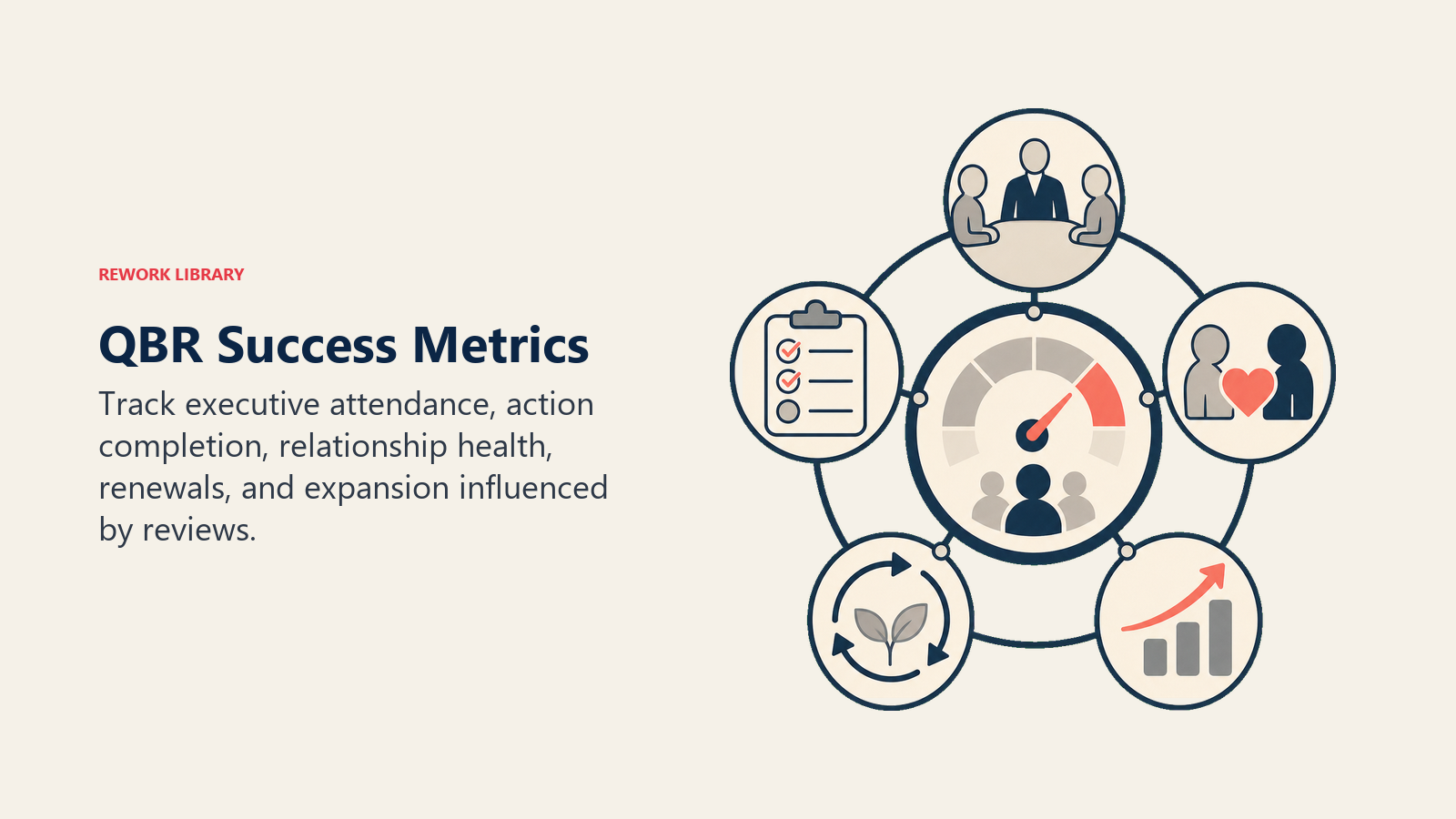
Attendance and participation: Who shows up? If you're getting senior stakeholders consistently, that signals they find value. If you're getting junior people or lots of last-minute reschedules, that's a problem.
Track attendance levels and seniority over time. Trends tell you about relationship health.
Engagement during meetings: Are people asking questions, contributing ideas, bringing up challenges? Or are they passive and distracted? You can't quantify this perfectly, but you know it when you see it.
Take notes on energy levels and participation. If meetings feel flat, something's off.
Action item completion rate: What percentage of action items (from both sides) get completed on time? If you're hitting 80%+ completion, you're doing well. If it's 40%, either you're committing to unrealistic things or there's no accountability.
Expansion pipeline: How many expansion opportunities emerge from QBRs? Not every QBR should produce a new sales opportunity, but over time, strategic relationships should expand.
Track expansion revenue that originated from QBR discussions. That's the clearest ROI.
Retention impact: Do clients who have regular QBRs renew at higher rates than those who don't? You should see a clear correlation. If QBR clients have 95% retention and non-QBR clients have 70% retention, that's a powerful signal.
Run the analysis annually to validate the investment.
Client satisfaction scores: If you run NPS or satisfaction surveys, segment by whether clients participate in QBRs. You should see higher scores for clients with regular strategic reviews. Your client satisfaction management program should track this correlation.
Best practices that make the difference
Executive sponsorship: Your most senior person who has a relationship with their most senior person should attend at least some QBRs. This signals that the relationship matters at the top of your organization.
Even if an account manager runs most QBRs, having your partner or VP join annually sends a message.
Data-driven not data-heavy: Show the metrics that matter, but don't drown people in 40 charts. Five key metrics with commentary beats 30 metrics with no context.
If they want more detail, have backup slides or offer to send a detailed report after.
Forward-looking not backward-focused: Spend 60% of the time on future priorities and strategic topics, 40% on past performance. The past is context. The future is where decisions get made.
Collaborative not presentational: Create dialogue, not monologue. Ask questions, invite input, build on their ideas. The best QBRs feel like working sessions where you're solving problems together.
Customized not templated: Tailor content to what matters to each client. If one client cares about cost optimization and another cares about speed to market, your emphasis should shift.
Generic QBRs feel like you're going through the motions.
Honest and transparent: If something went wrong, own it. If you don't have an answer, say so and commit to finding out. Credibility comes from honesty, not perfection.
Value-focused: Everything should tie back to business value for them. Not "we did X hours of work" but "that work enabled you to achieve Y outcome."
Common mistakes that undermine QBRs
Treating them as status reports: If your QBR is just a list of tasks completed, you're wasting everyone's time. Send that in an email. Use meeting time for strategy and discussion.
Not preparing adequately: Showing up with generic slides and no stakeholder intel makes you look like you don't care. Preparation shows respect and professionalism.
Focusing on your challenges instead of their success: Nobody cares that you had a resource leave or that a vendor delayed a delivery unless it impacts them. Frame everything from their perspective.
Asking for expansion when you haven't earned it: If the current work is rocky, fix that before asking for more budget. Clients don't give more money to vendors they're unhappy with. Focus on your client retention strategy before pursuing expansion.
No follow-up: If you don't execute on action items or go silent after the meeting, you've wasted the opportunity. Consistency matters more than perfection.
Making it too long: Two-hour QBRs lose attention. Keep it tight, focused, and valuable. If you need more time for strategic planning, schedule a separate session.
Only talking, not listening: If you're presenting for 80 minutes and leaving 10 for questions, you're not learning what you need to know. Balance sharing and listening.
How to launch a QBR program
If you're not currently doing structured client reviews, here's how to start.
Pilot with your top clients: Pick 3-5 of your best client relationships. These are clients who already trust you, where the engagement is healthy, and where you want to deepen the partnership.
Reach out and propose the concept: "We'd like to establish quarterly strategic reviews to make sure we're fully aligned on your priorities and delivering maximum value. Would you be open to testing this?"
Most clients will say yes if you position it as being about their success.
Create a standard template: Build your QBR deck template with the sections outlined earlier. Customize for each client, but start from a consistent foundation.
This makes preparation faster and ensures you don't forget key elements.
Set expectations internally: Make QBRs a required discipline for account managers. Build prep time into their capacity planning. Track completion and quality.
If QBRs are "nice to have," they won't happen consistently.
Gather feedback and iterate: After the first round, ask clients what was valuable and what wasn't. Adjust your approach based on their input.
Ask your team what's working operationally. Make it easier to do well.
Expand gradually: Once you've proven the model with your top clients, roll it out more broadly. You might tier it - comprehensive QBRs for top clients, lighter check-ins for mid-tier, nothing formal for small accounts.
Not every client needs or wants a full QBR. Match intensity to relationship value.
Where to go from here
Client success reviews are the keystone of retention and expansion. When done well, they transform vendor relationships into strategic partnerships.
Once you've established a strong QBR practice, everything else in client management gets easier:
- Client relationship strategy provides the foundation for structuring relationships at different levels
- Client communication cadence fills in the touchpoints between formal reviews
- Cross-sell strategy helps you systematically identify and pursue expansion opportunities
- Professional services metrics defines what to track and how to present business impact
Start simple. Schedule your first QBR with your best client. Prepare thoroughly. Make it about their success, not your accomplishments. Listen more than you talk. Follow through on commitments.
That foundation will create relationships that last, referrals that bring new business, and expansions that grow your accounts predictably. The client who feels cared for doesn't leave when a competitor comes knocking. They call you first when they have a new problem to solve.
That's what strategic client success reviews create - the right to be their first call.

Sales Director
On this page
- What makes a QBR strategic vs administrative
- Types of client success reviews and when to use them
- The QBR framework that actually works
- Pre-meeting preparation that sets you up for success
- Review content that demonstrates strategic partnership
- Presentation and facilitation techniques
- Value demonstration methods that create stickiness
- Strategic planning component
- Expansion integration that feels natural
- Post-review follow-up that maintains momentum
- Technology and tools that streamline the process
- Metrics that tell you if QBRs are working
- Best practices that make the difference
- Common mistakes that undermine QBRs
- How to launch a QBR program
- Where to go from here