Firm Specialization: The Bold Growth Strategy That Beats Generalists
 A bold growth strategy for a professional services firm means committing to one specialization instead of chasing every deal. Specialists out-earn generalists on the same revenue: higher margins, win rates near 40% to 50%, larger projects, and shorter sales cycles. This guide shows how to pick a niche, model the economics, and execute the transition.
Turn this article into takeaways for your work.


Each assistant summarizes the article only for you and suggests best practices for your work.
Here's the uncomfortable truth: 65% of professional services firms never make a clear strategic choice about specialization. They drift. They take whatever work comes through the door, build capabilities reactively, and end up being "pretty good" at a lot of things instead of exceptional at anything specific.
And that middle ground is getting expensive. Buyers want specialists. They'll pay 30-50% premiums for firms that know their industry, understand their challenges, and can show a track record of similar work. Meanwhile, generalist firms compete on price because they can't prove specialized expertise.
But here's the catch - specialization is scary. What if you pick the wrong niche? What if you turn away good business? What if the market shifts and your specialty becomes obsolete? These are real concerns, and they keep firm leaders stuck in analysis paralysis.
This guide walks through the specialization decision systematically. You'll learn how to evaluate your options, choose a profitable focus, build deep expertise, and execute the transition without destroying your existing business. Specialization isn't an all-or-nothing bet - it's a strategic choice with multiple models and implementation paths.
The specialization dilemma: why most firms stay stuck
Most professional services firms start as generalists by necessity. When you're building a practice, you can't afford to turn down work. You take projects in different industries, serve various client types, and develop broad capabilities. That's normal. The problem is what happens next. Firms grow to $5M, $10M, or $20M in revenue without ever defining what they're actually specializing in. They've got healthcare clients and financial services clients and manufacturing clients, each representing 15-20% of revenue. No single focus, no clear market positioning.
Why does this happen? A few reasons:
Fear of limiting opportunity. Partners worry that specializing means saying no to potential business. And they're not wrong - you will turn some things down. But the math works in your favor. When you specialize, you win a higher percentage of the opportunities you pursue in your chosen area. Your close rate might go from 20% to 40-50% because you're the obvious choice.
Existing client diversity. When you've already got clients across multiple industries, the idea of focusing on just one feels like you're abandoning revenue. But you don't have to fire clients - you just stop actively pursuing work outside your specialty. Those diverse clients often continue as long-term relationships while your new business efforts focus on your target niche.
Partner disagreement. Different partners have different backgrounds and preferences. One wants to focus on healthcare, another on financial services, a third on tech companies. Without consensus, the firm stays generalist. This is fundamentally a governance issue that requires leadership to make a strategic decision and commit to it.
Market uncertainty. What if the niche you pick stops growing? What if regulation changes? What if new technology disrupts the whole vertical? These risks exist, but they exist for generalists too. The difference is specialists see market shifts coming earlier because they're deeply embedded in that world.
The cost of staying generalist is hidden but real. You can't build deep expertise in everything. You can't create industry-specific IP or methodologies. You can't build strong referral networks in multiple verticals. You spread resources thin instead of building competitive advantages.
The economics: specialist vs generalist financial performance
Let's look at the numbers because specialization is ultimately an economic decision. Based on data from thousands of professional services firms, here's what the financial performance looks like:
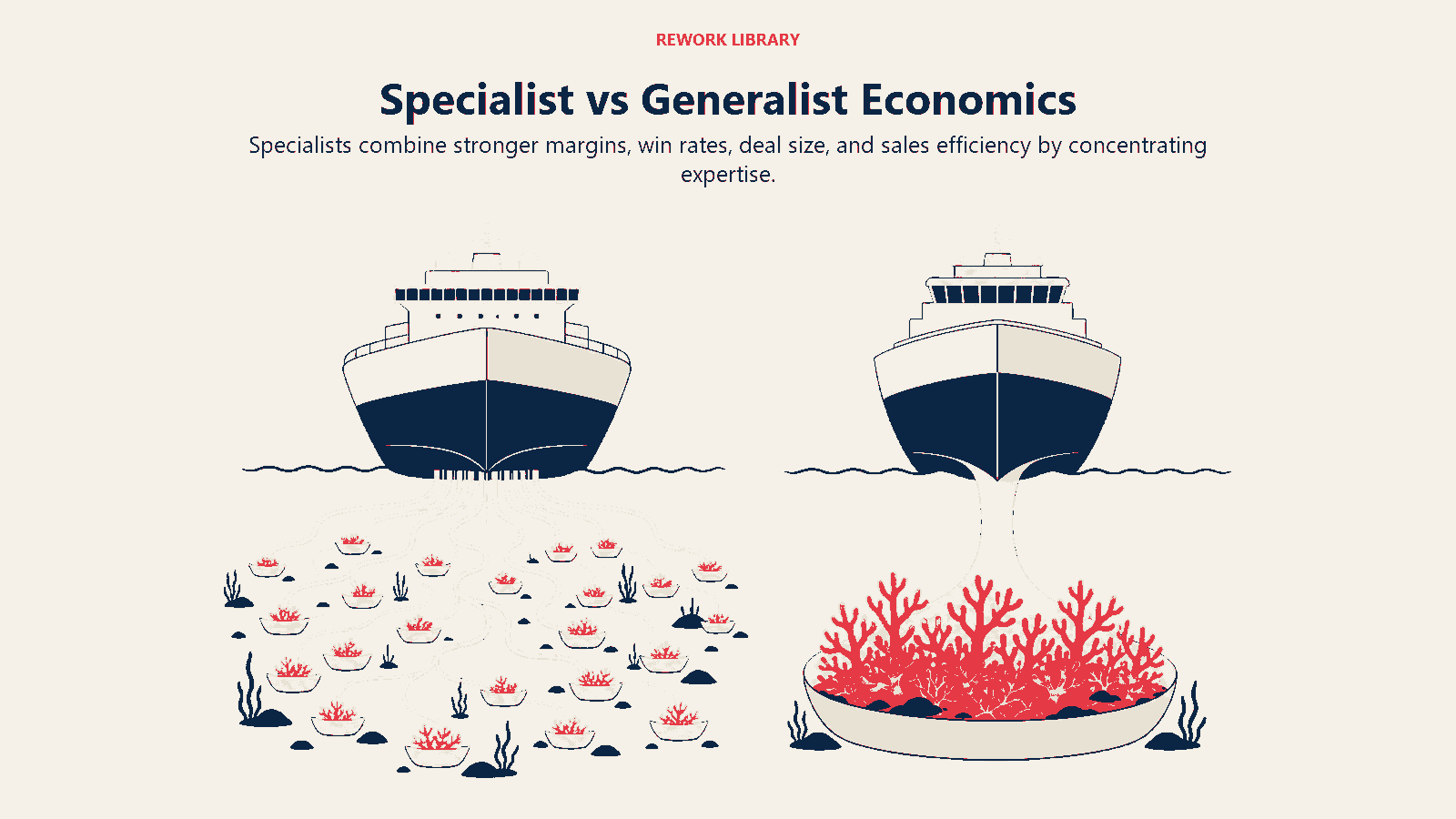
Generalist firms (no dominant industry focus):
- Average revenue per employee: $150K-$180K
- Gross margin: 40-50%
- Win rate on proposals: 15-25%
- Sales cycle: 3-6 months
- Average project size: baseline
- Client acquisition cost: high (lots of one-off relationships)
- Referral rate: moderate (clients refer within diverse industries)
Specialist firms (60%+ revenue from one vertical or niche):
- Average revenue per employee: $200K-$250K
- Gross margin: 50-65%
- Win rate on proposals: 35-50%
- Sales cycle: 2-4 months
- Average project size: 30-50% larger than baseline
- Client acquisition cost: lower (concentrated referral networks)
- Referral rate: high (deep industry networks)
The specialist advantage compounds. Higher margins plus larger project sizes plus better win rates equals significantly better economics. A $10M generalist firm might generate $3M in gross profit. A $10M specialist firm in a good niche could generate $5M+ with lower sales costs.
There's also the premium pricing factor. When clients see you as the expert in their space, they're less price-sensitive. You're not competing against five other firms on hourly rate - you're competing on outcomes and track record. That's a much better position.
But here's what most people miss: specialists also have better operational efficiency. When you do similar work repeatedly, you get faster. You develop templates, frameworks, and processes. Your teams ramp up quicker because they're not learning a new industry every project. Labor costs as a percentage of revenue drop.
Understanding the specialization continuum
Specialization isn't binary. There's a range of models between full generalist and hyper-specialist. Understanding where you might land helps with the strategic decision. Full generalist model: No industry or service focus. You'll work with anyone on anything within your broad capability areas (strategy consulting, marketing services, etc.). This is sustainable only if you have some other differentiation - geographic dominance in a small market, unique delivery model, personal relationships that drive business. Otherwise, you're competing primarily on price.
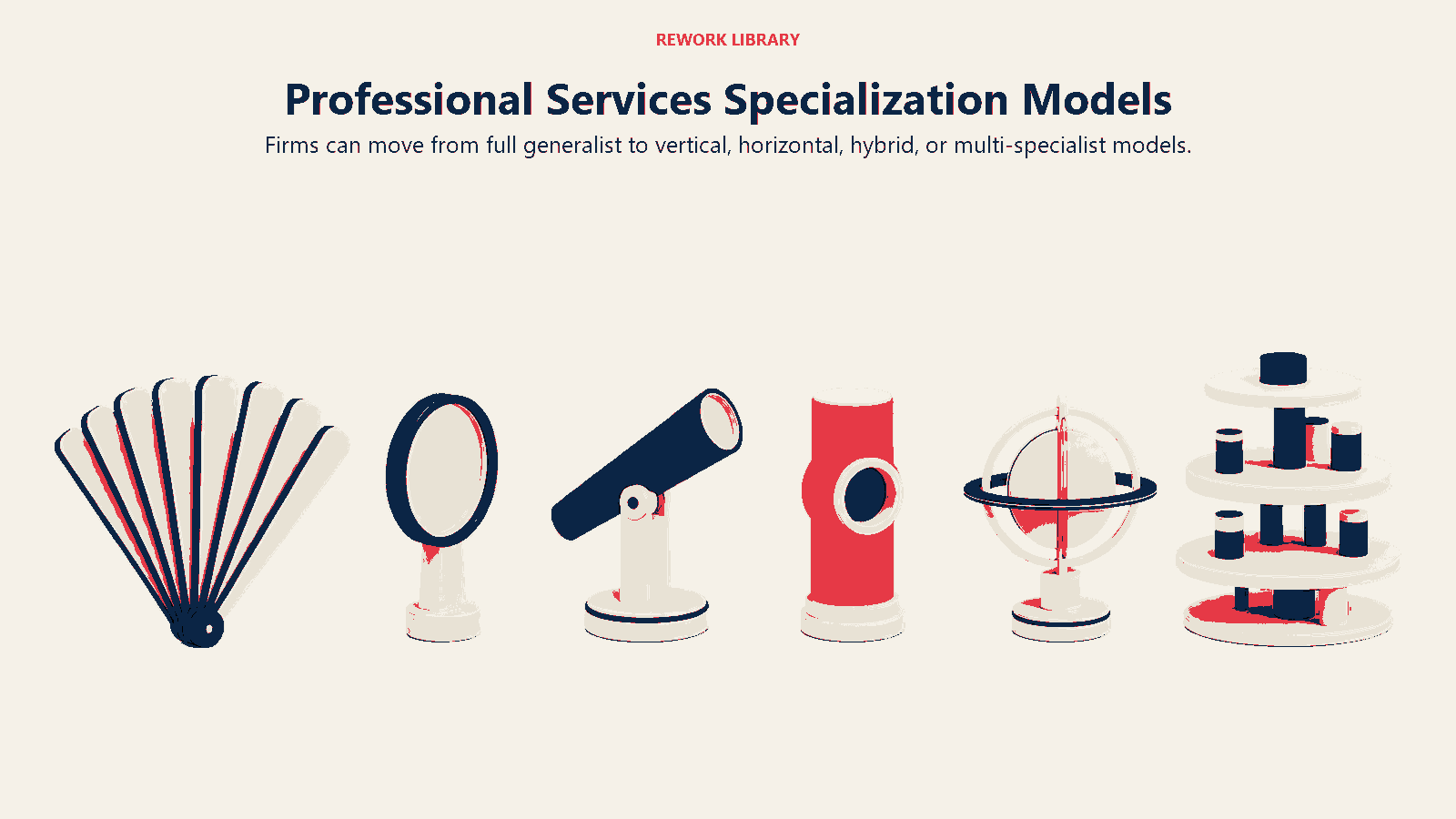
Broad specialist with capabilities edge: You focus on a general category but build deep expertise in specific capabilities. For example, "we do marketing for B2B companies" or "we do financial consulting for middle-market companies." You're not tied to one industry, but you've got a clear service profile and target client type. This works if your methodology or expertise is genuinely differentiated.
Vertical specialist: You focus on one industry and serve clients across that vertical. "We only work with healthcare providers" or "we specialize in financial services firms." This is the most common specialization model. You build deep industry knowledge, understand regulatory environments, develop industry-specific IP, and become known as the go-to firm for that sector.
Horizontal specialist: You focus on one type of problem or function across industries. "We do cybersecurity consulting" or "we specialize in M&A advisory." This works when the problem is similar regardless of industry, and your expertise in solving that specific problem is more valuable than industry knowledge.
Hybrid model (core + adjacent): You specialize in one primary niche but maintain 1-2 adjacent areas where you have existing strength. Maybe 60% of revenue from healthcare, 25% from life sciences, 15% from pharma. They're related enough that your expertise transfers, but you're not completely dependent on one sector.
Platform model (multi-specialist): You build different practice areas, each with their own specialization. This is really a portfolio of specialist practices under one firm brand. It requires scale (usually $20M+ revenue) and strong practice leadership. McKinsey operates this way - they have healthcare specialists, tech specialists, financial services specialists, all under one roof.
Most firms moving toward specialization land in the vertical specialist or hybrid model. They're concrete enough to build around but flexible enough to manage risk.
The niche selection framework: finding your best fit
Choosing a niche isn't about picking what sounds interesting. It's about finding the intersection of market opportunity, your capabilities, and economic viability. Here's how to evaluate options systematically. Market attractiveness (25% of decision weight)
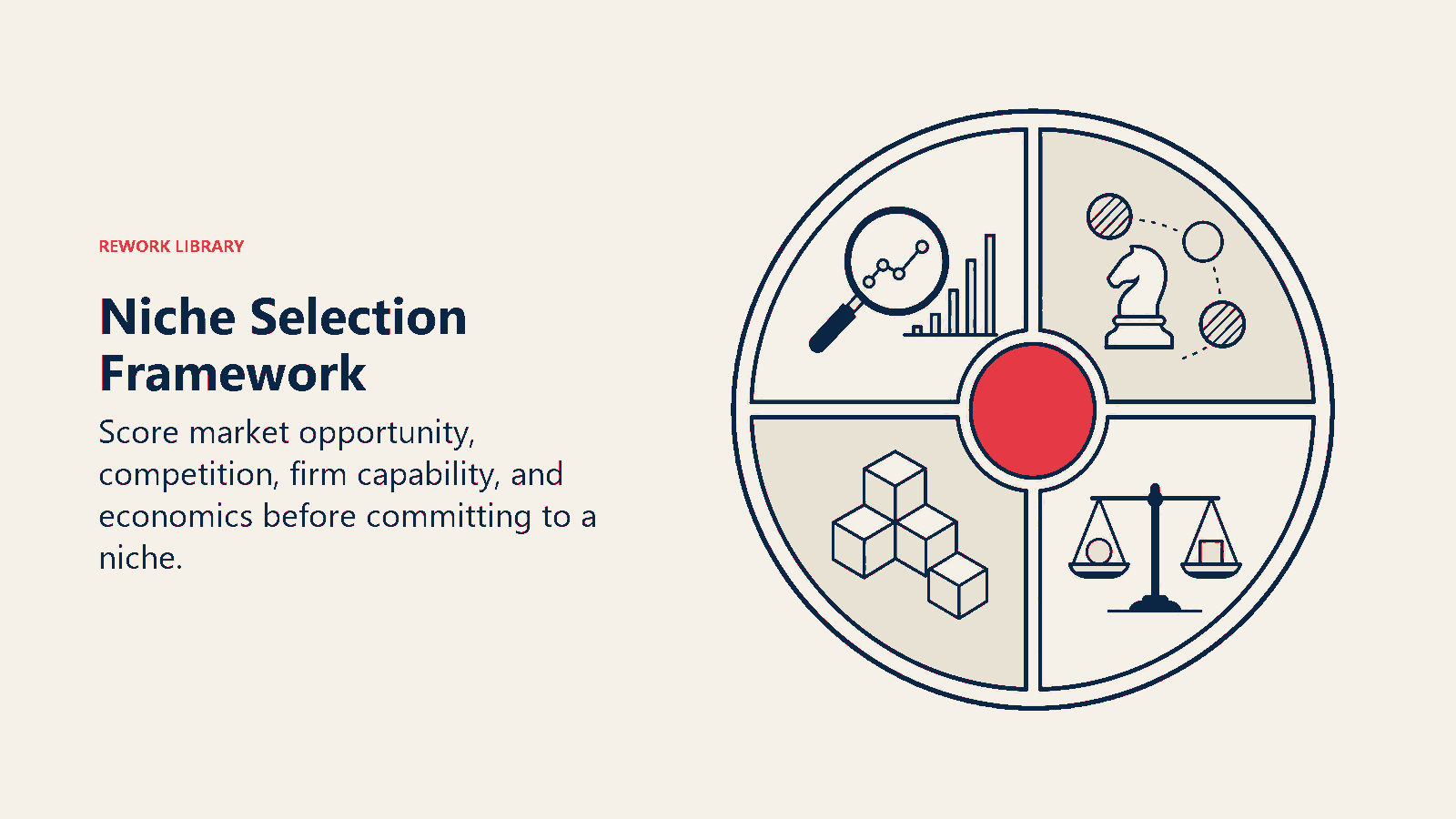
You're looking at the economic size and health of the potential niche:
Market size: Is there enough opportunity to build a meaningful practice? A niche needs at least 500-1,000 potential target clients to sustain a firm. If there are only 100 companies in the space, it's too small unless they're massive enterprises with huge budgets.
Growth trajectory: Is the market expanding, stable, or declining? Growing markets create more opportunity - companies are investing, new entrants are forming, and there's budget for outside help. Declining markets get budget-conscious fast.
Budget availability: Do companies in this space actually buy professional services? Tech companies spend heavily on consultants. Small retail businesses typically don't. Some industries have healthy margins and budgets. Others are perpetually cost-cutting.
Market fragmentation: Is the market dominated by a few huge players or lots of mid-sized companies? Usually, you want fragmentation - more companies mean more opportunities. But if the big players spend heavily on services, a concentrated market can work too.
Competitive positioning (25% of decision weight)
You need to understand who you're competing against:
Existing specialist firms: Are there already 10 well-established firms dominating this niche? That makes entry harder. If there are only 1-2 specialists and mostly generalists, there's room for a new specialized player.
Barriers to entry: How hard is it to build credibility here? Some niches require certifications, specific backgrounds, or regulatory knowledge that creates natural barriers. That's actually good once you're in - it protects your position.
Differentiation opportunities: Can you build a unique point of view or methodology? If every firm does essentially the same thing, you'll compete on price. If you can develop a distinctive approach, you can command premiums.
Big firm interest: Are the large global firms (Deloitte, Accenture, etc.) actively pursuing this space? If so, you're competing upmarket. That's not necessarily bad - there's often room for specialist boutiques - but you need to be realistic about where you'll play.
Firm capability fit (30% of decision weight)
This is the most important factor because it determines how credible your specialization will be:
Existing client concentration: Do you already have 3-5 strong clients in this niche? If 20-30% of your revenue already comes from this space, you've got a foundation. If you have zero clients there, you're starting from scratch.
Team expertise: Do your senior people have deep experience in this space? Did they come from the industry? Have they worked on multiple projects there? Credibility comes from demonstrated expertise.
Relevant case studies: Can you point to real results? Prospects want proof you've solved similar problems. If you've got 2-3 strong case studies, you can build from there. If you've got nothing, establishing credibility takes years.
Learning curve: How long will it take your team to become truly expert? Some industries are complex - healthcare, financial services, energy. Others are more accessible. Be honest about the ramp-up time.
Economic attractiveness (20% of decision weight)
The financial fundamentals need to work:
Average project size: Do companies in this space buy $50K projects or $500K projects? Larger deals mean you need fewer clients to hit your revenue targets. Smaller deals mean you need volume.
Buying cycle: How long from first contact to signed contract? Enterprise software companies have 6-12 month sales cycles. SMBs can move in weeks. Longer cycles mean more sales resources and higher customer acquisition costs.
Lifetime value: Is this a one-project relationship or a multi-year engagement? Recurring revenue and long client relationships are much more valuable than one-off projects.
Margins and pricing: Are clients in this space willing to pay premium rates? What's the typical pricing model - hourly, project-based, retainer? Some niches support higher prices than others.
When you score potential niches across these four dimensions, patterns emerge. The best opportunities score well across all factors. Marginal opportunities have one or two strong dimensions but weaknesses elsewhere.
Vertical specialization: industry-focused strategies
Most firms choose vertical specialization because it's intuitive and the value proposition is clear: "We know your industry." But executing vertical specialization well requires more than just claiming industry focus. Identifying high-potential verticals

Look for industries with specific characteristics:
Regulatory complexity: Healthcare, financial services, energy - these industries need specialized expertise because the rules are complicated. Generalists struggle to keep up with regulatory changes, creating opportunity for specialists.
Digital transformation pressure: Industries being disrupted by technology need help adapting. Traditional retail, insurance, banking - they're all investing heavily in modernization and need guides who understand both the industry and the technology.
Consolidation activity: When industries are consolidating through M&A, there's work to be done. Integration projects, systems rationalization, cultural alignment. Firms that understand the industry dynamics win this work.
High-consequence decisions: Industries where mistakes are expensive create demand for expert help. Manufacturing companies making $50M capital equipment decisions want specialists. Construction firms building major infrastructure need experts.
Building deep vertical expertise
Being a vertical specialist means knowing more than just the industry basics:
Understand the business model fundamentally: How do companies in this space actually make money? What are the unit economics? What drives profitability? You should be able to talk about the business model as well as industry insiders.
Know the regulatory environment: What agencies regulate this space? What are the major compliance requirements? What changes are coming? Your clients expect you to know this stuff.
Track industry trends and competitive dynamics: Who are the leading companies? What strategies are working? What innovations are emerging? Read industry publications, attend conferences, participate in industry associations.
Develop industry-specific frameworks and IP: Create methodologies tailored to this vertical. Instead of generic strategy frameworks, you've got "the healthcare provider growth model" or "the financial services digital transformation roadmap." Proprietary IP reinforces your expertise.
Vertical go-to-market differences
Selling in a vertical specialization is different than generalist sales:
Industry events and conferences matter hugely: Instead of general business conferences, you're at the Healthcare Financial Management Association or the Retail Technology Summit. This is where your buyers are, where you build visibility, and where you network.
Industry publications and media: Get articles published in trade publications, not just business journals. When the American Banker or Healthcare IT News features your perspective, you build credibility with your target market.
Industry-specific case studies and references: Your marketing materials should exclusively feature clients in the target vertical. Don't dilute your positioning by showing diverse industry examples. You want prospects to think "these people only do what we do."
Vertical-focused thought leadership: Your blog posts, webinars, and speaking topics should all center on industry-specific issues. You're not talking about "leadership in uncertain times" - you're talking about "how community hospitals are navigating value-based care transitions."
The depth of specialization compounds over time. After five years in a vertical, you know everyone. Clients refer you to peers. You get invited to speak at industry events. You develop relationships with industry analysts and influencers. That network becomes a competitive moat.
Building competitive moats through specialization
Specialization creates defensible advantages that are hard for generalists to replicate. These moats protect your position and pricing power. Expertise and intellectual capital
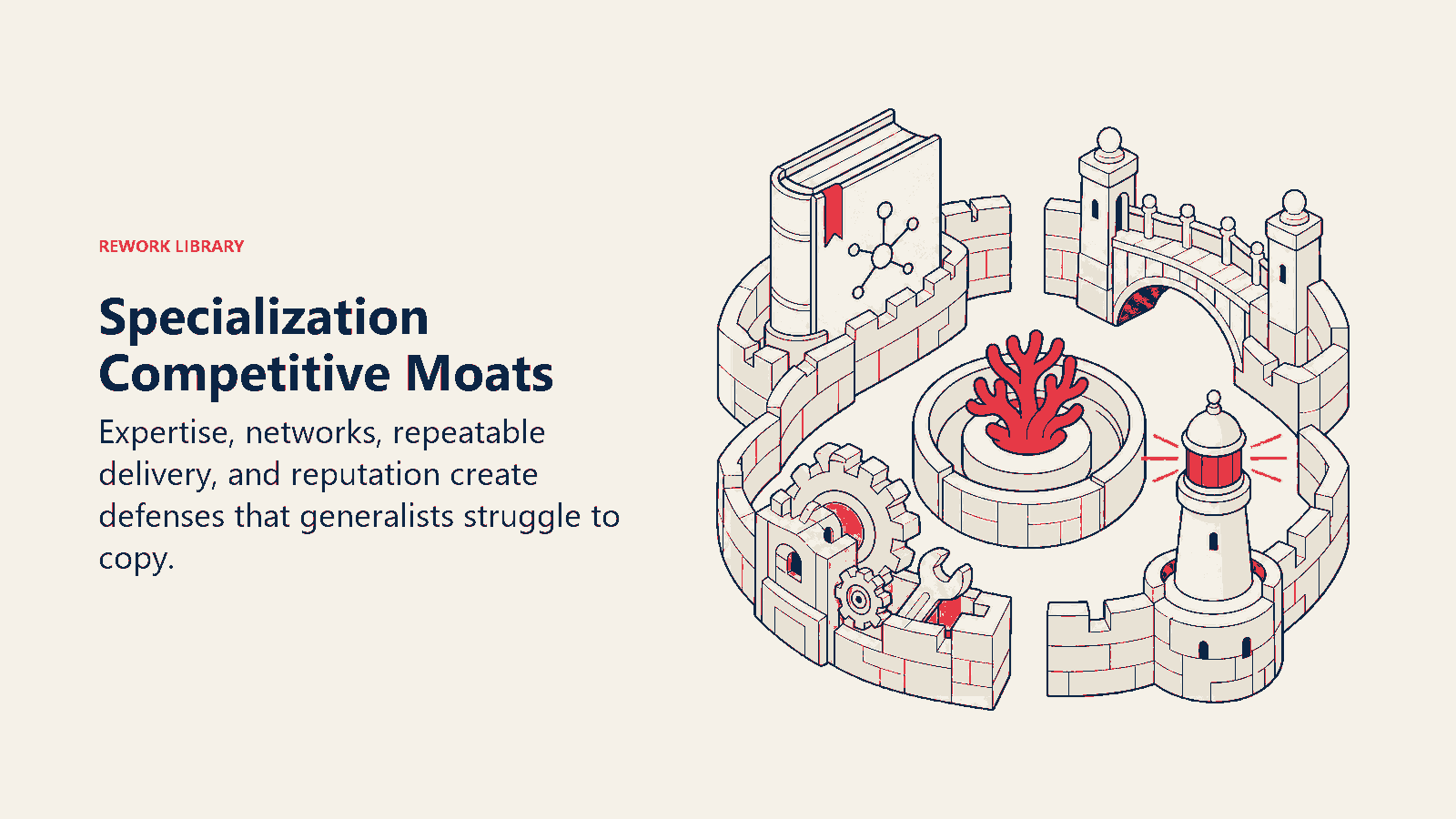
The more projects you do in a space, the smarter you get. You recognize patterns. You know what works and what doesn't. You develop frameworks and methodologies that deliver better outcomes faster.
This expertise manifests as:
- Proprietary diagnostic tools and assessment frameworks
- Industry-specific benchmarks and data sets
- Documented best practices and playbooks
- Trained teams with deep specialized knowledge
- Certifications and credentials specific to the niche
Clients pay for this accumulated wisdom. They're not buying your time - they're buying the knowledge you've built through dozens of similar engagements. A generalist has to learn on the job. You already know.
Relationship and network advantages
As a specialist, your network becomes incredibly valuable:
Client relationships that drive referrals: When you've worked with 30 companies in an industry, and they all know each other, referrals flow naturally. "Who should we talk to about this?" "Call XYZ Consulting - they do this work for everyone in our space."
Industry partnerships and alliances: You develop relationships with technology vendors, implementation partners, and other service providers who serve the same market. These partnerships create deal flow and credibility.
Industry influence and visibility: Over time, you become a known voice in the industry. You speak at their conferences, write in their publications, serve on industry committees. This visibility becomes a lead generation engine.
Operational efficiency advantages
Repeated similar work creates process efficiencies:
Standardized methodologies reduce delivery risk: You're not reinventing the approach every project. You've got proven playbooks that work.
Faster team ramp-up: When you hire someone into a specialized practice, they're learning one domain deeply instead of constantly switching contexts. They become productive faster.
Reusable tools and templates: Your project templates, analysis tools, and deliverable formats get refined and reused. This speeds up delivery and improves quality.
Better resource forecasting: When your projects follow similar patterns, you can predict resource needs more accurately. Utilization improves because you're not constantly scrambling to staff diverse project types.
These operational advantages flow straight to margins. Your cost to deliver drops while your pricing holds or increases. That's the specialization premium.
Brand and market perception
Being known for something specific is powerful marketing:
- When someone in your target market has a problem you solve, your name comes up. "Talk to ABC Consulting - that's all they do."
- You get inbound leads from your target market because your positioning is clear.
- You can charge premium prices because you're positioned as the expert, not a commodity provider.
- Your win rates improve dramatically because you're the obvious choice for specialized work.
These moats take time to build - typically 3-5 years of committed focus. But once established, they're hard for competitors to breach.
Niche selection scoring model
When you're evaluating multiple potential niches, use a structured scoring model to make the decision data-driven. Here's a framework with weighted criteria: Market Size and Growth (25% of total score)
Target market size (potential clients): 0-10 points
- 2,000+ companies (10 points)
- 500-2,000 companies (7 points)
- 100-500 companies (4 points)
- <100 companies (0 points)
Market growth rate: 0-10 points
- Growing >10% annually (10 points)
- Growing 3-10% annually (7 points)
- Flat or declining <3% (3 points)
- Declining >5% annually (0 points)
Budget availability: 0-5 points
- Strong margins, high services spend (5 points)
- Moderate spending on professional services (3 points)
- Low budget for external help (1 point)
Competitive Positioning (25% of total score)
Number of established specialists: 0-10 points
- 0-2 clear specialist competitors (10 points)
- 3-5 specialist competitors (6 points)
- 6-10 specialists in market (3 points)
-
10 specialists, crowded market (0 points)
Differentiation potential: 0-10 points
- High - unique approach possible (10 points)
- Moderate - some differentiation (6 points)
- Low - commodity services (2 points)
Big firm interest: 0-5 points
- Low interest from major firms (5 points)
- Moderate competition (3 points)
- Heavy big firm presence (0 points)
Firm Capability Fit (30% of total score)
Existing client base: 0-15 points
- 5+ clients, 30%+ of revenue (15 points)
- 3-4 clients, 15-30% of revenue (10 points)
- 1-2 clients, <15% of revenue (5 points)
- No current clients (0 points)
Team expertise: 0-10 points
- Multiple senior people with deep background (10 points)
- Some team experience in space (6 points)
- No specialized expertise (0 points)
Case studies and proof points: 0-5 points
- 5+ strong case studies (5 points)
- 2-4 case studies (3 points)
- 0-1 case studies (0 points)
Economic Attractiveness (20% of total score)
Average project size: 0-10 points
- $500K+ average deal (10 points)
- $150K-$500K average deal (7 points)
- $50K-$150K average deal (4 points)
- <$50K average deal (1 point)
Client lifetime value: 0-10 points
- Multi-year recurring relationships (10 points)
- Occasional repeat projects (6 points)
- Mostly one-time engagements (2 points)
Score each potential niche across all criteria. The highest-scoring option becomes your primary focus. But also look for options that score well on fit even if market size is moderate - those can be great niches because you can dominate them.
A score above 70 indicates a strong opportunity. 50-70 is viable but challenging. Below 50, you're probably forcing it.
Specialization go-to-market strategy
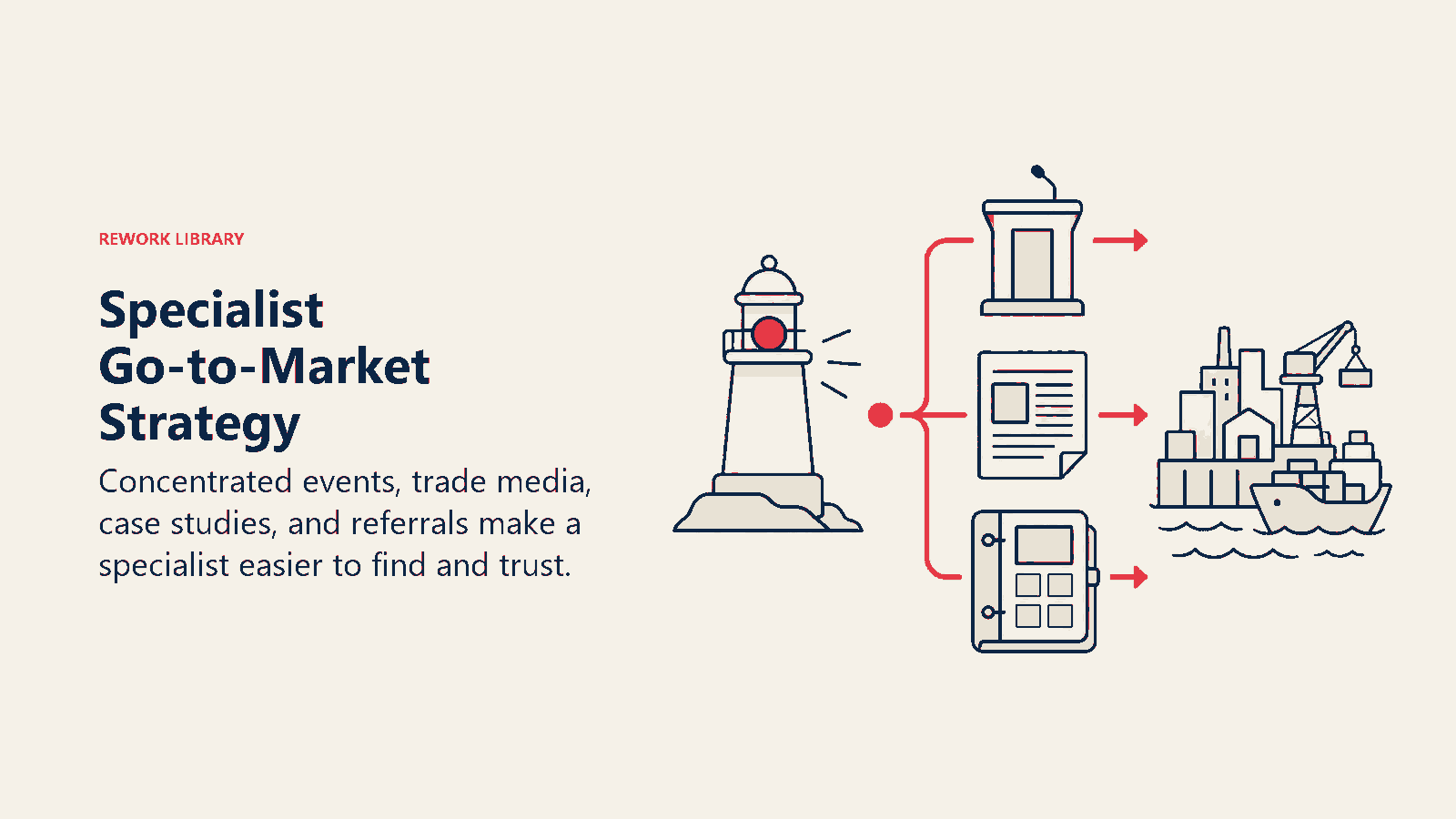
Once you've chosen your niche, you need a focused go-to-market plan that establishes credibility and generates pipeline.
Positioning and messaging
Your positioning needs to be absolutely clear:
Update your website to lead with your specialization. The headline should immediately communicate your focus: "Growth Strategy for Healthcare Providers" not "Strategic Consulting Services."
Rewrite your firm description to emphasize industry expertise and results: "We've helped 40 hospital systems improve operating margins through our proven efficiency framework."
Create a clear value proposition specific to the niche: What specific outcomes do you deliver? What problems do you solve that are unique to this space?
Thought leadership and brand building
Thought leadership is critical in specialization because it proves expertise:
Publish regularly on industry-specific topics: Blog posts, LinkedIn articles, and contributed pieces in trade publications. The content should demonstrate deep knowledge, not surface-level observations. See thought leadership strategy for detailed tactics.
Speak at industry conferences and events: Start by proposing panels or workshops at second-tier events. Build a reputation as a speaker, then work up to keynotes at major conferences. Learn more through speaking and publishing strategy.
Develop proprietary research or benchmarks: Original research gets attention. Annual industry surveys, benchmark reports, or trend analyses establish you as a data source. This also generates media coverage and speaking invitations.
Host webinars and roundtables: Bring together industry leaders to discuss hot topics. Position yourself as the convener and moderator. These events build your network while demonstrating expertise.
Sales and business development
Your sales approach should reflect specialized expertise:
Identify target account lists: Instead of broad outreach, focus on the 100-200 companies that are your ideal clients in the niche. Research them deeply, understand their challenges, and approach with relevant insights.
Use consultative business development: Don't pitch services. Start conversations about industry challenges you've observed. Share perspectives. Build relationships. See consultative business development for this approach.
Develop industry-specific prospecting: Instead of generic outbound, reference industry events you've attended, articles you've written, or observations about their company based on industry knowledge.
Content and marketing specialization
All your content should reinforce your specialized expertise:
Industry case studies: Feature client results in your target niche. Include specific metrics, challenges unique to the industry, and outcomes that matter to similar companies.
Vertical-specific content library: Build a content hub focused entirely on your niche. Instead of a blog with mixed topics, create "The Healthcare CFO Resource Center" or "Manufacturing Excellence Insights."
Email nurture sequences for the niche: Your marketing automation should include industry-specific content tracks. When someone downloads a resource, they enter a nurture sequence with content relevant to their industry challenges. More on this in content marketing for services.
Partnership strategy
Strategic partnerships accelerate specialization:
Technology vendors serving the industry: Partner with software companies, platform providers, or tech vendors that sell to your target market. They need implementation partners, and you need client access.
Complementary service providers: Build relationships with firms that do different work for the same clients. An IT consulting firm and a strategy firm can refer to each other without competing.
Industry associations and groups: Join industry associations, sponsor events, and participate actively. This builds visibility and credibility. Some associations even have preferred vendor programs.
The go-to-market strategy is a long game. It takes 12-18 months to build meaningful visibility in a new niche. But that investment pays off with stronger positioning and lower customer acquisition costs.
Building deep expertise: from specialist to authority
Claiming specialization is step one. Actually becoming an expert is what matters. Here's how to build depth over time.
Knowledge management
Capture and organize what you learn:
Create a centralized knowledge repository: Document insights, best practices, common challenges, and solutions from every project. This becomes your institutional knowledge.
Develop industry-specific frameworks: As you see patterns across clients, codify them into methodologies. These frameworks make your expertise tangible and repeatable.
Build a competitive intelligence database: Track what competitors in the industry are doing, what strategies are working, which companies are leading. Your clients expect you to know this landscape.
Maintain a trend and research library: Collect industry reports, research studies, regulatory changes, and market analyses. Be the most informed firm in your space.
Team capability development
Your people need to become specialists too:
Hire from the industry when possible: Former industry practitioners bring credibility and context that's hard to develop externally. A consultant who spent 10 years as a hospital administrator understands healthcare in ways outsiders can't match.
Invest in industry training and education: Send team members to industry conferences, certification programs, and continuing education specific to the niche. Budget for this as an ongoing expense.
Create internal learning programs: Regular knowledge-sharing sessions where team members present industry insights, client challenges, or new developments. This spreads expertise across the team.
Rotate people through diverse projects in the niche: Exposure to multiple clients and situations accelerates learning. Make sure people aren't stuck on one client indefinitely.
IP development strategy
Intellectual property differentiates specialists from generalists:
Develop assessment tools and diagnostics: Create frameworks that diagnose specific problems in your niche. "The Healthcare Revenue Cycle Maturity Model" or "The Manufacturing Digital Readiness Assessment." These tools demonstrate expertise and create engagement opportunities.
Build benchmarking capabilities: If you work with enough clients, you can create industry benchmarks. "Based on our work with 50 mid-sized manufacturers, here's how you compare." Proprietary data is valuable.
Write books or major research reports: A book focused on your niche establishes authority like nothing else. It's a long-term project, but the credibility payoff is substantial.
Create certification or training programs: If your methodology is strong enough, you can certify practitioners in it. This creates another revenue stream and spreads your influence.
External validation
Third-party recognition accelerates credibility:
Pursue industry awards and recognition: Most industries have awards for service providers. Winning "Best Healthcare Consultant" matters in that market.
Get analyst coverage: In some industries (like technology), analyst firms like Gartner track service providers. Getting recognized in their reports is valuable.
Secure industry media coverage: Being quoted in trade publications as an expert, or having your perspectives featured, builds authority. Develop relationships with industry journalists and bloggers.
Collect client testimonials and case studies: Social proof from recognized companies in the industry validates your expertise. Feature these prominently in your marketing.
Building expertise is continuous. Even after five years in a niche, you're still learning. Industries evolve, new challenges emerge, and best practices shift. The best specialists stay students of their chosen field.
Specialization implementation roadmap
Moving from generalist to specialist requires a phased approach. Here's a realistic timeline and what to focus on at each stage. Phase 1: Assessment and Planning (Months 1-3)
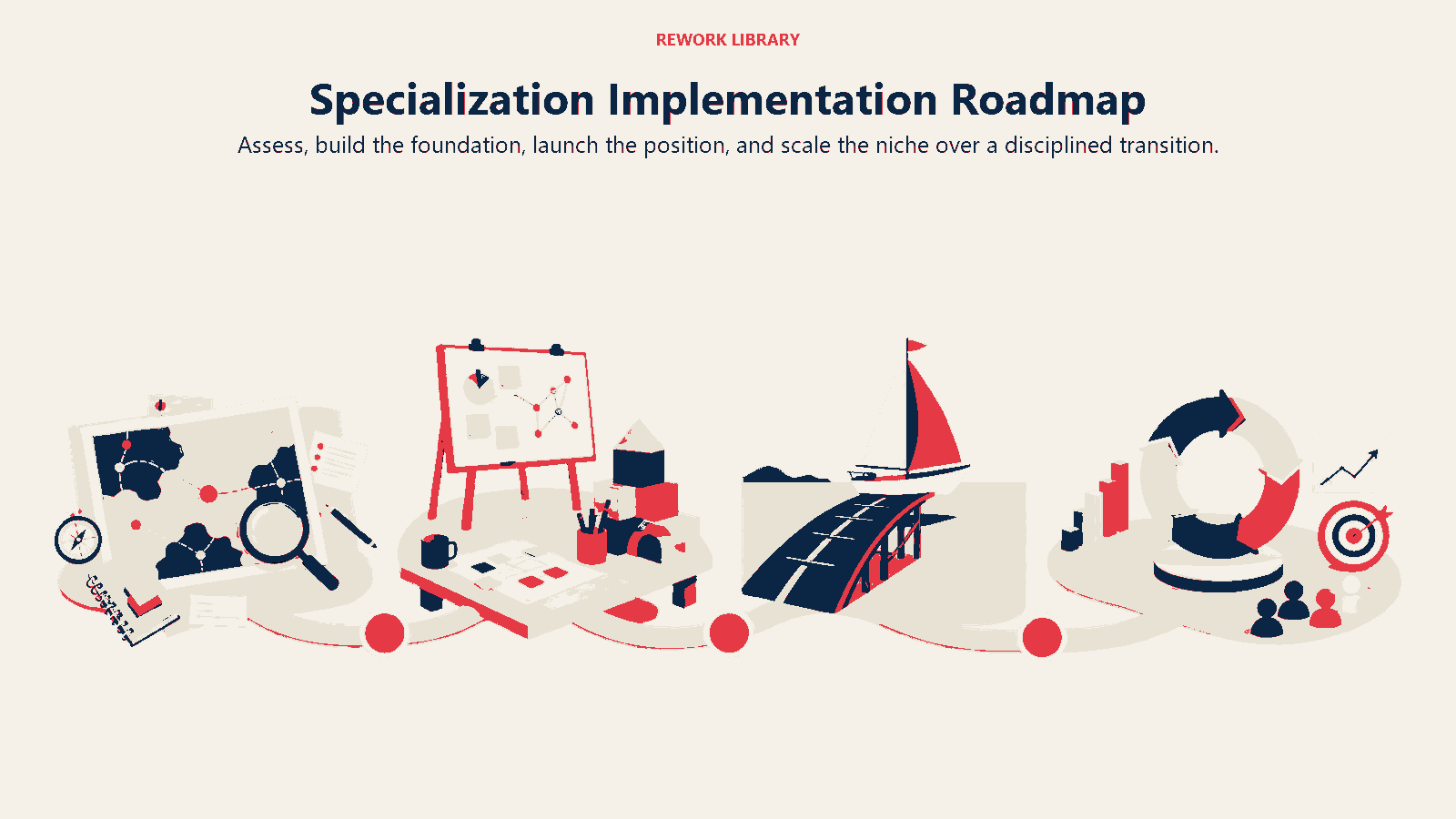
This is the foundation work before you announce anything:
Conduct rigorous niche analysis: Score potential niches using the framework above. Get consensus among partners on the chosen focus.
Audit current capabilities and gaps: What expertise do you already have? What do you need to build? Who on the team has relevant experience?
Analyze existing client portfolio: Which current clients fit the new focus? Which are outside it? How much revenue comes from each category?
Develop financial scenarios: Model the revenue impact. What if you lose 20% of non-focus clients? How long to replace that with specialized work? What's the break-even timeline?
Create stakeholder alignment: Get partners, senior staff, and key stakeholders bought into the strategy. Without internal alignment, execution fails.
Phase 2: Foundation Building (Months 3-6)
Start building expertise and capabilities before major marketing:
Hire or develop specialized talent: Bring in industry experts or invest in training existing team members. Start building the bench.
Create initial IP and frameworks: Develop your first industry-specific methodologies, templates, or assessment tools. You need something proprietary to talk about.
Develop 3-5 strong case studies: Document results from any existing work in the target niche. If you don't have case studies yet, take on some projects to build them - even at lower margins if needed.
Build industry knowledge foundation: Team members attend conferences, join industry associations, start reading trade publications, connect with industry contacts.
Redesign core marketing materials: Update website positioning, rewrite firm description, create new pitch deck focused on the specialization.
Phase 3: Launch and Market Entry (Months 6-12)
This is when you go public with the positioning:
Launch specialized brand and messaging: Update all external communications to reflect your focus. Press releases, website relaunch, social media updates announcing the specialization.
Begin thought leadership program: Publish articles, start speaking at industry events, launch a podcast or video series, create industry-specific content.
Initiate targeted business development: Build target account lists, start outreach to ideal clients in the niche, attend industry networking events.
Develop strategic partnerships: Form alliances with technology vendors, complementary service providers, or industry associations.
Monitor and refine positioning: Track what resonates. Which messages work? What objections do you hear? Adjust based on market feedback.
Phase 4: Growth and Scaling (Year 2+)
Now you're establishing dominance and scaling the practice:
Expand team with specialized hires: Bring in more industry experts, grow delivery capacity, build specialized practice teams.
Develop advanced IP and offerings: Create more sophisticated tools, frameworks, and service offerings based on accumulated expertise.
Pursue market leadership positions: Win industry awards, get featured in major publications, speak at top-tier conferences, join industry advisory boards.
Build referral ecosystem: Cultivate relationships with clients, partners, and industry influencers who drive referrals.
Consider adjacent expansion: Once you've dominated one niche, you can add adjacent areas. But only after the core specialization is firmly established.
This timeline assumes steady execution. Reality is messier - some phases take longer, some opportunities accelerate progress. But the sequence matters: build capabilities before marketing them, establish credibility before scaling.
Common specialization pitfalls to avoid
Most specialization failures come from predictable mistakes. Here's what to watch for.
Choosing niche based on current clients vs market opportunity
Just because 30% of your revenue comes from healthcare doesn't mean healthcare is the right specialization. Maybe those clients found you by accident. Maybe the market opportunity is limited. Choose based on forward-looking analysis, not historical accident.
Under-committing resources
Specialization is an investment that requires significant resources: hiring, training, marketing, business development. Firms that try to specialize "on the side" while keeping their generalist approach don't build real expertise or credibility. You need committed focus.
Too narrow specialization limiting opportunity
There's a balance between focused and too narrow. "We only work with pediatric orthopedic surgery centers in the Southeast" is probably too specific unless you're targeting massive enterprise accounts. Make sure your niche has enough addressable market to support your growth goals.
Losing existing business during transition
When you announce specialization, some existing clients outside that niche might worry you're abandoning them. You need a plan to either transition that work, maintain those relationships separately, or explicitly communicate that existing clients remain fully supported.
Not building true differentiation
Just claiming "we focus on healthcare" isn't enough if you do the same work as generalists. You need to develop genuinely differentiated approaches, frameworks, or expertise that deliver better outcomes. Otherwise, you're just a generalist with narrower marketing.
Geographic limitations
Some niches are geographically concentrated. If you specialize in oil and gas, you need to be willing to work in Houston, Calgary, or Aberdeen. If you're committed to staying local, make sure your chosen niche has sufficient local presence.
Failing to adapt as markets evolve
Industries change. Technology disrupts. Regulations shift. The specialists who succeed stay ahead of these changes. The ones who fail keep using outdated approaches because "that's how we've always done it." Build continuous learning into your specialization strategy.
When to diversify or expand specialization
Specialization isn't permanent. There are times when expanding or pivoting makes strategic sense.
Saturation signals in core niche
You'll know you're saturating your niche when:
- Your win rates start declining even though your expertise is strong
- You're seeing the same prospects repeatedly and losing to the same competitors
- Revenue growth in the niche has flattened despite strong sales effort
- Market dynamics have shifted (consolidation, budget cuts, regulatory changes)
When you see these signals, it's time to consider adjacent expansion or portfolio diversification.
Adjacent opportunity recognition
The best expansions are adjacent to your core niche:
- You specialize in hospital systems and expand to outpatient surgery centers
- You focus on retail banks and add credit unions
- You serve manufacturing companies and add distribution companies
Adjacent moves let you leverage existing expertise while accessing new markets. The learning curve is shorter than jumping to completely different industries.
Team capability expansion
Sometimes opportunity comes from talent. You hire a strong partner who brings deep expertise in a different niche. Rather than lose that capability, you can build a second specialization. But only if you have the scale to support multiple practices - usually this means you're already $15M+ in revenue.
Portfolio rebalancing
If your core niche faces structural challenges (declining industry, regulatory pressure, disruption), diversification becomes a risk management strategy. Don't wait until the market collapses. Start building the next specialization while the current one is still strong.
Economic and market cycle management
Some niches are cyclical. Construction services boom and bust with the economy. Energy consulting follows commodity prices. If your niche is volatile, having a counter-cyclical secondary focus can smooth revenue. But this only works if you can truly maintain expertise in both areas.
The key principle: expand from strength, not weakness. Don't add new specializations because your current one is failing. Build new ones because you've succeeded and have the resources to invest in growth.
Specialization maturity model
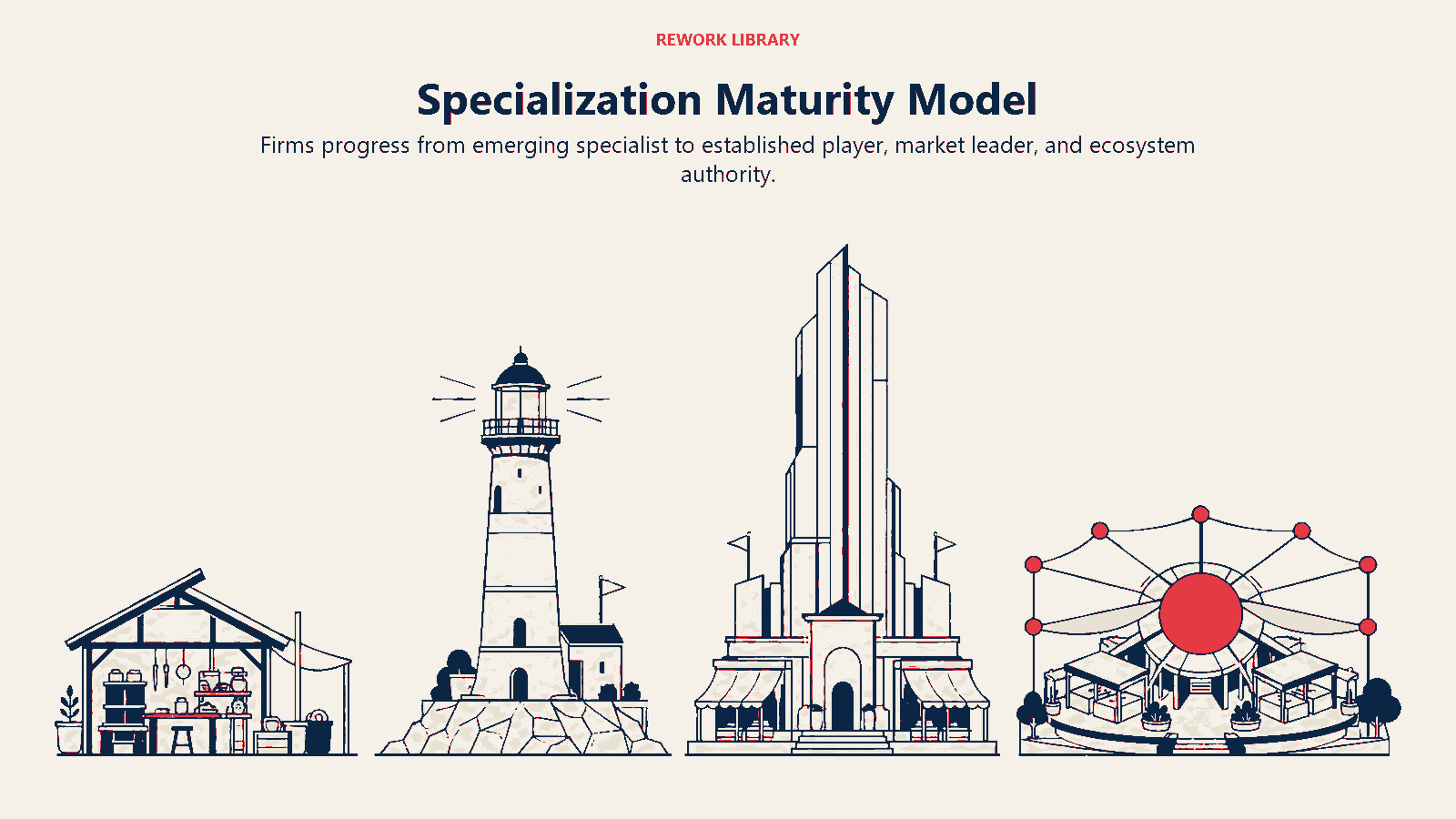
Understanding where you are in the specialization journey helps set realistic expectations and goals. Stage 1: Emerging Specialist (Year 1)
At this stage, you're building credibility:
- 20-40% of revenue from target niche
- 2-5 client case studies in the niche
- Basic industry-specific materials and messaging
- Team developing specialized knowledge
- Limited industry visibility
- Win rates improving in niche vs general market
- Still taking work outside specialization to maintain revenue
The focus here is on building proof points and expertise while managing the revenue transition.
Stage 2: Established Specialist (Years 2-3)
You're now recognized in your niche:
- 50-70% of revenue from target niche
- 8-15 client case studies
- Strong thought leadership presence (speaking, publishing)
- Specialized frameworks and IP developed
- Growing industry network and visibility
- Referrals starting to flow regularly
- Win rates significantly higher in niche work
- Can be more selective about non-specialized work
This is where the economics start really working. Sales cycles shorten, win rates improve, pricing strengthens.
Stage 3: Market Leader (Years 3-5)
You're among the top specialists in your niche:
- 70-90% of revenue from target niche
- 20+ client case studies
- Recognized thought leader (top conferences, major publications)
- Proprietary IP and methodologies
- Strong referral ecosystem
- Industry awards and recognition
- Premium pricing power
- Inbound leads from reputation
At this stage, you're not chasing work - work finds you. Your brand and reputation drive business development.
Stage 4: Ecosystem Player (5+ years)
You're part of the industry infrastructure:
- 80-100% of revenue from niche (or multiple established specializations)
- Extensive client portfolio and results
- Industry standard-setter (your frameworks are widely adopted)
- Published books or major research that's cited
- Board positions or advisory roles in industry organizations
- Partnership ecosystem that drives significant deal flow
- Training or certification programs others pay for
- Market-leading margins and growth
This is where you're not just serving the industry - you're helping define it. Your expertise is the gold standard.
Most firms plateau at Stage 2 or 3, which is fine. You don't need to reach Stage 4 to have an economically successful specialization. But understanding the trajectory helps you set goals and invest appropriately.
Financial modeling for specialization
Before committing to specialization, model the financial impact. Here's what to project.
Revenue impact of specialization
Build a three-scenario model:
Conservative scenario:
- 15% of current non-specialized revenue attrites over 24 months
- Specialized revenue grows 20% annually
- Mix shifts to 60% specialized by year 3
Base scenario:
- 10% of current non-specialized revenue attrites
- Specialized revenue grows 35% annually
- Mix shifts to 70% specialized by year 3
Optimistic scenario:
- 5% of current revenue attrites
- Specialized revenue grows 50% annually
- Mix shifts to 80% specialized by year 3
Which scenario is realistic depends on your starting point and market opportunity. Use your niche analysis to inform the assumptions.
Gross margin improvement potential
Specialization should improve margins through:
- Premium pricing: 10-30% higher rates in specialized work
- Operational efficiency: 15-25% faster delivery through reusable frameworks
- Lower sales costs: 20-40% reduction in customer acquisition cost
- Higher win rates: 30-50% increase in proposal success
Model gross margin by work type:
- Specialized work: 55-65% gross margin
- Non-specialized work: 40-50% gross margin
As your mix shifts toward specialized, overall gross margin improves.
Sales and marketing efficiency gains
Track these metrics over time:
- Sales cycle length (specialized vs non-specialized)
- Cost per qualified lead
- Proposal-to-close rate
- Customer acquisition cost as % of first-year revenue
Specialization should show:
- 25-40% shorter sales cycles in niche work
- 30-50% lower customer acquisition cost
- 40-100% improvement in win rates
These efficiency gains mean you can grow revenue without proportionally scaling sales headcount.
Operational leverage and profitability
As you build specialized expertise:
- Delivery hours per dollar of revenue decline (you work faster)
- Junior staff can handle more (better templates and processes)
- Rework and risk decrease (you know what works)
- Utilization improves (better resource matching and forecasting)
Model EBITDA impact:
- Year 1: Margin pressure from investment in specialization
- Year 2: Margins recover to baseline as efficiency kicks in
- Year 3+: Margins expand 300-500 basis points from combination of pricing and efficiency
Investment required and payback period
Specialization requires upfront investment:
- Specialized hires or training: $100K-$500K depending on firm size
- Marketing and positioning: $50K-$200K
- IP and framework development: $50K-$150K
- Sales and business development: $100K-$300K
- Conferences, memberships, visibility: $25K-$100K
Total first-year investment: $325K-$1.25M for a mid-sized firm
Payback typically happens in months 18-24 as revenue growth and margin improvement offset the investment.
Risk scenarios and sensitivity analysis
Model downside scenarios:
- What if specialized revenue grows only 10% instead of 35%?
- What if 20% of current revenue attrites instead of 10%?
- What if margin improvement is only 200bp instead of 400bp?
Run sensitivity analysis to understand which assumptions matter most. Usually, the specialized revenue growth rate has the biggest impact on outcomes.
The financial modeling gives you confidence in the decision and helps you manage the transition. It also provides metrics to track progress against plan.
Specialization vs generalist economics comparison
Let's make the economics concrete with a real example. Two firms, both $10M in revenue, one generalist and one specialized. Generalist Firm Profile:
- Revenue: $10M
- Team size: 65 people (partners, consultants, support)
- Average revenue per employee: $154K
- Gross margin: 45%
- EBITDA margin: 12%
- Average project size: $75K
- Sales cycle: 4.5 months
- Win rate: 22%
- Customer acquisition cost: $18K per client
- Client lifetime value: $125K
- Revenue concentration: No client >5%, no industry >20%
Specialist Firm Profile (Healthcare focus):
- Revenue: $10M
- Team size: 50 people
- Average revenue per employee: $200K
- Gross margin: 58%
- EBITDA margin: 22%
- Average project size: $120K
- Sales cycle: 3 months
- Win rate: 42%
- Customer acquisition cost: $12K per client
- Client lifetime value: $280K
- Revenue concentration: 75% from healthcare, top client 8%
ROI comparison:
The specialist firm generates:
- $1.3M more in gross profit on the same revenue ($5.8M vs $4.5M)
- $1.0M more in EBITDA ($2.2M vs $1.2M)
- 83% higher profit per employee ($44K vs $24K)
- 37% fewer people to manage (50 vs 65)
The specialist closes deals faster, wins more often, and spends less to acquire clients. Their clients stay longer and buy more. The economics are dramatically better.
Break-even analysis:
If you're transitioning from generalist to specialist, when do you break even?
Assume a $10M generalist firm invests $500K in year 1 to specialize:
- Year 1: Revenue drops 5% to $9.5M due to lost non-specialized work, EBITDA drops to $800K (from $1.2M baseline) due to investment
- Year 2: Revenue rebounds to $11M as specialized work grows, EBITDA recovers to $1.5M
- Year 3: Revenue grows to $13M, EBITDA reaches $2.1M
Cumulative EBITDA by end of year 3:
- Generalist path (no specialization): $3.6M
- Specialist path: $4.4M
You've broken even and pulled ahead by year 3. And the trajectory from there strongly favors the specialist.
The generalist advantages are primarily risk-related: diversification, flexibility, not being dependent on one market. But the specialist advantages are economic and strategic.
Strategic decision framework for specialization
Making the specialization decision requires more than financial analysis. Here's a comprehensive framework for the strategic choice.
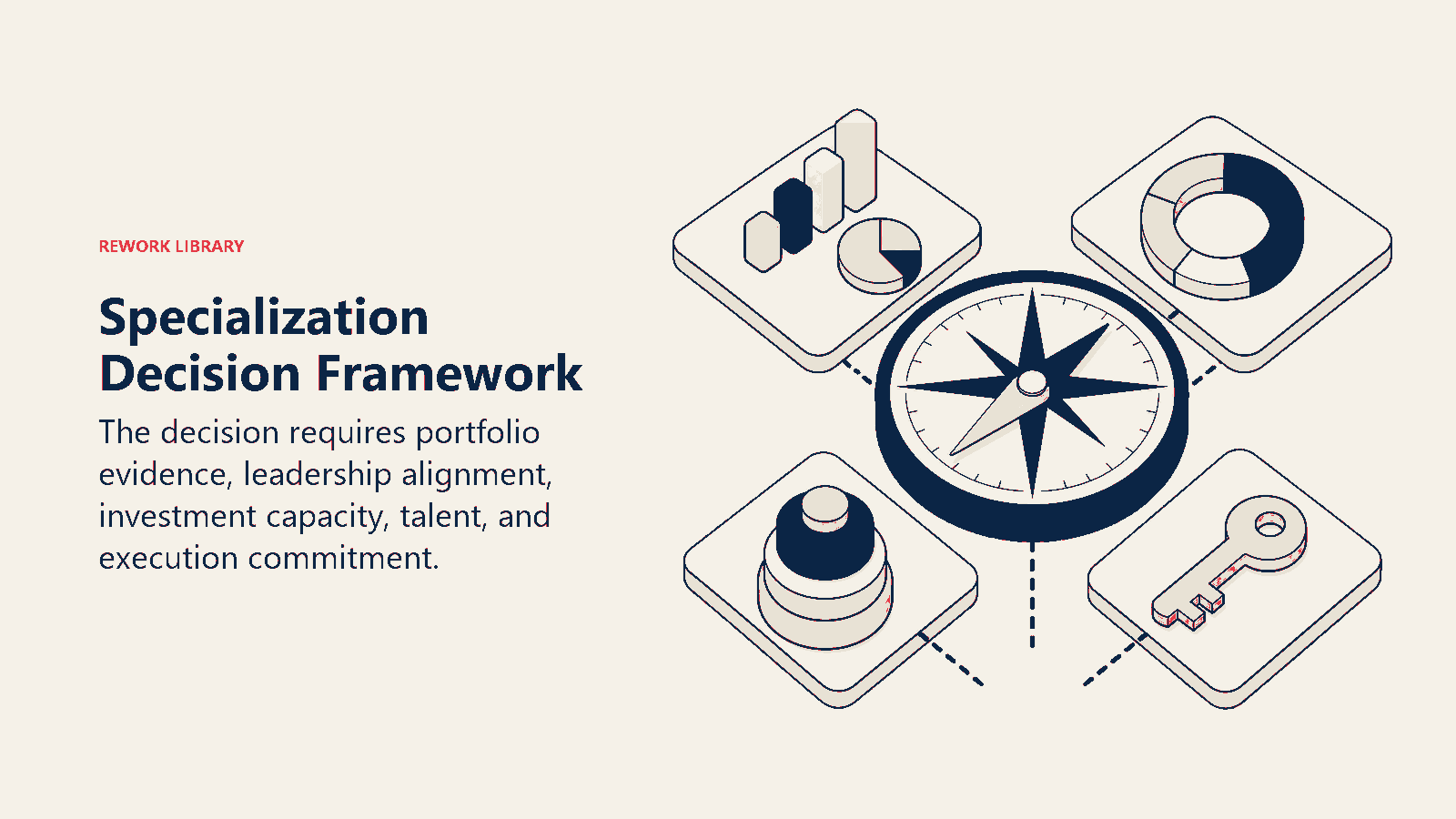
Portfolio review and opportunity assessment
Start with your current state:
- Where does revenue come from today (by industry, service, client type)?
- Which segments are growing vs declining?
- Where do you have the strongest case studies and results?
- Which markets show the strongest pull for your services?
- What are clients and prospects actually buying?
Then analyze future opportunity:
- Which markets are growing and investing?
- Where is competition weakest relative to opportunity?
- Which specializations align with your team's passions and expertise?
- What can you credibly claim and prove?
Management team alignment
Specialization fails without leadership consensus:
- Do partners agree on the chosen focus?
- Are they willing to turn down work outside that focus?
- Will they invest time in building industry expertise?
- Are they committed for the 3-5 year timeframe needed to establish the position?
If you can't get alignment, you'll end up with a half-hearted effort that doesn't deliver results. Better to stay generalist than fake specialization.
Financial commitment and investment
Quantify what you're willing to invest:
- Specialized hiring or training budget
- Marketing and positioning investment
- IP and framework development resources
- Sales and business development costs
- Lost revenue from turned-down work
Set a budget and commit to it. Underfunding the transition is worse than not doing it.
Talent strategy and hiring plan
Who do you need to make this work:
- Industry experts to hire (former practitioners, competitors)
- Training and development for existing team
- New capabilities to add (industry-specific technical skills)
- Role definitions and career paths in the specialized practice
Map out the talent roadmap for the first 18 months.
Go-to-market execution plan
Detail the launch and marketing strategy:
- Positioning and messaging rollout
- Website and materials redesign timeline
- Thought leadership content calendar
- Speaking and conference schedule
- Business development outreach plan
- Partnership development targets
Assign ownership and deadlines. Specialization is a significant change management effort.
Measurement and success metrics
Define what success looks like at each stage:
6 months:
- % of new pipeline from target niche
- Team participation in industry events
- Thought leadership pieces published
- Win rate in specialized vs non-specialized work
12 months:
- Revenue from specialization
- Number of new clients in niche
- Gross margin on specialized work
- Industry visibility metrics (speaking, media)
18 months:
- Revenue concentration in specialization
- Client referrals from niche
- Average deal size in niche vs firm average
- Customer acquisition cost trends
24+ months:
- Overall revenue growth
- EBITDA margin improvement
- Market position and recognition
- Team expertise and retention
Track these metrics quarterly and adjust based on what you learn.
Contingency and risk management
Plan for what could go wrong:
- What if specialized revenue doesn't materialize as fast as projected?
- What if key clients in other industries leave?
- What if the chosen niche faces unexpected disruption?
- What if critical specialized talent leaves?
For each risk, define triggers and response plans. Don't just hope things work out - actively manage the transition.
The bottom line on specialization strategy
Specialization is one of the highest-leverage decisions professional services firms make. The data is clear: specialists earn higher margins, grow faster, and build more defensible businesses than generalists.
But specialization only works if you commit fully. Half-hearted specialization - claiming industry focus while still chasing any work that comes in - doesn't deliver the benefits. You need to make hard choices about what you'll focus on and what you'll turn down.
The best time to specialize is when you're growing from strength, not running from weakness. If you've got a solid foundation and see an opportunity to dominate a niche, that's the time to make the move. Don't wait until competitive pressure forces your hand.
Choose your specialization based on the intersection of market opportunity, firm capability, and economic attractiveness. Don't just follow revenue where it happens to be today. Build toward where you want to be in five years.
Execute the transition systematically with clear phases, investments, and metrics. Specialization is a multi-year journey that requires patient, committed execution.
And remember: specialization doesn't mean rigidity. Markets change. Your strategy should evolve as you learn and as opportunities shift. The goal isn't to pick one thing forever - it's to build deep expertise in one area, capture the value that creates, and then make informed choices about where to go next.
Frequently Asked Questions
Is specialization really a bold growth strategy or just a marketing tactic? It is a strategic choice that reshapes economics, not just messaging. Specialist firms typically post 50% to 65% gross margins versus 40% to 50% for generalists, win 35% to 50% of proposals versus 15% to 25%, and command 30% to 50% pricing premiums. That is structural advantage, not positioning.
How do I choose the right niche to specialize in? Score each candidate niche across four dimensions: market attractiveness (25%), competitive positioning (25%), firm capability fit (30%), and economic attractiveness (20%). The best niche is the intersection of a growing market, beatable competition, real existing expertise, and healthy deal economics. A weighted score above 70 signals a strong opportunity.
Won't specializing mean turning away good business? You will decline some work, but you stop actively pursuing outside your specialty rather than firing existing clients. Win rates inside the niche climb from roughly 20% to 40% to 50%, so the math favors focus. Diverse clients often continue as long-term relationships while new business concentrates on the target market.
How long does it take to establish a specialization? Plan for a 24-month build: months 1 to 3 for assessment and planning, 3 to 6 for foundation and IP, 6 to 12 for launch and market entry, then year two for scaling. Most firms reach payback in months 18 to 24 as higher win rates and margins offset the upfront investment.
Related resources
- Service Line Strategy - How to structure and develop specialized service offerings
- Thought Leadership Strategy - Build visibility and credibility in your chosen specialization
- Consultative Business Development - Sales approaches that work for specialized firms
- Professional Services Growth Model - Overall growth framework for professional services firms
- Content Marketing for Services - Create niche-specific content that attracts ideal clients
- Geographic Expansion - Consider specialization before or alongside geographic growth

Sales Director
On this page
- The specialization dilemma: why most firms stay stuck
- The economics: specialist vs generalist financial performance
- Understanding the specialization continuum
- The niche selection framework: finding your best fit
- Vertical specialization: industry-focused strategies
- Building competitive moats through specialization
- Niche selection scoring model
- Specialization go-to-market strategy
- Building deep expertise: from specialist to authority
- Specialization implementation roadmap
- Common specialization pitfalls to avoid
- When to diversify or expand specialization
- Specialization maturity model
- Financial modeling for specialization
- Specialization vs generalist economics comparison
- Strategic decision framework for specialization
- The bottom line on specialization strategy
- Frequently Asked Questions
- Related resources