Initial Consultation Process: Mastering the First Meeting with Prospects
Turn this article into takeaways for your work.


Each assistant summarizes the article only for you and suggests best practices for your work.
The initial consultation process is a four-stage approach to running a first meeting with a prospect: prepare with research, structure the meeting in three phases, run strategic discovery using the 70/30 rule, and close with an honest fit assessment and clear next steps. Done well, it positions you as a strategic advisor rather than a vendor competing on price.
Here's something most consultants learn the hard way: 68% of buying decisions happen during the initial consultation. Not after the proposal. Not during the final pitch. Right there in that first meeting.
That single statistic should change how you approach every first conversation. You're not just gathering information or introducing yourself. You're either building the foundation for a long-term relationship or watching it crumble before it starts.
The problem? Most professionals treat initial consultations like sales pitches. They show up ready to talk about their credentials, their methodology, their past successes. They're selling before they understand what they're selling into. And prospects can smell that approach from a mile away.
This guide shows you how to run consultations that build trust, uncover actual needs, and position you as a strategic advisor instead of just another vendor competing on price.
Why the initial consultation isn't a sales call
Sales calls are transactional. You're trying to close a deal, overcome objections, and get to yes. Consultations are strategic. You're trying to understand a complex problem, assess fit, and determine whether you can deliver real value.
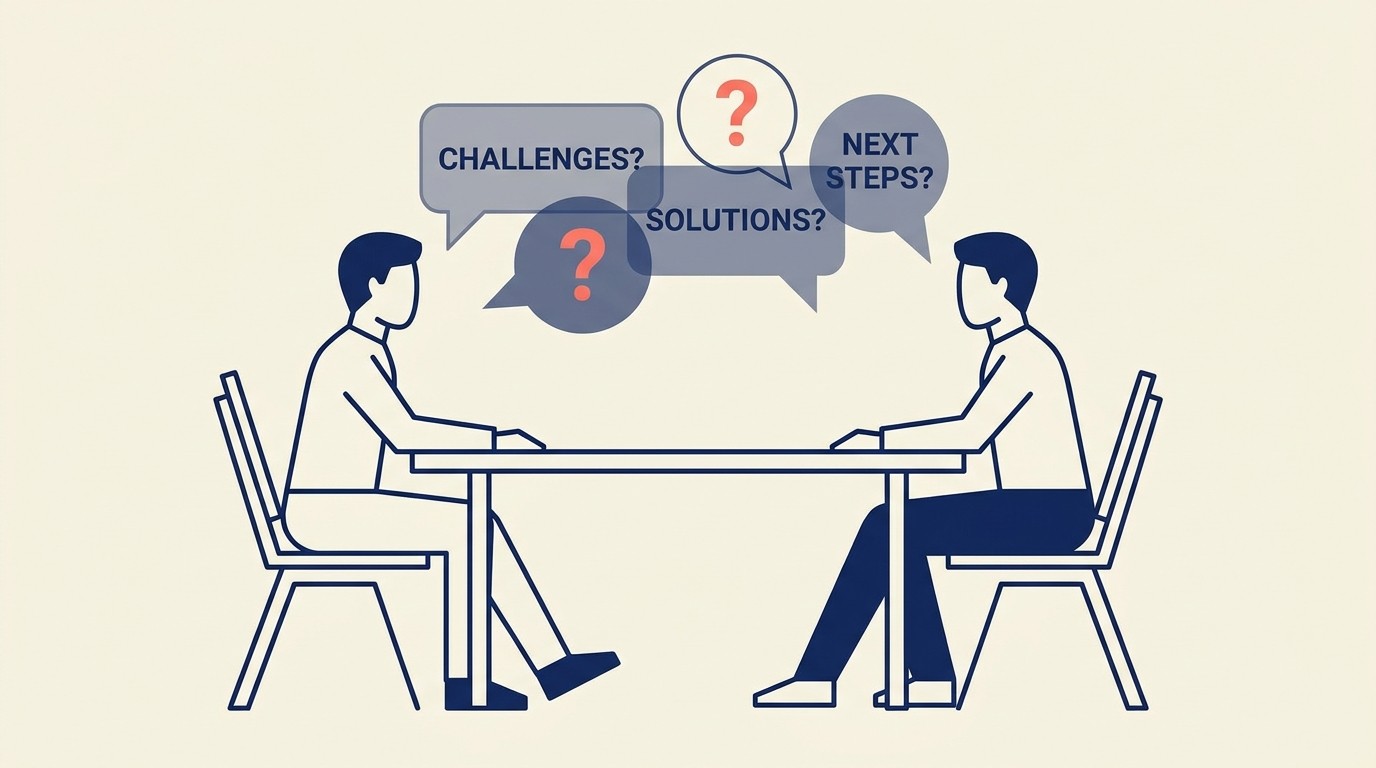
The shift in mindset matters. When you're in sales mode, you're convincing. When you're in consultation mode, you're exploring. One makes prospects defensive. The other makes them open up.
Think about it from the prospect's perspective. They've probably talked to three other firms before you. They've sat through the same tired presentations about "proven methodologies" and "best-in-class service." They're exhausted from being sold to.
You show up differently. You ask questions they haven't been asked. You share insights without being asked for a proposal. You treat their problem as genuinely interesting, not just an opportunity to land a client. That's differentiation that actually matters.
The best consultations feel like strategic dialogues between peers, not vendor-buyer transactions. You're both trying to figure out if there's a fit. You're both investing time to understand whether working together makes sense. That mutual respect changes everything.
Pre-consultation preparation: doing your homework
Walking into a consultation cold is professional malpractice. You should know more about the prospect's business than they expect. Not everything, but enough to ask smart questions instead of basic ones.
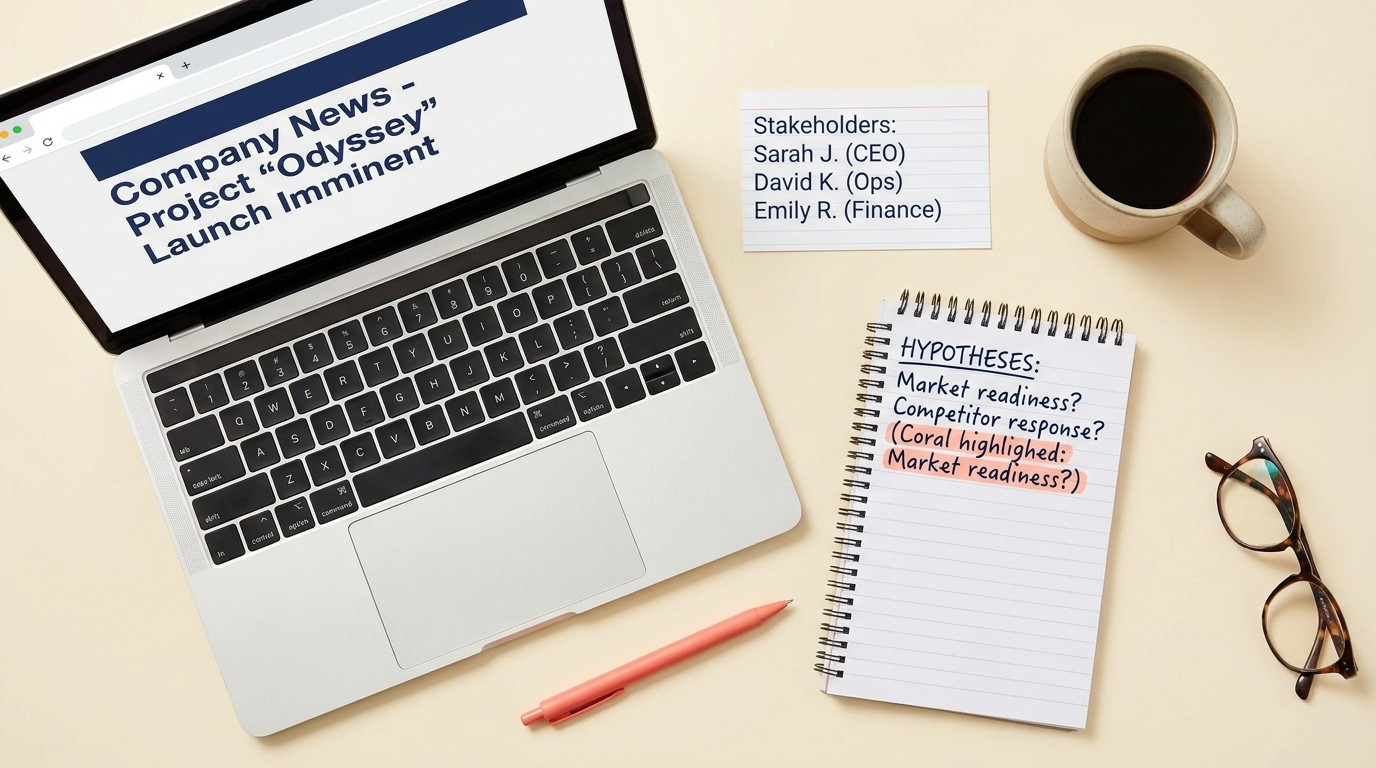
Client research starts with the obvious: their website, recent news, LinkedIn profiles of key stakeholders. But don't stop there. Read their investor presentations if they're public. Check their Glassdoor reviews to understand culture. Look at their competitors to see market context. This research forms the foundation for your client qualification framework and helps you determine if this prospect is worth pursuing.
You're building a picture of who they are, what they care about, and what pressures they're facing. A company that just announced layoffs has different priorities than one that just raised Series C. A firm with terrible Glassdoor reviews probably has retention problems. Context matters.
Industry analysis gives you credibility. If you're meeting with a fintech company, you should know about recent regulatory changes, competitive dynamics, and common challenges in that space. You don't need to be an expert, but you should be conversant.
This research helps you develop hypotheses about their challenges. Based on what you know, what problems might they be facing? What opportunities might they be missing? These hypotheses guide your discovery questions and show you've done your homework.
Relevant case studies should be ready to reference if appropriate. Not to pitch, but to demonstrate you've solved similar problems before. If they mention a challenge with scaling operations and you helped another company solve exactly that, it's worth mentioning. But only if it's genuinely relevant.
Team composition matters too. Who should be in the meeting? Just you, or do you need a subject matter expert? If they're bringing their CFO, maybe you should bring someone who can speak to financial impact. Match the room to the conversation.
Internal objectives should be clear before you walk in. What do you need to learn? What would make this a qualified opportunity? What would be a red flag to walk away? Know your own criteria so you aren't just reacting to whatever they say.
Good preparation doesn't mean you've already decided what they need. It means you're ready to have an intelligent conversation instead of a surface-level one.
Consultation structure: the 60-90 minute framework
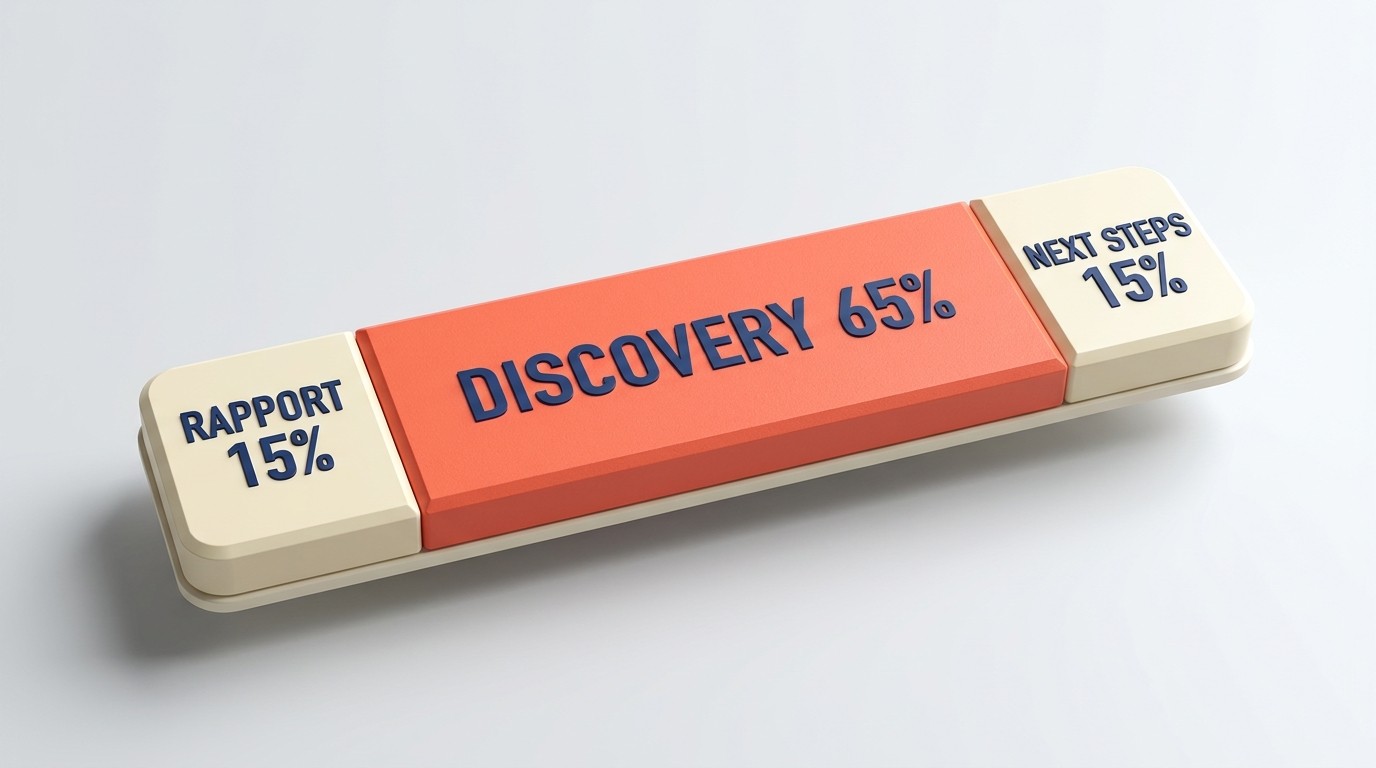
Initial consultations need structure. Not a rigid script, but a framework that ensures you cover what matters without rushing or rambling. The optimal length is 60-90 minutes, broken into three phases.
Here's the full process at a glance, with the time each phase should take and the outcome it produces:
| Phase | Time share | Goal | What you walk away with |
|---|---|---|---|
| Rapport and context | 15-20% | Build trust, set the agenda | A two-way tone, not a pitch |
| Discovery and exploration | 60-70% | Uncover needs, stakeholders, fit | A clear picture of the real problem |
| Next steps | 10-15% | Assess fit, define follow-up | Owned actions and a date |
Keep the discovery phase the longest by design. The whole process succeeds or fails on how much you learn there.
Phase 1: Rapport and context (15-20% of time)
Don't skip this. Jumping straight into business makes people uncomfortable. Spend the first 10-15 minutes building rapport and setting context.
Small talk matters, but make it substantive. Comment on something specific about their business or industry. Ask about the office or how they're navigating a recent market change. Show you're paying attention.
Set the agenda clearly. "I'd like to spend about an hour together today. I want to understand your situation and challenges, share some thoughts based on what we're seeing in the market, and talk through whether it makes sense to continue the conversation. Does that work for you?"
That agenda does three things: it shows you respect their time, it sets expectations for a two-way conversation, and it frames this as exploratory, not a sales pitch.
Phase 2: Discovery and exploration (60-70% of time)
This is where the real work happens. You're uncovering their business context, identifying challenges, understanding stakeholders, and assessing solution fit. We'll break this down in detail in the next sections, but the key is this: they should talk way more than you do.
The 70/30 rule applies here. They talk 70%, you talk 30%. Your 30% is asking great questions, sharing insights, and demonstrating expertise through how you engage with their answers. Not pitching.
Phase 3: Next steps (10-15% of time)
Don't let the meeting just end. The last 10-15 minutes should clarify what happens next. Summarize what you heard, assess mutual fit honestly, and outline the next steps if it makes sense to continue.
This structure keeps you on track without feeling mechanical. You're guiding the conversation, not controlling it.
Opening the meeting: setting the right tone
The first five minutes set the tone for everything that follows. You're establishing credibility, creating psychological safety, and positioning yourself as a trusted advisor instead of a vendor.
Establish credibility quickly but don't overdo it. A brief introduction that highlights relevant experience is fine. "We work with mid-market financial services companies on operational efficiency. I've been doing this for 12 years, mostly with firms similar in size to yours." That's enough. They can look you up if they want details.
Demonstrate preparation by referencing something specific about them. "I saw you recently opened a new office in Austin. I'm curious how that's affecting your operational structure." Or "Your CEO mentioned in the last earnings call that customer acquisition costs are a priority. Is that still top of mind?"
This shows you didn't just show up. You invested time to understand them. That earns respect.
Create psychological safety by being transparent about the process. "I don't know if we're the right fit for each other yet. This meeting is about figuring that out. I'll probably ask some questions that are tough to answer, and that's fine. And if it turns out we aren't a fit, I'll tell you that directly."
That honesty is disarming. Most consultants are trying so hard to win the work that they'll never suggest they're not the right choice. When you show you're willing to walk away from bad fits, prospects trust you more.
Set expectations for a dialogue. "I've prepared some questions, but this should be a conversation. If something I ask doesn't make sense or you want to go in a different direction, just say so." You're inviting them to co-create the conversation, not sit through your interrogation.
The goal is to shift the dynamic from vendor-buyer to advisor-client from the very start. How you open the meeting determines whether that shift happens.
Strategic discovery framework: what you need to uncover
Discovery is where most consultations either succeed or fail. You need to uncover four types of information: business context, challenge identification, stakeholders, and solution fit. Here's what to ask and what to listen for.
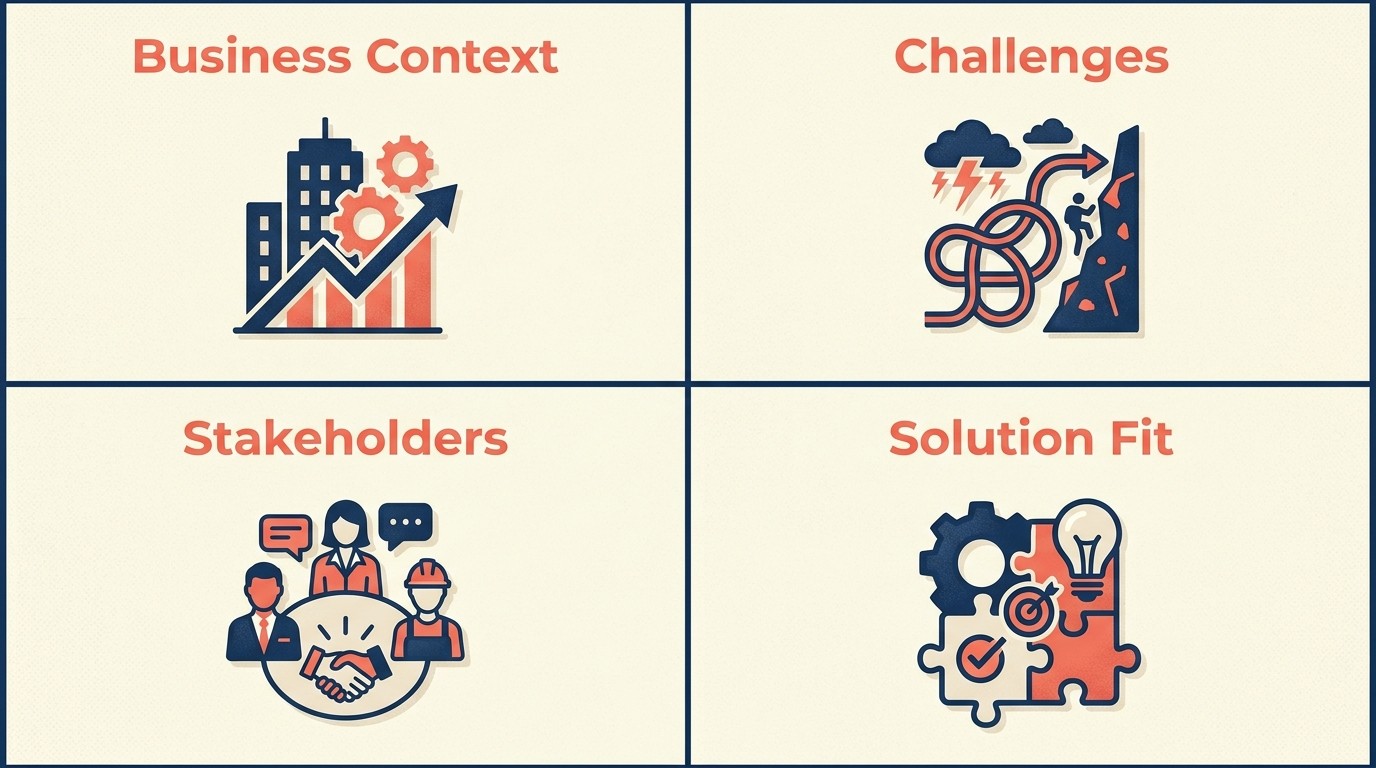
Business context: understanding where they are
Start broad before you go deep. You need to understand their current state, desired state, priorities, constraints, and timeline.
Current state: "Walk me through how you're handling this today." Let them describe their existing process, system, or approach. Don't interrupt. Just listen and take notes.
Desired state: "If we were having this conversation a year from now and things had gone really well, what would be different?" This question uncovers their vision, what success looks like to them.
Priorities: "You mentioned several challenges. If you could only fix one this year, which would it be?" This forces prioritization and reveals what they actually care about most.
Constraints: "What's off the table? Are there things we absolutely can't change or approaches we can't take?" Every organization has sacred cows. Find them early.
Timeline: "What's driving your timeline on this? Why now instead of six months ago or six months from now?" The answer reveals urgency and whether external pressures are creating real deadlines.
Challenge identification: getting to root causes
Surface problems are easy to identify. Root causes take work. Your job is to dig deeper than every other consultant they're talking to.
Problem impact: "What's this problem costing you? In time, money, lost opportunities, employee frustration?" Quantify the pain. Vague problems don't get budget allocation. Specific, measurable problems do.
Previous attempts: "What have you tried already?" This tells you what didn't work and why. It also reveals whether they're serious about solving this or just tire-kicking.
Root causes: "Why do you think this keeps happening?" Don't accept the first answer. Keep asking why until you get to systemic issues instead of symptoms.
Cost of inaction: "What happens if you don't solve this?" Sometimes the answer is "not much," which tells you this isn't really a priority. Sometimes it's "we'll lose major clients," which tells you it is.
Stakeholders: mapping the decision landscape
Professional services deals rarely involve just one decision-maker. You need to understand who's involved, how decisions get made, and what success looks like to each stakeholder.
Decision-makers: "Who needs to sign off on moving forward with something like this?" Get specific names and roles. "The VP of Operations and the CFO" is better than "senior leadership."
Approval process: "Walk me through how you typically make decisions on investments like this." Understanding the process helps you forecast timelines and identify potential bottlenecks.
Success criteria: "What would make this project a win for you personally? What about for your boss?" Different stakeholders care about different outcomes. The CFO wants ROI. The operations lead wants less chaos. Know the difference.
Budget authority: "Is budget already allocated for this, or would it need to be approved?" This is the BANT question done conversationally. You need to know if money exists or if they're just exploring options. For a deeper dive into these financial conversations, see our guide on budget and timeline discovery.
Solution fit: do you belong here?
Not every opportunity is a good fit. Use discovery to figure out whether your expertise aligns with what they need.
Expertise preferences: "Have you worked with consultants on something like this before? How'd that go?" This reveals whether they're consultant-friendly or skeptical, and what they value in external partners.
Working style: "How do you prefer to work with outside firms? Hands-on and collaborative, or give you the problem and come back with a solution?" Some clients want partnership, others want you to disappear and deliver. Know which this is.
Past experiences: "What worked well in past engagements? What didn't?" Learn from their history. If they hated the last consultant's communication style and you communicate the same way, that's a problem.
Cultural alignment: Pay attention to how they operate. Formal or casual? Data-driven or intuition-based? Collaborative or hierarchical? You need to work in a way that fits their culture or you'll struggle.
Active listening: the 70/30 rule and reading between the lines
The best consultants are the best listeners. Not passive listening, but active engagement that shows you're processing what they're saying and making connections they might not see.
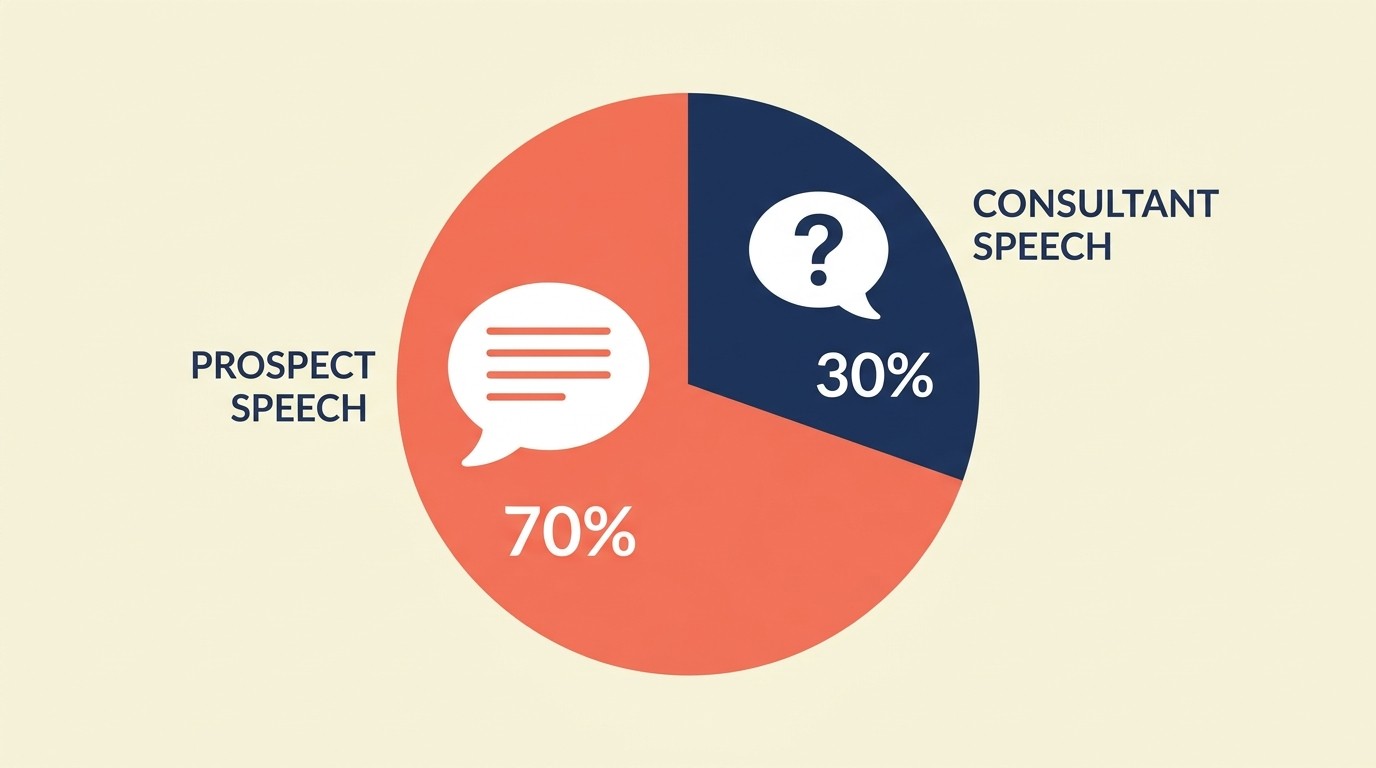
The 70/30 rule: They should talk 70% of the time, you should talk 30%. This is harder than it sounds. Most professionals are so eager to demonstrate expertise that they dominate the conversation. Fight that urge.
Your 30% should be:
- Asking follow-up questions
- Paraphrasing to confirm understanding
- Sharing relevant insights or observations
- Drawing connections between different points they've made
Take notes visibly. It shows you're paying attention and that what they're saying matters enough to write down. But don't hide behind your laptop. Look up, make eye contact, engage.
Paraphrase to confirm understanding: "Let me make sure I've got this right. You're saying the real problem isn't the technology, it's that your teams aren't aligned on process. Is that accurate?" This catches misunderstandings early and shows you're listening.
Read between the lines. Sometimes what people don't say is more important than what they do say. If they talk about budget constraints immediately, money is a real concern. If they avoid mentioning the CEO, there might be political issues at the top.
Watch body language. If they tense up when discussing a particular stakeholder, there's conflict there. If they light up talking about a specific aspect of the problem, that's what they really care about.
Use strategic silence. After they answer a question, pause for 2-3 seconds before responding. Often they'll fill the silence with additional information that's more honest than their initial answer. People keep talking when you create space for it.
The goal is to make them feel heard. When prospects feel understood, they open up. When they open up, you learn what you actually need to know to help them.
How to demonstrate value without selling
Here's a counterintuitive truth: the less you sell in the initial consultation, the more likely you are to win the work. Instead of pitching, demonstrate expertise through how you engage with their challenges.

Share insights and frameworks that help them think differently about their problem. "You mentioned struggling with retention. What we're seeing across the industry is that retention is usually a symptom, not a root cause. Companies with retention problems typically have one of three underlying issues: misalignment between compensation and performance, lack of career development, or cultural disconnect between leadership and employees. Based on what you've described, which of those resonates?"
That's not pitching. That's giving them a framework to understand their problem better. It positions you as someone who brings valuable thinking, not just execution capability.
Offer observations and hypotheses based on what they've told you. "Based on what you're describing, it sounds like your challenge isn't capacity, it's prioritization. You've got the resources, but everyone's working on different things without a clear strategic filter. Does that align with what you're seeing?"
When you synthesize what they've said and reflect it back with insight, you're demonstrating how you'd work with them. You're showing your thinking process.
Provide benchmarks and context from your experience. "In similar situations, we've typically seen this take 3-6 months to implement depending on organizational complexity. Does that align with your expectations, or were you thinking faster?"
Benchmarks help them calibrate their thinking and show you've done this before. But deliver them as information, not as sales material.
Connect dots they haven't connected. "You mentioned two things that I think are related. The sales team complaining about lead quality and the marketing team's frustration with long sales cycles. Those are usually symptoms of misalignment on ideal customer profile. Has anyone looked at whether sales and marketing are actually targeting the same buyers?"
This kind of insight shows you're not just listening, you're analyzing and finding patterns. That's valuable regardless of whether they hire you.
Reframe problems in ways that open new solutions. If they're describing their challenge as "we need better project management software," you might reframe it as "it sounds like the real issue is lack of visibility into project status and resource allocation. Software might help, but so might process changes or communication cadences. Worth exploring both."
The goal is to make the consultation itself valuable. Even if they don't hire you, they should walk away with new perspectives on their challenges. That's how you build reputation and differentiate from consultants who just show up to pitch their services.
Positioning your expertise: credibility without arrogance
At some point, you need to talk about yourself. Not a lot, but enough to establish that you can solve the problems they've described. The key is balancing confidence with humility.
Share relevant experience when it naturally fits the conversation. If they describe a challenge and you've solved it before, say so. "We worked with a similar company last year that had the same issue with cross-functional alignment. What we found was that the problem wasn't the people, it was the meeting structure. Changing how they ran leadership meetings eliminated 60% of the conflicts."
That's positioning through storytelling. You're not saying "we're experts in cross-functional alignment." You're showing you've done this work and got results.
Use case studies selectively. Don't dump your entire portfolio on them. Pick one or two examples that mirror their situation and share outcomes. "A client in your industry was struggling with utilization rates. We helped them move from 52% to 71% utilization within four months by changing how they allocated work and forecast capacity."
Specific numbers and outcomes are credible. Vague claims about "driving significant improvement" are not.
Explain your methodology without jargon. If they ask how you'd approach their problem, give a high-level overview. "Typically we start with a diagnostic phase where we interview key stakeholders and analyze current state data. That takes about 3-4 weeks and gives us a baseline. Then we co-create the solution with your team rather than delivering a report. The implementation phase is usually 8-12 weeks with ongoing support."
That's transparent and concrete. They understand what working with you looks like without feeling overwhelmed by process.
Differentiate honestly. If they ask what makes you different from other firms, don't give a marketing answer. Be specific. "I think our main difference is we embed with your team during implementation. A lot of consulting firms deliver recommendations and leave. We stay through execution because that's where things usually fall apart."
That's a real differentiator explained in practical terms, not buzzwords.
Acknowledge what you don't know. If they describe a challenge outside your expertise, say so. "That's not an area where we have deep experience. We could probably figure it out, but you'd be better served by someone who's done it before. I'm happy to refer you to a couple firms that specialize in that."
This honesty builds trust. They know you're not just trying to win every opportunity. You're trying to help them find the right solution, even if it's not you.
The balance is simple: be confident in what you know, humble about what you don't, and specific about what you've done. That's credibility without arrogance.
Navigating common consultation challenges
Not every consultation goes smoothly. Here's how to handle the situations that derail most first meetings.
Multiple stakeholders with different agendas: You ask about priorities and get three different answers from three different people in the room. Don't ignore the conflict. Address it. "I'm hearing different perspectives on what's most important. That's actually really common. Before we go further, it might be worth taking a few minutes to align on what success looks like for the group."
Facilitating that alignment demonstrates value immediately. You're showing how you'd help them even before they hire you.
Premature pricing questions: Someone asks "What's this going to cost?" before you understand what "this" even is. Don't dodge it, but don't answer it either. "That's a fair question, but honestly I don't know yet. I don't want to give you a number that's meaningless because we haven't scoped the work. Typically projects like this range from X to Y depending on scope and timeline, but let's figure out what you actually need first." Understanding how to handle these moments is crucial for pricing justification later in the process.
That's honest and positions pricing as a function of value, not an arbitrary number.
Scope ambiguity: They describe their challenge vaguely and expect you to know what to do. Your job is to create clarity. "What you're describing could mean a few different things. When you say you need help with 'operational efficiency,' are you talking about process optimization, technology implementation, organizational restructure, or something else?"
Force definition. Vague problems lead to misaligned proposals.
Information gatekeeping: They're not sharing critical information, either because they don't trust you yet or they're testing you. You can address this directly. "I'm sensing some hesitation about sharing specific data. That's totally fine, but it does make it harder for me to assess whether we can help. What would make you more comfortable sharing that information?"
Sometimes they just need permission to be protective of sensitive data. Acknowledging it reduces tension.
Competitor comparisons: "We're also talking to [Big Name Firm]. What makes you different?" Don't trash the competition. Focus on what you offer. "They're a solid firm. I think the main difference is approach. They tend to do a lot of analysis and deliver comprehensive reports. We do less analysis and more co-creation with your team during implementation. Depends on what you value more, thoroughness or execution speed."
That differentiates without criticizing.
Unrealistic expectations: They want a three-month project done in three weeks for half the budget. You have to be honest. "I understand the timeline pressure, but based on what you've described, three weeks isn't realistic if you want quality work. We could deliver something in three weeks, but it wouldn't be thorough and you'd likely need to redo it. Is there a way to adjust the timeline or scope to make this work right?"
Setting realistic expectations early avoids disaster later.
Red flags you need to address: Sometimes you'll see signs this isn't a good fit, like dysfunctional team dynamics, unrealistic expectations, unwillingness to invest in solutions, or scope that's outside your expertise. Don't ignore red flags hoping they'll go away. They won't. Address them in the consultation or walk away.
"Based on what I'm hearing, I'm not sure we're the right fit for this. The challenge you're describing needs someone with deep expertise in [area], and that's not our specialty. I'd hate to take your money for work where we're learning on your dime." That integrity earns respect even if you don't win the work.
Closing the consultation: defining next steps
Don't let the meeting just end. The last 10-15 minutes should create clarity on whether to move forward and how.
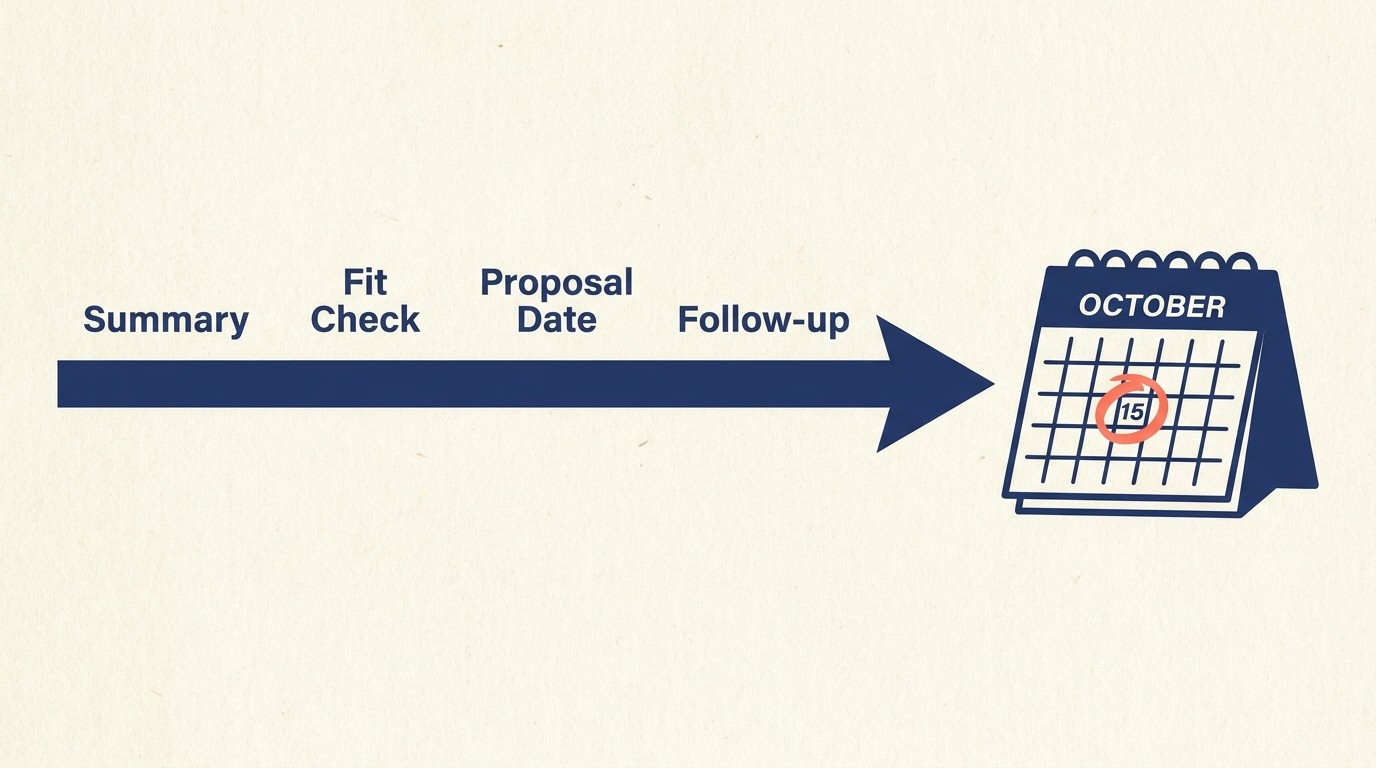
Summarize key findings. "Let me recap what I heard today. Your main challenge is [X], driven by [Y], and you're looking to address it by [Z]. You've got budget allocated, timeline is [timeframe], and the key stakeholders are [people]. Does that sound right?"
This confirms you understood correctly and gives them a chance to correct anything.
Assess mutual fit honestly. "Based on what we've discussed, I think there's a good fit here. The challenges you're facing are right in our wheelhouse, and it sounds like our approach aligns with how you like to work. Do you feel the same way?"
This is a two-way assessment. You're not begging for the work, you're confirming alignment.
If the fit is questionable, say so. "I'm on the fence about whether we're the right firm for this. The technical work is fine, but I'm concerned about the timeline and the internal alignment issues you mentioned. Those could make this really hard to execute well. What do you think?"
Honest assessment builds trust. If you're having doubts, they probably are too.
Outline proposal scope and approach. "If we move forward, here's what I'm thinking. A proposal that covers diagnostic work over 3-4 weeks, followed by implementation over 8-10 weeks, with your team embedded throughout. Does that align with what you're looking for?" This initial scoping conversation sets the stage for detailed project scope assessment.
You're not delivering a proposal on the spot, but you're giving them a sense of what it would include. This surfaces any major disconnects before you invest time writing a detailed proposal.
Clarify timeline for next steps. "I'll put together a proposal and get it to you by end of next week. Let's plan to reconnect the week after to discuss. Does that work for you?"
Specific dates and commitments. Not "I'll send something soon." That's vague and suggests you're not prioritizing them.
Define follow-up plan. "In the meantime, is there anything else you need from me? Additional references, examples of similar work, introductions to team members who'd be working on this?"
Give them an opportunity to ask for what they need. And confirm who owns the next step. "So I'll send the proposal by Friday, and you'll review it with your team the following week. I'll follow up on Monday the 23rd. Sound good?"
Clear ownership of next steps prevents the dreaded "I thought you were going to follow up" situation.
The close should feel natural, not forced. You've had a good conversation, you've both learned something, and now you're either moving forward or parting ways respectfully. Both outcomes are fine as long as they're clear.
Post-consultation activities: maintaining momentum
The work doesn't end when the meeting ends. What you do in the 24-48 hours after the consultation determines whether momentum continues or fizzles.
Internal debrief: Write down your notes while the conversation is fresh. Capture key insights, concerns, red flags, and opportunities. This information shapes your proposal and future conversations. If multiple people from your team were in the meeting, debrief together to compare observations.
Follow-up email within 24 hours. Send a summary email that recaps the conversation and confirms next steps. Here's a template structure:
Subject: Great meeting today - next steps for [Company]
Thanks for taking the time today. I appreciated the chance to learn about [specific challenge they shared] and how it's affecting [specific impact].
Based on our conversation, here's what I heard as your main priorities:
- [Priority 1]
- [Priority 2]
- [Priority 3]
And the key constraints we need to work within:
- Timeline: [specific timeline]
- Budget: [general range if discussed]
- Must-haves: [any non-negotiables they mentioned]
As we discussed, I'll put together a proposal that addresses [scope area] using [approach]. I'll have that to you by [specific date].
In the meantime, I've attached [relevant case study / article / resource] that's relevant to what you're trying to solve. And let me know if you need anything else from me.
Looking forward to continuing the conversation.
[Your name]
This email serves multiple purposes: it shows professionalism, confirms you listened, creates alignment on what matters, and keeps you top of mind.
Proposal development: Don't just template a proposal. Use what you learned in the consultation to customize everything, the challenge description, the approach, the outcomes, the timeline. They should read it and think "this person really understood what we said."
The proposal should feel like a natural extension of the consultation conversation, not a generic pitch document. Reference specific things they said. Address concerns they raised. Show you were paying attention.
Relationship nurturing: Even if they don't move forward immediately, maintain the relationship. Send them relevant articles, introduce them to useful contacts, check in periodically. Some of the best client relationships come from consultations that didn't turn into immediate work but stayed warm over time. This ongoing engagement is part of your broader client relationship strategy.
If you do land the work, the consultation insights shape everything that follows, how you onboard them, how you communicate, what you prioritize. The consultation isn't just about winning business. It's about gathering the intelligence you need to deliver great work.
Templates and frameworks
Consultation agenda template
Initial Consultation Agenda Duration: 60-90 minutes
Introduction & Context (10-15 min)
- Brief introductions
- Agenda overview and meeting objectives
- High-level context on why we're talking
Discovery & Exploration (40-60 min)
- Current state and desired outcomes
- Key challenges and root causes
- Stakeholders and decision process
- Timeline and constraints
- Success criteria
Expertise & Approach (10-15 min)
- Relevant experience and case examples
- High-level approach to similar challenges
- Differentiation and methodology
Wrap-up & Next Steps (10 min)
- Summary of key points
- Mutual fit assessment
- Next steps and timeline
- Follow-up plan
Discovery question framework
Business Context
- Where are you today with [challenge area]?
- Where do you want to be in 6-12 months?
- What's driving this as a priority right now?
- What constraints do we need to work within?
Challenge Identification
- What's this problem costing you today?
- What have you tried already? What worked and what didn't?
- Why do you think this keeps happening?
- What happens if you don't solve this in the next 6 months?
Stakeholder Mapping
- Who needs to be involved in this decision?
- What's your typical process for approving projects like this?
- What would make this a win for you? What about for [other key stakeholder]?
- Is budget allocated, or does it need approval?
Solution Fit
- How have you worked with outside firms before?
- What worked well in those engagements? What didn't?
- How do you prefer to work, collaborative or hands-off?
- What's most important to you in choosing a partner?
Active listening checklist
During the consultation, are you:
- Letting them talk 70% of the time or more?
- Taking visible notes on key points?
- Paraphrasing to confirm understanding?
- Asking follow-up questions that go deeper?
- Noticing what they're not saying?
- Reading body language and energy shifts?
- Using strategic silence to draw out more information?
- Connecting dots between different points they've made?
- Avoiding the urge to pitch solutions prematurely?
- Demonstrating curiosity about their challenges?
Follow-up email template
See the example in the Post-Consultation Activities section above for a complete template you can customize.
Making consultations work across different service types
The core consultation framework applies across professional services, but different types of firms need to adjust emphasis.
For management consultants: Focus heavily on business impact and ROI. Your clients care about measurable outcomes. Spend more time quantifying the cost of the problem and the expected value of solving it. Use frameworks and diagnostic thinking to show analytical rigor. Learn more about structuring these engagements in our guide on consulting engagement models.
For creative agencies: Balance business objectives with creative vision. Clients hire you for ideas and execution, but they need to justify the spend internally. Uncover both the business problem and the creative opportunity. Show examples of past work that solved similar challenges.
For legal and accounting firms: Trust and expertise matter more than methodology. Clients are buying your judgment and experience. Spend less time explaining process and more time demonstrating domain expertise through how you analyze their situation. Confidentiality and discretion matter, so read the room on what they're comfortable sharing.
For technology consultants: Separate the business problem from the technical solution. Too many tech consultations jump straight to architecture and tools. Start with what they're trying to accomplish, why current approaches aren't working, and what constraints exist. Then talk technology.
The consultation principles stay the same. What changes is what you emphasize based on what your specific clients value most.
Frequently Asked Questions about the Initial Consultation Process
What is the initial consultation process?
It's a structured first meeting with a prospect built around four stages: preparation, a three-phase meeting structure, strategic discovery, and a close that assesses mutual fit and defines next steps. The goal is to understand the problem and qualify the opportunity, not to deliver a sales pitch.
How long should an initial consultation last?
Plan for 60 to 90 minutes. That gives you 10 to 15 minutes for rapport and context, 40 to 60 minutes for discovery, and a final 10 to 15 minutes to assess fit and agree on next steps.
What's the difference between a consultation and a sales call?
A sales call is transactional and focused on closing. A consultation is strategic and exploratory, aimed at understanding a complex problem and assessing whether you can deliver real value. The consultation mindset makes prospects open up instead of getting defensive.
What is the 70/30 rule in consultations?
The prospect should talk about 70% of the time and you about 30%. Your share goes to asking strong questions, paraphrasing to confirm understanding, and sharing insights, not pitching. When prospects feel heard, they share what you actually need to know.
How do you close an initial consultation?
Summarize what you heard, assess mutual fit honestly, outline the likely proposal scope, and agree on specific dates for next steps. Clear ownership prevents the dreaded "I thought you were going to follow up" gap.
What comes next
The initial consultation is the first step in the sales process, but everything that follows builds on what you learn in that first meeting.
Your consultation insights flow directly into:
- Needs Assessment & Discovery - deepening your understanding of their challenges
- Proposal Development - crafting a customized approach based on what you learned
- Budget & Timeline Discovery - validating financial and time constraints
- Fit vs Misfit Identification - deciding whether to pursue the opportunity
The consultation also reflects the broader principles of Consultative Business Development, positioning yourself as a strategic advisor, not a vendor competing on price.
Master the initial consultation and you'll win more work at better margins with clients who value your expertise. Rush through it or treat it like a sales pitch and you'll compete on price with everyone else.
The first meeting sets the tone for the entire relationship. Make it count.

Sales Director
On this page
- Why the initial consultation isn't a sales call
- Pre-consultation preparation: doing your homework
- Consultation structure: the 60-90 minute framework
- Opening the meeting: setting the right tone
- Strategic discovery framework: what you need to uncover
- Business context: understanding where they are
- Challenge identification: getting to root causes
- Stakeholders: mapping the decision landscape
- Solution fit: do you belong here?
- Active listening: the 70/30 rule and reading between the lines
- How to demonstrate value without selling
- Positioning your expertise: credibility without arrogance
- Navigating common consultation challenges
- Closing the consultation: defining next steps
- Post-consultation activities: maintaining momentum
- Templates and frameworks
- Consultation agenda template
- Discovery question framework
- Active listening checklist
- Follow-up email template
- Making consultations work across different service types
- What comes next