Agency Pitch Process: Winning New Business Through Strategic Pitching
Turn this article into takeaways for your work.


Each assistant summarizes the article only for you and suggests best practices for your work.
Your agency just spent three weeks preparing a pitch. Design team worked nights on mockups. Strategy team developed custom research. The pitch deck went through 12 revisions. You brought your A-team to the presentation. Everyone nailed their parts. The chemistry felt great.
And then you lost to a competitor who charged 30% less.
This happens all the time. The average agency win rate sits at 20-30% of qualified pitches, which means you lose 7 out of 10 opportunities you pursue. But here's the painful part: each pitch costs between $5,000 and $25,000 in time and resources. That's real money burning on opportunities that never close.
The agencies that crack this problem boost their win rates to 40-50%. They don't win because they're cheaper or flashier. They win because they treat pitching as a strategic process, not a creative exercise. They qualify ruthlessly, discover deeply, differentiate clearly, and close confidently.
This guide breaks down the full pitch process from go/no-go decision through contract signing, with frameworks for the decisions that separate winners from also-rans. This process is a critical component of your agency new business pipeline.
How the pitch process actually works
Most agencies think the pitch starts when they receive the brief. Wrong. The pitch starts the moment you hear about the opportunity, because your first job is deciding whether to pursue it at all. Here's the typical timeline from first contact to decision:
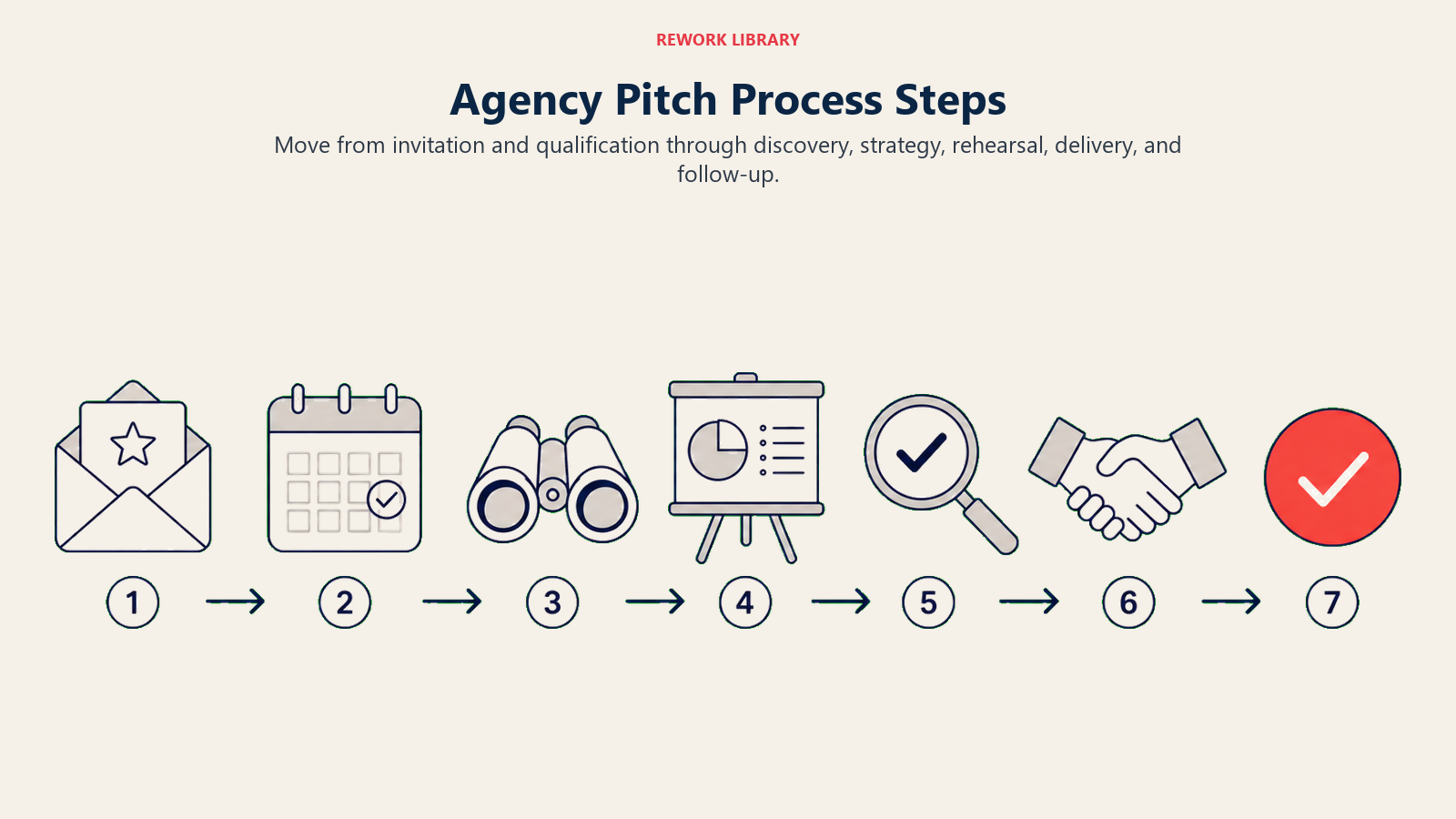
Week 0-1: Go/no-go evaluation. You receive the RFP or pitch invitation. Before you do anything, you assess whether this is worth pursuing based on fit, probability, and resource availability.
Week 1-2: Discovery and research. If you decide to pursue, you dig into the client's business, competitive landscape, stakeholders, and decision criteria. The deeper you go here, the better your pitch will be.
Week 2-4: Strategy and recommendation development. You analyze what you learned, develop your strategic point of view, create your approach, and build supporting materials. This is where differentiation happens.
Week 4-5: Presentation preparation and delivery. You structure the pitch, assign team roles, rehearse, and present. The actual presentation is the output of everything that came before.
Week 5-6: Follow-up and closing. You answer questions, address concerns, negotiate scope and pricing, review contracts, and either close the deal or learn why you lost.
The whole cycle runs 2-6 weeks depending on project size and client urgency. Small projects compress into days. Enterprise pitches stretch into months.
But here's what matters: agencies that win consistently spend more time on the first half (go/no-go and discovery) and less time on the second half (deck production and presentation). They know the pitch is won or lost before the first slide gets designed.
The go/no-go decision framework
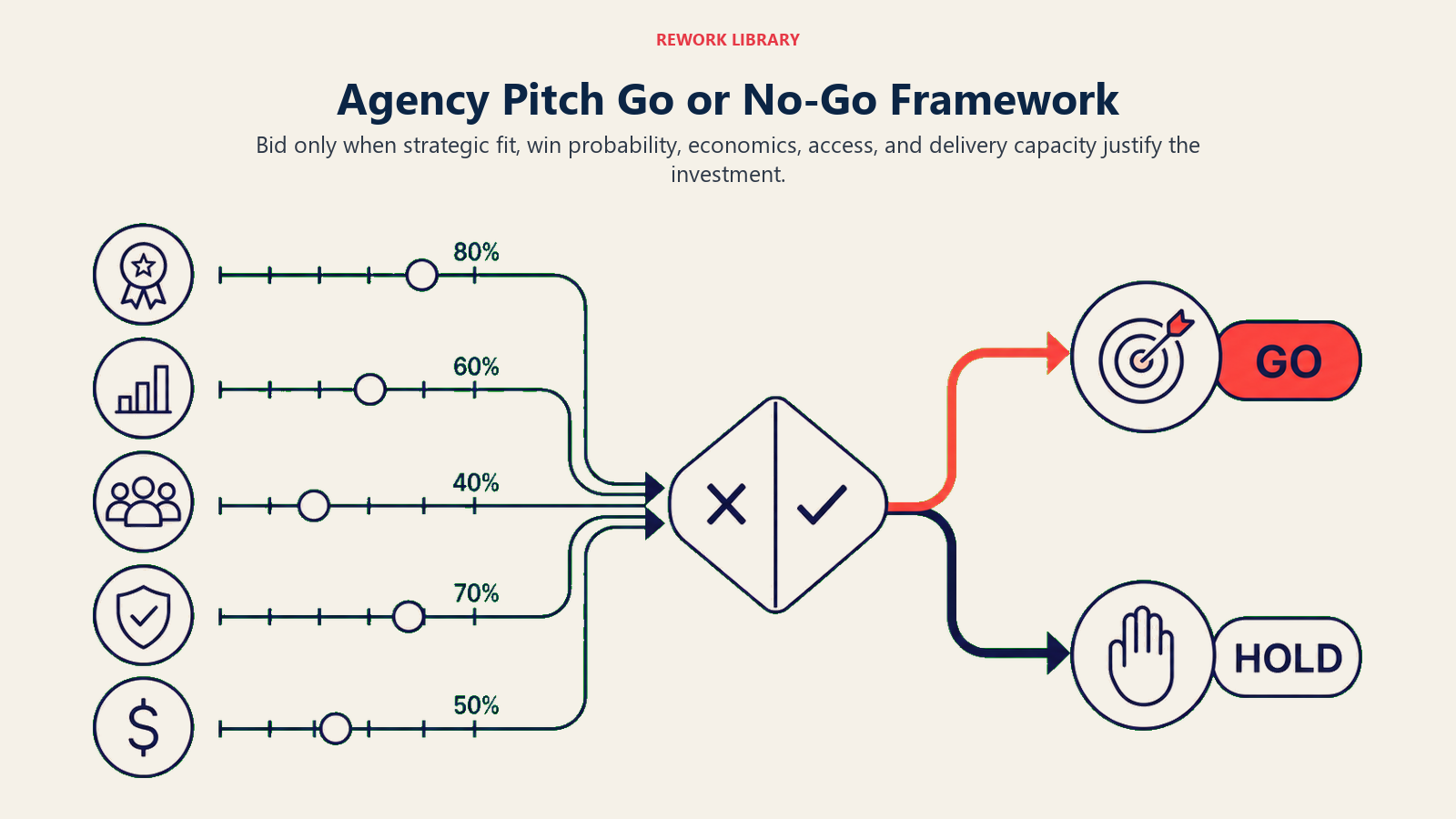
The biggest mistake agencies make is pitching everything that comes their way. More pitches don't equal more revenue. Bad pitches equal wasted resources and demoralized teams. Your go/no-go decision should be ruthless. You're evaluating seven factors: Strategic fit with agency capabilities. Can you actually deliver exceptional work on this? Not "can we figure it out," but do you have proven expertise, relevant case studies, and team members who've done this before? If you're stretching beyond your capability zone to chase revenue, that shows in the pitch and in the delivery. Prospects smell desperation, and even if you win, you'll struggle to deliver.
Budget alignment and profitability potential. Is the stated budget (or what you can infer about budget) enough to deliver great work and hit your margin targets? Agencies that lowball to win end up resenting the client and cutting corners. If the budget feels 30% too low for the scope, that's a red flag. You might negotiate up, but you need to believe there's a path to profitability.
Decision-maker access and relationship. Can you get in front of the actual decision-makers, or are you pitching through procurement gatekeepers? Do you have any existing relationship with the client, or are you starting cold against incumbents? The best pitches happen when you've built relationships before the formal process starts. If you're one of six agencies and you've never spoken to the CMO, your odds just dropped.
Competitive landscape assessment. Who else is pitching? Are you up against the incumbent who's already embedded? Are there three agencies with better category expertise? Understanding your competitive position helps you assess win probability. Sometimes being the underdog is fine if you have a clear differentiation angle. But if you're the fifth creative agency pitching a global CPG brand and you've never worked in CPG, be honest about your chances.
Resource availability for pitch and delivery. Do you have the people to execute this pitch at the level needed? More critically, if you win, can you staff the work without blowing up other commitments? Agencies get into trouble when they win too much at once and can't deliver. If your team is already at 90% utilization, think hard before committing to a big pitch that could land next month.
Client red flags and risk factors. Are there warning signs? Unrealistic timelines, vague scope, decision-by-committee structures, reputation for being difficult, history of churning through agencies every six months. Some clients are problems waiting to happen. Winning bad business is worse than losing good opportunities.
Win probability assessment. Combine all the above into a gut-check: What's your realistic chance of winning this? If it's under 20%, you're probably throwing resources away unless there's a strategic reason to participate (like building a relationship for future opportunities).
Create a simple scorecard. Each factor gets a rating, and you set a minimum threshold. If an opportunity scores below that threshold, you decline. This feels hard at first, especially when you need revenue. But the ROI on pitching well-qualified opportunities is 3-5x higher than pitching everything. For a complete framework, see client qualification.
Discovery and research: where pitches are won
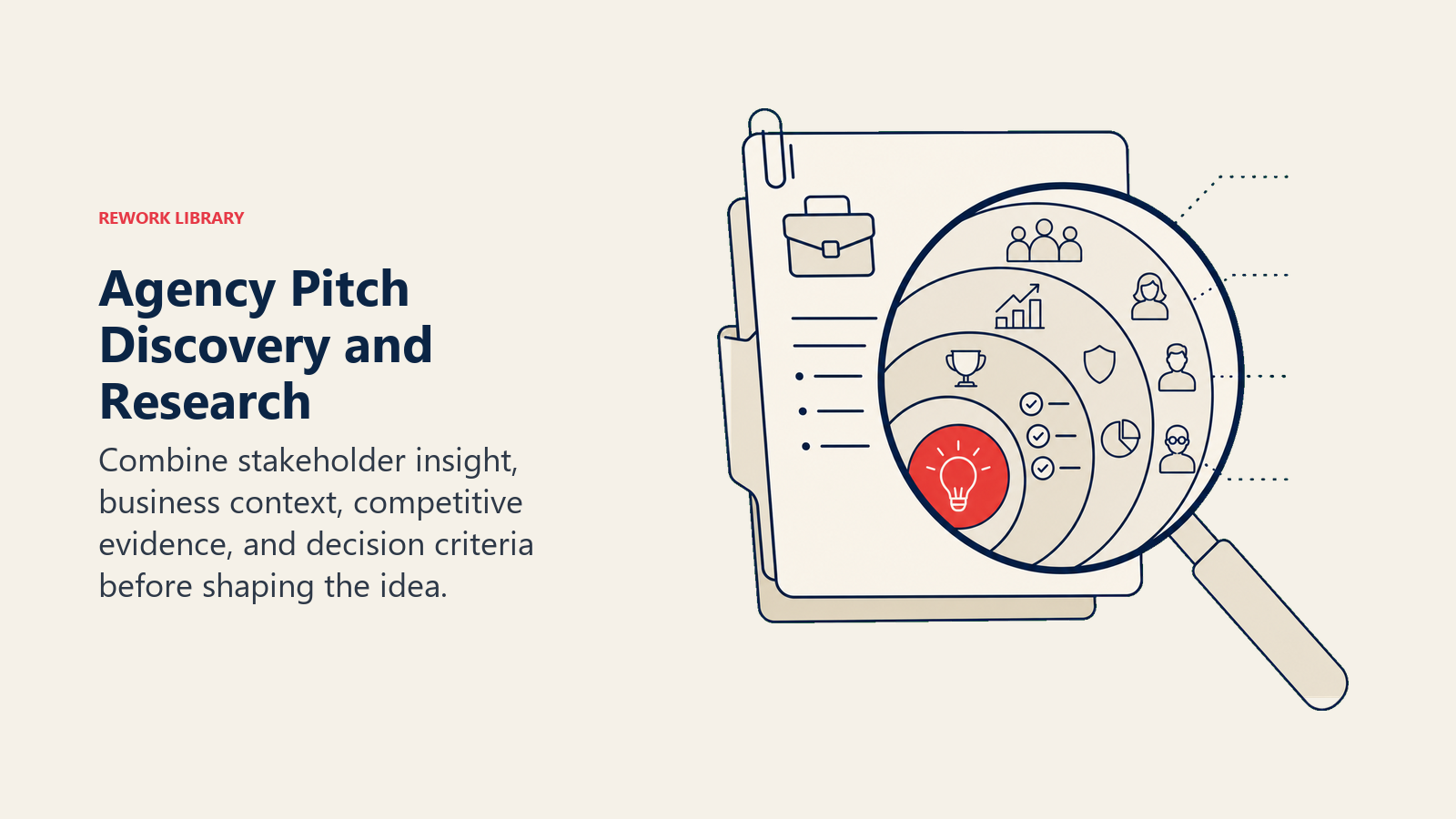
The agencies that win don't just respond to the brief. They understand the brief better than the client does. That comes from discovery. Your discovery process has six components: Understanding client business and challenges. Go deeper than the RFP. What's happening in their market? How's the business performing? What pressure is the CMO under? What initiatives failed recently? What does success look like from their perspective? You're trying to understand context, not just requirements. Read earnings calls, news coverage, Glassdoor reviews, LinkedIn posts from executives. Build a picture of what they're really trying to solve.
Competitive and market research. Analyze their competitors and category dynamics. What's working in the category? What's broken? Where are white space opportunities? If you can walk into the pitch with insights about their competitive position they haven't articulated, you instantly differentiate. This isn't about showing off research skills. It's about proving you understand their world.
Stakeholder interviews and alignment. Talk to everyone you can access. If the brief came from the VP of Marketing, can you get 15 minutes with the CMO? With the head of digital? With the product team? Different stakeholders have different priorities and concerns. Understanding those dynamics helps you address the real decision criteria, not just what's written in the RFP. Ask questions like "What would make this initiative a home run for you?" and "What's your biggest concern about this project?"
Decision criteria and process understanding. How will they actually make this decision? Is it about creativity, strategic thinking, cost, chemistry, relevant experience? Who has final say? How much weight do different stakeholders carry? What happened with the previous agency relationship? Understanding the real criteria lets you emphasize what matters and de-emphasize what doesn't.
Budget and timeline clarity. If the brief says "budget is flexible" or gives a wide range, push for specificity. You need to know what they're actually willing to spend so you can scope appropriately. Same with timeline. Is the stated deadline real or aspirational? Understanding constraints helps you propose something achievable instead of something that looks good but can't be delivered.
Uncovering unstated needs and concerns. Often the brief describes symptoms, not root causes. The client says they need a brand refresh, but what they really need is a repositioning because they're losing relevance with younger audiences. Or they say they want a new website, but what they need is a full digital transformation. If you can surface the deeper need and address it, you're solving a more valuable problem than your competitors who just respond to the stated request.
All of this requires hustle. You can't do good discovery sitting at your desk reading the brief. You need to research, network, make phone calls, ask for conversations. Agencies that treat discovery as a checklist lose. Agencies that treat it as detective work win. See needs assessment and discovery for a systematic approach.
Developing your strategic approach
Discovery gives you raw material. Strategy turns that into a differentiated point of view. Your strategic approach needs to do three things: diagnose the problem accurately, prescribe a solution that's uniquely yours, and prove you can deliver it. Diagnosis: Reframe the challenge. Most RFPs describe the problem from the client's current perspective. Your job is to offer a better framing that unlocks new thinking. Maybe they think they have an awareness problem, but your research shows they have a consideration problem. Maybe they think they need more content, but they really need better content distribution. When you reframe the challenge in a way that's insightful and credible, you demonstrate strategic value before you even get to recommendations.
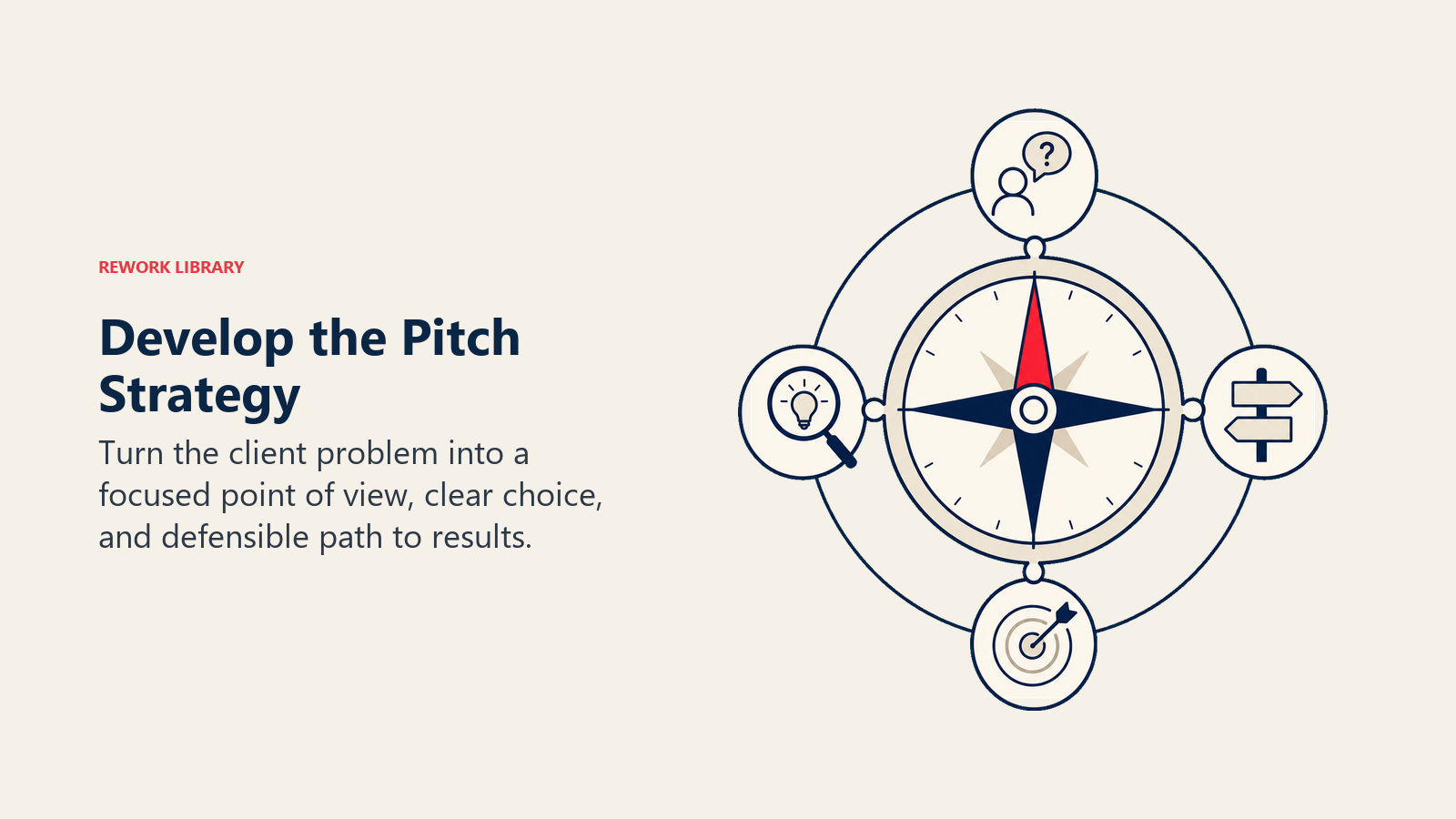
Prescription: Your unique approach. This is where most agencies default to templates and best practices. "We'll start with research, develop strategy, create concepts, test, refine, and launch." That's not differentiated, that's generic. Your approach needs to reflect something specific about this client, this challenge, and your agency's unique methodology or capabilities. Maybe you have proprietary research tools. Maybe you use a specific framework for brand positioning that you can explain. Maybe you bring in unexpected expertise (behavioral economics, cultural anthropology, whatever). The prescription should make competitors' approaches look generic by comparison.
Proof: Case studies and credibility. Once you've laid out your approach, you need to prove you can execute it. That means relevant case studies that demonstrate you've solved similar challenges. Not "we did a campaign for another brand," but "we helped a company in a similar category overcome a similar challenge using a similar approach, and here are the results." Specificity builds credibility. Include metrics, testimonials, and ideally introduce team members who worked on those projects and will work on this one.
The key is connecting all three. Diagnosis shows you understand them. Prescription shows you're differentiated. Proof shows you can deliver. Agencies that nail all three are hard to beat.
Structuring the pitch presentation
You've done the work. Now you need to present it in a way that lands. Here's a proven structure: Opening: Establish credibility and rapport (5-10 minutes). Start with a personal connection, not an agenda slide. Acknowledge something specific about their business or the people in the room. Set the tone as collaborative, not transactional. Then quickly establish your credentials with one sentence about your agency and why you're qualified to help. Don't spend 10 minutes on your agency history and client list. They already know who you are or they wouldn't have invited you.
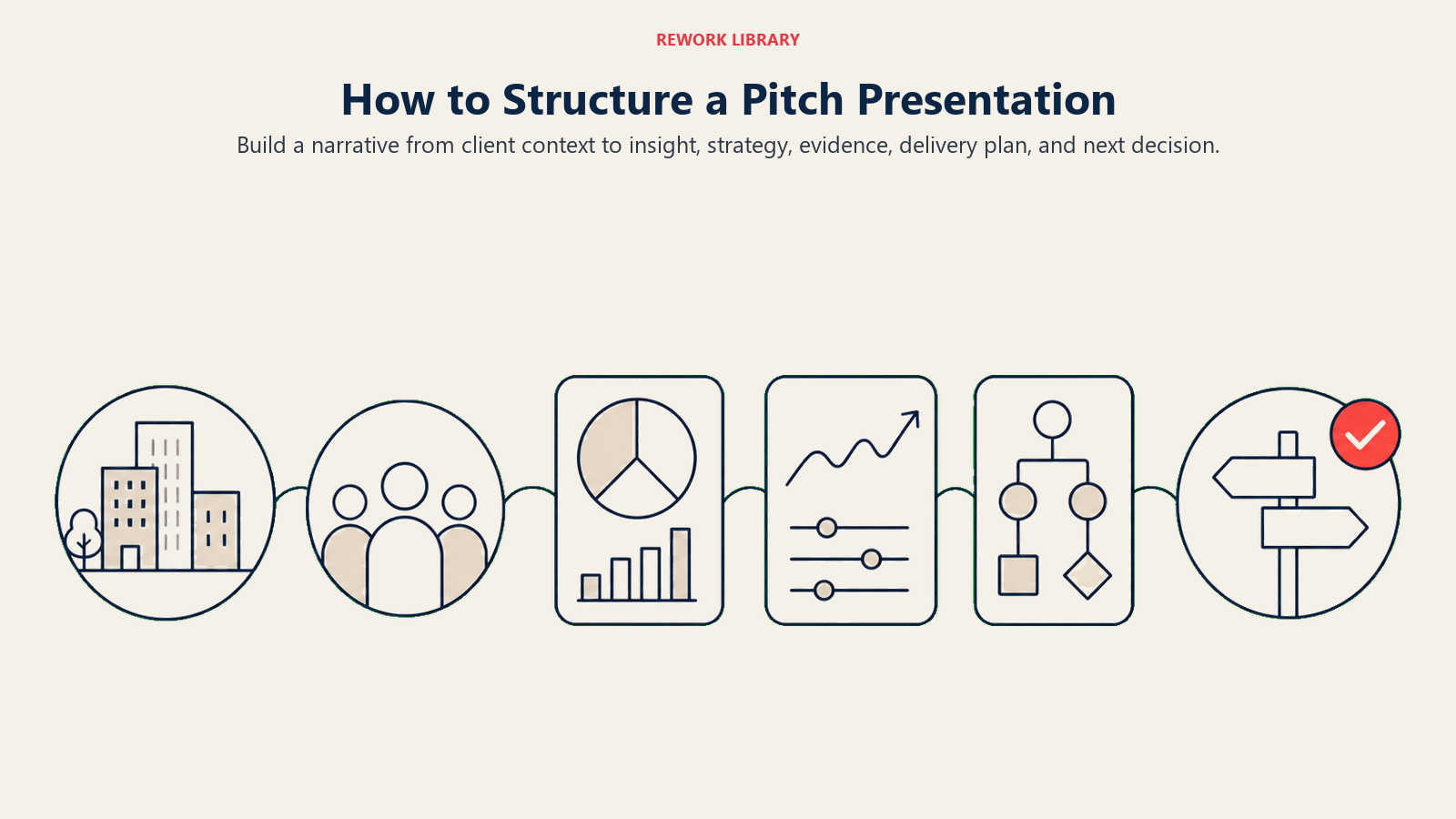
Problem understanding and reframing (10-15 minutes). Show them you understand their challenge by reflecting it back, then offer your reframe. "You described this as an awareness problem, and we understand why. But when we analyzed your category dynamics and competitive positioning, we saw something else..." This is where you demonstrate strategic thinking and insight. If they nod along here, you're winning.
Strategic approach and recommendation (15-20 minutes). Walk through your proposed approach step by step. Explain not just what you'll do, but why. Connect each element to the challenge you identified. Use frameworks or models if they help, but don't make it academic. Keep it grounded in their specific situation. Show creative concepts or campaign ideas if appropriate, but make sure they're clearly connected to strategy. Creativity without strategic rationale is just decoration.
Proof and case studies (10 minutes). Share 1-2 highly relevant examples of similar work you've done. Walk through the challenge, your approach, and the results. Use metrics and client testimonials. If you can, bring in team members who worked on those projects to add credibility and demonstrate bench strength.
Team and capabilities (5-10 minutes). Introduce the team that will work on this account. Don't just show headshots and titles. Explain what each person brings and why they're right for this challenge. Let them speak if possible. Chemistry matters. Clients want to know they'll enjoy working with you.
Scope, timeline, and investment (10 minutes). Be clear about what you're proposing to do, when you'll deliver it, and what it costs. Structure options if appropriate (good/better/best or phased approach). Don't bury pricing at the end or in an appendix. Present it confidently as a fair exchange of value. Explain what's included and what's not so there are no surprises later.
Q&A and closing (10-15 minutes). Open it up for questions. Answer directly and honestly. If you don't know something, say so and commit to following up. Use questions as opportunities to reinforce your key points. Close by restating your enthusiasm, summarizing why you're the right choice, and clarifying next steps.
That's roughly 75-90 minutes, which is typical for a formal pitch. Shorter for smaller projects, longer for enterprise. But the structure holds.
Delivering the pitch with confidence
The presentation itself is performance. Content matters, but delivery matters just as much.
Team selection and role assignment. Don't bring your entire leadership team if they're not going to work on the account. Bring the people who will be involved, plus one senior strategic thinker who can handle high-level questions. Assign clear roles: who opens, who presents strategy, who presents creative, who handles questions. Make sure everyone knows their part and timing.
Rehearsal and preparation. Run through the pitch at least twice as a team. Time it. Practice transitions. Anticipate questions and prepare answers. Rehearsal sounds obvious, but agencies skip this because they're scrambling to finish the deck. That shows in the presentation. Tight, well-rehearsed pitches beat brilliant but shaky ones.
Managing presentation dynamics. Pay attention to room energy and adjust. If people are checking phones, you're losing them. If someone asks a question, answer it even if it derails your flow. The pitch is a conversation, not a monologue. If you notice someone looking skeptical, engage them. "I noticed some concern when I mentioned timeline. What are you thinking?" That's better than plowing ahead.
Engaging the client and reading the room. Make eye contact with everyone, not just the obvious decision-maker. Ask questions and invite reactions. "Does this framing resonate?" or "Is this the kind of thinking you were hoping for?" Create dialogue instead of broadcasting. The more they talk, the more you learn and the more invested they become.
Handling questions and objections. When someone raises a concern or objection, don't get defensive. Acknowledge it, reframe if appropriate, and address it directly. If they say "this feels expensive," that's an opportunity to reinforce value. If they say "we tried something similar and it didn't work," find out why and explain how your approach is different. Objections are buying signals if you handle them well.
Demonstrating chemistry and fit. Clients hire agencies they like working with. Be professional but authentic. Show personality. Laugh if something's funny. Let your passion for the work come through. If you're stiff and corporate, they'll assume working with you will be stiff and corporate. If you're energized and collaborative in the pitch, they'll believe that's the experience they'll get.
Closing and next steps. Don't end with "any questions?" and trail off. Finish strong. Summarize why you're the right choice in 2-3 sentences. Express genuine enthusiasm for the opportunity. Then clarify the process: "What happens next? When will you make a decision? Is there anything else you need from us?" This shows you're serious about winning and want to stay engaged.
Presenting pricing with confidence
Pricing is where good pitches often fall apart. Agencies get nervous and either apologize for the number or bury it in complexity. Here's how to present pricing in a way that closes deals instead of killing them: Lead with value, then price. Before you show the number, remind them what they're getting. "We're proposing a three-phase engagement that includes comprehensive research, strategic repositioning, brand identity refresh, and a full campaign launch. Based on the scope we've discussed, the investment for this is $350,000." Value first, then price. This frames the number as a fair exchange, not a cost.
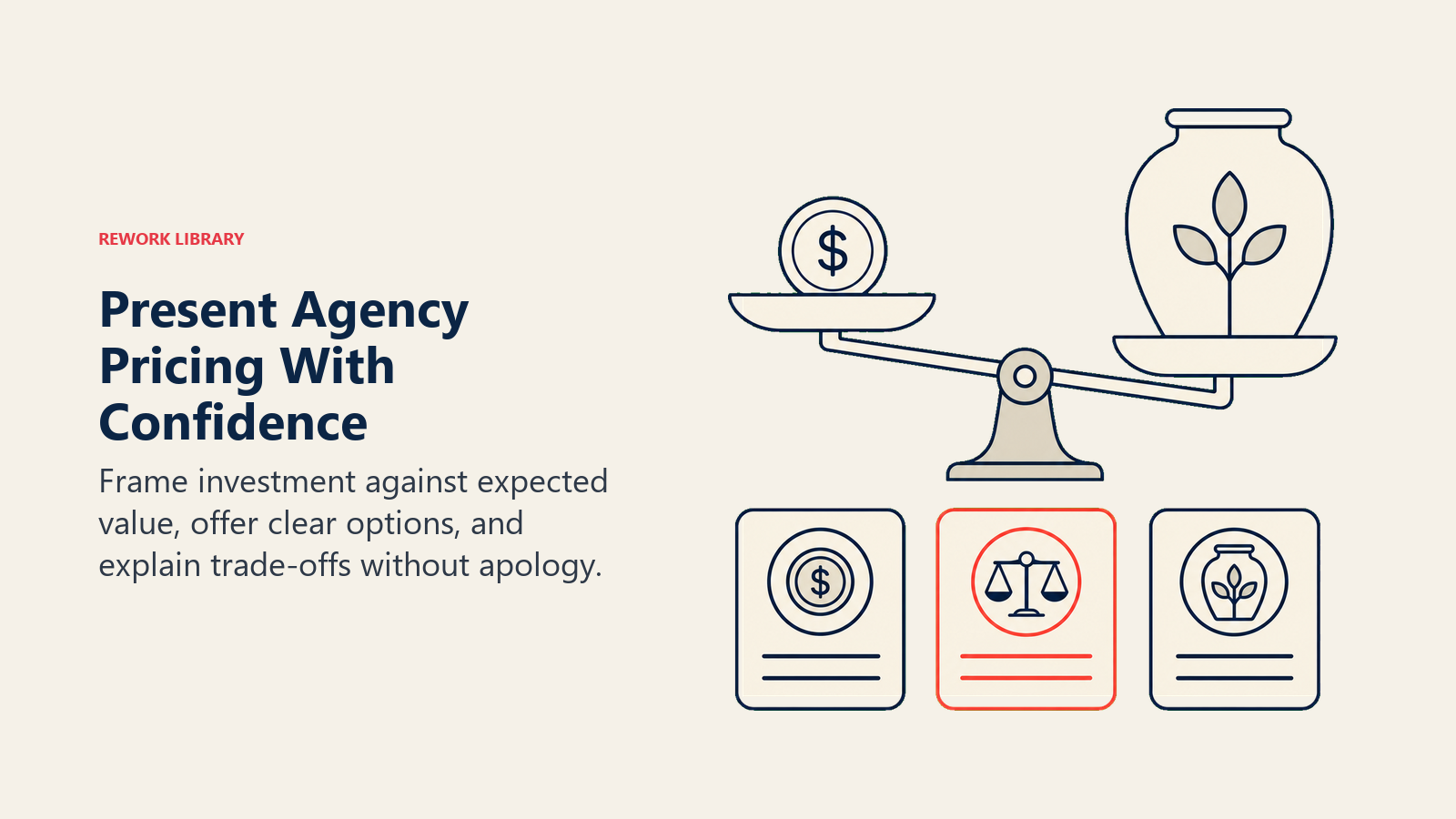
Break down what's included. Don't just say "$350K." Show the components: strategy phase, creative development, production, media planning, project management. When clients see the breakdown, the number feels more justified. It also helps them understand where they could trim if budget is tight.
Offer options if appropriate. Sometimes a tiered approach helps. "Here's the full scope at $350K. If budget is a constraint, here's a phased approach where we start with strategy and phase one creative for $180K, then expand based on results." Options give clients control and increase close rates. But don't offer options that compromise quality just to hit a lower price point.
Address ROI and return on investment. If you can credibly tie your work to business outcomes, do it. "Based on similar engagements, we'd expect this campaign to drive a 20% lift in consideration and 15% increase in qualified leads, which at your average deal size translates to roughly $2M in incremental revenue." Not every project allows ROI framing, but when it does, it reframes price as investment.
Handle price objections directly. If they say "that's more than we expected," don't panic and offer a discount. Ask questions: "What were you expecting? What's driving that budget constraint?" Maybe they were thinking $250K and you came in at $350K. Can you adjust scope to bridge the gap? Or maybe they have $400K but wanted to negotiate. Understanding the objection helps you respond strategically.
Don't apologize or justify defensively. When you say "$350,000" and immediately follow with "I know that seems high, but..." you've undermined your own pricing. Present the number confidently. Pause. Let them react. Then address whatever comes up. Confidence in pricing signals confidence in value.
Be clear about payment terms and structure. Explain how invoicing works: 50% upfront, 25% at midpoint, 25% at completion, or whatever your structure is. Clarify what's included in the price and what would be additional (third-party costs, media spend, etc.). Surprise costs later destroy trust. Transparency now builds it.
Pricing shouldn't be the scariest part of the pitch. If you've done discovery well, understood their budget, and scoped appropriately, the number should land within expectations. If it doesn't, that's a discovery failure, not a pricing failure. See pricing justification for more on communicating value.
Differentiating from competitors
Every pitch is a competition, even if you don't know who you're up against. Differentiation is how you win. Understand the competitive landscape. Who else is pitching? What are they known for? What will their approach likely be? Sometimes you can find out directly ("Who else are you considering?"). Sometimes you have to infer. If you're up against big networks, they'll lead with scale and resources. If you're up against boutiques, they'll lead with craft and attention. Position yourself in contrast.
Clarify your unique value proposition. What can you do that others can't? This needs to be specific, not generic. "We bring strategic rigor" isn't differentiated. "We're the only agency in this region with a dedicated healthcare strategy team and proprietary patient journey mapping tools" is differentiated. Find the thing that's both true and valuable for this client, then make it central to your pitch.
Use proof points and case studies strategically. Don't just show your best work. Show work that proves you can solve this client's specific problem. If they need to reach Gen Z, show Gen Z case studies. If they need to drive ecommerce, show ecommerce results. Relevance beats impressiveness.
Demonstrate team expertise and chemistry. Clients aren't just hiring your agency, they're hiring the people they'll work with. If your team has unique backgrounds, credentials, or experience, surface that. "Sarah spent five years on the client side running digital for a direct competitor, so she knows this category intimately." Personal stories and expertise create connection and credibility.
Differentiate on process and methodology. If you have a proprietary framework, workshop approach, or tool that others don't have, that's differentiating. But don't make it sound complicated or academic. Explain it in plain language and connect it to client value. "We use a three-day immersive discovery sprint that gets key stakeholders aligned on strategy before any creative work starts. That eliminates the back-and-forth revision cycles that slow most projects down."
Show cultural and values alignment. Some clients care about this more than others, but it's increasingly important. If they value diversity, show your team's diversity. If they're environmentally focused, talk about your B Corp certification. If they're scrappy and entrepreneurial, match that energy. Values alignment affects long-term fit and retention.
Differentiation isn't about being the biggest or cheapest or flashiest. It's about being the right fit for this specific client at this specific moment. That's why discovery matters so much. You can't differentiate effectively if you don't know what matters to them.
Following up after the pitch
The pitch doesn't end when you leave the room. What happens in the next week often determines the outcome.
Send a thank-you and recap within 24 hours. Email everyone who attended. Thank them for their time, reiterate your enthusiasm, and summarize key points from the conversation. "We're excited about the opportunity to help you reposition for the Gen Z market. As discussed, our approach focuses on cultural insight and authentic storytelling, and we're confident we can deliver the kind of impact you're looking for. Please let us know if you need any additional information."
Answer follow-up questions quickly and thoroughly. If they ask for more detail on pricing, team bios, case study results, or anything else, respond within a few hours. Speed signals responsiveness and eagerness. Slow responses signal you're not that interested or you're disorganized.
Provide additional information proactively. If something came up in the pitch that you couldn't fully address, send a follow-up. "You asked about measurement frameworks. Attached is an example dashboard from a similar client showing how we track and report performance." This shows you're thinking about their needs beyond the pitch.
Negotiate scope and pricing thoughtfully. If they come back with budget constraints or scope changes, engage constructively. Don't immediately cave on price. Explore options: "If we need to bring this down to $250K, here's what we'd recommend scoping out to maintain quality." Give them choices, not just discounts.
Handle contract and legal review professionally. Once you've agreed on scope and price, contracts often slow things down. Be responsive to legal questions. Negotiate terms that protect both sides but don't nickel-and-dime over small points. The goal is to close, not to win the contract negotiation.
Transition smoothly to onboarding. As soon as the contract is signed, start the client onboarding process. Introduce account and project teams, schedule kickoff, send onboarding materials. Strong onboarding reinforces that choosing you was the right decision and sets up a successful engagement.
And if you lose? Ask for feedback. Most clients won't volunteer it, but if you ask directly and position it as learning (not challenging their decision), many will share. "We'd love to understand what we could have done better. Any feedback you're willing to share would help us improve." Win or lose, you're gathering intelligence for the next pitch.
Learning from wins and losses
Every pitch is data. Agencies that analyze that data get better. Agencies that just move on to the next one stay mediocre. Conduct win/loss analysis consistently. After every pitch, win or lose, run a team debrief within a week while it's fresh. What went well? What didn't? What would we do differently next time? Document the answers. Over time, you'll see patterns.
Understand win factors. When you win, why? Was it the strategy, the team chemistry, the pricing, the relevant case studies, the relationship? Try to isolate what actually drove the decision. Sometimes clients will tell you directly if you ask: "We're thrilled you chose us. Can I ask what stood out in your decision?" That feedback is gold.
Analyze loss reasons. When you lose, get specific about why. Was it price? Lack of relevant experience? Competitor had a better strategic approach? Incumbent relationship? Sometimes you'll learn the decision was made before you even pitched (they were just checking boxes with multiple pitches). That tells you to qualify better next time.
Collect client feedback systematically. Create a simple post-pitch survey or interview template. Ask about the quality of discovery, clarity of strategy, creativity of approach, team presentation, pricing, and overall impression. Make it easy to give feedback (5-minute conversation, not a long survey). Some clients won't respond, but the ones who do give you actionable insights.
Gather competitive intelligence. When you learn who won and why, that's valuable intelligence about the competitive landscape. If the same competitor keeps beating you on pricing, you need to either adjust your pricing model or get better at selling value. If they're beating you on strategic thinking, you need to strengthen your strategy practice. Learn from losses instead of dismissing them.
Identify process improvements. Sometimes losses reveal process gaps. Maybe you didn't spend enough time on discovery. Maybe you brought the wrong team. Maybe your deck was too long or too sales-y. Each loss is a chance to refine your pitch process.
Share learnings across the team. Don't silo this knowledge with whoever ran the pitch. Share win/loss insights in team meetings, update pitch templates based on what you've learned, train new team members on proven approaches. Institutional knowledge compounds when you systematize learning.
The best agencies track win rates, average pitch cost, revenue per won pitch, and other metrics over time. That quantifies whether your process is improving. If your win rate goes from 25% to 40% while holding pitch costs steady, that's a massive ROI improvement. Track it.
Common pitfalls that kill pitches
Even good agencies make predictable mistakes. Here's what to avoid:
Weak discovery leading to generic recommendations. When you don't invest in discovery, you default to templated thinking. The pitch sounds like every other pitch because you didn't learn anything unique about this client. Clients can smell copy-paste approaches. Differentiation requires insight, and insight requires discovery.
Making the pitch about you instead of them. Agencies love talking about their history, their awards, their client roster, their office culture. Clients don't care. They care about whether you can solve their problem. Every slide should answer "so what?" from the client's perspective. If it doesn't, cut it.
Weak differentiation and point of view. If your pitch could come from any agency in your category, you're not differentiated. You need a clear POV on their challenge and a distinct approach to solving it. "We do great creative work" isn't a POV. "Your category has a storytelling problem, not an awareness problem, and here's why that matters" is.
Overdesigning the presentation, underinvesting in strategy. Beautiful decks don't win pitches. Clear thinking wins pitches. If you spend 80% of your time making slides look perfect and 20% developing your strategic approach, you've got it backwards. Better to have a simple, clear deck with brilliant strategy than a gorgeous deck with generic thinking.
Underpricing to win. This is tempting when you need revenue or really want the client. But underpriced work creates bad client relationships. You'll resent them, cut corners to stay profitable, and eventually lose the account anyway. It's better to lose at the right price than win at the wrong price.
Poor team chemistry and dynamics. Sometimes the team presenting doesn't work well together. Awkward handoffs, people talking over each other, obvious disagreements, lack of energy. Clients notice. They're imagining working with you for months or years. If the chemistry is off in the pitch, they'll assume it'll be off in the engagement.
No follow-up or closing discipline. You delivered a great pitch, everyone seemed engaged, you left feeling good, and then... silence. Because you didn't clarify next steps, didn't send a recap, didn't check in. Deals are lost in the follow-up phase because agencies don't stay engaged. Persistence without being annoying is a skill. Develop it.
Avoiding these pitfalls won't guarantee wins, but they'll dramatically improve your odds.
What happens next
The pitch process connects directly to the rest of your agency new business pipeline. You can't pitch well if you're pitching bad opportunities, which is why client qualification matters so much. And pitching is really just a specialized form of proposal development and pricing justification - all part of the same system.
Once you win, the work shifts to delivery. Everything you promised in the pitch needs to show up in the engagement, or trust erodes fast. That's why the best pitch processes tie directly into project delivery processes. What you sell is what you deliver.
Start with one improvement. Pick the weakest part of your current pitch process - maybe it's go/no-go discipline, maybe it's discovery depth, maybe it's pricing confidence - and fix that first. Then move to the next. Incremental improvements compound into significantly higher win rates over time.
Because here's the math: if you pitch 20 opportunities a year at an average project size of $200K, the difference between a 25% win rate and a 40% win rate is $600,000 in revenue. That's three extra clients, and you didn't have to generate more leads or work harder. You just got better at converting the opportunities you already had.
That's the leverage in pitch process improvement. It's one of the highest-ROI investments an agency can make.

Sales Director
On this page
- How the pitch process actually works
- The go/no-go decision framework
- Discovery and research: where pitches are won
- Developing your strategic approach
- Structuring the pitch presentation
- Delivering the pitch with confidence
- Presenting pricing with confidence
- Differentiating from competitors
- Following up after the pitch
- Learning from wins and losses
- Common pitfalls that kill pitches
- What happens next