Thought Leadership Strategy: Building Authority and Reputation in Professional Services
Turn this article into takeaways for your work.


Each assistant summarizes the article only for you and suggests best practices for your work.
Here's what most professional services firms call thought leadership: repackaged blog posts about "trends to watch," listicles pulled from industry reports they didn't write, and thinly veiled sales pitches disguised as expertise.
That's not thought leadership. That's content marketing with delusions of grandeur.
Real thought leadership is when a CFO considering a major ERP implementation reads your article on change management failures, saves it, shares it with their team, and six months later calls you first when they're ready to hire consultants. It's when conference organizers invite you to speak because your perspective on industry challenges is worth hearing. It's when competitors mention your frameworks in their proposals because your ideas have become industry standard.
Thought leadership creates something billable hours can't: trust before engagement. Buyers research you long before they contact you. They read your content, watch your videos, listen to your podcast interviews. By the time they reach out, they've already decided you're credible. The sales conversation becomes "how we work together" not "why you should hire us."
If you're a managing partner, practice leader, or senior professional responsible for business development, you need to understand this: thought leadership isn't about publishing more content. It's about building systematic authority that positions you as the expert buyers seek when they have problems to solve.
What is Thought Leadership (and What It Isn't)
Real thought leadership means sharing what you actually know in ways that shift how your industry sees problems. It's about building authority that makes clients trust you before they've even met you.

Notice what's missing: promotion, product pitches, generic advice. Thought leadership earns attention by being genuinely useful, not by asking for business.
The Authority vs Promotion Distinction
Most firms struggle with this boundary. They want to establish expertise AND generate leads AND promote services. Thought leadership does all three, but indirectly. But the moment content becomes promotional, it stops being thought leadership and becomes marketing.
Compare these approaches:
Promotional Content: "Our proprietary Change Acceleration Framework helps organizations achieve 40% faster adoption. Contact us to learn how we can drive transformation success in your company."
Thought Leadership: "Why do 67% of digital transformations fail despite executive sponsorship and adequate budgets? Our analysis of 200 implementations reveals three systemic mistakes: rushing past stakeholder analysis, underestimating middle management resistance, and confusing training with capability building. Here's what actually works."
The second example establishes expertise without selling. It provides value that helps readers whether or not they hire you. That generosity creates trust. Trust creates preference. Preference creates business.
The Trust-to-Revenue Connection
Professional services buying follows a relationship trajectory that thought leadership accelerates:
Awareness: They discover you exist, usually through content, speaking, or referrals.
Credibility: They consume your insights and judge whether you actually know what you're talking about.
Consideration: When they have a relevant need, you're on the shortlist because you've demonstrated expertise.
Preference: They prefer you over alternatives because you've invested in sharing knowledge, not just selling.
Engagement: They hire you with higher trust and less price resistance than if you'd come through cold outreach.
Thought leadership collapses the timeline from awareness to engagement by front-loading credibility. Instead of needing multiple meetings to prove expertise, your content has already done that work.
The revenue impact isn't immediate, which is why many firms abandon thought leadership too early. But firms that stick with it see 2-3x more inbound opportunities, shorter sales cycles, and higher win rates because buyers arrive pre-sold on expertise. This aligns with the inbound lead generation approach that attracts qualified prospects rather than chasing them.
The Long-Term Reputation Investment
Thought leadership is a compound interest game. Your first article reaches 200 people and generates one inquiry. Six months later, you've published twelve pieces. Your speaking engagements reference your frameworks. Your LinkedIn posts get shared. Someone discovers your content library, reads eight articles in one sitting, and becomes a qualified lead worth $200K.
The value accumulates. Each piece of content continues working long after publication. Each speaking engagement creates video clips, articles, and connections. Each framework you introduce becomes associated with your firm.
This compounding requires patience and consistency. Most firms publish sporadically when they have capacity, then wonder why thought leadership "doesn't work." It doesn't work that way. You're building reputation infrastructure, not running lead generation campaigns.
Defining Your Thought Leadership Platform
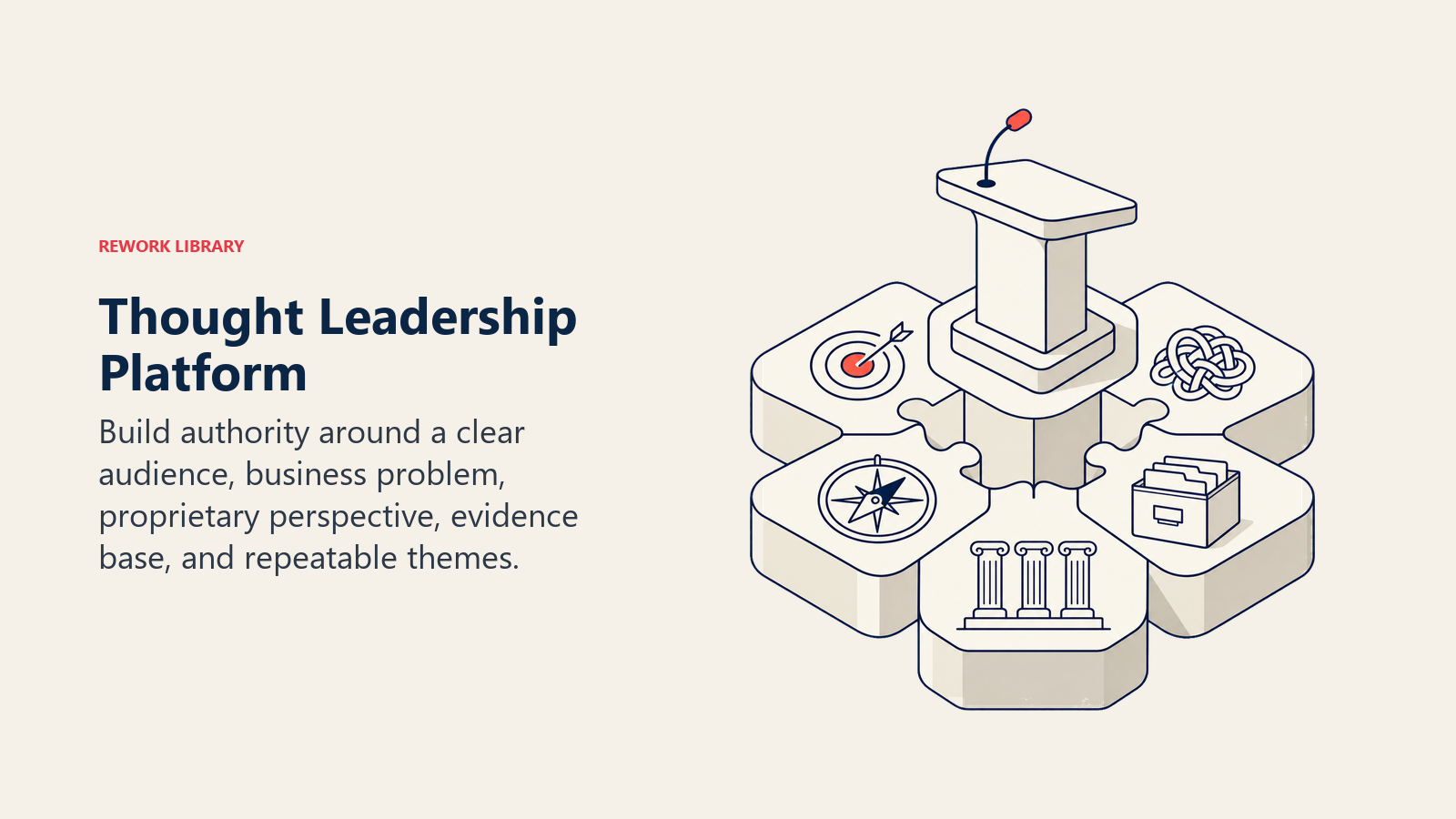
Before you publish anything, you need clarity on what you're known for and why anyone should listen. This is your thought leadership platform: the expertise areas, perspectives, and points of view that define your authority.
Identifying Your Unique Expertise and Perspectives
Start with honest inventory: what do you know that others don't? What have you learned from doing this work that creates valuable perspective?
Generic expertise doesn't build thought leadership. "We help companies improve operations" competes with 10,000 other consultants. "We've optimized fulfillment operations for 47 mid-market manufacturers and discovered that 80% of efficiency gains come from three specific workflow changes most consultants miss" is a platform.
The specificity creates authority. You're not claiming to know everything about everything. You're claiming deep knowledge about specific things you've actually done repeatedly.
Think about your actual experience:
- What patterns have you noticed across 20, 30, 50 client projects that others miss?
- What conventional wisdom sounds right but fails in practice?
- What methods have you developed that actually produce better results?
- What problems do you solve better than anyone else, and why?
Your platform should emerge from real expertise, not aspirational positioning. Trying to build thought leadership around capabilities you don't actually have creates content that rings hollow. Buyers can tell.
Finding Underserved Topics in Your Niche
The most valuable thought leadership addresses important topics that aren't being covered well. If fifteen competitors are all writing about "digital transformation best practices," that space is crowded. But maybe no one is addressing "managing board expectations during multi-year transformations" or "building internal change capabilities that outlast consultants."
These underserved topics are your opportunity. You can become the definitive voice on subjects where authority is available because no one else is investing there.
Finding these topics requires market research:
- What questions do prospects ask in early sales conversations that they can't find good answers for?
- What problems cause clients the most pain that aren't well addressed in public content?
- What industry publications or conferences have gaps in coverage?
- What's your team debating internally that would interest your market?
You want topics narrow enough to dominate but broad enough to support sustained content production. "Pricing strategy for professional services" is broad and competitive. "Transitioning from billable hours to value-based pricing in accounting firms" is specific enough to own while supporting dozens of articles, speaking topics, and frameworks.
Understanding overall content marketing for services helps position thought leadership within broader marketing efforts.
Balancing Proprietary Insights vs Accessible Knowledge
Every firm worries about giving away too much. "If we share our methodology, won't competitors copy it? If we reveal our frameworks, won't clients just do it themselves?"
This fear is mostly unfounded. Here's why:
Implementation complexity: Knowing what to do and actually executing are completely different. Your content explains concepts; your services deliver outcomes. Most organizations can't or won't do the work themselves even with perfect instructions.
Relationship value: Clients hire consultants for judgment, customization, and accountability, not just knowledge. Your content demonstrates you have knowledge worth accessing through engagement.
Market expansion: Teaching your approach often creates demand rather than cannibalizing it. Organizations that read your content realize the challenge is bigger than they thought and seek help.
The strategic balance: share frameworks, methodologies, and insights generously. Hold back only client-specific details, proprietary data, and implementation nuances that create competitive advantage in delivery.
Your thought leadership should make people think "this is brilliant, AND I need their help implementing it," not "this is too vague to be useful" or "now I'll just do it myself."
Developing a Consistent Point of View
Strong thought leadership has perspective, not just information. It takes positions on what works, what doesn't, and why conventional wisdom sometimes fails.
You need to develop clear points of view:
- What do you believe about your domain that's contrarian or non-obvious?
- What common practices do clients engage in that you think are misguided?
- What emerging trends do you think matter more (or less) than industry hype suggests?
Your point of view becomes your content anchor. Instead of just explaining topics, you're advancing an argument about the right way to think about them.
Example perspectives that drive thought leadership:
- "Most change management fails because firms focus on adoption metrics instead of capability building"
- "Agile methodology works brilliantly for software development and terribly for strategic planning"
- "The rise of AI makes human judgment more valuable in consulting, not less, but only for firms that develop it deliberately"
These perspectives give your content edge and memorability. Neutral, everyone-agrees content gets ignored. Content with perspective gets shared, debated, and remembered. The ability to challenge conventional wisdom often stems from experience gained through your firm specialization strategy.
Content Strategy and Planning
Random publishing kills your credibility. You need a content plan that builds momentum over time, not scattered posts whenever you find the time.
Core Content Pillars Aligned to Expertise
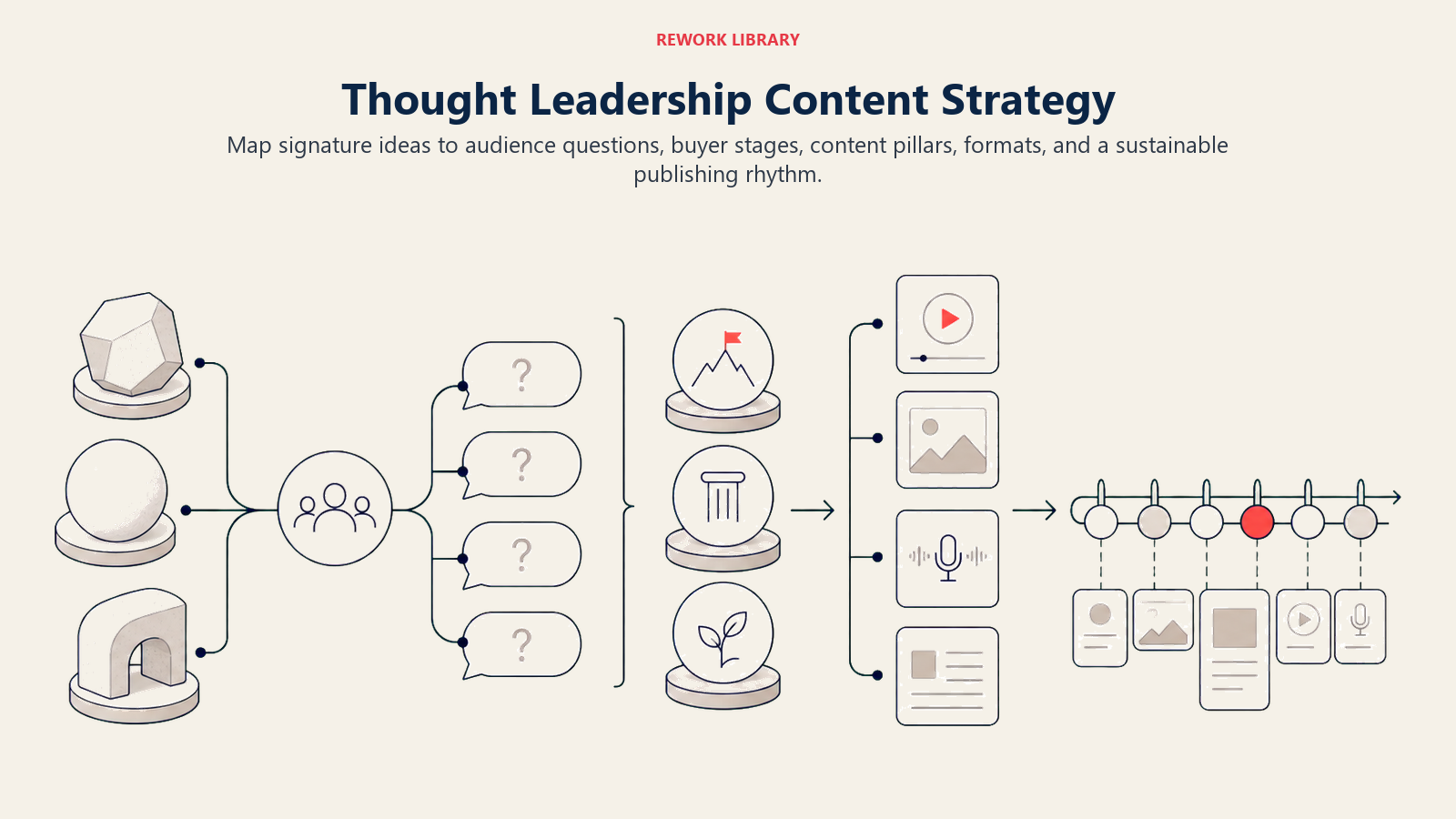
Content pillars organize your thought leadership into 3-5 major themes that represent your expertise areas. These pillars should map to:
- Services you provide
- Problems you solve
- Expertise you want to be known for
Example pillar structure for a consulting firm:
Pillar 1: Strategic Planning in Volatile Markets Topics: scenario planning, strategy in uncertainty, adaptive planning, board engagement
Pillar 2: Operational Excellence Implementation Topics: process optimization, change management, capability building, performance management
Pillar 3: Leadership Development for Growth Topics: executive coaching, succession planning, culture transformation, talent strategy
Each pillar supports 12-15 pieces of annual content, giving you ~50 total pieces across three pillars. This creates depth in each area while maintaining variety.
Pillars prevent content sprawl where you're publishing random topics that don't build cumulative authority. Every piece should ladder up to one of your core themes.
Topic Ideation Frameworks
Sustaining thought leadership requires systematic topic generation. Most firms struggle after their first 5-10 obvious topics. These frameworks keep ideas flowing:
Client conversation mining: What questions come up repeatedly in sales calls, project work, or advisory sessions? Each question suggests content topics.
Contrarian takes: What does everyone in your industry believe that your experience suggests is wrong or incomplete? Challenge conventional wisdom.
Process breakdowns: Take complex processes you help clients with and break them into teachable components. Each step becomes content.
Industry event response: Major industry conferences, research reports, or news events create timely topics where you add perspective.
Framework evolution: Develop proprietary frameworks, then create content explaining each component, application scenarios, and implementation approaches.
The best topic ideation happens in structured sessions with your team. Quarterly 90-minute brainstorming sessions with senior professionals can generate 20-30 topic ideas that feed your editorial calendar.
Content Formats by Buyer Journey Stage
Different content formats serve different purposes in the buyer journey:
Awareness Stage - Educational Content Goal: Demonstrate expertise and help people understand problems Formats: How-to articles, industry analysis, research reports, framework explainers Example: "Five Signs Your Pricing Strategy Is Leaving Money on the Table"
Consideration Stage - Applied Insights Goal: Show how your approach works and what makes it different Formats: Case studies, methodology explainers, comparative analysis, implementation guides Example: "How Three Mid-Market Manufacturers Cut Fulfillment Costs 23% Using This Framework"
Decision Stage - Trust Building Goal: Establish credibility and reduce perceived risk of working with you Formats: Speaking recordings, detailed case studies, client interviews, thought leadership books Example: "Inside Our Six-Month Board Advisory Engagement: What We Did and Why It Worked"
Your content mix should weight toward awareness and consideration content (70-80%) with smaller portions of decision-stage content (20-30%). Most buyers engage with multiple pieces across stages before they're ready to buy.
Editorial Calendar Development
Editorial calendars create publishing consistency and coordination across channels. Effective calendars specify:
Publishing cadence: How often you publish core content (weekly, bi-weekly, monthly)
Content types: What formats you're producing (articles, videos, podcasts, research)
Themes: What topics or pillars each period focuses on
Distribution plan: Where and how each piece gets promoted
Accountability: Who creates, reviews, approves, and publishes each piece
A realistic calendar for a mid-sized professional services firm might include:
- 2 long-form articles monthly (2,000+ words)
- 4 short insights or LinkedIn posts weekly
- 1 speaking engagement or webinar quarterly
- 1 major research piece or framework annually
This creates ~30 substantial pieces annually while remaining sustainable for firms balancing thought leadership with billable work.
The calendar should plan 3-6 months ahead with flexibility for timely topics. Too much rigidity prevents responding to market moments; too little structure leads to inconsistent publishing.
Quality Over Quantity Principles
Publishing frequency matters less than publishing substance. One exceptional article monthly builds more authority than four mediocre ones.
Quality markers in thought leadership content:
- Original insights from direct experience, not rehashed industry reports
- Specific frameworks, processes, or approaches readers can apply
- Real examples with details that demonstrate actual expertise
- Clear perspective or point of view, not neutral information
- Appropriate depth that respects reader intelligence
Compare: "Digital transformation requires strong leadership, clear communication, and employee engagement to succeed."
versus
"Digital transformation failures follow predictable patterns. In our analysis of 47 implementations, 68% failed not from technology problems but from misalignment between executive timelines and middle management capacity for change. Executives wanted results in 12 months. Middle managers needed 18-24 months to build new capabilities while maintaining operations. This timeline gap, rarely addressed in planning, created impossible expectations that undermined confidence in the initiative."
The second example provides substantive insight worth reading. The first is generic filler.
Your reputation depends on the weakest content you publish. Better to publish less frequently with consistent quality than maintain high volume with variable quality that dilutes authority.
Content Creation Approaches
Thought leadership takes multiple formats, each serving different audiences and distribution channels.
Written Content: Articles and Research
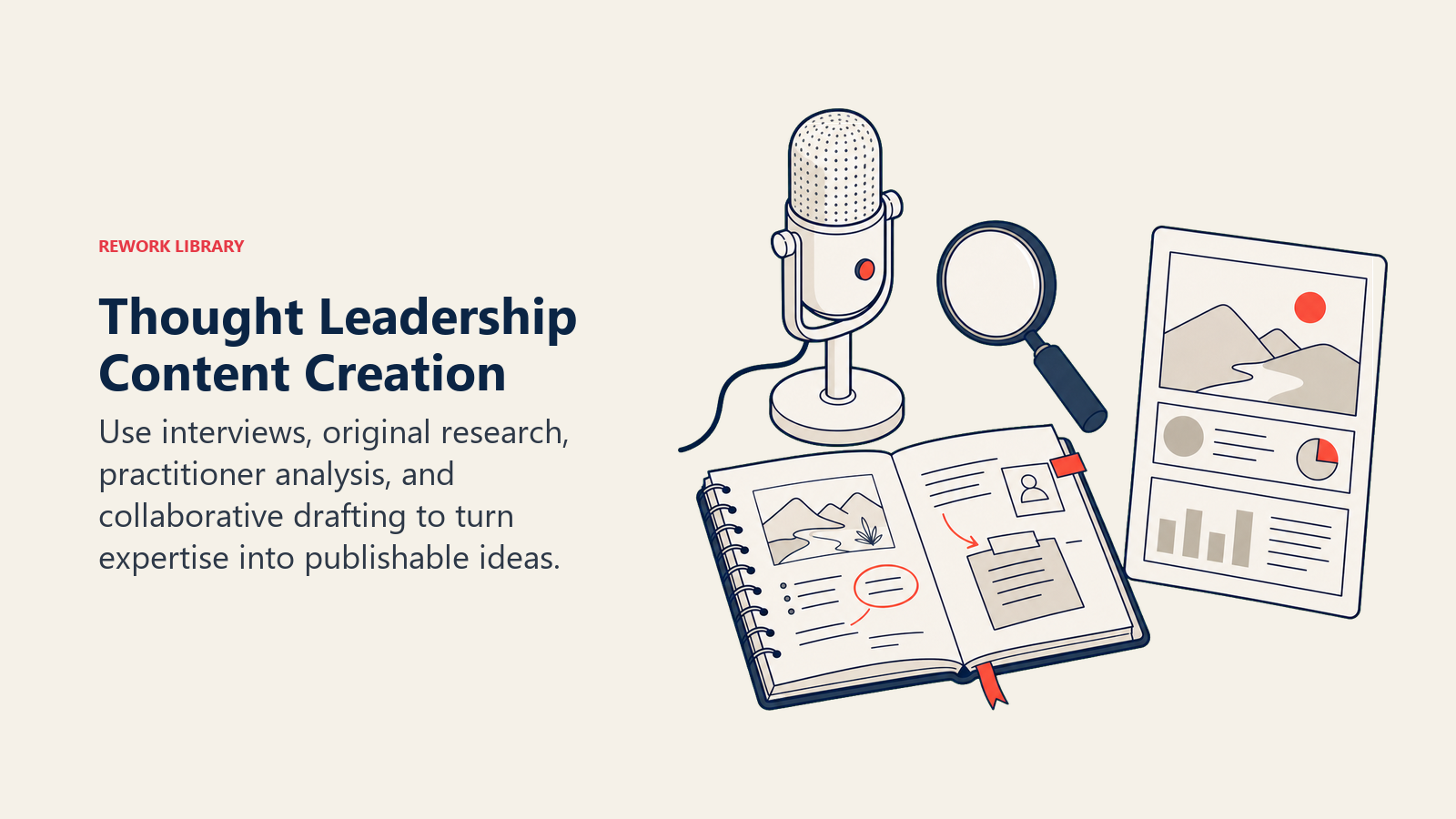
Long-form written content remains the foundation of most thought leadership programs. Articles ranging from 1,500 to 3,000 words allow depth that establishes expertise while remaining accessible.
Effective article structures:
- Problem-Solution: Identify a common challenge, explain why standard approaches fail, present your methodology
- Framework Explainer: Introduce a proprietary framework, explain each component, show application examples
- Trend Analysis: Examine an industry shift, provide perspective on implications, recommend response strategies
- Contrarian Position: Challenge conventional wisdom, present evidence for alternative view, explain what to do differently
Research reports and whitepapers provide deeper analysis on significant topics. These 15-40 page pieces work well for:
- Original primary research (surveys, interviews, data analysis)
- Comprehensive frameworks requiring detailed explanation
- Industry benchmarking or performance analysis
- Multi-faceted problems requiring systematic treatment
Research pieces take 3-6 months to produce but generate authority disproportionate to effort. They create speaking opportunities, media citations, and lead magnets for years after publication. This original research also provides ammunition for client testimonials and case studies that demonstrate real-world results.
Video and Visual Content
Video content expands reach to audiences who prefer visual learning and creates distribution opportunities on YouTube, LinkedIn, and conference platforms.
Effective video formats for thought leadership:
- Whiteboard explainers (5-10 minutes): Illustrate frameworks or concepts visually
- Speaking recordings: Capture conference presentations or webinar sessions
- Expert interviews: Discuss industry challenges with clients or peer experts
- Quick insights (2-3 minutes): Share single ideas or reactions to industry events
Video doesn't need high production value to work. Authentic expertise matters more than polish. Many successful thought leadership videos are recorded in offices or home studios with basic equipment.
What matters most is staying consistent with your format and schedule. Weekly 5-minute videos build more authority than sporadic 30-minute productions.
Speaking Engagements
Speaking at industry conferences, client events, and association meetings amplifies thought leadership by putting your expertise in front of concentrated audiences of potential buyers.
Speaking provides multiple benefits:
- Direct audience engagement allowing relationship building
- Credibility boost from event organizer endorsement
- Content creation opportunities from presentation recording
- Network expansion through attendee connections
- Geographic reach beyond your local market
Strategic speaking requires selectivity. Not all speaking opportunities build authority equally. Evaluate based on:
- Audience quality: Are decision-makers who hire services like yours present?
- Event reputation: Does the event itself confer credibility?
- Topic fit: Can you speak about your core expertise areas?
- Distribution potential: Will the presentation be recorded and promoted?
Target 4-8 major speaking engagements annually, supplemented by client-specific or association presentations. More than that becomes difficult to sustain while maintaining billable work.
Connecting speaking to overall speaking and publishing strategy ensures presentations support broader thought leadership goals.
Podcasts and Interviews
Podcast interviews provide leverage by accessing established audiences without building your own podcast infrastructure. Guest appearances on industry podcasts introduce your expertise to new audiences while creating content you can repurpose.
Hosting your own podcast works when you have:
- Consistent access to interesting guests in your target market
- Resources to maintain regular publishing (bi-weekly minimum)
- Willingness to build audience over 12-24 months before significant traction
Most firms benefit more from guest appearances than hosting. Target podcasts your prospects listen to, pitch specific episode topics aligned to your expertise, and prepare thoughtful insights that provide genuine value to listeners.
Case Studies and Client Stories
Case studies demonstrate thought leadership through proof. They show your frameworks and methodologies working in real client situations, providing evidence that your expertise delivers results.
Effective case studies for thought leadership (not sales) emphasize:
- The problem complexity and why it mattered
- Your unique approach and why conventional methods wouldn't work
- Implementation challenges and how you navigated them
- Measurable outcomes and broader lessons learned
The difference between sales case studies and thought leadership case studies is focus. Sales case studies emphasize your firm's capabilities. Thought leadership case studies emphasize insights about the problem domain that happen to include your work.
Example: Instead of "How We Helped Company X Achieve 35% Cost Reduction," frame as "Why Process Optimization Fails Without Frontline Buy-In: Lessons from a Manufacturing Transformation."
Original Research and Data
Original research establishes thought leadership authority like nothing else. Conducting primary research, surveys, interviews, data analysis, produces insights no one else has, positioning you as the definitive source on specific topics.
Research approaches accessible to most firms:
- Client benchmarking: Aggregate anonymized performance data across your client base to create industry benchmarks
- Professional surveys: Survey your industry network about challenges, practices, or trends
- Case study analysis: Systematically analyze patterns across your project experience
- Market analysis: Synthesize public data sources to produce new insights about your market
Research doesn't require academic rigor or massive sample sizes to provide value. Even modest research (50-100 survey responses, 15-20 interviews) generates proprietary insights that establish authority.
Be transparent about your methodology and honest in your interpretation. Don't overstate findings or cherry-pick data to support predetermined conclusions. Credible research admits limitations and presents findings objectively.
Platform Selection and Distribution
Creating great content means nothing if no one sees it. Distribution strategy determines thought leadership impact.
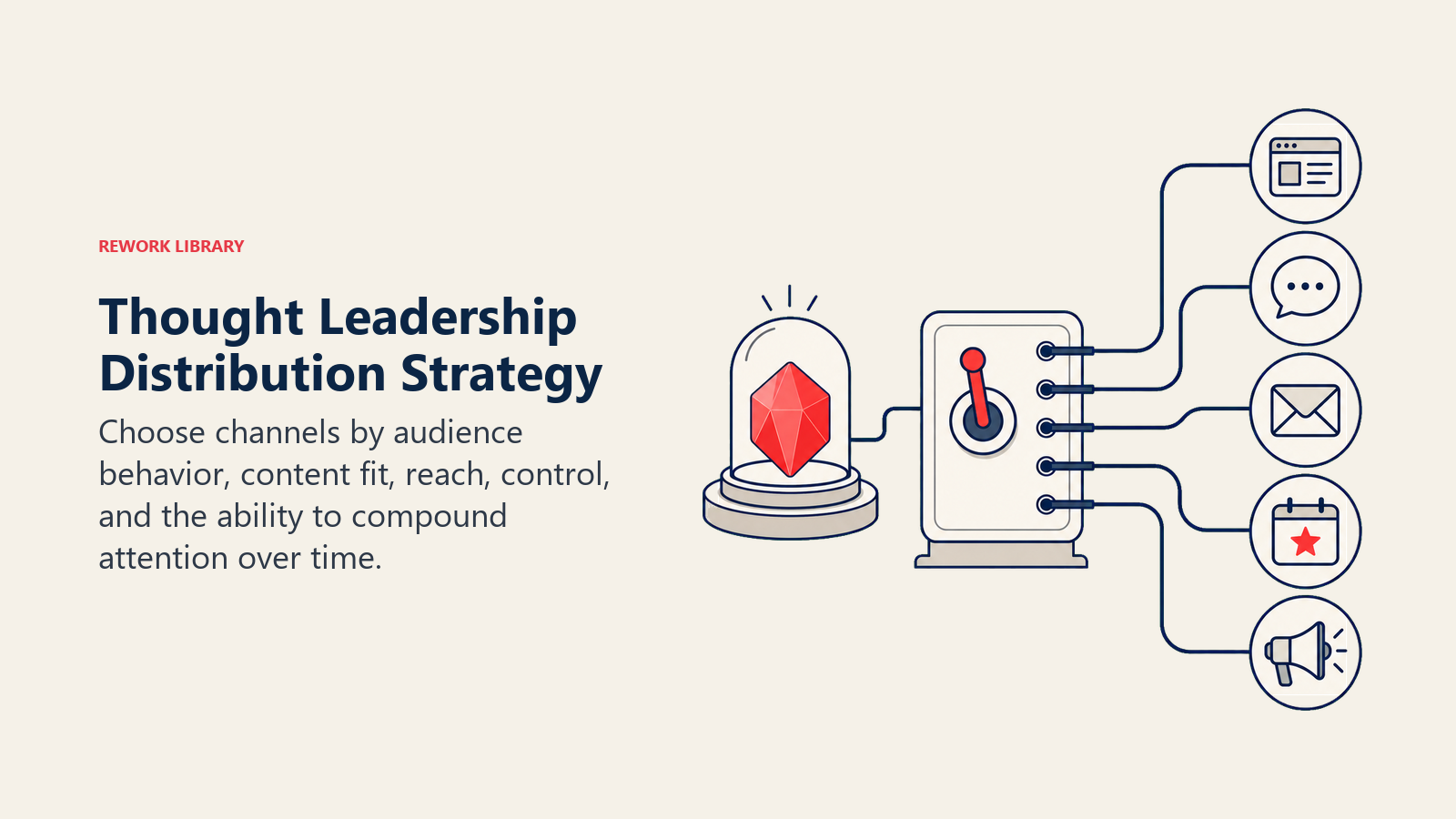
Owned Channels: Website, Blog, Email
Your owned channels provide complete control and build long-term audience assets.
Website/Blog: Your content hub where all thought leadership lives permanently. This creates an archive that demonstrates sustained expertise and provides discovery through search engines.
Blog best practices:
- Publish content directly on your site, not just on LinkedIn or Medium
- Optimize for search with clear titles, headers, and relevant keywords
- Include clear author attribution to build individual expert brands
- Make content easy to share with social buttons and email forwarding
Email Newsletter: Direct audience access without platform algorithm dependency. Email subscribers represent your highest-engagement audience who've explicitly opted in to hear from you.
Newsletter approaches:
- Curated insights: Weekly or bi-weekly emails sharing recent content, industry perspectives, and useful resources
- Original content: Email-exclusive insights or early access to content before public release
- Hybrid: Combination of both approaches
Frequency matters less than consistency and value. A monthly newsletter with substantive content outperforms weekly emails that feel like spam.
Building email lists from thought leadership:
- Content downloads (research reports, frameworks, guides) requiring email opt-in
- Newsletter signup prominent on articles and site
- Speaking event audience capture
- Webinar registration and follow-up
Earned Media: Publications, Podcasts, Conferences
Earned media provides third-party credibility through other people's platforms and audiences.
Industry publications: Contributing articles to respected industry media builds authority through editorial endorsement. Target publications your prospects read regularly.
Most industry publications accept contributed content if you provide:
- Original insights, not recycled blog posts
- Proper adherence to their editorial guidelines
- Non-promotional content focused on reader value
Start with less competitive publications to build clips, then approach top-tier outlets with proven writing samples.
Podcast appearances: Guest spots on relevant podcasts reach engaged audiences with high attention. Research podcasts in your industry, pitch specific episode topics, and prepare to provide genuine value rather than just promoting your services.
Conference speaking: Industry events provide concentrated access to potential buyers while conferring credibility through selection. Start with regional or niche conferences, build reputation, then pursue major industry events.
Getting selected for conferences:
- Submit proposals 6-12 months before events (most conferences plan far in advance)
- Pitch specific, valuable topics rather than company overviews
- Include speaker credentials and past presentation examples
- Attend events before speaking to understand audience and format
Social Media Platforms by Audience
Different platforms serve different professional services audiences and content types.
LinkedIn: The primary platform for B2B professional services thought leadership. Most decision-makers in professional services buying are active on LinkedIn.
LinkedIn strategies:
- Regular posts (2-3 times weekly) sharing insights, frameworks, and perspectives
- Long-form articles for in-depth content (though less algorithmic promotion than posts)
- Engagement with others' content to build network visibility
- Personal profiles as primary distribution (not just company pages)
Twitter/X: Good for real-time industry commentary, engaging with industry conversations, and building relationships with other experts. Less direct lead generation than LinkedIn but valuable for reputation building.
YouTube: Essential for firms emphasizing video content. Creates discoverable library of expertise while serving as hosting platform for video embedded elsewhere.
Instagram/Facebook: Generally less relevant for professional services thought leadership unless your audience is consumer-focused or you're building personal brand beyond professional expertise.
Pick platforms where your audience actually spends time. Don't spread yourself across every platform. Focus on 1-2 primary channels and do them well.
Connecting to broader LinkedIn strategy ensures social distribution integrates with relationship-building efforts. For broader event and conference distribution, see your conference and event strategy.
Personal vs Firm Branding
Professional services thought leadership balances individual expert brands with firm-level programs.
Individual Expert Positioning
Most professional services buying is relationship-based. Buyers hire people they trust, not abstract firms. This makes individual thought leadership powerful, buyers connect with specific experts.
Individual branding works through:
- Personal LinkedIn presence with regular posting
- Speaking engagements showcasing individual expertise
- Authored articles under personal byline
- Media interviews as subject matter experts
- Personal email newsletters from senior professionals
The challenge: what happens when individuals leave? Personal brands are portable. Investing heavily in individual thought leadership creates key person risk.
Firm-Level Thought Leadership Programs
Firm-level programs build organizational reputation that transcends any individual. This creates more sustainable competitive positioning while reducing dependency on specific people, and it reinforces the market positioning the firm wants to own.
Firm programs emphasize:
- Proprietary methodologies and frameworks owned by the organization
- Research and insights attributed to the firm
- Collective expertise rather than individual practitioners
- Consistent brand voice across multiple authors
- Organizational channels (company blog, firm newsletter)
The tradeoff: firm content often gets less engagement than individual expert content because it feels more corporate and less personal.
The Hybrid Approach
Most successful professional services thought leadership uses hybrid models: individual experts build personal brands while contributing to firm platforms, creating mutual reinforcement.
Hybrid structures:
- Senior professionals publish under personal brands on personal and firm channels
- Firm provides production support, distribution, and infrastructure
- Proprietary frameworks and methodologies brand to firm
- Individual experts become known for firm-distinctive approaches
- Non-compete and IP agreements protect firm investment
This model leverages individual relationship power while building firm assets, balancing personal brand value with organizational sustainability.
Authority Building Tactics
Consistent execution builds thought leadership authority over time through deliberate practices.
Publishing Cadence and Consistency
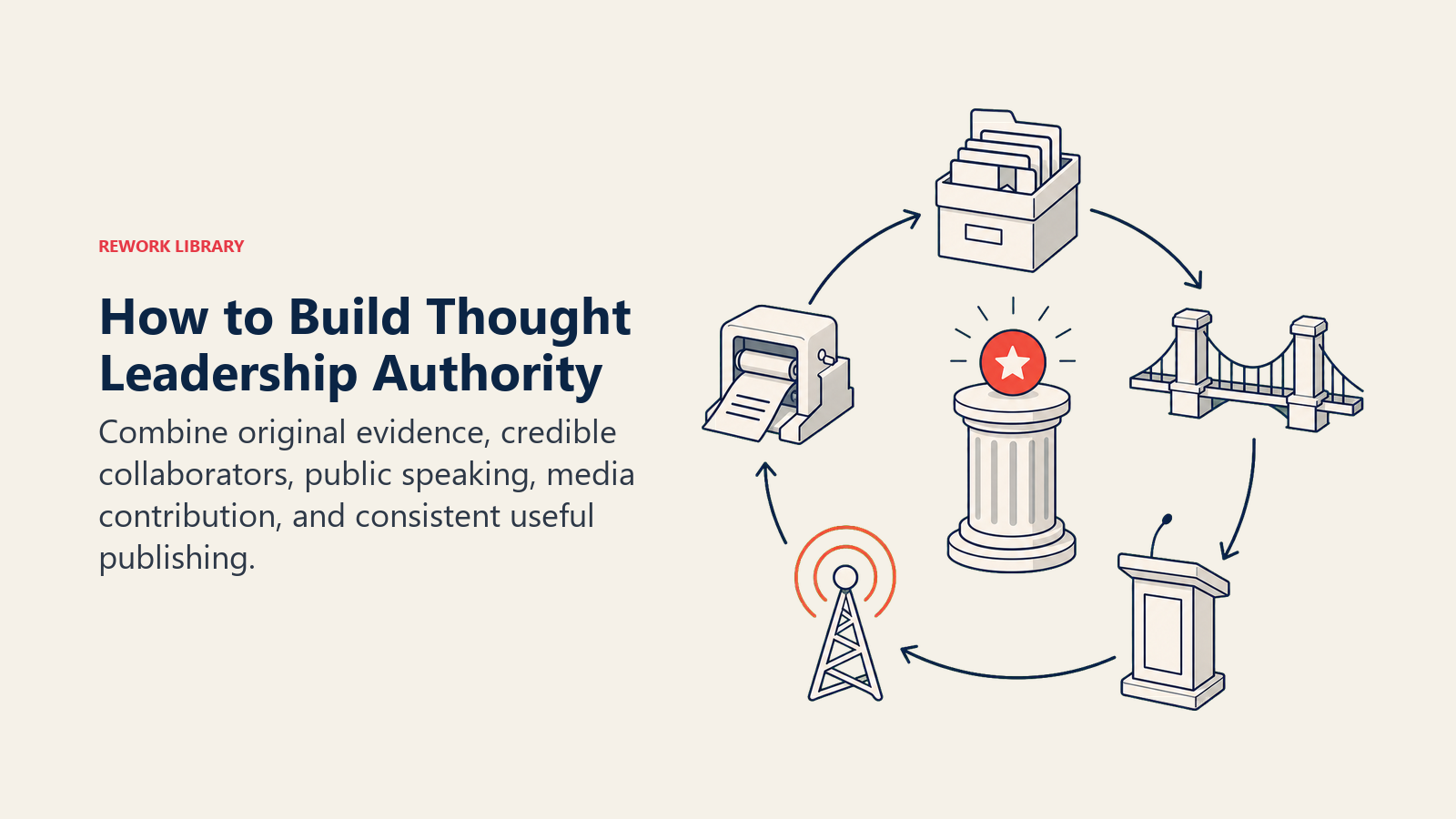
Authority requires presence. Sporadic publishing creates sporadic awareness. Consistent publishing builds audience expectations and cumulative impact.
Realistic cadences for professional services firms:
Individual contributors (senior professionals balancing billable work):
- 1-2 long-form articles monthly
- 2-3 social posts weekly
- 1 speaking engagement or major piece quarterly
Dedicated thought leadership roles (managing partners, business development leaders):
- 3-4 long-form articles monthly
- Daily social media presence
- Monthly speaking or media appearances
Firm programs (across multiple contributors):
- Weekly substantial content publication
- Daily social engagement
- Continuous speaking and media activity
The specific cadence matters less than maintaining consistency. Publishing every other Tuesday for a year builds more authority than publishing randomly when inspiration strikes.
Participating in Industry Conversations
Thought leadership isn't monologue, it's conversation. Engaging with industry discourse builds visibility and relationships beyond your own content.
Effective participation:
- Comment thoughtfully on others' content (LinkedIn posts, articles, research)
- Respond to questions in industry forums or social media
- Engage in respectful debate on industry issues
- Share and amplify others' good work (with your perspective)
- Participate in industry association discussions and working groups
This engagement keeps you visible between your own publications while building relationships with other industry voices and potential referral sources.
Speaking at Industry Events
Speaking remains one of the highest-impact thought leadership activities. A single 45-minute conference presentation can reach more qualified prospects than 20 articles.
Building a speaking practice:
- Develop 3-4 core presentations on your pillar topics
- Submit to multiple conferences (expect 10-20% acceptance rate)
- Record and repurpose every presentation
- Engage with audience during and after events
- Follow up systematically with connections made
Speaking creates virtuous cycles: successful presentations lead to speaking invitations, which create more content, which generates more opportunities. Learn more about building this capability through your speaking and publishing strategy.
Audience Development and Engagement
Thought leadership without audience is performance in an empty theater. Building engaged audiences amplifies impact.
Growing Your Following
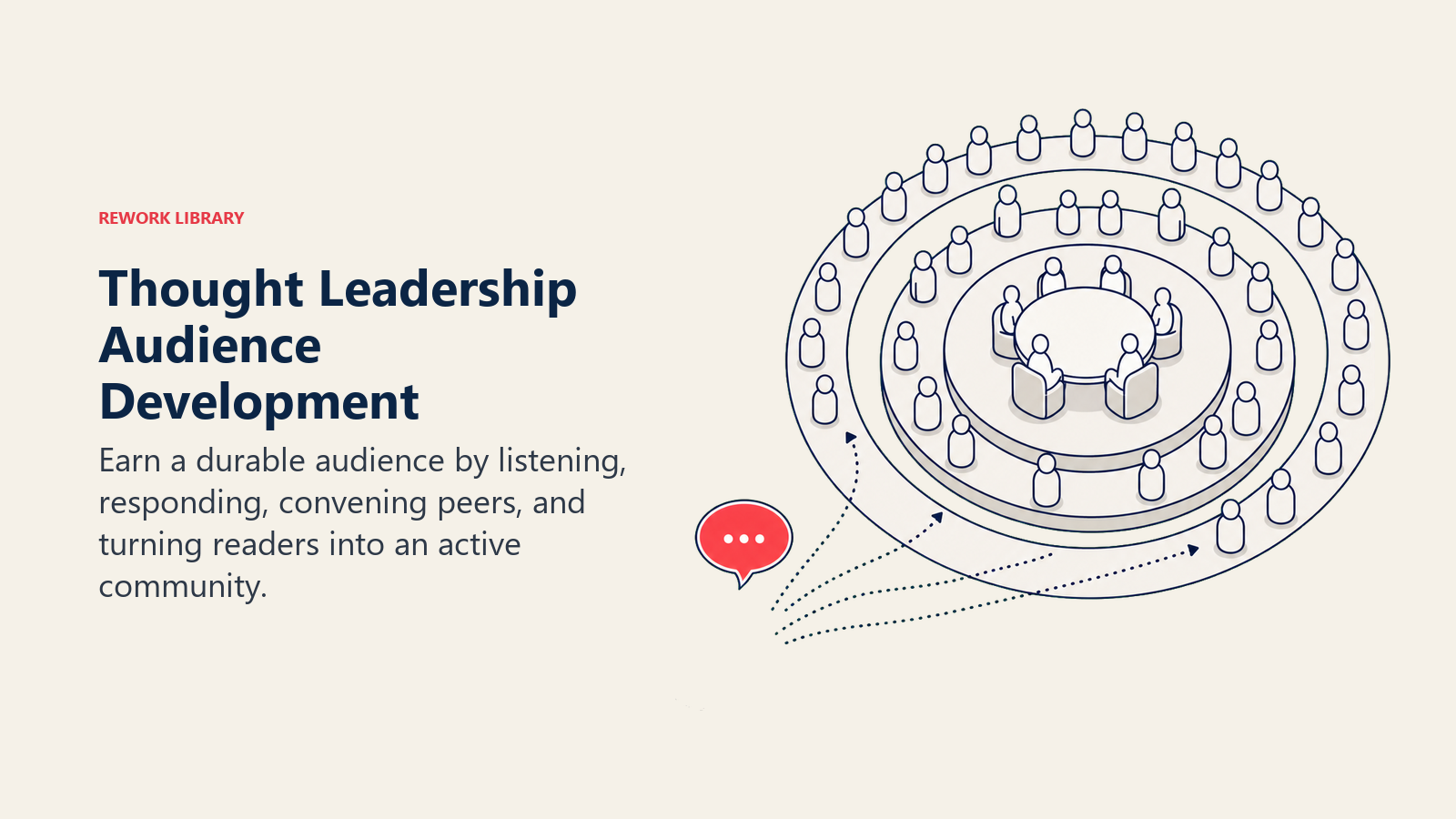
Audience growth comes from consistent value delivery that motivates people to opt in to your content.
Growth tactics:
- Content quality: The foundation, great content gets shared and attracts followers
- Guest appearances: Leverage others' audiences through podcast interviews, contributed articles, co-marketing
- Social engagement: Commenting, sharing, and participating makes you discoverable
- Speaking events: Convert attendees to newsletter subscribers and social followers
- Lead magnets: Downloadable resources (frameworks, templates, research) requiring email opt-in
- Cross-promotion: Reference your newsletter in articles, your articles in presentations, your presentations in social posts
Growth is slow initially, then compounds. Expect 12-18 months of consistent effort before you see meaningful traction. Firms that quit after 6 months miss the inflection point.
Building Community and Engagement
Engaged audiences provide more value than large passive ones. 1,000 people who read and share your content beats 10,000 who ignore it.
Building engagement:
- Ask questions and invite responses in content
- Reply to comments and messages personally
- Create discussions around your topics, not just broadcasts
- Recognize and amplify community members who contribute
- Provide exclusive value to engaged followers (early content access, community-only resources)
Consider community platforms beyond social media:
- Private LinkedIn groups for clients and prospects
- Email-based communities with regular discussions
- Virtual or in-person roundtables and events
- Membership communities for sustained engagement
Community building requires ongoing effort but creates differentiated relationships that casual content consumption doesn't.
Measuring Engagement Quality
Engagement quality matters more than volume. Track metrics that indicate genuine interest:
Content engagement:
- Time spent reading (not just pageviews)
- Social shares and meaningful comments (not just likes)
- Downloads of deeper resources
- Click-through from summaries to full content
Audience actions:
- Email newsletter open and click rates
- Speaking event attendance and follow-up
- Inbound inquiries mentioning specific content
- Direct messages and conversation starters
Relationship indicators:
- Content cited by others in their work
- Speaking or interview invitation frequency
- Referral conversations crediting your thought leadership
- Client mentions of content during sales processes
These quality metrics reveal whether your thought leadership is creating the trust and preference that drives business outcomes.
Measuring Thought Leadership Impact
Thought leadership creates business value through multiple channels that require appropriate measurement.
Brand Awareness and Reach
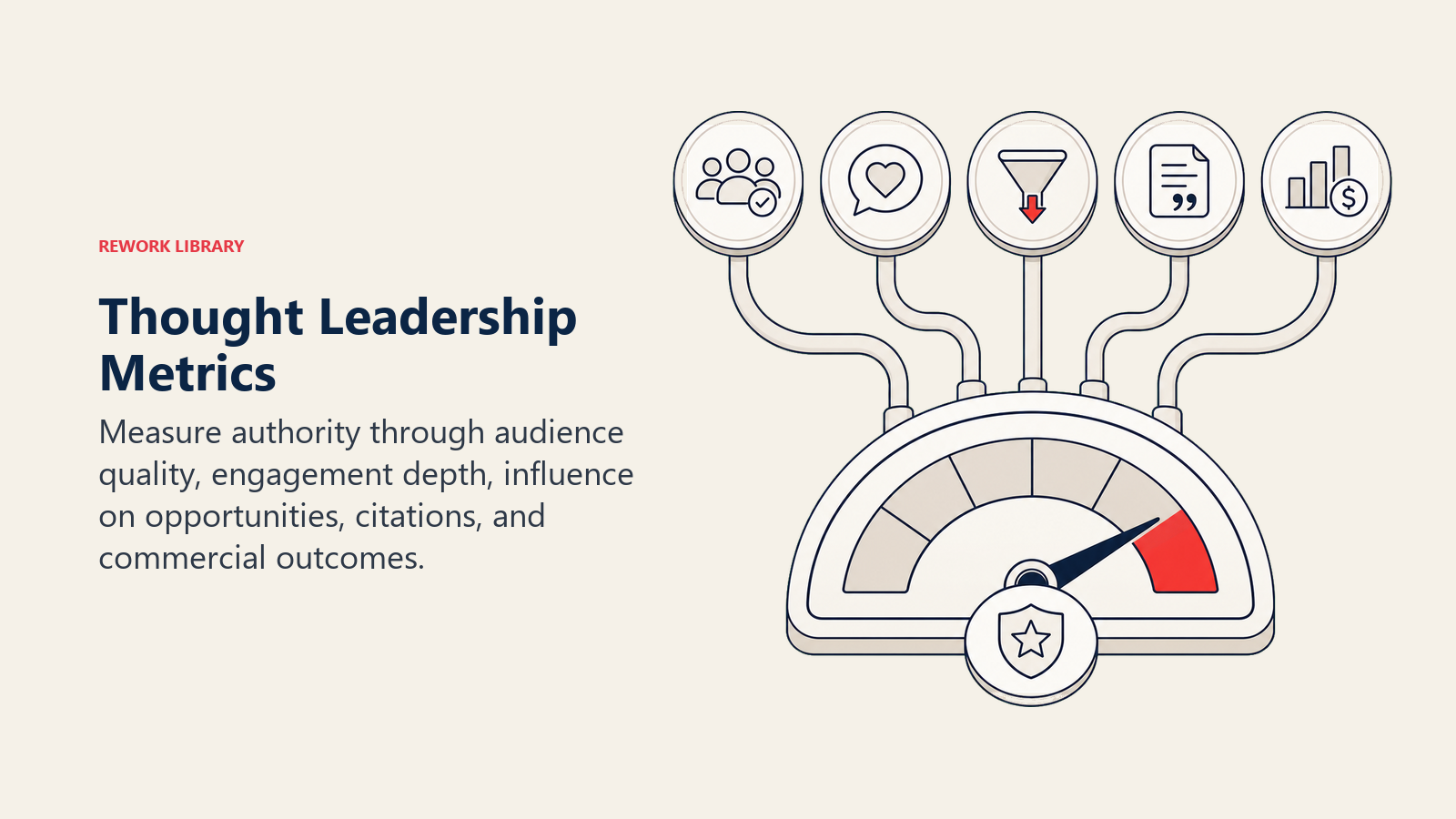
Reach metrics show how many people your thought leadership touches:
- Content views and impressions
- Social media followers and growth rate
- Speaking event audience size
- Media placements and circulation
- Search engine visibility for target topics
These top-of-funnel metrics matter but don't directly predict revenue impact. Broad reach with wrong audience creates vanity metrics without business value.
Engagement and Conversion Metrics
Deeper engagement metrics reveal whether reach converts to interest:
- Content downloads and resource requests
- Email newsletter subscribers and growth
- Webinar registration and attendance
- Speaking event connection requests
- Inbound contact form submissions
Track which content pieces drive highest engagement to understand what resonates with your audience.
Inbound Inquiry Attribution
The ultimate measure: does thought leadership generate qualified business inquiries?
Track:
- Inbound opportunities mentioning specific content or topics
- RFP invitations crediting your expertise or frameworks
- Client conversations that reference your thought leadership
- Referrals from people who discovered you through content
- Speaking engagement follow-up leading to opportunities
Many firms struggle with attribution because lead sources are muddied. Someone reads an article, sees you speak, gets a referral, then responds to an email. What "caused" the lead? Everything did.
Implement simple attribution by asking every inbound lead "How did you hear about us?" and "What prompted you to reach out now?" Their answers reveal thought leadership impact.
Speaking Invitations and Media Coverage
Peer recognition indicates growing authority:
- Conference speaking invitations (especially unsolicited ones)
- Podcast interview requests
- Media interview and quote requests
- Industry award nominations or recognition
- Citation in others' content or academic research
These validating signals show your expertise is recognized beyond your immediate audience.
Common Pitfalls to Avoid
Most professional services firms make predictable mistakes that undermine thought leadership effectiveness.
Being Too Promotional
The fastest way to destroy thought leadership credibility is making it promotional. Every piece that focuses on "why you should hire us" damages the trust you're trying to build.
Buyers can spot thinly disguised sales pitches a mile away. When your content consistently redirects to "contact us for our proprietary solution," readers tune out.
The discipline: create content that provides value even if readers never hire you. Trust that demonstrating expertise leads to business without explicit promotion.
Inconsistent Publishing
Publishing three articles one month, nothing for four months, then two articles in a week creates no momentum. Audiences disengage. Search engines deprioritize. You're constantly starting over.
Consistency beats intensity. Better to publish one solid article monthly for years than sprint for three months then disappear.
The fix: Create realistic editorial calendars with accountability. Build production systems that don't depend on inspiration. Treat thought leadership as an operational discipline, not a marketing project.
Expecting Immediate Results
Thought leadership is long-cycle business development. Someone discovers your content in month one, consumes more pieces over months 2-4, has an internal need emerge in month 6, evaluates options over months 7-8, and finally reaches out in month 9.
Firms expecting leads within 90 days abandon programs before they generate returns. The investment compounds over 12-24 months before significant traction appears.
Set appropriate expectations: early returns come from existing network recognizing your content. New audience development takes longer but creates the scale that drives meaningful business impact.
Inconsistent Quality
Publishing both brilliant insights and superficial filler confuses your audience about what you represent. Your reputation equals your weakest content.
Every piece should meet minimum quality standards for substance, usefulness, and insight. If something doesn't clear that bar, don't publish it.
The discipline here is hard because urgency pressures (need something for this week's newsletter, committed to speaking next month, promised a piece to a publication) tempt shortcuts. Resist. Delay publication rather than compromise quality.
Wrong Topics or Audience
Creating exceptional content about topics your buyers don't care about wastes effort. This happens when firms write about what interests them rather than what matters to prospects.
Validate topics through:
- Sales conversation patterns: what do prospects ask about?
- Client engagement data: what content gets read and shared?
- Industry event topics: what are conferences programming?
- Keyword research: what are people searching for?
If your brilliant content generates no engagement, the problem might be topic selection rather than execution quality.
Building the Thought Leadership Function
Scaling thought leadership beyond individual heroics requires operational systems and support.
Team Roles and Responsibilities
Effective thought leadership programs distribute responsibilities across multiple roles:
Senior professionals/SMEs: Provide expertise, core insights, and personal brand visibility. They contribute ideas, review content for accuracy, and engage with audience.
Content creators: Transform expertise into publishable content through writing, editing, and production. These roles (in-house or external) capture expert knowledge and shape it for target audiences.
Distribution specialists: Manage social media, email newsletters, SEO, and cross-platform promotion ensuring content reaches intended audiences.
Program managers: Coordinate editorial calendars, maintain publishing consistency, track performance metrics, and ensure accountability.
Small firms might combine these roles. Large firms separate them. Regardless, clarity about who does what prevents the diffused responsibility that kills consistency.
Content Workflows and Production Systems
Sustainable thought leadership requires production systems that don't depend on inspiration or heroic individual effort.
Here's what works:
- Ideation: Run quarterly brainstorming sessions to build a 3-month topic pipeline
- Briefing: Flesh out topics with core messages, key points, and target audience
- Creation: Draft content (by SME, professional writer, or hybrid approach)
- Review: Have subject matter experts review for accuracy and insight quality
- Editing: Get professional editing to ensure clarity and quality
- Production: Handle final formatting, graphics, and SEO optimization
- Distribution: Coordinate publishing across owned, earned, and social channels
- Promotion: Actively distribute and amplify for 2-4 weeks after publication
- Performance tracking: Review metrics to inform future content decisions
This structured approach transforms thought leadership from ad hoc activity into operational discipline.
Editorial Standards and Quality Control
Editorial standards prevent quality drift and maintain brand consistency:
Content quality criteria:
- Minimum word counts for substantive pieces
- Requirements for original insights or frameworks
- Examples or evidence supporting key points
- Clear value proposition for reader time investment
Voice and tone guidelines:
- Brand personality and writing style
- Level of formality and accessibility
- Use of industry jargon vs plain language
- Personal vs corporate voice
Technical standards:
- SEO best practices
- Accessibility requirements
- Citation and attribution policies
- Legal review triggers (client stories, competitive references)
Standards should enable quality without creating bureaucracy. The goal is consistency and substance, not compliance.
Technology and Tools
The right tools enable efficient production and distribution:
Content creation:
- Writing and collaboration tools (Google Docs, Notion, Craft)
- Content calendars (Airtable, Asana, Monday.com)
- Design tools for graphics (Canva, Figma)
Distribution:
- Website/blog platform (WordPress, Webflow, HubSpot)
- Email marketing (Mailchimp, ConvertKit, HubSpot)
- Social media management (Buffer, Hootsuite, Sprout Social)
Analytics:
- Website analytics (Google Analytics)
- Social media insights (native platform analytics)
- Email performance tracking
- CRM integration for lead attribution
Tool selection should match organizational size and complexity. Small firms need simple stacks. Large firms benefit from integrated platforms.
Content Pillar Framework Template
This framework organizes thought leadership into strategic themes:
Pillar Name: [Core expertise area]
Pillar objective: What authority we're building in this domain
Target audience: Who cares about this topic and why
Key topics (8-12 per pillar):
- Specific subjects within this pillar
- Problems we solve in this domain
- Frameworks and methodologies we employ
- Trends and developments we're tracking
Content formats:
- Primary formats for this pillar (articles, video, research)
- Why these formats match audience preferences
Success metrics:
- How we measure impact for this pillar
- What business outcomes this pillar should drive
Example Pillar:
Pillar Name: Pricing Transformation in Professional Services
Objective: Establish authority as the experts helping firms transition from billable hours to value-based pricing
Audience: Managing partners and finance leaders in consulting, legal, and accounting firms seeking pricing power
Key Topics:
- Billable hour limitations and value pricing benefits
- Client value quantification methodologies
- Pricing confidence and negotiation strategies
- Scope definition for fixed-fee engagements
- Managing partner objections to pricing changes
- Phased transition approaches from hours to value
Formats: Long-form articles (2,000 words), framework explainer videos, conference presentations, research on pricing practices
Success Metrics: Inbound inquiries about pricing consulting, speaking invitations at practice management conferences, citations in industry pricing discussions
Platform Selection Matrix
This matrix helps prioritize distribution channels:
| Platform | Audience Fit | Effort Required | Authority Building | Lead Generation | Priority |
|---|---|---|---|---|---|
| Owned blog | High - builds permanent asset | Medium | High - SEO & archive | Medium - indirect | PRIMARY |
| Email newsletter | High - direct audience | Medium | High - relationship | High - direct response | PRIMARY |
| LinkedIn posts | High - B2B buyers | Low-Medium | Medium | Medium | PRIMARY |
| Speaking engagements | High - concentrated prospects | High | Very High | High | SECONDARY |
| Industry publications | Medium - broader audience | High | High - third-party | Low-Medium | SECONDARY |
| Podcast appearances | Medium - depends on show | Medium | Medium | Low | TERTIARY |
| Twitter/X | Low-Medium for most PS | Low | Low-Medium | Low | TERTIARY |
| YouTube | Medium - video audience | High | Medium | Low-Medium | TERTIARY |
Prioritize 2-3 primary channels, supplement with secondary, and minimize tertiary until primary channels are working effectively.
Editorial Calendar Example
Month: June 2026
Week 1:
- Publish: "Why Process Optimization Projects Fail: The Stakeholder Alignment Gap" (Blog, 2,200 words)
- Distribute: Email newsletter featuring article
- Social: LinkedIn post series (3 posts) on key article insights
- Speaking: Prep for Manufacturing Innovation Conference (June 15)
Week 2:
- Publish: "Quick Insight: The Two Questions That Reveal Implementation Readiness" (LinkedIn article, 600 words)
- Social: Daily LinkedIn engagement, share industry article with commentary
- Event: Deliver Manufacturing Innovation Conference presentation
- Follow-up: Connect with 15-20 conference attendees
Week 3:
- Publish: Framework video: "The Stakeholder Alignment Matrix" (7 minutes, YouTube)
- Distribute: Email to newsletter list with video
- Social: LinkedIn posts sharing video + behind-the-scenes
- Content creation: Interview client for July case study
Week 4:
- Publish: "Conference Recap: Five Themes from Manufacturing Innovation 2026" (Blog, 1,500 words)
- Distribute: Share with conference connections
- Social: LinkedIn discussion post: "Which of these trends matters most?"
- Planning: Finalize July content calendar, prep August topics
Monthly totals: 2 long articles, 1 video, 1 speaking event, 12-15 social posts, 4 email sends
This creates sustainable rhythm without overwhelming production capacity.
Making Thought Leadership Work for Your Firm
Thought leadership transforms how professional services firms generate business development opportunities by building trust before engagement. The firms that succeed treat it as strategic business development infrastructure, not a marketing side project.
And it requires several commitments:
Consistency over intensity: Publishing regularly for years beats sporadic bursts. Build systems that sustain effort through slow periods.
Substance over volume: Quality establishes authority. Quantity without substance damages reputation.
Patience with timeline: Compound returns take 12-24 months to materialize. Early momentum comes from existing network; new audience development takes longer.
Integration with business development: Thought leadership supports consultative business development by creating awareness and credibility before sales conversations.
The strategic choice to invest in thought leadership makes most sense for firms pursuing:
- Premium positioning based on expertise and specialization
- Inbound opportunity generation reducing sales cycle friction
- National or global reach beyond immediate networks
- Personal and firm brand building that outlasts any individual
For firms with these objectives, thought leadership provides the systematic authority-building that generates opportunities, shortens sales cycles, reduces price resistance, and creates sustainable competitive differentiation.
The alternative is hoping existing networks and referrals sustain growth indefinitely. That works until it doesn't. Thought leadership creates the reputation infrastructure that makes growth predictable rather than opportunistic.
Ready to build authority that drives business development? Start with the fundamentals: Content Marketing for Services for broader content strategy and Professional Networking to build the relationships that amplify thought leadership impact.
Deep dive into distribution strategies:

Sales Director
On this page
- What is Thought Leadership (and What It Isn't)
- The Authority vs Promotion Distinction
- The Trust-to-Revenue Connection
- The Long-Term Reputation Investment
- Defining Your Thought Leadership Platform
- Identifying Your Unique Expertise and Perspectives
- Finding Underserved Topics in Your Niche
- Balancing Proprietary Insights vs Accessible Knowledge
- Developing a Consistent Point of View
- Content Strategy and Planning
- Core Content Pillars Aligned to Expertise
- Topic Ideation Frameworks
- Content Formats by Buyer Journey Stage
- Editorial Calendar Development
- Quality Over Quantity Principles
- Content Creation Approaches
- Written Content: Articles and Research
- Video and Visual Content
- Speaking Engagements
- Podcasts and Interviews
- Case Studies and Client Stories
- Original Research and Data
- Platform Selection and Distribution
- Owned Channels: Website, Blog, Email
- Earned Media: Publications, Podcasts, Conferences
- Social Media Platforms by Audience
- Personal vs Firm Branding
- Individual Expert Positioning
- Firm-Level Thought Leadership Programs
- The Hybrid Approach
- Authority Building Tactics
- Publishing Cadence and Consistency
- Participating in Industry Conversations
- Speaking at Industry Events
- Audience Development and Engagement
- Growing Your Following
- Building Community and Engagement
- Measuring Engagement Quality
- Measuring Thought Leadership Impact
- Brand Awareness and Reach
- Engagement and Conversion Metrics
- Inbound Inquiry Attribution
- Speaking Invitations and Media Coverage
- Common Pitfalls to Avoid
- Being Too Promotional
- Inconsistent Publishing
- Expecting Immediate Results
- Inconsistent Quality
- Wrong Topics or Audience
- Building the Thought Leadership Function
- Team Roles and Responsibilities
- Content Workflows and Production Systems
- Editorial Standards and Quality Control
- Technology and Tools
- Content Pillar Framework Template
- Platform Selection Matrix
- Editorial Calendar Example
- Making Thought Leadership Work for Your Firm