Budget & Timeline Discovery: The Financial Conversation That Makes or Breaks Deals
Turn this article into takeaways for your work.


Each assistant summarizes the article only for you and suggests best practices for your work.
Budget and timeline discovery is the practice of qualifying a prospect's spending range and project schedule early, usually in the first or second conversation, before you invest in detailed scoping. Doing it up front lets you scope work that actually fits, avoids wasted proposals, and surfaces mismatches while they are still fixable. Research shows 65% of professional services deals stall on budget or timeline misalignment, almost always because the money conversation came too late.
Here's a frustrating pattern you've probably experienced: You spend three weeks on a detailed proposal, present it to an enthusiastic prospect, and then hear "This is exactly what we need, but we only have half that budget." Or worse: "We're not planning to start until next fiscal year."
Research shows that 65% of professional services deals stall because of budget or timeline misalignment. Not because the solution was wrong or the prospect wasn't interested, but because someone avoided the money conversation until it was too late.
The budget and timeline discussion makes most consultants uncomfortable. It feels pushy, mercenary, or presumptuous to ask "Do you have money?" before you've even proven your value. But here's the reality: avoiding these questions doesn't make you more professional, it makes you less efficient. You're wasting your time and theirs.
This guide shows you how to discover budget and timeline constraints early, handle mismatches professionally, and qualify opportunities before you invest serious proposal effort.
Why Budget Discovery Happens Too Late
Most consultants wait until the proposal stage to discuss numbers. They want to understand the problem first, build rapport, demonstrate expertise, and then talk about investment. That sounds logical, but it's backward.
If you don't know whether a prospect has $50K or $5K to spend, you can't scope the work appropriately. You'll either over-design a solution they can't afford or under-deliver against expectations you didn't understand. Neither outcome leads to a sale.
The timing problem is even more insidious. You might land a client who's genuinely interested and has budget, but they're not planning to start for six months. That's fine if you know it up front and can pipeline the opportunity accordingly. But if you're treating them like a hot lead for weeks before discovering the timeline, you've misallocated resources.
Here's what effective discovery looks like: you qualify budget and timeline in the first or second conversation, before you invest in detailed scoping or proposal development. Not to disqualify good prospects, but to understand constraints so you can propose something that actually works.
The Budget Discovery Framework
Budget conversations have three natural timing points in your sales process:
Initial qualification (first call or meeting): You're determining if this is even worth pursuing. Ask about budget ranges, past spending, and whether funds are allocated. Keep it high-level.
Discovery phase (needs assessment): You understand the problem better now, so you can discuss budget in context. "Projects like this typically range from X to Y depending on scope. Is that aligned with your planning?"
Proposal prep (scoping conversation): Before you write anything, confirm the budget reality. "Based on what we've discussed, I'm thinking this will be in the range of $X. Does that work within your budget?"
The approach you take depends on the relationship, the sales context, and your style. Here are four ways to ask:
Four Budget Discovery Approaches
Direct inquiry: "What budget have you allocated for this project?" This is the cleanest approach. Some prospects will tell you straight up, some will deflect. If they deflect, that's useful information too.
Range positioning: "Projects like this typically run between $30K and $60K depending on scope and timeline. Is that the range you're planning for?" You're giving them a frame of reference and seeing if they flinch.
Investment framing: "How much are you planning to invest in solving this problem?" The word "invest" positions it as a strategic decision, not just a cost. It also implies they've thought about this.
Past project reference: "What have you spent on similar initiatives in the past?" This works well if they've hired consultants before. Their historical spending tells you what they consider reasonable.
None of these are perfect for every situation, but they're all better than not asking.
Budget Categories: What You're Really Discovering
When you ask about budget, you're not just looking for a number. You're trying to understand where they are in the funding process. Prospects fall into these categories:
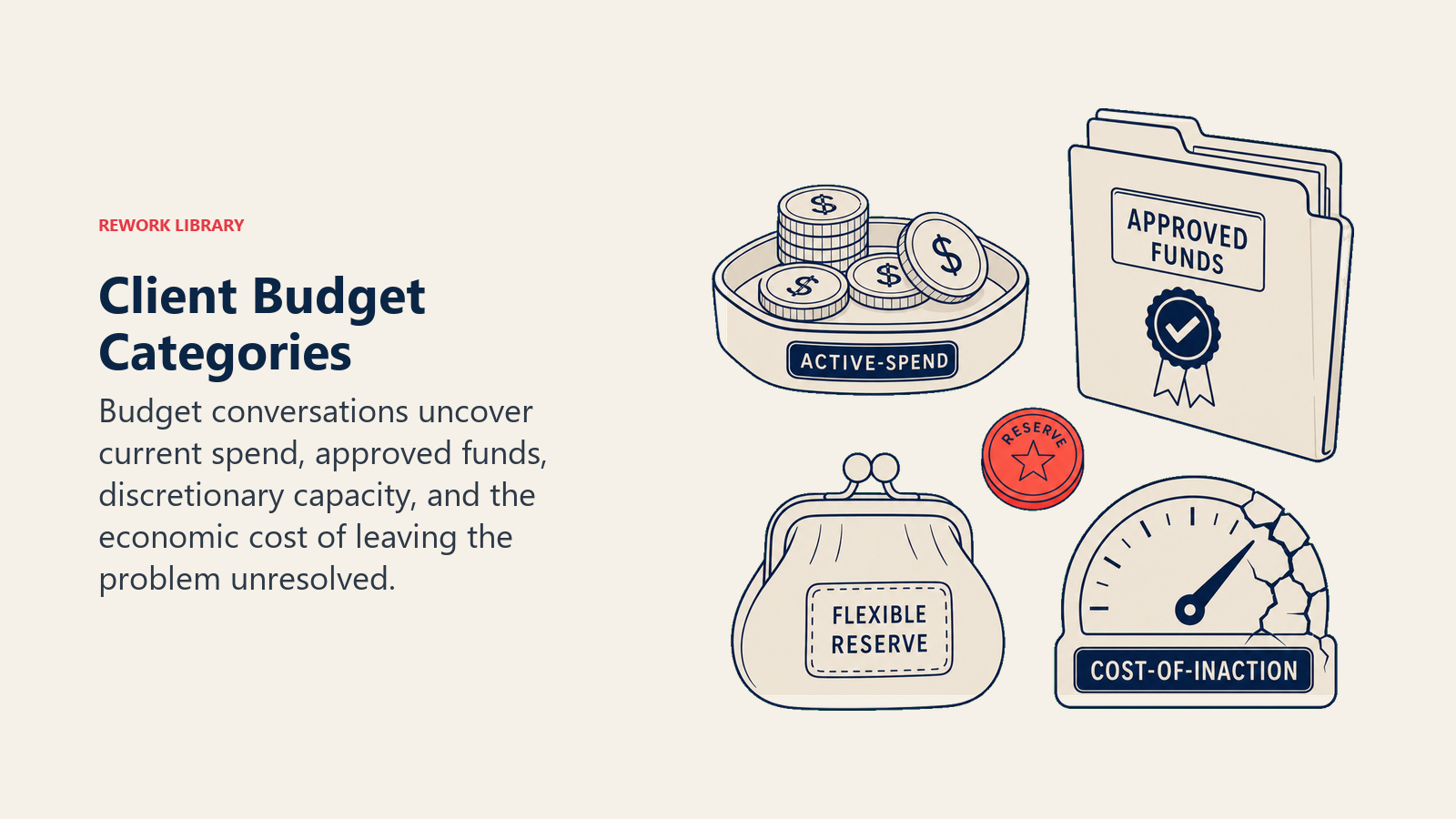
Approved budget: They have a specific amount approved and allocated. This is the best scenario. You know what you're working with, and someone has already committed to spending it.
Allocated but not approved: Budget exists in the plan, but it needs sign-off. This is common in larger organizations. You need to understand the approval process and who controls it.
Flexible budget: They don't have a specific amount set aside, but they can find money if the ROI is compelling. This requires more justification work on your part, but it's workable.
No budget: They haven't allocated anything yet. This doesn't mean they can't buy, but it means you need to help them build a business case. Longer sales cycle, more education required.
Unknown: They genuinely don't know what this should cost. This happens with first-time buyers or novel problems. You'll need to educate them on typical investment levels.
Your approach changes based on which category they're in. Approved budget means you're scoping to fit. No budget means you're building the case for why this matters.
Discovery Phase Questions
Here's what to ask during your discovery conversations to understand budget reality:
Investment allocated:
- "What budget have you allocated for this project?"
- "What investment range are you working with?"
- "Is there a specific amount set aside for this?"
Past spending patterns:
- "What have you invested in similar projects?"
- "What did your last consulting engagement cost?"
- "How much do you typically spend on initiatives like this?"
Approval authority:
- "Who needs to sign off on this investment?"
- "What's the approval process for a project this size?"
- "Do you have authority to approve this budget?"
Comfortable range:
- "If I told you this would cost $X, would that be completely out of range?"
- "Are we talking $20K, $50K, or $100K+ for what you're trying to accomplish?"
- "What number would make you immediately say 'that's too much'?"
The last question is particularly useful. When someone tells you their "no way" number, you know the ceiling. Propose below that and you're in the conversation. This is essential for effective pricing justification later in the process.
Context-Building Questions
Budget doesn't exist in a vacuum. You need to understand the business context around the spending decision:
Cost of inaction:
- "What's this problem costing you right now?"
- "What happens if you don't solve this in the next 6 months?"
- "How much revenue/efficiency/time are you losing?"
Expected ROI:
- "What return are you expecting on this investment?"
- "How quickly do you need this to pay for itself?"
- "What outcomes would make this a clear win for you?"
Priority ranking:
- "Where does this fall in your list of priorities?"
- "What other projects are competing for this budget?"
- "If you could only fund three initiatives this quarter, would this be one of them?"
Approval process:
- "How do investment decisions like this typically get made?"
- "Who's involved in evaluating vendors and proposals?"
- "What criteria will this be judged against?"
These questions help you understand whether budget constraints are real or just negotiating tactics. If they can't articulate the cost of the problem or the expected ROI, they're probably not serious buyers yet.
Risk Assessment Questions
You also need to assess whether they understand what they're buying and whether they have realistic expectations:
Consultant experience:
- "Have you worked with consultants or agencies before?"
- "What was that experience like?"
- "What worked well and what didn't?"
Project scope familiarity:
- "Have you done a project like this before?"
- "Do you have a clear picture of what's involved?"
- "What do you think the major components of this work are?"
Fiscal constraints:
- "Are there any budget cycles or fiscal year considerations we need to work around?"
- "Is this coming from operating budget or project budget?"
- "Are there any procurement requirements or competitive bidding rules?"
First-time buyers often underestimate costs because they don't know what's involved. If you're dealing with someone who's never hired a consultant for this type of work, you'll need to do more education on what reasonable investment looks like. This ties into your broader fit vs misfit identification process.
Timeline Discovery Framework
Timeline discovery is just as important as budget. A prospect with perfect budget but no urgency is a "someday maybe" opportunity, not a real deal.
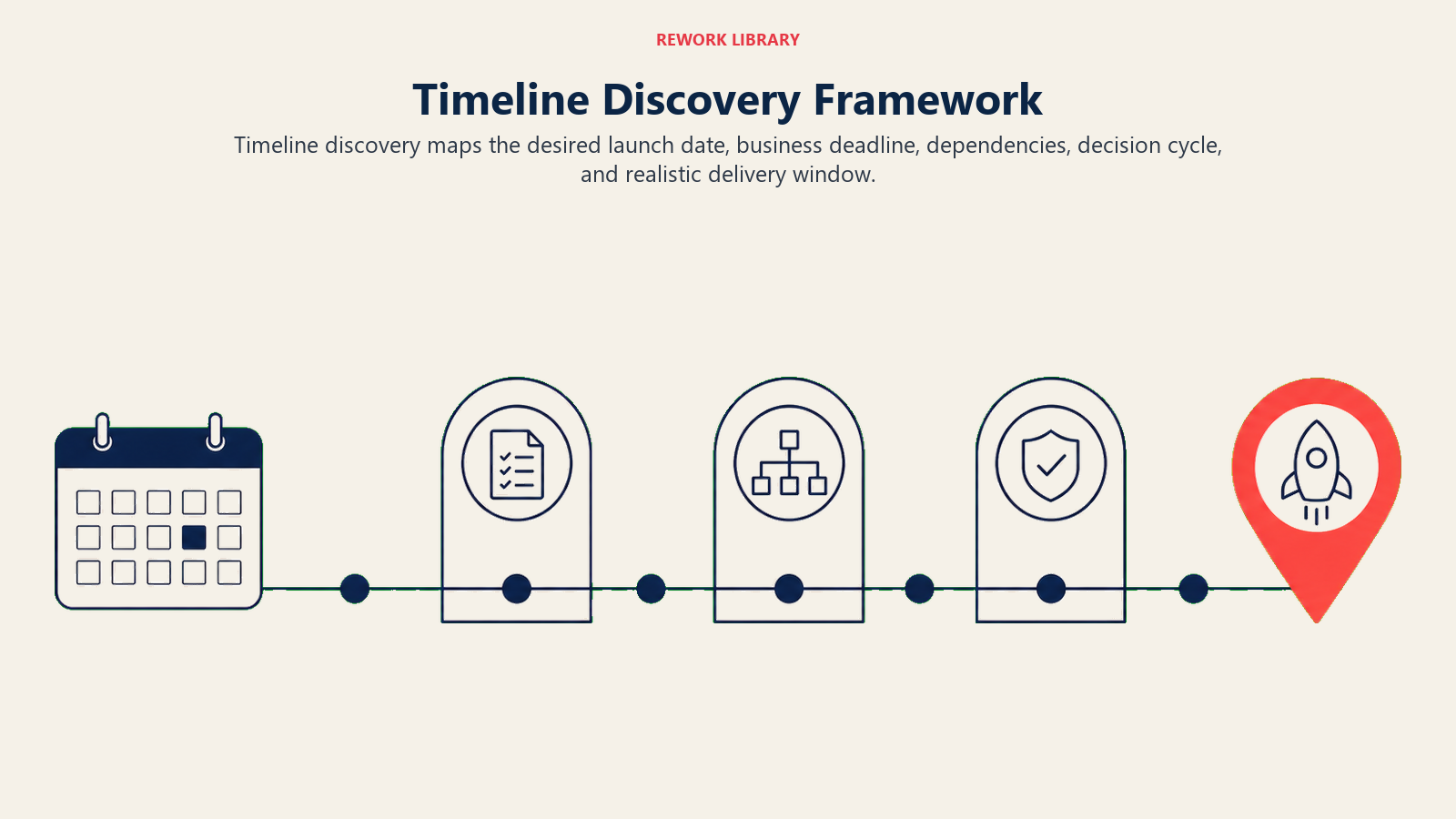
You need to understand these critical elements:
Decision date: When will they decide on a vendor? This is different from start date. You need to know when they're making the choice.
Start date: When do they want to actually begin the work? Is it immediate, next month, next quarter?
Completion deadline: When does this need to be done? Is there a hard deadline or is it flexible?
Key milestones: Are there interim deliverables or checkpoints that matter to them?
Budget cycles: When does their fiscal year start? When do budgets get allocated? Timing your proposal around budget availability can make or break a deal.
Stakeholder availability: Are key people available when you'd need them, or are there conflicts with vacations, other projects, or seasonal busy periods?
Timeline Questions That Reveal Urgency
Ask these questions to understand not just when they want to start, but why:
Timeline drivers:
- "What's driving the timeline for this project?"
- "Why now versus three months from now?"
- "What happens if this gets pushed back?"
Consequences of delay:
- "What's at stake if this doesn't happen on schedule?"
- "Are there costs or risks associated with waiting?"
- "What triggered you to reach out now?"
Hard deadlines:
- "Are there any non-negotiable dates we need to work around?"
- "Is this deadline flexible or fixed?"
- "What happens if we miss that date?"
Decision timeline:
- "When do you need to make a decision on this?"
- "What's your evaluation process and how long does it take?"
- "Are you talking to other consultants, and what's your timeline for choosing?"
Availability:
- "When are your key stakeholders available to participate?"
- "Are there any blackout periods we need to avoid?"
- "How much time can your team dedicate to this project?"
Seasonal factors:
- "Are there busy seasons that would make certain start dates better or worse?"
- "Do you have quarterly planning cycles or other rhythms we should align with?"
Assessing Urgency vs. Importance
Not all timelines are created equal. You need to distinguish between business-critical urgency and "nice to have" preferences:
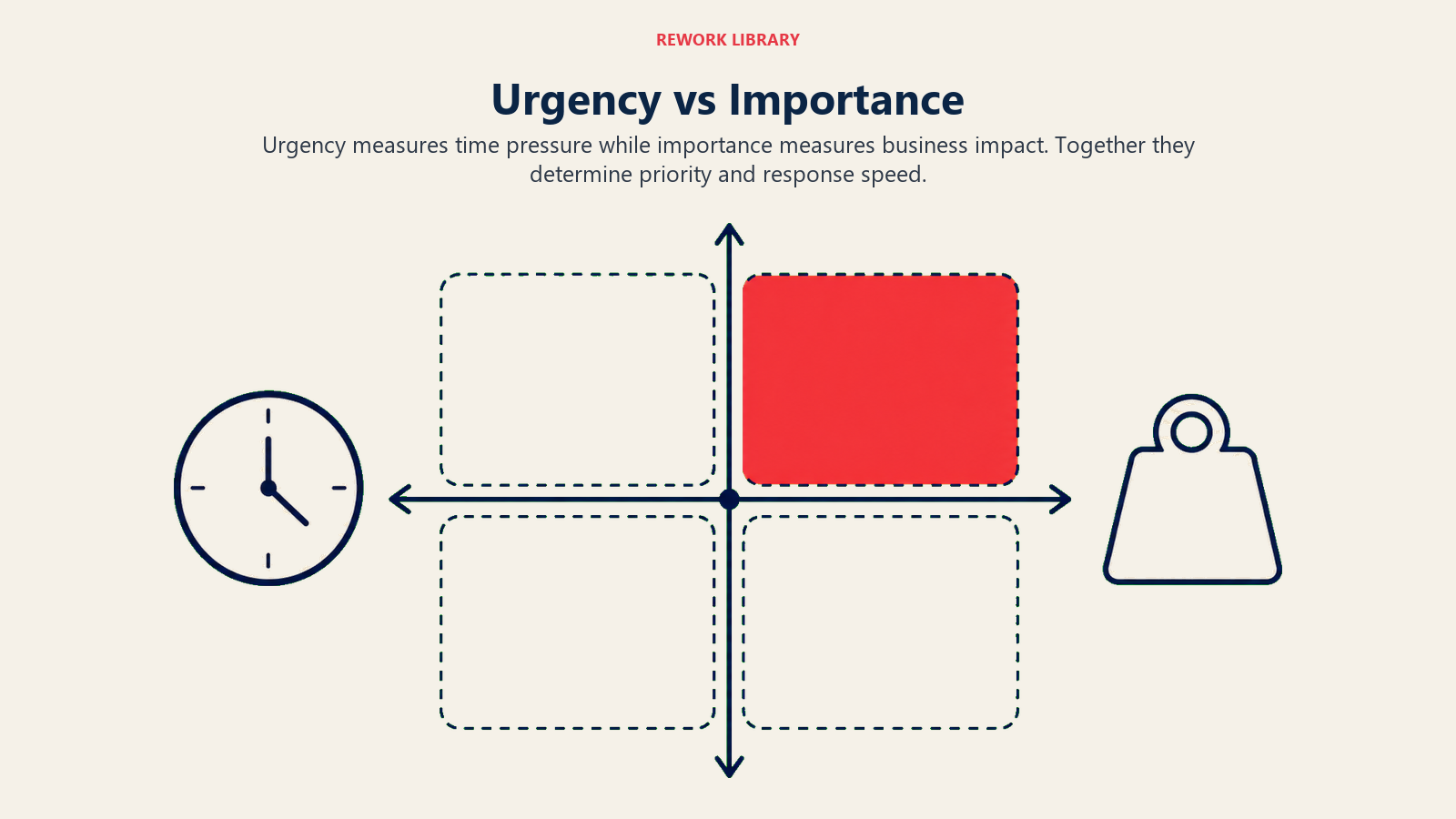
Business-critical: There's a real consequence to delay. Revenue is at risk, compliance deadlines loom, competitive pressures are mounting. These projects happen.
Regulatory or contractual: External forces create hard deadlines. These are non-negotiable and create real urgency.
Strategic window: There's an opportunity that won't last. A market shift, a competitive advantage, a key hire. These create medium urgency.
Resource-dependent: The timeline is driven by when key people are available or when budget frees up. These can shift.
Aspirational: They'd like it done soon, but there's no real driver. These timelines are soft and projects often get delayed.
Ask "What happens if we push this back three months?" If the answer is "not much," you don't have urgency. If the answer is "we lose a major contract" or "we fail an audit," you have urgency.
The Budget-Timeline-Scope Triangle
Here's a fundamental truth: clients can have any two of these three things, but not all three:
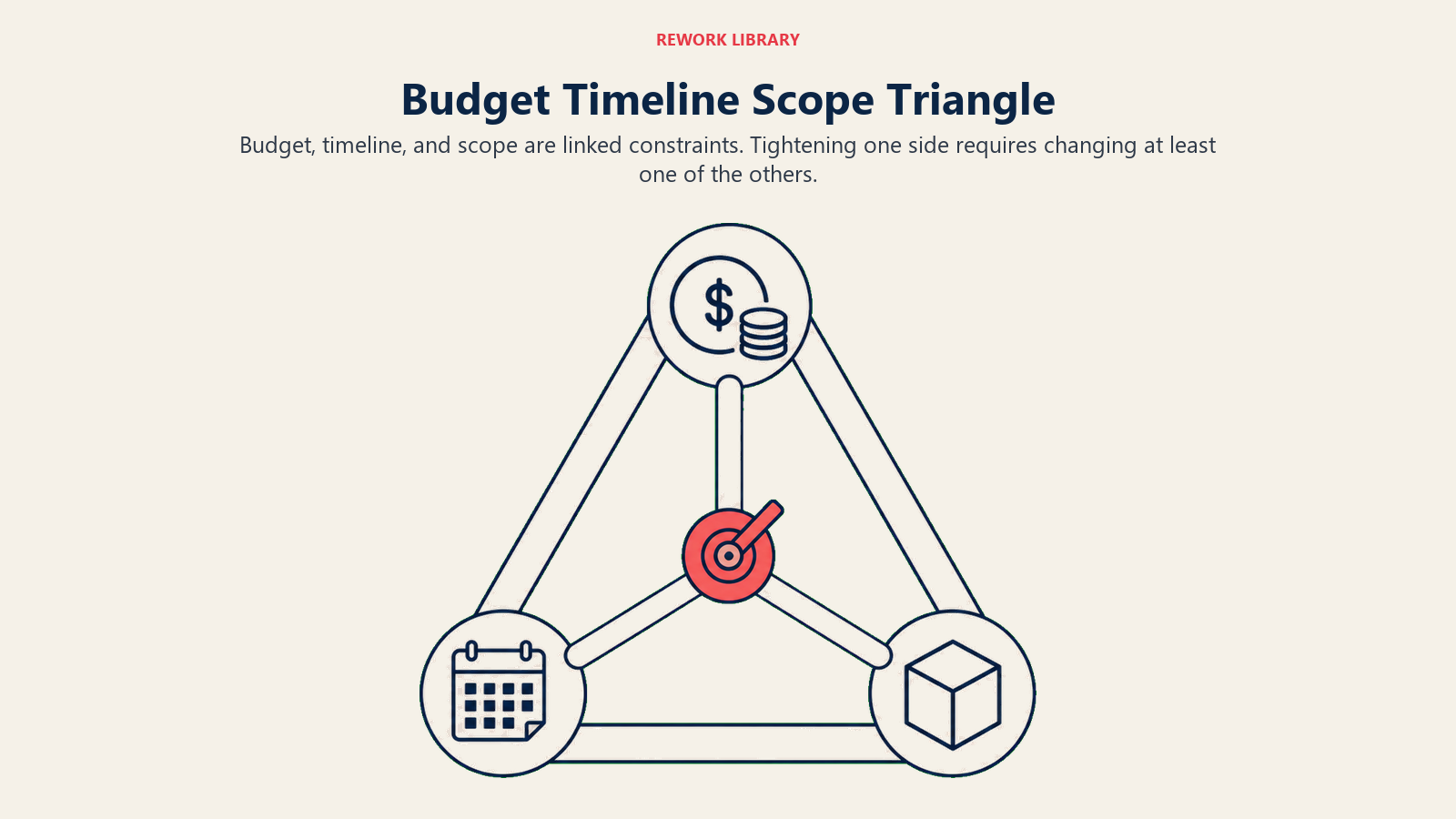
- Low budget
- Fast timeline
- Broad scope
If they want it fast and comprehensive, it won't be cheap. If they want it cheap and comprehensive, it won't be fast. If they want it cheap and fast, it won't be comprehensive.
This is the project management triangle, and it's your friend when navigating trade-offs.
Phased Approaches
When budget and scope don't align, break the project into phases:
Phase 1 - Essential: The minimum viable project that solves the core problem. Fits within their immediate budget.
Phase 2 - Value-add: Enhanced features or broader scope that can be added later when budget allows.
Phase 3 - Optimization: Nice-to-haves that provide incremental value but aren't critical.
This approach lets you start the relationship within their budget constraints while setting up future revenue opportunities. Phasing is a key skill covered in project scope assessment.
Acceleration Options
When timeline is the constraint, you can often compress it for a premium:
- Add resources (more consultants working in parallel)
- Reduce review cycles (faster client feedback and decisions required)
- Pre-allocate time (reserve your calendar now for their timeline)
- Expedite deliverables (rush fees for faster turnaround)
The key is pricing the acceleration honestly. If you need to pull someone off another project or work nights to meet their deadline, that costs more.
Scope Reduction
When neither budget nor timeline can flex, scope has to give. Help them prioritize:
- "If we had to cut 30% of this scope to hit your budget, what matters most?"
- "What's the minimum set of deliverables that would make this successful?"
- "Which components can we defer or eliminate without killing the core value?"
This isn't about doing less work for the same money - it's about clearly defining a smaller project that fits their constraints and delivers real value.
Addressing Budget Mismatches
Budget mismatches happen. Here's how to handle different scenarios:
Budget Too Low
When their budget is 50% of what the work actually costs, you have options:
Value gap analysis: Show them what they'll get for their budget versus what the full solution provides. "For $30K we can do A and B. For $50K we can also include C and D which addresses your biggest risk."
Scaled scope: Propose a smaller project that fits their budget. "Here's what $30K gets you. It won't solve everything, but it addresses your immediate need."
Phased investment: Break it into stages. "Let's start with $30K for Phase 1. Based on results, we can discuss Phase 2."
ROI justification: Help them see why the higher investment makes sense. "This $50K investment should generate $200K in value over the next year. Here's the math."
When to walk away: If they want champagne on a beer budget and won't adjust either expectations or investment, walk away. You can't deliver quality work at a loss, and a disappointed client isn't worth the revenue.
No Budget
They love what you're proposing but haven't allocated money. Don't give up immediately:
Range education: "Projects like this typically run $40K-$60K. Is that something you could potentially allocate for?"
Business case development: Help them build the internal case. "Let's quantify the ROI. If we can show a 10x return, can you get budget approved?"
Pilot or proof of concept: "What if we start with a $10K pilot to prove value? That might be easier to approve."
Benchmarking: "Similar companies in your industry typically invest $X for this capability. Does that align with how you think about it?"
No budget doesn't mean no deal, but it does mean a longer sales cycle while they secure funding.
Hidden Budget
Sometimes prospects have budget but won't disclose it. They want you to bid blind so they can negotiate down. A few approaches:
Indirect discovery: "In your experience, what have similar projects cost?" or "What range would seem reasonable to you?"
Assumption-based positioning: "Based on what you've described, I'm assuming a budget in the $50K-$75K range. Am I in the ballpark?"
Multiple options: Provide three tiers (basic, standard, premium) at different price points. See which one they gravitate toward.
If they absolutely won't discuss budget at all, you can still propose, but acknowledge the risk. "I'm designing this proposal based on typical investment levels for this scope. If your budget is very different, let me know now so I can adjust."
Handling Timeline Conflicts
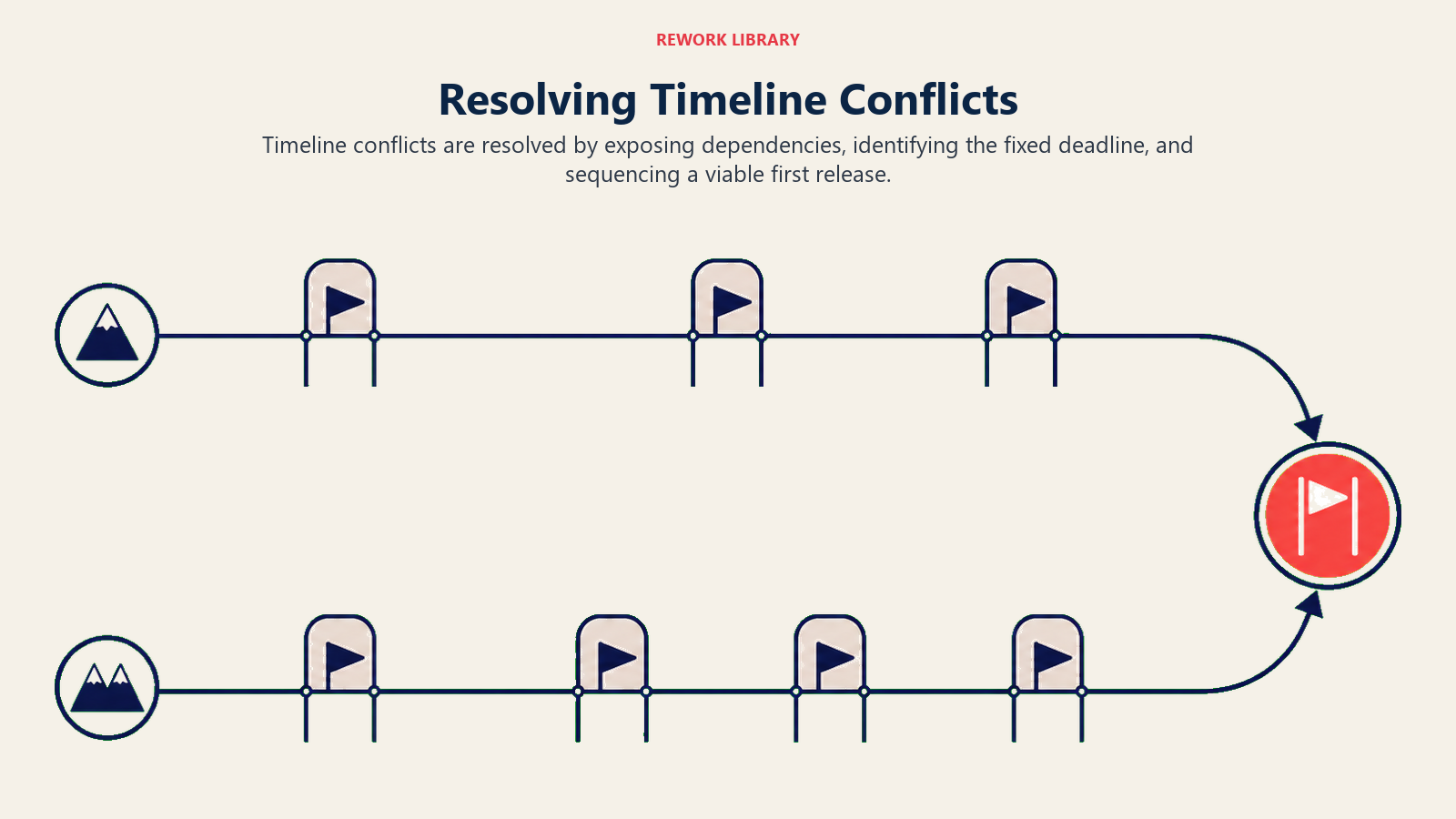
Timeline mismatches are equally common. Here's how to navigate them:
Unrealistic Timelines
They want a four-month project done in six weeks. You can't work miracles, but you can offer options:
Risk education: "We can try to hit that timeline, but here are the risks: quality issues, incomplete work, or burnout that affects later phases."
Minimum viable timeline: "The absolute fastest we could responsibly deliver this is 10 weeks. Here's why each phase takes time."
Resource trade-offs: "To hit six weeks, we'd need to double the team size, which increases cost by 40%."
Expectation resetting: "Let me show you what's achievable in six weeks versus what you'd get with a full timeline. You decide which makes more sense."
Sometimes they don't realize what they're asking for is impossible. Educating them on realistic timelines is part of your professional value.
Flexible Timelines
When they don't have hard deadlines, you have negotiating room:
Optimal scheduling: "Our next available start is in four weeks. That timing actually works better because it lets us do X and Y upfront."
Resource optimization: "If we can start in March instead of February, I can assign my senior team to this instead of junior folks."
Value enhancement: "With a slightly longer timeline, we can add this component at no extra cost."
Flexible timelines let you optimize for quality, team allocation, and other projects in your pipeline.
Non-Negotiable Deadlines
When the deadline is truly fixed (regulatory, contract, event-driven), you need to be clear about what it takes:
Scope adjustments: "To hit this deadline, we need to prioritize ruthlessly. Let's identify the must-haves."
Premium pricing: "Meeting this deadline requires us to reallocate resources from other projects. That comes with a 20% premium."
Risk mitigation: "We'll commit to the deadline, but we need these things from you on this schedule or the timeline slips."
Non-negotiable deadlines often come with budget flexibility because the cost of missing the deadline is high. Use that to your advantage.
Budget Authority Discovery
Knowing the budget isn't enough. You need to know who controls it and how decisions get made.
Decision-makers: "Who ultimately approves expenditures of this size?" Don't assume the person you're talking to has authority.
Approval workflows: "What's the process for getting this approved?" Understand if it's one signature or a committee.
Budget committees: "Does this need to go through procurement or a budget committee?" Enterprise clients often have formal processes.
Procurement involvement: "Will procurement be involved in vendor selection?" This changes your approach entirely.
Competitive requirements: "Are you required to get multiple bids?" Know if you're competing and against how many others.
Payment terms: "What are your standard payment terms?" Net-30, net-60, milestone-based? This affects your cash flow.
Understanding the approval process helps you navigate politics and timing. If you need CFO approval and the CFO is traveling for three weeks, factor that into your timeline.
Red Flags to Watch For
Certain responses signal that budget or timeline aren't real:
Budget Red Flags
"We don't have a budget yet, just send us a proposal": They're price shopping or doing research, not buying. You'll spend hours on a proposal they may never act on.
"We're just getting quotes": Similar issue. They're collecting data points, not making decisions.
"What's your best price?": Leading with this question suggests they're optimizing for cost, not value. These clients are often problematic.
Vague or evasive responses: If they won't talk about budget at all after multiple attempts, they either don't have money or don't trust you yet.
Timeline Red Flags
"We need this done by next week": Unless there's a legitimate emergency, this suggests poor planning. They'll be equally chaotic as a client.
"No rush, whenever you can fit us in": No urgency usually means no commitment. These projects get postponed repeatedly.
"We're still evaluating options": Fine in early stages, but if they say this after weeks of conversations, they're not close to deciding.
Unrealistic expectations without urgency: "We need a comprehensive strategy in two weeks, but it's not time-sensitive." These things don't add up.
Red flags don't automatically disqualify a prospect, but they require direct conversation. "I'm sensing some misalignment on timeline. Help me understand what's driving this schedule."
Value Over Price Positioning
Throughout budget discussions, frame investment in terms of value, not cost:
Investment framing: Use "investment" instead of "cost" or "price." Investments generate returns. Costs are expenses.
ROI quantification: "This $50K investment should save you $150K annually. That's a 3x return in year one."
Risk mitigation value: "The cost of getting this wrong is $500K. Our approach reduces that risk to near zero."
Expertise premium: "You could hire someone cheaper, but they'll learn on your dime. We've done this 50 times and know the pitfalls."
Competitive differentiation: "The $20K difference between us and the other firm represents X, Y, and Z capabilities that directly impact your outcomes."
Total cost of ownership: "A cheaper solution that requires 40 hours of your team's time isn't actually cheaper when you factor in their time value."
Your goal isn't to be the cheapest option. It's to be the best value proposition for clients who care about outcomes.
Implementation Tools
Here are practical tools to support your budget and timeline discovery:
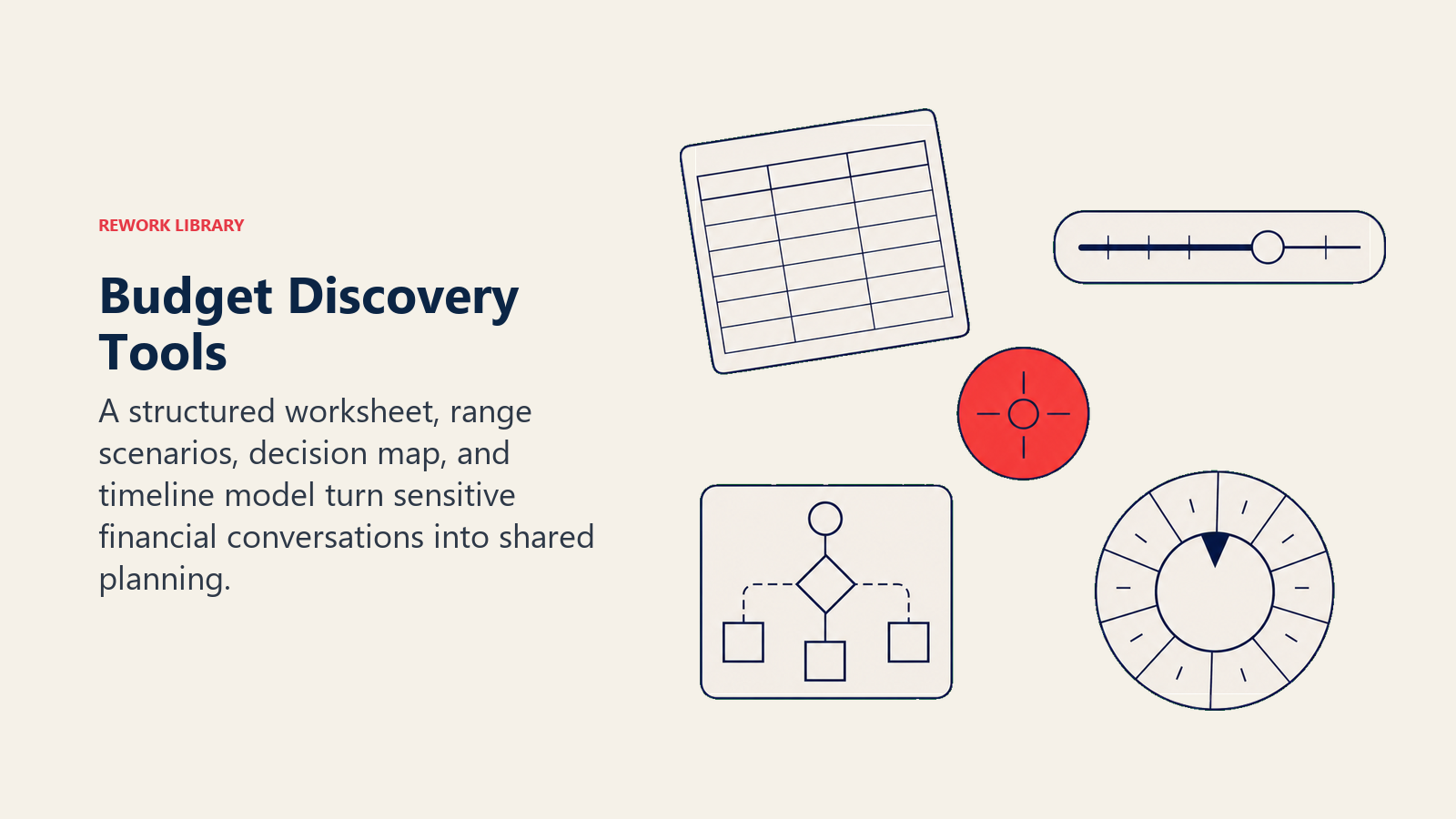
Budget Discovery Question Template
Create a conversation guide with questions organized by stage:
- Initial qualification (5-7 basic budget questions)
- Discovery phase (10-12 detailed financial questions)
- Proposal prep (final confirmation questions)
Train your team to work these into natural conversation, not fire them off like an interrogation.
Budget-Timeline Mismatch Decision Tree
Build a decision framework:
- If budget is 75%+ of needed → Scope reduction options
- If budget is 50-74% of needed → Phased approach
- If budget is <50% of needed → Qualify further or walk away
- If timeline is <75% of needed → Resource/premium options
- If timeline is 75%+ of needed → Standard approach
- If both constrained → Fundamental scope rethinking required
This gives your team consistent guidance on handling common scenarios.
BANT Integration Scorecard
Integrate budget and timeline into a broader qualification framework. Score leads on:
- Budget (approved/allocated/flexible/unknown/none): 0-25 points
- Authority (decision maker/influencer/no authority): 0-25 points
- Need (critical/important/nice-to-have): 0-25 points
- Timeline (immediate/<30 days/<90 days/unknown): 0-25 points
Leads scoring 70+ are high priority. 50-69 are medium. Below 50 need more qualification or nurturing. For more on this approach, see Client Qualification Framework.
Go/No-Go Criteria Checklist
Before investing significant proposal effort, check:
- Budget confirmed and in appropriate range
- Authority identified and accessible
- Timeline realistic and aligned with our capacity
- Scope clearly defined and achievable within constraints
- Decision process understood
- Competitive landscape known
- Client demonstrates genuine urgency
If you can't check most of these boxes, don't write a detailed proposal yet. Do more discovery.
Connecting to Your Broader Sales Process
Budget and timeline discovery doesn't happen in isolation. It's part of your qualification and sales workflow:
During your Initial Consultation Process, you're doing preliminary budget and timeline screening. Basic questions that help you decide whether to invest more time.
In Needs Assessment & Discovery, you're diving deeper. Understanding the business context that informs budget allocation and timeline drivers.
When you get to Proposal Development, you should already know budget and timeline constraints. You're scoping to fit, not proposing blind and hoping.
Your Pricing Justification approach relies on understanding budget context. You can't justify value if you don't know what they consider reasonable investment.
And if you're implementing Value-Based Pricing, you absolutely need to understand budget in relation to outcomes. Value pricing only works when budget aligns with the value you're creating.
The Real Reason Budget Conversations Matter
Here's what this all comes down to: professional budget and timeline discovery is about respect. Respect for your time, respect for their time, and respect for the working relationship you're trying to build.
When you avoid money conversations because you're afraid of seeming pushy, you're not being respectful. You're being inefficient. You're setting up a potential mismatch that wastes everyone's effort and creates frustration later.
When you ask direct questions about budget and timeline early, you're saying "I want to make sure we can actually work together before we invest a lot of time in this." That's professional. Clients appreciate it, even if the conversation feels uncomfortable at first.
The best clients expect you to ask about budget. They've worked with consultants before, and they know that good ones qualify properly. If a prospect gets offended by reasonable budget questions, that's a sign they're not a good client fit anyway.
Your job isn't to sell to everyone. It's to identify the right opportunities and pursue them effectively. Budget and timeline discovery is how you do that. Master it, and you'll waste less time on proposals that go nowhere and win more of the deals that actually matter.
Frequently Asked Questions
When should I ask about budget and timeline? Qualify both in the first or second conversation, before you invest in detailed scoping or proposal writing. Early discovery is not about disqualifying good prospects. It lets you understand constraints so you can propose something that actually fits, instead of over-designing a solution they cannot afford.
How do I ask a prospect about budget without sounding pushy? Use one of four approaches: direct inquiry ("What budget have you allocated?"), range positioning ("Projects like this typically run $30K to $60K, is that your range?"), investment framing ("How much are you planning to invest in solving this?"), or past-project reference ("What have you spent on similar initiatives?"). Framing it as respect for everyone's time keeps it professional.
What do I do when the budget is too low? You have options short of walking away: run a value gap analysis, propose a scaled scope that fits their number, phase the investment into stages, or build an ROI case for the higher amount. Walk away only when they want full scope at half the budget and will not adjust expectations or investment.
How do I tell real urgency from a soft timeline? Ask "What happens if we push this back three months?" If the answer is "not much," there is no real urgency and the project will likely slip. If the answer involves lost revenue, a failed audit, or a missed contract, the deadline is business-critical and the deal is real.
Learn More
Master the full qualification process with these related resources:
- Client Qualification Framework - Comprehensive system for evaluating client fit
- Project Scope Assessment - Evaluate complexity and feasibility
- Initial Consultation Process - Structure productive first meetings
- Consultative Business Development - Build trust while qualifying
- Fit vs Misfit Identification - Recognize good and bad opportunities quickly

Sales Director
On this page
- Why Budget Discovery Happens Too Late
- The Budget Discovery Framework
- Four Budget Discovery Approaches
- Budget Categories: What You're Really Discovering
- Discovery Phase Questions
- Context-Building Questions
- Risk Assessment Questions
- Timeline Discovery Framework
- Timeline Questions That Reveal Urgency
- Assessing Urgency vs. Importance
- The Budget-Timeline-Scope Triangle
- Phased Approaches
- Acceleration Options
- Scope Reduction
- Addressing Budget Mismatches
- Budget Too Low
- No Budget
- Hidden Budget
- Handling Timeline Conflicts
- Unrealistic Timelines
- Flexible Timelines
- Non-Negotiable Deadlines
- Budget Authority Discovery
- Red Flags to Watch For
- Budget Red Flags
- Timeline Red Flags
- Value Over Price Positioning
- Implementation Tools
- Budget Discovery Question Template
- Budget-Timeline Mismatch Decision Tree
- BANT Integration Scorecard
- Go/No-Go Criteria Checklist
- Connecting to Your Broader Sales Process
- The Real Reason Budget Conversations Matter
- Frequently Asked Questions
- Learn More