Travel Pricing Strategy: Maximizing Profit & Competitiveness - 2026
Turn this article into takeaways for your work.


Each assistant summarizes the article only for you and suggests best practices for your work.
Price your Italy tour at $3,200 and you'll sell lots of them, while barely breaking even. Price it at $5,800 and nobody books. Land at $4,400 and you're profitable, competitive, and consistently filling departures.
Pricing is the fastest lever for improving profitability. A 10% revenue increase drops straight to the bottom line, unlike cost reductions that require operational overhauls. But price too high and you lose sales. Price too low and you're working for nothing.
Strategic pricing balances multiple factors: your costs, competitive positioning, perceived value, customer psychology, and market conditions. Get this right and you build a sustainable, profitable travel business.
Travel Pricing Fundamentals
Understanding cost structures is essential before setting prices.
Net rates from suppliers represent your actual costs. Hotels offer net rates (often 20-30% below public prices) that you mark up for retail sale. Tour operators quote net rates assuming you'll add margin. Airlines, car rentals, and activities have their own commission or net rate structures. Know your true costs to calculate meaningful margins.
Commissions versus markups work differently. Some suppliers pay commission (you sell at their retail price, they pay you a percentage). Others quote net rates (you determine final price). Hotels might pay 10% commission OR offer net rates you mark up 15-20%. Each approach affects your pricing strategy.
Gross versus net pricing models: gross pricing includes your margin in the quoted price (client pays $5,000, your cost is $4,000, margin is $1,000). Net pricing shows your costs and markup separately. Most B2C pricing is gross. B2B or transparent models sometimes use net plus markup disclosure.
Profitability analysis requires understanding fixed versus variable costs. Fixed costs (rent, salaries, systems) don't change with bookings. Variable costs (supplier payments, commissions to sales staff) scale with revenue. Break-even analysis shows how much revenue you need to cover fixed costs before profit starts.
Markup & Commission Strategies
Standard industry markups vary by product type.
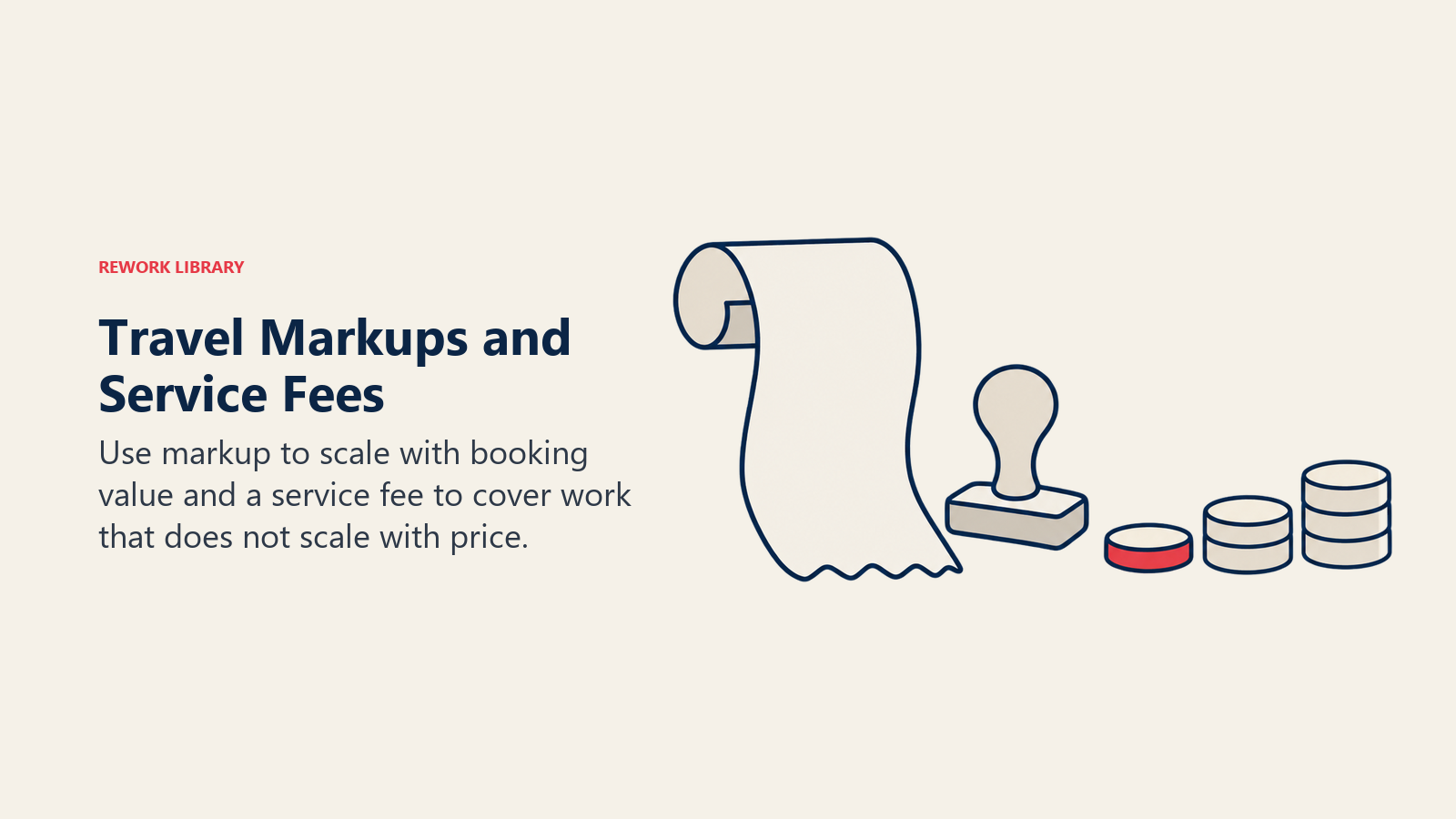
Hotel markups typically run 15-25% on net rates. Basic properties might get 15% markup, luxury properties can support 20-25% because perceived value is higher and clients are less price-sensitive.
Tour package markups range from 18-30% depending on complexity. Simple packages where you're aggregating existing products might only support 18-20%. Highly customized itineraries requiring significant design time justify 25-30%.
Activities and experiences can carry 20-35% markups. They're harder to price-compare, involve curation value, and clients appreciate convenience of booking through you rather than researching themselves.
Ground transportation (transfers, car services) typically supports 15-25% markup. Simple airport transfers are more price-sensitive. Multi-day private drivers support higher margins.
When to use flat fees versus percentage: Flat fees ($50-75 per booking) work when transaction costs don't scale with price, booking a $400 hotel requires similar effort to a $200 hotel. Percentage markups work when value scales with price, designing a $15,000 itinerary deserves more compensation than a $3,000 trip.
Hybrid models combine both: $75 booking fee plus 15% markup. This ensures minimum compensation while scaling earnings with booking size.
Competitive Pricing Analysis
You're not pricing in a vacuum. Market awareness matters.
Monitor competitor pricing through mystery shopping, website reviews, and client feedback. What are similar itineraries priced at? How do your quotes compare? If you're consistently 20% above competitors, you better have clear differentiation justifying that premium.
Positioning options: budget (low price, basic service), mid-market (balance of value and service), or premium (high price, exceptional service/access). Choose intentionally, don't try serving all segments. Pick your positioning and price accordingly.
Strategic pricing differentiation means charging more when justified. Maybe you specialize in Italy with local connections competitors lack. Maybe you offer 24/7 support they don't. Maybe your booking process is seamless while theirs is clunky. Differentiation allows premium pricing.
Value-Based Pricing Approach
Price based on value delivered, not just costs incurred.
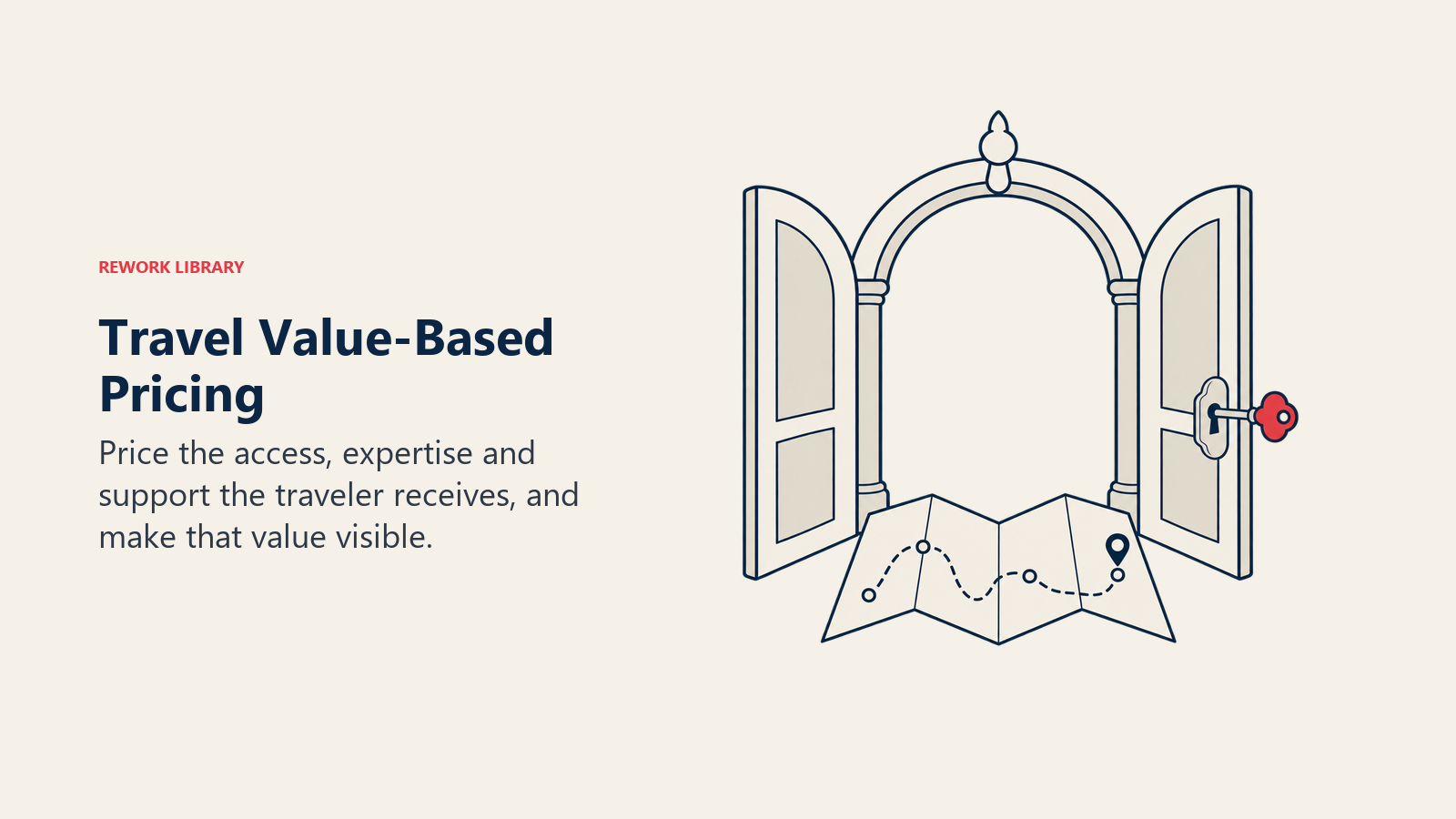
Customer perception of value matters more than your costs. If clients perceive tremendous value in your exclusive access to sold-out restaurants, behind-the-scenes tours, or personalized service, they'll pay premiums. Your job is making that value obvious.
Expertise premium means charging more because you know more. Specialists can charge 15-25% above generalists. Someone who's visited Patagonia 12 times can command higher prices than someone Googling itineraries. Expertise reduces client risk and improves outcomes, that's valuable.
Service level justification: white-glove service costs more to deliver but clients will pay for it. Same itinerary with basic email support versus 24/7 concierge service justifies price differences.
Avoid race to bottom by resisting pure price competition. Competing solely on price means you'll lose to someone willing to work for less. Compete on value, experience, expertise, service, access, peace of mind.
Psychological Pricing Tactics
How you present prices affects buying behavior.
Charm pricing ($4,999 vs $5,000) works even for sophisticated buyers. The price feels significantly lower psychologically even though it's essentially the same. Use $X,999 or $X,995 pricing for packages over $3,000.
Decoy pricing presents a third option making your preferred option seem optimal. Three package tiers: $3,200 (basic), $4,600 (enhanced, your recommended), and $6,400 (premium). The premium option makes enhanced seem reasonably priced. Many clients choose the middle option.
Anchoring with premium options means showing expensive options first. Present your $8,500 luxury package, then your $5,200 standard package. The standard package now seems more affordable than if presented alone.
Package bundling obscures individual item costs and creates perceived value. "$4,800 all-inclusive" feels better than itemizing: $1,200 hotels + $950 flights + $680 activities + $1,970 other. Bundled pricing simplifies decisions and reduces price resistance.
Seasonal Pricing Variations
Travel demand fluctuates dramatically by season.
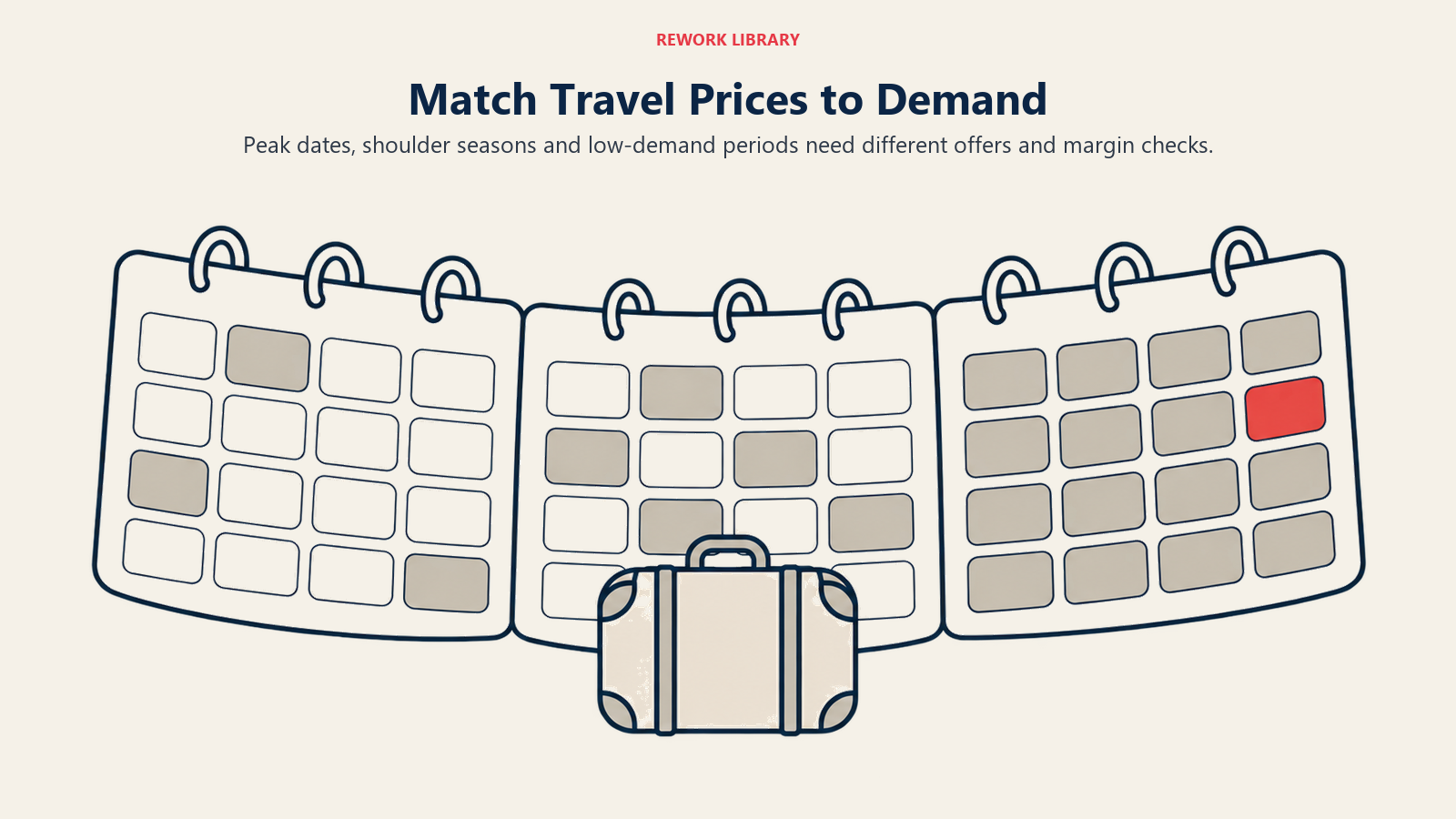
Peak season pricing (summer in Europe, winter in Caribbean, cherry blossoms in Japan) supports 25-40% premiums over shoulder season. Demand exceeds supply, you can charge more and still fill capacity.
Shoulder season pricing (spring/fall in most destinations) offers the sweet spot: good weather, fewer crowds, moderate pricing. Many travelers prefer shoulder season specifically for this balance.
Low season pricing must be low enough to drive demand despite weather or other downsides. Heavy discounts (30-50% below peak) or added value inclusions make off-season compelling.
Holiday premiums for Christmas, New Year's, Thanksgiving, or cultural holidays (Chinese New Year, Diwali) can add 15-30% to base pricing. Limited availability and high demand justify premiums.
Special event pricing for festivals, sporting events, cultural celebrations can support massive premiums. Hotel rooms in Austin during South by Southwest, or Paris during Fashion Week, cost 3-5x normal rates. Events create temporary scarcity.
Segment-Based Pricing
Different customer types accept different pricing.
FIT versus groups: Individual travelers might pay $4,200 for an itinerary that costs $3,400 per person for groups of 8+. Groups accept lower per-person pricing but generate much higher total revenue.
Corporate versus leisure: Corporate bookings prioritize convenience and service over absolute lowest price. Leisure travelers are more price-sensitive. Same service can carry different pricing based on segment.
Luxury versus budget: Luxury clients expect higher pricing and become suspicious of low prices (quality concerns). Budget travelers need affordable options. Serve different segments with different products at appropriate price points.
Senior, family, military discounts (5-15% off standard pricing) build goodwill and capture segments with specific motivations. Seniors have time flexibility but fixed incomes. Military appreciate recognition. Families need affordability for 4+ travelers.
Transparent vs Opaque Pricing
How much price detail do you show?
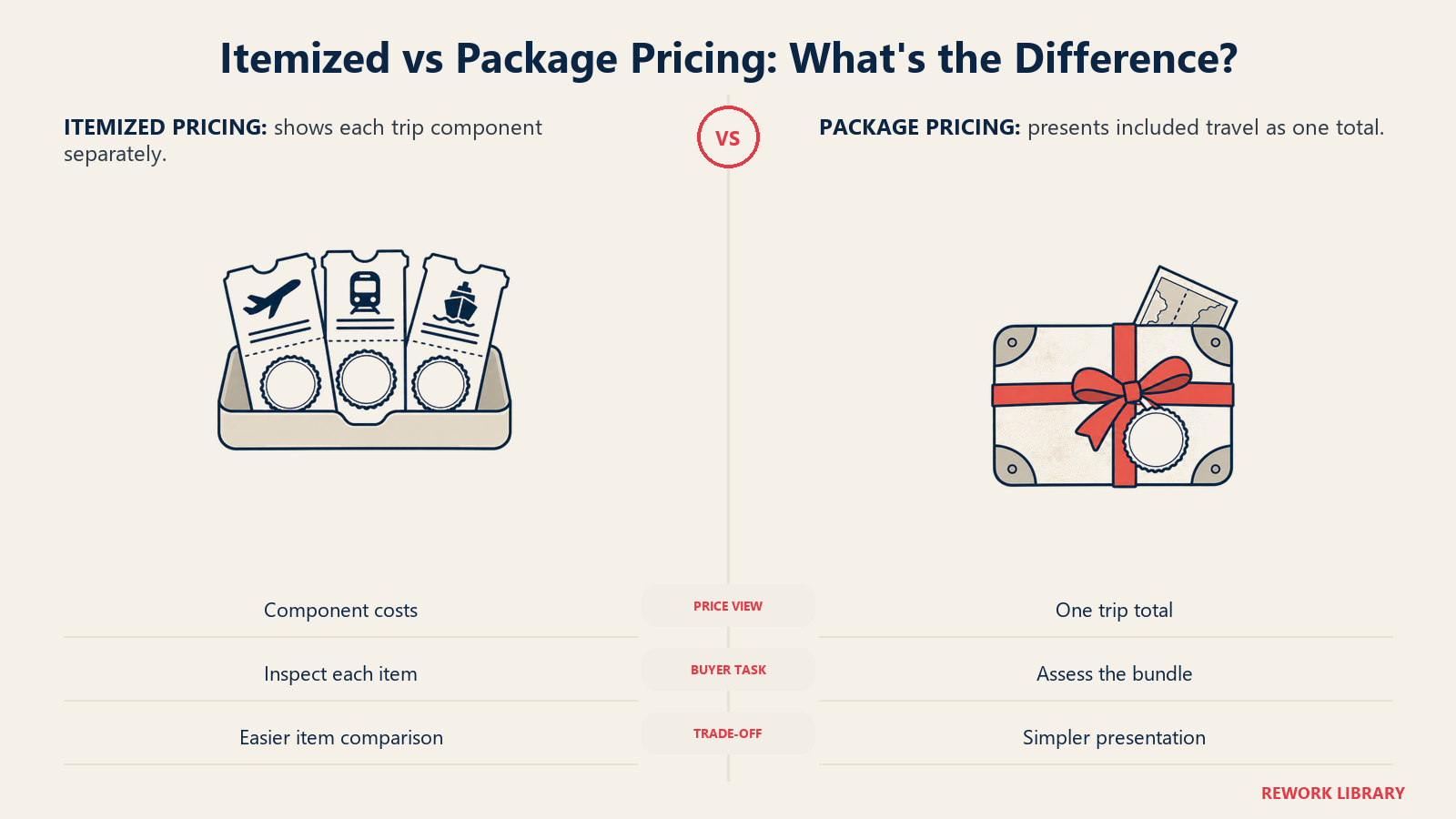
Itemized pricing lists each component and cost. $1,240 hotels + $890 flights + $520 activities + $340 transfers = $2,990 total. Transparency builds trust but invites price comparison on individual elements.
All-inclusive packages show one price covering everything. $4,800 includes all accommodations, transportation, activities, most meals, and taxes. Simplifies decisions but obscures value of components.
Optional add-ons separately priced gives base package price with clearly available upgrades. "$3,400 base package. Add cooking class +$95, wine tasting +$120, room upgrades +$340."
Customer preference trends toward simplicity for leisure travel, transparency for corporate travel. Test what converts better with your audience.
Price Matching & Discount Policies
Handle competitive price challenges strategically.
When to match competitors: If the offer is genuinely identical (same hotels, same inclusions, same service level), consider matching if it's a client you want. Don't match if their lower price reflects inferior service.
How to handle "found cheaper" claims: Investigate carefully. Often "cheaper" means different quality level, fewer inclusions, or hidden costs. "I see they're offering hotels in the same area but different properties. Let me show you the specific hotels we're using and why we choose them."
Promotional discount strategies use time-limited offers to drive urgency without permanently reducing prices. "Book by March 15 and save 10%" encourages action without training customers to expect perpetual discounts.
Protect margins by discounting strategically, not reactively. Planned promotions during slow booking periods make sense. Knee-jerk discounting to every competitor undercut trains customers to always negotiate.
Pricing Technology & Tools
Systematic pricing requires appropriate tools.
Pricing calculators with standardized markup formulas ensure consistency. Input net costs, calculator applies your markup rules, outputs retail pricing. Prevents pricing errors and enables delegation.
Real-time cost updates matter when supplier rates change frequently. Automated feeds from major hotel and tour operator systems keep your pricing current.
Automated markup application built into booking systems means salespeople don't manually calculate each time. System knows markup rules and applies them consistently.
Profit margin tracking shows what you actually make per booking. Many agencies quote eagerly without tracking whether bookings are profitable. Dashboard showing margin by booking, product type, and salesperson reveals where money is made or lost.
Pricing is part art, part science. The science is understanding costs, margins, and market rates. The art is judging what clients will pay, how to position value, and when to hold firm versus flex.
Get pricing right and you build a profitable business that can invest in growth, weather slow periods, and compensate yourself appropriately. Get it wrong and you'll work constantly while struggling financially.
Study your numbers, know your market, understand your value, and price accordingly.
Related Articles:

Business Consultant