Travel Booking Funnel: Optimize Every Stage from Discovery to Confirmation
Turn this article into takeaways for your work.


Each assistant summarizes the article only for you and suggests best practices for your work.
Ninety-seven percent of visitors to website conversion for travel sites don't book. They arrive through Google searches, Instagram ads, or email campaigns. They browse packages, compare pricing strategy, read reviews, and then... disappear. Your analytics show 10,000 monthly visitors but only 300 bookings. That 3% conversion rate feels inevitable, but it's not, it's the result of optimization failures at multiple funnel stages.
Travel booking funnels are fundamentally different from e-commerce product funnels. Someone buying headphones decides in hours. Someone booking a $4,000 vacation researches for 45-180 days, visits 15-20 different websites, consults family members, compares alternatives obsessively, and abandons multiple travel inquiry management booking attempts before finally converting.
This complexity creates opportunity. While most operators accept 2-4% conversion as "normal," optimized operators achieve 6-8% by understanding where their specific funnel leaks and systematically fixing those breaks. A 2-percentage-point improvement in conversion doesn't sound dramatic, until you calculate that it represents 67% more bookings from the same travel lead generation traffic.
Travel-Specific Funnel Dynamics
Generic funnel optimization advice doesn't account for travel's unique characteristics.
Extended consideration periods mean someone might discover your Iceland tour in January, research seriously in March, compare options in May, and finally book in July for October travel. That's a six-month travel sales process journey with dozens of touchpoints. Standard e-commerce attribution windows miss 90% of this story. You need customer data management tracking that connects January's Instagram ad to July's booking.
Multiple touchpoints across platforms complicate attribution. The typical journey: see Instagram ad → Google search → website visit → exit → TripAdvisor review research → return to website → email capture → nurture emails → website visit → price comparison on OTA → direct booking strategy. That's 15+ interactions before conversion. Last-click attribution wrongly credits only the final touchpoint.
Comparison shopping behavior is structural, not aberrant. Travel is expensive and unfamiliar. People don't have direct experience with most destinations or providers, so they comparison shop obsessively to reduce perceived risk. Rather than fighting this tendency, your funnel should embrace it by making comparisons easy within your website conversion for travel site (compare our 7-day vs 10-day Iceland packages) rather than forcing people to compare across multiple sites.
Trust and risk factors are higher than typical e-commerce. Buying a defective product from Amazon costs $30 and arrives with easy returns. Booking a terrible tour costs $3,000 and ruins your only vacation this year with no recourse. This risk elevation means travelers need more trust-building for travel businesses social proof, more information, more reassurance before committing. Your funnel must build trust at every stage.
Decision committee dynamics add complexity. Rarely does one person decide alone. Couples negotiate preferences. Families accommodate multiple generations. Friend groups coordinate schedules. Your funnel must facilitate this collective decision-making, features like "share this itinerary" and "hold this date for 72 hours" help groups coordinate.
Funnel Stage Breakdown
Each stage requires different content, messaging, and conversion tactics.
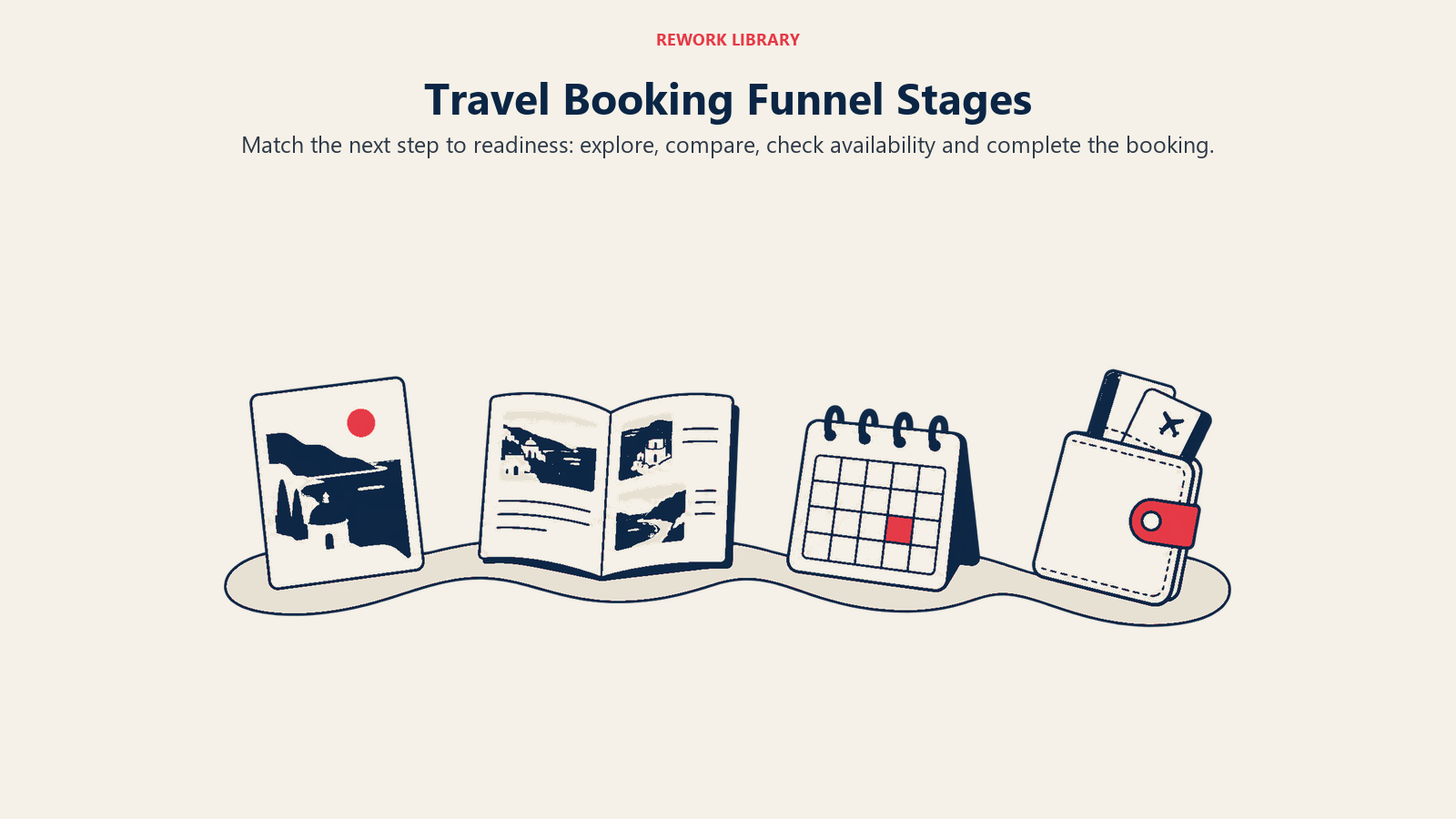
Inspiration stage captures people in dream mode. They're browsing "bucket list destinations" or "best adventure travel experiences." They don't have specific plans, they're exploring possibilities. Your goal isn't immediate booking, it's moving them to research mode. Content that works: stunning photography, video tours, destination guides, experience highlights. CTA: "Explore Iceland Tours" or "Get Trip Ideas."
Research stage engages people evaluating specific destinations or trip types. They've narrowed from "somewhere amazing" to "Iceland" or "adventure tours." They're comparing tour lengths, itineraries, activity levels, and price ranges. Content that works: detailed itinerary descriptions, inclusion/exclusion lists, difficulty ratings, FAQs. CTA: "Compare Iceland Packages" or "See Detailed Itinerary."
Consideration stage captures shortlist comparison. They've identified 3-5 operators or specific packages they're seriously considering. They're reading reviews obsessively, analyzing value differences, and assessing trustworthiness. Content that works: testimonials, review aggregation, trust badges, detailed photos showing quality. CTA: "Check Availability" or "Get a Quote."
Intent stage signals imminent booking. They're checking specific dates, real-time availability, and exact pricing. They might create accounts, save favorites, or start booking forms. This is high-intent behavior that should trigger immediate engagement. Content that works: live availability calendars, transparent pricing, deposit requirements, cancellation policies. CTA: "Book Now" or "Reserve Your Spot."
Decision stage is commitment. They've decided to book and are completing the transaction. Friction at this point kills conversions that were nearly complete. Optimize for: minimal form fields, multiple payment options, progress indicators, security reassurance, immediate confirmation.
Booking completion stage is the transaction finish line. Your payment processes successfully, dates are confirmed, and they receive confirmation emails. Failures here are catastrophic, you've done all the work to earn the booking but failed to close it.
Pre-trip stage maintains engagement from booking to departure. This isn't traditionally considered part of the booking funnel, but it affects future referrals and repeat bookings. Send preparation guides, packing lists, local information, and countdown excitement-builders.
Stage-Specific Conversion Metrics
Benchmark your funnel against industry standards.
Inspiration to research rate should be 25-35%. Of people landing on inspirational content, one-third should progress to researching specific packages. If you're below 20%, your inspiration content isn't creating sufficient desire, or your navigation to research content is unclear.
Research to consideration rate should be 15-25%. People viewing detailed itineraries should add packages to their shortlist or save favorites. Below 12% suggests information overload, unclear differentiation, or pricing that doesn't match value perception.
Consideration to intent rate should be 30-40%. People seriously considering you should check availability or request quotes. Below 25% suggests trust barriers, unclear next steps, or lack of urgency.
Intent to booking rate should be 15-25%. People who start booking should complete it. Below 12% indicates checkout friction, payment issues, or last-minute hesitation that isn't being addressed.
Booking completion rate should be 85-95%. Once someone initiates payment, nearly all should successfully complete. Below 80% indicates technical issues, payment processing problems, or unexpected fees.
Overall funnel conversion from first visit to booking is typically 2-4% for travel. Well-optimized operators achieve 5-8%. Above 10% is exceptional and usually reflects highly targeted traffic rather than broad awareness visitors.
Drop-Off Analysis Framework
Find your specific leaks before trying to fix everything.
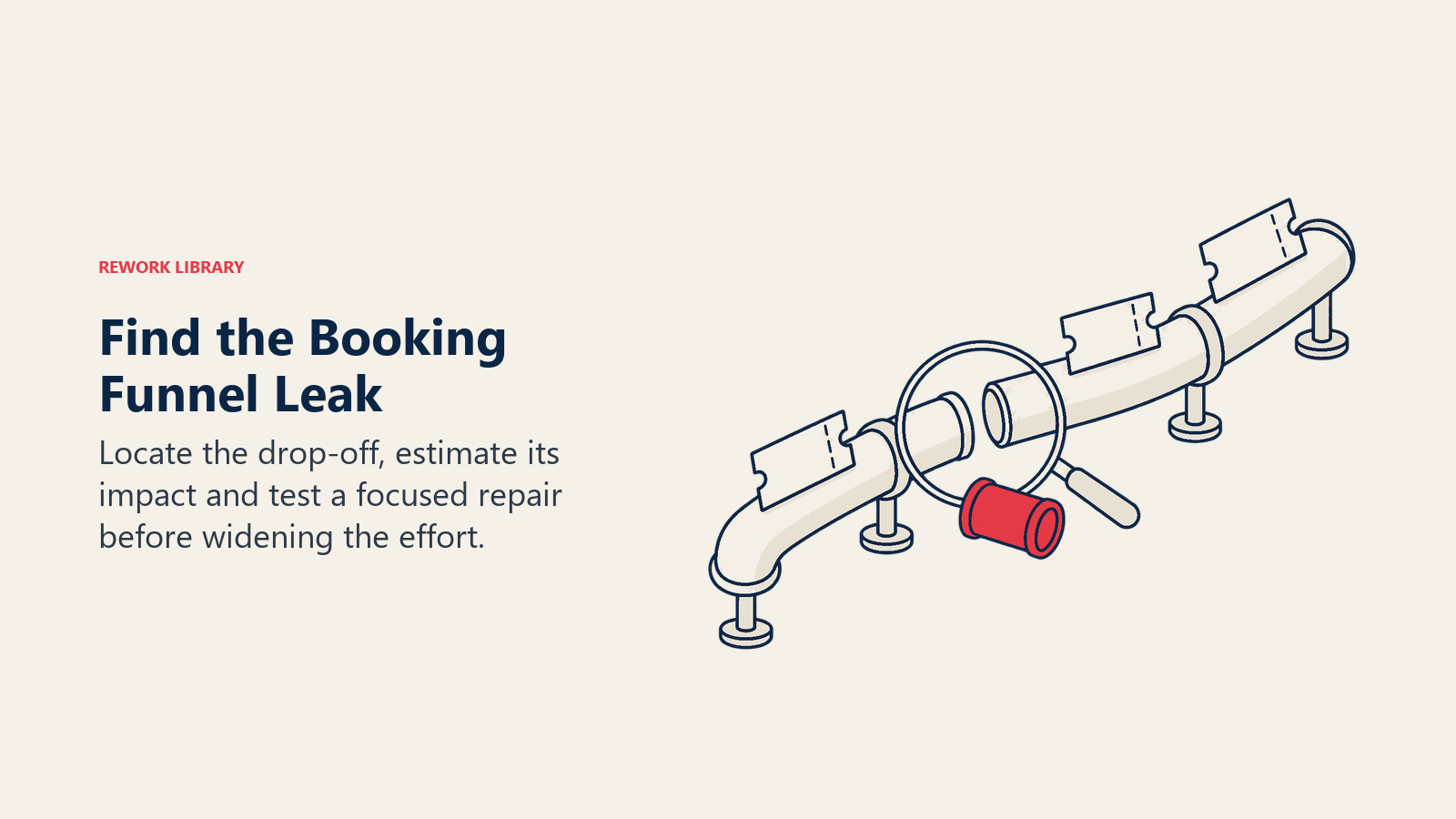
Identifying leak points starts with data. Use Google Analytics Enhanced Ecommerce tracking or similar funnel visualization to see where people exit. If 60% of people drop off between viewing a tour page and checking availability, that's your primary leak. Don't guess, measure.
Quantifying revenue impact prioritizes fixes. Multiply drop-off rate by average booking value and monthly traffic to calculate cost of the leak. If 500 people monthly drop between viewing tour details and booking, and you convert 20% of those who don't drop off, you're losing 100 bookings. At $3,000 average value, that's $300,000 monthly revenue leak. Fixing this justifies significant investment.
Prioritizing optimization efforts balances impact and effort. The biggest revenue leak might require six months of development to fix. A smaller leak might be fixable in two weeks. Create a prioritization matrix plotting revenue impact against implementation difficulty. Start with high-impact, low-difficulty wins.
A/B testing methodology ensures you're actually improving. Don't just implement changes and hope, test them. A/B test simplified booking forms against current versions. Test different CTA button copy. Test pricing display variations. Statistical significance requires patience, travel's conversion rates mean you need weeks or months of data to prove improvements.
Channel-Specific Funnels
Different traffic sources require different funnel optimization.
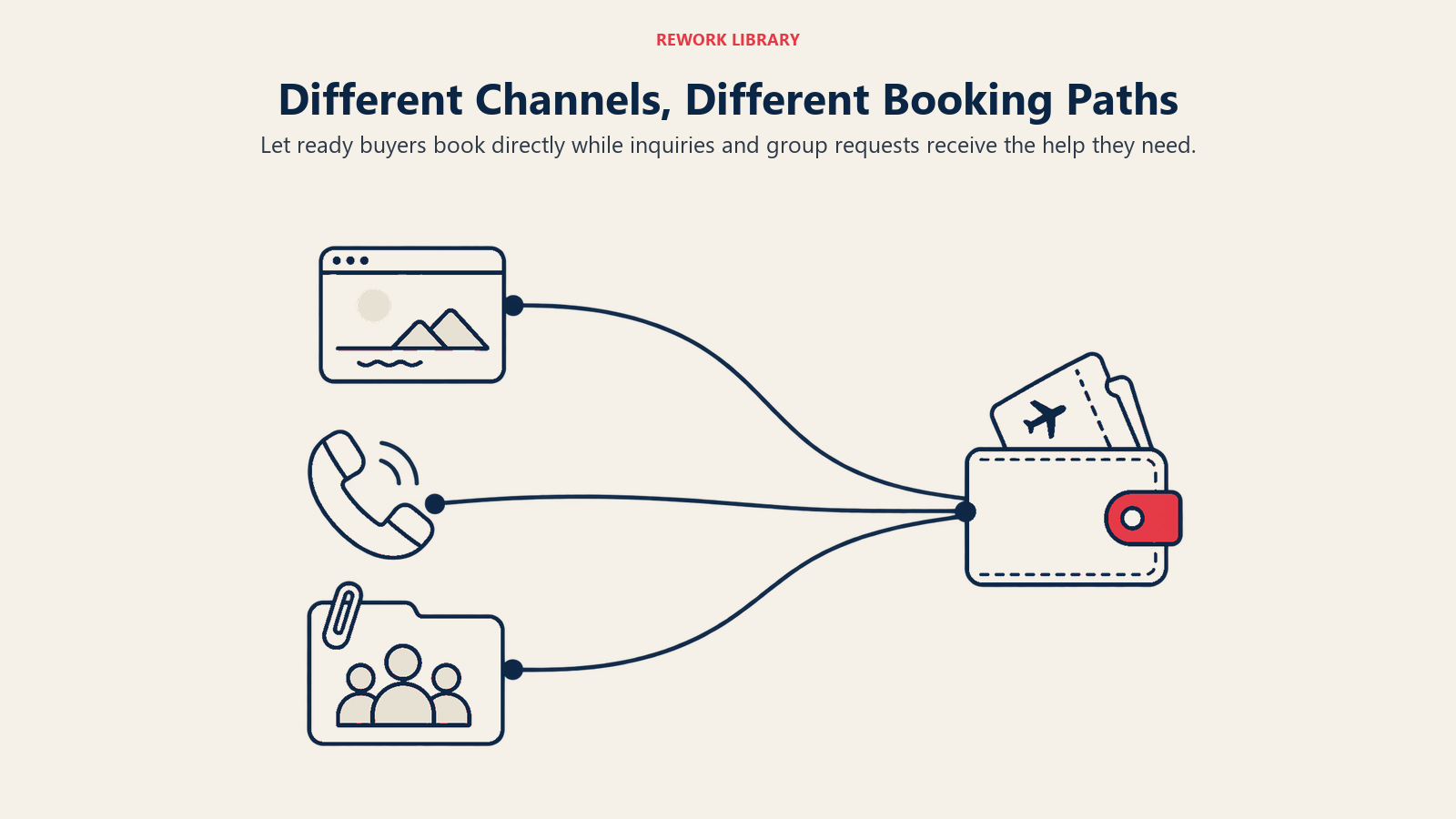
Direct website booking path serves people who found you organically or through brand searches. These visitors have highest intent and familiarity. Optimize for: fast path to booking, minimal distraction, trust reinforcement. Don't force them through educational content they don't need.
OTA referral flow captures people who researched you on Booking.com or Expedia but clicked through to book direct. They're comparing your direct price to OTA price. Optimize for: rate parity proof, direct booking benefits (free breakfast, upgrade, flexible cancellation), seamless continuation of their research (pre-populate dates they searched).
Inquiry-based sales funnel serves people not ready to book online, they want human interaction. Optimize for: easy inquiry submission, fast response promises, multiple contact methods (phone, email, WhatsApp, chat). After inquiry submission, funnel shifts to email and phone nurture tracked in CRM, not website analytics.
Phone booking process bypasses website entirely for some segments. Elderly travelers, complex group bookings, and high-value luxury segments prefer speaking to humans. Track these separately, measure inquiry to booking conversion, average handle time, and customer satisfaction.
Group and corporate sales cycles stretch 6-18 months with multiple stakeholders. Funnel stages: inquiry → discovery call → proposal → negotiation → contract → booking. Optimize for: simplified RFP submission, showcasing group-specific capabilities, proposal generation speed, stakeholder communication tools.
Optimization Strategies by Stage
Targeted interventions address specific stage challenges.
Inspiration optimization focuses on engagement and desire creation. Use video prominently, 60% of travelers say video influences their destination decisions. Create content that triggers emotional connection: "Imagine watching the Northern Lights dance above an Icelandic glacier." Avoid premature selling, inspiration stage isn't about pricing or booking mechanics.
Research optimization provides comprehensive, organized information. Implement comparison tools: "Compare our 7-day, 10-day, and 14-day Iceland tours side-by-side." Use progressive disclosure, show overview first, expand into detailed day-by-day itineraries on request. Include filterable options: activity level, price range, trip length. Make it easy to research without leaving your site.
Consideration optimization leverages social proof and trust signals. Display TripAdvisor ratings prominently. Feature video testimonials. Show real customer photos, not just professional shots. Add trust badges: secure payments, ATTA membership, industry awards. Implement "recent bookings" notifications: "Sarah from Toronto just booked this tour."
Intent optimization removes barriers and creates urgency. Show real-time availability: "Only 4 spaces remaining for June 15 departure." Display transparent pricing with no hidden fees. Offer flexible payment: "$500 deposit today, balance due 60 days before departure." Provide instant booking confirmation, not "we'll get back to you in 48 hours."
Booking optimization minimizes friction. Reduce form fields from 25 to 12. Implement progress indicators (Step 2 of 4). Accept multiple payment methods. Use address auto-complete. Pre-populate information from previous steps. Show security badges on payment screens. Provide phone support number visible during checkout.
Technology Stack Requirements
You can't optimize what you can't measure.
Analytics and funnel visualization via Google Analytics 4, Adobe Analytics, or specialized tools like Heap provide customer data management visibility into user journeys. Set up Enhanced Ecommerce tracking to measure each funnel stage, segment by traffic source, and identify specific drop-off points.
Session recording and heatmaps through tools like Hotjar or FullStory show why people drop off. Watch recordings of users who abandoned booking engine optimization forms. See where they hesitate, what confuses them, where they click expecting something to happen but nothing does. This qualitative insight complements quantitative analytics.
A/B testing platforms like Optimizely, VWO, or Google Optimize enable controlled experiments. Test hypotheses: "Does adding trust-building badges above the booking button increase conversion?" Run tests until reaching statistical significance (typically 95% confidence, several hundred conversions per variation).
Attribution modeling connects touch points across the long travel buying cycle. Use multi-touch attribution that assigns partial credit to each interaction rather than 100% to the last click. This prevents you from cutting travel paid advertising channels that assist conversions even if they don't close them.
Abandonment recovery tracking identifies partially completed bookings. When someone starts a booking form but doesn't complete it, capture their email (request it early in the process) and trigger recovery campaigns: "You started booking Iceland for June, still interested? Here's a $100 incentive to complete your booking today."
Measurement Dashboard
Monitor these metrics to guide ongoing optimization.
Funnel conversion by source reveals which traffic sources deliver best-converting visitors. Organic search might convert at 5% while Facebook ads convert at 1.5%. This doesn't mean Facebook is bad, it might be delivering top-of-funnel awareness that assists later conversions. But it guides budget allocation and expectation-setting.
Time in funnel analysis shows how long people take between stages. Average time from first visit to booking is 45-60 days in travel. If your highest-value customers take 90+ days, you need longer retargeting windows and more patient nurture campaigns.
Revenue per visitor calculates total booking revenue divided by total visitors. This blended metric captures both conversion rate and average booking value. You can improve it by converting more visitors (higher conversion rate) or selling more expensive packages (higher average order value).
Booking abandonment rate measures percentage of people who start booking but don't complete. Industry average is 75-85% in travel, higher than most e-commerce because booking complexity and commitment level are higher. Below 70% is excellent. Above 90% indicates serious checkout problems.
Conclusion
Your travel booking funnel is a leaky bucket. The question isn't whether you have leaks, you do. The question is whether you know where they are and whether you're systematically fixing them.
The operators with 7% conversion aren't lucky. They've instrumented their funnels, identified specific drop-off points, run controlled experiments to address them, and iterated continuously. They understand that a 1-percentage-point improvement at each stage compounds into dramatic overall improvement.
Start by measuring your current funnel performance at each stage. Find your biggest leak. Fix it. Measure again. The compounding returns from this iterative approach transform marketing efficiency more than any single tactic ever could.
Related Articles: