Travel Paid Advertising: High-ROI Campaign Strategies for Tour Operators
Turn this article into takeaways for your work.


Each assistant summarizes the article only for you and suggests best practices for your work.
Generic advertising advice doesn't work for travel. Run a standard e-commerce campaign and you'll burn through budget without understanding why your cost per acquisition is three times higher than benchmarks suggest. Book a flight, and you'll decide in two days. Book a $5,000 European vacation, and you'll research for six months, visit 47 websites, and abandon your cart eight times before finally converting.
The travel customer journey mapping spans 45-180 days across dozens of touchpoints. Cart abandonment hovers above 80% because people research dream trips they can't afford yet, compare options compulsively, and wait for the perfect moment to commit. Understanding seasonality management in travel is critical, you're fighting for inventory in December and desperately trying to fill capacity in February.
This complexity demands advertising strategies built specifically for travel economics.
Travel-Specific Advertising Challenges
Long consideration cycles break traditional conversion tracking. Someone sees your Instagram ad in January, visits your website in March, compares you to competitors in May, and finally books in July for an October departure. Standard 30-day attribution windows miss 90% of the customer journey. You can't optimize what you can't measure.
High cart abandonment creates a second challenge. When 80% of people who start a booking don't complete it, your advertising funnel looks broken even when it's working correctly. That abandoned cart isn't always a lost sale, it's often someone not ready to commit today but planning to book next week. You need retargeting strategies that nurture rather than pester.
Seasonal demand volatility destroys budget efficiency if you don't plan for it. Bidding $8 per click for "Hawaii vacation packages" works in September when competition is moderate. That same keyword costs $22 in December when everyone's booking spring break. Your annual budget allocation needs to anticipate these swings or you'll overspend in low seasons and get priced out during high-demand windows.
High customer acquisition costs are structurally normal in travel. Acquiring a customer who books a $3,000 tour might cost $200-400 when you account for the full funnel. That's 7-13% of revenue, higher than most e-commerce, but acceptable if lifetime value justifies it. Understanding customer acquisition cost in travel helps set realistic benchmarks. The mistake is comparing your CAC to industries with shorter sales cycles and lower transaction values.
Attribution complexity across touchpoints means you're probably misallocating budget. That Google Search ad that gets credit for the conversion might have been the seventh touchpoint in a journey that started with a Pinterest pin. If you only fund last-click channels, you starve the top-of-funnel awareness that makes bottom-funnel conversions possible.
Channel Strategy Matrix
Different channels serve different purposes in the travel buying journey.
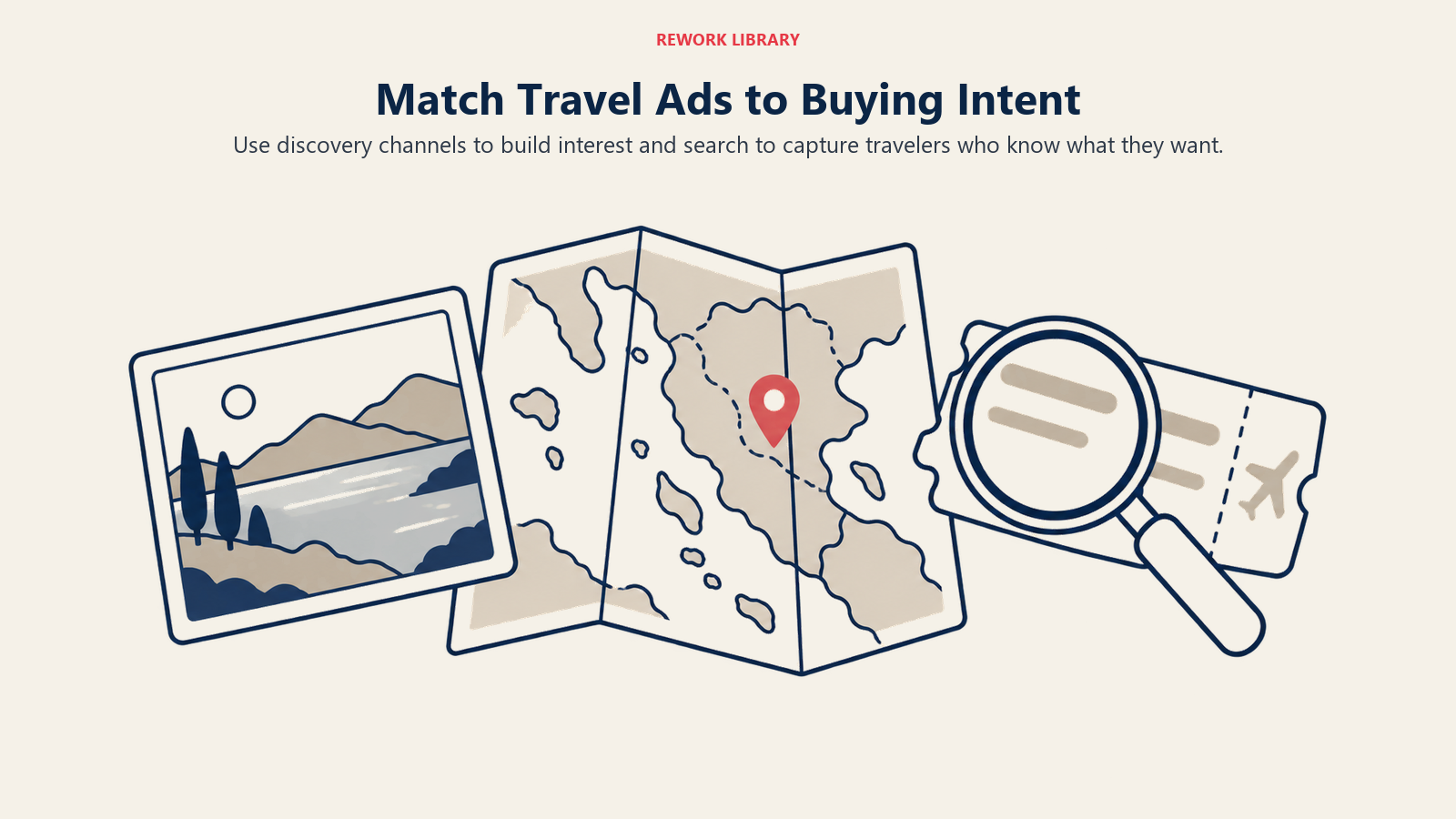
Google Search Ads capture high-intent demand when people know what they want. Someone searching "Machu Picchu tours 2026" is actively shopping. These campaigns convert at 4-8% and should receive 40-50% of your total paid budget. Focus on destination plus experience keywords ("Costa Rica zip lining tours"), competitor terms ("alternative to G Adventures"), and your brand name defense. Expect $3-15 CPC depending on destination competitiveness.
Google Display Network builds awareness with people who aren't actively searching yet. These are banner ads following someone across the web after they've visited travel blogs or searched vacation-related terms. Conversion rates sit around 0.5-1%, but CPCs are $0.50-2.00, making this cost-effective for reaching dreamers before they become searchers. Allocate 10-15% of budget here for audience building.
Meta platforms (Facebook and Instagram) excel at inspiration and targeting based on interests, life events, and behaviors. You can target people who've recently gotten engaged (honeymoon tours), live in cold climates during winter (tropical escapes), or follow adventure travel influencers through social media for travel brands strategies. Expect 1-2% conversion rates with $1-4 CPC. These platforms get 25-30% of budget for mid-funnel engagement.
Pinterest captures people in the planning phase. Someone creating a "Japan Travel 2026" board is actively dreaming and researching. Promoted pins blend natively into this discovery behavior. Conversion rates around 1.5-2.5% with $0.75-2 CPC make Pinterest surprisingly effective for destinations with strong visual appeal. Worth 5-10% of budget if your target demographic skews female 25-45.
TikTok reaches Gen Z and Millennials with short-form video that prioritizes entertainment over hard selling. A 30-second tour highlight reel that goes semi-viral can generate thousands of website visits at $0.10-0.50 per click. Conversion rates are lower (0.8-1.2%) because the audience is younger and earlier in their travel planning, but the platform builds brand awareness efficiently. Allocate 5-10% if targeting under-35 travelers.
YouTube showcases destinations through longer video content. A 2-minute tour experience video serves both as advertising and valuable content people actually want to watch. Effective travel video marketing uses in-stream ads and discovery ads for different goals, interruption for retargeting, discovery for new audience building. Conversion rates of 1-2% with CPV (cost per view) of $0.05-0.15 make this efficient for visual storytelling. Worth 10-15% of budget.
Campaign Structure Framework
Organize campaigns by funnel stage, not by channel.
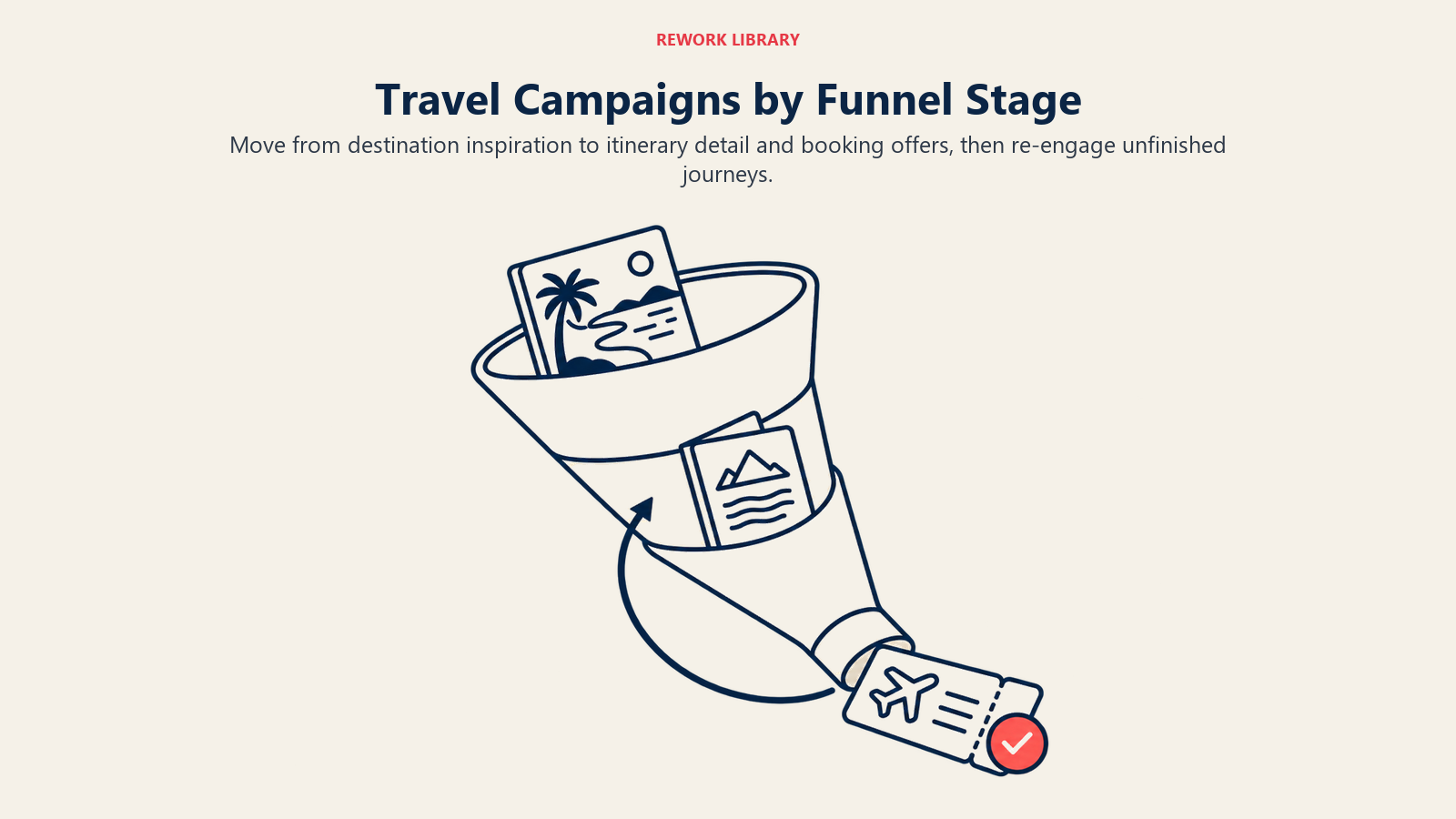
Top-of-funnel campaigns focus on destination inspiration. These target broad interests like "adventure travel," "luxury vacations," or "family trip ideas." Creative emphasizes stunning visuals and emotional appeal over specific offers. Goal is to build audiences you can retarget later. Budget 20-25% here with success metrics centered on engagement like video views and landing page visits, rather than direct conversions.
Mid-funnel campaigns engage people considering specific destinations or trip types. Someone who watched your Patagonia video last month now sees ads highlighting specific 10-day Patagonia trekking packages. Creative includes more details like itinerary highlights, pricing ranges, and departure dates. Budget 25-30% here with metrics tracking landing page engagement, PDF downloads, email signups, and soft conversions that indicate serious interest.
Bottom-funnel campaigns convert people ready to book. These target high-intent keywords, retarget cart abandoners, and promote time-sensitive offers to engaged audiences. Creative is direct: "Book by Friday and save $500." Expect 30-35% of budget here with ROAS (return on ad spend) as primary success metric. Acceptable ROAS in travel is typically 3:1 to 5:1 depending on margins.
Retargeting campaigns re-engage people who've shown interest but haven't converted. Someone who viewed a tour page gets retargeted with that specific tour. Cart abandoners get urgency messaging through abandonment recovery in travel sequences. Past customers get new destination offers. Budget 15-20% here with conversion rates of 5-12%, significantly higher than cold traffic because you're reaching demonstrated interest.
Keyword Strategy for Travel
Travel keyword strategy requires specificity that balances search volume with conversion intent.
Destination-specific targeting combines location with trip type: "Iceland Northern Lights tours," "Vietnam family vacations," "Tanzania safari packages." These convert better than generic "international tours" because they match specific research intent. Build separate campaigns for each major destination you serve to control budgets and messaging independently.
Activity and experience modifiers capture niche intent: "shark cage diving South Africa," "hot air balloon Cappadocia," "cooking class Tuscany." These long-tail keywords have lower search volume but higher conversion rates (often 8-12%) because they indicate specific interests. Someone searching "cooking class Tuscany" is much closer to booking than someone searching "Italy trips."
Seasonal and event-based keywords capture timely demand: "New Year's Eve Dubai packages," "cherry blossom Japan tours 2026," "Oktoberfest Munich trips." Create campaigns 3-6 months before peak search periods. Pause them post-event to avoid wasted spend. These keywords spike dramatically during specific windows. Traffic can increase 400% in a two-week period.
Competitor and OTA defense protect your brand and capture comparison shoppers. Bid on "alternative to [competitor]" and defend your own brand name against OTAs bidding on your brand keywords. Someone searching your company name wants you specifically, losing that click to an OTA that charges 15% commission is expensive. Brand defense should maintain 90%+ impression share.
Creative Best Practices
What you show matters as much as who you target.
User-generated content (UGC) outperforms professional photography by 25-40% in engagement metrics. A slightly grainy iPhone video of real customers zip-lining in Costa Rica feels authentic. A perfectly lit professional video feels like advertising. Effective user-generated content strategy sources material from past customers (with permission) and incorporates it into ads. The imperfection is the point. It builds trust.
Video performance benchmarks show that 15-30 second videos drive highest completion rates (65-75%) while maintaining strong click-through rates (1.5-2.5%). Videos under 10 seconds don't communicate enough value. Videos over 60 seconds lose viewer attention. Front-load the hook, you have three seconds to capture interest before someone scrolls.
Seasonal creative rotation prevents ad fatigue and aligns with purchase timing. Promote Caribbean beach vacations in January-March (escape winter). Push European tours in March-May (summer booking window). Highlight Asia-Pacific destinations in August-October (spring travel planning). Rotate creative every 4-6 weeks within each seasonal campaign to maintain freshness.
Dynamic ad personalization tailors messaging to specific audiences. Someone who abandoned a Bali tour cart sees an ad featuring that exact Bali package. A returning visitor from New York sees departure city messaging. Facebook and Google's dynamic product ads automatically pull content from your tour catalog to show each person the most relevant offering.
Budget Allocation Model
Smart budget allocation matches spending to demand patterns.
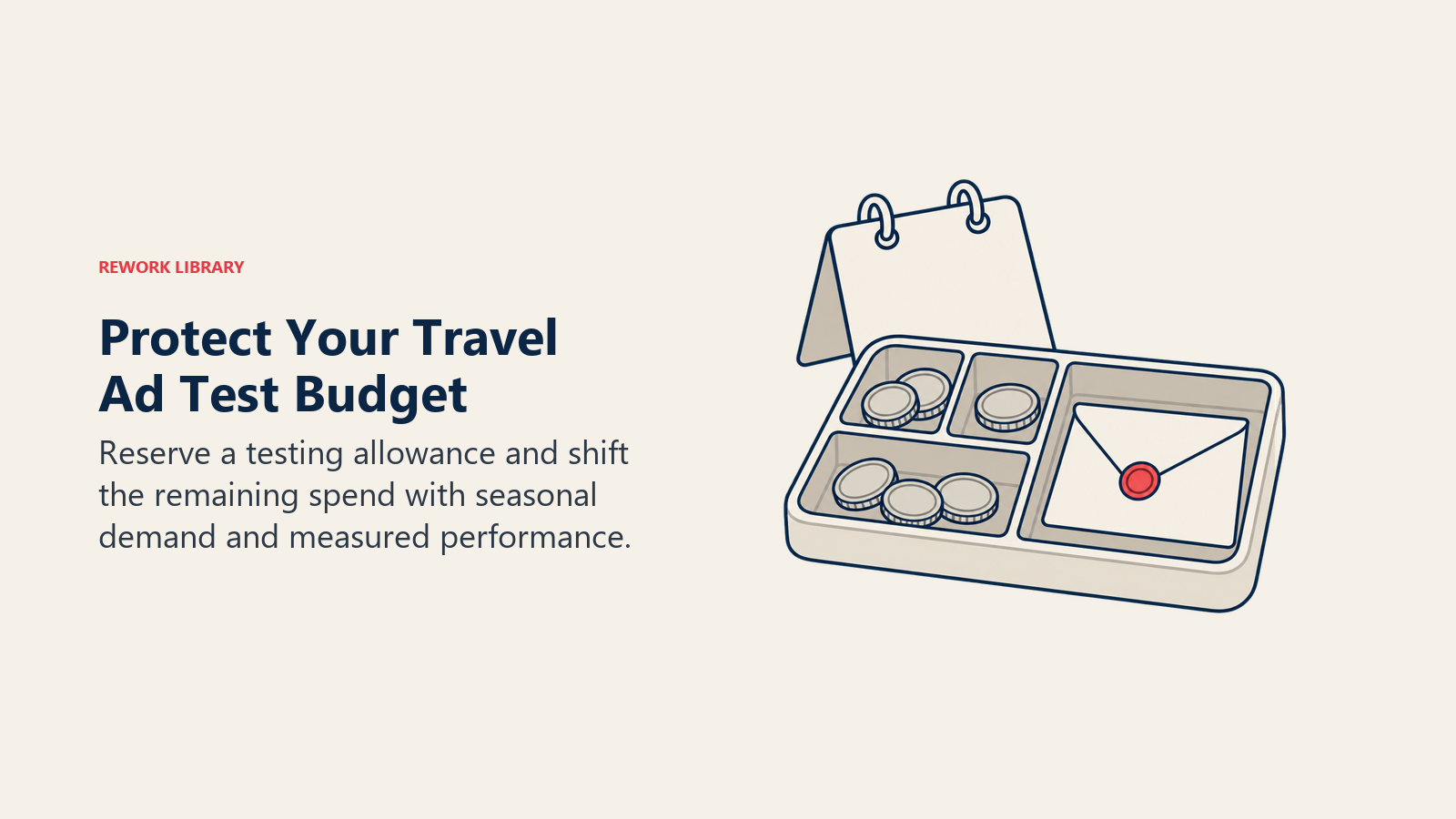
Channel mix by season should shift based on where your audience is during different buying phases. Q4 (October-December) is high-intent booking season for spring travel, allocate 45% to Google Search, 30% to retargeting, 25% to social. Q2 (April-June) is research phase for fall travel, shift to 30% Google Search, 35% social, 20% YouTube, 15% retargeting.
Testing budget allocation should be 10-15% of total spend, protected from performance pressure. Use this to test new channels (is TikTok viable for your audience?), new creative formats (do carousel ads outperform single image?), and new targeting strategies (do life event-based audiences convert?). Don't judge tests by immediate ROAS, evaluate whether they uncover scalable opportunities.
Performance threshold for scaling is straightforward: if a campaign achieves your target ROAS consistently for 30 days, increase budget by 20-30%. Monitor performance closely after scaling, often CPCs increase with higher budgets, which can erode ROAS. Scale gradually rather than doubling budget overnight.
Geographic prioritization focuses spending on highest-value markets. If 60% of your customers come from five metro areas, those markets should get 70-80% of geo-targeted budget. Don't spread budget evenly across all markets, concentrate where conversion data proves demand exists.
Measurement and Attribution
You can't optimize what you can't accurately measure.
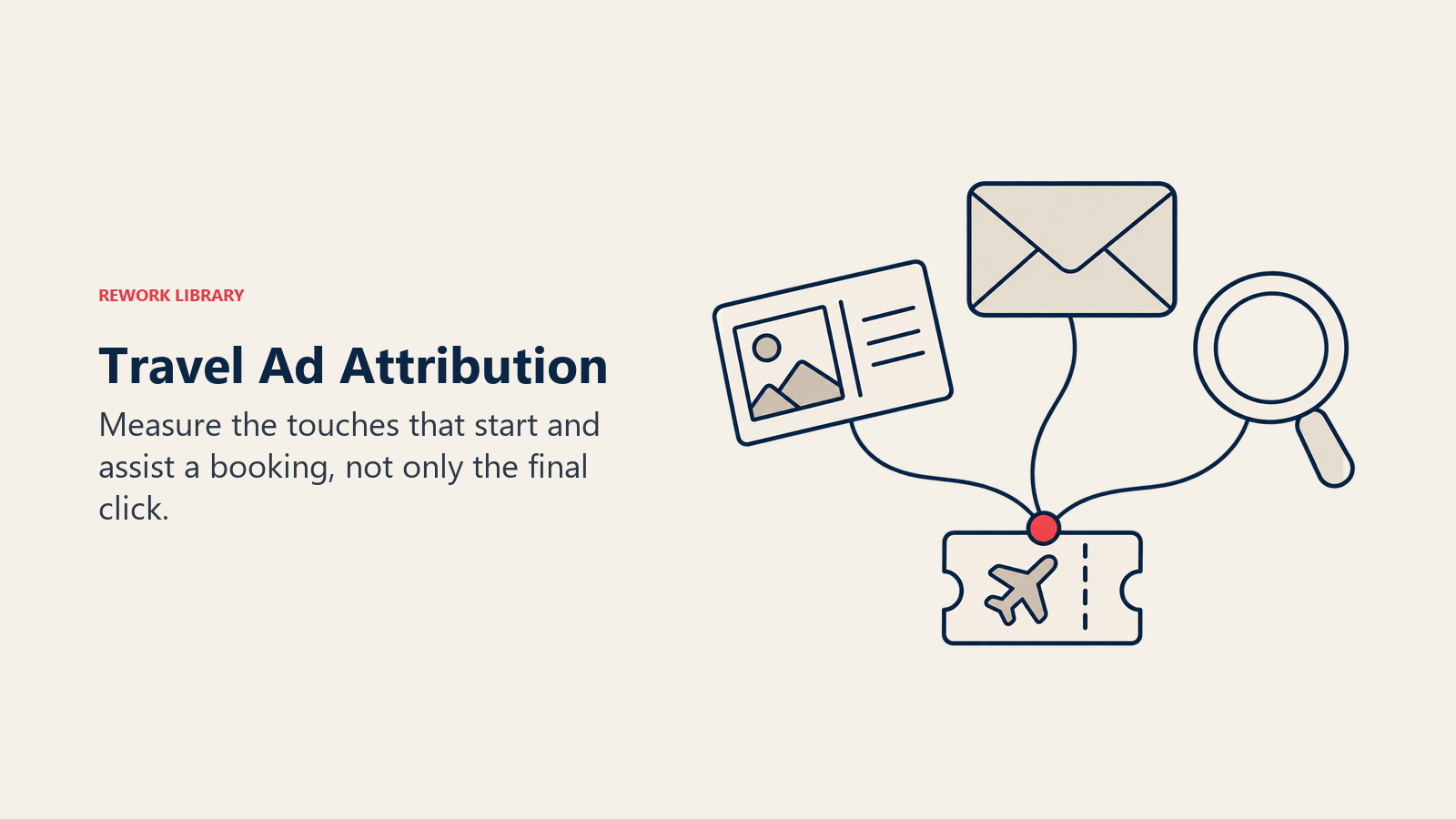
Multi-touch attribution models assign partial credit to each touchpoint in the customer journey. Someone might interact with your brand seven times before booking: Instagram ad → website visit → email signup → retargeting ad → website visit → cart abandonment → retargeting email → booking. Last-click attribution gives 100% credit to the final retargeting email. Linear attribution gives 14.3% credit to each touchpoint. Time-decay attribution gives more credit to later interactions. For travel's long buying cycle, position-based (U-shaped) attribution often works best, giving 40% credit to first and last touch, splitting 20% among middle interactions.
Assisted conversion tracking reveals which channels start journeys even if they don't close sales. Your Pinterest ads might have a terrible last-click ROAS but actually assist 30% of eventual conversions by introducing people to your brand. Google Analytics' Top Conversion Paths report shows these assisted journeys. Don't cut channels with poor last-click ROAS until you understand their assist value.
ROAS benchmarks by channel provide realistic targets. Google Search should achieve 4:1 to 6:1 ROAS. Facebook typically hits 3:1 to 5:1. Display and YouTube are 2:1 to 4:1. These are blended averages, bottom-funnel campaigns often exceed 8:1 while top-funnel might run at breakeven. The mix needs to average profitably, not every individual campaign.
Booking window analysis shows the lag between ad interaction and conversion. In travel, 60-70% of bookings happen 30-120 days after first ad click. Extend your conversion tracking windows to 90 days minimum so you're measuring actual performance rather than just immediate conversions. Monthly ROAS calculations should look back 90 days to capture the full impact of previous months' spending.
Advanced Tactics
These strategies separate sophisticated advertisers from beginners.
Weather-triggered campaigns activate when conditions favor booking. When a blizzard hits Chicago in January, automatically increase ad spend targeting Chicago residents with Caribbean beach vacation offers. Weather APIs can trigger bid adjustments or activate campaigns within hours of forecast changes. These contextual moments can increase conversion rates 40-60% because you're reaching people when desire peaks.
Event-based targeting capitalizes on known demand spikes. When a major sporting event or concert is announced for Barcelona, launch campaigns targeting people interested in that event with Barcelona tour packages. Conference attendees often extend business trips, target people registered for major conferences in your destination cities with pre- or post-conference vacation packages.
Competitive conquest strategies target people researching your competitors. Bid on competitor brand names (where legally permissible) and create ads highlighting your differentiation. "Considering [Competitor]? We include more meals and fewer hidden fees." This works best when you can credibly claim superior value or different positioning.
Dynamic pricing integration syncs ad creative with your actual pricing. When you run a flash sale reducing prices 20%, your ads automatically update to reflect the new price and display urgency messaging. When inventory is low for popular dates, ads highlight scarcity. This requires API integration between your booking system and ad platforms but dramatically improves relevance. Learn more about dynamic pricing in travel strategies.
Conclusion
Travel advertising fails when you import strategies from e-commerce or SaaS without adapting for the unique buying behavior of people planning vacations. Long consideration cycles, high abandonment rates, and seasonal volatility aren't problems to solve, they're realities to plan around.
Success comes from matching channel strategy to funnel stages, building attribution models that capture multi-touch journeys, and allocating budgets to seasonal demand patterns rather than spreading evenly across the year. Your creative should prioritize user-generated authenticity over polished perfection, and your optimization should measure 90-day ROAS rather than last-click conversions.
The operators who master travel-specific paid advertising don't just generate more leads, they generate better leads at lower costs because they're reaching people at the right moment in their buying journey.
Related Articles: