Travel Win-Back Campaigns - Lapsed Customer Reactivation 2025
Turn this article into takeaways for your work.


Each assistant summarizes the article only for you and suggests best practices for your work.
Someone booked a trip with you two years ago. They had a great time. They said they'd definitely travel with you again. And then... nothing.
They're not angry. They didn't switch to a competitor. Life just happened, and they drifted away.
You have hundreds or thousands of customers like this in your travel CRM. People who've already said yes once, who know your quality, and who could book again if you gave them the right reason at the right time through customer segmentation.
Win-back campaigns target these lapsed customers and turn dormant relationships into active ones. Done well through email marketing automation, they're one of the most cost-effective ways to drive revenue.
This guide shows you how to identify lapsed customers, understand why they left, design compelling reactivation campaigns, and measure success.
Win-Back Campaign Strategy
Win-back is about economics. Reactivating a lapsed customer typically costs 3x less than acquiring a brand new one.
You've already overcome the biggest hurdle: initial trust. They know your brand, they've experienced your service, and they've handed you money before. That's valuable.
Define lapsed customer segments by time since last trip. Twelve months inactive might be early-stage lapsed, they're still aware of you, still interested in travel, just haven't booked recently. Twenty-four months inactive is mid-stage lapsed, they've likely traveled elsewhere or stopped traveling. Thirty-six months or more is late-stage lapsed, the relationship is cold.
Calculate win-back campaign ROI using this formula: (recovered customers × average booking value × gross margin) - campaign costs. If you recover 50 customers at $3,000 average with 30% margins through a $5,000 campaign, you've generated $45,000 in gross profit for a 9x return.
Target response rates vary by segment. Early-stage lapsed customers might reactivate at 8-15% rates with good campaigns. Mid-stage drops to 3-8%. Late-stage is often under 3%. Know your benchmarks and measure against them.
Prioritize high-CLV lapsed customers for reactivation. Someone who booked five trips totaling $25,000 deserves more effort than someone who booked one $1,500 trip. Calculate lifetime value and segment accordingly.
Set realistic reactivation targets. If you have 500 twelve-month lapsed customers, a 10% reactivation rate means 50 recovered bookings. Run the numbers and know what success looks like.
Budget for multiple touches. One email won't cut it. Plan for 3-5 campaign touches across multiple channels, each with associated costs.
The foundation: win-back campaigns are strategic investments in proven customers, not desperate discounting to anyone who'll take it.
Identifying Lapsed Customers
You can't win back customers if you don't know who's lapsed.
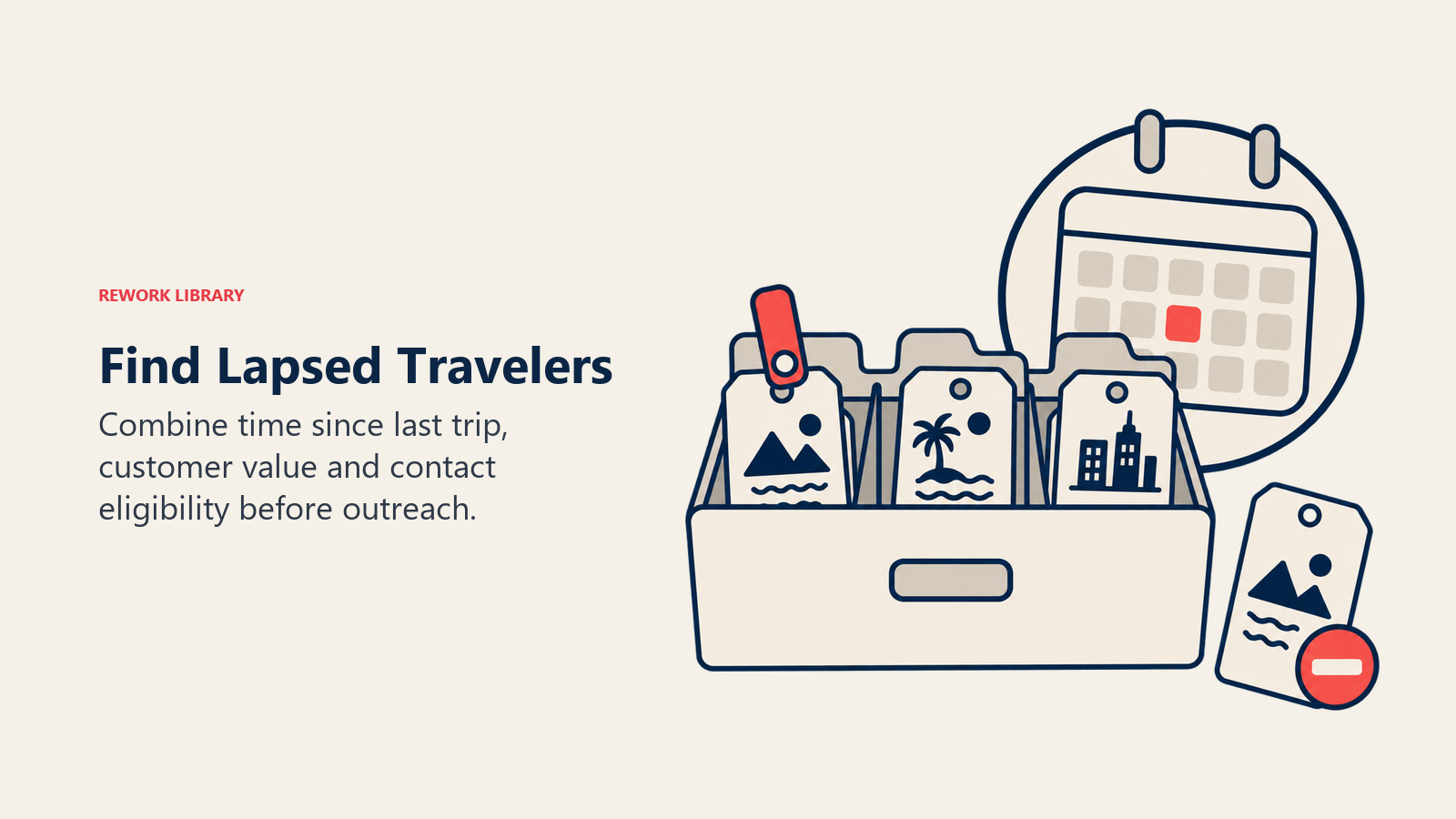
Segment by time since last trip and historical value. Create categories: 12-month lapsed (early), 24-month lapsed (mid), 36+ month lapsed (late). Within each, separate high-value from low-value customers.
Analyze pre-lapse behavior for warning signs. Did engagement decline before they stopped booking? Did they skip usual travel windows? Did email opens drop off? Understanding patterns helps you prevent future churn.
Identify reason for lapse if known. Check your records: did they complain about something? Did they mention life changes? Did they request different trip types you don't offer? Known reasons enable targeted messaging.
Create lapsed customer stages for targeted campaigns. Recent lapsed get gentle "we miss you" outreach. Mid-stage lapsed get stronger incentives. Long-term lapsed need compelling reasons to reconsider.
Build queries in your CRM: "Customers with last trip date 12-18 months ago, lifetime value over $5,000, no open bookings." These become your target lists.
Exclude people who shouldn't be in win-back campaigns. Someone who complained bitterly and you couldn't resolve. Someone who moved to a location where your trips aren't viable. Someone who explicitly unsubscribed with "never contact me again." Respect those signals.
Tag lapsed customers in your system. "Lapsed-12mo-high-value" or "Lapsed-24mo-mid-value" enables easy segmentation and campaign targeting.
Monitor customers approaching lapsed status. If someone typically books annually and it's been 11 months, they're not lapsed yet but they're at risk. Trigger retention campaigns before they fully lapse.
The goal is identifying exactly who to target, when to target them, and with what level of effort.
Understanding Churn Reasons
You can't solve a problem you don't understand.
Survey lapsed customers directly through guest feedback collection to understand departure reasons. Keep it short: "We noticed you haven't traveled with us recently. We'd love to know why. [Multiple choice options plus open text]" Offer a small incentive for completion.
Categorize churn causes into buckets: price/value concerns, life circumstances (kids, job changes, budget), competitive alternatives, service dissatisfaction, simply stopped traveling, or forgot about you through post-trip engagement.
Identify addressable versus non-addressable churn factors. If someone stopped traveling entirely due to health issues, you probably can't solve that. If someone thinks your trips are too expensive for the value, that's addressable through better communication or different offerings.
Life circumstances cause much travel churn. New baby. Job loss. Parent care responsibilities. Divorce. House purchase. These temporarily or permanently change travel behavior. Understanding which customers are in which situation helps you approach them appropriately.
Price sensitivity shows up in patterns. If customers lapse right after booking lower-priced trips, they might have affordability concerns. If they lapse after premium trips, price probably isn't the issue.
Competitive loss happens when customers explicitly book with other companies. Sometimes you'll know this from their social media or from mutual connections. It tells you they're still traveling, just not with you.
Dissatisfaction churn comes from negative experiences. Check their post-trip surveys, customer service interactions, and feedback. If someone had problems you didn't fully resolve, that's likely why they left.
Simple attrition, people who had good experiences but just drifted away, is actually your best opportunity. They don't have negative associations. They just need a reason to return.
Use insights to prevent future churn. If 40% of lapsed customers mention price, you have a value communication problem. If 30% mention life changes you could accommodate with shorter trips, develop those products.
Win-Back Offer Design
Your offer needs to overcome whatever barrier prevented them from booking again.
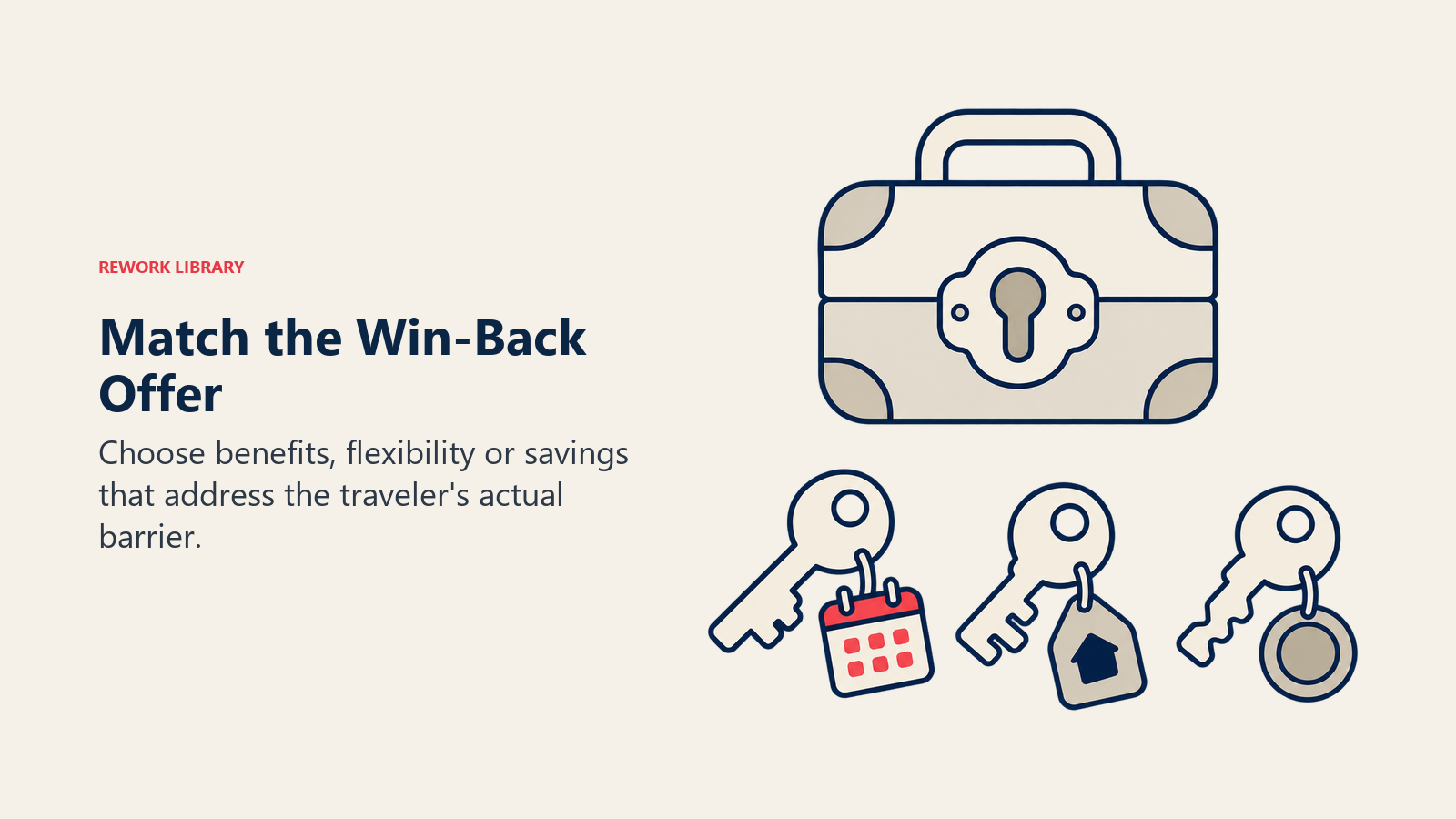
Create compelling reactivation incentives in the 20-30% off range. This is more aggressive than general promotional pricing because you're solving for lapsed status specifically. "Welcome back. Here's 25% off your next trip."
Offer welcome-back bonuses and upgrades beyond just price discounts. Complimentary airport transfers. Room upgrades. Extra inclusions. Added experiences. Sometimes value-adds work better than pure discounts.
Design limited-time urgency in offers. "This welcome-back offer expires in 10 days." Or "Book by March 15 to get your 25% returning customer discount." Deadlines create action.
Balance discount depth with profitability. A 30% discount that fills a trip you need to fill anyway is worth it. A 30% discount that kills your margin on a trip that would have sold anyway isn't. Know your inventory situation.
Test different offer types with different segments. High-value lapsed customers might respond better to exclusive experiences than to discounts. Budget-conscious customers need clear price savings.
Consider deposit-only offers to lower commitment threshold. "Secure your spot with just $200 deposit and get 20% off." Easier than committing to full payment immediately.
Create offers that address known barriers. If someone lapsed because they couldn't find trips that fit their schedule, offer flexible booking. If price was the issue, offer payment plans alongside discounts.
Package offers with guarantees. "Book now with our satisfaction guarantee. If you don't love it, we'll refund the difference." Removes risk.
Frame discounts as recognition: "As a past traveler, you qualify for our 25% returning customer rate on these trips." It's not desperation; it's appreciation.
The right offer depends on knowing your customer, their lapse reason, and what will motivate them specifically.
Segmented Win-Back Messaging
One message for all lapsed customers is lazy and ineffective.
Personalize win-back messages based on past trip history stored in travel CRM. Reference their specific trip: "We remember how much you loved exploring the temples of Angkor Wat in 2023. We'd love to help you plan your next adventure through our loyalty program."
Acknowledge time elapsed appropriately. For 12-month lapsed: "It's been about a year since your Peru trip." For 36-month lapsed: "It's been a while since we've had the pleasure of planning your travel through our repeat booking program."
Address known barriers or concerns directly. If they mentioned budget in a past survey, acknowledge it: "We know value matters. Here's an exclusive offer that makes your next trip more affordable."
Highlight what's new since their last trip. New destinations, improved services, better pricing, new trip types. Give them reasons to reconsider even if they were happy before.
Use different tones for different segments. Adventure seekers get energetic, exciting copy. Luxury travelers get sophisticated, exclusive messaging. Family travelers get practical, value-focused language.
Create curiosity-driven subject lines. "Sarah, this caught our eye for you..." or "Remember how much you loved Vietnam? You need to see this." Personal and intriguing.
Test emotional versus rational appeals. Emotional: "We miss planning your adventures." Rational: "Here's 25% off your next trip, but only through Friday." Both can work for different audiences.
Include social proof relevant to them. "175 past travelers have returned this year to explore new destinations with us." Shows others are coming back.
The principle: win-back messages should feel personally crafted, acknowledge the relationship history, and provide compelling reasons to return.
Multi-Channel Win-Back Campaigns
Email is primary, but it shouldn't be your only channel.
Use email marketing as your main win-back channel because it's cost-effective and allows detailed messaging. But recognize that inbox competition is fierce and many people won't open.
Implement retargeting ads through paid advertising for lapsed customers. Upload your lapsed customer email list to Facebook and Google. Show them ads specifically crafted for win-back through social media marketing. This catches people who don't open emails.
Try direct mail for high-value lapsed VIPs. A physical postcard or letter stands out when everyone else is digital. It signals that they're important enough for you to spend money reaching them.
Test SMS for time-sensitive reactivation offers. "Hi Tom, we're holding two spots on our Iceland trip just for past travelers. 25% off if you book this week. Reply YES for details." High open rates, immediate response.
Coordinate timing across channels. Email on Monday. Retargeting ads start Tuesday. SMS on Thursday. Direct mail arriving mid-week. Multiple touchpoints increase probability of response.
Use different messages on different channels. Email carries detailed offer information and emotional appeal. Retargeting ads show beautiful imagery and simple offers. SMS delivers urgency and ease of response.
Track channel performance separately. Which channel drives the most reactivations? Which has the best ROI? Adjust spend accordingly.
Consider phone outreach for highest-value lapsed customers. Personal call from a real person: "Hi Jennifer, I noticed it's been about two years since your last trip with us. I wanted to reach out personally and see if we can help plan something for you this year."
Multi-channel doesn't mean spam everywhere. It means strategic use of different channels to reach people where they're most receptive.
Win-Back Campaign Sequences
One email gets ignored. Sequences get results.
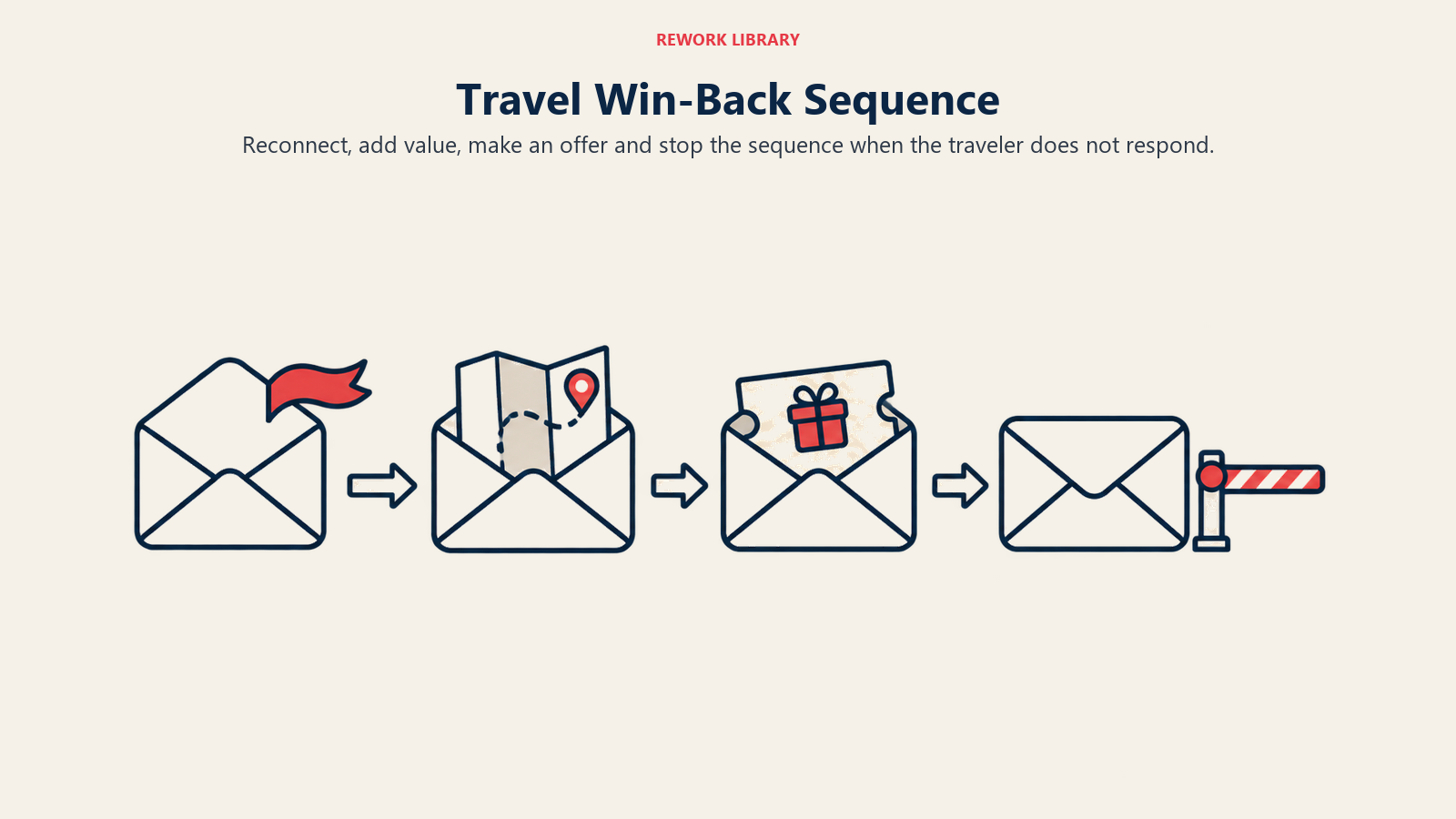
Design 3-5 touch campaign sequences over 2-4 weeks. Touch 1: "We miss you" gentle reconnection. Touch 2: Value proposition and what's new. Touch 3: Specific offer with urgency. Touch 4: Last chance reminder. Optional Touch 5: Final offer before suppression.
Start with gentle reconnection messages before hitting them with offers. "It's been a while since we've seen you. We wanted to check in and let you know about some exciting new trips we think you'd love."
Escalate offers through the sequence. Touch 1 might be 15% off. Touch 3 could be 25% off. Touch 5 might add additional bonuses. Increasing incentives reward people who were on the fence.
Vary messaging and angles across the sequence. Touch 1 is emotional reconnection. Touch 2 is value and new offerings. Touch 3 is limited-time deal. Touch 4 is urgency and scarcity. Different people respond to different triggers.
Test different sequence lengths. Some customers convert on touch 1. Others need all five touches. Track conversion by touch to understand your audience.
Include educational content in the sequence, not just offers. Touch 2 could be a destination guide for places they've expressed interest in. Touch 3 could feature customer stories from trips they'd enjoy. Provide value beyond discounts.
Time touches appropriately. 3-5 days between emails prevents fatigue while maintaining momentum. Too fast feels spammy. Too slow loses urgency.
Know when to suppress non-responders. After 5 touches over three weeks with no opens, no clicks, no response, move them out of active campaigns. You can try again in 6-12 months, but continuing weekly isn't productive.
Automate sequences for scale, but personalize key elements. Automated workflow handles sending and timing. Personalization includes names, past trip references, and segment-appropriate offers.
Addressing Past Issues
If someone left because of a problem, you need to acknowledge it.
Check their history for negative experiences. Low post-trip survey scores, customer service complaints, refund requests, negative reviews. These are red flags that require different handling.
Acknowledge if their previous trip had problems. "We know your 2023 trip didn't meet expectations. We've made significant improvements to that experience and would love the opportunity to show you what we've changed."
Demonstrate improvements made since their last experience. New guides, better accommodations, improved itineraries, enhanced support systems. Specific changes matter more than vague promises.
Offer service recovery gestures where appropriate. If they had a genuinely bad experience, consider offering more than a standard discount. Complimentary upgrade, significant price reduction, or even a complimentary short trip to rebuild trust.
Rebuild trust through transparent communication. Don't pretend problems didn't happen. Don't make excuses. Acknowledge issues, explain what you've done about them, and demonstrate commitment to better experiences.
Sometimes the right approach is a direct apology. "We're sorry we didn't deliver the experience you deserved. Here's what we've changed, and we'd be honored if you'd give us another opportunity to serve you."
Be realistic about unrecoverable relationships. If someone had a truly terrible experience and you couldn't make it right, they might not come back regardless of offers. Don't waste resources on impossible conversions.
Focus recovery efforts on situations where you can genuinely deliver better experiences now. If you haven't actually fixed the underlying problems, win-back campaigns will just create more disappointed customers.
The principle: you can't rebuild relationships without acknowledging what broke them.
Timing and Triggers
When you launch win-back campaigns matters enormously.
Launch win-back campaigns at 12, 18, and 24-month lapse milestones. These are natural points to check in. Before 12 months, they might not be truly lapsed. After 24 months, relationships are very cold.
Time campaigns seasonally when travel interest peaks. January (New Year planning), September (fall travel), and spring (summer trip booking) are strong travel planning periods. Launching win-back campaigns then catches people in planning mode.
Trigger win-backs based on life events or anniversaries. The anniversary of their trip with you is perfect timing: "It's been exactly one year since your amazing adventure in Costa Rica. Ready for your next one?"
Test optimal campaign timing through A/B tests. Does Monday morning perform better than Wednesday afternoon? Does weekend send timing work for your audience? Small timing changes can significantly impact open and response rates.
Consider customer booking cycles in your timing. If someone typically books trips in March for summer travel, start win-back outreach in February. Match your timing to their decision windows.
Use behavioral triggers beyond time-based sequences. If a lapsed customer visits your website, trigger immediate outreach: "We noticed you were checking out our Italy trips. As a past traveler, you qualify for 20% off..."
Time urgency appropriately in offers. A 7-day deadline creates action. A 60-day deadline doesn't. Match urgency windows to decision timelines.
Avoid bad timing. Don't send travel offers during obvious non-travel periods (December holidays for most people, tax season, back-to-school). Respect obvious "not now" times.
Coordinate win-back timing with other campaigns. Don't send win-back emails the same week you send regular promotional emails. Space them out.
The goal is reaching lapsed customers when they're most receptive and most able to act.
Measuring Win-Back Success
Win-back campaigns only matter if they drive profitable reactivations.
Track reactivation rate by segment and campaign. Of the 500 twelve-month lapsed customers you targeted, how many booked? Break this down by value tier, lapse stage, and campaign variation.
Calculate win-back customer CLV versus new customers. Do reactivated customers behave like first-time customers or like repeat customers? Often they're somewhere in between but closer to repeat customer value.
Measure time to second purchase after reactivation. If someone books again through your win-back campaign, how long until they book a third trip? You want to reactivate them into ongoing booking patterns, not just one additional transaction.
Track campaign costs versus incremental revenue. Include email platform costs, offer discounts, creative development, and staff time. Compare to revenue and profit generated.
Monitor which campaign elements drive results. Which subject lines get opened? Which offers get clicked? Which calls-to-action convert? Optimize based on data.
Measure channel effectiveness separately. Does email outperform retargeting ads? Is SMS worth the higher per-contact cost? Invest more in what works.
Test continuously. Run A/B tests on messaging, offers, timing, and channels. Every campaign should teach you something about what reactivates your specific lapsed customers.
Segment performance reporting. Win-back likely works better for some segments than others. High-value customers probably reactivate at higher rates. Understand these patterns.
Calculate customer retention rate post-reactivation. If you reactivate 100 customers, how many are still booking a year later? Two years later? True success is restoring ongoing relationships, not just one-time reactivations.
Set benchmarks and targets. If your current reactivation rate is 5%, target 7% next quarter. Continuous improvement matters more than one-time wins.
Building Win-Back Systems
Win-back can't be manual if you want it to scale.
Create automated workflows in your CRM that identify lapsed customers at set intervals (12, 18, 24 months) and trigger campaign sequences automatically.
Build campaign templates that can be quickly customized for different segments. You don't need to reinvent the wheel every time you run win-back campaigns.
Establish clear processes: who owns win-back? When do campaigns run? What approval is needed for offers? Who monitors results? Document this.
Set up reporting dashboards that show lapsed customer counts, campaign performance, and reactivation trends. Make metrics visible.
Create a content library of win-back email templates, ad creative, and messaging frameworks. Build on what works rather than starting from scratch each time.
Train your team on win-back principles. Everyone should understand the value of reactivation and how to handle reactivated customers appropriately.
Budget for win-back as a consistent program, not occasional campaigns. Monthly or quarterly win-back initiatives outperform sporadic efforts.
Integrate win-back data with your broader customer analytics. How do reactivated customers perform compared to acquired customers? Use this to inform budget allocation between acquisition and retention.
The businesses that excel at win-back treat it as a systematic program with dedicated resources, not an afterthought when new acquisition gets expensive.
Making Win-Back Work
Win-back campaigns work when you focus on the right customers with the right messages at the right time.
Start by segmenting your lapsed customers. Prioritize high-value recent lapsed customers for your first campaigns. They're easiest to reactivate and most valuable when you do.
Design compelling offers that address actual barriers. Test different approaches and measure what works.
Build automated campaign sequences that reach lapsed customers consistently, not just when you remember.
Measure ruthlessly. Track reactivation rates, campaign ROI, and long-term retention of reactivated customers.
Remember that win-back is about rebuilding relationships, not extracting one more transaction. Reactivated customers who return to regular booking patterns are exponentially more valuable than one-time responders.
The customers who've already said yes once are often your highest-probability prospects. They're also far cheaper to convert than strangers who've never heard of you.
Build systematic win-back programs that keep these relationships alive, and you'll drive sustainable growth while reducing reliance on expensive new customer acquisition.
Related Resources

Business Consultant
On this page
- Win-Back Campaign Strategy
- Identifying Lapsed Customers
- Understanding Churn Reasons
- Win-Back Offer Design
- Segmented Win-Back Messaging
- Multi-Channel Win-Back Campaigns
- Win-Back Campaign Sequences
- Addressing Past Issues
- Timing and Triggers
- Measuring Win-Back Success
- Building Win-Back Systems
- Making Win-Back Work
- Related Resources