Direct Booking Strategy: Reduce OTA Dependence and Maximize Margins
Turn this article into takeaways for your work.


Each assistant summarizes the article only for you and suggests best practices for your work.
Your profit margin is bleeding out through OTA commissions. Every booking that comes through Expedia, Booking.com, or Airbnb costs you 15-25% of the revenue. For a $200 hotel room, that's $30-50 you'll never see. Scale that across thousands of bookings, and you're looking at hundreds of thousands, sometimes millions, in lost revenue every year.
But the commission is just the beginning. You're also losing something more valuable: customer data, direct relationships, and the ability to build lifetime value. When guests book through OTAs, they're the OTA's customers, not yours.
Direct Booking Economics
The math is brutal. A typical mid-sized hotel with 100 rooms and 70% occupancy generates about $5.1 million annually at an average daily rate of $200. If 60% of those bookings come through OTAs at an average 18% commission, you're paying $550,000 in fees every year. Understanding travel business economics reveals why commission reduction is critical to profitability.
Shift just half of those OTA bookings to direct, and you save $275,000 annually. That's not revenue, that's pure margin improvement.
And the benefits compound. Direct bookers spend 12-15% more per visit because you can upsell them on room upgrades, spa packages, and dining experiences. They also return 2.3 times more frequently than OTA customers because you own the relationship and can market to them directly. Maximizing customer lifetime value in travel requires owning the customer relationship.
Customer data ownership changes everything. When someone books direct, you capture their email, preferences, travel patterns, and spending behavior. You can segment them through effective travel customer segmentation and build loyalty programs that drive repeat bookings. With OTA customers, you get none of this.
The true cost of OTA dependence extends beyond commissions. You're funding their marketing machine while your brand becomes invisible. Customers search for "hotels in Miami" and see Booking.com, not your property. You're training the market to shop on price comparison platforms rather than seek out your unique value.
Strategic Pillars of Direct Booking Success
Building a strong direct channel requires four foundational elements working in concert.
Rate parity management is non-negotiable. OTAs have sophisticated monitoring systems that detect rate disparities within hours. Violate parity agreements, and you risk losing visibility or getting kicked off the platform entirely. The solution isn't undercutting OTAs on price, it's adding value that doesn't trigger parity violations. Think free breakfast, late checkout, room upgrades, or resort credits available only on direct bookings.
Value differentiation separates you from the commodity pricing game. Your direct channel should offer something OTAs can't match. Marriott Bonvoy points only accrue on direct bookings. Hilton offers free WiFi exclusively to members booking direct. These perks don't violate rate parity, but they shift the value equation decisively in favor of direct bookings.
Brand investment builds the trust that converts browsers into bookers. People book through OTAs partly because they trust the platform more than individual properties. You need to close that trust gap through consistent brand presence, strong review management, transparent pricing, and exceptional post-booking communication. Your brand must become as recognizable and trustworthy as the OTA itself.
Technology infrastructure determines whether you can compete. Your booking engine optimization must deliver experiences as fast and intuitive as the OTAs. Real-time availability, dynamic pricing, one-click booking, and instant confirmation are table stakes. If your website makes booking difficult, customers will return to OTAs regardless of perks you offer.
Channel Shift Tactics
Moving customers from OTAs to direct bookings requires deliberate tactics that change decision-making behavior.
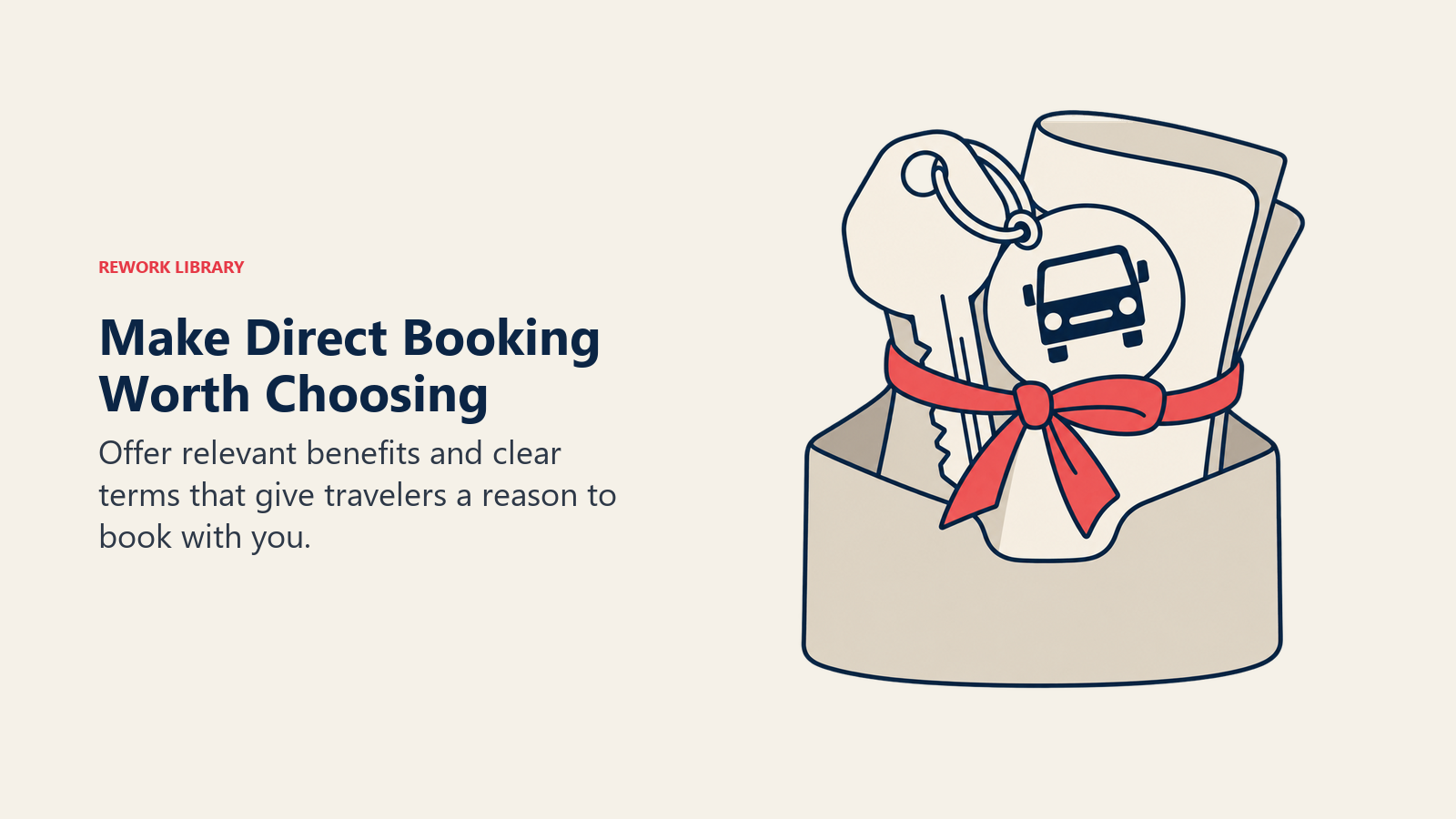
Best Rate Guarantee programs work when executed properly. The promise is simple: find a lower rate elsewhere within 24 hours, and we'll match it and give you an additional 10% discount or credit. This neutralizes the price comparison behavior that drives OTA usage. But the guarantee must be legitimate and easy to claim, or it becomes an empty promise that damages trust.
Direct-only perks create tangible reasons to bypass OTAs. Free airport transfers, complimentary room upgrades, early check-in, late checkout, spa credits, dining vouchers, these add-ons cost you far less than OTA commissions but feel substantial to customers. A $40 airport transfer costs you maybe $25, but saves a $36 commission on a $200 booking while enhancing the guest experience.
Member-exclusive pricing sidesteps rate parity by creating a qualification barrier. Joining your free loyalty program unlocks rates 5-10% below public pricing. This isn't a parity violation because it requires membership. The OTA can't offer the same rate because they can't replicate your membership program.
Flexible cancellation policies remove booking friction. OTAs often promote their cancellation flexibility as a key selling point. Match or beat their policies on direct bookings. Free cancellation up to 48 hours before arrival removes the "what if" hesitation that pushes uncertain travelers toward OTAs.
Price match with added value combines rate protection with differentiation. If you're matching OTA rates anyway through Best Rate Guarantees, proactively add value that OTAs can't match. Same price as Booking.com, but with free breakfast and a room upgrade. That's a winning proposition.
Marketing Mix for Direct Traffic
Driving traffic to your direct booking engine requires a coordinated marketing approach across multiple channels. Strategic travel lead generation captures high-intent travelers before they reach OTA platforms.
SEO for high-intent keywords captures demand before it reaches OTAs. When someone searches "boutique hotel Nashville downtown," they're ready to book. If you rank first for that query, you intercept the booking before they see OTA listings. Effective travel SEO optimization focuses on location plus property type, location plus amenities, and brand name queries. These convert at 15-20% compared to 2-3% for broader awareness terms.
Brand search optimization protects your name from OTA poaching. OTAs bid on your brand keywords in paid search, capturing customers specifically looking for you. Defend your brand with paid search campaigns that ensure your direct booking link appears first when someone searches your property name. Yes, you're paying for clicks you might get organically, but it's cheaper than losing the booking to an OTA.
Retargeting strategies bring back browsers who didn't book. Someone who viewed your property page but left without booking is a hot lead. Retarget them across social media and display networks with specific messaging: "Still thinking about your Miami getaway? Book direct and get free breakfast." These campaigns convert at 8-12% because you're reaching people who've already shown strong intent.
Email marketing to past guests drives repeat bookings at near-zero acquisition cost. Someone who stayed with you once is 5-7 times more likely to book again than a cold prospect. Effective email marketing for travel leverages seasonal promotions, anniversary offers, and local event tie-ins. "Coming back to Seattle for the food festival? Book now and save 20%." This only works if you've captured their email through direct bookings, another reason OTA dependence is costly.
Social proof and review leverage builds trust that competes with OTA platforms. Display your TripAdvisor rating, Google reviews, and guest testimonials prominently on your booking pages. Video testimonials are particularly effective, a 90-second clip of a happy couple talking about their anniversary stay builds more trust than a dozen written reviews.
Website Conversion Optimization
Getting traffic to your site means nothing if your booking engine doesn't convert. Comprehensive website conversion for travel optimization turns visitors into confirmed bookings.
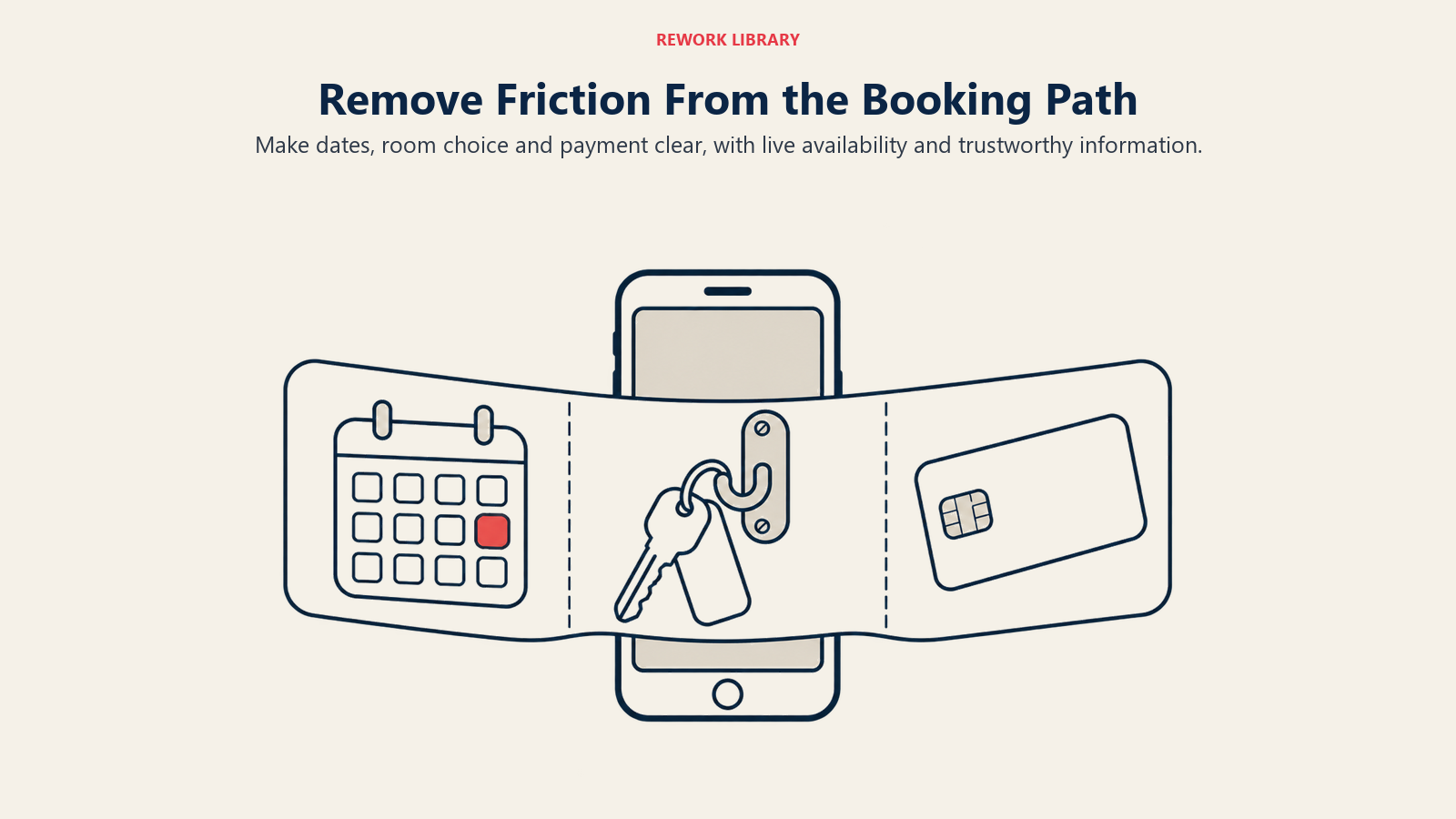
Booking engine UX requirements start with speed. Your booking flow should complete in three clicks: select dates, choose room type, enter payment. Every additional step drops conversion by 10-15%. Real-time rate updating without page refreshes keeps users engaged. Multi-currency display and language options expand your addressable market.
Trust signals and social proof need to saturate the booking path. Display security badges, SSL certificates, and verified payment icons. Show recent bookings ("Sarah from Toronto just booked this room") to create urgency through social proof. Include property photos, amenity lists, and room layouts so users don't need to leave your site to research details.
Mobile-first design isn't optional. Over 60% of travel research happens on mobile devices, and 40% of bookings now come from phones. Implementing mobile booking optimization with thumb-optimized interfaces ensures you don't lose half your potential bookings.
Real-time availability display eliminates uncertainty. Show exactly which room types are available for selected dates with live inventory updates. Nothing kills conversions faster than selecting a room, entering details, and then discovering it's sold out. OTAs excel at this, your system must match their transparency.
Measurement Framework
You can't manage what you don't measure. Track these metrics to guide your direct booking strategy.
Direct booking ratio is your primary KPI. Calculate total direct bookings divided by total bookings across all channels. Industry benchmark for hotels is 40-50% direct. Above 60% means you've built serious independence from OTAs. Below 30% means you're dangerously dependent on third parties.
Channel attribution model reveals which marketing efforts drive direct bookings. Someone might discover you through Instagram, research reviews on TripAdvisor, compare prices on an OTA, and then book direct. Multi-touch attribution assigns credit across this journey rather than only crediting the final click. This prevents you from cutting marketing channels that assist conversions even if they don't close the booking.
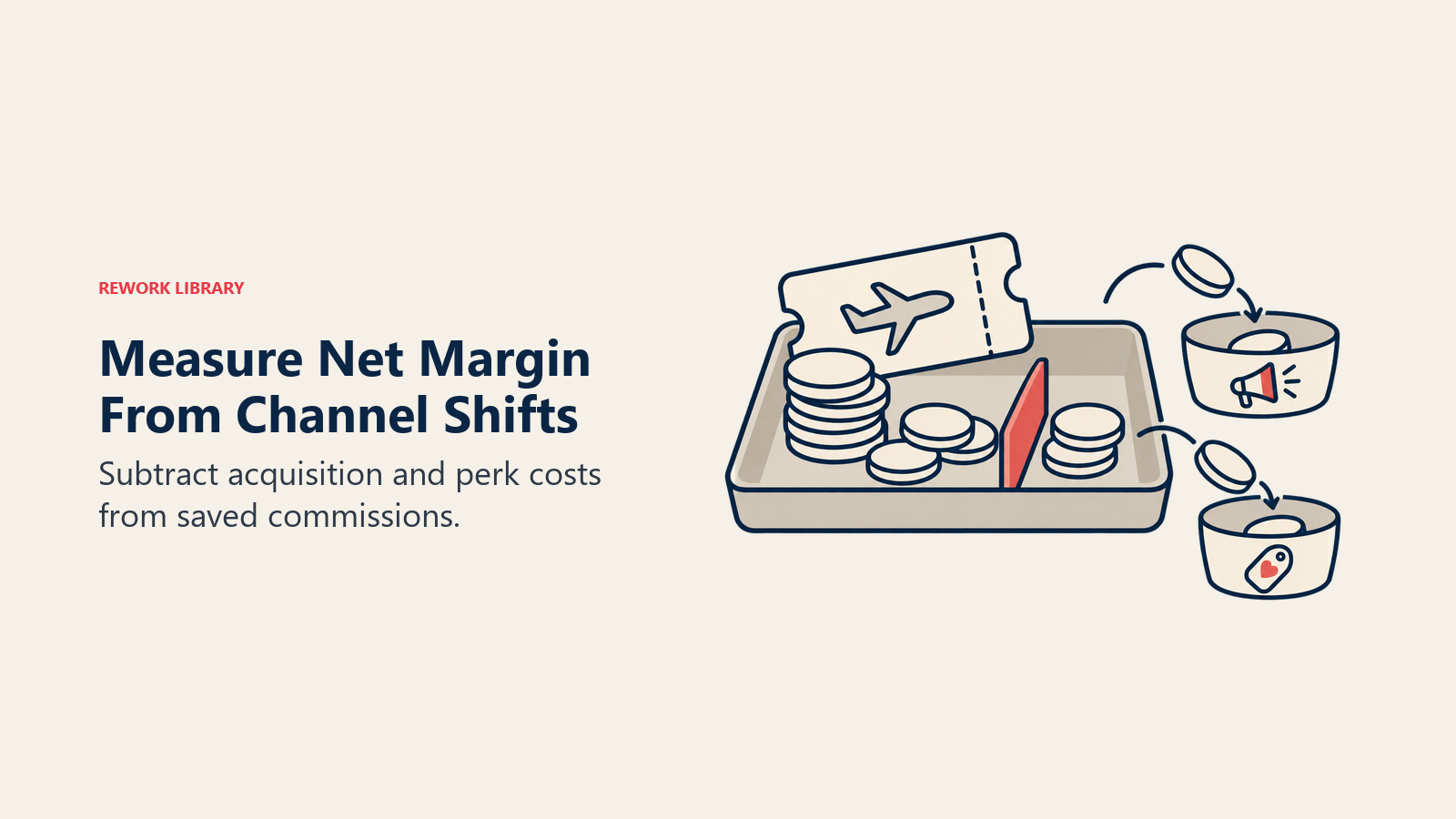
Incremental margin calculation shows the true profit impact of channel shifting. Take the commission saved on each direct booking and subtract the incremental marketing cost to acquire that customer directly. If OTA commissions are 18% and your direct customer acquisition cost is 8%, you're netting 10 points of margin improvement per booking.
Customer acquisition cost by channel quantifies efficiency. Divide total marketing spend per channel by bookings attributed to that channel. Your email campaigns might cost $2 per booking while paid search costs $45. This guides budget allocation toward highest-efficiency channels.
Implementation Roadmap
Here's a 90-day plan to materially increase direct bookings.
Days 1-30: Foundation
- Audit current booking engine UX and identify friction points
- Implement Best Rate Guarantee program with clear claiming process
- Create direct-only perks worth at least 50% of average OTA commission
- Set up retargeting pixels on property website through travel paid advertising channels
- Launch brand defense paid search campaigns
Days 31-60: Activation
- Begin SEO content creation targeting high-intent keywords
- Implement email capture pop-ups for site visitors
- Create member-exclusive rate tier
- Launch retargeting campaigns to recent site visitors
- A/B test booking engine layouts for conversion optimization
Days 61-90: Scaling
- Expand paid search to location plus amenity terms
- Launch email campaigns to past guests (if you have this data)
- Implement abandonment recovery in travel email sequences
- Add social proof elements throughout booking funnel
- Analyze channel attribution and shift budget to highest-performing sources
Case Studies
A 150-room boutique hotel chain in the Pacific Northwest was 72% dependent on OTAs in 2022. They implemented a comprehensive direct booking strategy including member-exclusive pricing (10% off for free loyalty program members), direct-only perks ($50 dining credit per stay), and aggressive retargeting.
Within 18 months, their direct booking ratio climbed to 58%. The shift represented $890,000 in annual commission savings. They reinvested 30% of those savings into brand marketing and booking engine improvements, creating a virtuous cycle. Their customer lifetime value increased 43% because they now owned the guest relationship and could execute repeat booking strategy campaigns effectively.
A safari tour operator in East Africa reduced OTA dependence from 65% to 38% in two years. Their key tactics: requiring email capture to access trip itineraries, offering 5% discounts for direct bookings paid in full upfront, and creating exclusive add-on experiences (private guide services, photography workshops) only available when booking direct. These high-margin add-ons offset the perceived risk of booking directly with a less-known brand.
Conclusion
OTA commissions are a tax on your profitability, paid to someone else's marketing machine. Building a strong direct booking channel isn't about abandoning OTAs entirely, they still provide valuable demand, especially for emerging properties. But letting them control 60-70% of your bookings means surrendering control of your business economics and customer relationships.
The path forward combines rate parity compliance with creative value differentiation, technology investments that match OTA user experience, and marketing tactics that intercept demand before it reaches third-party platforms. Every percentage point you shift from OTA to direct drops straight to your bottom line and strengthens your long-term competitive position.
Related Articles: