Travel Sales Team Performance - 2026 Complete Guide
Turn this article into takeaways for your work.


Each assistant summarizes the article only for you and suggests best practices for your work.
Your top travel agent books 18 trips monthly averaging $4,200 each tracked in travel KPI dashboard - $75,600 in monthly revenue. Your struggling agent books 4 trips averaging $2,800 - $11,200 monthly. Both work full-time with similar inquiry volumes through travel inquiry management. The 7x performance gap tracked via booking conversion metrics isn't talent. It's measurable behaviors: response speed using travel automation tools, product knowledge, consultative selling in travel approach, and follow-up consistency via travel CRM implementation.
Most travel agencies know some agents perform better than others. Few systematically measure the behaviors that drive performance, coach to improve them, or compensate to reward results. They tolerate wide performance variation and wonder why revenue is inconsistent.
The agencies scaling successfully treat sales performance like science, not art. They measure leading and lagging indicators, coach to specific gaps, and create compensation systems that align individual and company success.
Key Sales Performance Metrics
Bookings per agent per month is the primary output metric. Track total closed bookings by agent monthly and quarterly. Industry averages vary wildly by segment:
- FIT/custom travel: 3-8 bookings monthly
- Package tours: 15-30 bookings monthly
- Group travel specialists: 2-5 large groups quarterly
Compare each agent to team averages and personal trends. Are they improving or declining? How do they rank within the team?
Average booking value shows whether agents are selling up or down. Your luxury specialist should average $8,000-15,000 per booking. Your budget tour agent might average $2,500-3,500. Track this monthly.
If average booking value drops, investigate why. Are they discounting aggressively? Selling lower-tier products? Failing to upsell?
Conversion rates at each pipeline stage reveal sales effectiveness:
- Inquiry-to-quote: Should exceed 75%
- Quote-to-booking: Target 25-40% (varies by segment)
- Overall inquiry-to-booking: Target 20-30%
Low conversion at inquiry-to-quote suggests qualification or response speed issues. Low quote-to-booking indicates sales skill gaps or pricing problems.
Quote turnaround time directly impacts conversion. Agents responding within 4 hours convert significantly better than those taking 24+ hours. Track average and median turnaround time by agent.
Pipeline velocity measures how fast deals move through stages. Long stalls indicate indecision, lack of urgency, or poor qualification. Top performers move opportunities efficiently without being pushy.
Activity Metrics that Matter
Inquiries handled per agent shows workload distribution. Are inquiries assigned equitably? Is one agent drowning while another is underutilized? Track weekly and monthly inquiry volume by agent.
But volume without quality misleads. An agent might handle 60 inquiries monthly but only quote 25. Another handles 40 inquiries and quotes 35. The second is more effective.
Quotes sent tracks outbound proposals. This is a leading indicator of future bookings. If quote volume drops 30%, expect bookings to drop 2-4 weeks later. Monitor this closely to forecast revenue.
Separate first-time quotes from quote revisions. Excessive revisions suggest unclear initial communication or difficulty understanding customer needs.
Follow-up calls and emails made measures persistence. Most travel bookings require 5-8 touchpoints. Agents who give up after 2 contacts lose deals to more persistent competitors.
Track follow-up frequency by deal stage. Quotes should get follow-up within 2-3 days, then again at 7 days, 14 days, and 21 days. CRM should automate tracking and provide visibility.
Client meetings conducted (virtual or in-person) often correlate with higher-value bookings. Complex custom itineraries benefit from consultative conversations. Track meeting frequency for deals above certain thresholds.
Referrals generated by agent reveals customer satisfaction and advocacy. Your best agents don't just close deals. They create such good experiences that customers refer friends. Track referrals attributed to each agent's service.
Quality vs Quantity Balance
Volume (number of bookings) rewards activity. Agents who book 25 trips monthly generate more revenue than those booking 8 trips. But this metric alone can drive wrong behaviors - chasing quick easy sales instead of consulting on complex high-value trips.
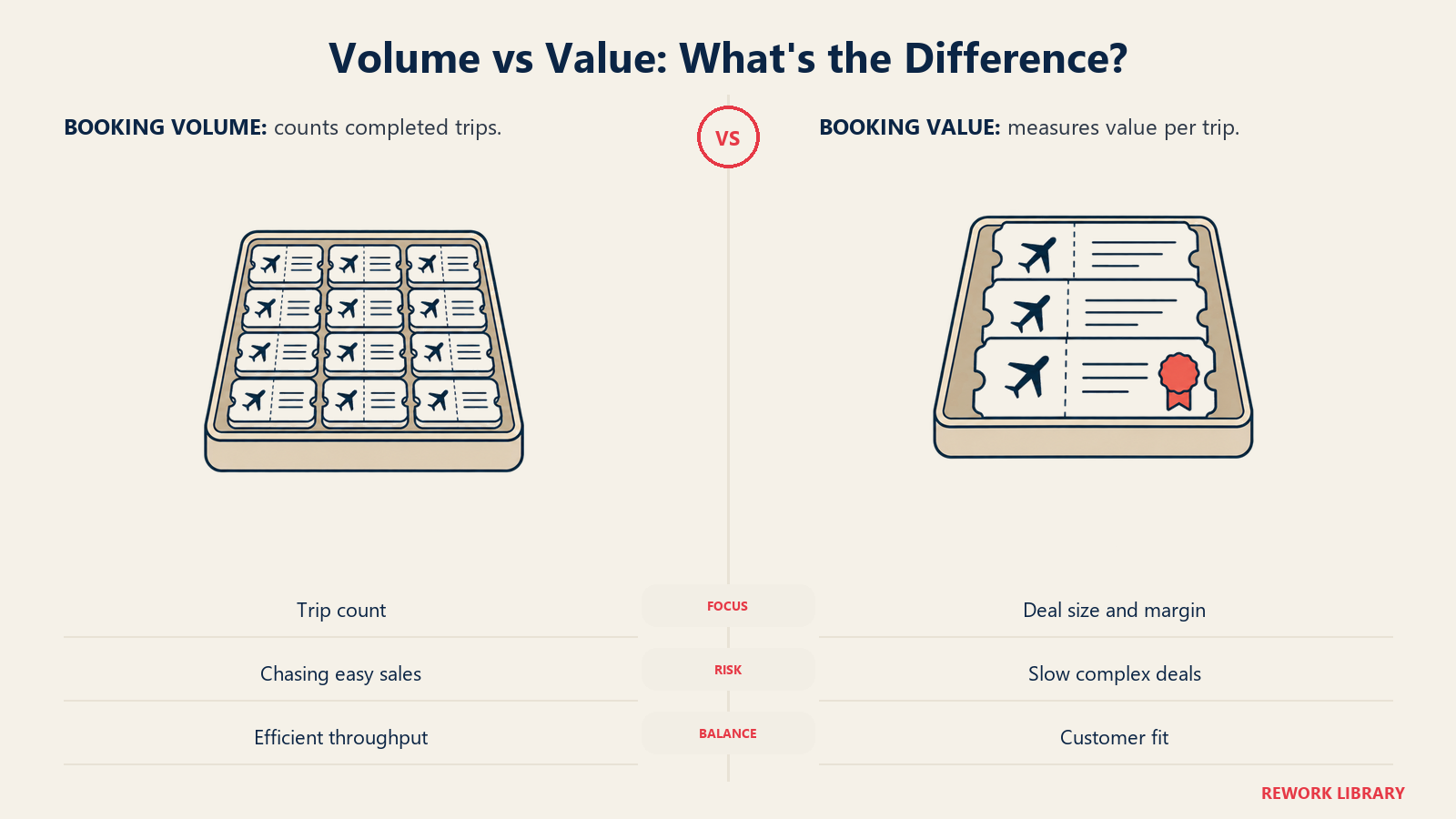
Value (average deal size and profit margin) rewards quality. An agent booking 8 trips at $8,500 average generates $68,000 monthly. An agent booking 25 trips at $2,400 average generates $60,000. The "slower" agent is more valuable.
Balance both in compensation and recognition. Weight bookings by value: small, medium, large, and enterprise tiers. Celebrate both volume achievements and high-value wins.
Quality indicators beyond deal size include:
- Customer satisfaction scores for bookings
- Modification and cancellation rates (excessive suggests poor fit)
- Upsell and cross-sell rates on bookings
- Margin percentage on bookings
Top performers excel at both volume and value. They efficiently qualify leads, close appropriate deals fast, and invest time in complex high-value opportunities without losing momentum on smaller deals.
Sales Leaderboards & Dashboards
Real-time leaderboards create visibility and friendly competition. Display monthly rankings by:
- Total bookings
- Revenue generated
- Conversion rate
- Average booking value
Update daily or weekly. Make data transparent. Top performers gain recognition. Struggling performers see the gap and can ask top performers for help.
But avoid purely competitive culture. Frame leaderboards as "How can we all improve?" not "Winner takes all." Celebrate everyone moving upward, not just the top spot.
Individual agent dashboards provide personal performance tracking. Each agent sees:
- Personal KPIs vs. targets
- Trend lines (improving or declining)
- Pipeline status (opportunities by stage)
- Recent wins and losses
Accessible via CRM or BI tool, these dashboards enable self-management and informed coaching conversations.
Team dashboards aggregate for management visibility:
- Total team bookings vs. target
- Individual agent performance distribution
- Conversion funnel health
- Activity levels and trends
Management reviews these daily to spot issues early and identify coaching needs.
Identifying Top Performers
Top 20% of agents typically generate 50-70% of revenue. They distinguish themselves through specific behaviors:
Product knowledge: They know destinations deeply. They can answer detailed questions without researching. They suggest relevant alternatives when customers ask about options. This comes from continuous learning, destination familiarization trips, and supplier relationship building.
Response speed: They reply to inquiries within 1-2 hours during business hours. They use mobile tools to respond while out of office. They set expectations clearly if they need time to research.
Consultative approach: They ask smart qualifying questions. They listen for unspoken needs. They recommend based on customer goals, not just what's easiest to sell. They educate rather than pitch.
Relationship building: They remember customer details. They follow up after trips. They maintain contact between bookings. They genuinely care about customer experiences.
Process discipline: They follow up systematically. They update CRM consistently. They use templates and tools effectively. They manage their pipeline actively.
Resilience: They don't get discouraged by rejections. They learn from losses. They maintain positive energy with customers.
Study your top performers systematically. What do they do differently? Document best practices and teach them to others.
Coaching for Improvement
Regular 1-on-1 meetings with each agent weekly or biweekly provide coaching opportunities. Review:
- Current pipeline status
- Recent wins and losses
- Performance metrics trends
- Skill development needs
- Support required
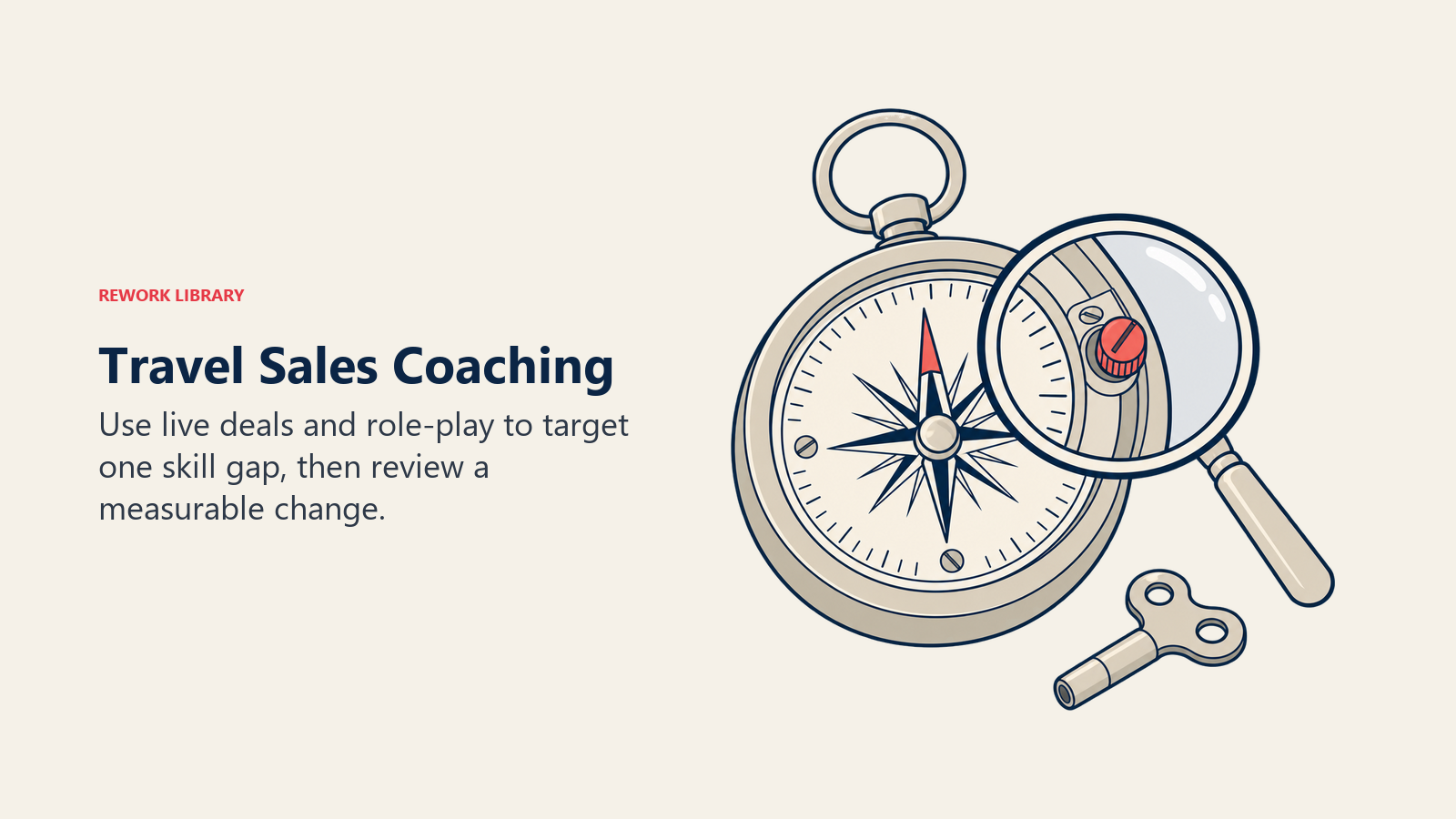
Keep meetings focused and action-oriented. Don't just review numbers - discuss how to improve them.
Pipeline reviews examine specific deals. For stuck opportunities, ask coaching questions:
- What's preventing this from moving forward?
- What objections or concerns do they have?
- What additional information do they need?
- How can we create urgency?
- Is this still a qualified opportunity?
This develops deal strategy thinking and unsticks stalled opportunities.
Deal coaching involves role-playing customer conversations. Practice:
- Handling price objections
- Qualifying questions for complex requests
- Upselling premium experiences
- Addressing concerns about specific destinations
- Closing techniques
Record calls (with permission) and review together identifying improvement areas.
Skill development plans target specific gaps. If an agent converts well but has low average booking value, focus on upselling and premium product knowledge. If they're great consultants but slow responders, work on time management and mobile tool usage.
Create monthly learning objectives tied to measurable outcomes. "This month, focus on upselling premium hotels. Goal: increase average booking value 12% by suggesting premium options on every quote."
Compensation Structure Design
Base salary vs. commission models have trade-offs:
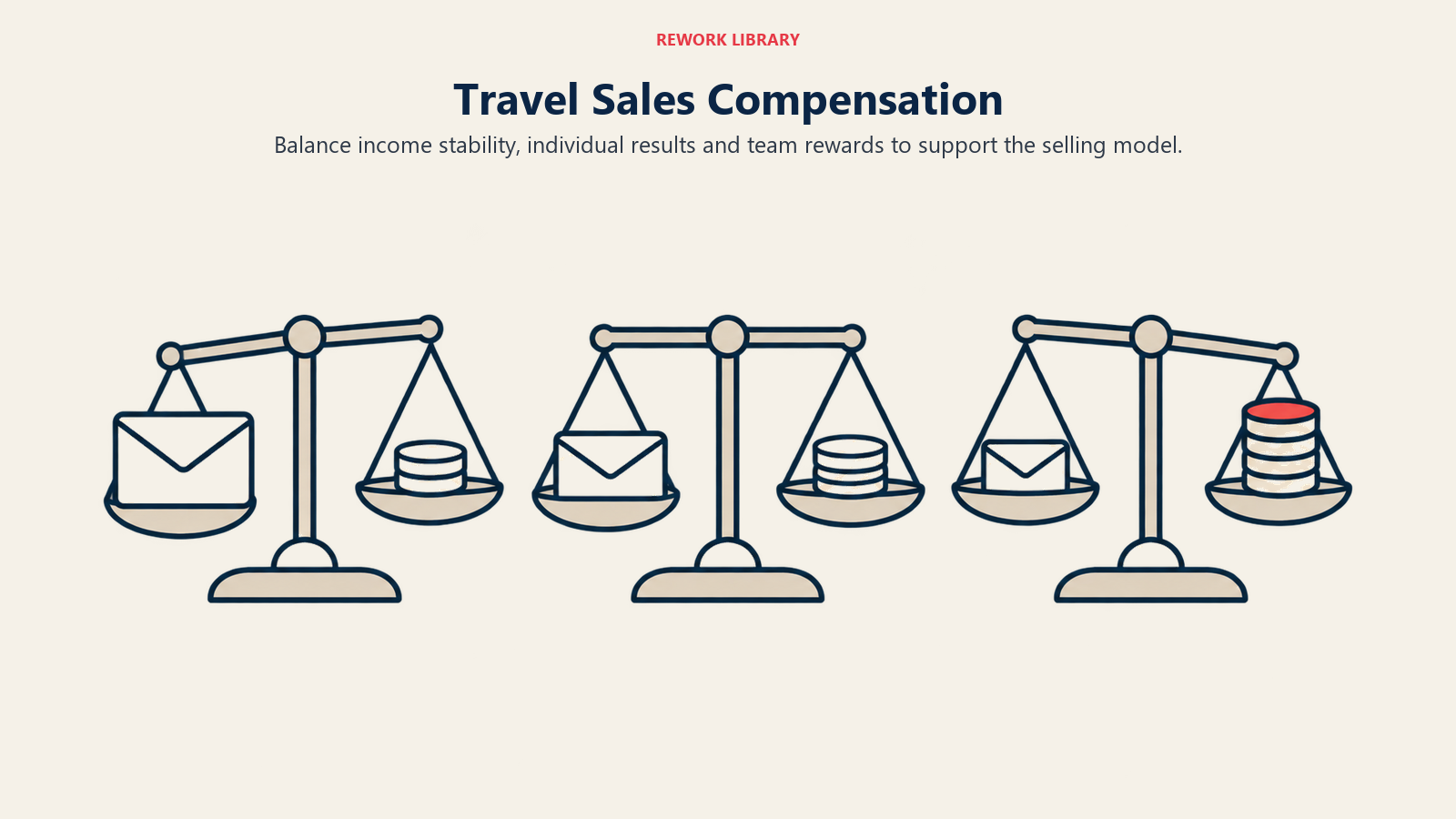
High base / low commission (70-80% base):
- Pros: Income stability, teamwork focus, less pressure
- Cons: Less motivation for top performers, harder to differentiate pay
- Best for: Complex consultative sales, junior agents, team environments
Low base / high commission (40-50% base):
- Pros: Rewards performance, attracts driven agents, variable costs
- Cons: Income volatility, encourages competition over collaboration
- Best for: Transactional sales, experienced agents, volume businesses
Balanced approach (60% base / 40% commission):
- Pros: Stability with performance rewards
- Cons: Doesn't maximize either benefit
- Best for: Most travel agencies
Commission structures should reward both volume and value. Tiered structures work well:
- First $50K monthly revenue: 5% commission
- Next $25K: 7% commission
- Above $75K: 10% commission
This rewards higher performance disproportionately while providing baseline commission for all sales.
Team vs. individual incentives balance depends on culture. Individual incentives drive personal accountability. Team incentives encourage collaboration and mutual support. Combine both: 70% individual performance, 30% team performance.
Monthly vs. quarterly bonuses affect behavior. Monthly bonuses provide faster feedback and rewards, motivating consistent effort. Quarterly bonuses allow for bigger rewards and smooth out monthly volatility. Many agencies use monthly commission with quarterly bonuses for exceptional performance.
Onboarding & Training Programs
New agent onboarding should be structured and measured. Typical timeline:
- Week 1-2: Company, products, systems training
- Week 3-4: Shadowing experienced agents, CRM mastery
- Week 5-6: Handling inquiries with supervision, quote practice
- Week 7-8: Independent inquiry handling with review
- Month 3: Full independence with lighter supervision
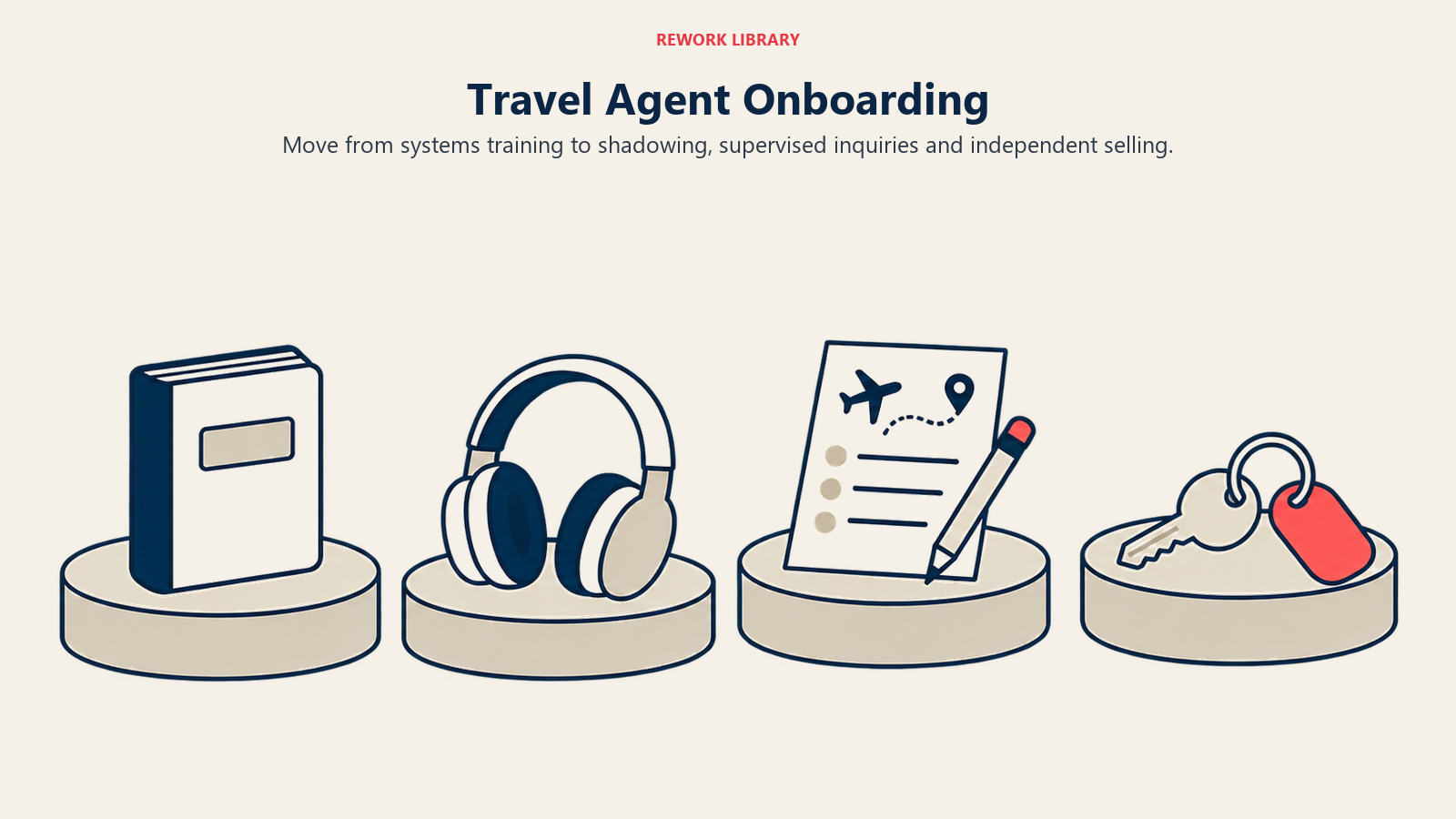
Set specific milestones: 3 successful bookings by end of month 2, 6 bookings by end of month 3. Provide intensive coaching during ramp-up.
Product training never stops. Schedule monthly destination deep-dives. Arrange familiarization trips for top performers and agents learning new destinations. Partner with suppliers for training sessions.
Knowledge should be tested. Quiz agents on destination knowledge, booking systems, policies. Top performers continuously expand expertise.
Sales process certification ensures consistency. Document your sales methodology:
- Initial inquiry response and acknowledgment
- Qualification questions to ask
- Quote development and presentation
- Follow-up sequence and timing
- Closing and objection handling
- Post-booking communication
Certify agents on each step. Role-play scenarios and grade competency.
Mentorship programs pair new agents with top performers. Weekly check-ins, shadowing opportunities, and pipeline reviews help junior agents learn from experienced colleagues faster than formal training alone.
Territory & Lead Assignment
Equitable distribution prevents favoritism concerns and ensures fair opportunity. Rotating assignment gives everyone similar quality and volume. Track inquiry source and quality to ensure fairness.
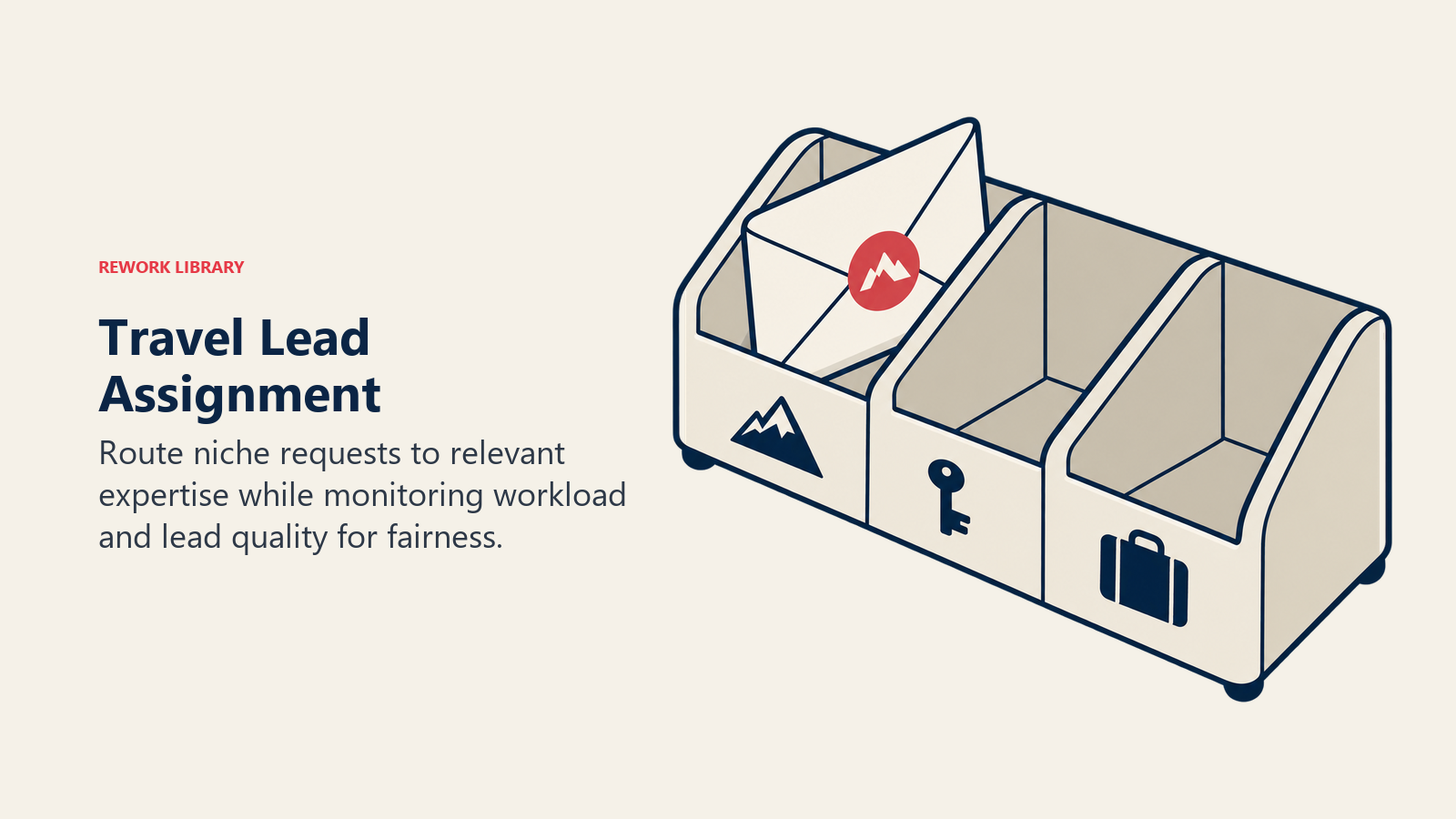
Round-robin assignment works for inbound inquiries: each agent receives inquiries in turn. This works well when inquiry quality is relatively consistent.
Specialty-based assignment routes inquiries to agents with relevant expertise. Japan inquiries go to your Japan specialist. Luxury inquiries go to your luxury-certified agents. This improves conversion but can create volume imbalances.
Performance-based assignment rewards top performers with first pick of high-value inquiries. This maximizes conversion on best leads but can demoralize struggling agents who get lower-quality leads.
Hybrid approaches combine methods. Round-robin for standard inquiries, specialty routing for niche requests, performance bonuses (extra high-value leads) for top achievers. Balanced and motivating.
Monitor lead quality by source and assignment. If certain agents consistently get lower-quality leads, conversion metrics don't compare fairly. Adjust assignment to ensure equitable opportunity.
Using Technology for Performance
CRM analytics track every metric automatically. Dashboards show bookings, conversion rates, pipeline health, activity levels. Agents and managers have instant visibility without manual reporting.
Configure CRM to capture:
- Inquiry source and timestamp
- Quote sent timestamp
- Follow-up log
- Deal stage and stage change history
- Booking details and value
- Customer satisfaction scores
This data drives all performance analysis and coaching.
Call recording (with consent) enables quality coaching. Review calls with agents:
- How did they handle objections?
- Did they ask qualifying questions?
- Was their tone consultative or pushy?
- How did they close?
Recorded calls provide concrete examples for coaching conversations.
Automation tools free agents from admin work. Automated email sequences, quote generation from templates, calendar scheduling, and document collection give agents more time for selling.
Track time saved through automation and ensure it goes to revenue-producing activities, not just creating extra slack.
Analytics platforms beyond CRM provide deeper insights. Business intelligence tools connect CRM data with website analytics, marketing platform data, and financial systems showing complete customer journeys and ROI by agent and channel.
Conclusion
Travel sales team performance improves through systematic measurement, targeted coaching, and aligned compensation. Track both output metrics (bookings, revenue) and leading indicators (activity, conversion rates). Identify what top performers do differently and teach those behaviors to everyone.
Create transparency through dashboards and leaderboards. Coach to specific gaps revealed by data. Design compensation that rewards both volume and value. Invest in continuous training and development. The agencies with high-performing sales teams don't just hire better people - they build better systems for developing and managing talent.
Related Articles:

Business Consultant