Customer Lifetime Value in Travel - 2026 Complete Guide
Turn this article into takeaways for your work.


Each assistant summarizes the article only for you and suggests best practices for your work.
A first-time couple books a $4,500 European tour. Your acquisition cost was $800. Profitable sale, right? Maybe not. If they never book again, you're looking at narrow margins. But if they become annual travelers who refer friends, that same couple could generate $45,000 over a decade. This is why customer lifetime value matters more in travel than almost any other industry.
Most travel businesses focus obsessively on the next booking. They celebrate high conversion rates and big first transactions. But the companies that dominate their markets think differently. They're optimizing for the fifth booking, not the first.
Why CLV Matters in Travel
Travel purchases are naturally high-value compared to most consumer transactions. A $3,000 tour package beats the average e-commerce order by 20x or more. This creates both opportunity and risk in how you allocate marketing dollars. Understanding travel business economics helps you make better investment decisions.
The repeat behavior patterns in travel are predictable once you understand them. Couples who book honeymoons often return for anniversaries. Families who take successful ski trips become annual visitors. Corporate groups that have smooth experiences expand their programs. Each segment has distinct lifetime value curves that travel customer segmentation can help you identify.
Referral potential amplifies CLV significantly in travel. Happy travelers don't just book again themselves. They bring friends, family, and colleagues through travel referral programs. A single satisfied client can trigger a network effect that generates bookings for years. When you calculate CLV without accounting for referrals, you're missing 30-40% of the true value.
And the cost structure of travel rewards repeat business disproportionately. You've already paid for the initial acquisition, built the relationship, and established trust. Subsequent bookings carry almost no acquisition cost. Your customer service team knows their preferences. The sales cycle shortens dramatically.
CLV Calculation Models for Travel
The basic CLV formula gives you a starting point:
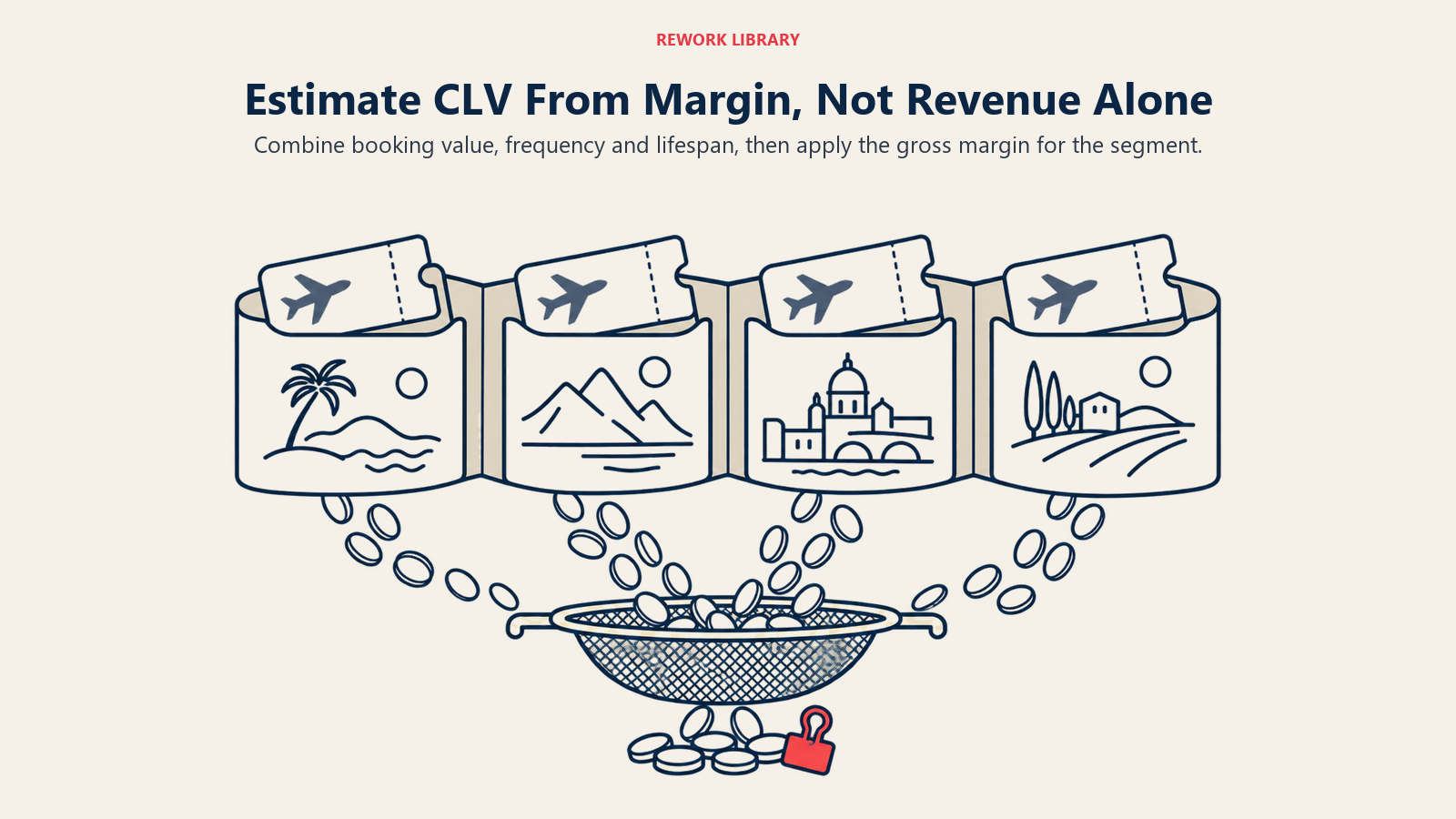
CLV = (Average Booking Value × Purchase Frequency × Customer Lifespan) × Gross Margin
For a leisure travel agency with $4,000 average bookings, 0.8 trips per year, 4-year customer lifespan, and 15% margin:
CLV = ($4,000 × 0.8 × 4) × 0.15 = $1,920
This basic model works for quick estimates. But it misses the nuances that matter in travel.
Cohort-based models reveal how different customer segments perform over time. Track monthly cohorts from acquisition through their lifecycle. You'll see that summer 2024 luxury travelers might have 3x the CLV of winter 2024 budget segment. These patterns guide where to invest acquisition dollars.
Here's what a cohort table might show:
| Acquisition Month | Year 1 Revenue | Year 2 Revenue | Year 3 Revenue | Total CLV |
|---|---|---|---|---|
| Jan 2023 Luxury | $8,500 | $6,200 | $4,800 | $2,925 |
| Jan 2023 Budget | $2,100 | $1,400 | $0 | $525 |
| Jul 2023 Family | $5,200 | $4,800 | $4,200 | $2,130 |
The patterns jump out immediately. Luxury clients show high initial spend with gradual decay. Budget travelers drop off fast. Family segments deliver consistent annual bookings.
Predictive CLV approaches use machine learning to forecast future value based on early signals. Purchase patterns in the first 90 days, email engagement rates, review participation, and referral behavior all predict long-term value. Companies using predictive CLV models report 25-35% improvement in marketing ROI because they can identify high-value customers early.
Key CLV Components
Average booking value varies wildly by segment. Your luxury African safari clients book $12,000 trips. Your European city break customers spend $2,500. Your corporate retreat planners commit $45,000. Don't average these together. Calculate CLV by segment.
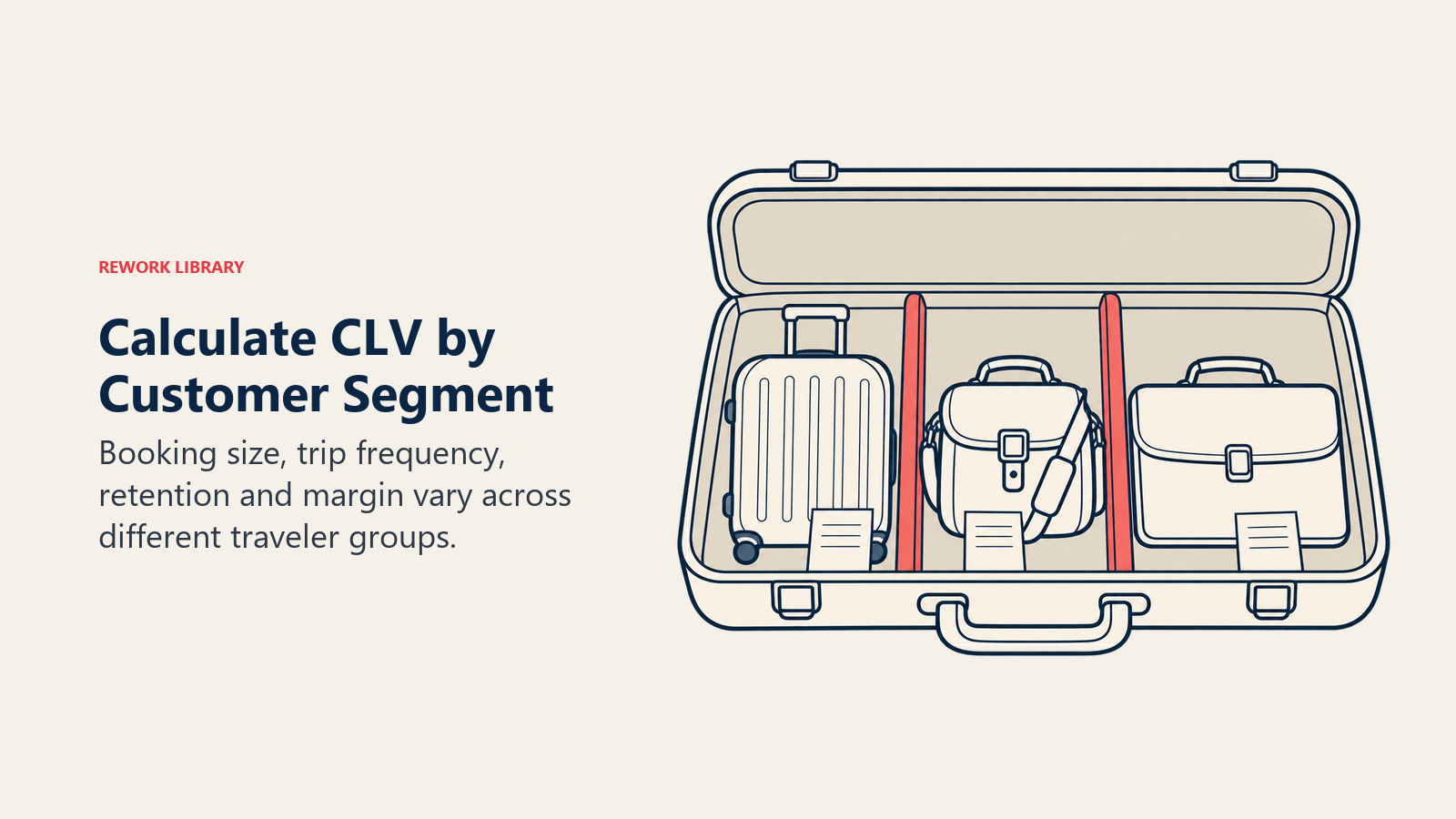
Purchase frequency is where travel businesses often guess wrong. Industry data shows leisure travelers book 0.6-1.2 trips per year with agencies they trust. But this masks huge variation. Multi-generational family travel groups book 2-3 trips annually. Solo adventure travelers might book quarterly. Your data will show the real patterns.
Customer retention rate determines everything. The difference between 60% annual retention and 80% retention is the difference between mediocre and exceptional CLV. Even small improvements compound. Moving from 65% to 70% retention can increase CLV by 25-30% over a five-year period.
Gross margin considerations change how you think about CLV strategy. If your luxury segment has 20% margins but your group tour segment has 8%, equal revenue doesn't mean equal profitability. Factor margins into every CLV calculation or you'll optimize for the wrong outcomes.
CLV by Customer Segment
Leisure travelers typically show $1,500-$3,000 CLV over 3-5 years. They book occasionally, respond to inspiration marketing, and value convenience. The key is converting them from one-time to repeat bookers through repeat booking strategy. Email nurture campaigns and loyalty incentives can lift repeat rates from 25% to 45%.
Luxury clients deliver $4,000-$12,000 CLV with the right service model. They book more frequently, spend significantly more per trip, and stay loyal longer when you deliver exceptional experiences through luxury travel sales approaches. But they also demand more attention. Your cost to serve is higher. The math still works because their booking values are 3-5x standard packages.
Corporate accounts represent some of the highest CLV scenarios: $15,000-$50,000 over 5+ years. Once you secure a corporate client through corporate travel sales efforts for team retreats, incentive travel, or executive programs, they book multiple times per year. The decision cycle is longer initially, but the lifetime value justifies the investment.
Group organizers and association planners create massive CLV through large events plus ongoing relationships. A single conference planner might book $200,000 in travel over a five-year relationship. These clients need specialized service but deliver returns that dwarf individual traveler segments.
Family travelers occupy a sweet spot. CLV of $3,500-$7,000 over 4-6 years with strong annual booking patterns. They're planning around school schedules, which makes them predictable. They value reliability over novelty. Once you deliver a successful family trip, you're their default provider.
CLV vs CAC Ratio Analysis
The relationship between customer acquisition cost and lifetime value determines whether your business model works. The target ratio is 3:1 or higher. For every dollar you spend acquiring a customer, you should generate at least three dollars in lifetime value.
If your average CAC is $650 and your CLV is $1,950, you're at exactly 3:1. That's acceptable but not comfortable. You have thin margins for error. When CAC creeps up or retention dips, profitability evaporates fast.
Premium travel businesses often run 4:1 or 5:1 ratios. They pay $1,200 to acquire luxury clients worth $6,000 in lifetime value. This buffer lets them invest aggressively in customer experience, knowing the economics support it.
But watch your ratios by channel. Your referral customers might deliver 10:1 ratios with $200 CAC and $2,000 CLV. Your paid search customers might be break-even at 2:1. This tells you where to double down and where to pull back.
Travel businesses that fall below 2:1 need immediate intervention. You're spending too much on acquisition, delivering too little value, or retaining customers poorly. Fix CAC, improve offerings, or rebuild retention programs before the business bleeds out.
Strategies to Increase CLV
Upselling premium experiences during the booking process lifts transaction values 15-25% without adding acquisition cost. When a client books a standard European tour, offer the premium version with better hotels and exclusive experiences using travel upselling techniques. When they're already committed, they're most receptive to upgrades.

Extending trip duration adds revenue with minimal additional cost to serve. A client booking 7 days in Italy will often extend to 10 days if you make it easy and compelling. The incremental revenue from those extra days flows almost entirely to CLV since acquisition is already covered.
Increasing booking frequency through travel loyalty program design can transform CLV. A points-based system that rewards annual bookings shifts customer behavior. Instead of booking every 18-24 months, motivated travelers start booking every 12 months to maintain status and earn rewards.
Cross-selling related services using travel cross-selling strategy captures revenue that otherwise goes to competitors. Your client books a tour. Do you offer travel insurance? Airport transfers? Pre-trip hotel nights? Post-trip extensions? Each add-on increases CLV while improving their overall experience.
Subscription and membership models create unprecedented CLV in travel. Companies like Inspirato and Exclusive Resorts charge $2,500-$30,000 annual fees plus trip costs. Members book frequently because they've already paid the membership. The psychological commitment drives booking behavior.
CLV-Based Marketing Decisions
Your acquisition budget should be dictated by CLV, not arbitrary percentages. If your luxury segment has $6,000 CLV, you can afford $1,800 CAC while maintaining healthy 3.3:1 ratios. Don't set universal CAC limits across segments with different economics.
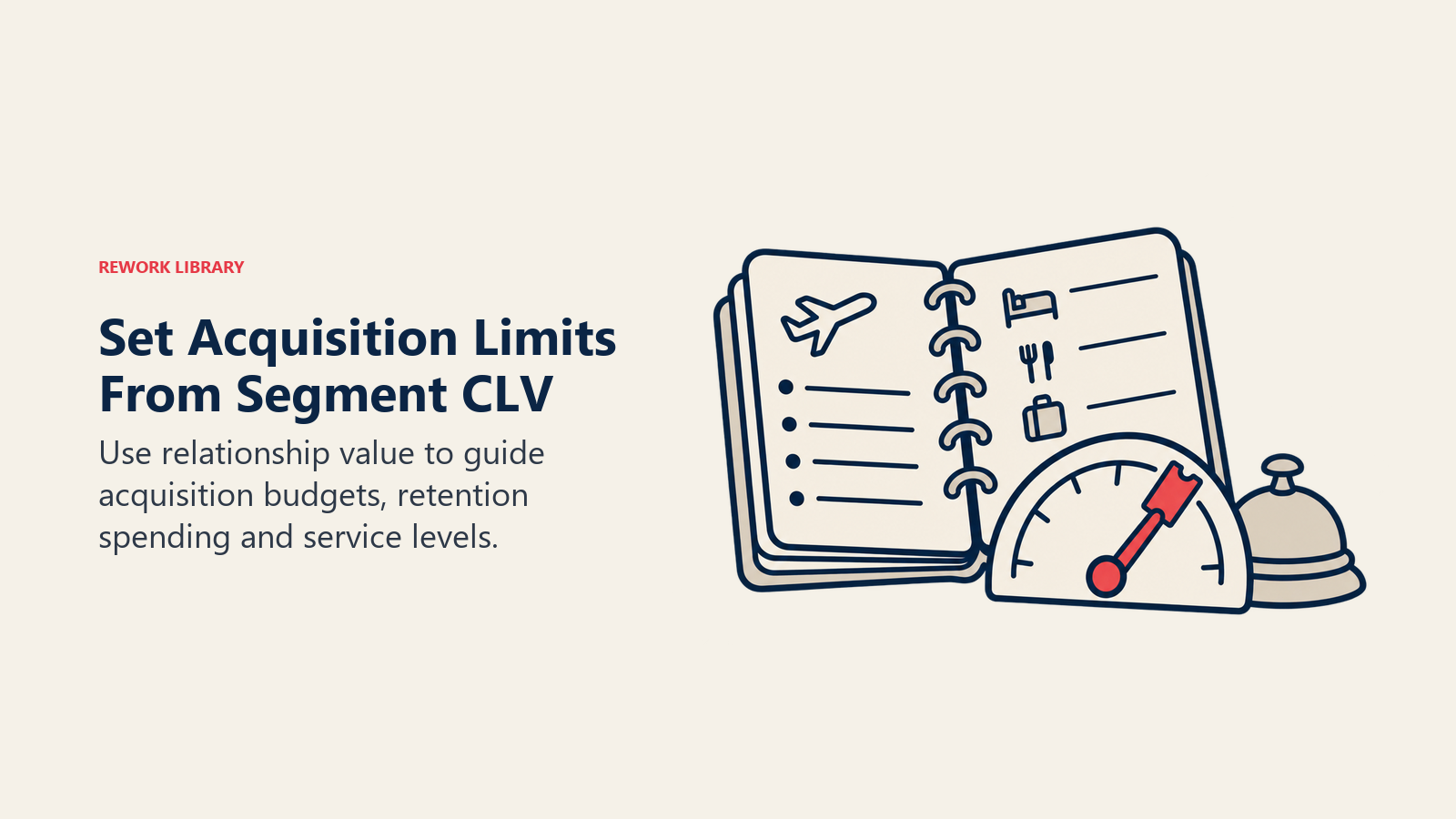
Channel investments follow CLV data. If customers acquired through travel agent partnerships have 40% higher CLV than those from social media ads, shift budget accordingly. Optimize your travel paid advertising spend based on these insights. The channel that delivers the highest absolute CLV deserves more investment, even if the CAC is higher.
Retention program ROI becomes clear through CLV analysis. If your annual retention rate is 65% and a loyalty program could lift it to 75%, calculate the CLV impact. That 10-point improvement might add $400 per customer in lifetime value. Suddenly a $50 annual loyalty program cost looks incredibly profitable.
Customer service levels should vary by predicted CLV. Your high-value segments deserve white-glove treatment because the math supports it. Your budget segments need efficient service but not concierge-level attention. Align resource allocation with lifetime value potential.
Predictive CLV Modeling
Booking history reveals future value faster than any other signal. Customers who book within 90 days of their first inquiry through travel inquiry management are 2.5x more likely to become repeat bookers. Those who book complex multi-destination trips show 60% higher lifetime value than single-destination travelers.
Engagement data predicts CLV with surprising accuracy. Email open rates, website return visits, content downloads, and social media interactions all correlate with repeat booking probability. Build scoring models that identify high-engagement prospects early in the lifecycle.
Demographic factors influence CLV significantly. Age, household income, family status, and location all matter. But behavioral data almost always outperforms demographics. A 35-year-old who opens every email and requests custom quotes is worth more than a 55-year-old who booked once and never engaged again.
Advanced models combine multiple variables using machine learning. They might discover that customers who book 6+ months in advance, engage with destination guides, and add travel insurance have 4x higher CLV than average. These insights let you identify high-value customers from their first interaction.
CLV Dashboards & Reporting
Visualize CLV trends by segment using cohort curves. Plot revenue contribution over time for each acquisition cohort. You'll immediately see which segments have staying power and which drop off after initial purchase. These curves guide both acquisition strategy and retention focus.
Track CLV by acquisition channel to optimize marketing spend. Your dashboard should show:
- Average CLV by channel (referral, organic, paid search, social, partnerships)
- CAC:CLV ratio by channel
- Cohort retention curves by channel
- Time to second purchase by channel source
Monthly CLV trending alerts you to changes before they become crises. If CLV starts declining, investigate immediately. Are retention rates dropping? Has average order value decreased? Is purchase frequency slowing? Early detection enables faster correction.
Segment comparison views reveal where to focus growth efforts. Side-by-side CLV dashboards for luxury vs. budget, domestic vs. international, individual vs. group show you exactly which segments deserve more investment and which are marginal.
Common CLV Mistakes in Travel
Ignoring referral value understates true CLV by 30-40%. When a satisfied customer refers three friends who each book $4,000 trips at 15% margin, that's $1,800 in additional value attributable to the original customer. Track referrals and credit them to source customers for accurate CLV.
Underestimating repeat booking potential happens when you focus on first-transaction economics. Travel has natural repurchase cycles. Annual vacations. Seasonal trips. Recurring corporate events. Your financial models should reflect multi-year booking patterns, not single transactions.
Focusing solely on first transaction revenue blinds you to the real business model. Some travel companies lose money or break even on first bookings intentionally. They're acquiring customers they know will book repeatedly. If your acquisition cost equals first booking margin, you're still building a valuable business through CLV.
Using industry averages instead of your own data leads to bad decisions. Travel CLV varies enormously by business model, target market, and service quality. An adventure tour operator and a luxury villa rental company might both be "travel businesses" but have completely different CLV profiles.
Not segmenting CLV by customer type treats all revenue equally when it's not. Your VIP clients with $8,000 CLV need different treatment than your budget travelers with $1,200 CLV. Strategy, service, and spending should reflect these differences.
Conclusion
Customer lifetime value is the single most important metric for travel business strategy. It determines how much you can spend on acquisition, which customers to pursue, and where retention investments pay off. Companies that master CLV optimization build durable competitive advantages because they can profitably acquire customers competitors can't afford.
Start with accurate measurement using cohort-based models and segment-level analysis. Use CLV data to guide marketing spend, retention programs, and service delivery. Continuously improve the drivers: booking value, purchase frequency, and retention rates. The businesses that win in travel are those that think in lifetimes, not transactions.
Related Articles:

Business Consultant