Travel Lead Generation Overview: Multi-Channel Strategy for Tour Operators
Turn this article into takeaways for your work.


Each assistant summarizes the article only for you and suggests best practices for your work.
By year five, Rebecca's tour company had grown to $6.2 million in annual revenue, 82% from OTA bookings, 18% direct. Then Viator changed their algorithm and commission structure. Overnight, her inquiry volume dropped 47%. She had no alternative channels developed. The business nearly collapsed.
Meanwhile, competitor David built systematically diversified lead sources: 35% organic search, 25% OTAs, 20% paid search, 10% referrals, 10% email/direct. When one channel fluctuated, others compensated. His growth wasn't faster, it was more sustainable and predictable.
Most tour operators depend too heavily on one or two channels, creating dangerous vulnerability. The solution isn't finding the "best" channel, it's building a balanced portfolio that delivers consistent inquiries regardless of external changes.
Lead Generation in Travel Context
Understanding what makes travel leads different:
Definition of Travel Lead vs Other Industries:
Travel leads aren't quick conversions. A lead is someone who's expressed genuine interest in your destinations or trip types and provided contact information. They're 3-12 months away from booking, require multiple touchpoints, and need education and nurturing.
This is dramatically different from SaaS (trial signup converts in days) or e-commerce (browse to purchase in hours).
Quality vs Quantity Trade-Offs:
Not all inquiries are equal:
- High-Quality Lead: Specific destination interest, realistic budget, appropriate timeline, decision-maker involved
- Low-Quality Lead: Vague interest, price shopping, unrealistic expectations, far future or no timeline
100 low-quality inquiries convert worse than 20 high-quality inquiries. Channel optimization focuses on quality, not just volume.
Lead Source Economics and CAC by Channel:
Different channels have vastly different costs:
- Organic Search: $20-$60 per inquiry (after initial investment compounds)
- Paid Search: $150-$400 per inquiry
- OTAs: $80-$200 per inquiry (through commission)
- Referrals: $30-$100 per inquiry
- Social Media: $40-$120 per inquiry
- Content Marketing: $25-$75 per inquiry
Understanding economics helps allocate budget appropriately.
Conversion Rate Variance by Source:
Sources convert at different rates:
- Referrals: 25-40% inquiry-to-booking
- Organic Search (Direct): 15-25%
- Email/Past Customers: 20-35%
- Paid Search: 10-18%
- OTAs: 8-15%
- Social Media: 5-12%
Higher conversion offsets higher CAC. Referrals at $100 CAC converting 30% is better than OTAs at $80 converting 10%.
The Travel Lead Generation Framework
Three strategic layers:
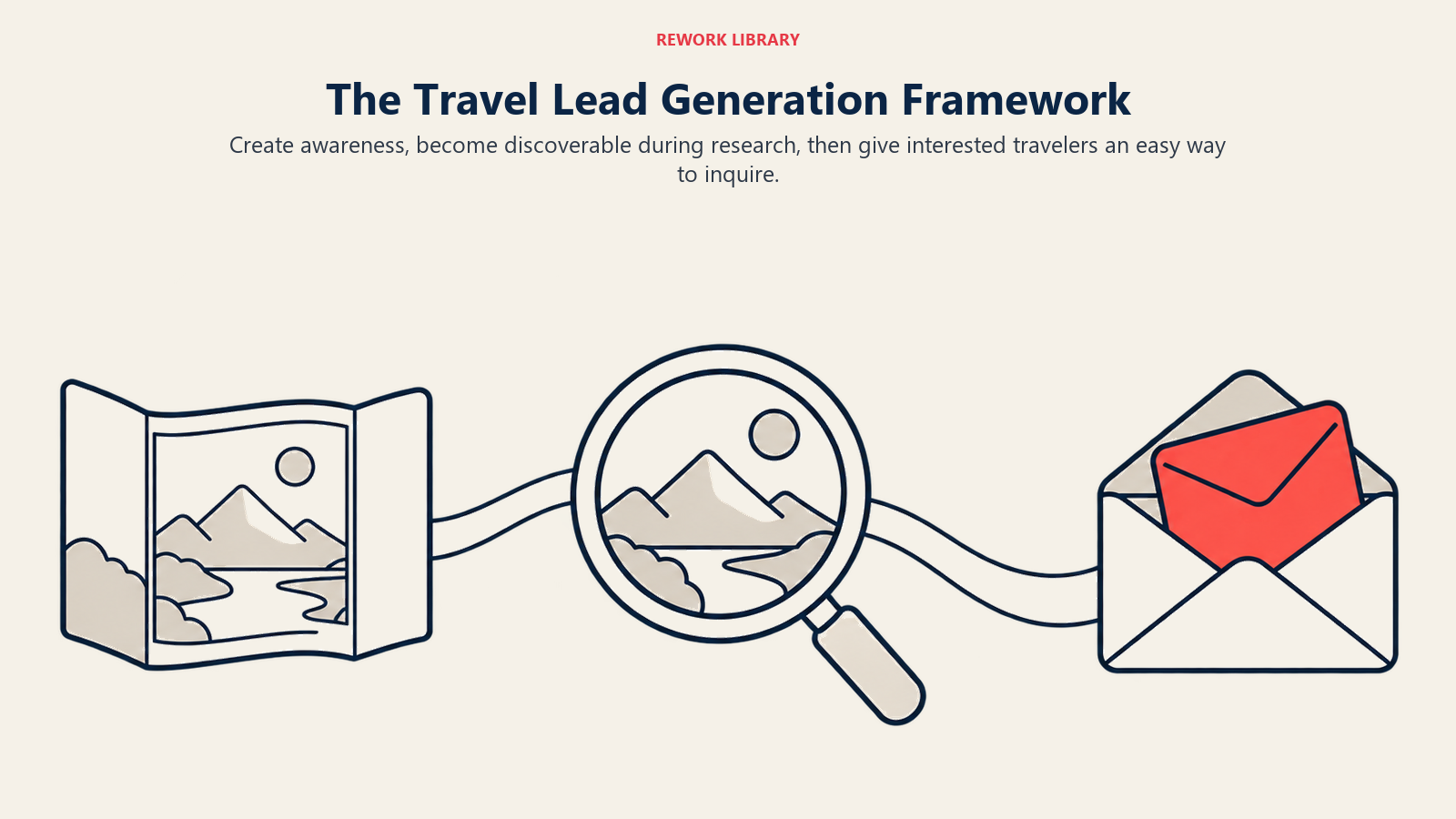
Awareness Layer: Destination Marketing Creating Demand:
Before anyone can inquire, they need to know:
- Your destinations exist and are desirable
- You exist as option for booking them
- Why they should care about traveling there
This layer includes:
- Content marketing (destination guides, inspiration)
- Social media presence
- PR and media coverage
- Brand awareness advertising
- Influencer partnerships
Awareness doesn't generate immediate inquiries but seeds future demand.
Discovery Layer: Making Your Company Findable:
When prospects research destinations, you must appear:
- High organic search rankings
- OTA listings and visibility
- Review site presence (TripAdvisor, Google)
- Social media discoverability
- Paid search coverage
- Referral mentions
This layer intercepts active research and drives initial contact.
Capture Layer: Converting Interest to Inquiry:
When prospects encounter you, conversion mechanisms activate:
- Easy inquiry forms
- Click-to-call functionality
- Chat and messaging options
- Email signup offers
- Downloadable resources
- Compelling calls-to-action
This layer determines what percentage of aware, interested prospects actually convert to leads.
All three layers must work together. Awareness without discovery wastes effort. Discovery without capture loses opportunities.
Core Lead Generation Channels
Understanding each channel's role:
Organic Search (SEO) - Highest ROI, Long Timeline:
How it Works: Rank for destination and trip-type keywords in Google. Prospects searching "Peru tours" or "Machu Picchu trek" find your content, visit site, inquire.
Investment Required: Content creation, technical SEO, backlink building ($3,000-$10,000/month for 12-24 months)
Timeline to Results: 6-18 months before significant results
Inquiry Cost: $20-$60 once compounded
Best For: Patient operators willing to invest long-term for sustained returns
Paid Search (SEM) - High Intent, High Cost:
How it Works: Bid on keywords in Google Ads. Ads appear when prospects search. Pay per click.
Investment Required: Ad budget ($3,000-$15,000/month) plus management time or agency
Timeline to Results: Immediate, but requires optimization over 3-6 months
Inquiry Cost: $150-$400 typically
Best For: Operators needing immediate inquiries, supplementing organic during build-up, high-value trips justifying CAC
OTA Partnerships - Volume, Margin Pressure:
How it Works: List tours on Viator, GetYourGuide, Expedia, etc. They drive traffic, you pay 20-30% commission on bookings.
Investment Required: Setup time, inventory management, commission on sales
Timeline to Results: 30-90 days to build reviews and visibility
Inquiry Cost: Varies, but commission equals $80-$200 effective CAC
Best For: Filling inventory, accessing volume, entering new markets, operators willing to trade margin for scale
Social Media - Awareness and Inspiration:
How it Works: Build following, post destination content, engage audience, drive profile visits and website traffic.
Investment Required: Content creation time/cost, optional paid promotion ($1,000-$5,000/month)
Timeline to Results: 6-12 months to build meaningful following
Inquiry Cost: $40-$120 typically
Best For: Visual destinations, younger demographics, building brand over time
Content Marketing - Education and Trust:
How it Works: Create valuable destination content (guides, tips, stories). Prospects find via search and social, consume content, develop trust, inquire.
Investment Required: Writing, photography, production ($2,000-$8,000/month)
Timeline to Results: 6-18 months to build content library and traffic
Inquiry Cost: $25-$75 once established
Best For: Building authority, long-term sustainable lead flow, SEO support
Email Marketing - Nurturing and Conversion:
How it Works: Build email list through lead magnets, nurture with valuable content, convert inspiration to inquiries and bookings.
Investment Required: ESP subscription ($100-$500/month), content creation, list building tactics
Timeline to Results: Immediate for list (if you have traffic), 3-6 months to see conversion impact
Inquiry Cost: Very low ($10-$40) for nurtured subscribers
Best For: Converting website visitors, re-engaging past inquirers, customer retention
Referral Programs - Highest Quality, Limited Scale:
How it Works: Incentivize past customers to refer friends and family. Word-of-mouth powered by systematic program.
Investment Required: Incentive costs (discounts or cash), program management
Timeline to Results: 3-6 months to establish program, ongoing
Inquiry Cost: $30-$100
Best For: High customer satisfaction businesses, premium experiences, community-driven brands
Travel Trade Shows - B2B and Group Sales:
How it Works: Exhibit at consumer travel shows, industry trade shows, or corporate travel events. Generate inquiries through booth interactions.
Investment Required: Booth costs ($2,000-$10,000 per show), travel, materials
Timeline to Results: Immediate inquiry generation, 3-12 month sales cycle
Inquiry Cost: $150-$500 depending on show
Best For: B2B operators, group travel, high-value trips, local market penetration
Metasearch - Price Comparison Shoppers:
How it Works: List on Google Travel, Kayak, TripAdvisor Experiences. Price-focused shoppers compare options.
Investment Required: CPC model ($1-$5 per click) or commission
Timeline to Results: 30-60 days
Inquiry Cost: $100-$300
Best For: Competitive pricing, commodity trips, supplementing other channels
Display and Video Advertising - Awareness Building:
How it Works: Banner ads, YouTube pre-roll, programmatic display targeting travel interests and website retargeting.
Investment Required: Ad budget ($2,000-$10,000/month)
Timeline to Results: 3-6 months to optimize
Inquiry Cost: $200-$500 (high CAC, primarily awareness play)
Best For: Large operators ($10M+), brand building, remarketing past visitors
Channel Mix Strategy
Building balanced portfolio:
Balancing Owned, Earned, and Paid Channels:
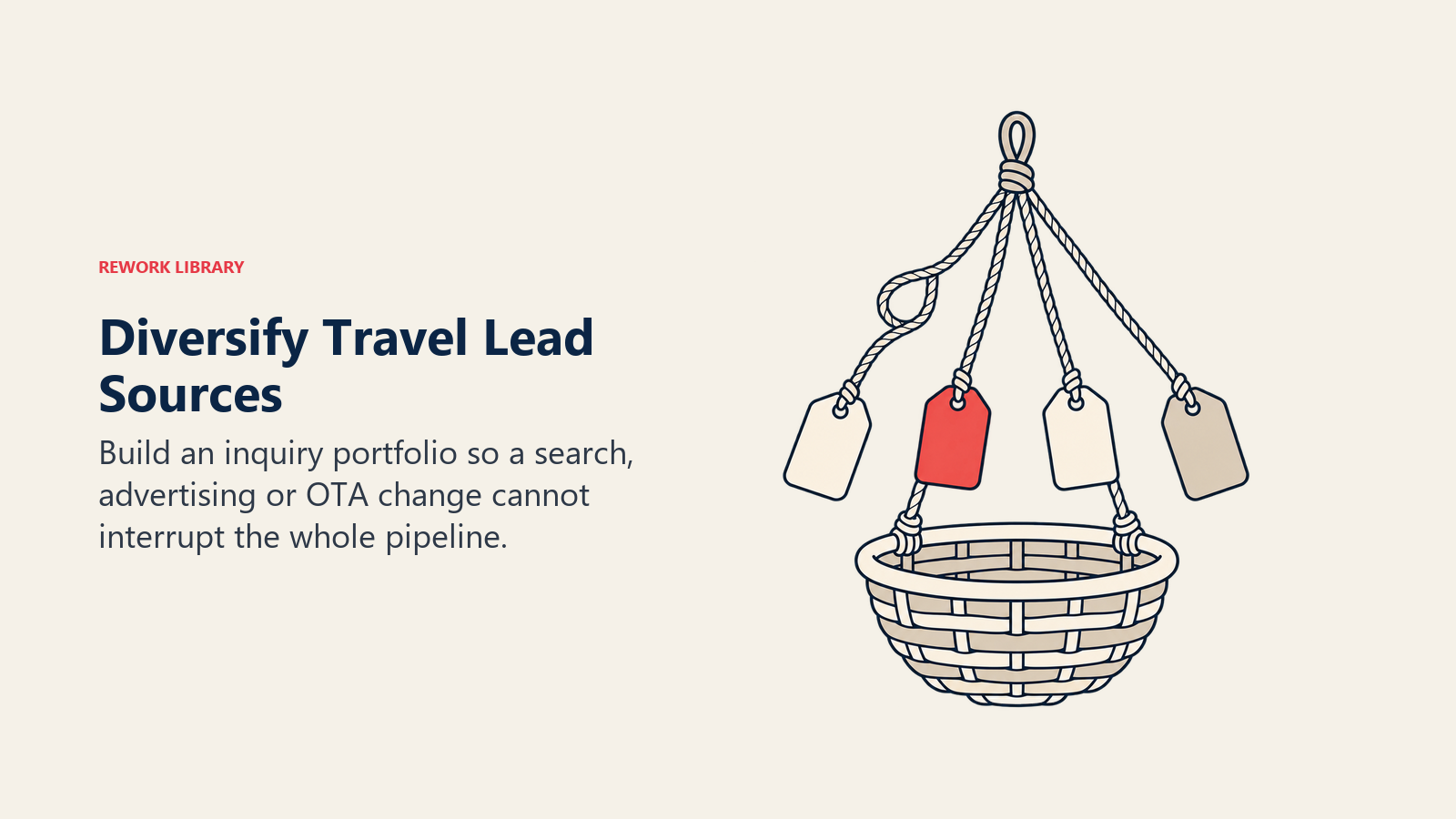
Owned: You control (website, email list, social following) Earned: You earn through quality (organic search rankings, PR mentions, referrals) Paid: You buy (ads, OTA commissions)
Healthy mix: 40-50% owned/earned, 30-40% paid. Over-reliance on paid creates expense treadmill. Under-investment in paid limits growth.
Risk Mitigation Through Diversification:
Never let one channel exceed 50% of inquiries. If it disappears or changes, you're vulnerable.
Target distribution at $5M+ revenue:
- 25-35% organic search
- 20-30% paid search + OTA
- 15-25% referrals + past customers
- 10-20% content marketing + email
- 10-15% social media + other
Budget Allocation Framework:
Start with goals, allocate backward:
- Need 200 inquiries monthly? Calculate mix based on channel costs and conversion rates
- Example: 70 from organic (build-up phase), 50 from paid search, 40 from OTAs, 25 referrals, 15 other = 200 total
Then budget: Organic ($6K/mo), Paid Search ($7K/mo), OTA (commission only), Referral Program ($1K/mo), Social ($2K/mo) = $16K total marketing budget
Channel Sequencing for Growth Stages:
$0-$1M: Focus on OTAs (fast volume), basic SEO, referral program foundation
$1M-$3M: Add paid search, invest in content/SEO, build email list, improve referrals
$3M-$10M: Mature SEO paying off, diversify across all channels, reduce OTA dependency
$10M+: Sophisticated multi-channel operation, brand awareness efforts, PR, advanced programs
Lead Quality Definition and Management
Not all inquiries are created equal:
MQL (Marketing Qualified Lead) Criteria for Travel:
Indicates genuine interest and fit:
- Expressed interest in specific destination or trip type
- Provided contact information willingly
- Engaged with content (time on site, pages viewed)
- Budget indicators align with your offerings
- Timeline mentioned or implied (within 12 months)
SQL (Sales Qualified Lead) Characteristics:
Ready for sales engagement:
- Specific trip interest and dates
- Budget discussed or acknowledged
- Decision-makers involved or accessible
- Timeline definite (within 6 months)
- Responsive to communication
Lead Scoring for Travel Inquiries:
Score based on signals:
- +10: Specific destination request
- +10: Reasonable timeline (1-12 months)
- +10: Budget discussed
- +5: Email engagement prior to inquiry
- +5: Multiple page views
- +5: Referred by past customer
- -5: No timeline or far future
- -5: Budget far below your offerings
Prioritize high-scoring leads for fastest response.
Inquiry Quality Metrics by Source:
Track conversion and quality by channel:
- Which sources convert best?
- Which have highest average booking value?
- Which require least sales time?
- Which have lowest cancellation rates?
Optimize budget toward highest-quality sources.
Multi-Touch Attribution in Travel
Understanding the complex journey:
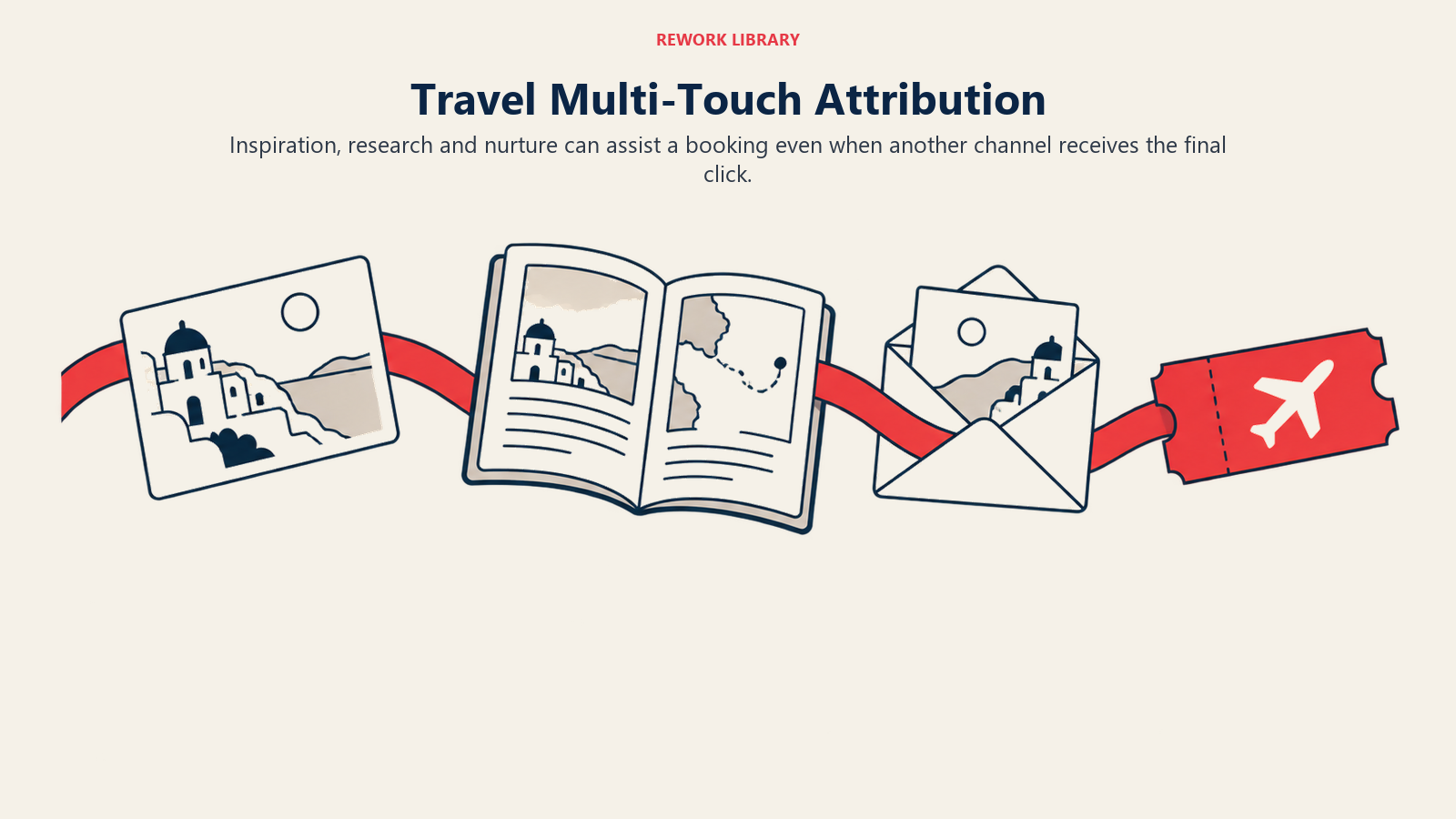
8-12 Touch Customer Journeys:
Typical path before booking:
- Instagram post (inspiration)
- Google search (research begins)
- Your blog post (initial visit)
- Email signup (lead capture)
- 3-4 nurture emails
- Return website visit
- Review site check
- Inquiry submission
- Sales call
- Proposal review
- Final website visit
- Booking
Single-touch attribution misses most of this journey.
First-Touch, Last-Touch, Multi-Touch Models:
First-Touch: Credit first interaction (Instagram in example above). Shows what creates awareness but ignores conversion factors.
Last-Touch: Credit final interaction (website visit before booking). Shows what converts but ignores journey.
Multi-Touch: Credit all touchpoints proportionally. Most accurate but complex.
Use all three perspectives to understand full picture.
Assisted Conversion Analysis:
Which channels assist bookings even if not last touch?
- Content marketing often first touch, not last
- Social media inspires, search converts
- Email nurtures middle of journey
Give credit to channels playing supporting roles.
Technology Stack for Lead Generation
Systems enabling execution:
Website and Landing Page Platforms: WordPress, Webflow, custom CMS. Mobile-optimized, fast-loading, conversion-focused.
Forms and Inquiry Capture: Optimized inquiry forms, chat (Intercom, Drift), booking widgets, email capture tools.
CRM and Lead Management: HubSpot, Salesforce, TravelJoy, or travel-specific CRM. Track leads, sources, status, communication.
Analytics and Attribution: Google Analytics, attribution platforms, call tracking, UTM parameters throughout.
Integration critical, systems must talk to each other.
Performance Benchmarking
Know what good looks like:
Inquiry Volume Targets by Revenue:
- $1M revenue: 30-50 inquiries/month
- $3M revenue: 80-120 inquiries/month
- $5M revenue: 150-200 inquiries/month
- $10M revenue: 300-400 inquiries/month
Varies by average booking value and conversion rate.
Cost Per Inquiry by Channel (targets):
- Organic: $20-$60
- Referrals: $30-$100
- Content: $25-$75
- Social: $40-$120
- OTA: $80-$200
- Paid Search: $150-$400
Inquiry-to-Booking Conversion Rates:
- Overall: 12-20% (healthy)
- High-quality segments: 25-35%
- Low-quality segments: 5-10%
Track overall and by source.
Building Scalable Lead Gen Operation
People, process, technology:
Under $3M: Founder/marketer handles lead gen, sales does follow-up, some outsourced help (SEO, ads).
$3M-$10M: Marketing manager or director, content person, possibly PPC specialist, systematized processes.
$10M+: Full marketing team (content, SEO, PPC, social, email), sophisticated attribution, continuous optimization.
Scale systematically as revenue grows.
Related Articles

Business Consultant
On this page
- Lead Generation in Travel Context
- The Travel Lead Generation Framework
- Core Lead Generation Channels
- Channel Mix Strategy
- Lead Quality Definition and Management
- Multi-Touch Attribution in Travel
- Technology Stack for Lead Generation
- Performance Benchmarking
- Building Scalable Lead Gen Operation
- Related Articles