Metasearch Marketing: Capture High-Intent Travelers on Google, Kayak, and Trivago
Turn this article into takeaways for your work.


Each assistant summarizes the article only for you and suggests best practices for your work.
Metasearch marketing is a core B2B travel marketing channel where properties bid on platforms like Google, Kayak, and Trivago to capture high-intent travelers and convert them into direct bookings. You pay per click rather than the 15 to 25 percent commission OTAs charge, so it wins when your booking engine converts well and your rates stay competitive.
Over 60% of travelers start their booking journey on metasearch engines. They type "hotels in Austin" into Google, compare prices across Kayak, or filter options on Trivago. These platforms don't take bookings themselves. Instead, they aggregate rates from multiple sources and send users to whoever offers the best price or most compelling value.
This creates an opportunity. Unlike OTA partnership strategy that charges 15-25% commissions, metasearch platforms typically charge per-click. You pay $1-5 to send a high-intent traveler directly to your booking engine. If they convert, you've acquired a direct customer at a fraction of OTA commission costs.
But metasearch is also ruthlessly competitive. If your rate is $10 higher than a competitor or your listing doesn't inspire confidence, that click goes elsewhere. You're competing on price, reviews, and perceived value in a marketplace where switching costs are zero.
Metasearch Landscape Overview
Understanding each platform's dynamics shapes your strategy.
Google Travel dominates with 40%+ market share of metasearch traffic. When someone searches "hotels near Times Square," Google displays a map with hotel pins and a comparison grid showing rates from multiple sources. Your property can appear with a free listing (no cost, but lower visibility) or paid placement (CPC model, premium position). Google pulls inventory from your direct booking engine or through connectivity partners. The platform favors properties with strong review scores and competitive pricing.
Kayak, Trivago, and Skyscanner operate on similar models but with different user demographics. Kayak users tend to be US-based, price-conscious, and comparison-focused. Trivago skews European with users who research extensively before booking. Skyscanner dominates flight search but has growing hotel inventory. All three monetize through CPC advertising: you bid for placement, pay when clicked, and compete primarily on price and availability.
TripAdvisor occupies a hybrid position. It's a review platform first, metasearch second. Users research your property through reviews, then compare rates from multiple booking sources. TripAdvisor Instant Booking lets users complete reservations without leaving the site, similar to OTAs but with lower commissions (12-15%). The platform's strength is trust. If you have 4.5+ stars with 500+ reviews, TripAdvisor clicks convert at higher rates than pure metasearch platforms.
Emerging platforms like Momondo and HotelsCombined capture smaller market segments but can deliver profitable traffic if your target demographic aligns. Test budget on these platforms is typically 5-10% of your total metasearch spend.
When Metasearch Makes Sense
Metasearch isn't universally profitable. Assess fit before investing.
Business model compatibility starts with margins. If OTAs charge 18% commission and metasearch can deliver direct bookings at 3-6% customer acquisition cost, metasearch makes sense. But if your booking engine has poor UX and converts at 1% while OTAs convert at 4%, you'll pay for clicks that don't convert. Understanding travel business economics helps determine if metasearch fits your profitability model.
Margin requirement analysis is straightforward. Calculate your maximum acceptable customer acquisition cost as a percentage of booking value. If average booking value is $300 and you can afford 8% CAC, you have $24 to work with. At $2 per click, you need 8.3% conversion rate to hit that target. Below that threshold, metasearch becomes unprofitable.
Competitive intensity evaluation requires honest assessment. If you're a budget hotel competing against Marriott and Hilton in a major metro market, you're bidding against properties with 10x your marketing budget and stronger brand recognition. Metasearch favors price leaders and brand names. Independent properties succeed when they target niche segments (boutique design hotels, historic properties, eco-lodges) where big chains don't dominate.
Direct booking capability checklist must be met before investing in metasearch:
- Mobile-optimized booking engine that loads in under 2 seconds
- Real-time availability and rates synced across all platforms
- Secure payment processing with multiple currency options
- Competitive pricing that matches or beats OTA rates
- Strong review profile (4.0+ stars, 100+ reviews minimum)
If you're missing any of these, fix them first through booking engine optimization. Metasearch traffic is expensive to waste on a broken booking funnel.
Platform-Specific Strategies
Each platform requires tailored tactics.
Google Hotel Ads offers two tiers. Free listings appear in search results but receive lower visibility, typically below paid placements. They're worth enabling (zero downside) but don't drive significant volume unless you're the price leader. Paid placement through Google Ads puts you at the top of results and in the prominent map pins. You set maximum CPC bids, which range from $0.50 for low-competition markets to $8+ for premium locations during peak season. Google's smart bidding can optimize bids automatically based on likelihood to convert, but it requires conversion tracking implementation and at least 30 conversions to learn effectively.
Kayak integration requires connectivity through a channel manager or direct API integration. You submit rate and availability feeds, which Kayak displays alongside OTA rates for your property. Users see all options side-by-side, creating pure price competition unless you differentiate through amenities ("Free Breakfast Included") or flexible cancellation policies. Kayak's CPC model averages $1-3, but spikes during high-demand periods. The platform offers optional sponsored placements that guarantee top positioning for an additional 30-50% cost premium.
Trivago bidding strategies center on cost-per-acquisition targets rather than raw CPC. You can set bids based on desired CPA and Trivago's algorithm adjusts exposure accordingly. This works well once you have conversion data but makes testing difficult. Start with moderate CPC bids ($1.50-2.50) to gather data, then shift to CPA bidding once you have 50+ conversions. Trivago users are comparison-obsessed, so your listing needs strong review scores and competitive rates to generate clicks regardless of bid level.
TripAdvisor Instant Booking functions more like a mini-OTA. You pay 12-15% commission on completed bookings rather than CPC. This reduces risk (you only pay for results), but creates less urgency to optimize conversion since you're not paying for clicks. The advantage is TripAdvisor's trust halo. Users who've read 20 reviews about your property and decide to book there are highly qualified. Conversion rates average 8-12%, double typical metasearch rates.
Bidding and Budget Management
Smart bidding prevents overspending while capturing valuable traffic.
Cost-per-click versus commission models create different economics. On CPC platforms (Google, Kayak, Trivago), you pay $2 per click regardless of whether the user books. At 5% conversion rate, you're paying $40 CAC per booking. On commission platforms (TripAdvisor Instant Booking), you pay nothing for clicks but 15% of a $300 booking = $45 CAC. The CPC model is cheaper if your conversion rate is strong, more expensive if it's weak.
Dynamic bidding by occupancy level maximizes profitability. When occupancy is 90%, reduce metasearch bids or pause campaigns entirely. You don't need expensive customer acquisition when you're nearly full. When occupancy drops below 60%, increase bids aggressively. A $5 CPC that feels expensive when you're at 85% occupancy is a bargain when you're at 45% and facing empty rooms.
Seasonal budget allocation should mirror demand patterns. If 40% of your annual bookings happen in Q4, allocate 45-50% of your metasearch budget there. Don't spread budget evenly across the year. Instead, concentrate spending when demand and booking intent are highest. Create separate campaigns for shoulder season with lower bids and more flexible parameters.
ROI threshold setting establishes clear guardrails. Define your maximum acceptable CAC as a percentage of booking value. For most properties, this is 6-10%. Track customer acquisition cost in travel weekly and pause campaigns that consistently exceed thresholds. Don't chase volume at unprofitable margins. Metasearch should be a profitable channel, not a visibility expense.
Rate Parity and Competitiveness
Pricing strategy determines metasearch success more than bidding sophistication.
Metasearch users are comparison shopping. If your rate is $15 higher than Booking.com for an identical room, you won't get the click regardless of how much you bid. Rate parity with OTAs is typically contractually required, so you can't undercut them directly. But you can match their rate while adding value that doesn't violate parity agreements.
Value-add differentiation works around rate parity restrictions. Show the same nightly rate as the OTAs, but include "Free Breakfast" or "Complimentary Airport Transfer" or "Room Upgrade" on your direct booking listing. This doesn't violate parity because you're not offering a lower price. You're offering additional value for the same price. Effective direct booking strategy combines rate parity with value differentiation. Users who care about breakfast will choose your listing even at the same rate.
Direct booking incentive design can include loyalty points, future stay credits, or flexible policies. "Book direct and earn points worth $30 toward your next stay" provides tangible value without reducing the current booking rate. "Free cancellation up to 48 hours before arrival" removes risk, making your listing more attractive even at identical pricing.
But some properties compete purely on price. If you're willing to take lower margins on metasearch traffic compared to OTA traffic, you can offer members-only rates (requires joining your free loyalty program) that are 5-8% below public rates. This sidesteps parity agreements because the rate isn't publicly available. It's aggressive and OTAs won't like it, but it's technically compliant.
Technical Integration
Metasearch only works if your technical infrastructure can support it.
Connectivity API requirements vary by platform. Google Hotel Ads accepts feeds via Google Hotel Center (your own integration) or through connectivity partners like Pegasus, Sabre, or SiteMinder. Kayak and Trivago require channel manager integration unless you have development resources to build direct API connections. TripAdvisor pulls rates from multiple sources including direct feeds and OTA inventory.
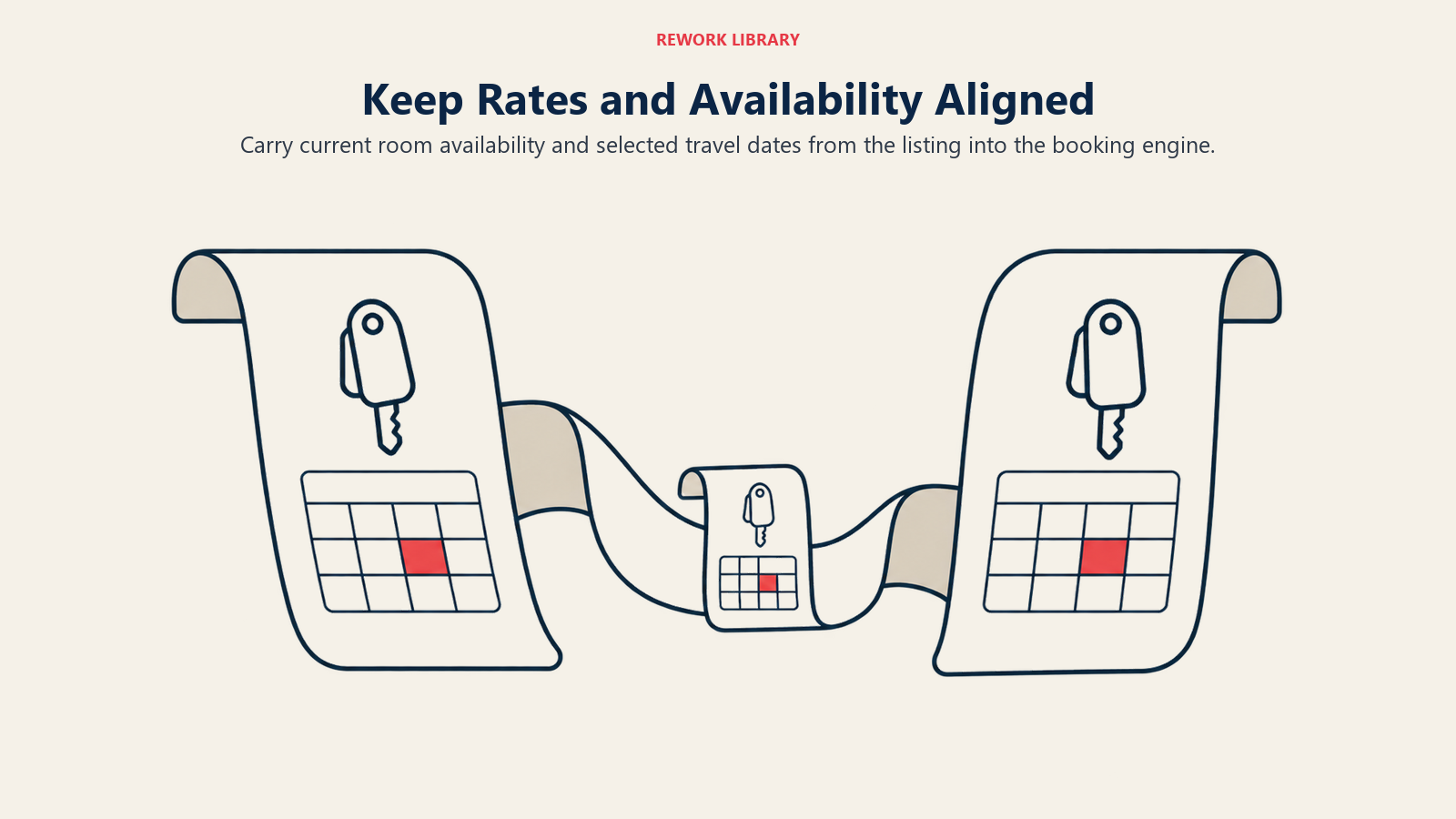
Real-time inventory sync is non-negotiable. If your metasearch listings show availability that doesn't exist, users click through and encounter "sold out" messages. That's wasted spend and brand damage. Your channel manager must update availability within 5-10 minutes across all platforms. Most modern systems handle this automatically, but verify before launching campaigns.
Rate and availability feeds need to reflect your pricing strategy accurately. If you offer dynamic pricing that adjusts based on demand, your feeds should update hourly or even more frequently. Stale rates mean you're either advertising rates that are no longer available (user frustration) or failing to capitalize on competitive pricing (lost bookings).
Booking engine optimization determines whether metasearch clicks convert. Users landing from metasearch expect a seamless experience: pre-filled dates, direct display of the room type they clicked on, and one-click booking. Every additional step or form field drops conversion by 10-15%. Your website conversion for travel should be as streamlined as major OTAs or you'll lose the traffic you've paid for.
Performance Optimization
Ongoing optimization separates profitable metasearch programs from cash drains.
Quality score improvement on Google Hotel Ads works similarly to standard Google Ads. Properties with higher quality scores get better ad positions at lower CPCs. Quality score considers review ratings, booking engine performance, site speed, and mobile experience. Improving from 4.2 to 4.6 stars can reduce your required CPC by 20-30% while increasing click-through rates.
Click-through rate optimization focuses on listing appeal. Your property photo should be your best angle, not a generic building shot. Amenity highlights should emphasize unique differentiators: "Rooftop Pool," "Historic Building," "Pet Friendly." Call out value-adds: "Free Breakfast Included." These small tweaks can increase CTR from 2% to 4%, effectively cutting your cost-per-visitor in half.
Conversion rate benchmarks provide targets. Well-optimized hotel booking engines convert metasearch traffic at 4-7%. Below 3% suggests UX or pricing problems. Above 8% is excellent. Track booking conversion metrics by source (Google vs Kayak vs Trivago) to identify which platforms send best-quality traffic.
Attribution tracking setup requires conversion pixels on your booking confirmation page. This lets metasearch platforms track which clicks resulted in bookings, enabling their algorithms to optimize toward conversions rather than just clicks. Without proper tracking, you're flying blind and can't leverage algorithmic bidding improvements.
Measurement Framework
Metasearch success isn't just about volume. It's about profitable volume.
Channel profitability analysis compares fully loaded CAC against lifetime value. Don't just calculate first booking CAC. Measure whether metasearch customers return for repeat bookings and at what rates compared to OTA customers. If metasearch delivers customers with 30% higher lifetime value because you own the relationship, you can afford higher CAC than OTA commissions.
Incremental versus cannibalized bookings matter. If 40% of your metasearch traffic would have booked through your website organically anyway, you're paying for bookings you would have captured for free. Track branded search traffic and direct website visits before and after launching metasearch. Some cannibalization is inevitable, but if it exceeds 50%, you're overspending.
Customer quality metrics reveal whether metasearch delivers valuable guests. Measure average booking value, length of stay, ancillary purchases, and review scores for metasearch customers versus other channels. If metasearch customers book shorter stays with lower spend, their true value is less than headline booking numbers suggest.
Lifetime value comparison between channels guides budget allocation. If metasearch customers return at the same rate as direct website bookers but lower than email campaign responders, allocate budgets accordingly. Understanding customer lifetime value in travel ensures you optimize for long-term profitability. The goal isn't to maximize metasearch bookings. It's to maximize profitable customer acquisition across all channels.
Conclusion
Metasearch platforms offer a path to direct bookings at costs well below OTA commissions, but only if you execute strategically. Competitive pricing, strong review profiles, and optimized booking engines are prerequisites. Without these foundations, metasearch traffic is expensive and converts poorly.
Success comes from treating metasearch as a performance channel, not a visibility play. Set clear CAC thresholds, monitor conversion rates obsessively, and shift budgets toward platforms and tactics that deliver profitable bookings. The properties winning on metasearch aren't outspending competitors. They're out-optimizing them.
Frequently Asked Questions
What is metasearch marketing in travel?
Metasearch marketing is the practice of bidding for placement on platforms that aggregate rates from many sources, such as Google Hotel Ads, Kayak, and Trivago. These sites don't take bookings themselves. They send high-intent travelers to whoever offers the best price or value, usually on a cost-per-click basis.
How is metasearch different from OTAs?
OTAs like Booking.com take a 15 to 25 percent commission on each booking and own the customer relationship. Metasearch charges per click, typically $1 to $5, and sends the traveler to your own booking engine. That makes metasearch cheaper per booking when your site converts well, and it keeps the customer relationship yours.
Is metasearch worth it for independent properties?
It can be, if your booking engine converts at 4 percent or better, your rates match the OTAs, and you have a strong review profile. Independents win by targeting niches where big chains don't dominate. If your funnel is broken, metasearch traffic gets expensive fast.
Which metasearch platform should you start with?
Most properties start with Google Hotel Ads because it holds the largest share of metasearch traffic and offers free listings alongside paid placement. Add Kayak and Trivago once you have conversion tracking and data to bid against. Test smaller platforms with 5 to 10 percent of budget.
How do you measure metasearch ROI?
Set a maximum acceptable customer acquisition cost as a percentage of booking value, usually 6 to 10 percent, then track conversion rate and fully loaded CAC by platform. Compare against customer acquisition cost in travel and pause campaigns that exceed your threshold.
Related Articles: