Travel Inquiry Management: Convert More Inquiries into Bookings
Turn this article into takeaways for your work.


Each assistant summarizes the article only for you and suggests best practices for your work.
Sixty percent of travel lead generation inquiries never receive a response. Someone fills out your website contact form asking about a Costa Rica tour, and three days later they still haven't heard from you. They've moved on to the next operator who responded in 90 minutes with a thoughtful, personalized reply and preliminary itinerary suggestions.
You're spending thousands on travel paid advertising and SEO to generate inquiries, then losing them to response time failures and generic, impersonal replies. The operators who win don't necessarily have better products or lower travel pricing strategy, they respond faster, engage more personally, and follow up systematically.
When you respond within an hour, conversion rates are 7x higher than next-day responses. When you engage through multiple channels, email for details, phone for relationship building, video for personalization, you build trust-building for travel businesses that mass-email competitors can't match. When you follow up five times over two weeks rather than sending one quote and waiting, you stay top-of-mind through the 7-14 day travel sales process decision window most travelers need.
Inquiry Source Landscape
Inquiries arrive through multiple channels requiring different handling.
Website website conversion for travel contact forms are structured and capture information you request. If your form asks for travel dates, budget, and group size, you have travel lead qualification data immediately. But forms have friction, people abandon them if they require too much information. Balance data collection with travel booking funnel conversion optimization. Start with 4-5 fields (name, email, destination interest, travel dates, message) and gather additional details through follow-up conversation.
Phone inquiries signal higher intent than digital channels. Someone willing to call you is further along in their decision process than someone casually browsing online. But phone requires immediate response, missed calls that go to voicemail convert 40% worse than answered calls. If you can't staff phones during business hours, use virtual receptionists or route calls to mobile booking optimization devices.
Email requests to your general info@ address need to be monitored constantly. If these only get checked twice a day, you're introducing multi-hour response delays. Route inquiry emails to a monitored inbox or integrate them into your travel CRM systems for immediate assignment. Email gives you time to craft thoughtful responses but loses the immediacy of real-time conversation.
Social media direct messages on Instagram, Facebook, and TikTok are increasingly common for younger travelers. These travel social media marketing platforms create expectations of instant response, users expect replies within hours, not days. Assign team members to monitor social channels or use social media management tools that aggregate messages into a single dashboard.
Live chat on your website captures visitors in the moment they're researching. Someone browsing your Patagonia tour page who has a quick question can get instant answers without leaving the page. This prevents them from navigating away to competitors. But live chat requires staffing or AI chatbot implementation, you can't leave chat boxes unanswered for hours.
WhatsApp and messaging apps are standard in many international markets. European, Asian, and Latin American travelers often prefer WhatsApp over email for travel planning. If you serve international markets, you need WhatsApp Business set up with quick replies and availability hours clearly communicated.
OTA and partner referrals come with context. When a hotel partner forwards a guest inquiry or an OTA sends a lead, respond extra quickly because these sources also contacted other providers. You're competing directly for the referral.
Response Time Impact
Speed matters more than most operators realize.
One-hour response achieves 7x higher conversion than next-day response. The person who just submitted an inquiry is actively researching. They have your website open, they're comparing options, and they're in decision mode. An immediate response captures them while they're still engaged. A delayed response arrives after they've moved on to other tabs, other research, or other priorities.
Same-day response delivers 3x higher conversion. You've missed the immediate window, but you're still demonstrating attentiveness. Your response arrives while they remember submitting the inquiry. This is acceptable performance, not great, but competitive.
Next-day response is baseline. Most operators achieve this, so you're not differentiated. The inquiry is one day colder, and they've likely heard from faster competitors. You're in the game, but not winning on speed.
Forty-eight plus hour response loses 60% of inquiries before you even engage. By day three, the person has received responses from others, formed preliminary opinions, and mentally moved you to "backup option" status. You're fighting uphill to recover attention.
Centralized Inquiry System
Managing inquiries across channels requires unified infrastructure.
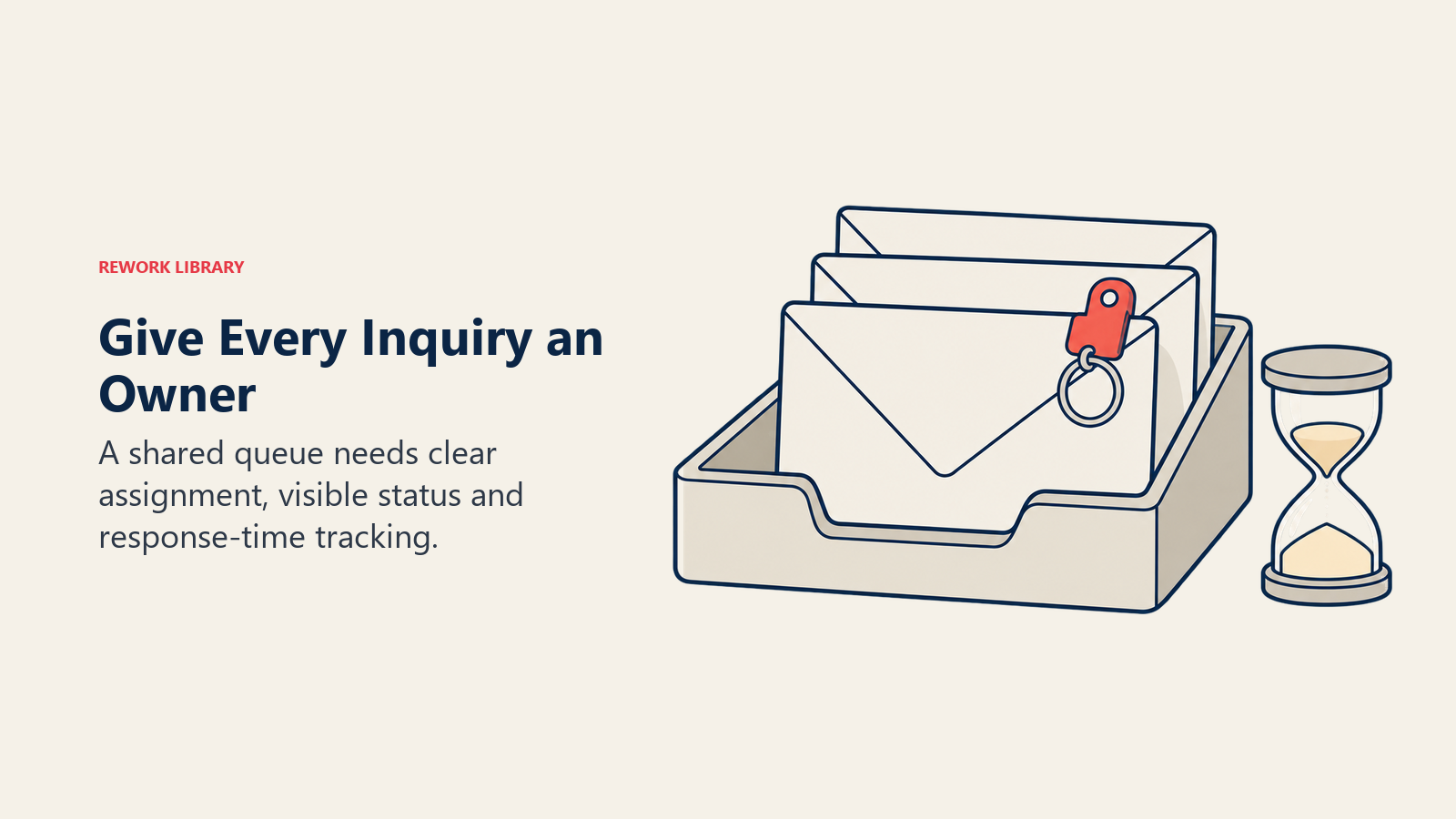
Single inbox aggregation routes all inquiry sources into one system. Website forms, emails, social DMs, and live chat should feed into your CRM or shared inbox where they're visible to your entire team. This prevents inquiries from getting lost in individual email accounts or platform-specific notification systems. Tools like Front, HubSpot, or Salesforce can aggregate multiple sources.
Round-robin assignment distributes inquiries fairly and prevents overload. When an inquiry arrives, it automatically assigns to the next available agent in rotation. This prevents cherry-picking of easy inquiries and ensures balanced workload. But honor specialization, group travel inquiries should route to group specialists, corporate inquiries to B2B team members.
Response time SLA enforcement means measuring and holding team members accountable. Set clear standards: 50% of inquiries acknowledged within 1 hour, 95% within 4 hours, 100% same business day. Dashboard your team's performance. Celebrate success and address patterns of delayed response. What gets measured gets managed.
Inquiry tracking and status prevents duplication and tracks progress. Each inquiry moves through stages: New → Acknowledged → Qualified → Proposal Sent → Follow-Up → Booked or Lost. This visibility lets managers identify bottlenecks. If 80% of inquiries get acknowledged quickly but only 40% receive proposals within 48 hours, you have a proposal creation bottleneck to address.
Inquiry Qualification Process
Not all inquiries deserve equal effort. Qualify to prioritize effectively.
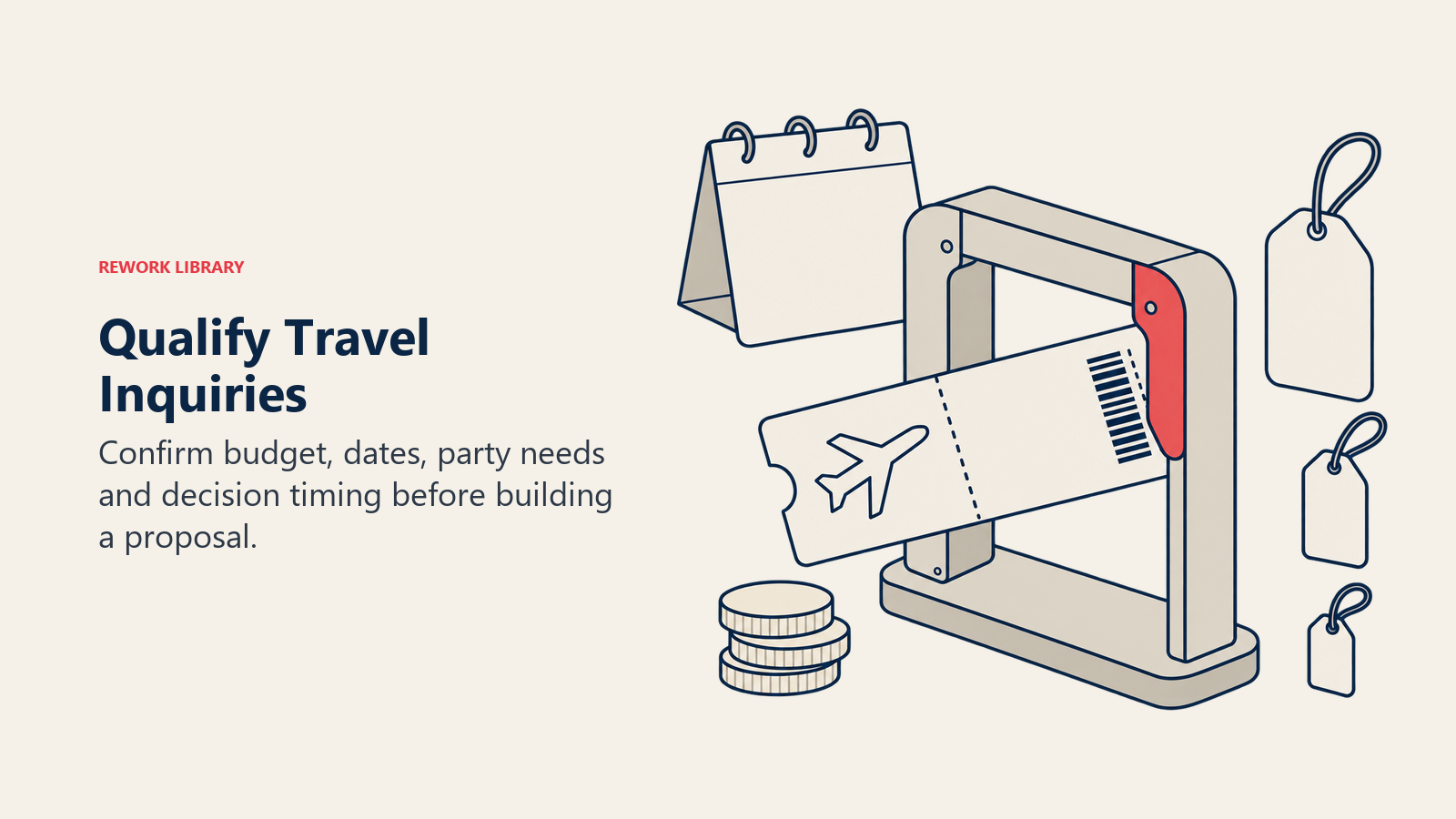
Budget and affordability signals reveal whether they can afford your product. If your average tour is $4,500 and someone asks "Do you have anything around $1,500?" there's a fundamental mismatch. You can educate them on realistic pricing or gracefully refer them to budget providers. Don't invest proposal time in inquiries that can't afford you. Look for signals: "luxury," "best available," "premium" suggest budget flexibility. "Cheapest," "budget," "affordable" suggest price sensitivity.
Travel dates and flexibility affect urgency and conversion probability. Fixed dates ("We're traveling June 15-25") are higher intent than vague windows ("Sometime next summer"). Ask about flexibility, can dates shift by a week if it means better availability or pricing? Flexible prospects are easier to serve profitably.
Group size and composition determine product fit and complexity. Solo travelers need different offerings than groups of 12. Families with young children need different pacing than retired couples. Multi-generational groups need diverse activity options. Understand composition to recommend appropriately.
Decision authority and timeline separate researchers from buyers. Ask "When are you hoping to make a decision?" and "Who else is involved in this decision?" Someone traveling next month who's the sole decision-maker has high urgency and authority. Someone casually researching for a potential trip next year with no decision timeline is low-priority nurture.
Competition awareness tells you what you're competing against. Ask "Are you considering other destinations or providers?" If they're comparing you to two competitors, you know you need to differentiate. If you're their first inquiry, you have an opportunity to frame their expectations before competitors engage.
Response Framework
Systematic response structure improves consistency and conversion.
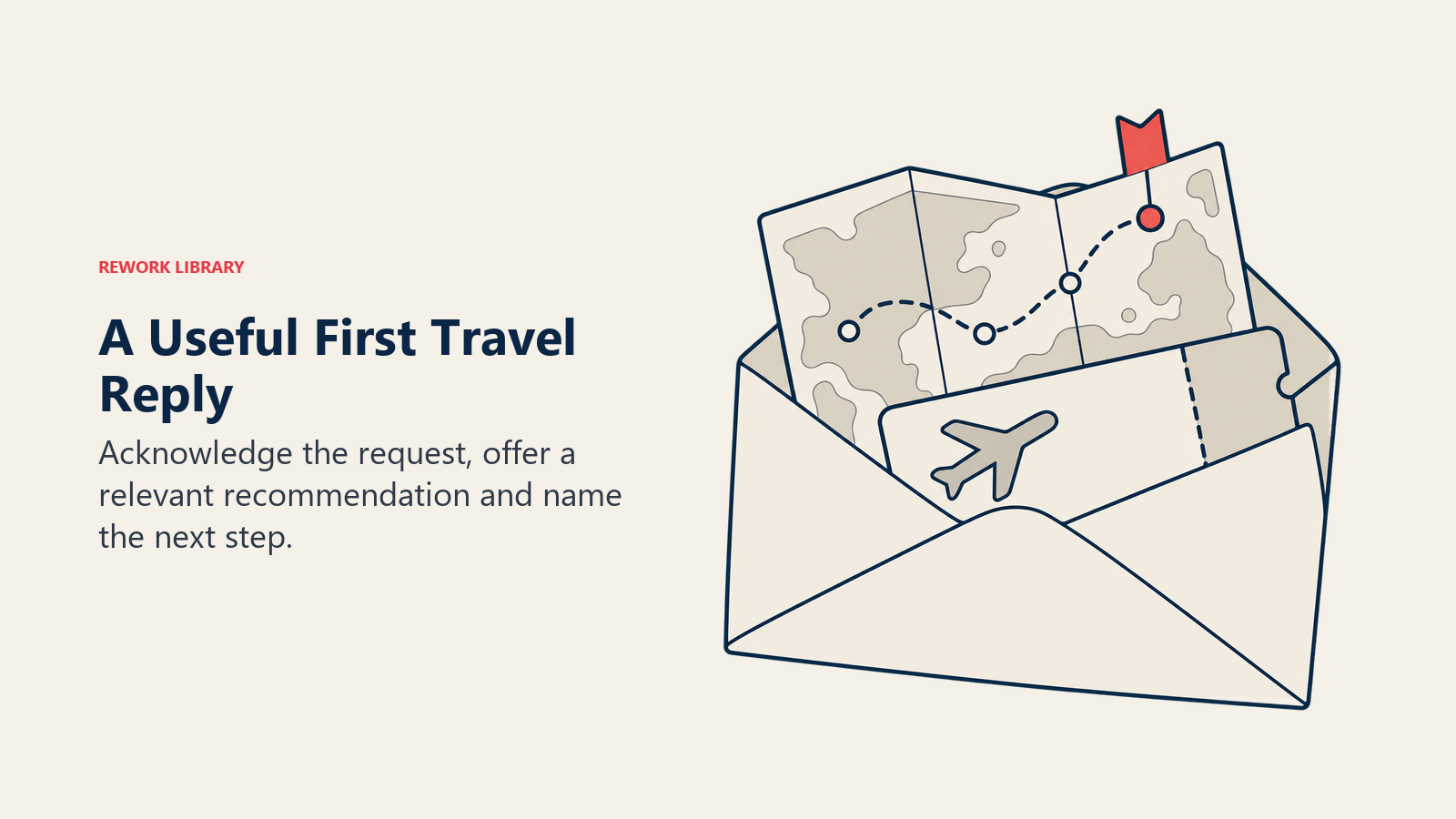
Acknowledgment template sent within 1 hour shows you received their inquiry and sets expectations. "Thank you for your interest in our Patagonia tours. I'm reviewing your request and will send detailed recommendations by end of day. Meanwhile, is there anything specific about Patagonia that's most important to you, wildlife viewing, hiking, glacier experiences?" This buys you time to craft a thoughtful response while demonstrating immediate attention.
Information gathering questions uncover needs beyond what they initially shared. "What's most important to you in this trip, adventure, relaxation, cultural immersion?" "Have you traveled to South America before?" "What attracted you to this destination?" These questions inform your recommendations and show you're customizing, not sending generic brochures.
Preliminary recommendation demonstrates expertise immediately. Don't wait until you've created a full proposal to add value. In your first substantive response, share high-level thoughts: "Based on your interest in wildlife and June timing, I'd suggest our 12-day Patagonia Wildlife Explorer focusing on penguin colonies and glacier kayaking. Let me know if that aligns with what you're envisioning, and I'll send detailed itinerary and pricing."
Call-to-action and next steps keep momentum. End every communication with clear next steps: "Can we schedule a 15-minute call tomorrow to discuss details?" or "I'll send a detailed proposal by Friday. Meanwhile, check out this gallery of our recent Patagonia tours: [link]." Don't leave responses open-ended.
Value demonstration builds confidence early. Share a relevant testimonial, link to a blog post about the destination, or provide a planning resource ("Here's our Patagonia Packing Guide to help you prepare"). These small value-adds position you as a helpful advisor, not just a vendor.
Multi-Channel Response Strategy
Different channels serve different purposes.
Email for detail and documentation provides written records of itineraries, pricing, terms, and logistics. Email allows you to share comprehensive information, attach documents, and give people time to review at their pace. Use email for proposals, detailed itineraries, and formal quotes.
Phone for relationship and urgency builds personal connections faster than text-based channels. A 15-minute phone conversation can accomplish what requires a dozen emails. Use phone calls for discovery (understanding needs), objection handling (addressing concerns), and closing (confirming booking). Warm up cold inquiries with email, then request a call to personalize the relationship.
Video for personalization and trust creates face-to-face connection without travel. Record a 60-90 second personalized video introducing yourself and your preliminary recommendations. "Hi Sarah, I'm excited to help you plan your Iceland adventure. Here's what I'm thinking based on your interests..." This feels shockingly personal compared to text emails and differentiates you dramatically from competitors.
WhatsApp for convenience meets international customers where they already communicate. After initial email contact, offer to continue the conversation on WhatsApp for faster back-and-forth. This works especially well for customers in Europe, Asia, and Latin America where WhatsApp is default communication.
Follow-Up Cadence
Systematic follow-up prevents leads from going cold.
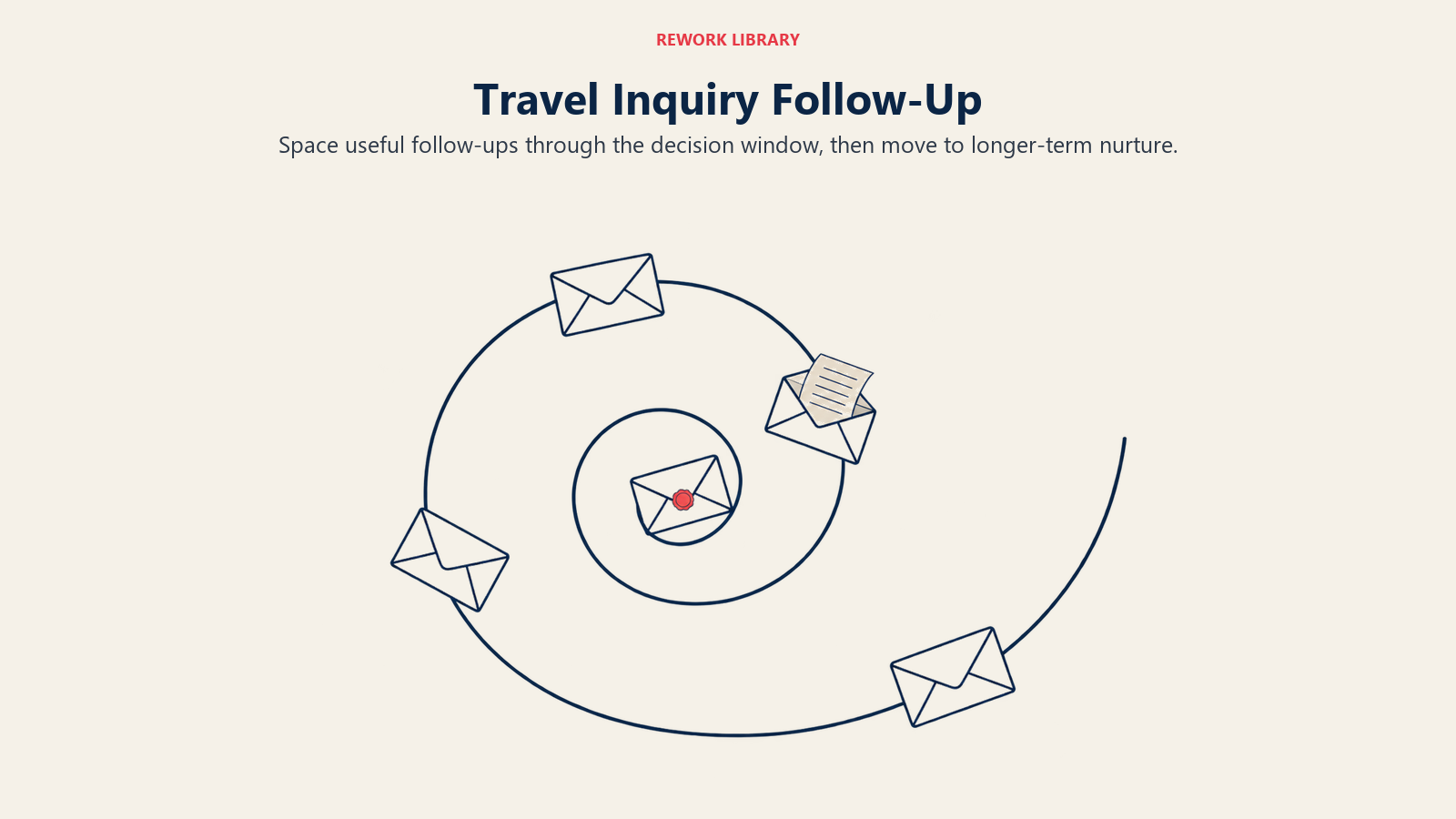
Day 1 immediate acknowledgment confirms you received their inquiry. This is the placeholder that buys time.
Day 2 detailed proposal delivers substantive value. Send your customized itinerary recommendation with pricing, inclusions, and next steps. This is your main value delivery.
Day 4 check-in and question response gives them time to review your proposal, then re-engages. "Did you have a chance to review the itinerary I sent? Happy to answer any questions or adjust based on your feedback." Don't assume silence means disinterest, people are busy and need prompts.
Day 7 value reinforcement shares additional content. Send a relevant testimonial: "I thought you'd appreciate hearing from John and Susan who just returned from this exact itinerary." Or share a blog post: "This article on best time to visit Patagonia might help with your timing decision."
Day 14 limited availability urgency creates gentle pressure. "I wanted to check in because availability for June departures is starting to tighten. I can still hold space for you through this Friday if you'd like to move forward." This is truthful urgency (availability does tighten), not manufactured scarcity.
If they don't convert after 14 days, move them to long-term nurture, monthly check-ins, seasonal promotions, destination updates. Don't give up entirely, but reduce frequency.
Technology Stack
The right travel CRM systems make systematic inquiry management scalable.
CRM with inquiry management capability tracks every inquiry, conversation, and status change. HubSpot, Salesforce, or travel-specific CRMs like TravelJoy or Traveltek provide inquiry pipelines, automated task creation, and customer data management performance dashboards. Don't rely on personal email inboxes, you need shared visibility.
Email marketing for travel automation with personalization lets you send triggered follow-ups while maintaining customization. When someone fills out a form, an automated email fires immediately with acknowledgment. When you send a proposal, an automated sequence schedules check-ins on days 4, 7, and 14 unless they respond. But inject personalization, use their name, reference their specific destination interest, and customize based on inquiry source.
Proposal generation tools like Traveltek, Travefy, or Streamlined let you build beautiful itineraries quickly by assembling pre-built components. This reduces proposal creation time from 4 hours to 45 minutes, enabling faster response. Templates for common destinations and tour types provide consistency while allowing customization.
Response time monitoring dashboards show team performance. How quickly are inquiries being acknowledged? What's average time to proposal? Which team members are fastest and slowest? Which inquiry sources convert best? This data drives operational improvement.
Conversion tracking connects inquiries to revenue. Track conversion rate by source (website form converts at 18%, phone inquiries at 35%, social media DMs at 12%). This guides marketing budget allocation. Track conversion rate by team member to identify coaching opportunities or best practices to replicate.
Conclusion
You're already generating inquiries through marketing investments. The question is whether you're converting them efficiently or losing them to operational failures. Response speed, personalization, and systematic follow-up separate operators booking 30% of inquiries from those booking 8%.
The infrastructure isn't complicated, centralized inbox, response time standards, qualification frameworks, and multi-touch follow-up sequences. But it requires discipline and measurement. Track your response times, monitor conversion rates, and hold your team accountable to standards.
Inquiry management is the highest-leverage operational improvement most travel companies can make. You're already paying for the leads. Don't waste them by responding slowly or following up inconsistently.
Related Articles: