Travel Quote Management: Streamlining Proposals & Tracking - 2026
Turn this article into takeaways for your work.


Each assistant summarizes the article only for you and suggests best practices for your work.
You've got 23 outstanding quotes in various stages. The Miller family is waiting for your response on their Bali revision. The corporate group inquiry from last week hasn't received your proposal yet. Someone emailed asking about "that Spain quote from a few months ago" and you can't immediately find which version they mean.
When quote management lives in your email inbox and a scattered collection of documents, opportunities slip through. Systematic tracking transforms chaos into conversion.
Quote Management System Overview
An effective quote management system captures every proposal from creation through final outcome, creating visibility into your sales pipeline and preventing lost opportunities.
The complete lifecycle includes: inquiry receipt and qualification, initial proposal creation, delivery to client, follow-up sequences, revisions and adjustments, decision (booked or lost), and post-decision analysis. Each stage requires specific actions and tracking. Understanding the full travel sales process helps you map quotes to each pipeline stage.
CRM integration connects quotes to broader client relationships. You need to see all quotes associated with a client (they might inquire multiple times before booking), track communication history (what did you discuss on that call last Tuesday?), and link quotes to eventual bookings for revenue tracking. A proper travel CRM implementation centralizes all this information.
Pipeline visibility shows where opportunities concentrate and where they stall. If you've got 40 quotes in "sent" status but only 5 in "negotiating," your follow-up process isn't working. If quotes move quickly to "negotiating" but stall there, you're likely having pricing issues or competitive challenges.
Version control prevents the nightmare of clients referencing the wrong proposal. Each revision gets a new version number, clearly labeled, with change summaries. When the Johnsons email about "the quote you sent," you know exactly which one they mean.
Quote Creation Workflow
Standardizing quote creation ensures consistency, improves speed, and reduces errors that cost time or money.
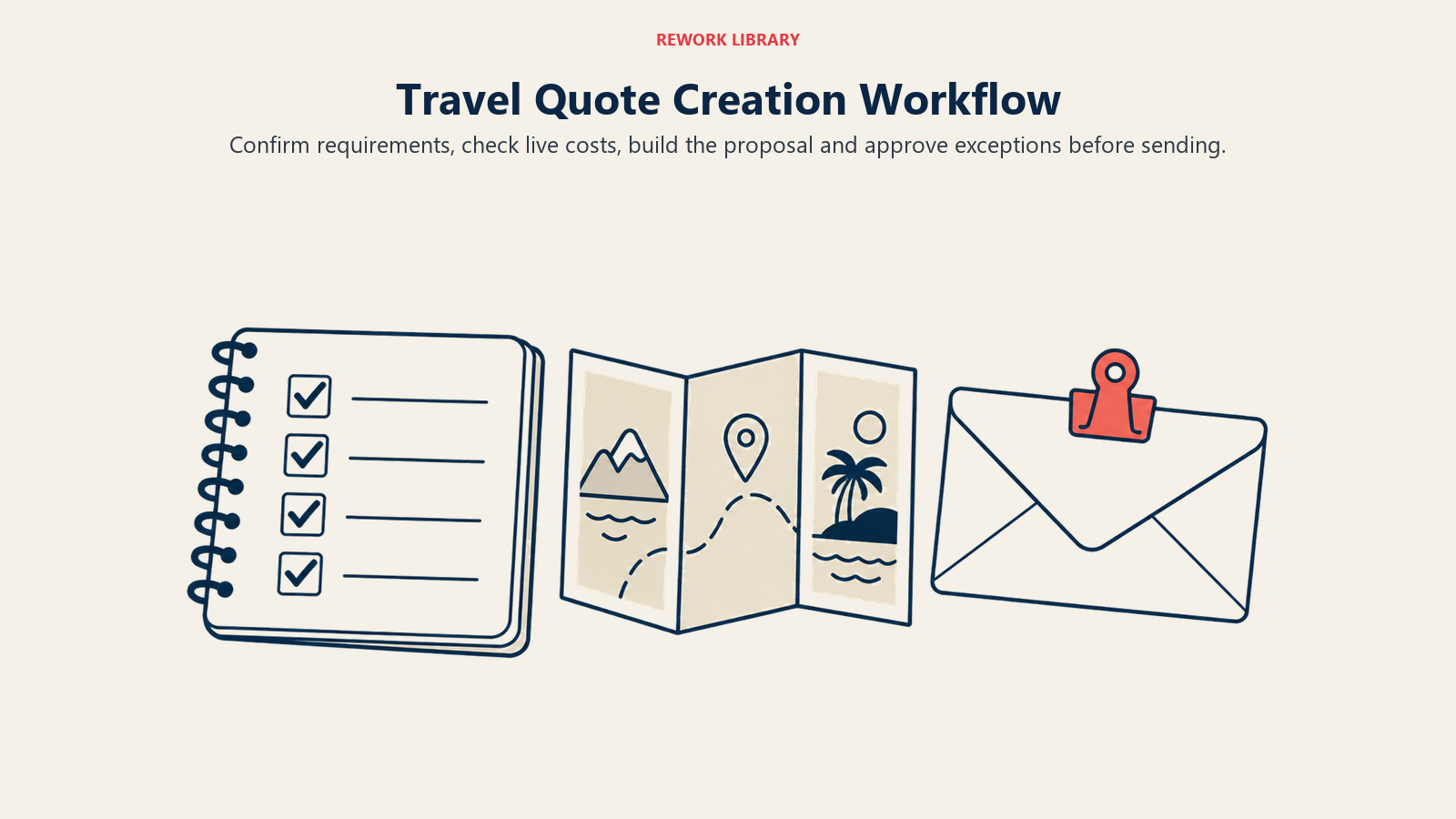
Requirements gathering starts the process. Before pricing anything, confirm: exact travel dates (departure and return), number of travelers (adults and children with ages), destination preferences and must-see elements, accommodation standards and preferences, pace expectations (relaxed vs comprehensive), budget parameters, and any special requirements (dietary restrictions, accessibility needs, celebration occasions).
Pricing research involves checking current rates with preferred suppliers, confirming availability for specific dates, calculating seasonal pricing variations, researching market rates for competitive positioning, and factoring in your margins and commissions.
Markup calculation methodology should be consistent across quotes. Standard markup percentages by product type (hotels, transportation, activities), minimum profit thresholds per booking, competitive rate checking to ensure you're not priced out of consideration, and value-based pricing for unique or exclusive elements you provide. Your travel pricing strategy should guide these decisions.
Professional proposal creation follows your proven template: compelling introduction that captures their specific interests, clear itinerary day-by-day, detailed inclusions and exclusions, transparent pricing breakdown, payment terms and booking process, and your contact information with next steps. Master itinerary building to create proposals that sell themselves.
Internal approval processes prevent costly errors. For new agents, manager review before sending ensures accuracy. For exceptional discounts or unusual terms, leadership sign-off protects margins. For complex group bookings, operations review confirms feasibility before committing.
Quote Numbering & Organization
A systematic naming convention transforms random documents into an organized library you can search efficiently.
Quote numbering should encode useful information. Format like: YYYY-MM-ClientInitials-Destination-Version. Example: 2026-03-SM-Italy-v1. The year and month let you track sales pipeline timing. Client initials enable quick identification. Destination clarifies what trip this covers. Version tracks iterations.
File organization structure keeps related documents together. Create folders by client, then subfolders for each quote, containing the proposal PDF, pricing worksheets, supplier confirmations, communication history, and final booking confirmation (if they book).
Digital asset management means storing files where your team can access them. Cloud storage (Google Drive, Dropbox, OneDrive) enables remote access and prevents loss if someone's laptop dies. CRM document storage links quotes directly to client records. Whatever system you choose, consistency matters more than sophistication.
Archiving strategies balance accessibility with organization. Active quotes (last 90 days) stay in your main working folders. Won bookings move to a "booked" archive. Lost quotes after a specific period (180 days of no response) move to "inactive." This keeps your active workspace manageable while preserving history.
Pricing Components & Markup Strategy
Understanding what you're actually charging for enables strategic pricing decisions rather than arbitrary margins.
Net rates from suppliers represent your cost before markup. Hotel net rates might be 20-30% below public prices. Tour operator net rates include their margins. Transfer services quote wholesale prices. Activity providers offer trade rates. Know your true costs to calculate meaningful margins.
Commission structures vary by product type. Hotels might pay 10-15% commission. Tour operators offer 10-20%. Airlines typically don't pay commission to traditional agencies (but might through consolidators). Activities and attractions pay varying rates. Your pricing strategy differs based on how suppliers compensate you. Understanding commission & margin management is critical for profitability.
Markup percentages should align with value delivered and competitive positioning. Standard FIT bookings might carry 15-20% markup on net rates. Complex custom itineraries justify 25-30% because of design effort involved. Luxury bookings can support higher percentages if value is clearly demonstrated. Budget-conscious travelers require lower markups and higher volume.
Bundling strategies can improve perceived value while protecting margins. Package pricing (one total versus itemized breakdown) sometimes converts better. Inclusive pricing (all meals, activities, transfers included) prevents nickel-and-diming feeling. Tiered packages (good-better-best) guide clients toward optimal choices. Effective package pricing optimization maximizes both conversion and margins.
Competitive positioning requires knowing market rates. If competitors consistently win similar bookings at lower prices, either your costs are too high (find better supplier rates) or your value demonstration is weak (improve proposals). If you're always the lowest price, you might be leaving money on the table.
Quote Validity & Expiration Management
Travel pricing fluctuates constantly. Managing quote validity protects you from rate increases while encouraging timely decisions.
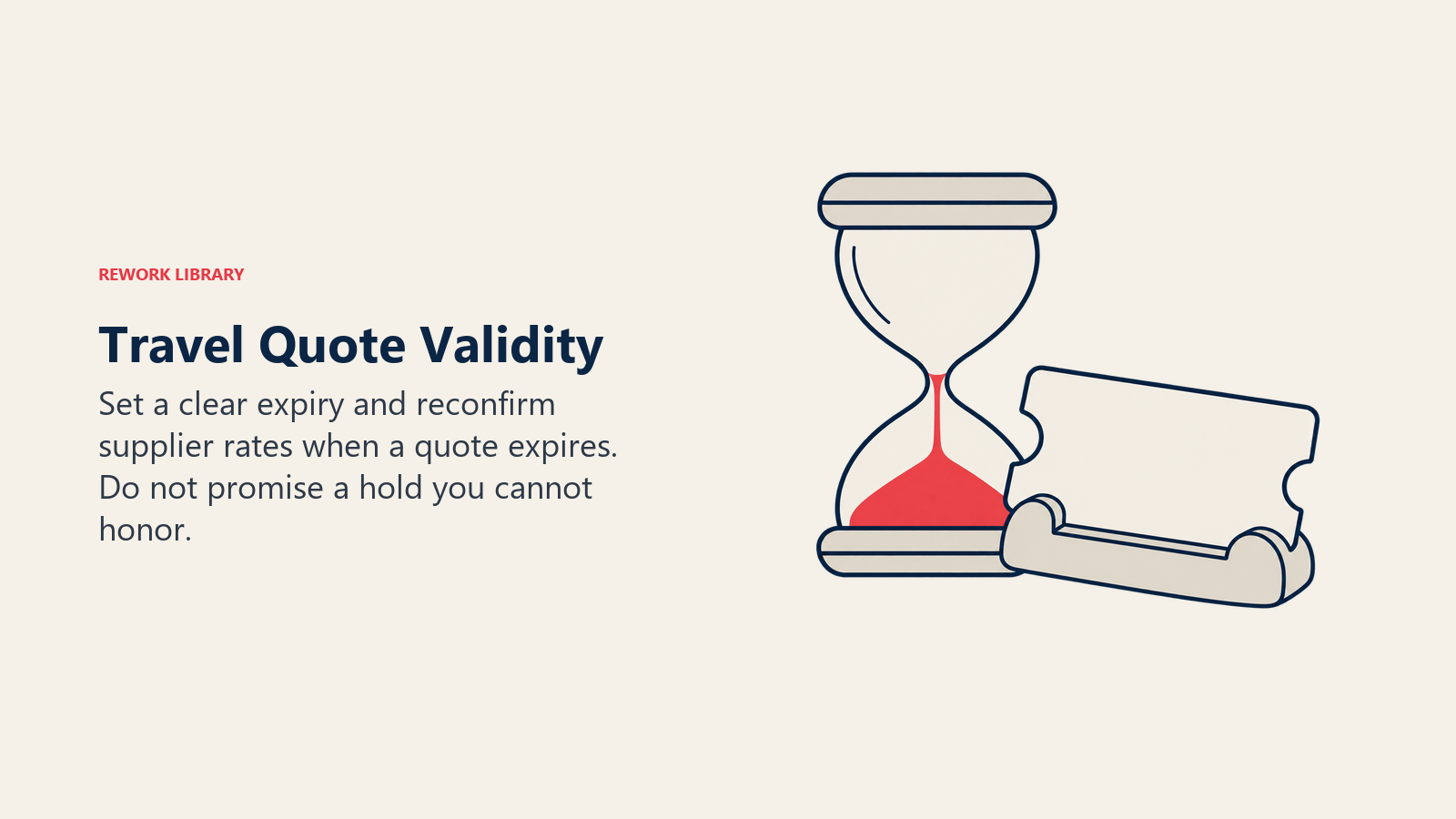
Setting appropriate validity periods balances client decision time against pricing stability. For domestic travel 30-60 days out, a 7-14 day validity period is reasonable. For international travel 6-12 months out, 30-45 days makes sense because rates are more stable far in advance. For peak season or limited availability, shorter validity periods (48-72 hours) create appropriate urgency.
Managing price holds with suppliers requires understanding their policies. Hotels might hold rates for 24-48 hours, then release if not booked. Tour operators handling groups need longer lead time for confirmations. Flights change constantly, quote them with the caveat that pricing is live at booking time. For complex pricing, consider dynamic pricing in travel strategies.
Communicating deadlines clearly prevents misunderstandings. In your quote: "This proposal is valid through March 15, 2026. After this date, pricing and availability must be reconfirmed as rates may change." Set calendar reminders to follow up before expiration rather than letting quotes silently expire.
Revalidating expired quotes takes time but maintains client relationships. "I'm checking on your Italy trip, the quote I sent in February has expired. Would you like me to refresh pricing for your June dates? Some rates have increased slightly, but I can also check if any promotions have become available that might offset increases."
Follow-Up Automation & Scheduling
Consistent follow-up separates top converters from average performers. Automation ensures nothing falls through cracks while maintaining personalization.
Creating follow-up sequences builds systematic touchpoints. Day 1 after sending: "Confirming you received the Portugal proposal. Happy to walk you through any sections or answer questions." Day 3-4: "Checking if you've had a chance to review the itinerary. Anything you'd like me to adjust?" Day 7: "Following up on the proposal. The coastal properties I included have strong interest for your dates, I can hold them for a few more days while you decide." Day 14: "Still interested in Portugal for October? Happy to refresh availability and pricing if you'd like to revisit."
Timing strategies based on client behavior improve conversion. If they open the proposal multiple times, they're interested, call rather than email. If they haven't opened it at all after 72 hours, maybe it went to spam or they're traveling, try a different communication method. If they opened immediately but didn't respond, they might have questions they're hesitant to ask, proactively address common concerns.
Multi-channel approaches recognize different communication preferences. Email works for detailed information and provides written records. Phone calls build rapport and enable real-time conversation about concerns. Text messages work for quick check-ins with clients who've shown that's their preference (always ask permission first). Video calls let you walk through complex proposals visually.
Persistence without annoyance requires reading client signals. Someone who responds to every message is engaged, continue consistent follow-up. Someone who's gone silent after initially being responsive might need space, give them a week before checking in again. Someone who never responded at all might not have been qualified, one final "Should I close this out or are you still considering?" message, then move on.
Quote Status Tracking
Pipeline stages create workflow visibility and forecasting accuracy.
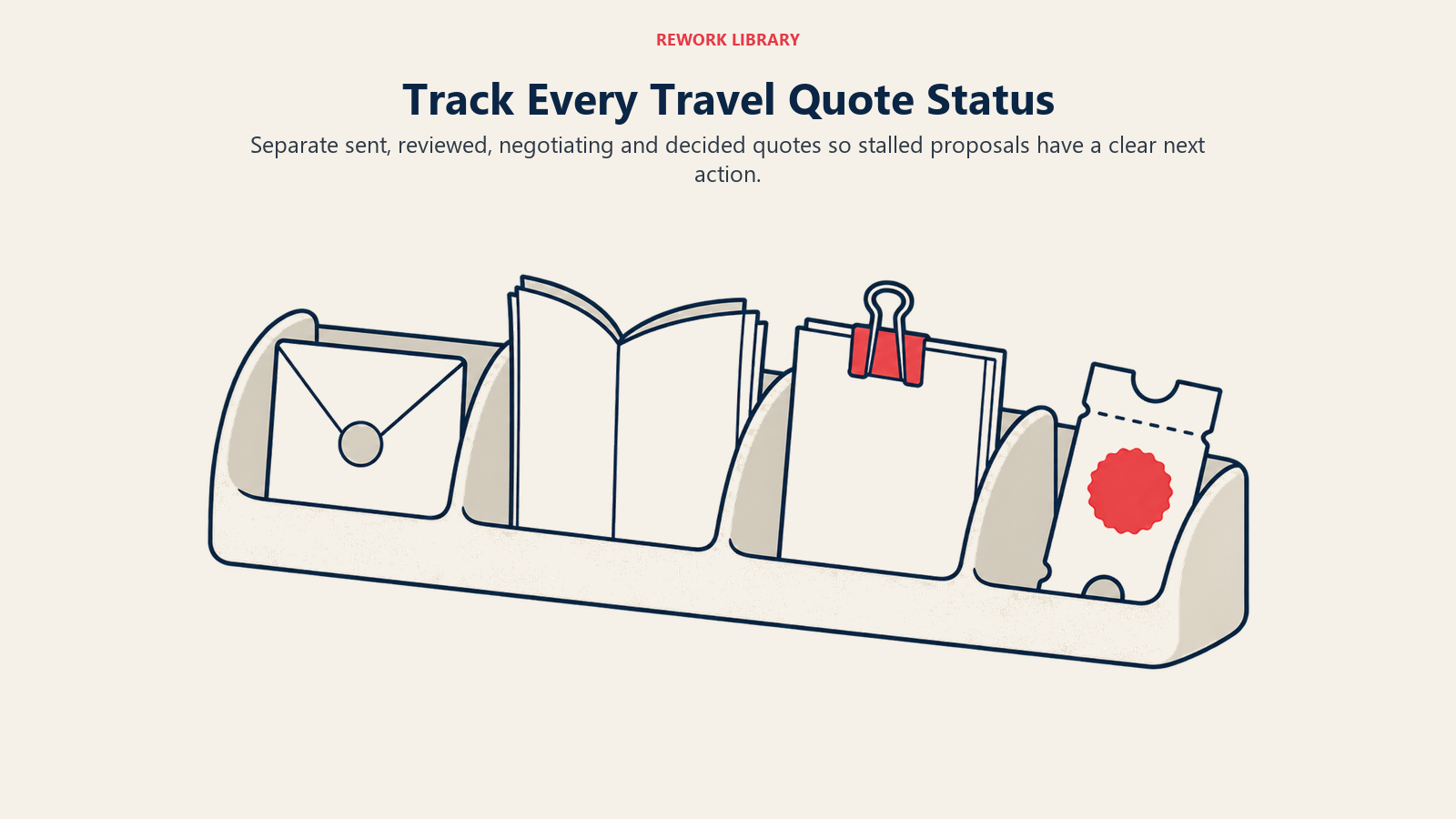
Standard stages might include: Inquiry received (qualified but not yet quoted), Quote in development (actively building proposal), Quote sent (delivered, awaiting response), Under review (client confirmed they're reviewing), Negotiating (discussing adjustments or concerns), Decision pending (client indicated timing for decision), Booked (deposit received), and Lost (confirmed not moving forward).
Probability weighting helps forecast revenue. Quote sent might be 20% probability. Under review increases to 35%. Negotiating jumps to 60%. Decision pending hits 80%. This lets you project revenue based on your active pipeline: "We have $280,000 in active quotes with weighted probability of $67,000 closing this month."
Forecasting from pipeline data improves business planning. If your typical FIT sale is $8,000 and you need $160,000 in monthly revenue, you need roughly 20 bookings. At a 30% conversion rate, you need about 67 active quotes. Track your actuals against these benchmarks to know if you're ahead or behind.
Sales velocity metrics identify bottlenecks. If average time from inquiry to quote delivery is 4.3 days but top performers do it in 1.8 days, you've found an improvement opportunity. If quotes sit "sent" for 12 days on average before clients respond, your follow-up strategy needs work.
Revision & Amendment Process
Virtually every quote goes through changes before booking. Efficient revision management prevents frustration and maintains momentum.
Managing changes to existing quotes starts with understanding what's actually being requested. "We want to adjust the Italy trip" could mean different dates, different cities, different hotels, or different pace. Clarify specifics before rebuilding: "Just to confirm, you want to keep Rome and Florence but replace Venice with the Amalfi Coast, and add two days to the overall trip?"
Repricing after changes requires efficiency. If you're rebuilding pricing from scratch for every minor adjustment, you're wasting time. Have rapid-access tools: supplier rate sheets bookmarked, markup calculators ready, CRM templates that populate automatically. Major changes might require hours of research; minor tweaks should take minutes.
Communicating modifications clearly prevents confusion. "I've updated the proposal based on our conversation. Changes: Replaced Hotel ABC in Barcelona with Hotel XYZ (your preferred location), added extra day in Granada, removed Madrid entirely. New total: €7,850 per couple (previous was €7,200). Attached is version 2 with changes highlighted."
Maintaining quote history prevents disputes and helps you understand client decision-making. Keep every version you send. When they book, you know exactly what they're expecting. If they claim "You said it would only be $10,000," you can pull up version 3 from March 12 showing the actual quote was $11,500 for the specific dates and inclusions they selected.
Lost Quote Analysis
Learning from losses prevents repeating mistakes and identifies systemic issues to address.
Capturing loss reasons requires actually asking. Don't let quotes die silently. Final outreach: "I haven't heard back on the Japan proposal and wanted to check if you've decided not to move forward. If so, would you mind sharing why? It helps me improve my service for future clients." Many people will tell you if asked directly.
Common categories include: Price too high (they found cheaper or exceeded budget), Timing didn't work (dates no longer feasible), Booked with competitor (selected different company), Decided not to travel (changed their mind about the trip itself), Not responsive (ghosted after initial inquiry), and Other circumstances (job loss, health issues, family emergencies).
Competitive intelligence emerges from lost deals. If clients consistently mention a specific competitor undercutting your pricing, investigate what they're actually offering. Often "cheaper" means inferior product (lower hotel category, fewer inclusions, less service). But if they're genuinely offering equivalent value at better prices, you need better supplier rates or more efficient operations.
Price sensitivity insights help refine your target market. If you're consistently losing deals over price, you're either attracting the wrong clients (your marketing targets budget travelers but you specialize in luxury) or you're truly overpriced for your market. Analyze: what were the average booking values of lost quotes versus won quotes? Where's the price threshold where clients start balking?
Continuous improvement strategies turn analysis into action. Monthly review of all lost quotes looking for patterns. Quarterly deep-dive with the team to identify trends. Annual analysis of lost quote reasons to spot macro shifts in your market. Use these insights to refine targeting, adjust pricing strategies, improve proposals, or enhance value delivery.
Quote-to-Booking Conversion Optimization
Systematic improvement of conversion rates compounds into significant revenue increases.
A/B testing proposal formats reveals what actually drives decisions. Send half your quotes with itemized pricing, half with package pricing, which converts better? Try different visual layouts, various levels of detail, different numbers of options presented. Track results rigorously.
Improving response times dramatically impacts conversion. Industry data shows the first travel company to respond to an inquiry has significantly higher booking odds than those responding later. If your average response time is 24 hours, cut it to 4 hours and watch conversion rates climb. Systematic travel inquiry management ensures fast, consistent responses.
Value communication matters more than pricing details. Clients rarely choose the cheapest option when value differences are clear. Your proposal should make obvious why booking with you delivers outcomes they can't get elsewhere: your destination expertise, supplier relationships enabling special access, personalized service throughout their trip, and problem-solving capability when things go wrong.
Closing rate improvement tactics compound small gains into major results. If you're converting 25% of quotes at $8,000 average booking value with 100 monthly quotes, you're at $200,000 monthly revenue. Improve conversion to 30%, everything else unchanged, and monthly revenue jumps to $240,000. Small percentage improvements in conversion rates matter enormously.
Quote management isn't about bureaucratic systems for the sake of organization. It's about converting more opportunities into bookings by ensuring nothing falls through cracks, enabling better client service through information access, and continuously improving through data analysis.
Your quote pipeline is your revenue pipeline. Manage it like your business depends on it, because it does.
Related Articles:

Business Consultant
On this page
- Quote Management System Overview
- Quote Creation Workflow
- Quote Numbering & Organization
- Pricing Components & Markup Strategy
- Quote Validity & Expiration Management
- Follow-Up Automation & Scheduling
- Quote Status Tracking
- Revision & Amendment Process
- Lost Quote Analysis
- Quote-to-Booking Conversion Optimization