Travel Trade Shows & Events: B2B Lead Generation for Tour Operators
Turn this article into takeaways for your work.


Each assistant summarizes the article only for you and suggests best practices for your work.
Travel companies spend $50,000+ attending a major trade show (booth rental, flights, hotels, staff time, collateral) and return home with a stack of business cards and vague promises to "stay in touch." Six months later, they've closed maybe two deals from 87 conversations and can't definitively attribute either sale to the event.
The problem isn't trade shows. It's the execution. Most exhibitors treat shows as networking cocktail parties rather than focused sales campaigns with clear objectives and measurement systems. They wing it on the show floor, capture leads inconsistently, and follow up sporadically if at all.
But when executed strategically, trade shows deliver concentrated access to qualified buyers that no digital channel can match. A single conversation with a group travel planner can generate $200,000 in bookings through effective group travel sales. An introduction to a corporate travel manager opens doors to annual corporate travel sales contracts. The ROI is there, but only if you approach events as a structured sales program rather than a brand awareness exercise.
Travel Trade Show Landscape
Different events serve different purposes and attract different buyers.
Major global shows like ITB Berlin, World Travel Market London, and USTOA Annual Conference draw thousands of travel professionals across all sectors: tour operators, travel agents, DMCs, airlines, hotels, and destinations. These mega-events provide broad exposure but also intense competition. Your booth is one of 800. Making an impression requires significant investment and pre-planned meetings. The advantage is scale: you can conduct 30-40 pre-scheduled meetings over three days with buyers from multiple markets.
Regional and niche events focus on specific segments. IPW (International Pow Wow) targets inbound travel to the US. Adventure Travel Trade Association Summit attracts adventure and experiential travel specialists. GBTA Conference serves corporate travel buyers. These events offer higher buyer relevance if your product aligns with their focus. Instead of filtering through general travel professionals, you're surrounded by your exact target audience.
Virtual and hybrid formats emerged during COVID and persist for events where physical presence matters less. They dramatically reduce costs but also reduce relationship depth. Screen fatigue is real. Attention spans in virtual settings are 40% shorter than in-person. Use virtual events for early-stage discovery and relationship maintenance, not for high-value deal closing.
Hosted buyer programs flip the traditional model. Destinations or large suppliers invite qualified buyers to attend at reduced or zero cost in exchange for pre-scheduled meetings with exhibitors. You pay a fee per meeting ($200-500 each), but you're guaranteed face time with vetted decision-makers. Conversion rates on hosted buyer meetings are 2-3x higher than walk-up booth traffic because buyers are pre-qualified and committed to attending meetings.
Event Selection Framework
Not every event deserves your investment. Evaluate systematically.
Target buyer profile alignment is the starting filter. If you sell luxury African safaris, ASTA Destination Expo makes sense because it attracts high-end leisure travel advisors. If you sell corporate group travel, GBTA Conference is your target. Attending events where your ideal customer doesn't attend wastes money regardless of the event's overall size or prestige.
Geographic market priorities guide regional event selection. If you're expanding into Asian markets, attending ITB Asia in Singapore provides more relevant connections than doubling down on European shows. But don't spread too thin. Attend one major event per target market rather than five small ones. Depth of relationships matters more than breadth of casual introductions.
Investment versus opportunity sizing requires honest math. Calculate total event cost: booth rental ($8,000-25,000 for premium positions), travel and lodging ($3,000-5,000 per person × 3-4 staff), collateral printing ($2,000-4,000), sponsorships ($5,000-50,000 if pursuing), and opportunity cost of staff time. If total cost is $60,000 and you need to close 10 new clients at $15,000 average booking value to break even, you need a realistic plan to conduct 60+ qualified meetings (assuming 15-20% conversion). Understanding customer acquisition cost in travel helps set realistic ROI expectations.
Timing and seasonality considerations matter. Attending a show in June to generate leads for winter travel makes sense. Attending in November for summer departures leaves a long gap between lead capture and booking urgency. Align event timing with your selling cycle. Ideally 4-9 months before your peak booking season so leads have time to mature but maintain urgency.
Pre-Event Strategy
Success is determined before you arrive.
Outreach campaign timeline should start 90 days before the event. Send targeted emails to prospects you know will attend: "We'll be at ITB Berlin in March. Can we schedule 30 minutes to discuss our new Patagonia departures?" Book meetings before arrival. Your calendar should be 60-70% full before the show opens. The best buyers book early. If you wait until you arrive to schedule meetings, you get leftover time slots.
Meeting scheduling system needs centralization. Use Calendly, HubSpot Meetings, or event-specific platforms to let prospects book available slots. Assign each team member specific time blocks and buyer segments to avoid double-booking or gaps. Confirm meetings 48 hours before the event and again the morning of. No-show rates for unconfirmed meetings are 30-40%.
Booth design and messaging must communicate your value proposition in three seconds. Attendees walk past 200 booths. What makes them stop at yours? Strong visual imagery (destination photos, not generic travel clip art), clear value propositions ("Specialists in Multi-Generational Family Travel to Costa Rica"), and open, inviting layouts that encourage entry. Avoid sitting behind tables. Stand, engage, make eye contact.
Collateral and demo preparation should be digitally accessible but have select physical pieces. Most buyers don't want to carry 40 brochures through three days of show floor walking. Have QR codes linking to digital brochures, pricing sheets, and sample itineraries. Print 50-75 copies of your best showcase piece for high-priority meetings. Prepare your demo pitch: a 5-minute overview of your unique selling points with specific itinerary examples ready to discuss.
Team training and role assignments prevent confusion and missed opportunities. Assign clear roles: one person manages scheduled meetings, another handles walk-up traffic, a third focuses on competitor intelligence (walking the floor to observe trends and competitive positioning). Practice your elevator pitch until everyone can deliver it consistently. Role-play objection handling so you're prepared for "your prices seem high" or "we already work with a supplier in that region."
On-Site Execution
The show floor is where preparation converts to pipeline.
Lead capture methodology must be consistent and immediate. Use badge scanners that integrate with your travel CRM implementation, or have a tablet-based form that captures name, company, role, specific interests, and conversation notes. Capture leads within 30 seconds of ending a conversation while context is fresh. The business card fishbowl approach where you collect hundreds of cards with no context is worthless. You won't remember who was interested in what.
Qualification criteria separate real prospects from casual browsers. Ask questions that reveal buying intent: "What timeline are you working with for booking?" "How many groups do you typically send annually?" "What's your decision-making process?" Not every conversation needs to be qualified (networking has value), but prioritize follow-up resources toward prospects with near-term buying intent and budget authority.
Meeting structure and follow-up commitment should be consistent. Open with a brief introduction, ask discovery questions to understand their needs, present 2-3 relevant offerings, discuss next steps explicitly ("I'll send you detailed pricing by Friday. Can we schedule a follow-up call for next Tuesday?"), and confirm their commitment before closing. Don't leave meetings open-ended. Pin down specific actions and dates.
Networking strategies beyond the booth often generate the best leads. Attend evening receptions and speaker sessions. The person you stand next to at the bar might become your largest client. Wear your badge everywhere. Other attendees are identifying themselves as travel industry professionals. Be approachable, curious, and generous with introductions to others in your network. Social capital compounds.
Demo and presentation best practices emphasize customization. Don't deliver the same canned pitch to every prospect. If you're talking to a luxury travel advisor, emphasize luxury travel sales approaches with five-star accommodations and unique experiences. If you're talking to a corporate group planner, emphasize logistics coordination and budget management. Effective consultative selling in travel tailors examples to their specific interests mentioned in conversation.
Lead Management System
Organize leads in real-time or lose them to chaos.
Real-time lead entry means capturing every conversation into your CRM or shared spreadsheet immediately. Assign leads to team members before the day ends. Tag priority levels: Hot (ready to book, wants pricing immediately), Warm (interested, 3-6 month timeline), Cold (early research, 12+ months out). This triage determines follow-up urgency.
Qualification scoring standardizes prioritization. Use BANT framework: Budget (do they have money allocated?), Authority (are they the decision-maker?), Need (do they have a clear use case?), Timeline (when will they buy?). Score each dimension 1-3 and focus highest effort on prospects scoring 9-12.
Hot lead escalation process ensures your best opportunities don't wait. If someone says "send me pricing tonight, I need to book next week," that lead goes to your most senior salesperson for immediate follow-up. Create a Slack channel or WhatsApp group for real-time hot lead alerts during the event.
Team coordination prevents duplicate outreach and dropped leads. Hold a 15-minute team meeting each evening to review the day's leads, assign follow-up responsibility, and share intelligence gathered on buyer trends or competitor activity. This debrief is when patterns emerge. "Three people asked about flexible cancellation policies" signals a product development opportunity.
Post-Event Follow-Up
Most leads are lost here, not on the show floor.
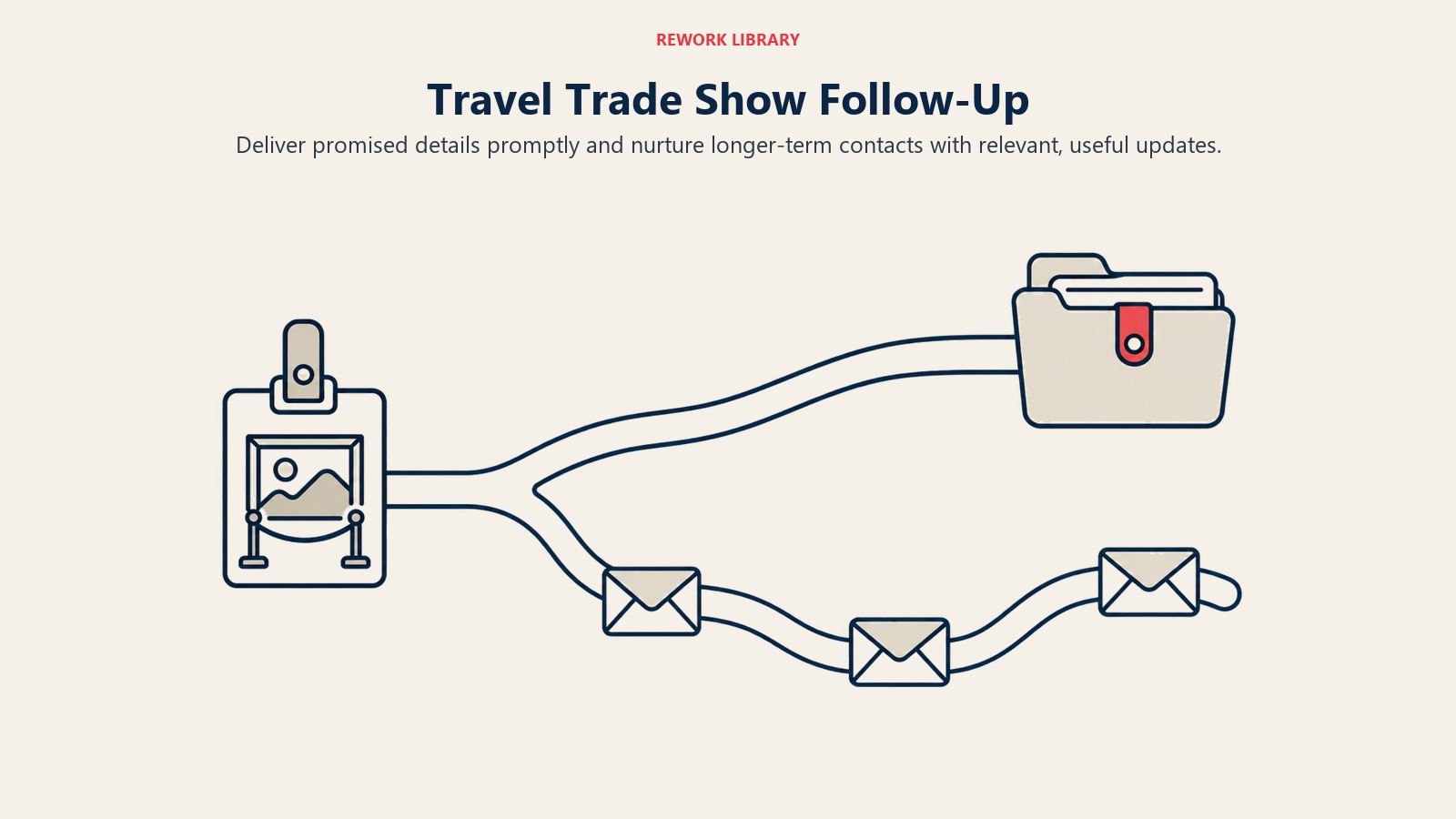
24-hour response protocol is non-negotiable for hot leads. Send the pricing, itinerary, or information promised within 24 hours of the conversation through your travel inquiry management system. Waiting three days tells prospects they're not a priority. Reference specific conversation details ("You mentioned your client is interested in multi-generational travel to Japan") to show you were paying attention.
Nurture campaign structure for warm and cold leads keeps you top-of-mind without being pushy. Week one: send thank-you email with link to your digital brochure. Week three: share a relevant blog post or destination update. Week six: send a case study of a similar client you've served well. Week ten: invite them to a webinar or offer a limited-time promotion. The goal is regular, valuable touchpoints every 3-4 weeks.
Meeting conversion tracking measures show effectiveness. Track: leads captured → qualified prospects → follow-up meetings scheduled → proposals sent → deals closed. Identify drop-off points. If 80% of proposals don't convert, your pricing might be off. If 60% of qualified leads won't schedule follow-up calls, your initial meeting didn't build enough value.
Relationship building cadence extends beyond immediate sales. Not everyone will book in the next 90 days. Some of your best trade show connections mature into partnerships over 12-18 months. Send holiday greetings, congratulate them on business wins mentioned on LinkedIn, introduce them to others in your network who can help them. Invest in relationships, not just transactions.
ROI Measurement Framework
You can't improve what you don't measure.
Cost per qualified lead reveals efficiency. Divide total event cost by number of qualified leads generated. If you spend $55,000 and capture 110 qualified leads, your CPL is $500. Compare this to other lead generation channels. Trade shows typically have higher CPL than digital marketing but much higher close rates and lifetime value.
Meeting to opportunity rate shows qualification effectiveness. If you conduct 45 meetings but only 15 turn into legitimate opportunities (requested proposals or scheduled follow-up), your 33% rate suggests either poor pre-qualification or weak meeting execution. Strong trade show programs convert 40-60% of meetings to active opportunities.
Booking conversion timeline recognizes that trade show leads have longer sales cycles. Track time from initial meeting to closed deal. In B2B travel, this averages 3-8 months. Don't judge trade show ROI 30 days post-event. Give leads time to mature, but set calendar reminders to evaluate 6 and 12 months later.
Customer lifetime value analysis is where trade show ROI really shines. A qualified group travel buyer might book $80,000 in their first year, but if they return annually for five years, lifetime value is $400,000. Understanding customer lifetime value in travel shows your $500 lead cost looks brilliant against that outcome. Track multi-year retention rates for trade show-sourced customers versus other channels.
Brand awareness lift measurement is harder to quantify but valuable. Survey booth visitors about brand awareness and consideration before and after the show. Even if they don't convert immediately, being top-of-mind when their next travel need arises has value.
Alternative Approaches
Exhibition booths aren't the only way to leverage events.
Hosted buyer programs offer guaranteed meetings with pre-qualified prospects. You pay $300-500 per meeting but avoid booth costs and walk-up traffic lottery. If your sales model relies on deep consultative conversations with decision-makers, hosted buyer programs often deliver better ROI than traditional booths.
Sponsorship versus exhibition trades brand visibility for direct sales conversations. Sponsoring the conference app or cocktail reception gets your logo in front of all attendees but provides fewer structured selling opportunities. Effective if you're building awareness in a new market or launching a new brand. Less effective if you need near-term bookings.
Speaking opportunities position you as a thought leader rather than a vendor. Propose a session on travel trends, operational best practices, or destination expertise. Speakers gain credibility that makes subsequent sales conversations easier. After presenting, you're the expert, not just another vendor.
Private events and dinners during trade shows create intimacy impossible on the crowded show floor. Invite your top 15 prospects to a dinner the evening before the show officially starts. Host a breakfast meeting for past clients. These settings foster deeper relationship building and signal that these relationships matter to you beyond transactional selling.
Conclusion
Trade shows remain one of the highest-ROI lead generation channels in travel, but only when approached with the discipline and measurement rigor of a digital campaign. The exhibitors who succeed don't show up hoping for serendipity. They pre-schedule 60% of their meetings, qualify rigorously on the show floor, follow up within 24 hours, and track conversion metrics through to closed deals.
Your $60,000 trade show investment can generate $800,000 in bookings, or it can produce 200 business cards that never convert. The difference is execution discipline before, during, and especially after the event.
Related Articles: