Revenue Per Available Tour (RevPAT) - 2026 Complete Guide
Turn this article into takeaways for your work.


Each assistant summarizes the article only for you and suggests best practices for your work.
You run 50 departures of your signature tour annually. Each tour has 16 available seats. That's 800 total seat-opportunities through revenue management for tours. Some tours sell out at $2,200 per person using travel pricing strategy. Others run with 8 people at $1,900 per person via dynamic pricing in travel. One perspective says you made $1,760,000 revenue - success tracked in travel KPI dashboard. But RevPAT tells the truth: you generated $2,200 per available seat. Your competitor running the same capacity through yield management in travel generated $2,850 RevPAT with smarter pricing and better load factors. They made $2,280,000 from identical capacity - $520,000 more.
RevPAT is the tour operator equivalent of RevPAR in hotels. It measures how effectively you're monetizing your finite capacity, not just whether you're busy. Busy isn't profitable if you're discounting heavily. Empty seats generate zero revenue regardless of your rack rate.
Mastering RevPAT means balancing pricing and occupancy to maximize total revenue.
Understanding RevPAT
The formula is beautifully simple:
RevPAT = Total Tour Revenue ÷ Total Available Capacity
If your 10-day Europe tour has 16 available seats and runs 24 times annually:
- Total capacity: 16 seats × 24 departures = 384 seats
- Total revenue: $738,240
- RevPAT: $738,240 ÷ 384 = $1,922
This single number tells you how effectively you're pricing and filling tours. Unlike occupancy percentage (which ignores pricing) or average price (which ignores load factor), RevPAT captures both variables.
Why it matters more than occupancy alone: Running 90% full at $1,500 per person generates $1,350 RevPAT. Running 70% full at $2,100 per person generates $1,470 RevPAT. The "less full" tour is more profitable. Occupancy alone misleads.
Why it matters more than price alone: Your published rate might be $2,500, but if you're discounting aggressively to fill tours and only averaging $1,900 realized price, RevPAT reflects reality. Published rates are marketing. RevPAT is economics.
RevPAT reveals capacity utilization effectiveness. Hotels talk about RevPAR. Tour operators should obsess about RevPAT with equal intensity. It's the single best metric for comparing performance across time periods, competitors, and different tour products.
RevPAT vs Other Metrics
Load factor (occupancy percentage) measures fullness but ignores revenue quality. A tour running 95% full feels successful. But if you're deeply discounting to achieve that load factor, profitability suffers. Track load factor but don't optimize for it exclusively.
ADR (Average Daily Rate) applies more to accommodations than tours, but the concept translates. It's average revenue per booked unit. For tours, this is average revenue per booked seat. High ADR with low load factor still underperforms on RevPAT.
Total revenue is the ultimate metric but doesn't show efficiency. Your 50-person mega-tour generates more total revenue than your intimate 8-person specialty tour. But the specialty tour might have 3x better RevPAT, indicating it's using capacity more effectively.
The relationship between these metrics:
RevPAT = ADR × Load Factor
If your average realized price is $2,100 and load factor is 78%, RevPAT is $1,638. This formula shows you have two levers: raise prices or fill more seats (or both).
Calculating RevPAT
Fixed departure tours have straightforward calculation. Your Africa safari departs 18 times annually with 12-person maximum capacity. Total available seats: 216. Total revenue from all departures: $486,000. RevPAT: $2,250.
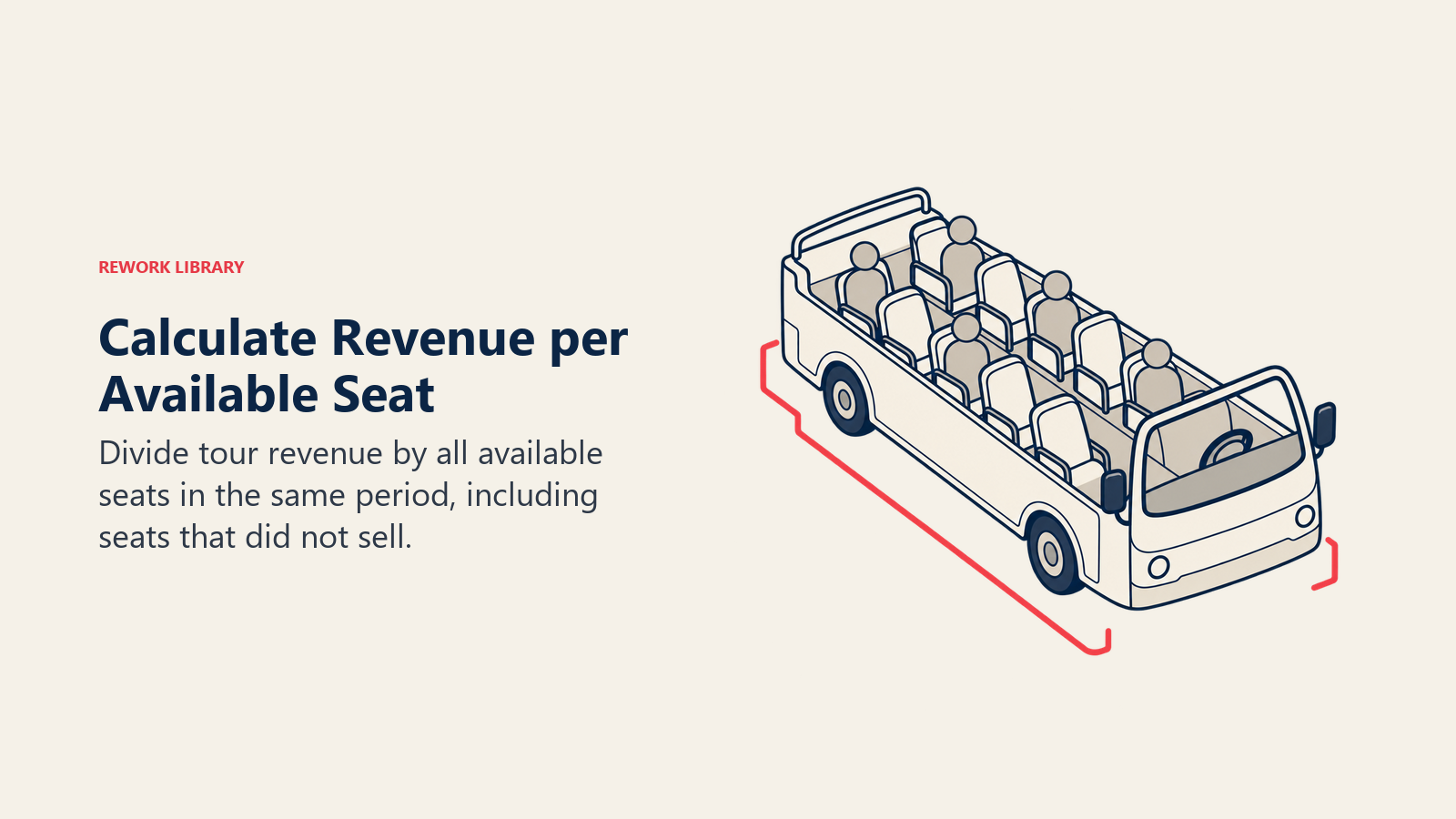
Track this by individual tour product, by season, and overall. Knowing your flagship tour has $2,850 RevPAT while your budget option runs $950 RevPAT guides resource allocation.
Private tours complicate RevPAT because capacity is flexible. A private tour might accommodate 2-8 people. Define "available capacity" as your average group size or most common configuration. If private tours average 4 people and you run 35 annually, that's 140 "available seats" for RevPAT calculation purposes.
Multi-day tours calculate RevPAT on total tour capacity, not daily. Your 14-day tour with 16 capacity running 12 times has 192 total available seats (not 192 × 14 = 2,688 seat-days). You're selling tour spots, not individual nights.
Day tours can calculate RevPAT daily or seasonally. If you run daily departures with 20-person capacity, that's 7,300 annual available seats (20 × 365). Total annual revenue ÷ 7,300 = RevPAT. Or calculate monthly RevPAT to see seasonal patterns.
Example calculations:
Luxury African Safari (12 seats, 18 departures, $4,800 avg price, 75% load factor):
- Total capacity: 216 seats
- Total revenue: $4,800 × 162 booked = $777,600
- RevPAT: $3,600
- This is excellent for luxury segment
Budget Europe Tour (40 seats, 24 departures, $1,600 avg price, 82% load factor):
- Total capacity: 960 seats
- Total revenue: $1,600 × 787 booked = $1,259,200
- RevPAT: $1,312
- Solid for high-volume budget segment
Industry Benchmarks
Budget group tours typically run $800-1,500 RevPAT. They compete on price, run high volume, and accept lower per-seat revenue to achieve high load factors. If you're under $800, pricing is too low or load factors are terrible.
Mid-market tours average $1,200-2,200 RevPAT. This is the largest segment - premium enough to generate decent margins, accessible enough for strong demand. Performance within this range depends on destination, inclusions, and competitive positioning.
Luxury tours range $2,500-5,000+ RevPAT. Small groups, high prices, premium experiences. Load factors run lower (50-70%) because you're not filling every seat at high prices, but per-seat revenue compensates.
Specialty/expedition tours can exceed $6,000 RevPAT for Antarctica, Galapagos, and unique experiences with limited capacity and strong demand. These products have natural scarcity.
Regional variations matter. Europe tours have more competition and price pressure, leading to lower RevPAT averages. Exotic destinations like Madagascar or Bhutan support higher RevPAT due to limited supply and specialized knowledge requirements.
Seasonal benchmarks shift dramatically. Peak season might run 30-50% higher RevPAT than shoulder season for the same tour. This is healthy - price when demand is strong, discount lightly when demand softens.
Components of RevPAT
Pricing strategy directly drives one RevPAT component. Your published rates, discount policies, early booking incentives, and last-minute pricing all affect average realized price. Premium pricing with modest load factors can outperform aggressive discounting with high load factors.
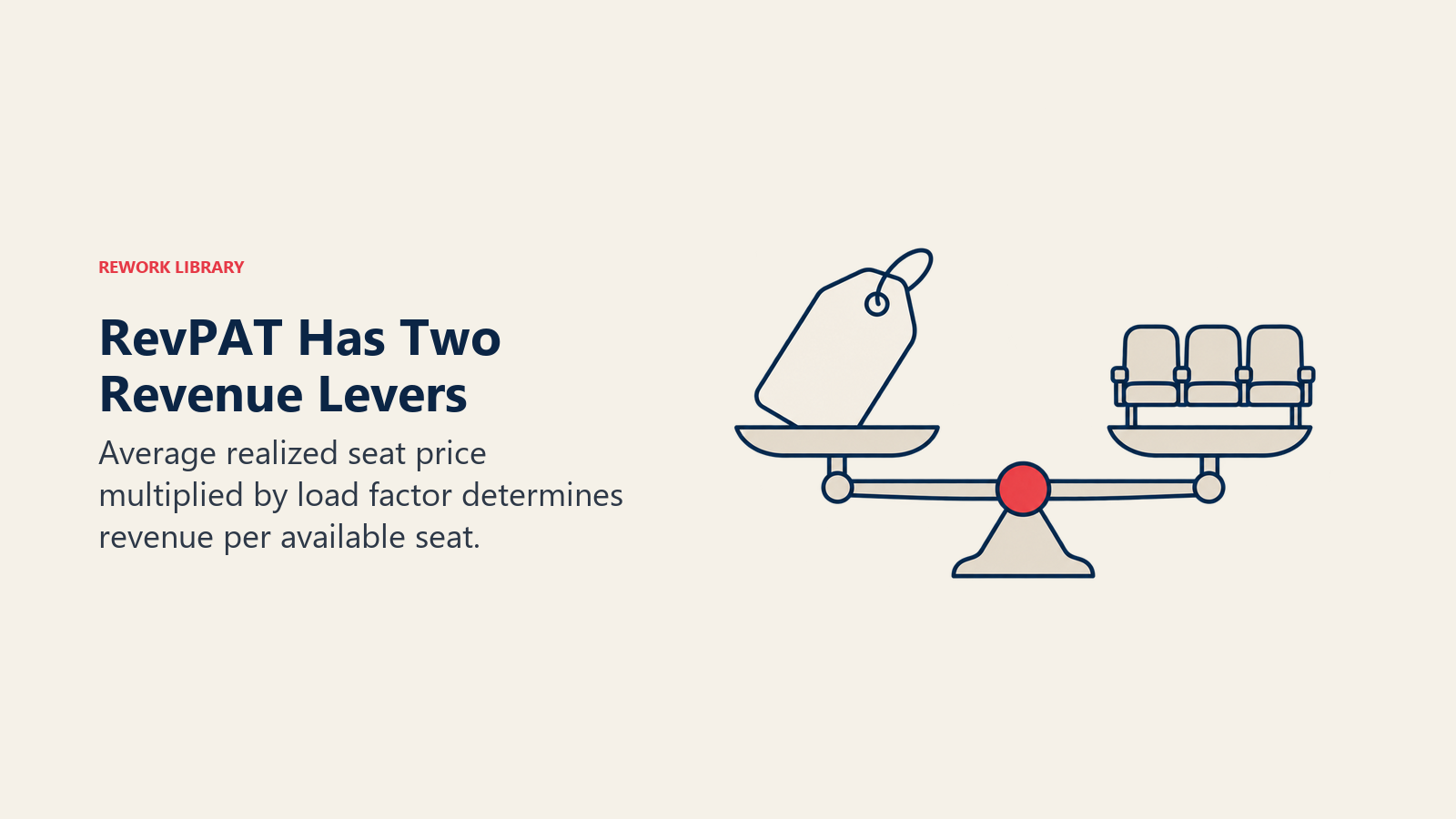
Test pricing sensitivity. If raising prices 8% reduces load factor only 3%, RevPAT improves significantly. If raising prices 10% drops load factor 15%, RevPAT suffers. Find the optimal balance through systematic testing.
Load factor (occupancy) is the second component. This is percentage of available seats actually sold. Calculate: Booked seats ÷ Available seats. An 18-seat tour that averages 14 booked travelers runs 78% load factor.
Industry average load factors: 60-75% for most group tours. Under 50% is concerning unless you're premium luxury intentionally running small. Over 85% is excellent but may indicate you're under-pricing.
The relationship is multiplicative, not additive. You can't compensate for terrible pricing with great load factors, or vice versa. Both matter. A tour at $3,000 price with 40% load factor generates $1,200 RevPAT. A tour at $2,000 price with 75% load factor generates $1,500 RevPAT. The "cheaper" tour wins on RevPAT.
Strategies to Increase RevPAT
Dynamic pricing adjusts rates based on demand signals. When a tour is filling fast, raise prices for remaining seats. When departure is 30 days out and tour is only 40% full, discount moderately to drive bookings. Software tools can automate this.
Minimum group sizes protect profitability. If running a tour with under 8 people destroys unit economics, set 8 as minimum. Cancel departures that don't meet minimums far enough in advance to rebook travelers on other dates.
This might lower load factor on paper (cancelled departures count as 0% load factor in some calculations) but improves RevPAT by eliminating unprofitable low-occupancy departures.
Private tour upsells convert group tour inquiries to higher-revenue private experiences. When someone inquires about your group tour, offer: "This tour runs $2,200 per person with 12-16 travelers. We can also create it as a private experience for $8,500 total for your party of three." The private option generates $2,833 RevPAT versus $2,200 for group.
Load factor optimization through better marketing, earlier booking incentives, and targeted sales to fill tours improves RevPAT without discounting. If you can move load factor from 65% to 72% while maintaining pricing, RevPAT increases 11%.
Inventory management decisions about how many departures to run affect RevPAT. Running 30 departures at 60% load factor generates lower RevPAT than running 22 departures at 82% load factor. Sometimes less is more. Constrain supply to drive demand and pricing power.
Yield management balances pricing and timing. Early bookers get best prices, incentivizing advance commitments. Last-minute buyers pay premium unless inventory isn't moving. The goal is filling tours at optimal blended rates, not just maximum rates or maximum occupancy.
Seasonal RevPAT Management
Peak season premium pricing can run 25-50% above shoulder season for the same tour. If June-August European tours command $2,400 while April-May shoulder season runs $1,800, that's normal market dynamics. RevPAT will vary accordingly.
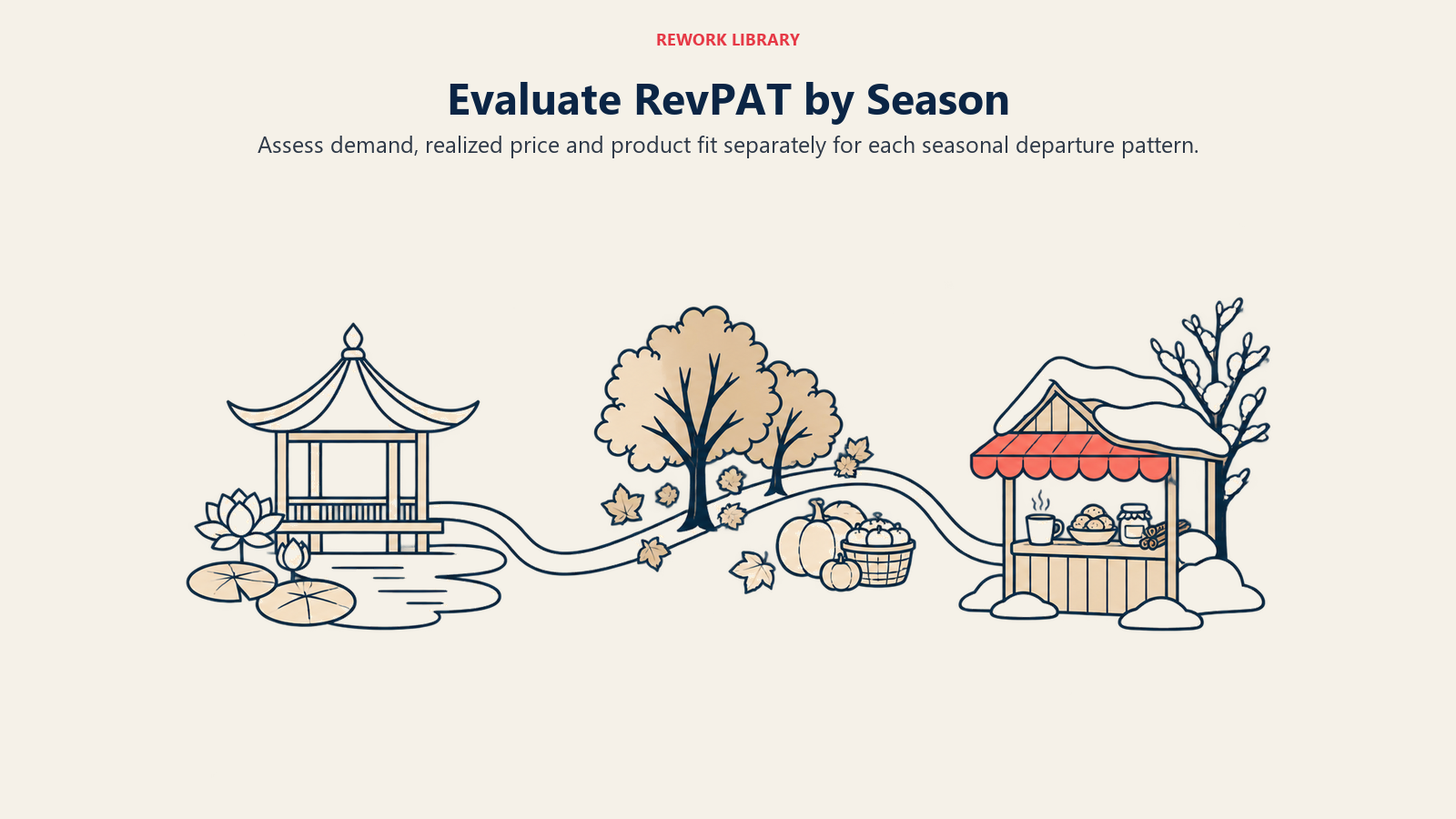
But peak season also often achieves better load factors. Higher demand + higher prices = significantly better RevPAT. Your summer tours might run 85% full at $2,400 = $2,040 RevPAT. Spring tours might run 68% full at $1,800 = $1,224 RevPAT. The gap compounds.
Shoulder season volume strategies can still generate strong RevPAT through smart discounting. Instead of dropping prices 30%, reduce 15% and target marketing aggressively. Better to fill tours at modest discounts than run them half-empty at high prices.
Off-season decisions require careful math. If winter European tours historically run 35% load factor even with 25% discounts, consider eliminating them entirely. The operational complexity and poor RevPAT don't justify continuing. Redirect resources to stronger seasons.
Or package off-season differently. Christmas markets tours in December Europe might fill well at premium prices even though general Europe tours struggle in winter. Themed offerings can justify higher RevPAT in otherwise slow periods.
RevPAT by Channel
Direct bookings typically generate highest RevPAT because you're avoiding channel commissions. A tour selling for $2,200 direct generates full RevPAT. Through an OTA at 18% commission, realized revenue is $1,804 - that's what counts for RevPAT.
OTA partnerships drive volume but reduce RevPAT due to commissions. If OTAs fill seats that would otherwise be empty, the lower RevPAT still beats zero revenue from empty seats. But if OTAs cannibalize direct bookings, you're paying 15-20% commissions unnecessarily.
Track this carefully. Calculate RevPAT by channel: direct website, OTAs, travel agents, partnerships. If direct generates $2,400 RevPAT and OTAs generate $1,950 RevPAT, you know the cost of that distribution channel. Decide if volume justifies lower per-seat revenue.
Group sales often accept lower per-person pricing but guarantee high load factors. A corporate group booking 14 seats at $1,950 versus individual sales at $2,200 reduces per-seat revenue but guarantees 87.5% load factor on that departure. The blended RevPAT might actually improve.
Last-minute deals sold through flash sale platforms or email promotions lower RevPAT but beat empty seats. Running with 9 people at $1,700 average generates $1,062 RevPAT. Adding 3 last-minute deals at $1,400 brings the tour to 12 people and RevPAT improves to $1,575. Selective discounting makes sense.
RevPAT Dashboards & Reporting
Track trends by tour product over time. Your Asia tour's RevPAT might be declining from $2,100 to $1,850 over two years. This signals pricing pressure, quality issues, or increased competition. Investigate before it declines further.
Seasonal comparison shows whether strategies are working. If last year's shoulder season averaged $1,150 RevPAT and this year's averages $1,290, your pricing or volume improvements succeeded. Continue those tactics.
Channel contribution to RevPAT reveals which distribution partners deliver value. Create dashboard views showing RevPAT by booking source. If referral partners generate $2,650 RevPAT but pay you 15% commission, they're still more valuable than direct bookings at $2,200 RevPAT with no commission.
Year-over-year performance comparisons account for seasonality. Compare May 2026 to May 2025, not May 2026 to March 2026. YoY trends show whether you're gaining or losing ground in the market.
Visualizations should include:
- RevPAT trend line by month with prior year overlay
- RevPAT by tour product (horizontal bar chart)
- RevPAT decomposition showing price and load factor contributions
- Scatter plot of load factor vs. price colored by profitability
Common RevPAT Mistakes
Ignoring the metric entirely is the biggest mistake. Many tour operators focus on bookings and total revenue without calculating RevPAT. They miss optimization opportunities and don't realize they're underperforming.
Optimizing only for load factor destroys RevPAT through excessive discounting. A tour operator might celebrate 92% average load factor while running rock-bottom pricing that generates terrible margins. RevPAT would expose this.
Focusing solely on published rack rates while ignoring discounts creates false confidence. Your rate sheet shows $2,800 but you're actually selling 60% of seats at $2,100-2,300 through early bird and group discounts. Published rates don't pay the bills. Realized RevPAT does.
Not segmenting by tour product or season treats all departures as equal when they're not. Your flagship tour might subsidize underperforming products. Calculate RevPAT by product to identify winners and losers.
Ignoring capacity constraints in planning. If you add 10 more annual departures that run at 45% load factor because demand doesn't support them, overall RevPAT declines even if your popular departures remain strong. Sometimes growing capacity hurts performance.
Conclusion
RevPAT is the tour operator's essential performance metric. It reveals how effectively you're monetizing your finite capacity through the combination of pricing strategy and load factor management. Unlike occupancy or price alone, RevPAT tells the complete revenue story.
Track RevPAT by tour product, by season, and by channel. Set targets based on segment and market position. Optimize through dynamic pricing, smart inventory management, and selective distribution. The tour operators who master RevPAT generate 20-40% more revenue from the same capacity as competitors who ignore it.
Related Articles: