Travel Sales Process: From Inquiry to Booking - 2026 Guide
Turn this article into takeaways for your work.


Each assistant summarizes the article only for you and suggests best practices for your work.
Your inquiry inbox shows 47 new requests this morning. One's a family of four looking at Tanzania next July. Another's a corporate team wanting Iceland in three weeks. A third is asking about "something special" for their anniversary with a budget that could mean $5,000 or $50,000.
Each inquiry represents potential revenue, but without a systematic sales process, you're leaving bookings on the table. The difference between 15% and 35% conversion rates isn't luck, it's methodology.
Understanding the Travel Sales Cycle
The travel sales cycle isn't a straight line from inquiry to booking. It's a complex journey that varies dramatically by client type and product complexity.
For FIT (Free Independent Traveler) bookings, you're typically looking at 2-4 weeks from initial contact to deposit, sometimes stretching to 8-12 weeks for complex international itineraries. The client controls timing, researches extensively, and compares multiple options before committing. Understanding the travel customer journey mapping helps you anticipate decision points and optimize each touchpoint.
GIT (Group Inclusive Tour) sales follow a completely different rhythm. Decision cycles extend to 4-8 months because multiple stakeholders must align on dates, budgets, and destinations. You're not just selling a trip, you're facilitating group consensus while managing individual preferences. Group travel sales requires specialized approaches for managing multiple decision-makers.
Corporate travel sales might close in 48 hours for urgent trips, but establishing ongoing relationships takes 3-6 months of consistent value demonstration. The initial "sale" is securing the account; ongoing revenue comes from execution quality and relationship management. Learn more about corporate travel sales strategies for business clients.
Luxury travel extends everything. Discovery takes longer because personalization requirements are deeper. Proposal development demands more supplier coordination. Decision-making involves extensive consideration because the investment is significant. Expect 6-12 weeks minimum, often longer for once-in-a-lifetime journeys. Luxury travel sales demands elevated service at every stage.
Inquiry Qualification Framework
Not every inquiry deserves the same level of effort. Qualification separates legitimate prospects from time-wasters and matches your resources to opportunities with real potential. Effective travel inquiry management starts with systematic qualification.
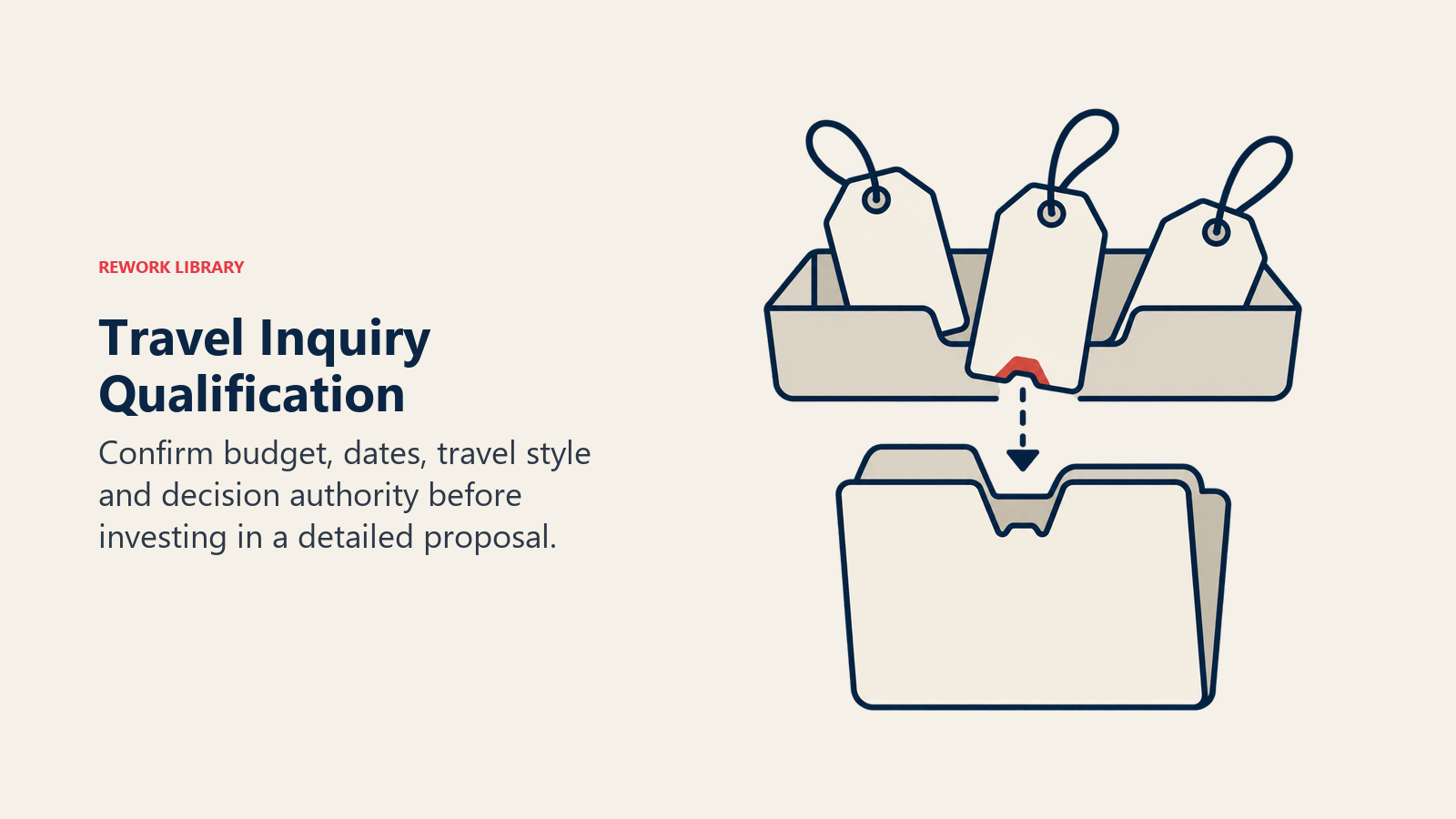
Start with budget reality. Don't ask "What's your budget?", most clients don't know what trips actually cost. Instead, frame it contextually: "For the experience you're describing in New Zealand, most clients invest between $8,000 and $15,000 per person. Does that align with your expectations?" You'll immediately know if you're in the right ballpark. This approach supports your broader travel pricing strategy by educating clients early.
Timeline qualification matters because urgency affects your approach and the client's seriousness. Someone traveling in six months is further along mentally than someone exploring options for "someday." Ask specific questions: "Have you settled on dates?" and "Are these dates flexible or fixed?"
Destination flexibility reveals how open clients are to your expertise. Fixed on Paris in spring? You're executing their vision. Open to "romantic European cities"? You can guide them toward optimal timing, better value, or less crowded alternatives that still deliver the experience they want.
Travel style understanding prevents mismatches that lead to cancellations or bad reviews. Boutique hotel enthusiasts won't be happy in large resorts. Adventure seekers will feel constrained by structured group tours. Ask about past trips they loved and hated, the answers tell you everything.
Group size and composition change everything about logistics, pricing, and decision-making. A couple is straightforward. A multi-generational family of 12 requires different accommodations, activities for various ages, and consensus-building among multiple decision-makers.
Decision-making authority determines who you're really selling to. The person who emails isn't always the person who approves the budget. For couples, are both partners involved in planning? For corporate travel, who signs off? For group trips, who has final say on bookings?
Discovery & Needs Assessment
Most travel sales conversations start with "Where do you want to go?" but that's the wrong opening question. What someone wants from a trip matters more than the destination itself. This is where consultative selling in travel separates advisors from order-takers.
Begin with motivation. "What's driving this trip?" reveals whether they're celebrating an anniversary, fulfilling a lifelong dream, strengthening family bonds, or escaping burnout. The same Tuscany itinerary serves each motivation differently.
Past travel experiences provide the roadmap. Ask about favorite trips, and what made them special. Ask about disappointing trips, and what went wrong. Someone who raves about their small ship cruise to Antarctica but hated their crowded tour of Rome is telling you exactly what they value: intimacy, expertise, and avoiding tourist masses.
Constraints shape feasibility. Time constraints (limited vacation days, school schedules, seasonal business cycles). Physical constraints (mobility issues, dietary restrictions, health considerations). Emotional constraints (fear of flying, safety concerns, cultural discomfort). Budget constraints (total available, payment timing, value expectations).
Unspoken expectations cause the most problems. Don't assume anything. Is every meal included or just breakfast? Private guides or group experiences? Free time or packed schedules? Luxury accommodations or authentic local stays? Get specific.
Proposal Development Process
A travel proposal isn't a price list, it's a vision document that transforms abstract desires into tangible experiences while demonstrating why booking with you delivers value competitors can't match. Master itinerary building to create compelling proposals that sell themselves.
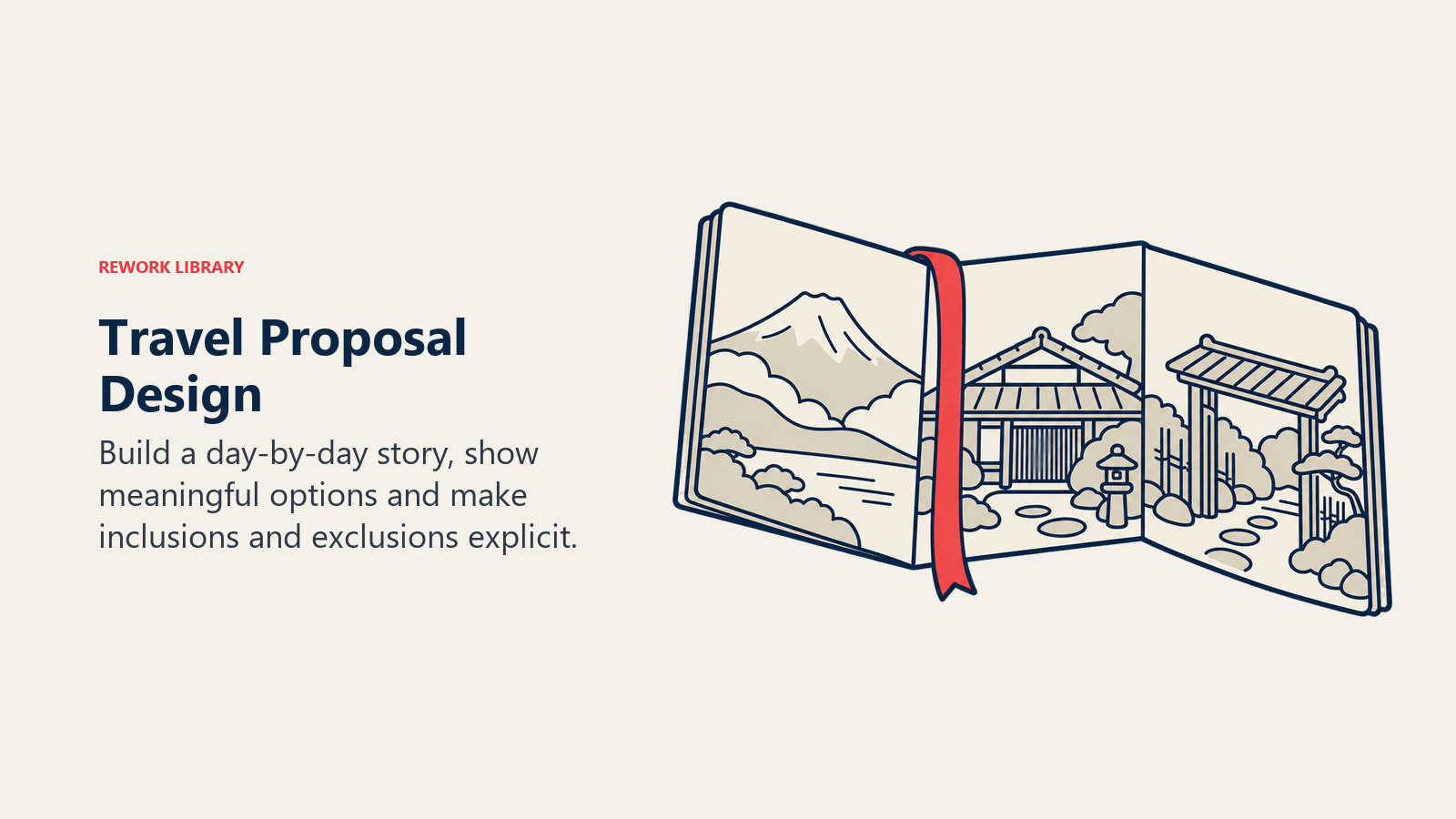
Structure proposals with clear narrative flow. Start with an executive summary that captures the essence: "Ten days exploring Japan's cultural heartland, balancing ancient temples with modern innovation, intimate ryokan stays with Tokyo energy, guided expertise with independent discovery."
Build each day as a chapter. Not just "Day 3: Kyoto" but "Day 3: Temple Hopping & Hidden Gardens, Discover three of Kyoto's most serene temples before crowds arrive, then explore a secret garden that's been in the same family for 400 years." You're selling the experience, not the logistics.
Present multiple options strategically. Don't overwhelm with choices, but give clients clear pathways: a foundational option that delivers core experiences, an enhanced version with meaningful upgrades, and a premium option that adds exceptional elements. Each tier should represent genuine value increases, not just price escalation.
Pricing transparency builds trust. Break down what's included: accommodations (with property names and room types), transportation (private vs shared, vehicle types), activities (entrance fees, guide services), meals (which ones, where), and unique inclusions. Separately list exclusions, optional add-ons, and payment terms.
Visual elements create emotional connection. Maps showing the journey flow. Photos of specific hotels you've selected. Images of activities they'll experience. Not generic stock photos, but actual representations of their itinerary.
Quote Follow-Up Strategy
You've sent a beautiful proposal. Now comes the part most travel sellers get wrong: follow-up that maintains engagement without feeling pushy. Systematic travel quote management prevents opportunities from falling through the cracks.
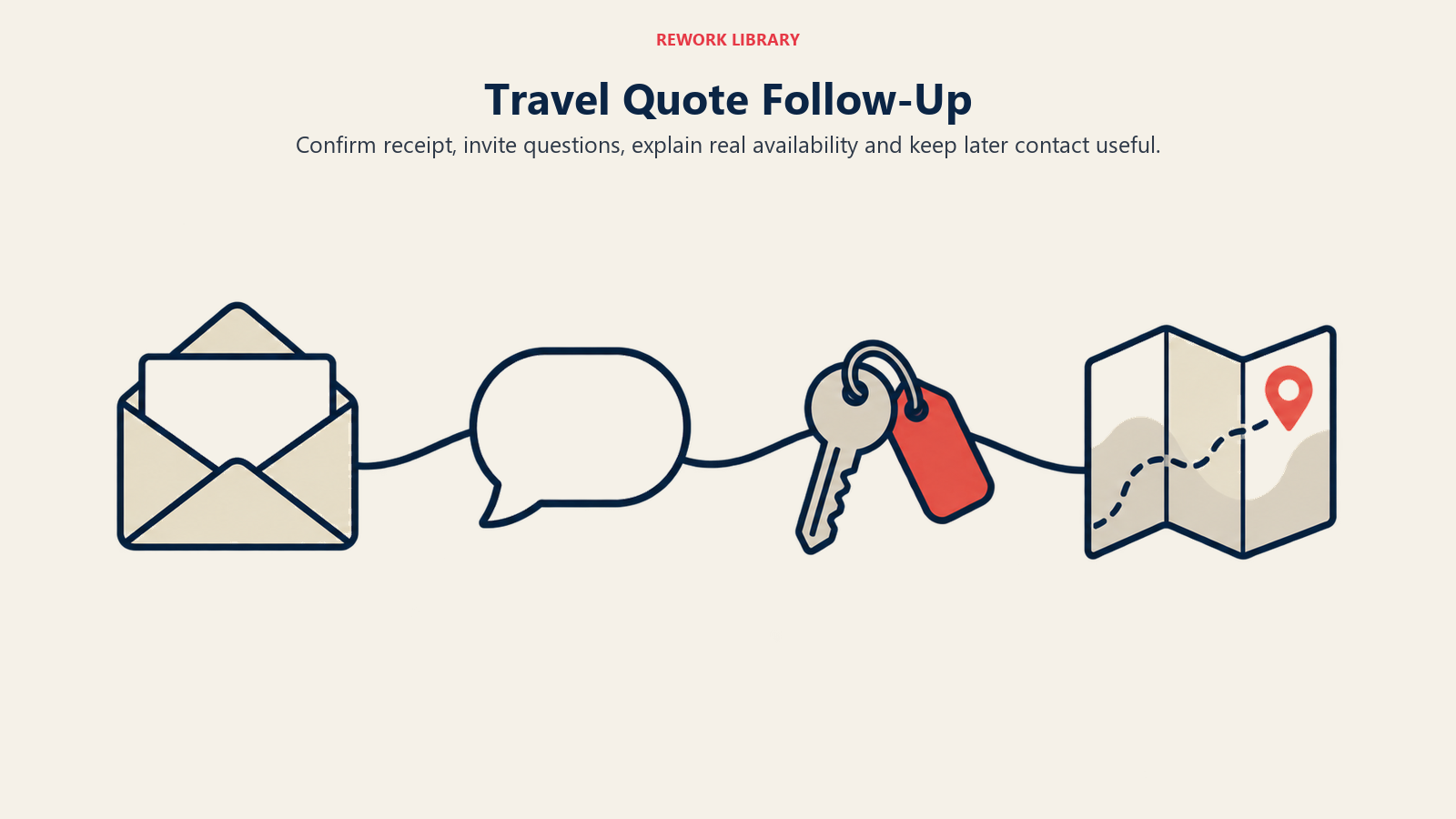
Timing matters enormously. Your first follow-up should happen within 24 hours, not asking for a decision but confirming receipt and offering to walk them through the proposal. Most clients have questions but won't reach out proactively.
Day three or four, check in specifically: "I wanted to see if you've had a chance to review the Italy itinerary, and whether anything stood out that you'd like to discuss or adjust." You're showing availability, not pressure.
After a week, introduce subtle urgency if legitimate: "The coastal property we included has limited availability for your dates, I can hold it for another five days while you finalize your decision." Never invent false urgency, but communicate real constraints.
Beyond two weeks, value-add follow-ups maintain connection: sharing a relevant article about their destination, mentioning a seasonal event happening during their travel dates, or noting a positive review from recent clients who visited the same region.
Multi-channel approaches work when varied appropriately. Email for detailed information and proposal updates. Phone calls for complex discussions and relationship building. Text messages for quick check-ins with clients who've shown that's their preference. Video calls to walk through itineraries visually.
Handling Objections & Concerns
Price objections surface in every sales process, but they're rarely about the actual number. They're about perceived value, trust, or hidden concerns. Learn effective strategies for handling travel objections without damaging relationships.
When someone says "That's more than I expected," don't immediately offer discounts. Ask questions: "What were you expecting?" or "What specific aspects concern you about the pricing?" Often you'll discover they're comparing your customized private itinerary to group tour pricing, or they don't understand what's included.
Reframe value by breaking down daily costs: "This breaks down to $380 per person per day, which includes your luxury accommodations, private guide services, all transportation, most meals, and entrance fees. You're not paying extra for anything except personal shopping and occasional drinks." Suddenly $8,000 per person sounds more reasonable.
Safety concerns require acknowledgment, not dismissal. "I understand your concern about traveling to Morocco right now. Let me share the current situation on the ground from our local partners, the safety protocols we have in place, and recent feedback from clients who just returned." Provide specific information, not platitudes.
Timing objections often mask other concerns. Someone saying "We need more time to think" might really mean "I'm not convinced this is the right fit" or "My spouse isn't sold yet." Ask gently: "Of course, take your time. Is there anything specific you're uncertain about that I can help clarify?"
Closing Techniques for Travel
Travel purchases are emotional decisions supported by logical justification. Your closing approach should honor both elements.
Recognize buying signals. Clients asking about payment plans are mentally committed. Questions about specific details ("Which room will we have at this hotel?") indicate they're visualizing the trip. Statements like "My wife would love this" show internal selling is happening.
Trial closes test readiness without forcing decisions: "If we move forward, would you prefer to secure this with a deposit or full payment?" or "Does the June 15th departure work better than June 8th?" You're assuming the sale while offering choices.
Create natural urgency through real constraints. Limited hotel availability for specific dates. Seasonal price increases approaching. Group tour departure that's filling up. Permit restrictions for certain activities. Never fabricate scarcity, but communicate genuine limitations clearly.
The assumptive close works beautifully in travel: "I'll go ahead and request holds with our key suppliers today. That gives us 48 hours to finalize details and secure your spots before releasing them back to inventory. I'll email you the deposit information shortly." You're taking next steps confidently while giving them an easy off-ramp if needed.
Securing deposits marks the psychological commitment point. Make this process friction-free with multiple payment options: credit cards, bank transfers, payment plans for large bookings. The easier you make saying yes, the more often clients will.
Quote-to-Booking Conversion Metrics
You can't improve what you don't measure. Tracking conversion metrics reveals where your sales process strengthens or weakens.
Overall conversion rate (quotes sent versus bookings secured) should average 25-35% for established travel businesses. Below 20% suggests qualification problems or proposal quality issues. Above 40% might mean you're leaving money on the table with underpricing or not proposing premium options.
Break down conversion by travel type for deeper insights. FIT bookings typically convert at 30-40% because they're highly personalized. Group travel might only hit 15-25% due to longer sales cycles and more stakeholders. Corporate travel should exceed 50% once account relationships are established.
Time-to-decision metrics identify bottlenecks. If quotes sit unresponded for weeks, your follow-up strategy needs work. If clients request multiple revisions before booking, your discovery process isn't thorough enough. Track days from initial inquiry to quote delivery, quote delivery to booking, and total inquiry-to-booking cycle time.
Lost quote analysis prevents repeating mistakes. Categorize losses: price too high, timing didn't work, booked with competitor, decided not to travel, ghosted. Patterns emerge. If you're consistently losing on price, either you're overpriced or you're attracting the wrong prospects. If timing kills deals, ask about flexibility earlier. If competitors win, understand what they offered that you didn't.
Sales Tools & Technology
Manual quote tracking in spreadsheets breaks down as volume grows. Purpose-built systems scale with your business. Implement a comprehensive travel CRM implementation to manage the entire sales cycle efficiently.
Travel-specific CRM systems (like Travefy, TravelJoy, or Trellis) integrate inquiry management, itinerary building, proposal delivery, and booking tracking in one platform. They're worth the investment when you're handling more than 50 inquiries monthly.
Proposal software transforms static PDFs into interactive experiences. Clients can click through day-by-day itineraries, view hotel photos, watch destination videos, and see exactly what they're buying. Tools like Ezus, Umapped, and Inspirock create proposals that sell.
E-signature solutions (DocuSign, HelloSign, Adobe Sign) eliminate printing, signing, scanning, and mailing contracts. Clients can book from their phones in minutes instead of days. Friction kills sales, remove every possible obstacle.
Payment processing integration means clients can secure bookings immediately after deciding. Stripe, Square, or travel-specific processors like WeTravel handle deposits, payment plans, and final payments automatically.
Automation tools handle repetitive tasks without losing personalization. Follow-up email sequences triggered by client actions. Reminders to sales staff about pending quotes. Automatic updates to quote status when clients open proposals or click links.
Sales Team Performance Management
Individual travel sellers are artists. Sales teams are orchestras that need conducting.
Clear quotas establish expectations. Monthly quote volume targets ensure adequate pipeline flow. Conversion rate minimums prevent spray-and-pray approaches. Revenue targets balance quantity with quality. New client acquisition metrics drive business growth beyond repeat bookings.
Commission structures should reward the behaviors you want. Base commission on revenue booked, not just quoted. Bonus tiers for exceeding targets create motivation. Team-based incentives for large group bookings recognize collaborative selling. Premium commissions for difficult-to-book destinations or off-season travel encourage year-round sales.
Regular training keeps skills sharp. Weekly pipeline reviews where sellers present their active opportunities and receive coaching. Monthly workshops on new destinations, supplier products, or sales techniques. Quarterly deep-dives into lost opportunities to extract lessons.
Performance dashboards make metrics visible. Leaderboards create healthy competition. Individual tracking shows improvement over time. Team metrics build collective accountability.
One-on-one coaching addresses individual development needs. Role-playing difficult client conversations. Reviewing actual proposals for improvement opportunities. Listening to discovery calls to refine questioning techniques. Analyzing personal conversion patterns to identify strengths and weaknesses.
The travel sales process isn't about pushing products onto reluctant buyers. It's about guiding genuine travelers from initial curiosity through confident commitment by understanding their needs, presenting compelling options, and making the path to booking completely clear.
Every inquiry represents someone dreaming about their next journey. Your sales process is the bridge between that dream and reality.
Related Articles:

Business Consultant