Corporate Travel Lead Generation: Win High-Value Business Travel Accounts
Turn this article into takeaways for your work.


Each assistant summarizes the article only for you and suggests best practices for your work.
A single mid-sized corporate client generates more lifetime value than 200 individual leisure travelers. One enterprise account booking $500,000 annually in business travel creates recurring revenue streams that stabilize cash flow and reduce dependence on seasonal leisure demand. But corporate travel operates on completely different buying cycles, decision-making processes, and value priorities than consumer travel.
You're not selling dream vacations to people scrolling Instagram. You're selling cost control, compliance, and duty of care to procurement managers who measure everything in basis points and risk mitigation. The travel sales process stretches 6-18 months instead of 6-18 days. Multiple stakeholders influence the decision, and price, while important, often ranks third behind service quality and reporting capabilities.
This market rewards specialization. Generic travel companies struggle to compete against dedicated travel management companies (TMCs) and corporate specialists who speak the language of procurement, understand policy enforcement, and provide the reporting infrastructure corporate buyers demand.
Corporate Travel Market Segmentation
Different company sizes require completely different approaches.
SMB travel managers at companies with 1-50 employees are often HR managers or executive assistants wearing multiple hats. Travel isn't their primary function, it's something they coordinate alongside their other responsibilities. They need simplicity and reliability more than sophisticated technology. Decision cycles are short (2-8 weeks) because there's minimal bureaucracy. One or two stakeholders make the call. Annual travel spend is typically $25,000-200,000.
Your value proposition here emphasizes time savings and stress reduction. "We handle everything so you don't have to" resonates more than "Our proprietary booking platform offers 47 features." These buyers want a responsive account manager they can call or email, not self-service portals. They're profitable if you serve them efficiently without heavy customization.
Mid-market procurement teams at companies with 51-500 employees have dedicated travel managers or procurement specialists who oversee travel as part of their broader responsibilities. They're sophisticated enough to issue RFPs, negotiate rates, and measure customer lifetime value against KPIs, but they don't have enterprise-level leverage with airlines and hotels. Annual travel spend ranges from $200,000 to $3 million. Decision cycles run 2-6 months with 3-5 stakeholders (travel manager, CFO, HR, sometimes legal).
Your value proposition centers on cost savings through negotiated rates, policy compliance, and reporting. These buyers want proof of savings potential through travel pricing strategy benchmark analysis: "Companies like yours in the tech sector typically save 12-18% by consolidating with a specialized provider." They appreciate technology but prioritize human support for exceptions and complex itineraries.
Enterprise travel programs at companies with 500+ employees have dedicated travel departments with global reach requirements. They're managing $3-50 million+ in annual travel spend with complex policy frameworks, preferred supplier agreements, and integration requirements with expense management systems. Decision cycles extend 6-18 months with buying committees that include senior procurement, finance, legal, HR, and sometimes C-suite executives.
Your value proposition must demonstrate global capabilities, risk management sophistication, data analytics depth, and scalable technology integration. These buyers evaluate proposals with 50-page RFPs and weight technical capabilities heavily. You're competing against American Express GBT, BCD Travel, and CWT, established players with enterprise credentials.
Buying Committee Dynamics
Corporate travel decisions involve multiple stakeholders with different priorities.
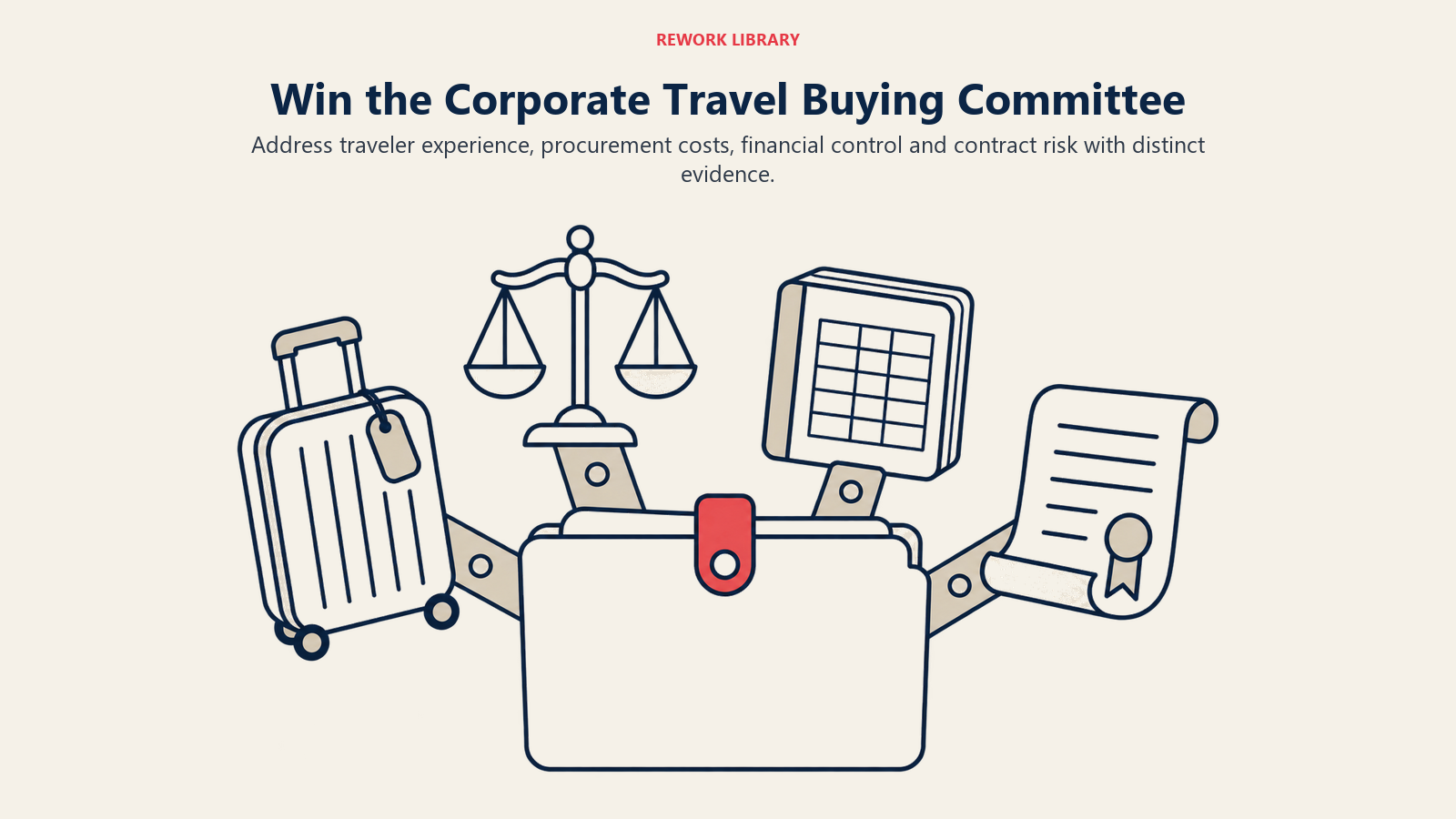
Travel managers prioritize traveler satisfaction and smooth operations. They're measured on whether employees can book trips easily, get support when things go wrong, and stay productive during travel. They care about your customer service responsiveness, traveler support availability, and booking tool user experience. Win the travel manager by demonstrating you'll make their life easier, not harder.
Procurement focuses on cost reduction and contract management. They want to see savings quantified in RFP responses, benchmark data proving you're competitive, and service level agreements with financial penalties for non-performance. They care less about traveler experience and more about total cost of ownership. Win procurement with data-driven savings analysis and transparent pricing structures.
Finance and compliance stakeholders worry about budget control, policy adherence, and audit trails. They need reporting that shows spend by department, cost center, or project code. They want to know that travelers are booking within policy and that you can enforce approval workflows. Win finance with robust reporting capabilities and policy enforcement tools.
Legal gets involved in enterprise deals to review contracts, liability provisions, and data privacy compliance. They care about indemnification clauses, data protection (especially for EU companies under GDPR), and duty of care obligations. Don't try to win legal, just don't lose the deal by having unacceptable contract terms.
Value Proposition Development
Corporate buyers buy outcomes, not features.
Cost savings and negotiated rates are table stakes. If you can't demonstrate 10-20% potential savings for mid-market or better rates than their current provider, you won't advance. But savings alone don't win, everyone claims savings. Differentiate by showing how you'll deliver those savings: pre-negotiated hotel rates, airline discount programs, policy optimization analysis, and behavioral nudges toward lower-cost options.
Duty of care and risk management matter increasingly. Companies face legal and moral obligations to protect traveling employees. You need to show how you'll provide 24/7 traveler support, proactive disruption management (rebooking when flights cancel), traveler tracking during emergencies, and risk alerts for destinations with safety concerns. If a hurricane hits and you can account for all travelers and rebook them within two hours, you've demonstrated irreplaceable value.
Reporting and compliance separate professional TMCs from consumer travel agencies. Corporate buyers need monthly spend reports by department, policy compliance dashboards showing out-of-policy booking rates, savings reports quantifying negotiated rate usage, and expense integration that eliminates manual receipt submission. If your reporting requires manual data exports and Excel manipulation, you're not enterprise-ready.
Traveler experience and satisfaction create internal champions. The travel manager might select you, but business travelers use your service. If your booking tool is clunky, your customer service is slow, and your hotel selections are inconvenient, travelers will complain and erode your relationship. Delivering excellent traveler experience builds advocates inside the client organization who defend your relationship during reviews.
Policy enforcement tools help travel managers do their jobs. If company policy says "book economy for flights under 4 hours," your booking tool should prevent employees from selecting premium economy without manager approval. If policy requires booking 14+ days in advance for better rates, your system should flag last-minute bookings and require justification. You're not just processing transactions, you're helping clients control costs through behavioral guardrails.
Lead Generation Channels
Corporate prospects don't browse your website or click Instagram ads.
LinkedIn Sales Navigator targeting enables precision prospecting. Build target account lists by company size, industry, geography, and employee title. Search for "Travel Manager," "Procurement Manager," "Office Manager" (at smaller companies), or "Director of Global Services." Filter by company headcount to focus on your sweet spot (50-500 employees for mid-market). Export lists and enrich with contact data through tools like ZoomInfo or Apollo.
Industry association partnerships provide credibility and access. Join associations like Global Business Travel Association (GBTA), Association of Corporate Travel Executives (ACTE), or regional equivalents. Sponsor their conferences, present on panels, and network aggressively. Corporate travel managers trust vendors their peers recommend. Association involvement signals seriousness and provides trust-building for travel businesses pathways.
Trade show presence at GBTA Convention, ACTE Global, or regional conferences concentrates corporate buyers in one place. Unlike consumer travel shows, these events are explicitly for corporate travel decision-makers. Pre-schedule 20-30 meetings before the event. Don't rely on booth walk-ups, corporate buyers attend with packed schedules.
RFP platforms and marketplaces like TravelPerk, TripActions, and Navan are self-service comparison platforms where SMBs and mid-market companies research providers. Create profiles, respond quickly to RFP inquiries, and differentiate through client reviews and specific capability descriptions. These platforms pre-qualify leads, companies on these sites are actively shopping.
Content marketing for travel managers positions you as a thought leader. Publish guides on "How to Negotiate Hotel Rates," "Duty of Care Best Practices," or "Travel Policy Benchmarks for Tech Companies." Travel managers researching best practices find your travel content marketing content, engage with your brand, and remember you when they're ready to evaluate vendors. This builds pipeline 6-12 months before active buying cycles.
Outbound Strategy
Proactive outreach drives corporate pipeline more than inbound marketing.
Account-based marketing approach focuses effort on 50-100 target accounts rather than broad campaigns. Research each target: understand their industry, employee count, likely travel patterns, current provider (if known), and recent news (expansion, funding, leadership changes). Tailor travel inquiry management outreach to specific company context rather than generic mass emails.
Executive outreach cadence should span 6-8 touchpoints over 90 days. Email 1: Introduction with relevant case study. Week 2: LinkedIn connection with personalized note. Week 4: Share valuable content (benchmark report). Week 6: Phone call referencing previous emails. Week 8: Video message offering savings analysis. Week 10: Final email with specific meeting request. Persistence wins, decision makers are busy and one email rarely breaks through.
Benchmark and savings analysis offers provide tangible value that opens doors. "I analyzed travel spend patterns for companies like yours in the SaaS sector. Most are overspending by 15-22% on hotel bookings. I'd like to share what we're seeing and explore whether similar opportunities exist for [Company Name]." This is consultative, not salesy. You're offering insights before asking for business.
Industry-specific case studies build credibility. Don't send generic "we serve corporate clients" messaging to a biotech company. Send "How we helped a biotech company reduce travel costs by 18% while improving compliance" with specific examples of challenges relevant to their industry. Specificity signals expertise and reduces perceived risk.
Inbound Conversion
When corporate buyers find you, make engagement frictionless.
Corporate travel landing page design should speak directly to corporate needs. Generic "book your vacation" messaging doesn't convert corporate traffic. Use headlines like "Corporate Travel Management for Growing Companies" or "Reduce Travel Costs by 15-20% Without Sacrificing Service." Include client logos, case studies, and clear CTAs for "Request Savings Analysis" or "Download Corporate Travel Benchmark Report."
Self-service RFP submission removes friction for buyers in research mode. Provide a structured form collecting key info: company size, annual travel volume, current challenges, decision timeline. This qualifies leads while demonstrating that you're accustomed to formal travel sales process procurement processes. Don't make them email you to start a conversation, let them submit requirements on their schedule.
Cost savings calculators provide instant value and capture contact info. Input: number of employees, average trips per employee per year, typical destinations. Output: estimated current spend and potential savings range with your service. Require email to see results. This generates travel lead qualification leads who've self-identified savings potential.
Benchmarking reports gated behind contact forms attract travel managers researching best practices. "2026 Corporate Travel Benchmark Report: Average Costs, Policy Trends, and Savings Opportunities by Industry" is valuable enough that a travel manager will trade their email to access it. Follow up with personalized outreach referencing insights from the report relevant to their industry.
Qualification Framework
Not every corporate inquiry deserves the same sales effort.
Travel volume assessment determines account potential. Ask: How many employees travel regularly? How many trips per year? What's your approximate annual travel spend? A 200-person company with $800,000 in travel spend is worth significant sales investment. A 30-person company with $60,000 in spend might be profitable but doesn't justify custom proposals and extensive discovery.
Decision timeline separates active buyers from researchers. Ask: When does your current contract expire? What's driving you to evaluate alternatives now? Are you in an active RFP process? Someone whose contract expires in 3 months and is actively comparing providers gets immediate attention. Someone casually researching with no timeline goes into nurture.
Incumbent relationship strength indicates difficulty of displacement. Ask: Who's your current provider? How long have you worked with them? What would need to change for you to switch? A company frustrated with their current TMC and actively shopping is high probability. A company happy with their provider but doing periodic market checks is low probability, stay in touch but don't invest heavily.
Budget authority and approval process reveal decision complexity. Ask: Who else is involved in this decision? What does your approval process look like? A 50-person company where the CEO and CFO make the call together has a simple process. A 300-person company where procurement, finance, HR, and legal all have input requires longer sales cycles and multi-threaded relationship building.
Competitive Positioning
How you position determines which deals you can win.
TMC differentiation clarifies whether you're competing as a full-service TMC (managing all corporate travel) or a specialized provider (group travel, incentive travel, meetings). Trying to position as a full-service TMC against American Express or BCD requires enterprise capabilities most smaller players lack. Positioning as "the best choice for mid-market tech companies" or "specialists in pharmaceutical conference and meeting management" creates defensible niches.
Direct versus indirect booking engine optimization strategy shapes your technology story. Will corporate travelers book through your platform, or do you support indirect channels (calling agents, email booking)? SMBs often prefer email and phone support. Mid-market wants self-service platforms with agent backup. Enterprise demands integrated booking tools with expense system connections. Be clear about which model you support.
Technology and service mix determines competitive advantage. Some competitors emphasize technology (automated booking, AI-powered recommendations, mobile apps). Others emphasize white-glove service (dedicated agents, 24/7 support, personal relationships). Most successful providers balance both. Understand where your strength lies and target customers who value that dimension.
SMB versus enterprise positioning requires focus. Trying to serve both with the same sales motion fails. SMB sales are transactional, short-cycle, and volume-driven. Enterprise sales are consultative, long-cycle, and customized. Your marketing, sales process, and service delivery need to align with your target segment. Choose one and dominate it before expanding to the other.
Conclusion
Corporate travel lead generation isn't about volume, it's about precision. One well-qualified enterprise opportunity can represent more customer lifetime value revenue potential than 500 leisure leads. But corporate buyers don't respond to consumer marketing tactics. They need proof of savings, demonstrations of capability, and confidence that you'll protect their travelers while controlling costs.
Success comes from understanding buying committee dynamics, delivering value before asking for the sale, and building relationships over months rather than closing deals in days. The companies winning corporate travel accounts aren't necessarily the largest or cheapest, they're the ones who make procurement feel confident, travel managers feel supported through trust-building, and finance feel in control.
Related Articles: