Revenue Management for Tours: Maximizing Profitability Per Departure
Turn this article into takeaways for your work.


Each assistant summarizes the article only for you and suggests best practices for your work.
You run 24 departures annually. Half fill completely, a quarter run at 65% capacity, and a quarter cancel due to insufficient bookings. Total revenue: $520,000. Profit margin: 12%.
Apply strategic revenue management, dynamic pricing, optimized scheduling, better capacity planning, and those same 24 departures generate $680,000 at 18% margins. Same destinations, same hotels, same guides. Just smarter economic management.
Revenue management transforms tour operations from hoping tours fill to systematically maximizing profitability per departure.
Revenue Management in Tour Operations
Adapting principles from airlines and hotels requires understanding unique tour dynamics.
Fixed-departure tours have capacity constraints (bus holds 40, boat holds 12, permits allow 15) and timing constraints (weekly departures, seasonal only, event-based). Unlike hotels selling rooms nightly or airlines with multiple daily flights, each tour departure is discrete with unique economics.
Capacity constraints mean your maximum revenue is capped. A 16-person tour at $4,000 per person maxes at $64,000. No matter how high demand, you can't sell 17 seats. This scarcity enables premium pricing when demand is high.
The challenge is variable demand meets fixed capacity. Peak season tours sell out quickly. Shoulder season struggles to reach minimum viable group size. You need pricing and scheduling strategies handling both scenarios.
Tour Capacity Planning
Determining optimal group sizes balances economics and experience quality.
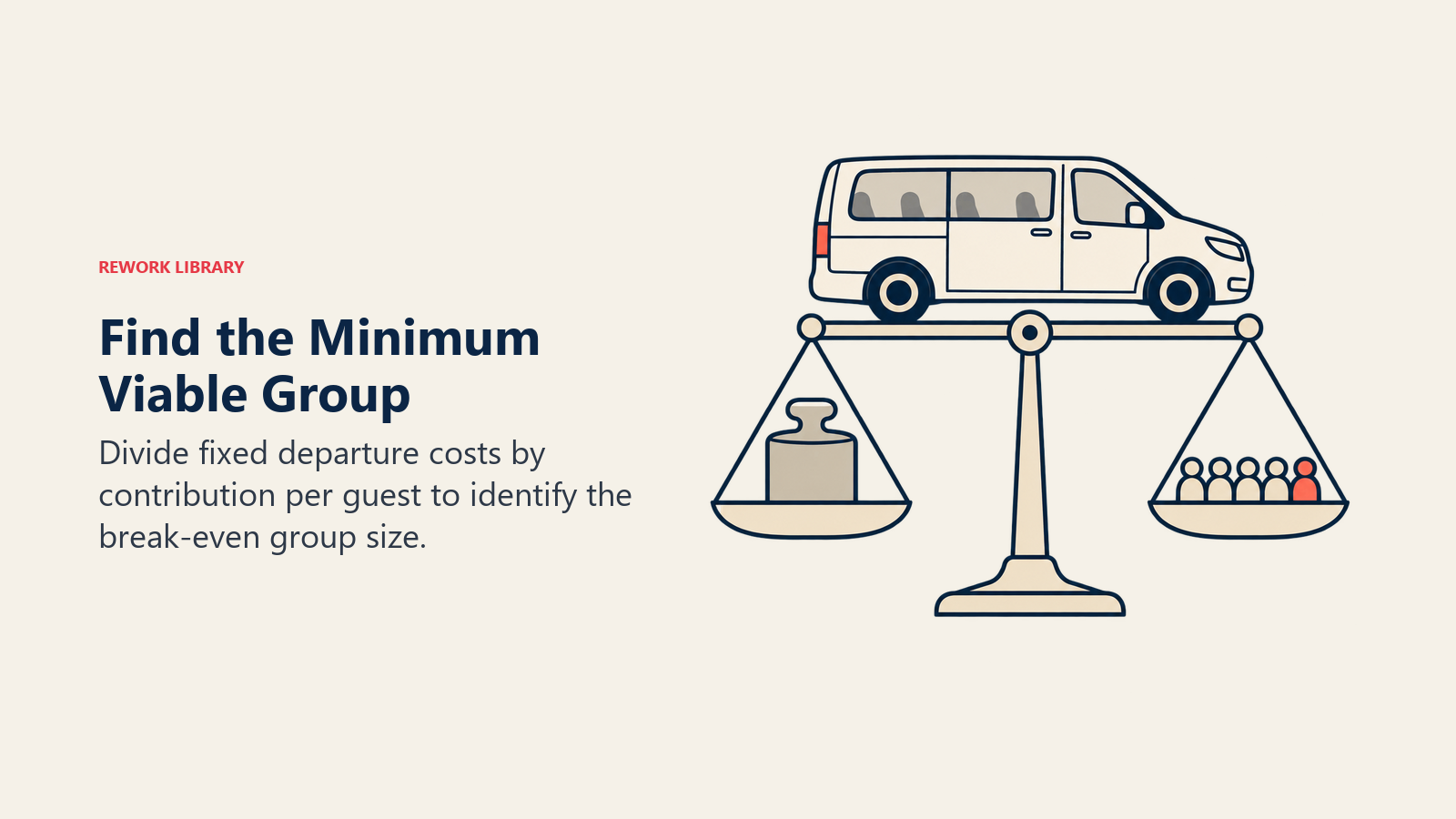
Minimum viable groups (MVG) represent the participant count where departure becomes profitable. Calculate: fixed costs (guide, vehicle, permits, some meals) ÷ contribution margin per participant. If fixed costs are $6,400 and contribution margin is $800 per person, MVG is 8 participants.
Running departures below MVG loses money. Options: cancel (refund deposits, lose revenue, disappoint clients), reduce capacity costs (smaller vehicle, no assistant guide), or accept strategic losses (new destination launch, building market presence).
Maximum capacity balances revenue potential against experience quality. A 40-person bus tour is economically efficient but impersonal. A 12-person van tour is intimate but less profitable. Choose maximums aligned with your positioning and product type.
Breakeven analysis per departure shows exact profitability thresholds. Fixed costs + (variable costs × participants) = total costs. Revenue = price × participants. Plot these curves to see breakeven point and profit zones.
Departure Scheduling Optimization
When you run tours matters as much as how you price them.
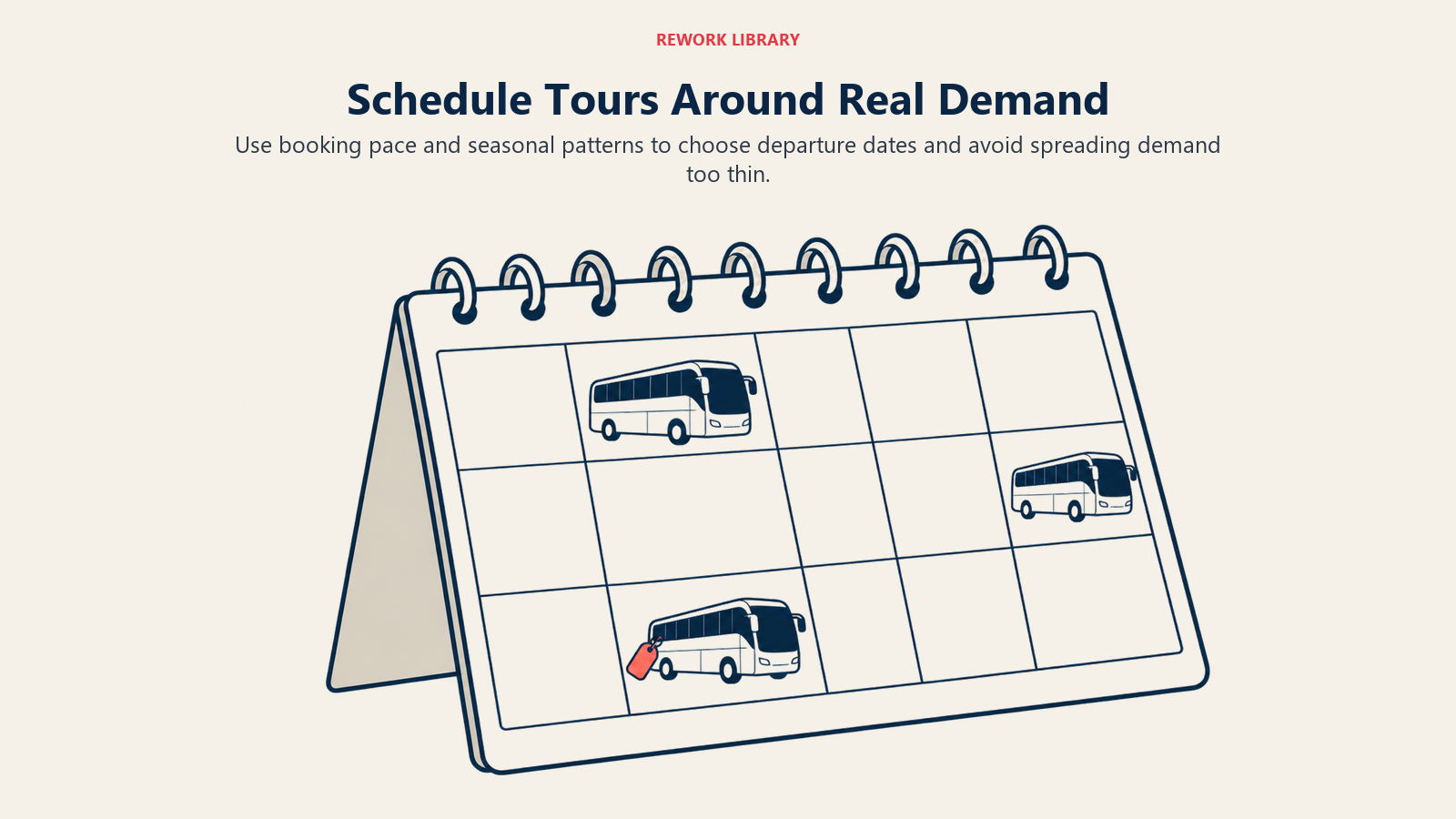
Frequency planning considers market demand versus operational efficiency. Weekly departures mean more choice for customers but risk running half-empty tours. Monthly departures concentrate demand but frustrated clients who can't make those specific dates.
Seasonality considerations align scheduling with demand patterns. Europe tours primarily summer and shoulder months. Caribbean winter. Antarctica November-March only. Don't fight seasonality, work with it.
Demand forecasting uses historical booking data, market trends, and forward indicators (website traffic, inquiries, competitor sellout rates). "Last year this week in June sold out 4 months early. This year we're only 60% sold at 5 months out. Should we add a second departure or adjust pricing?"
Managing unsold inventory through cancellations has costs. Cancelled departures mean refunding deposits, losing revenue, paying some non-recoverable costs (permits, deposits to suppliers), and damaging reputation. Strategic revenue management minimizes cancellations through better demand forecasting and pricing.
Price Optimization by Departure
Different departures should carry different prices.
Early booking discounts secure commitments when people are researching. "Book 6+ months ahead, save 15%." This locks revenue, improves forecasting, and reduces marketing costs closer to departure.
Last-minute pricing adjusts based on inventory situation. Tour departing in 21 days with 5 of 14 spots filled? Drop price 20% to stimulate last-minute bookings and reduce cancellation risk. Tour departing in 21 days with 13 of 14 spots filled? Surge pricing for that last seat.
Surge pricing for high-demand dates captures willingness to pay. Cherry blossom season in Japan? Northern Lights peak months? Festival dates? Charge 25-40% premiums because demand far exceeds supply.
Dynamic date-based pricing means identical tours at different times carry different prices. Your Iceland August departures might be $4,200 (peak demand) while May departures are $3,400 (shoulder season).
Inventory Control & Allocation
Managing seat inventory strategically maximizes revenue.
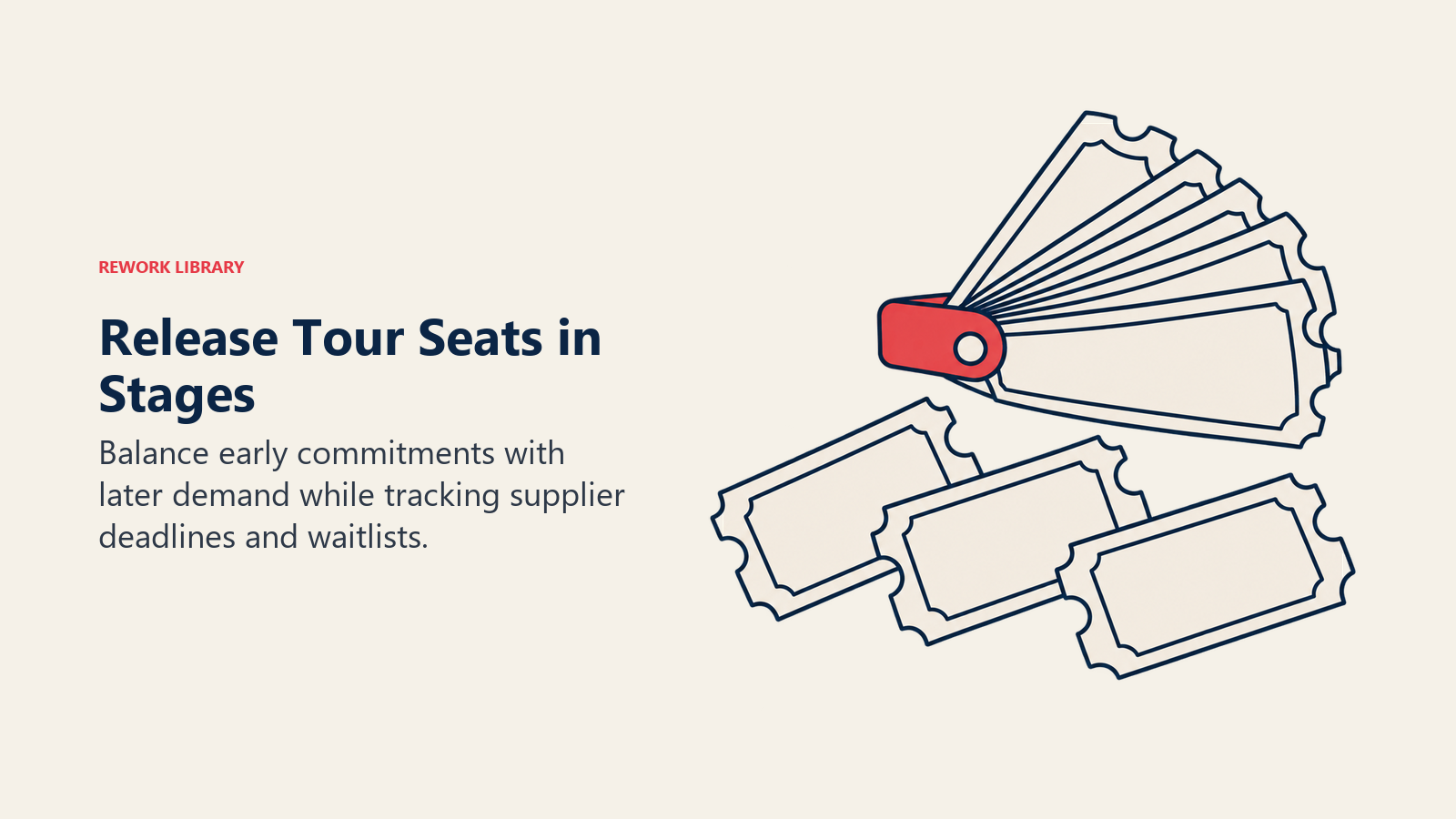
Holding versus releasing inventory balances early commitments against potential premium pricing later. Don't sell all 16 seats at early bird pricing. Release 6-8 seats at early bird, hold remaining for standard and premium pricing as departure approaches.
Allotment management with suppliers coordinates capacity. Hotel blocks of 10 rooms need confirmation 60 days out or you lose them. Vehicle rental for 15 passengers requires deposit. Manage supplier commitments alongside sales pace.
Overbooking strategies account for historical cancellation rates. If you typically have 6% cancellations, booking to 106% capacity means you'll likely hit exactly 100% after cancellations. Risky, have clear policies for handling the rare situation where everyone shows up.
Waitlist management for sold-out departures creates future opportunities. Sold-out July 15 departure but capturing 8 waitlist requests? Consider adding July 22 departure if enough interest exists.
Channel Mix Management
Where you sell tours affects profitability.
Direct bookings through your website generate highest margins. No intermediary commissions, complete customer relationship, all pricing control. Invest in direct booking infrastructure and marketing.
OTA distribution (Viator, GetYourGuide, Expedia Local Experiences) provides volume and visibility but pays 20-30% commissions. Profitable when they fill seats that would otherwise go unsold, but problematic when they cannibalize direct bookings at full margin.
Wholesale allotments to travel agencies provide bulk commitments but require deep discounts. Selling 8 of 16 seats to a wholesaler at 35% off provides cash flow certainty but reduces potential revenue if you could have sold those seats retail.
Channel profitability analysis tracks which channels generate best risk-adjusted returns. Direct bookings at full price are obviously best, but if direct marketing only fills 60% of capacity and wholesalers fill remaining 40% at 65% of retail, the mixed model might be optimal.
Revenue Per Available Tour (RevPAT)
The key metric for measuring tour revenue performance.
Calculate RevPAT: Total tour revenue ÷ total available seats. If your 16-seat tour generates $56,000 in revenue, RevPAT is $3,500. This normalizes performance across different-sized groups and time periods.
Benchmarking performance against historical data. Is this year's Croatia tour generating higher or lower RevPAT than last year? Better than 3-year average? Understanding trends reveals whether revenue management is improving.
Identify improvement opportunities by analyzing components. Low RevPAT could mean: too much early bird discounting, insufficient premium pricing when demand is high, wrong capacity (too many seats for demand), or ineffective yield management.
Cancellation & Refund Policies
Balancing flexibility with revenue protection requires structured policies.
Graduated cancellation fees increase as departure approaches. "90+ days: full refund minus $200 admin fee. 60-89 days: 50% refund. 30-59 days: 25% refund. Under 30 days: no refund." This encourages booking while protecting you from last-minute cancellations that can't be resold.
Revenue protection through nonrefundable deposits ($500-1,000) covers hard costs you'll incur immediately (supplier deposits, permits, planning time). Even if they cancel, you've covered your downside.
Rebooking incentives give clients options while retaining revenue. "If you can't make July 15, apply your payment to any future departure within 12 months." They keep the trip, you keep the revenue.
Guaranteed vs On-Request Departures
Managing customer expectations about tour certainty.
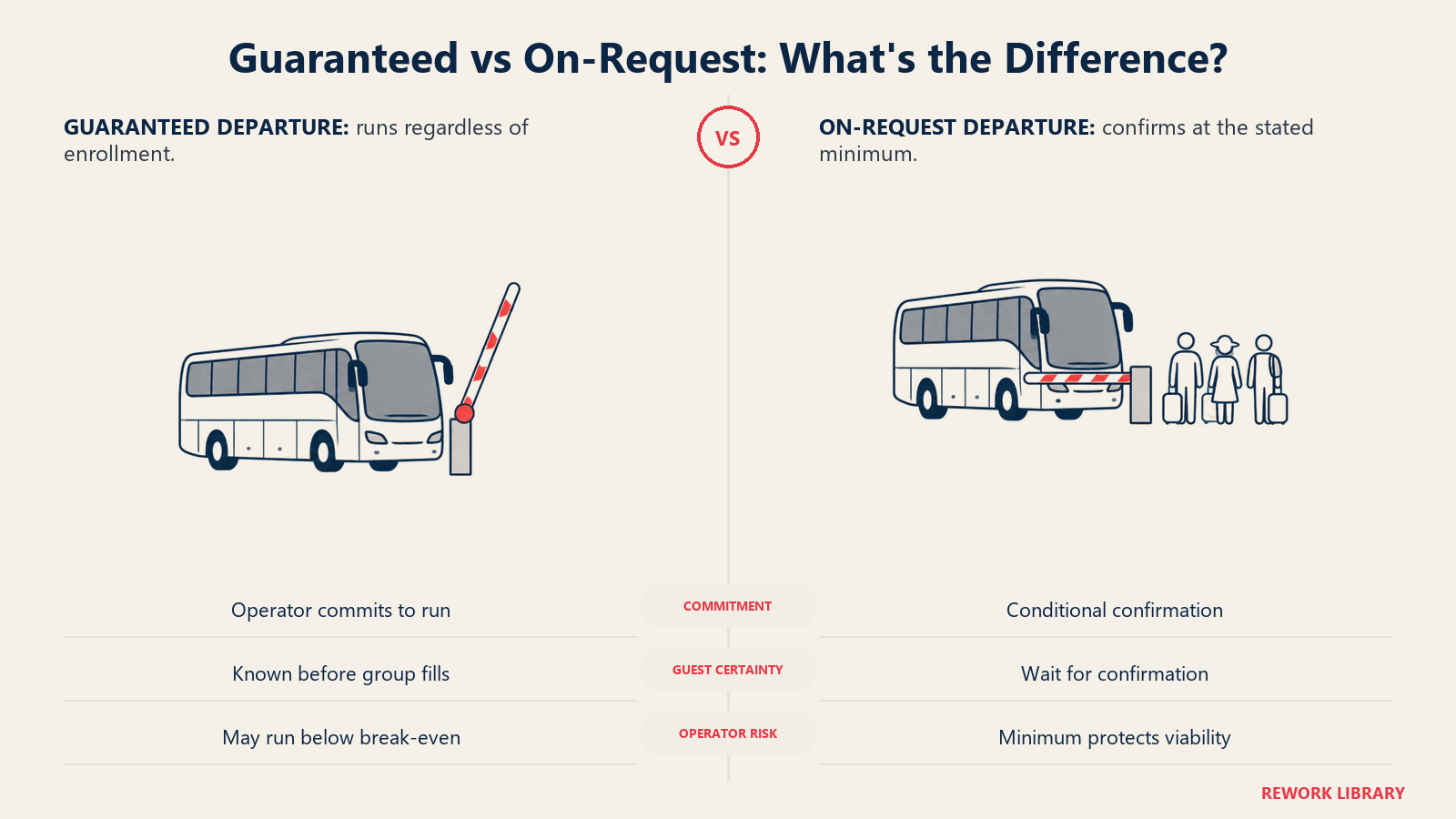
Guaranteed departures run regardless of enrollment. Marketing as "guaranteed" removes customer risk, enabling earlier bookings. But you're committed to operating even at a loss if minimum isn't met.
On-request departures confirm only when minimum is reached. More flexible for you, riskier for customers who don't know if trip will run. Communicate minimum thresholds and confirmation deadlines clearly.
Marketing confirmed departures once minimum is met converts waitlist and late bookers. "August 12 departure is CONFIRMED, booking now open." Confirmation removes uncertainty barrier.
Minimum group requirements should be realistic. Setting minimum at breakeven protects profitability. Setting it too high (aiming for full capacity) means frequent cancellations.
Forecasting & Demand Prediction
Predicting demand enables proactive revenue management.
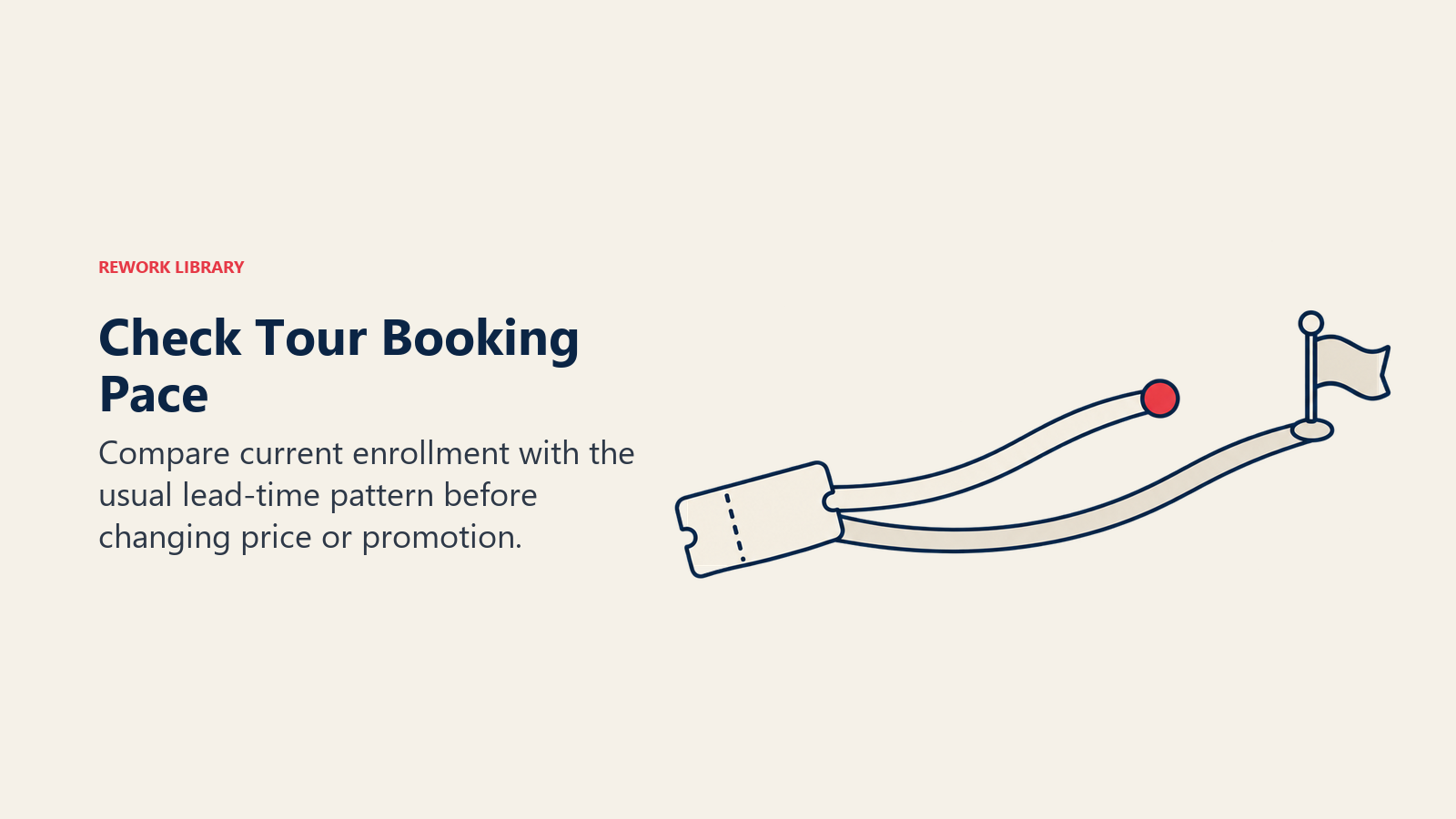
Use historical data from past years. When did bookings happen? What was booking pace? When did sellouts occur? Past patterns predict future behavior.
Booking pace analysis shows whether current enrollment is ahead or behind normal. If you're typically 70% sold at 3 months but currently at 45%, you're behind pace and should adjust pricing or marketing.
Lead times vary by product. Luxury tours book 9-12 months ahead. Adventure trips book 4-6 months. Budget tours book 1-3 months. Understand your lead time patterns to forecast appropriately.
External factors affecting demand include economy, exchange rates, geopolitical events, natural disasters, competitor actions, or cultural trends. Iceland exploded in popularity through social media. Monitor factors influencing your destinations.
Revenue management for tours isn't about squeezing maximum dollars from every customer. It's about strategically managing capacity, pricing, and inventory to ensure profitability while delivering great experiences.
Tours that consistently generate strong RevPAT, hit capacity targets, and maintain healthy margins provide the financial foundation for sustainable operations and growth.
Master these principles and you'll transform tour economics from unpredictable to optimized.
Related Articles:

Business Consultant
On this page
- Revenue Management in Tour Operations
- Tour Capacity Planning
- Departure Scheduling Optimization
- Price Optimization by Departure
- Inventory Control & Allocation
- Channel Mix Management
- Revenue Per Available Tour (RevPAT)
- Cancellation & Refund Policies
- Guaranteed vs On-Request Departures
- Forecasting & Demand Prediction