Customer Acquisition Cost in Travel - 2026 Complete Guide
Turn this article into takeaways for your work.


Each assistant summarizes the article only for you and suggests best practices for your work.
The average customer acquisition cost in the travel industry ranges from about $50 to $200 for organic and referral channels and $100 to $800 for paid channels, with luxury and corporate travel running into the thousands. The number that matters most is not CAC alone but the CAC to customer lifetime value ratio, where 1:3 or better signals sustainable, profitable growth.
You spent $24,000 on travel paid advertising Facebook ads last month and generated 60 bookings through booking conversion metrics. Success? Maybe tracked in travel KPI dashboard. If those customers each spent $3,500 and never book again, you paid $400 CAC for $3,500 customers. Your margin at 15% is $525. You netted $125 per customer - acceptable but not great. But if those customers book twice more over three years through repeat booking strategy and refer two friends each via travel referral programs, their customer lifetime value in travel is $14,000. Suddenly that $400 CAC looks brilliant.
You can't evaluate acquisition costs without understanding customer lifetime value. And you can't optimize marketing without knowing CAC by channel. Your organic search might cost $80 CAC. Your paid search might cost $450 CAC. But if paid search customers have 3x the lifetime value, they're actually more profitable despite higher acquisition costs.
Most travel businesses know they spend money on marketing. Few know exactly what it costs to acquire each customer and whether that cost is sustainable.
Defining CAC in Travel
The formula is straightforward in concept:
CAC = Total Marketing & Sales Costs ÷ New Customers Acquired
If you spent $48,000 on marketing and sales last quarter and acquired 120 new customers, your CAC is $400.
But "total marketing & sales costs" requires careful definition. Incomplete CAC calculations lead to bad decisions. Include everything that goes into acquiring customers, not just advertising spend.
Why CAC is critical for profitable growth: You can't scale if acquisition costs exceed customer value. Every business has a maximum sustainable CAC based on unit economics. Exceed it and growth destroys value. Stay below it and scaling works.
The relationship to business model: High-touch consultative travel sales with long customer relationships can support higher CAC than transactional booking platforms. Luxury operators can pay more to acquire customers than budget providers. Your sustainable CAC depends on your margins and customer lifetime value.
What to Include in CAC
Marketing spend includes all customer acquisition channels:
- Paid advertising (Google, Facebook, Instagram, TripAdvisor, etc.)
- Content marketing (writers, designers, SEO tools)
- Email marketing platforms and campaigns
- Social media management and ads
- PR and influencer partnerships
- Trade show attendance and booth costs
- Marketing technology stack (CRM, analytics, automation)
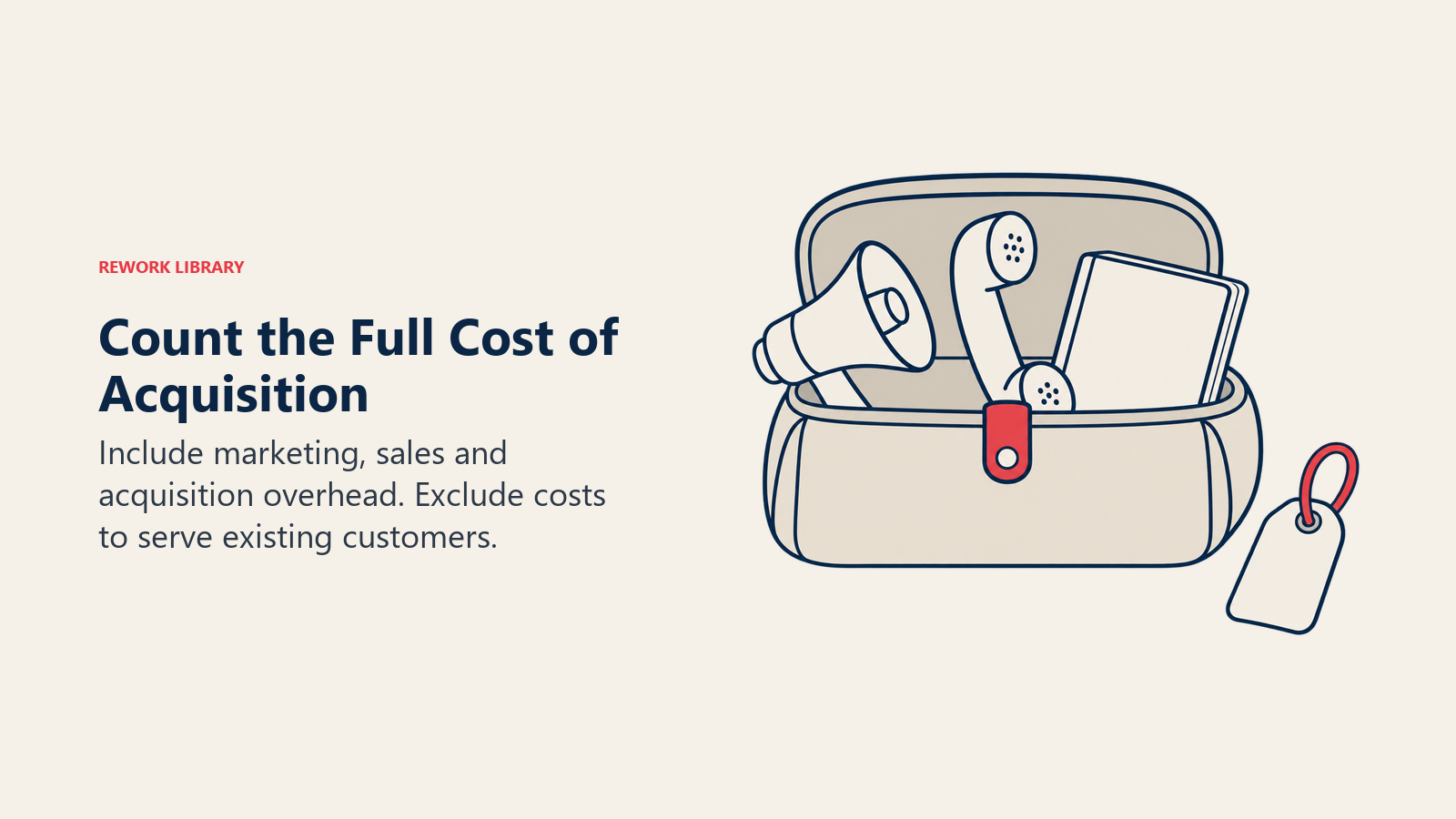
Sales costs often get overlooked in CAC calculations but must be included:
- Sales team salaries and commissions
- Sales tools and training
- Demo/consultation time spent with prospects who don't book
- Travel and entertainment for sales activities
- Sales manager overhead
Overhead allocation for functions supporting acquisition:
- Marketing team leadership and admin
- Portion of technology infrastructure
- Office space and equipment for sales/marketing teams
Attribution considerations require judgment. If you run brand campaigns that support all channels, allocate costs proportionally. If you invest in website improvements that benefit both acquisition and retention, allocate based on usage.
Don't include costs for serving existing customers. Customer support, post-booking communications, and retention marketing aren't acquisition costs. Keep CAC separate from customer retention costs.
CAC by Acquisition Channel
Organic search delivers the lowest CAC in mature markets: typically $50-200 for travel businesses with established SEO. But building organic presence requires 12-24 months and upfront investment. Calculate CAC including historical SEO investment amortized over time for accuracy.
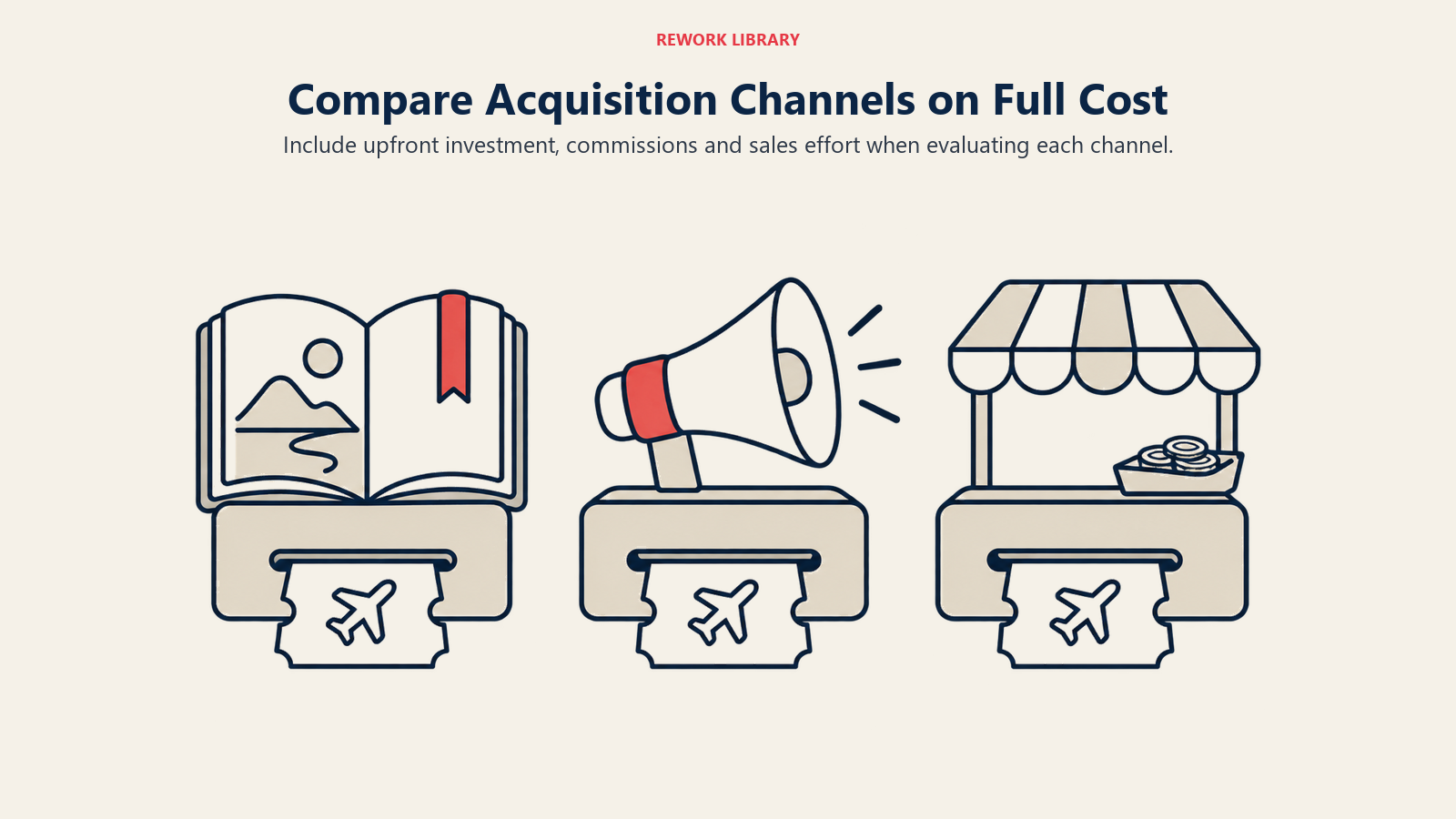
Paid search costs vary dramatically: $100-500 CAC depending on competitiveness. Generic searches like "Europe tours" run high CPC with low conversion. Specific searches like "15-day guided Italy tour for seniors" cost more per click but convert better. Net CAC can be similar.
Social media advertising runs $80-300 CAC for travel depending on targeting and creative quality. Facebook and Instagram work well for inspiration-driven travel. The visual medium suits destination marketing. But users aren't always ready to book, leading to longer nurture cycles.
OTA commissions are effectively acquisition costs for new customers: 15-25% of booking value. If your average booking is $3,500 and OTA commission is 18%, you're paying $630 CAC. But OTA bookings convert quickly - different trade-off than paid ads requiring long nurture.
Referral program costs typically run $100-300 CAC including referral bonuses and program administration. A well-designed referral program offers $200 credit to referrer and referee. If 60% of credits get redeemed, actual cost is $240 per acquisition plus program overhead.
Trade shows generate $200-800 CAC depending on quality. Major shows like ITB Berlin or WTM London cost $8,000-25,000 for booth and travel. If you acquire 30-50 clients annually from show contacts, CAC runs high but these are often high-value B2B relationships.
Email marketing to house lists has near-zero incremental CAC for current customers but requires you already built the list somehow. For cold email marketing, factor list acquisition, platform costs, and send volume. Usually $30-120 CAC.
Content marketing and SEO have high upfront costs but low marginal costs. Spending $5,000 monthly on content that generates 40 customers monthly is $125 CAC currently. But that content continues attracting customers for months or years. Amortize costs across customer lifetime of the content.
CAC Benchmarks by Travel Segment
Budget travel agencies ($50-200 CAC) operate on thin margins requiring strict CAC discipline. They're competing largely on price. Customer LTV is lower. Acceptable CAC is proportionally lower. Focus on low-cost channels: SEO, email, referrals.
Luxury operators ($500-2,000+ CAC) can pay significantly more because customer LTV is 3-5x higher than mid-market. A luxury safari operator might comfortably pay $1,500 to acquire a $12,000 booking with strong repeat probability. The unit economics work.
Corporate travel services targeting B2B accounts run $1,000-5,000 CAC because contract values are large and recurring. Landing a corporate account that books $150,000 annually for 3+ years justifies high acquisition costs including lengthy sales cycles and relationship building.
Tour operators with packaged products typically run $200-600 CAC. They're between budget and luxury on pricing. Margins support moderate acquisition costs. They compete on experience quality and convenience, not just price.
FIT (free independent traveler) agencies with high-touch service run $300-900 CAC. Complex custom itineraries require expertise. Customers pay premium prices. LTV supports higher acquisition investment.
CAC vs Customer Lifetime Value
The critical CAC:CLV ratio determines sustainable growth. Industry consensus targets 1:3 or better - customer lifetime value should be at least 3x acquisition cost. If you pay $600 CAC, customer LTV should be $1,800+.
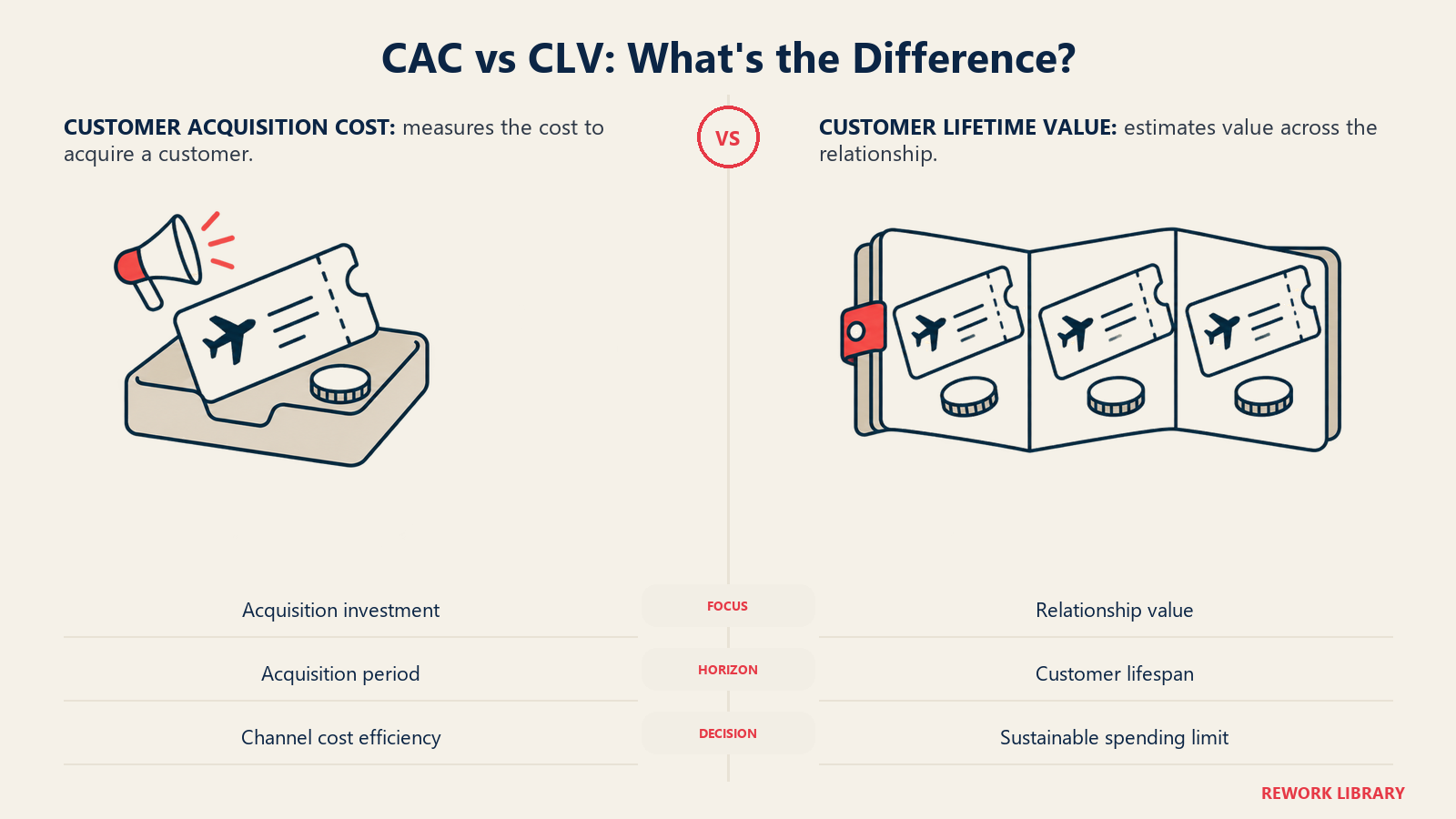
At 1:3 ratio, you're generating healthy returns that support scaling. Better ratios (1:4, 1:5) indicate competitive advantages - superior conversion, better retention, or efficient acquisition.
Below 2:1 is dangerous. You're not generating sufficient return on acquisition investment. At 1:1 you're break-even on first transaction, relying entirely on repeat business for profitability. Below 1:1 means you're losing money acquiring customers.
Calculate this by channel. Your referral customers might deliver 8:1 CAC:CLV ratios ($200 acquisition, $1,600 LTV). Your paid search might be 2.5:1 ($500 acquisition, $1,250 LTV). Both can be viable with different strategic purposes.
When high CAC is acceptable: Market entry, defensive positioning against competitors, acquiring customers with exceptionally high LTV, or strategic loss leaders that lead to profitable upsells.
Payback period measures how long to recover acquisition costs. If CAC is $600 and gross margin on first booking is $750, you're profitable immediately. If first booking margin is $300, you need repeat booking to reach profitability. Shorter payback periods reduce risk.
CAC Trends & Tracking
Track monthly CAC trends to spot concerning patterns early. If CAC is creeping from $350 to $425 over six months while LTV remains flat, investigate. Are ads getting more expensive? Is conversion dropping? Is competition intensifying?
Rising CAC isn't automatically bad if LTV is rising faster. But rising CAC with flat LTV is unsustainable.
Seasonal variations affect CAC predictably. Q4 travel advertising is more expensive due to competition from retail holiday campaigns. Summer advertising for summer travel competes with high demand. Expect 20-40% CAC swings seasonally and plan accordingly.
Compare year-over-year same-month CAC to isolate real trends from seasonal noise. November 2026 CAC compared to November 2025 shows true direction.
Cohort analysis tracks CAC and LTV for customers acquired in specific months. Your Jan 2024 cohort might have $400 CAC and now shows $1,650 LTV after 24 months. Your Jan 2025 cohort has $485 CAC and $950 LTV after 12 months - not as strong. This guides adjustments.
Strategies to Lower CAC
Content marketing and SEO reduce CAC over time by creating organic traffic that doesn't require ongoing ad spend. A destination guide ranking well generates inquiries for years. Initial creation cost amortizes across all resulting customers.
Invest $40,000 in content creation and SEO infrastructure. Year 1 might generate 100 customers = $400 CAC. Year 2 adds 200 customers with minimal incremental cost = $133 blended CAC. Year 3 adds 300 more = $100 blended CAC. Long-term thinking wins.
Referral programs leverage existing customers to acquire new ones efficiently. Well-designed programs generate $150-300 CAC versus $400-600 for paid advertising. And referred customers often have higher LTV.
Community building creates environments where customers recruit each other organically. Travel community groups generate inquiries through peer discussions and recommendations. Initial community setup requires investment but ongoing CAC approaches zero for community-driven bookings.
Conversion optimization reduces CAC without reducing spend. If you're spending $10,000 monthly and converting 3% of leads, that's one CAC. Improve conversion to 4.2% and CAC drops 30% from the same spend. Small conversion improvements generate massive CAC reductions.
Sales efficiency improvements through better qualification, faster response times, and improved close rates lower CAC by reducing wasted effort on unqualified leads and improving win rates on qualified ones.
When to Increase CAC
Market expansion into new segments or geographies justifies temporarily higher CAC. You're building brand awareness and customer base. Accept 1.5:1 or 2:1 CAC:CLV ratios initially, expecting to improve as you optimize.
Competitive positioning during market consolidation might require defensive CAC increases. If a competitor is aggressively acquiring customers in your core market, you might increase CAC to protect share, accepting temporarily lower returns.
Customer LTV growth through improved retention, upsells, or repeat rates can justify higher CAC. If you historically had $1,500 LTV supporting $500 max CAC but improvements lift LTV to $2,200, you can pay up to $730 CAC while maintaining 1:3 ratios.
Strategic long-term value scenarios where customers become advocates, brand ambassadors, or enter lucrative referral cycles justify higher initial CAC for specific segments.
Testing and learning in new channels requires accepting poor initial CAC. When exploring TikTok advertising or a new trade show, expect learning curves. Budget for testing without expecting immediate positive ROI.
Channel Mix Optimization
Allocate budget based on CAC, volume potential, and strategic priorities. Don't just chase lowest CAC. A channel with $150 CAC generating 20 customers monthly is less valuable than a channel with $350 CAC generating 80 customers monthly (assuming similar LTV).
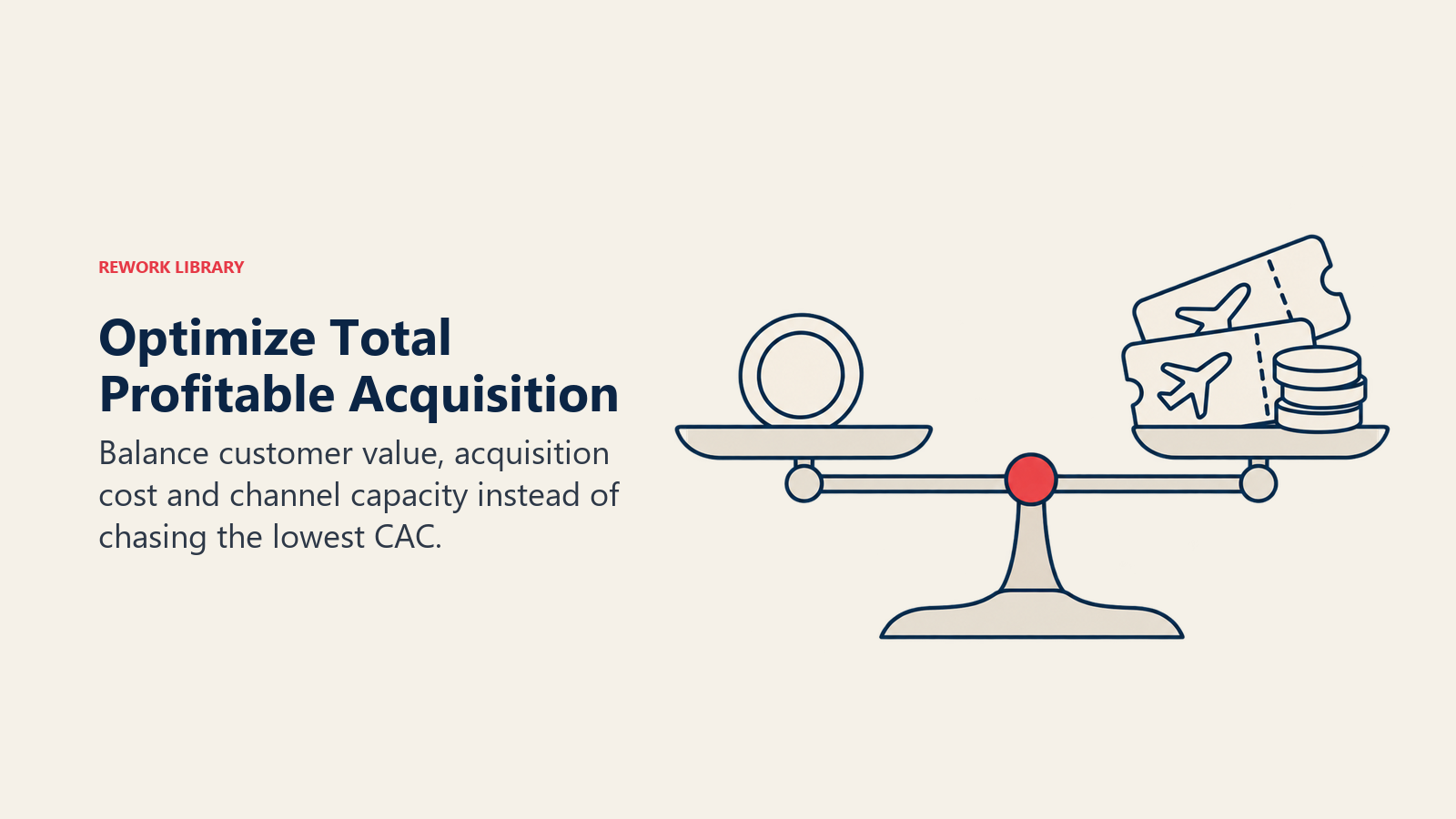
Calculate total contribution: (Customers Acquired × (LTV - CAC)). Optimize for total profitable customer acquisition, not lowest cost per customer.
Portfolio approach balances low-CAC channels (SEO, email, referrals) with scalable higher-CAC channels (paid search, social ads). Low-CAC channels often have limited volume. You need multiple channels to scale.
Example balanced mix:
- 30% budget to SEO/content (low CAC, limited scalability)
- 25% budget to paid search (medium CAC, high scalability)
- 20% budget to social advertising (medium CAC, high reach)
- 15% budget to referral programs (low CAC, moderate growth)
- 10% budget to partnerships/trade shows (high CAC, strategic value)
Test aggressively in 10-15% of budget experimenting with new channels, platforms, and tactics. Successes graduate to core budget. Failures get cut quickly.
Tracking CAC Accurately
Attribution models determine which touchpoints get credit. Last-click attribution gives all credit to final touchpoint before booking - usually undervaluing top-of-funnel awareness channels. First-click overvalues initial discovery.
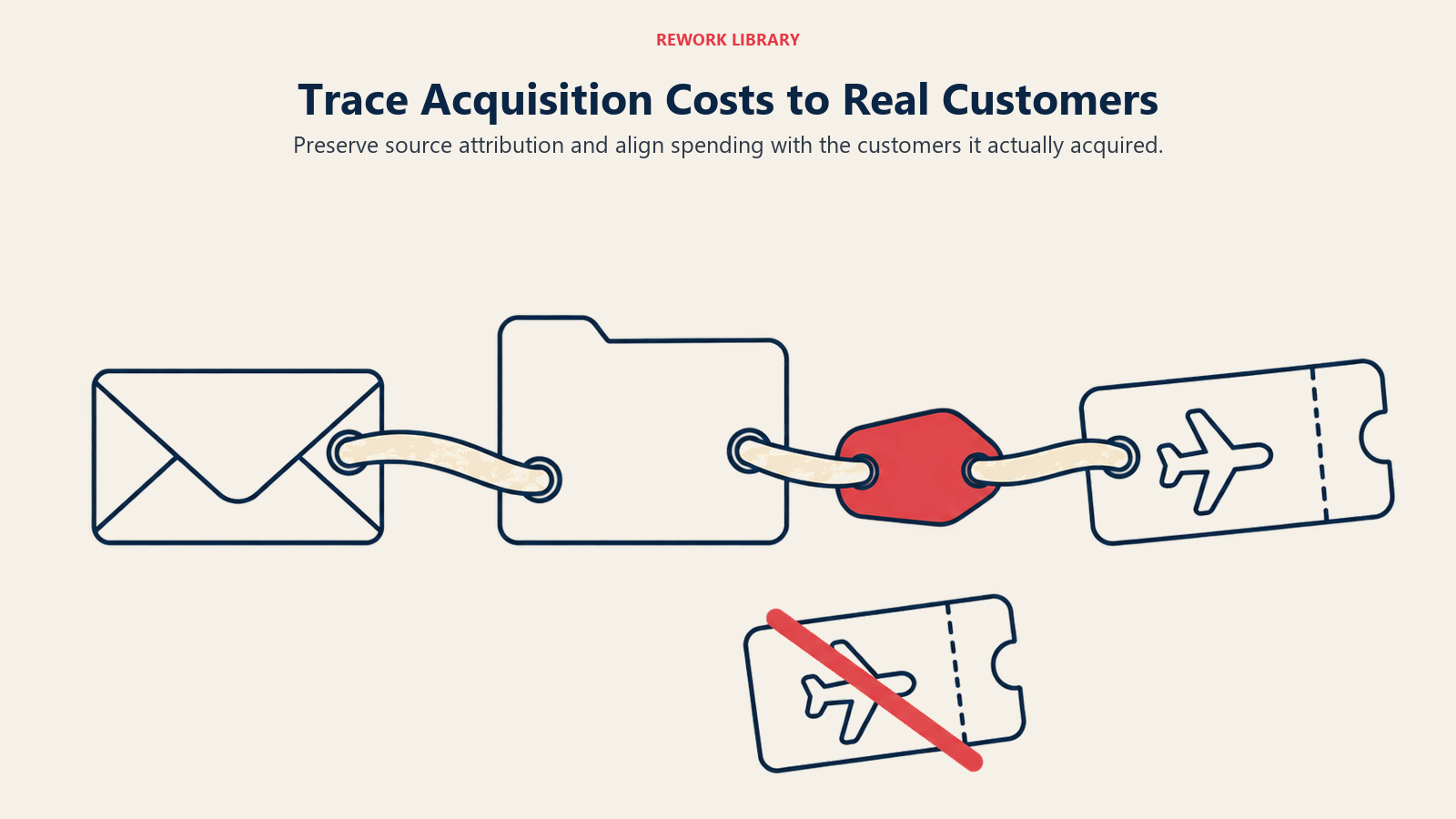
Multi-touch attribution distributes credit across the customer journey. Position-based gives 40% to first touch, 40% to last touch, 20% distributed to middle touches. Time-decay gives more credit to recent interactions.
Choose attribution models that match your sales cycle. Quick transactional sales work with simpler attribution. Long consultative cycles need sophisticated multi-touch models.
CRM requirements include capturing source data for every inquiry. Use UTM parameters religiously on all links. Tag campaigns, sources, mediums, and content. This data flows into analytics and CRM showing complete customer journeys.
Without source tracking, CAC by channel is guesswork.
Common calculation mistakes:
- Excluding sales costs - only counting advertising spend
- Not allocating overhead - missing team salaries and tools
- Wrong time periods - calculating spend in one month against acquisitions from different month (lag matters)
- Including retention costs - mixing acquisition and retention expenses
- Forgetting cancellations - tracking bookings as acquisitions when 15% later cancel
Conclusion
Customer acquisition cost is the foundation of sustainable travel business growth. You can't scale profitably without knowing what it costs to acquire customers and whether that cost is justified by customer lifetime value. Track CAC by channel, compare to LTV, and optimize ruthlessly.
The travel businesses that master CAC operate with discipline competitors lack. They know exactly which channels deliver profitable growth. They invest confidently because they track returns precisely. They scale successfully because their unit economics work.
Frequently Asked Questions
What is the average customer acquisition cost in the travel industry? It varies widely by channel and segment. Organic search and referrals run roughly $50 to $300, paid search and social run $80 to $500, and trade shows or B2B corporate sales can reach $800 to $5,000. Budget agencies sit at the low end while luxury and corporate operators sit at the high end.
How do you calculate CAC for a travel business? Divide total marketing and sales costs by new customers acquired in the same period. Include advertising, content, sales salaries and commissions, marketing technology, and overhead allocation. Exclude costs for serving existing customers, which belong to retention, not acquisition.
What is a good CAC to lifetime value ratio in travel? A ratio of 1:3 or better is the industry benchmark, meaning customer lifetime value should be at least three times acquisition cost. Below 2:1 is dangerous, and below 1:1 means you lose money on every customer you acquire.
Which travel marketing channel has the lowest CAC? Mature organic search and referral programs deliver the lowest cost, often $50 to $300, but organic search takes 12 to 24 months to build. Paid channels scale faster but cost more, so a portfolio mix of low-cost and scalable channels usually performs best.
Why is CAC higher for luxury and corporate travel? Higher acquisition costs are justified by higher customer lifetime value. A luxury operator can pay $1,500 to land a $12,000 booking with strong repeat probability, and a corporate account booking $150,000 a year for several years supports CAC of several thousand dollars.
Related Articles:

Business Consultant