Package Pricing Optimization: Creating Profitable Travel Bundles
Turn this article into takeaways for your work.


Each assistant summarizes the article only for you and suggests best practices for your work.
Sell flights, hotels, transfers, and activities separately and you'll close about 22% of inquiries at an average value of $3,800. Package them together as "Complete Costa Rica Adventure" and conversion jumps to 34% with average value of $4,650.
Same components. Different presentation. Better economics.
Packages simplify purchasing decisions, increase perceived value, obscure component price comparisons, and create opportunities for strategic margin management that component-by-component selling doesn't allow.
Package Design Principles
Good packages feel cohesive and complete, not random assemblages of products.
What to bundle together should make thematic and practical sense. Adventure package: whitewater rafting, zip-lining, hiking, surf lessons. Cultural package: cooking class, temple tours, traditional performances, local market visits. Don't randomly combine adventure and culture, that's two different packages.
Component selection balances comprehensiveness with value. Include enough to feel complete without over-including items clients don't value. Most clients want hotels, airport transfers, and signature activities. Not everyone wants every meal or every possible excursion.
Create coherent themes that tell a story. "Tuscany Food & Wine Journey" signals exactly what's included. "Italian Vacation Package" is generic and unclear. Themed packages set expectations and attract the right audience.
Ensure operational feasibility before marketing packages you can't actually deliver. Can suppliers handle the volume? Are activities available on required days? Do timing and logistics actually work? Design beautiful packages that are actually executable.
Cost Structure of Packages
Understanding true costs enables strategic pricing.
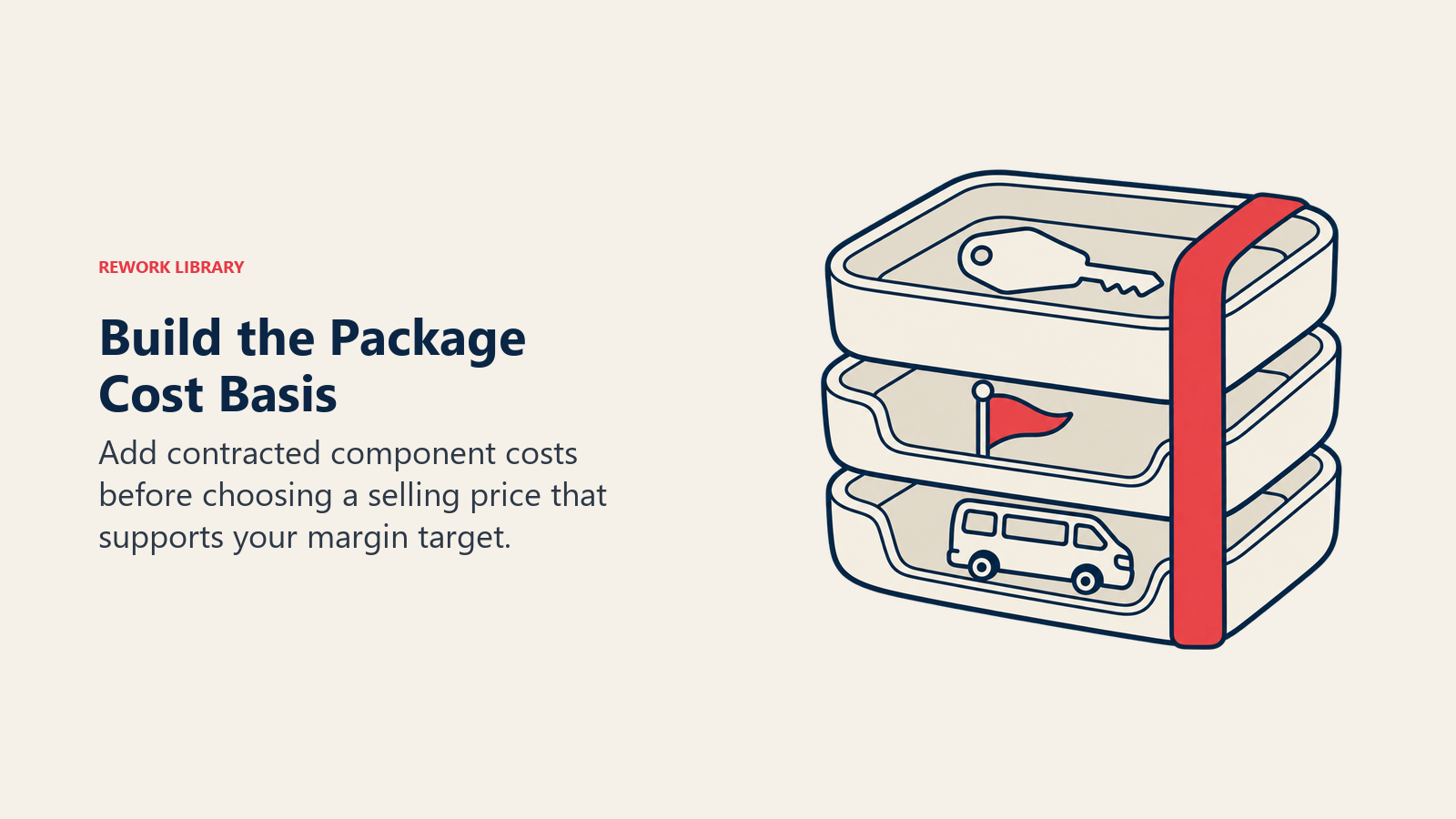
Calculate net costs for each component. Hotels at net rates, activities at wholesale prices, transportation at contracted rates, meals at group pricing. Sum these to understand your total cost basis.
Negotiate bulk rates with suppliers when packaging creates volume. "I'll send 40 guests to your hotel over the next quarter if you give me 18% off net rates." Volume creates negotiating leverage.
Absorbing versus passing through costs is strategic. Maybe absorb airport taxes and booking fees in the package price (simplifies client perception) but pass through optional activity costs separately (gives flexibility).
Margin calculations require knowing total package cost, desired gross margin percentage, and market pricing constraints. Package costs $3,200. Desired margin 22%. Minimum price is $4,103. Can market support that? If not, adjust components or accept lower margin.
Package Pricing Models
Different approaches to setting package prices.
Cost-plus markup is straightforward: calculate costs, add desired margin percentage. $3,600 cost + 25% markup = $4,500 package price. Simple, predictable, ensures profitability.
Market-based pricing looks at what competitors charge for similar packages and prices competitively. If market range is $4,200-4,800, price in that range regardless of exact costs. Works when competitive intelligence is good.
Value-based pricing charges what customers will pay based on perceived value. A "luxury honeymoon package" might command $12,000 even though costs are only $7,500 because perceived value and emotional investment justify the premium.
Psychological pricing for packages uses charm pricing ($4,995 not $5,000), anchoring with premium options, and creating good-better-best tiers that guide clients toward mid-tier selections.
All-Inclusive vs À La Carte
Choose the right model for your market and product.
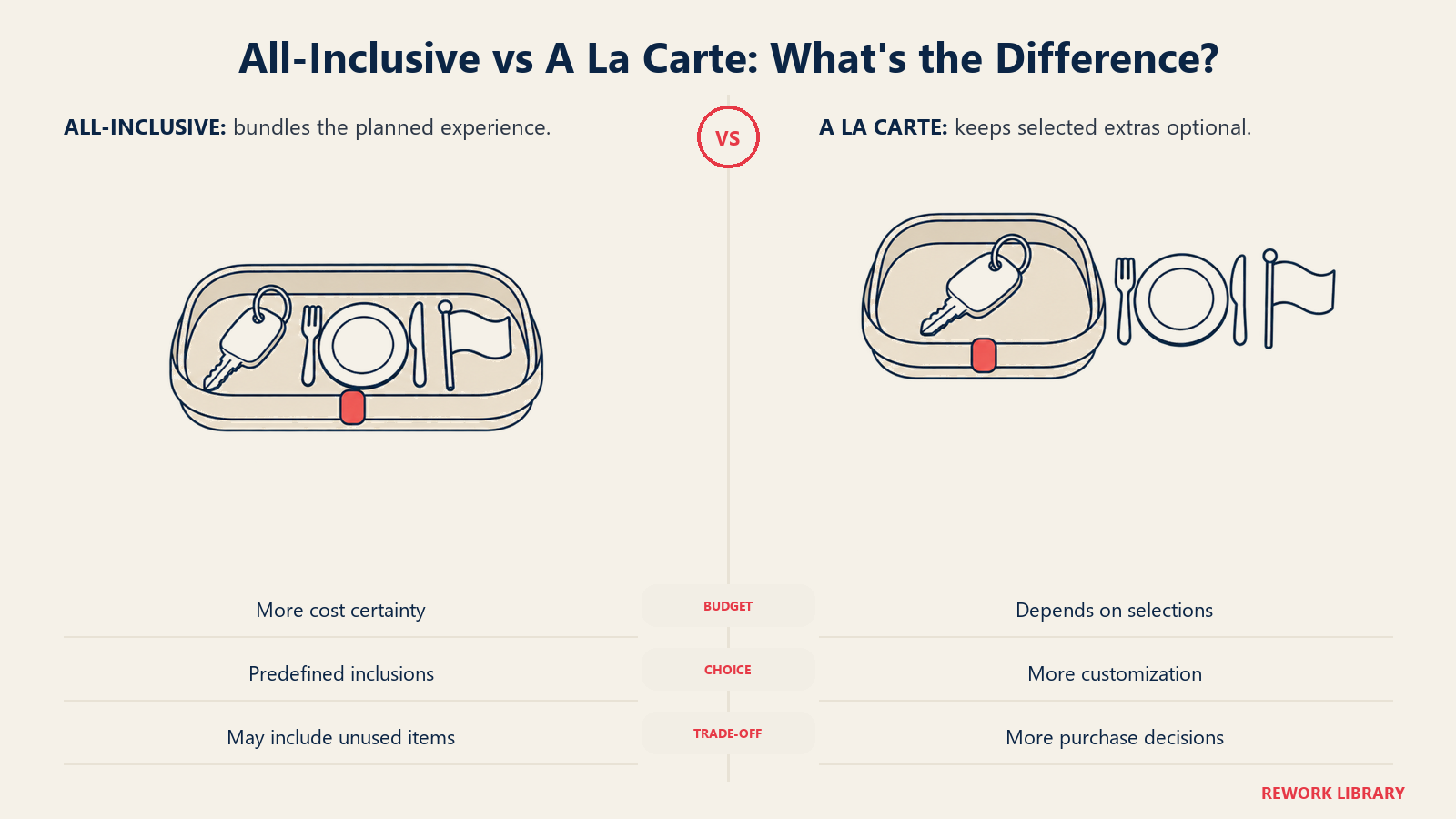
All-inclusive packages include everything: accommodations, all meals, drinks, activities, transfers, taxes, tips. One price, zero surprises. "Your complete Maldives week: $8,400 per couple, everything included." Simpler decision-making, higher perceived value, but less flexibility.
Benefits of all-inclusive: easier budgeting for clients, higher average booking value, simplified operations (you control all components), and reduced price comparison (hard to unbundle and compare).
Drawbacks: requires higher upfront investment from clients, less flexibility (they're paying for meals even if they prefer exploring local restaurants), and potential for unused inclusions if you over-include.
À la carte base + optional add-ons gives flexibility. "$3,200 base package includes hotels, breakfasts, and airport transfers. Add activities: snorkeling tour +$95, island hopping +$140, spa treatment +$110." Clients customize to preferences and budget.
Hybrid approaches work well: "Base package is all-inclusive for accommodations, transportation, and breakfasts. Lunches and dinners at your choice, we'll provide restaurant recommendations and can book reservations." This balances comprehensiveness with flexibility.
Customer preferences trend toward simplicity for international destinations (all-inclusive reduces uncertainty) and flexibility for domestic or familiar destinations (clients comfortable navigating themselves).
Tiered Package Strategy
Good-better-best frameworks maximize revenue while serving different segments.
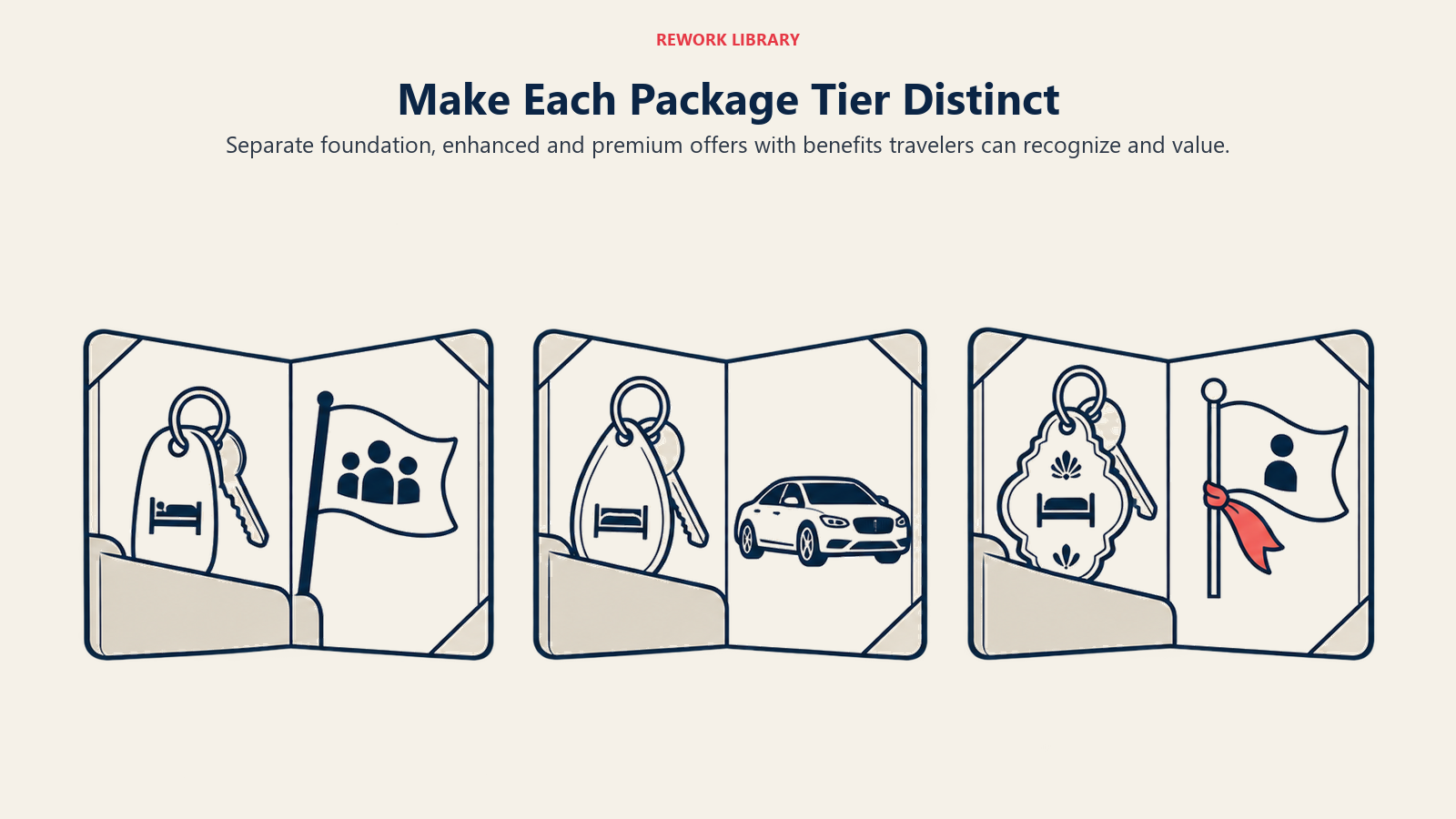
Create three tiers with clear differentiation. Foundational package delivers core experience at accessible price. Enhanced package adds meaningful upgrades most clients will value. Premium package includes exceptional elements for clients wanting the best.
Example for Peru: Foundation ($3,400) includes 3-star hotels, shared transfers, group tours, standard train to Machu Picchu. Enhanced ($4,800) upgrades to boutique hotels, private transfers, small group tours (max 8), upgraded train with panoramic windows. Premium ($6,800) adds luxury properties, private guide throughout, first-class train, helicopter over Nazca Lines, cooking class with renowned chef.
Differentiate value propositions clearly. Enhanced isn't just "more expensive foundation", it's substantively better with specific benefits clients will notice and value. Premium offers truly exceptional elements unavailable in lower tiers.
Guide customers to optimal choices through strategic presentation. Present all three but recommend Enhanced as "best value for this experience" or "what most clients choose." Middle options disproportionately attract buyers.
Maximize revenue by designing tiers where majority choose mid-tier at good margins, some stretch to premium (great margins), and few choose foundation (acceptable margins). Avoid having everyone cluster at foundation by insufficiently differentiating higher tiers.
Optional Add-On Pricing
Separate must-haves from nice-to-haves for flexibility.
Must-haves belong in base package: accommodations, essential transportation, signature experiences. Nice-to-haves offer as add-ons: extra activities, spa treatments, room upgrades, special dinners, extended nights.
Price add-ons for easy incremental purchases by keeping them reasonably priced and clearly valuable. "$120 for a private sunset cruise" is easy to say yes to when base package is already $4,600. "$1,200 for three additional excursions" feels like big decision.
Upsell optimization through strategic add-on presentation. Offer at multiple touchpoints: initial quote (show what's possible), booking confirmation (capture enthusiasm), and pre-departure email (final opportunity to enhance experience).
Package Positioning & Marketing
How you present packages dramatically affects conversion.
Communicate package value by highlighting what's included and emphasizing convenience of having everything arranged. "Your complete Portugal journey includes 11 nights luxury accommodations, all breakfasts and 6 dinners, private airport transfers, guided tours of Lisbon and Porto, wine tastings in Douro Valley, cooking class, and dedicated travel coordinator. Everything's arranged, just show up and enjoy."
Simplify complex offers by using "includes" lists, visual itineraries showing day-by-day flow, and clear pricing (not hidden costs or confusing terms).
Highlight savings versus à la carte by showing value. "If booking components separately: Hotels $2,100, activities $840, transfers $280, tours $620 = $3,840. Package price: $3,400. Save $440 plus get upgraded hotel category." Demonstrate concrete value.
Create urgency through limited-time offers ("Book by March 31 and save 12%"), limited availability ("Only 4 packages available for May departures"), or special inclusions ("First 10 bookings receive complimentary wine tasting").
Seasonal Package Variations
Adapt packages to different seasons and events.
Peak season packages maximize value at higher price points. "Summer Croatia: $5,200 includes best hotels, private boat experiences, festival tickets." Peak demand supports premium positioning.
Shoulder season packages emphasize value and weather still being good. "September Italy: $3,800, perfect weather, fewer crowds, lower prices than summer. All the beauty without the chaos."
Low season packages require aggressive value to drive demand. "February Iceland: $2,800, northern lights season, winter activities, dramatic landscapes. Includes thermal baths, glacier hiking, ice cave tour." Frame winter as feature, not bug.
Special event packages capitalize on temporary demand. "New Year's in Dubai: $7,500 including premium hotel, Burj Khalifa observation deck reservation, fireworks dinner cruise, and exclusive desert safari." Events justify premium pricing.
Holiday-themed offerings for Christmas, Valentine's, anniversaries, or cultural celebrations. "Valentine's Weekend in Paris: $2,400, romantic Seine cruise, Eiffel Tower dinner, couples spa treatment, champagne in room."
Channel-Specific Packaging
Design different packages for different distribution channels.
Wholesale packages for travel agency distribution offer deep discounts but guaranteed volume. "Agent net rate: $3,000 (retail value $4,200). Minimum 6 packages per quarter." Agencies mark up for retail sale.
Retail-only exclusives reward direct bookings with upgraded elements. "Book direct and receive complimentary room upgrade and $200 dining credit, $600 value." Incentivizes avoiding OTA commissions.
Direct booking incentives might include payment flexibility, free cancellation, best price guarantee, or exclusive add-ons unavailable through other channels.
OTA versus direct differentiation: OTAs get standard packages at retail pricing (you pay their commission). Direct bookings get enhanced versions at same price point (you keep the margin that would have gone to commission).
Package Performance Analysis
Continuous improvement requires measuring what works.
Track package attach rates showing how often packages sell versus individual components. If 65% of clients book packages versus 35% buying à la carte, packages are working.
Profitability by package type reveals which packages generate best margins. Maybe your enhanced tier has highest gross margin percentage, but premium tier has highest absolute profit per booking. Both matter.
Customer feedback through post-trip surveys asking "Was the package comprehensive?" "What would you add/remove?" "Did pricing feel fair?" "Would you recommend this package?"
Continuous optimization based on data and feedback. If everyone removes the same optional dinner, maybe it's overpriced or doesn't fit the itinerary. If everyone adds the cooking class, include it in base package and raise prices accordingly.
Package pricing isn't about tricking clients into buying more. It's about creating comprehensive offerings that deliver better experiences while simplifying decisions and improving your economics.
Well-designed packages convert better, generate higher revenue per booking, command stronger margins, and create happier clients than component-by-component sales.
Test different package structures, monitor performance, listen to customer feedback, and continuously refine. The best packages evolve over time based on real market feedback.
Related Articles:

Business Consultant