Handling Travel Objections: Overcoming Booking Barriers - 2026
Turn this article into takeaways for your work.


Each assistant summarizes the article only for you and suggests best practices for your work.
You've sent a beautiful proposal. The client loves the itinerary. Then comes the message: "This is more than we expected to spend." Or "We're concerned about safety there." Or the classic "We need to think about it."
Most travel sellers hear these objections as rejection. Top performers recognize them as progress. An objection means the client is seriously considering booking, they just need help getting past a specific concern.
Understanding Travel Objections
Not all objections are what they appear to be on the surface.
Real objections versus excuses require different approaches. A real objection is a legitimate concern preventing the booking: budget constraints that genuinely can't stretch, safety concerns based on recent news, or timing that doesn't work with their schedule. These need addressing directly.
Excuses mask the real issue. "We need to think about it" rarely means they need thinking time, it usually means they're not convinced of value, they have concerns they're uncomfortable voicing, or they're comparison shopping but don't want to tell you. Understanding the full travel sales process helps you anticipate objections at each stage.
Root cause identification comes from asking gentle follow-up questions. When someone says "It's too expensive," that could mean: your price exceeds their budget, they don't understand what's included, they found cheaper options elsewhere, they don't perceive enough value to justify the investment, or they're negotiating for a discount. Each requires a different response.
Objections as buying signals is a fundamental sales principle. People who aren't interested ghost you. People raising objections are engaged in the decision process, they're looking for reasons to say yes. Your job is to provide those reasons.
Price Objection Frameworks
"That's more than I expected" is the most common objection in travel sales.
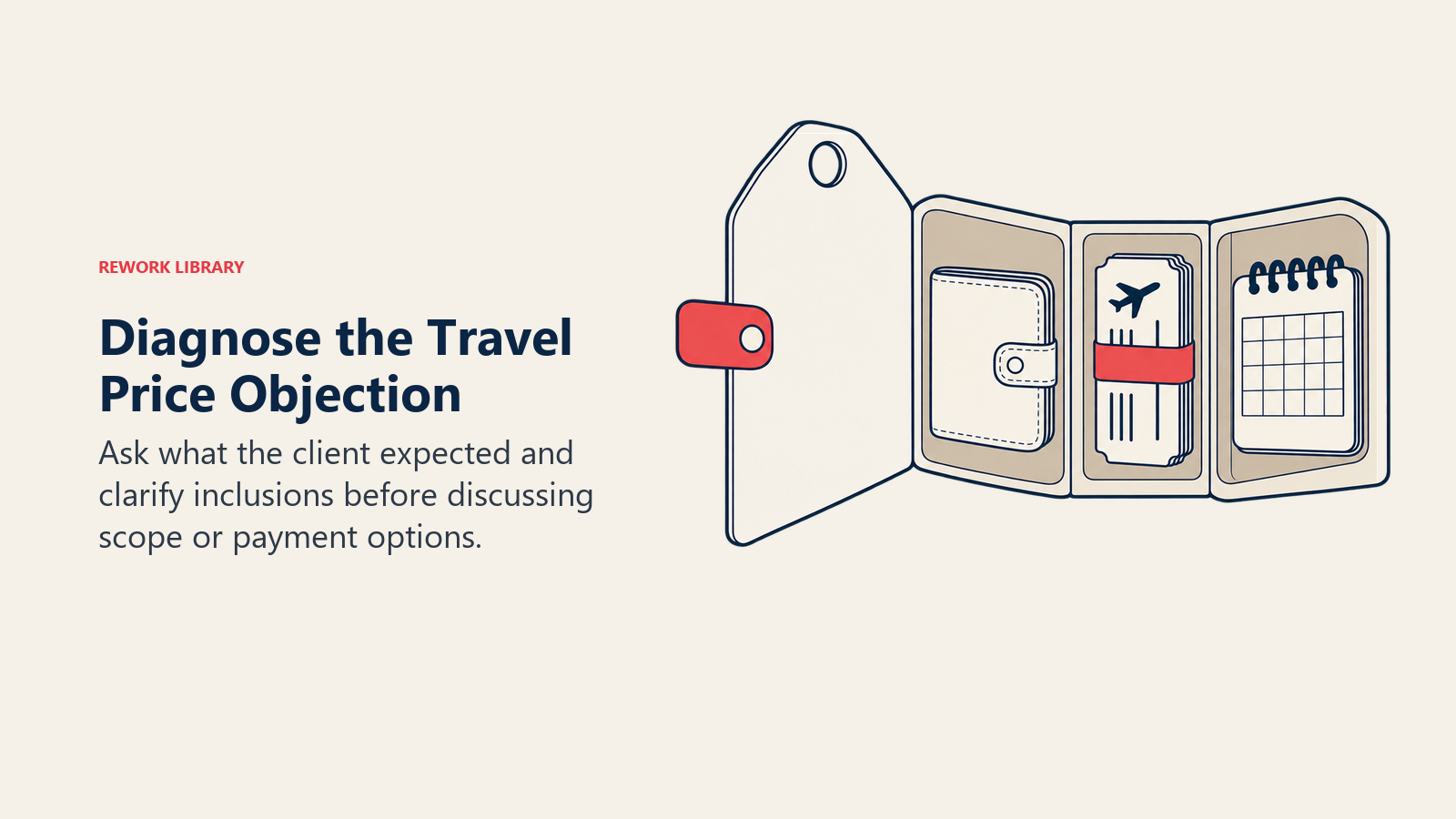
Respond with questions before defending your pricing. "I appreciate you being direct about budget. Can I ask what you were expecting?" or "What specific aspects of the pricing concern you?" Often you'll discover they're comparing your custom private tour to group tour pricing, or they don't realize how much travel to that destination typically costs.
Value reframing shifts focus from cost to worth. "Let me break this down differently. This is $410 per person per day, which includes your five-star accommodations, private guide services, all entrance fees, most meals, and ground transportation. You're not paying extra for anything except personal shopping and drinks. Compare that to the $300+ per night just for hotels, then add $150 per person for day tours, and you're actually getting tremendous value." This ties to your overall travel pricing strategy.
Payment plan options remove immediate financial barriers. "I can structure this with 20% deposit to secure your booking, 40% due 90 days before departure, and the final 40% at 60 days. That spreads the investment over several months rather than one large payment."
Alternative options demonstrate flexibility. "If this price point doesn't work, let me show you a few adjustments that would bring it down: moving to four-star properties instead of five-star saves about $1,800, shortening the trip by two days reduces it by $2,400, or we could switch from private to small group tours and cut roughly $3,000. You'll still have an amazing trip." Effective package pricing optimization provides these tiered options.
ROI of experiences resonates emotionally. "Travel is one of the few purchases that becomes more valuable over time. Twenty years from now, you won't remember what you paid, but you'll still tell stories about watching sunrise over Angkor Wat with your daughter. That's worth a lot."
Safety & Security Concerns
Safety objections require acknowledgment, specific information, and empathy.
Address destination safety fears with current, factual information. Not "Oh, it's totally safe!" but "I understand your concern. The region you'd visit is the tourist heartland where security is prioritized. Our local partners have been operating there for 15 years without incident involving clients. The UK Foreign Office and US State Department currently have no travel warnings for that area. Would it help if I shared recent client feedback from trips last month?"
Health concerns need practical solutions. "For the food safety concerns, we're selecting restaurants our local team has vetted and knows maintain high standards. All accommodations have purified water. We provide a list of recommended clinics in each city. And travel insurance includes emergency medical coverage including evacuation if needed."
Travel insurance addresses multiple fears. "Comprehensive travel insurance costs about 6-8% of your trip total. It covers medical emergencies, trip cancellation if someone gets sick before departure, evacuation if needed, lost luggage, and dozens of other scenarios. Given the investment you're making, it's worth the peace of mind."
Credible information sources build confidence. "I'd encourage you to look at current traveler reviews on TripAdvisor for the properties we're suggesting. You'll see recent guests, including families with kids, had wonderful, safe experiences. I can also connect you with past clients who just returned if you'd like firsthand perspectives."
Timing & Commitment Hesitation
"We need to think about it" is rarely about needing time. It's about unvoiced concerns.
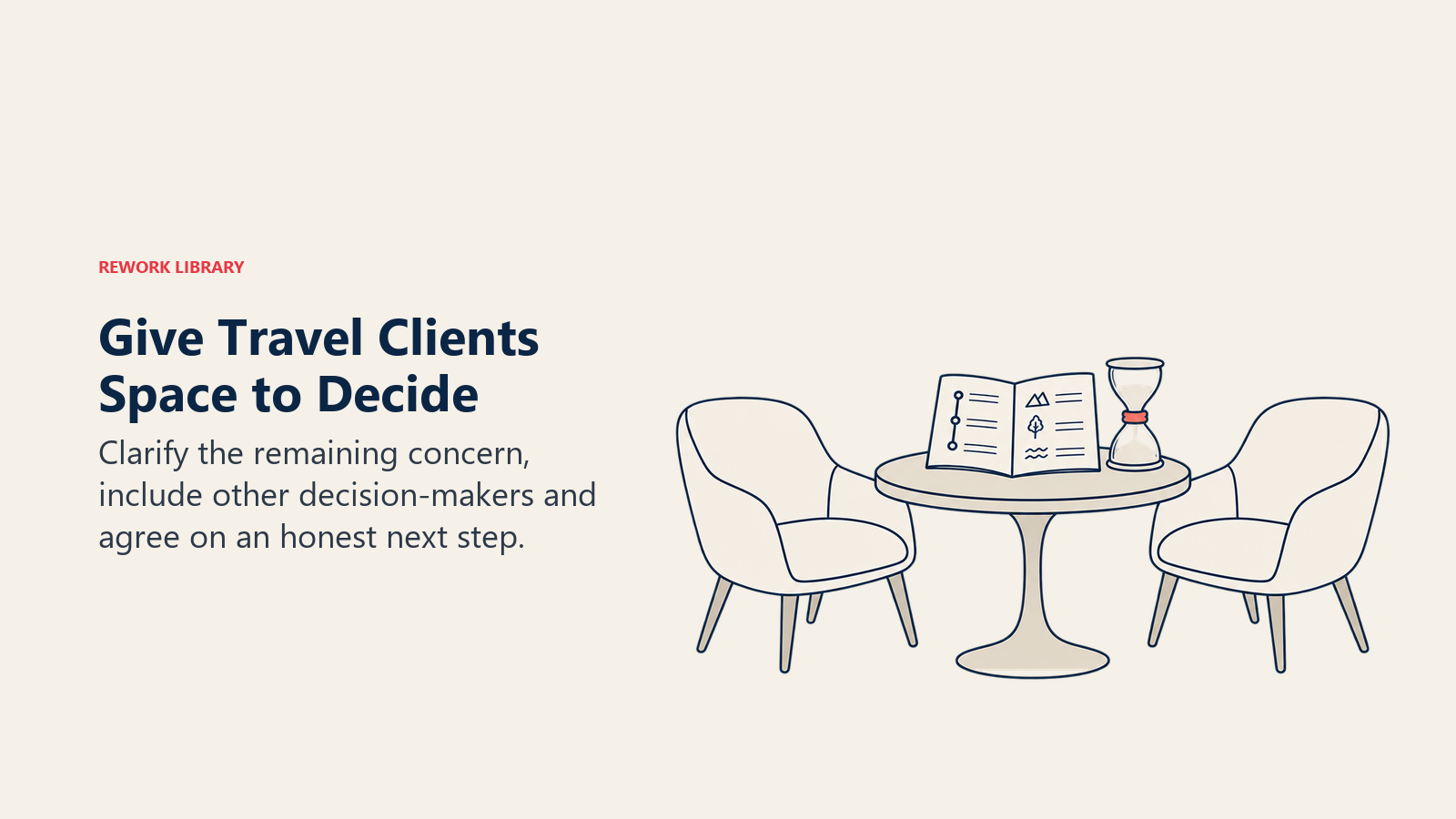
Identify the real concern with gentle probing. "Of course, this is a big decision. To make sure I'm giving you the information you need, is there something specific you're uncertain about that would help to discuss?" Often they'll reveal the actual issue: spouse isn't fully sold, budget concerns, comparing other options, or they simply need permission to prioritize themselves.
Create decision-making frameworks. "What I find helpful is asking: Does this trip deliver the experiences you want? Yes or no. Does the timing work with your schedules? Yes or no. Is the investment appropriate for what you're getting? Yes or no. If those three are yes, the decision is really about committing to prioritizing it."
Help clients commit without pressure. "I completely understand wanting to be certain. Here's what I'd suggest: I'll request holds on the key properties, which gives us 72 hours before they're released. Take that time to talk it through, and let me know if any questions come up. If you're not ready by Thursday, no problem, we'll revisit when timing feels right."
Address spouse/partner dynamics. "Would it be helpful for me to schedule a call with both of you? Sometimes one partner has done the research and is excited, while the other hasn't fully engaged yet. A conversation where I can answer questions for both of you often helps align on the decision."
Comparison Shopping Objections
"I found it cheaper online" is common in an era of price transparency.
Respond with curiosity, not defensiveness. "I'm glad you're doing research, that's smart. Can I ask what you found and where? I want to make sure we're comparing apples to apples, because there are often differences in what's included that aren't obvious at first glance."
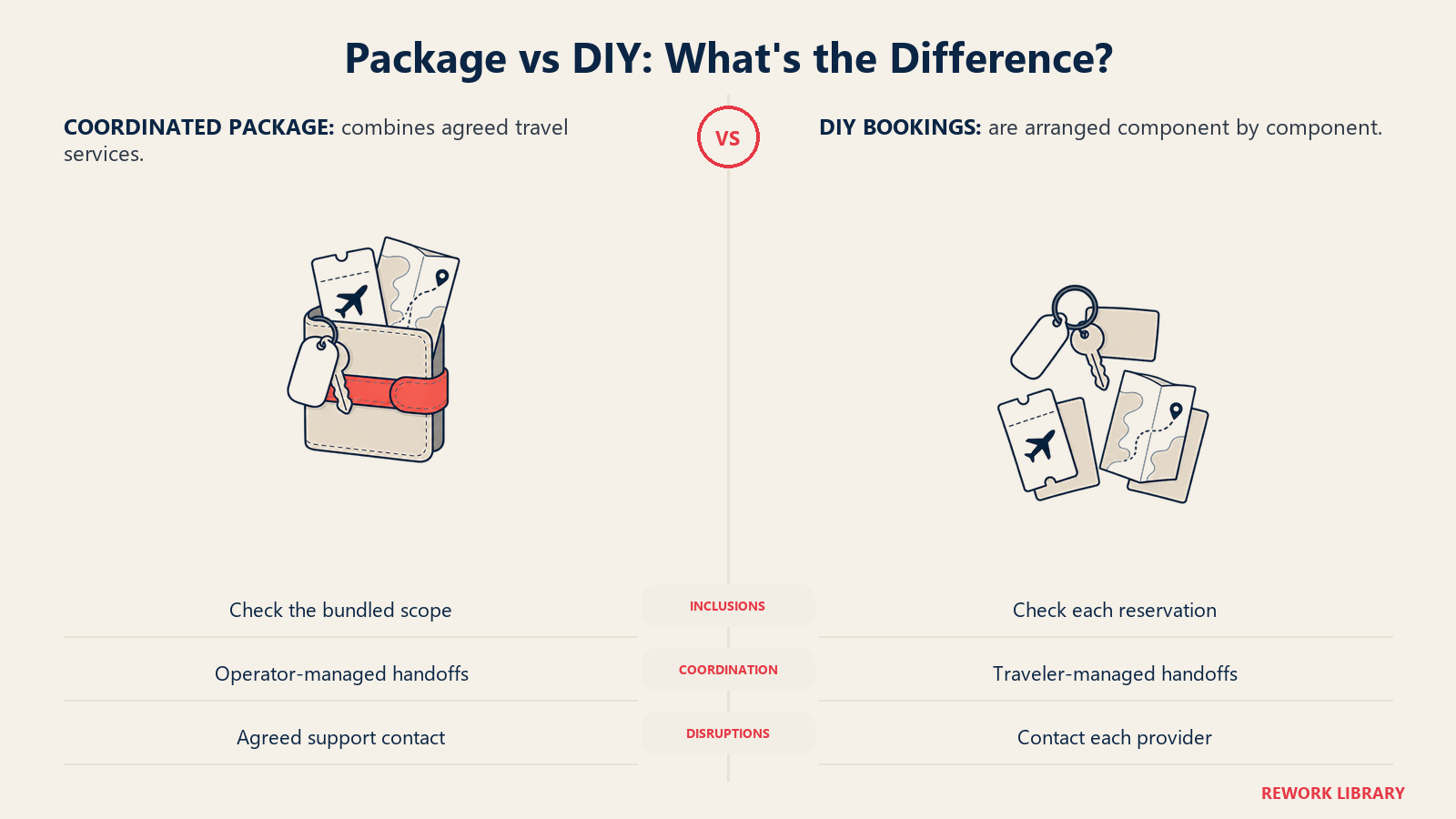
OTA competition requires value differentiation. "Booking.com shows lower hotel rates because you're booking just the room. Our pricing includes not just accommodations but private transfers, guided tours with skip-the-line access, entrance fees, and several meals. Plus, if anything goes wrong during your trip, you call me and I handle it. With an OTA booking, you're troubleshooting yourself." A strong direct booking strategy emphasizes these differentiators.
Highlight what competitors can't match. "The experience I've designed for you includes after-hours access to the Sistine Chapel, something you can't book yourself online. Your private guide is someone I've worked with for years who's an art historian, not just a tour guide reading from a script. And I've built relationships with these hotels that get my clients room upgrades and special amenities. That's worth something."
Package value versus piecemeal booking. "You're right that you could book each component separately and maybe save $800-1,000. What that doesn't account for is the 20+ hours you'd spend researching, booking, and coordinating everything. Plus, you'd have eight different confirmations to track, and if one piece fails, you're managing the rebooking yourself. I'm handling all of that, so you can actually enjoy your vacation."
Budget Constraints & Financial Concerns
Real budget limitations require creative problem-solving, not dismissal.
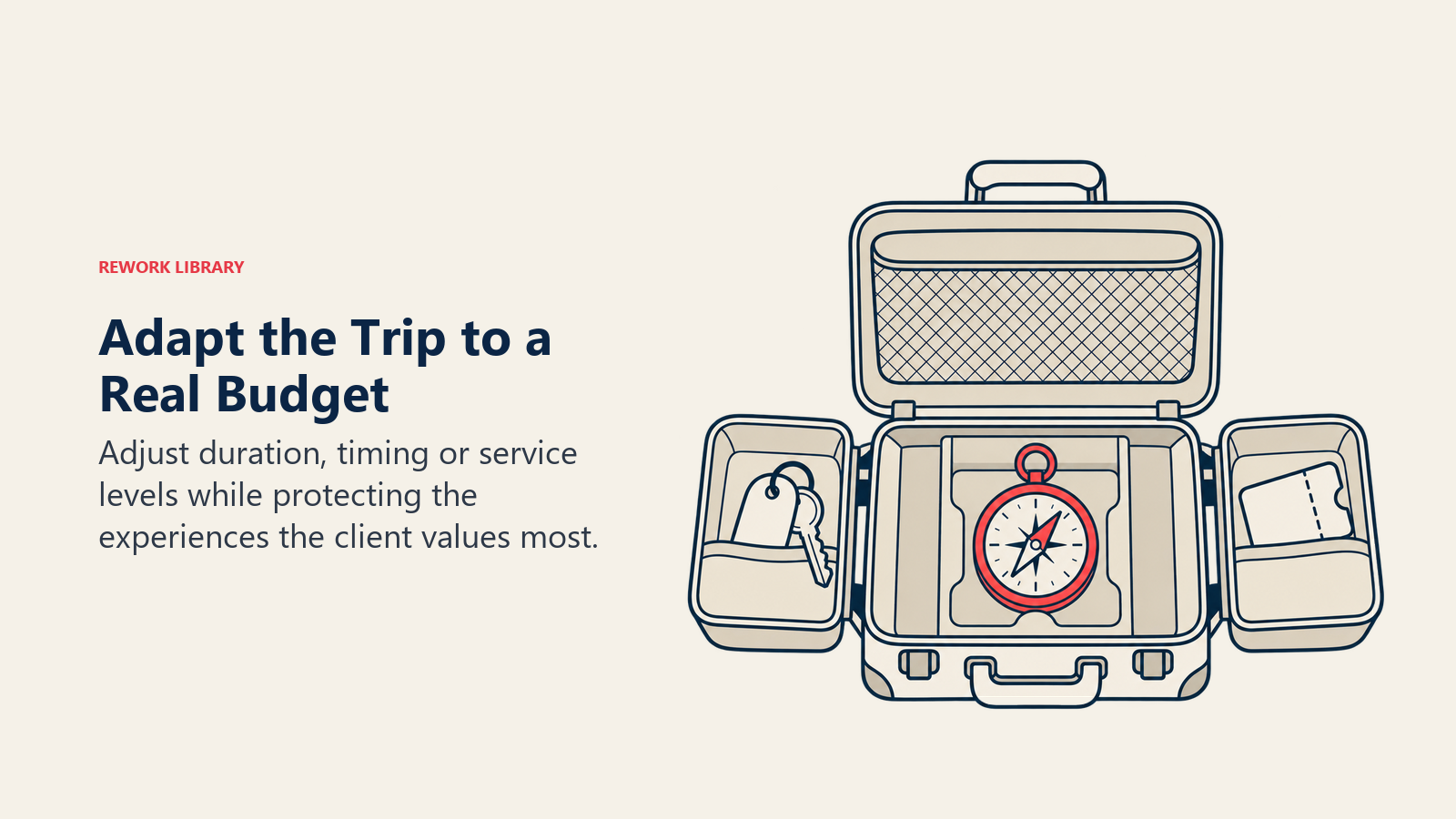
Work within budgets by adjusting scope. "If $12,000 is your absolute maximum, let's redesign this to fit. We could do 8 days instead of 10, focus on two destinations instead of three, mix in some self-guided days with guided experiences, and adjust accommodations. You'd still have an incredible trip, just slightly different from what I initially proposed."
Suggest modifications strategically. "The most budget-friendly adjustments with least impact on experience: traveling shoulder season instead of peak season saves about $2,400, switching from all private to mix of private and small group tours saves $1,800, and choosing four-star versus five-star hotels saves $2,000. That's $6,200 in savings while keeping the core experience intact."
Phased payment options make large trips accessible. "Some clients book six months out specifically to spread payments. With your departure in February, we could do: $3,000 deposit now, $3,000 in September, $3,000 in November, and final $3,000 in December. Four payments instead of one large one."
Future booking alternatives maintain the relationship. "If this timing doesn't work financially, let's talk about when would be better. Many clients find that waiting 4-6 months lets them budget properly while still keeping the trip a priority. I'm happy to hold onto this itinerary and update pricing when you're ready."
Destination Uncertainty
Indecisive clients struggle with too many options.
Help clients choose destinations with guided frameworks. "Let's narrow it down. You mentioned wanting culture, great food, and moderate activity levels. That suggests Italy, Peru, or Morocco would be excellent fits, while New Zealand might be too outdoorsy and Thailand too exotic if you prefer familiarity. Should we focus on those three?"
Provide guidance without overwhelming. Don't present twelve destination options. Show two or three that clearly match their stated criteria, explain why each is suited to their needs, and let them react. "Based on what you've told me, I'd strongly suggest either Portugal or Croatia. Here's why each could work for you..."
Build confidence through expertise demonstration. "I've personally spent three weeks in Vietnam and sent dozens of clients there. I know the regions, the seasonal considerations, which experiences deliver and which disappoint. I'm confident I can design exactly what you're looking for. Trust the process."
Use elimination rather than selection. Sometimes it's easier to identify what you don't want. "Let's start with what's off the table. Too far? Too exotic? Too expensive? Too undeveloped? Weather constraints?" Eliminating non-starters narrows options quickly.
Group Travel Objections
Group dynamics create unique objections.
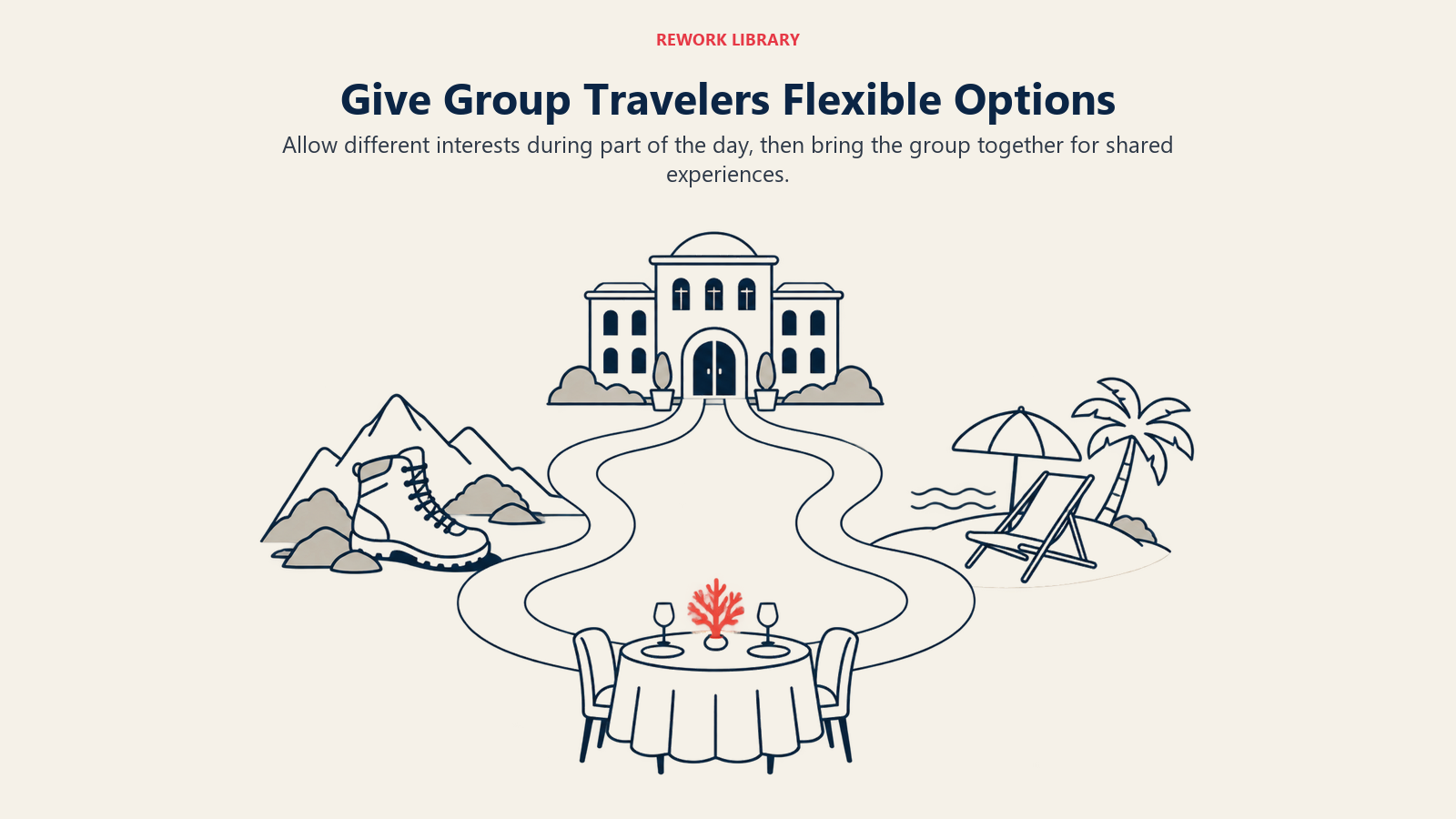
Manage diverse preferences within groups. "I'm hearing that half your group wants adventure and half wants relaxation. Here's how we handle that: mornings with optional activities for different interests, then group experiences mid-day, and evenings together. Everyone gets what they want without feeling forced into the wrong activities." Learn more about group travel sales techniques.
Coordinate multiple decision-makers. "For groups, I typically set up one video call with key decision-makers to align on priorities and budget, then share a proposal for feedback. Once core organizers approve, I create a customized website where participants can see the itinerary and sign up. This keeps everyone informed without requiring constant group coordination." Effective group travel lead capture systems streamline this process.
Address individual concerns privately. "If some group members have specific concerns, maybe someone has mobility limitations or dietary restrictions, they can reach out to me directly. I'll address those needs without broadcasting to the whole group if they prefer discretion."
Past Negative Experience
Clients burned before are naturally skeptical.
Acknowledge previous problems without dismissing them. "I'm sorry you had that experience. It's frustrating to invest in a trip that disappoints. Can you tell me what specifically went wrong? I want to make sure we don't repeat those mistakes."
Differentiate your service clearly. "The tour company you used before sounds like they focus on volume and rock-bottom pricing. We're structured differently, smaller client loads, vetted suppliers we have relationships with, more expensive but much more reliable. Our value proposition is specifically not repeating bad experiences like what happened to you."
Provide specific reassurances. "Here's how we prevent issues: I personally visit destinations and properties we sell, we have 24/7 emergency support phone line, our local partners have backup plans for common disruptions, and I stay in touch throughout your trip via WhatsApp. If something goes wrong, you're not figuring it out alone."
Offer guarantees that reduce risk. "If there's any issue with services we arrange, we'll fix it immediately or refund that portion. You're not locked into tolerating poor service. That's our commitment to you."
The "Let Me Check With" Objection
Decisions involving multiple people need special handling.
Facilitate spouse discussions. "I totally understand needing to discuss with your wife. Would it help if I sent you a simple one-page summary you can share with her? Or I'm happy to schedule a time to talk with both of you together, sometimes it's easier when everyone hears the same information."
Provide decision-making tools. "Here's what I send couples: a simple pro/con list for this trip, the investment breakdown showing what you get for the price, and answers to common questions. Use that as a starting point for your discussion, and let me know what other information would help."
Committee approval scenarios. "For group bookings needing board or committee approval, I can provide a formal proposal document with all the details needed for their review, including budget breakdown, itinerary overview, terms and conditions, and references if helpful. What format would work best for your approval process?"
Objections aren't rejection, they're opportunities to provide the additional information, reassurance, or creative solutions that turn hesitant prospects into confident clients.
The difference between average and top performers isn't getting fewer objections. It's handling them with empathy, expertise, and frameworks that address real concerns rather than deflecting them.
Related Articles:

Business Consultant