Travel KPI Dashboard - 2026 Complete Guide
Turn this article into takeaways for your work.


Each assistant summarizes the article only for you and suggests best practices for your work.
The best travel KPIs to track sit in five groups: marketing (traffic, cost per lead, channel ROI), sales (inquiry-to-quote and quote-to-booking rates), revenue (total bookings, average booking value, load factor), customer success (NPS, review ratings), and operations (quote turnaround, error rate). A good dashboard shows your north star metric plus its primary drivers in real time.
Your monthly management meeting starts with 45 minutes of people searching through reports, reconciling conflicting numbers, and arguing about whether bookings are actually up or down tracked in booking conversion metrics. Someone mentions conversion rates improved, but nobody can instantly confirm it through travel data analytics. Another person claims customer acquisition cost in travel is terrible, but the marketing director counters with different data. The meeting ends with more questions than answers.
This chaos disappears when everyone looks at the same dashboard showing real-time, accurate metrics. The best travel companies run on data displayed visibly. Their teams know exactly where they stand on key metrics daily, not monthly. Problems get detected early when they're small and fixable, not late when they're crises.
Dashboards don't just display data. They drive accountability, align teams, and enable fast decision-making.
Why KPI Dashboards Matter
Data-driven decisions beat gut feelings consistently. When you can see that inquiry-to-booking conversion dropped from 32% to 27% this month, you investigate immediately. You discover your best agent is on vacation and inquiries are being handled slower. You adjust assignments and conversion recovers. Without dashboards, you'd notice the revenue impact two months later when it's harder to diagnose.
Early problem detection prevents small issues from becoming disasters. Your dashboard shows website traffic down 25% week-over-week. Investigation reveals your site went down for 8 hours overnight due to hosting issues. You switch hosts before search rankings suffer. The dashboard caught what could have been a silent crisis.
Accountability increases when performance is visible. Sales agents see their personal metrics alongside team averages. Nobody wants to be the outlier performing poorly. Healthy competition emerges naturally. Top performers push higher. Lower performers get support or coaching.
Team alignment happens when everyone tracks the same north star metrics. Marketing focuses on generating qualified leads because they see how lead quality affects sales conversion. Sales prioritizes high-value segments because they see which customers have the best lifetime value. Operations optimizes processes that dashboard metrics reveal are bottlenecks.
And fast course correction becomes possible. Traditional monthly reporting means you're driving using a rear-view mirror with a month's delay. Real-time dashboards let you steer based on current conditions. See a problem today, fix it today, measure improvement tomorrow.
Dashboard Design Principles
Hierarchy of metrics prevents overwhelming users. Your dashboard should follow this structure:
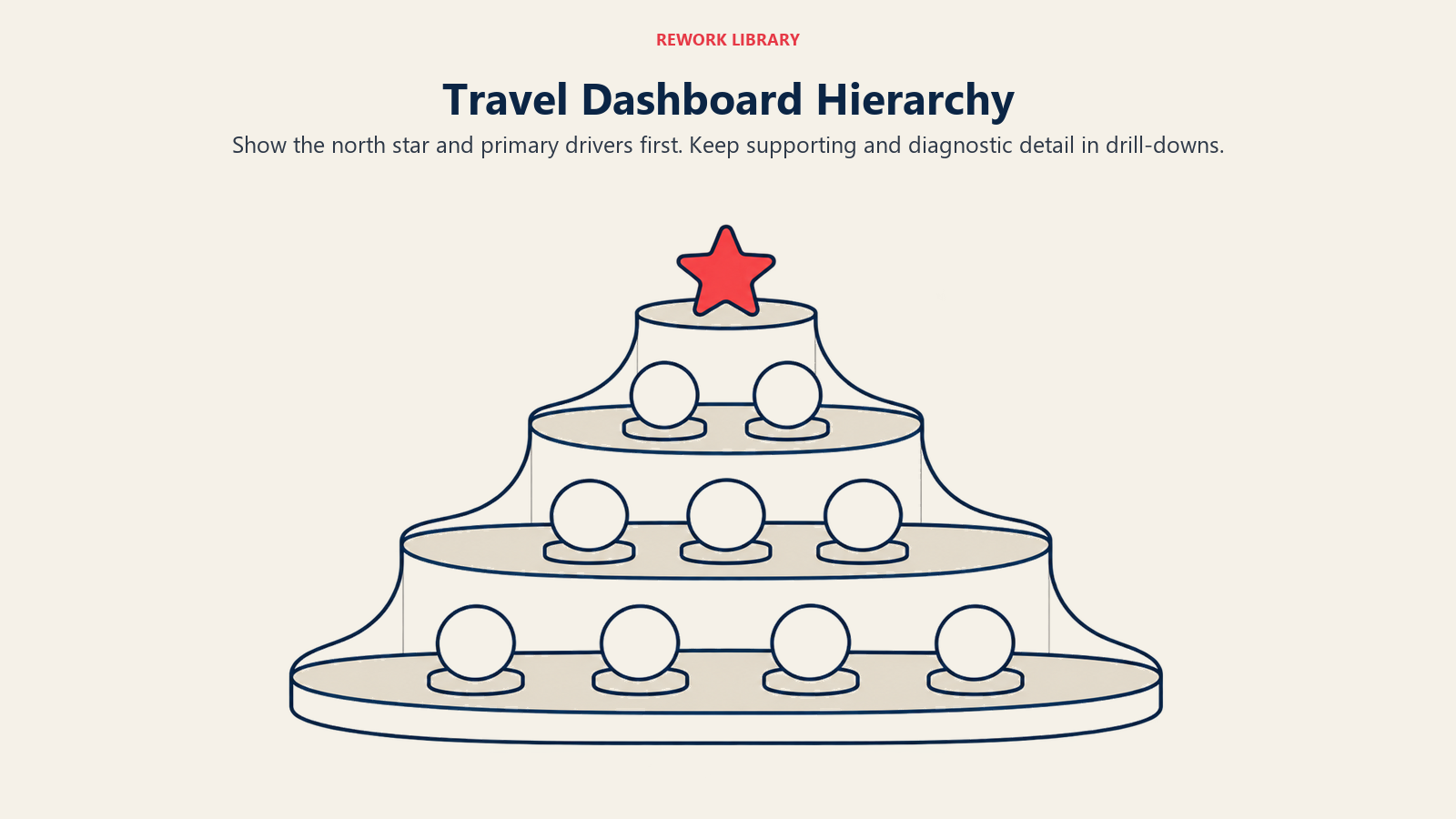
Level 1 - North Star Metric: The one number that matters most. For most travel businesses, this is monthly revenue or bookings.
Level 2 - Primary Drivers: The 4-6 metrics that drive your north star. Usually: traffic/inquiries, conversion rate, average booking value, and customer acquisition cost.
Level 3 - Supporting Metrics: Detailed breakdowns that explain primary drivers. Conversion by channel, AOV by segment, traffic sources, etc.
Level 4 - Diagnostic Metrics: Operational details used for troubleshooting. Quote turnaround time, agent productivity, booking modification rates.
Start with Level 1 and 2 visible immediately. Level 3 and 4 available through drill-downs or secondary views.
Visualization best practices make data instantly understandable. Use:
- Line charts for trends over time (revenue, bookings, traffic)
- Bar charts for comparisons across categories (bookings by destination, revenue by channel)
- Gauges for progress toward goals (monthly revenue target)
- Tables only for detailed breakdowns that need precision
Avoid pie charts (hard to compare slices) and 3D charts (distort perception). Keep visualizations simple and clear.
Dashboard overload is the biggest implementation mistake. Companies create dashboards with 40+ metrics because "more data is better." Wrong. Information overload leads to analysis paralysis. Limit your primary dashboard to 12-15 key metrics. Create separate focused dashboards for deep dives.
Color coding should convey meaning. Green for on-target, yellow for caution, red for problem. Be consistent. Don't make users interpret whether red is good or bad.
Refresh frequency depends on the metric. Website traffic can update hourly. Revenue updates daily. Customer lifetime value calculates weekly. Show users when data was last updated to build trust.
Marketing Performance Metrics
Traffic sources reveal where visitors find you. Track visitors by channel: organic search, paid search, social media, direct, referral, email. Understand not just volume but quality - which sources lead to bookings?
Display as stacked area chart showing total traffic with colored sections for each source. Trends become obvious. If organic search traffic drops, investigate SEO issues. If paid search traffic spikes but bookings don't follow, question campaign targeting.
Lead volume measures inquiry quantity. How many serious inquiries did you receive this week, month, quarter? Break down by source: website forms, phone calls, email, chat, social media. Track trends month-over-month and year-over-year.
But volume alone misleads. 100 inquiries from tire-kickers is worse than 30 inquiries from ready-to-book travelers. Track inquiry quality alongside volume.
CPL (Cost Per Lead) by channel shows marketing efficiency. Calculate total channel spend divided by leads generated. If Facebook ads cost $2,400 and generated 48 leads, CPL is $50. Compare across channels to allocate budget optimally.
Expected CPL ranges: SEO/organic ($5-20), email marketing ($10-30), paid search ($40-120), social ads ($30-90), trade shows ($150-400).
Channel ROI answers whether marketing spend is profitable. Calculate (Revenue from Channel - Channel Costs) / Channel Costs. A channel generating $24,000 revenue from $4,000 spend has 500% ROI or 5:1 ratio. Aim for 3:1 minimum in travel.
Content performance indicators show which blog posts, destination guides, and resources drive inquiries. Track pageviews, time on page, conversion rate, and inquiry attribution. Double down on high-performing content topics.
Sales & Conversion Metrics
Inquiry-to-quote rate shows how well you qualify and engage leads. Best-in-class agencies quote 75-85% of qualified inquiries. If you're quoting under 60%, investigate why so many inquiries don't reach quote stage.
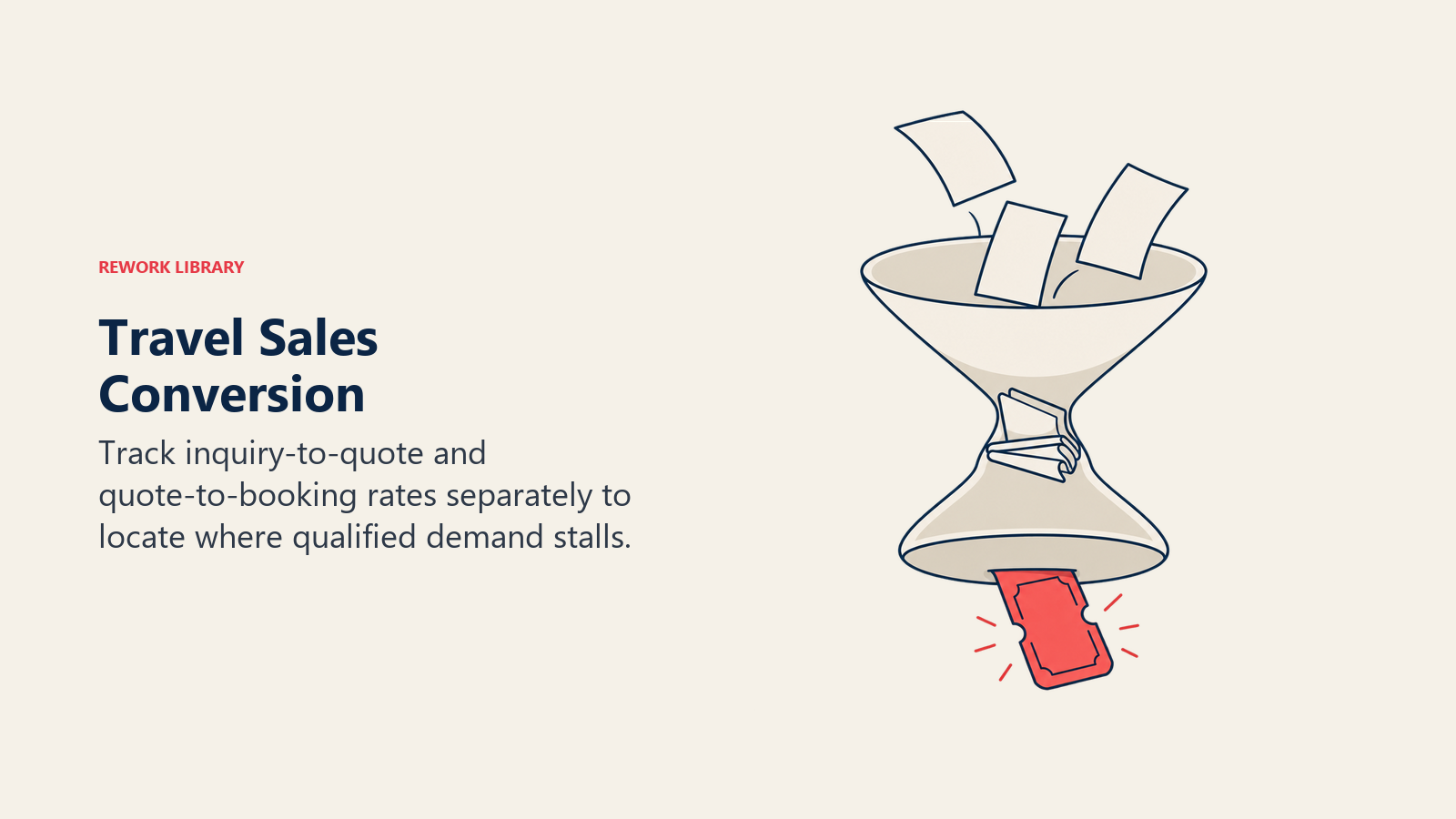
Common causes: slow response time, poor qualification, inquiries outside your offerings, inadequate information gathering. Fix the biggest lever.
Quote-to-booking rate measures sales effectiveness. Industry averages run 25-35% for qualified quotes. Top performers hit 40-50%. If you're under 20%, focus here. Small improvements generate big revenue gains.
Track this by agent, destination, lead source, and customer segment. Patterns reveal training needs and optimization opportunities.
Average booking value tells you how much customers spend. Track this overall and by segment (luxury, mid-market, budget), by destination, and by booking type (FIT, group, package). Increasing AOV even 5% dramatically improves revenue without needing more bookings.
Win rate by channel shows which sources deliver easiest closes. Your referral inquiries might convert at 55%. Cold paid search leads at 18%. This justifies different CAC tolerance by channel.
Sales cycle length measures time from inquiry to booking. Faster is generally better, but varies by trip complexity and value. Luxury multi-week tours naturally take longer than weekend getaways. Track average and median to spot delays.
If sales cycles are lengthening, investigate friction points. Is quoting slow? Are follow-ups inconsistent? Do travelers ghost after initial engagement?
Revenue Metrics
Total bookings tracked daily, weekly, monthly, and quarterly keeps everyone aligned on the most important number. Display current month progress toward target prominently. Include same-month last year for context.
Use a big, obvious visualization. This is your north star. Everyone should know this number immediately when viewing the dashboard.
Revenue by destination/product reveals what's selling. Your Italy tours might generate 35% of revenue while Asia tours generate 12%. This guides inventory planning, marketing focus, and agent training.
Display as horizontal bar chart showing revenue by category, sorted largest to smallest. Update monthly.
RevPAT (Revenue Per Available Tour) benchmarks tour operator efficiency. Calculate total tour revenue divided by total available capacity. Track by tour, season, and year-over-year to identify improving and declining products.
Typical ranges: $800-1,500 for budget group tours, $1,200-2,200 for mid-market, $2,500-5,000+ for luxury.
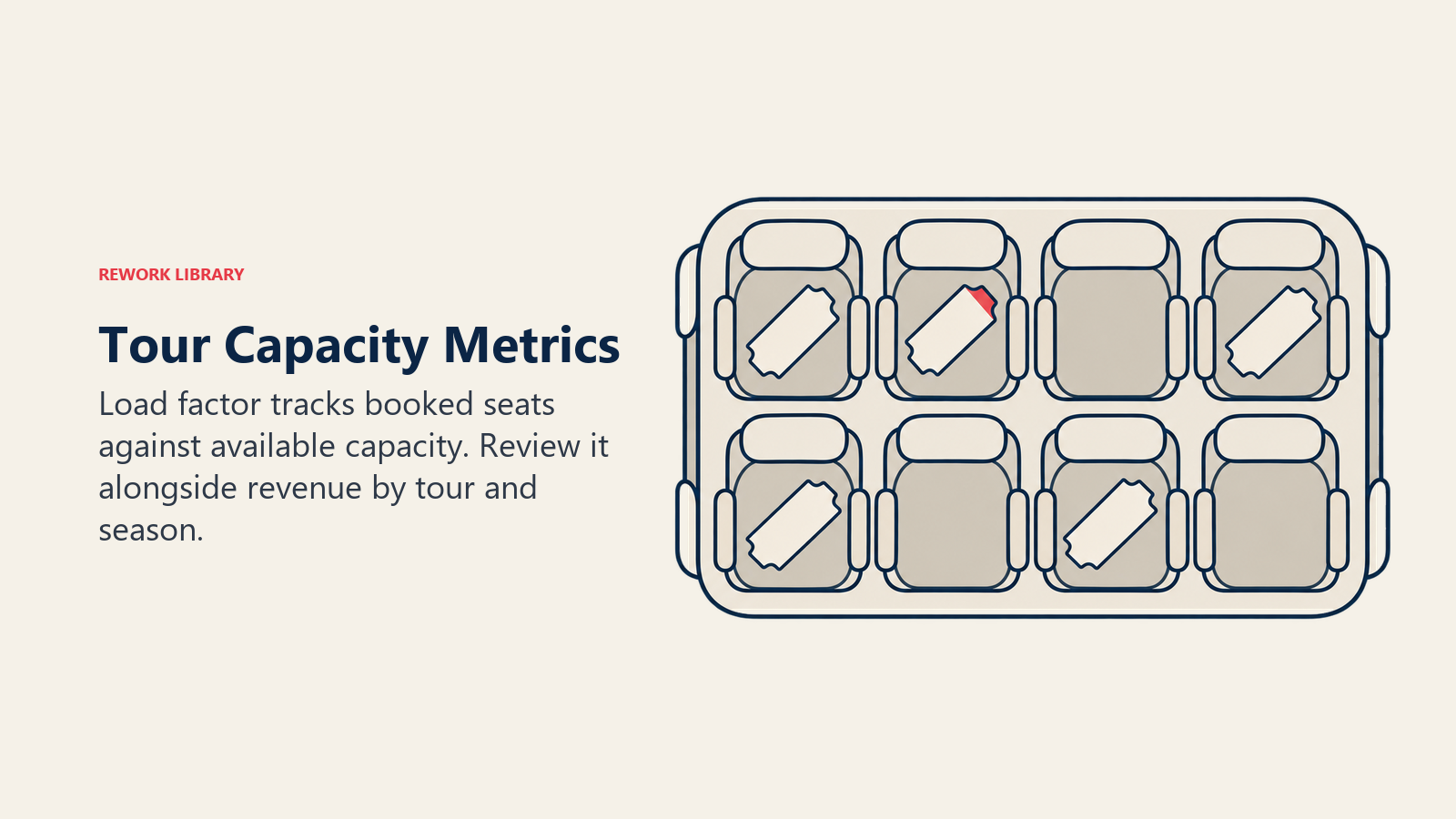
Load factor shows tour fullness. Calculate booked seats divided by available seats as a percentage. Industry averages run 60-75% for most group tours. Higher is better but 100% is rare except for premium limited-capacity tours.
Track load factor trends. Are they improving or declining? Which tours consistently run full? Which struggle?
Revenue growth trends should be segmented. Total revenue might be flat while luxury segment grows 25% and budget segment declines 15%. These insights guide strategy pivots.
Display as multi-line chart showing revenue trends for key segments over time. Highlight growth rates with labels.
Customer Success Metrics
NPS (Net Promoter Score) predicts future growth through customer advocacy. Survey customers post-trip: "How likely are you to recommend us to a friend (0-10)?" Calculate % Promoters (9-10) minus % Detractors (0-6).
Benchmarks: 70-85 (excellent), 50-70 (good), 30-50 (acceptable), under 30 (problem). Display current NPS prominently with trend over time.
Review ratings from TripAdvisor, Google, Facebook, and industry sites impact bookings directly. Display average rating by platform and total review count. Set targets: maintain 4.5+ on all platforms, respond to 100% of reviews within 48 hours.
Track rating trends. If your Google rating drops from 4.7 to 4.4, investigate immediately. Recent negative reviews need addressing.
Complaint rate as percentage of total travelers shows service quality. Less than 2% is excellent. 2-5% is acceptable. Over 5% indicates systemic problems. Track complaint types to focus improvements.
Booking modification frequency indicates either flexibility (good) or confusion (bad). Some modifications are normal. Excessive modifications suggest unclear communication or complicated processes. Track why modifications occur.
Customer satisfaction scores from post-trip surveys provide detailed feedback. Use 1-5 scale for specific elements: pre-trip communication, accommodation quality, guide performance, itinerary flow, value for money. Track trends and identify weak areas.
Operational Metrics
Quote turnaround time directly correlates with conversion. Track average time from inquiry to quote sent. Best practice: under 4 hours for standard inquiries, under 24 hours for complex custom requests.
Display as histogram showing distribution: how many quotes sent in under 1 hour, 1-4 hours, 4-24 hours, 24+ hours. Aim to shift the distribution left.
Document processing time for passports, visas, insurance, etc. measures operational efficiency. Track days from request to completion. Long delays frustrate travelers and risk deadlines.
Booking error rate counts mistakes: wrong dates, incorrect pricing, missing services, reservation mistakes. Target: under 0.5% error rate. Track errors by type and cause to prevent recurrence.
Team productivity in bookings per agent, revenue per agent, and inquiries handled per agent shows individual and team performance. Compare to industry benchmarks and historical performance.
Typical range: 3-8 bookings per agent monthly for FIT, 15-30 for package tours. Revenue per agent varies wildly by segment: $30K-80K monthly for mid-market, $80K-200K+ for luxury.
Leading vs Lagging Indicators
Leading indicators predict future performance. They're early warning signals. In travel:
- Website traffic predicts future inquiries
- Inquiry volume predicts future revenue (with lag time matching sales cycle)
- Email engagement predicts retention and upsells
- Social media followers and engagement predict brand awareness
- Quote volume predicts bookings 2-6 weeks out
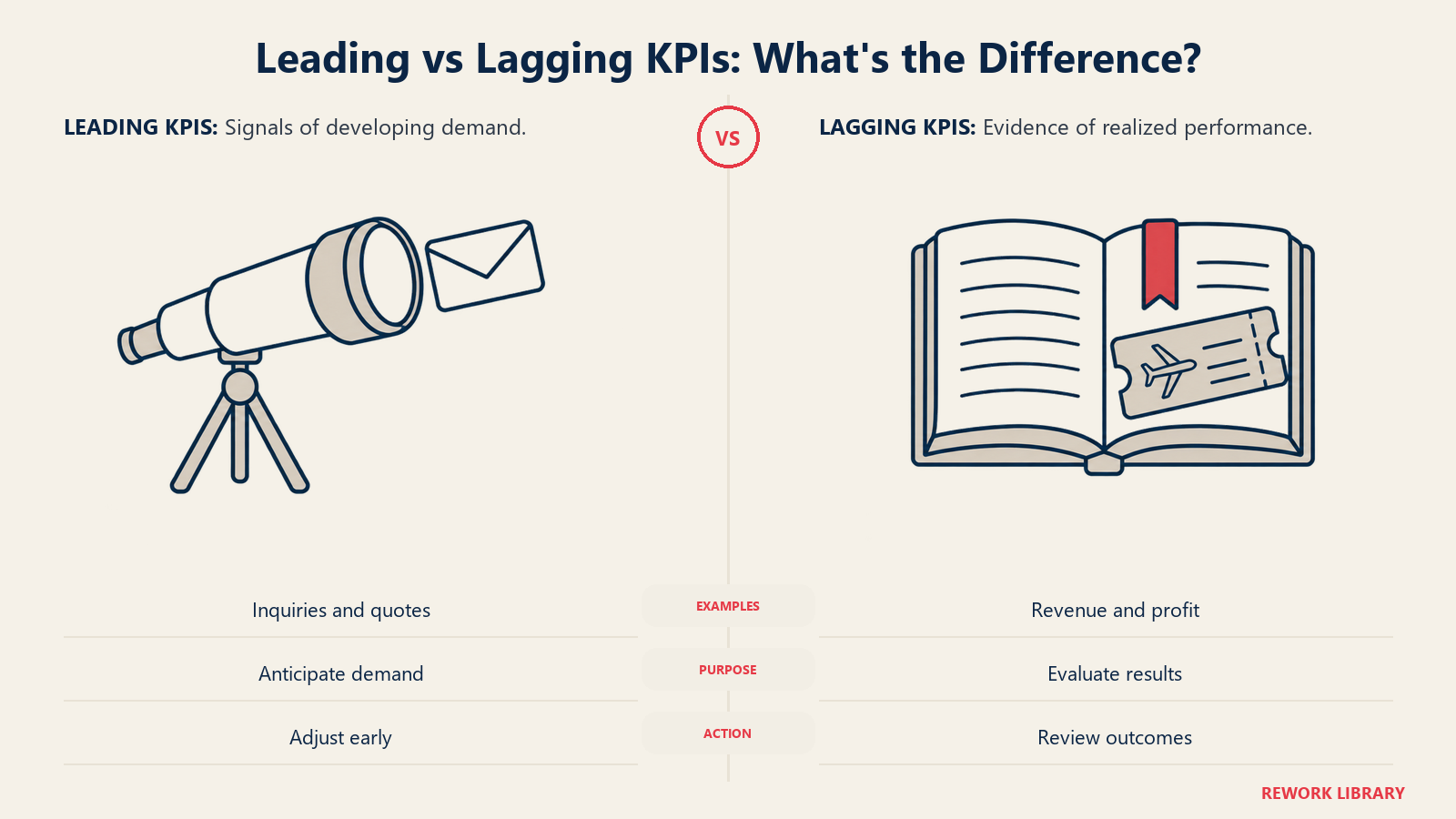
Monitor leading indicators to forecast and adjust proactively. If website traffic drops 30%, expect inquiry volume to follow. Increase marketing now rather than waiting for inquiries to actually drop.
Lagging indicators report past results. In travel:
- Revenue (reflects bookings closed weeks ago)
- NPS (measures past experiences)
- Profit (combines many historical factors)
- Repeat booking rate (shows long-term satisfaction)
Lagging indicators tell you if strategies worked but don't enable fast correction. You need both. Lead with leading indicators for day-to-day management. Track lagging indicators to evaluate strategic success.
Balance your dashboard: 60% leading indicators, 40% lagging. This keeps you forward-looking while maintaining accountability for results.
Dashboard Tools & Implementation
Google Looker Studio (formerly Data Studio) provides free, powerful dashboarding. Connects to Google Analytics, Google Sheets, MySQL databases, and many third-party sources. Create beautiful, interactive dashboards without coding.
Best for: Small to mid-size agencies wanting professional dashboards without budget constraints. The learning curve is moderate. Templates speed implementation.
Tableau offers enterprise-grade business intelligence. Handles massive datasets, provides sophisticated analysis, and creates publication-quality visualizations. The power comes with complexity and cost.
Best for: Large tour operators and agencies with dedicated analysts and BI budgets ($70-400/user monthly).
Power BI from Microsoft integrates naturally with Microsoft ecosystem. If you use Dynamics CRM, Office 365, and Azure, Power BI connects seamlessly. Pricing is competitive ($10-20/user monthly).
Best for: Windows-centric operations wanting Microsoft integration.
Travel-specific platforms like OTA Insight, RateGain, and Travel Analytics provide pre-built dashboards for common travel metrics. They integrate with major booking systems, GDS, and OTA platforms.
Best for: Hotels and tour operators wanting industry-standard dashboards without custom development. Expect $200-1,000+ monthly.
Implementation success factors:
- Start with one dashboard covering core metrics
- Ensure data accuracy before launching (garbage in = garbage out)
- Train users on interpretation, not just access
- Schedule regular review meetings using the dashboard
- Iterate based on usage and feedback
Building a Dashboard Culture
Regular dashboard reviews in team meetings embed data into operations. Start every sales meeting reviewing key metrics. Celebrate wins visible in data. Discuss concerning trends. Assign accountability for improvements.
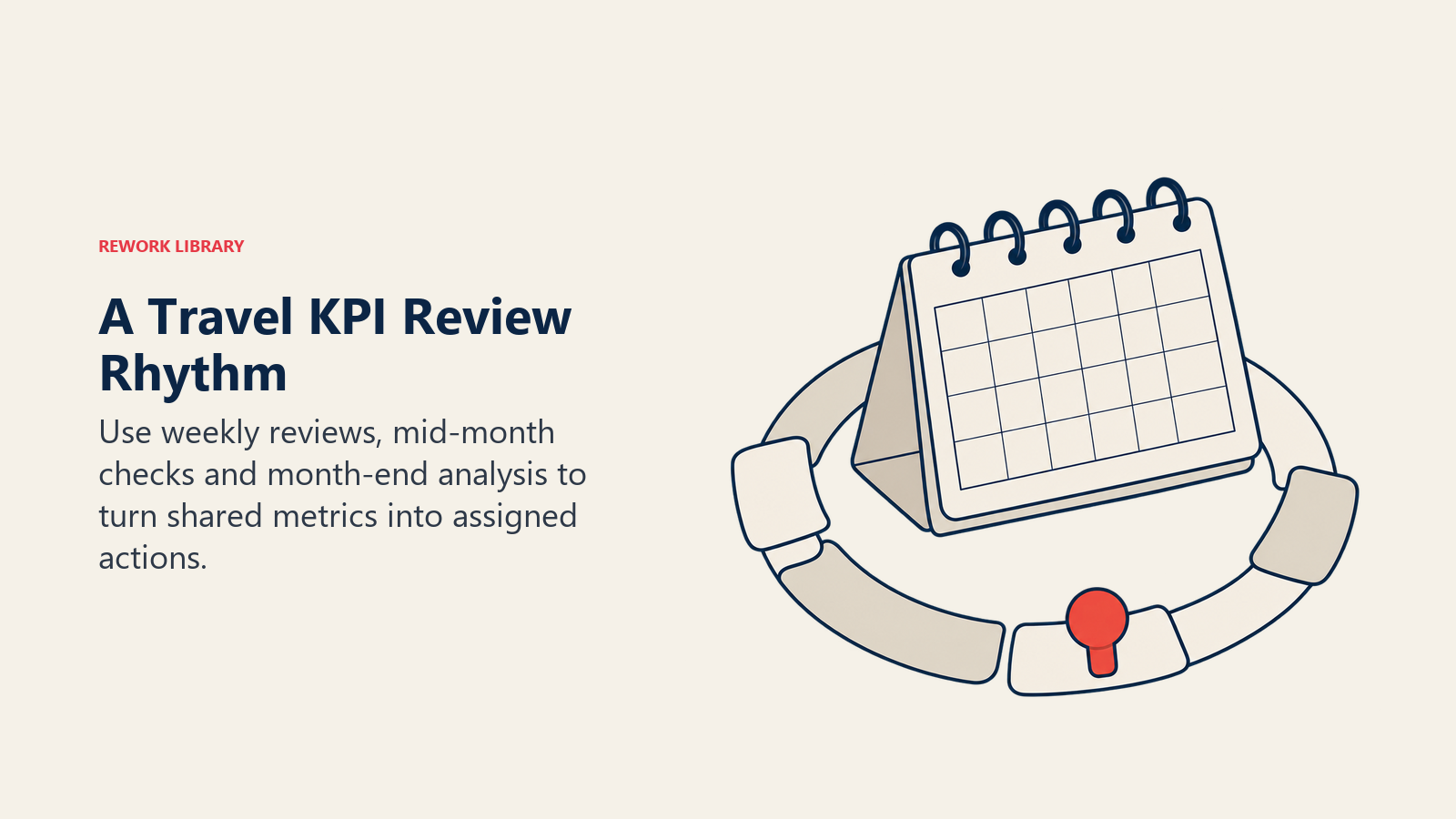
Monday morning: Review previous week's performance Mid-month: Check progress toward monthly targets Month-end: Analyze full month, set next month's targets
Setting targets based on data creates meaningful goals. Instead of arbitrary "increase revenue 20%", use data: "Improve quote-to-booking conversion from 28% to 32% through faster follow-up and better qualification, generating 15% revenue growth."
Data-derived targets are achievable and specific.
Celebrating wins when metrics improve motivates teams. When an agent's conversion rate jumps from 25% to 38%, celebrate publicly. When marketing generates 40% more inquiries, recognize it. Positive reinforcement drives dashboard engagement.
Addressing underperformance visible in data should be constructive. If metrics show problems, investigate causes before blaming people. "Your conversion rate dropped significantly. What challenges are you facing? How can we help?"
Use data to support, not attack. The goal is improvement, not punishment.
Conclusion
KPI dashboards transform travel business management from reactive fire-fighting to proactive optimization. When everyone sees the same real-time metrics, teams align naturally around shared goals. Problems surface early when they're manageable. Winning strategies become obvious and get amplified.
Start simple with a single dashboard covering your north star metric and primary drivers. Ensure data accuracy. Train your team on interpretation. Review metrics regularly in team meetings. Iterate based on what you learn. The companies that master dashboard-driven management make faster, better decisions than competitors still operating on gut feel and monthly reports.
Frequently Asked Questions
What is the most important KPI for a travel business? The single most important KPI is your north star metric, usually monthly bookings or revenue. Everything else on the dashboard explains movement in that one number. Display it prominently and compare it to the same month last year for context.
How many KPIs should a travel dashboard show? Limit your primary dashboard to 12-15 metrics. More than that creates information overload and analysis paralysis. Show the north star plus 4-6 primary drivers up front, and push detailed breakdowns into drill-downs or secondary views.
What is the difference between leading and lagging KPIs in travel? Leading indicators predict future performance, like website traffic, inquiry volume, and quote volume. Lagging indicators report past results, like revenue, NPS, and profit. Aim for roughly 60% leading and 40% lagging so you stay forward-looking while still measuring outcomes.
How often should travel KPIs update? Refresh frequency depends on the metric. Website traffic can update hourly, revenue daily, and customer lifetime value weekly. Always show when the data was last refreshed so the team trusts it.
Related Articles:

Business Consultant