Abandonment Recovery in Travel: Win Back 20-30% of Lost Bookings
Turn this article into takeaways for your work.


Each assistant summarizes the article only for you and suggests best practices for your work.
Eighty-five percent of people who start booking engine optimization abandon before completion. They select dates, choose packages, enter personal information, and then... disappear. That abandoned cart contains real purchase intent, someone was 80% of the way to a $3,000 booking. They didn't browse casually. They actively tried to buy.
Most travel companies accept this travel booking funnel abandonment as inevitable. Smart operators recognize it as a recovery opportunity worth millions. If you generate $8 million annually with 85% booking abandonment, there's $46 million in abandoned cart value. Recovering just 20% of those abandoners delivers $9 million in incremental customer lifetime value revenue.
The psychology is straightforward. People abandon for specific reasons, need to check with partner, compare travel pricing strategy, got distracted, payment concerns, price shock. These aren't permanent rejections. They're temporary pauses that systematic email marketing follow-up can convert. Abandoned cart email campaigns alone recover 10-15% of abandoners. Add retargeting, SMS, and phone outreach for high-value bookings, and total recovery rates reach 20-30%.
Travel Abandonment Landscape
Understanding why people abandon informs how to win them back.
Eighty to eighty-five percent travel checkout optimization abandonment is structural in travel. Compare this to 70% in general e-commerce. Travel decisions are more complex, more expensive, and often involve multiple decision-makers. Someone booking solo might abandon to discuss with their partner. A parent booking family vacation might abandon to confirm dates with school calendar. This travel sales process abandonment isn't always hesitation, sometimes it's process.
Sixty percent inquiry abandonment happens when someone requests a quote or information but never responds. They filled out a travel inquiry management form, received your proposal, and went silent. These are warm leads who expressed explicit interest, making them higher quality than cold traffic. But without systematic follow-up, they disappear.
Reasons for abandonment cluster into five categories. Comparison shopping (40%) means they're checking competitor travel pricing strategy or destination alternatives before committing. Price checking (20%) means they're confirming they can afford it or seeking better deals. Family consultation (15%) means they need approval or input from travel companions. Complexity (15%) means the booking engine process confused or overwhelmed them. Payment concerns (10%) mean security worries, card issues, or sticker shock at final price.
These reasons suggest different recovery approaches. Comparison shoppers need differentiation. Price checkers need value reinforcement or incentives. Family consulters need time and reminders. Complexity victims need simplified paths. Payment-concerned need trust-building.
Abandonment Tracking Setup
You can't recover what you don't track.
Browser cart abandonment tracking captures people who selected packages and started booking but didn't complete. Most booking platforms track this natively. Ensure you're capturing email addresses early in booking flow, ideally before requiring payment info. If you only ask for email on the payment screen, you can't recover people who abandon before reaching it.
Email inquiry abandonment tracks people who submitted inquiry forms, received responses or quotes, but never moved forward. CRM tagging should flag "proposal sent, no response" after 7 days. These are qualified leads worth systematic follow-up beyond one reply.
Phone inquiry follow-up requires manual tracking unless you have integrated telephony. When someone calls asking about tours but doesn't book, create a CRM record with conversation notes, interests mentioned, and timeline. Schedule follow-up tasks. Phone inquiries represent high intent, don't let them slip away.
Proposal abandonment applies to custom quotes for groups or complex itineraries. You sent a detailed proposal in response to their request. Track whether they opened it, how long they spent reviewing it, and whether they followed up. Unopened proposals need different recovery than reviewed-but-no-response proposals.
Quote expiration tracking prompts action before deadlines. If you quote pricing valid for 30 days, set reminders to follow up at days 7, 14, and 25. "Your custom Iceland quote expires in 5 days" creates deadline urgency that prompts decision.
Recovery Timing Strategy
When you reach out matters as much as what you say.
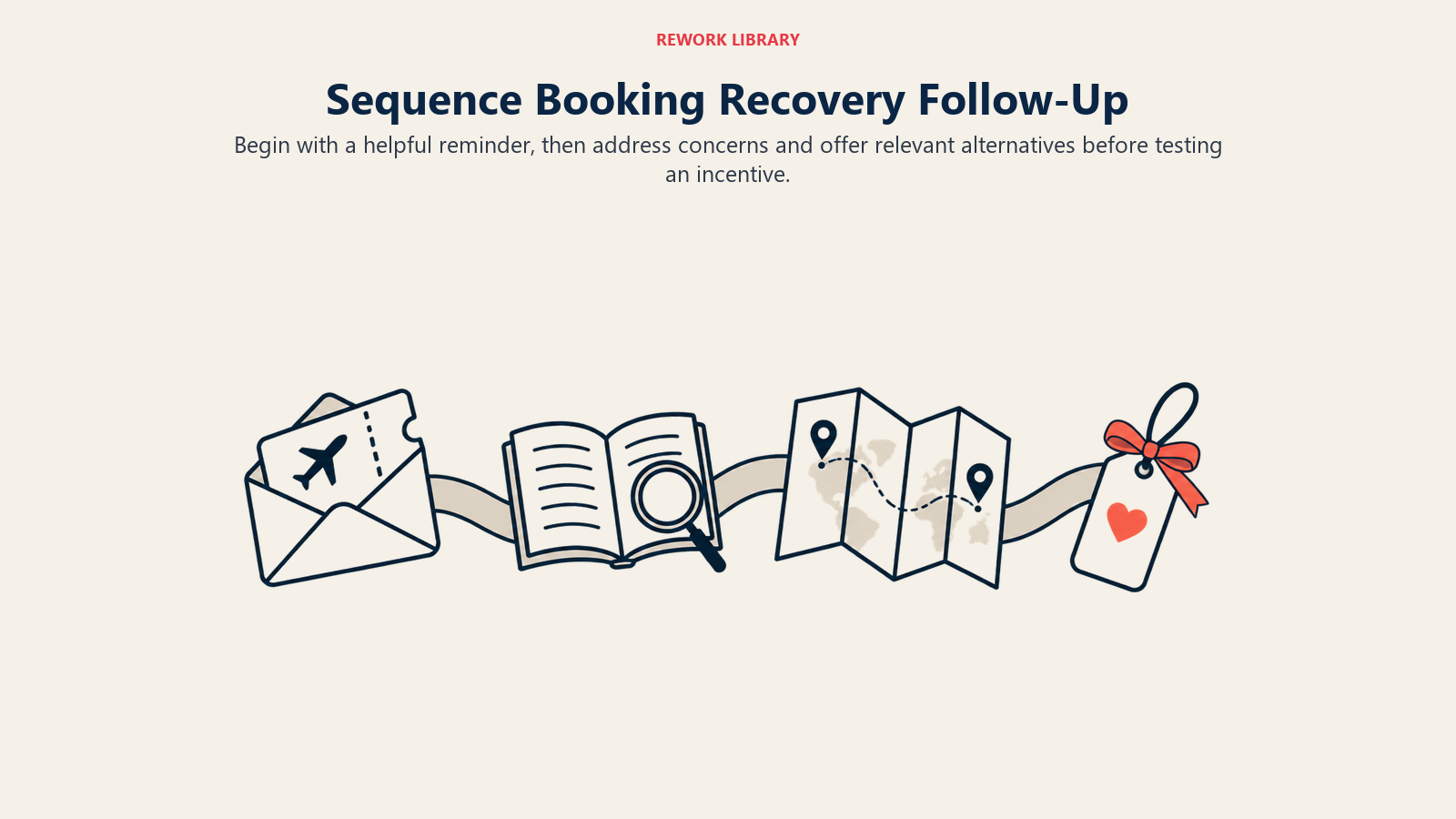
One-hour email acts as cart reminder for immediate abandoners. "Looks like you started booking our Iceland tour but didn't finish. Your selection is saved. Complete your booking here: [link]." This catches people who got distracted, had technical issues, or wanted to resume on different device. Recovery rate: 3-5%.
Twenty-four-hour email provides value reinforcement. By now they've had time to think, compare, or discuss. "Still planning your Iceland adventure? Here's what our guests loved most about this tour: [testimonials]." Include FAQ addressing common objections. Recovery rate: 2-4%.
Three-day email creates urgency without being pushy. "Your Iceland tour holds are expiring soon. June departures are filling up, only 5 spaces left. Secure your spot: [link]." Real urgency (if true) prompts action. Recovery rate: 1-3%.
Seven-day email offers alternatives if they haven't responded. Maybe Iceland wasn't the right fit. "Still interested in Iceland, or would you like to explore other destinations? Our Norway and Greenland tours offer similar experiences." Broaden the appeal. Recovery rate: 1-2%.
Fourteen-day email considers discount incentives. After two weeks of non-response, you're likely losing them without intervention. "Complete your Iceland booking this week and save $200 with code WELCOME200." Test whether discounts improve recovery enough to justify margin sacrifice. Recovery rate with discount: 3-7%.
Total recovery across this sequence: 10-21% depending on execution quality and audience.
Email Campaign Structure
Effective recovery emails follow proven patterns.
Subject line formulas focus on urgency, curiosity, or benefit. "Your Iceland tour is almost booked" (urgency), "Forget something?" (curiosity), "Save your spot for Iceland Northern Lights" (benefit). Test variations. Avoid spammy "Limited time offer!!!" language. Keep subject lines under 50 characters for mobile visibility.
Email copy templates should be concise and focused. No lengthy storytelling. Remind them what they were booking, reinforce why it's amazing, provide easy path to complete. Three paragraphs maximum: 1) Remind what they abandoned, 2) Reinforce value or address objections, 3) Clear CTA to complete.
Personalization tokens make emails feel individual. Use their name, specific package they selected, dates they chose, and any customization details. "Hi Sarah, complete your June 15-23 Iceland Northern Lights tour booking" beats "Complete your booking." Dynamic content based on abandonment stage adds relevance.
Visual reminders show cart contents with images. Display thumbnail of the tour they selected, dates, pricing, and "Resume Booking" button. Visual reinforcement of what they're giving up increases conversion. Don't make them remember or reconstruct their choices.
CTA optimization emphasizes easy completion. "Complete My Booking in 2 Minutes" is more compelling than generic "Book Now." Remove friction by linking directly to checkout with their selections pre-loaded, not to homepage where they start over.
Multi-Channel Recovery
Email alone leaves money on the table.
Email marketing for travel automation is foundational. Set up triggered sequences based on abandonment event. Use ESP (email service provider) or marketing automation platform to send timed emails automatically. HubSpot, ActiveCampaign, or Klaviyo handle this well for travel CRM systems.
SMS for high-value bookings adds urgency. Someone who abandoned a $10,000 luxury safari deserves extra effort. Text within 2-4 hours: "Hi Sarah, noticed you started booking our Tanzania safari but didn't finish. Can I help? Call me at [number] - Mark." Recovery rate for high-value customer retention bookings via SMS: 8-15%.
Travel paid advertising retargeting ads keep you top-of-mind across the web. Someone who abandoned booking sees display ads on Facebook, Instagram, and Google Display Network reminding them about the Iceland tour. "Still thinking about Iceland? Your Northern Lights adventure awaits." Retargeting assists 15-25% of eventual recoveries even if it doesn't get last-click credit.
Phone outreach for luxury and group travel is high-touch but high-return. If someone abandoned a $25,000 private tour or a 40-person group booking, have a human call within 24 hours. "I see you started a quote request for your company retreat. I'd love to discuss details and answer any questions." Phone recovery rates for complex bookings: 20-35%.
WhatsApp for mobile abandoners works especially well for international travelers. If someone from Europe or Asia abandoned on mobile, WhatsApp follow-up might resonate more than email. "Hi! Saw you were looking at our Bali tours. Happy to answer questions via WhatsApp if that's easier."
Incentive Strategy
Discounts work but aren't always necessary or optimal.
When to offer discounts depends on abandonment reason. If someone abandoned due to price, small discount might convert them. If they abandoned due to complexity or need to coordinate schedules, discount won't help. Don't default to discounting, try value reinforcement and urgency first. Reserve discounts for late-stage recovery (day 14+) or high-value bookings worth margin sacrifice.
Non-discount incentives often work better. Free airport transfer ($50 cost to you, $100+ value to customer), room upgrade, included activity, flexible cancellation policy, or extended payment plan. These add value without reducing headline price. "Complete booking by Friday and receive complimentary premium room upgrade" feels more valuable than "$100 off."
Time-limited offers create deadline urgency. "Complete booking by end of week for free airport transfers" performs better than open-ended "free airport transfers available." Deadlines prompt action. But make deadlines real, manufactured urgency damages trust.
Scarcity messaging reinforces genuine limitations. "Only 3 spaces remaining for your June 15 departure date" drives action if true. But don't lie. If you have 15 spaces available, don't claim only 3 remain. Use real scarcity: seasonal availability, early booking discounts expiring, limited group sizes.
Segment-Specific Approaches
Different abandoners need different recovery tactics.
High-value booking recovery deserves premium effort. Someone who abandoned a $15,000 booking gets personal phone call, custom recovery offer, and multi-touch campaign. Assign to senior salesperson. Recovery investment justified by booking value.
Group travel abandonment often involves complex decision dynamics. Multiple stakeholders, payment collection challenges, coordination needs. Follow up with group organizer offering simplified payment collection, extended deadlines, or proposal adjustments. "Would it help if we extended your hold to allow time to collect deposits?"
Mobile versus desktop abandoners show different behaviors. Mobile abandoners might have hit friction on small screens or gotten interrupted. Recovery email should emphasize "Complete on desktop for easier checkout" or simplify mobile process. Desktop abandoners more likely price shopping or seeking alternatives, emphasize differentiation.
First-time versus returning visitors require different messaging. First-timers need trust-building and reassurance. Past customers who abandoned need relationship leverage: "We loved having you in Peru last year, we'd be honored to host your Iceland adventure too."
Geographic and demographic segmentation tailors recovery. European abandoners might prefer WhatsApp. Asian travelers might need multi-currency pricing clarity. Luxury segment responds to exclusivity and personalization. Adventure segment responds to authenticity and experience highlights.
Technology Stack
Systematic recovery requires integrated tools.
Email automation platform delivers triggered campaigns. Klaviyo, ActiveCampaign, HubSpot, or Mailchimp with e-commerce integration trigger emails based on abandonment events. Set up workflows once, recover abandoners automatically ongoing.
Abandoned cart tracking through booking platform or analytics must capture abandonment events and email addresses. Google Analytics 4 Enhanced Ecommerce tracks cart abandonment. Booking platforms like TravelJoy, Traveltek, or custom builds should have native abandoned booking tracking.
CRM integration ensures recovery campaigns feed into broader customer relationship management. When someone recovers and books, update CRM status from "Abandoned" to "Customer." Track which recovery channel worked for attribution analysis.
Retargeting pixel setup on Facebook, Google, and Instagram enables ad targeting to abandoners. Install pixels on booking pages, create custom audiences of abandoners, serve them targeted ads reminding them about tours they viewed.
Attribution tracking connects recovery efforts to bookings. When someone books after receiving three abandonment emails and seeing two retargeting ads, which gets credit? Multi-touch attribution assigns partial credit. This prevents cutting effective channels that assist conversions even if they don't close them.
Measurement Framework
Track performance to optimize recovery efforts.
Recovery rate by channel shows which tactics work best. Email 1-hour: 4% recovery. Email 24-hour: 3%. Phone outreach: 25%. SMS: 12%. Calculate recovery rate as (recovered bookings / total abandoners) for each channel.
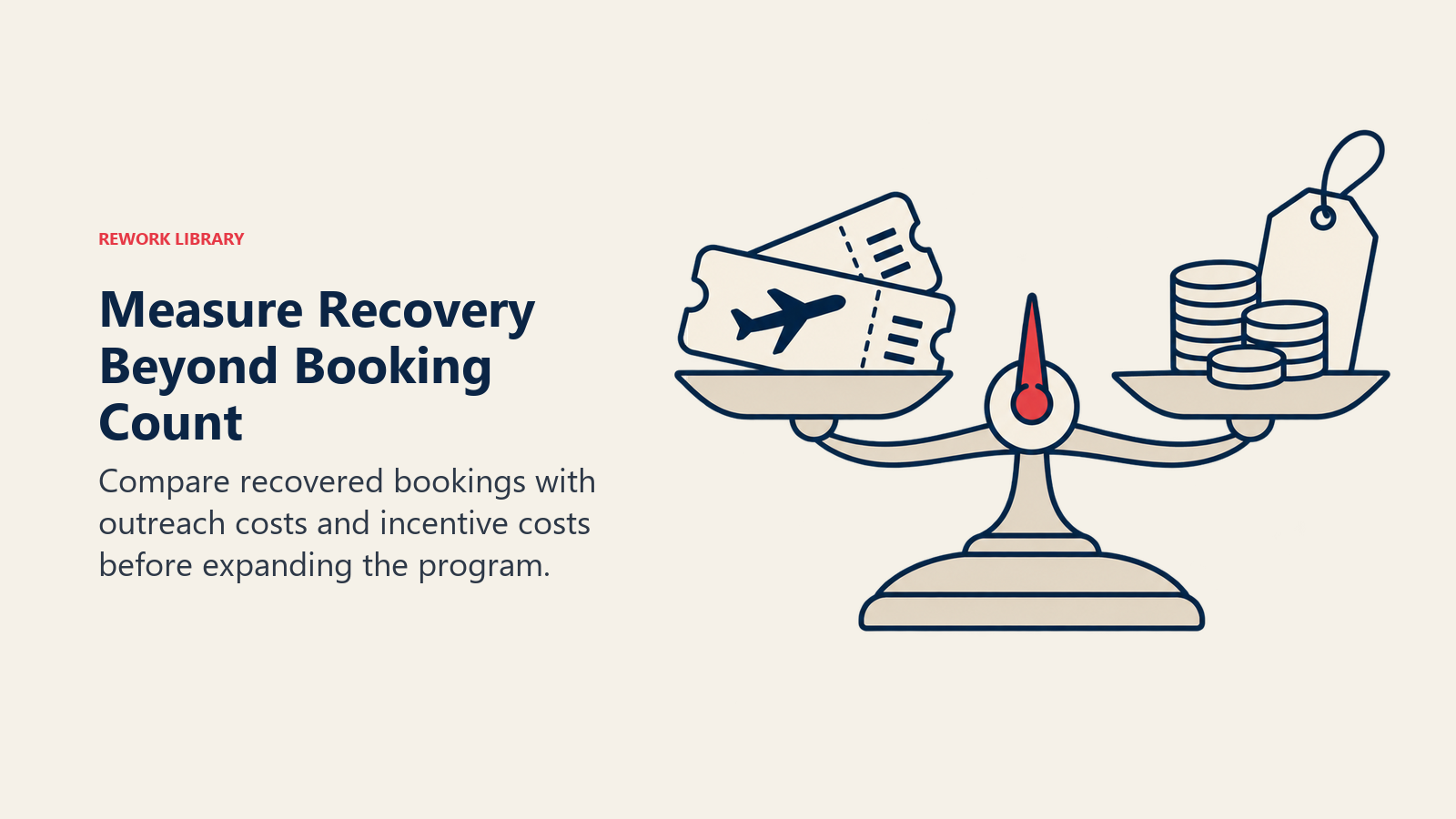
Revenue recovered quantifies program value. If you recover 500 bookings at $3,200 average value through abandonment campaigns, that's $1.6 million in recaptured revenue. Compare this to program costs (email tool, staff time, discounts offered).
Time to recovery reveals optimal timing. Do most recoveries happen within 24 hours, or after day 7? This guides where to focus effort and budget. If 60% of recoveries happen in first 48 hours, prioritize early-stage emails.
Incentive cost analysis measures whether discounts are necessary. If recovery rate is 15% with no discount and 18% with $100 discount, is the 3% lift worth $100 per incremental booking? Often non-discount incentives deliver better ROI.
ROI calculation compares program investment to recovered revenue. Subtract all costs (email platform, staff time, incentives offered, technology) from recovered booking revenue. Typical abandonment recovery ROI is 400-800%, highly profitable.
Conclusion
Abandoned bookings aren't lost revenue, they're recovery opportunities. The people who abandoned were interested enough to start booking. They're infinitely more qualified than cold traffic. Systematic follow-up through automated emails, retargeting, and personalized outreach recovers 20-30% of them.
Build the infrastructure once, tracking, email workflows, retargeting audiences, and it runs continuously. Every abandoner gets systematic follow-up without manual effort. The recovered bookings are nearly pure profit because you already paid the acquisition cost.
The operators winning recovery aren't those offering the biggest discounts. They're the ones following up fastest, across multiple channels, with personalized messaging that addresses specific abandonment reasons. Speed, personalization, and persistence convert abandoned carts into confirmed bookings.
Related Articles: