Travel Business Economics: Unit Economics and Profitability for Tour Operators
Turn this article into takeaways for your work.


Each assistant summarizes the article only for you and suggests best practices for your work.
Three years into running their boutique tour company, Sarah's team had generated $4.2 million in bookings. From the outside, they looked successful. Inside, they were hemorrhaging cash. The problem wasn't operations or customer satisfaction, their economics were fundamentally broken. They didn't know it until their accountant showed them the numbers: they were losing $180 on every booking after accounting for true customer acquisition costs.
This is why 60% of travel startups fail within three years. They focus on revenue growth without understanding the underlying economics. You can't fix what you don't measure, and most tour operators don't measure the metrics that actually determine viability.
Revenue Structures in Travel
Tour operators and travel agencies make money in different ways, and understanding your revenue model is foundational:
Commission-Based Model (Traditional Agencies): You connect travelers with suppliers, hotels, airlines, tour operators, and earn commission on bookings. Commission rates typically range from 10-15% on accommodations, 5-10% on tours, and 5% on flights. The advantage is low capital requirements and no inventory risk. The disadvantage is thin margins and vulnerability to supplier commission cuts.
Net Rate/Markup Model (Tour Operators): You contract with suppliers at net rates, then add markup to create your selling price. If a hotel charges you $150 net and you sell at $225, your gross margin is $75 or 33%. This model offers higher margins but requires capital to pre-purchase inventory and creates risk if you can't sell it.
Package Pricing Model: You bundle multiple components, flights, accommodations, activities, guides, meals, into a single price. This obscures individual component costs, making price comparison difficult and protecting margins through strategic pricing. It's common for organized group tours and luxury experiences. Your margin is the difference between total package price and your cost structure.
Hybrid Approaches: Many successful operators mix models. They earn commissions on easy-to-book components like flights, mark up hotels and tours, and offer fully packaged trips for premium experiences. This diversifies revenue and maximizes margins where possible.
Your revenue model choice impacts everything downstream, sales cycle, marketing strategy, capital requirements, and profit potential.
Cost Structure Analysis
Travel businesses have both fixed and variable costs, but the mix is more complex than other industries:
Fixed Costs remain constant regardless of booking volume:
- Team salaries (sales, marketing, operations, admin)
- Office space and utilities
- Technology systems (CRM, booking engines, website)
- Insurance and licensing
- Marketing infrastructure (brand building, content, SEO)
- Professional services (legal, accounting)
For most tour operators, fixed costs run $300,000-$800,000 annually depending on team size and location. This creates a break-even threshold you must exceed before profitability.
Variable Costs scale with bookings:
- Supplier costs (hotels, transport, activities, guides)
- Payment processing fees (2-3% of booking value)
- OTA commissions (15-30% if booking through platforms)
- Customer support and service costs
- Booking-specific marketing (paid ads, promotional discounts)
Variable costs in travel typically run 70-85% of revenue, leaving 15-30% gross margin to cover fixed costs and profit.
Hidden Costs that most operators underestimate:
- Cancellations and refunds (5-15% of bookings)
- Service recovery when things go wrong
- Late payment from customers
- Supplier payment terms requiring upfront cash
- Currency fluctuation impact
- Seasonal cash flow gaps
- Unproductive sales time on inquiries that don't convert
These hidden costs can add 5-10% to your true cost structure. Operators who don't account for them wonder why they're not profitable despite "good margins."
Unit Economics Framework
Unit economics tell you whether your business model works at a per-customer level. Here's what actually matters:
Customer Acquisition Cost (CAC) is what you spend to generate one booking. Calculate it properly:
CAC = (Total Marketing + Sales Costs) / Number of New Customer Bookings
Most travel operators calculate this wrong. They divide marketing spend by total bookings, ignoring sales team salaries, tools, and the cost of nurturing inquiries that don't convert.
For travel, typical CAC ranges widely:
- Luxury tours: $800-$2,500 per booking
- Adventure travel: $400-$1,200 per booking
- Family vacations: $300-$900 per booking
- Budget tours: $150-$500 per booking
Your CAC should be appropriate for your Average Booking Value and margin structure.
Average Booking Value (ABV) is your typical booking size:
ABV = Total Revenue / Number of Bookings
This varies enormously by business model:
- Budget hostels: $500-$1,500
- Mid-range tours: $2,500-$7,500
- Luxury experiences: $10,000-$50,000+
- Group travel: $3,000-$15,000
Higher ABV allows higher CAC but often comes with longer sales cycles and more complex sales process.
Gross Margin Per Booking is what's left after variable costs:
Gross Margin = Booking Revenue - Direct Costs
In travel, gross margins typically are:
- Commission-only agencies: 10-15%
- Tour operators with markup: 20-35%
- Packaged tours: 25-40%
- High-touch luxury: 35-50%
This gross margin must cover your fixed costs and generate profit.
Customer Lifetime Value (LTV) is the total profit from a customer across all bookings:
LTV = (Average Booking Value × Gross Margin %) × (Number of Bookings Per Customer)
If your average customer books a $5,000 trip at 30% margin once every two years over six years, their LTV is: $5,000 × 30% × 3 = $4,500
But most operators only see one booking, making their LTV much lower.
LTV:CAC Ratio tells you if your economics work:
LTV:CAC Ratio = Customer Lifetime Value / Customer Acquisition Cost
Healthy ratios in travel:
- 3:1 is minimum viability
- 5:1 is good
- 7:1+ is excellent
- Below 2:1 means you're losing money
If your LTV is $4,500 and CAC is $900, your ratio is 5:1, sustainable. If CAC is $2,000, your ratio is 2.25:1, you're probably struggling.
The Margin Squeeze Challenge
Tour operators face constant pressure on margins from multiple directions:
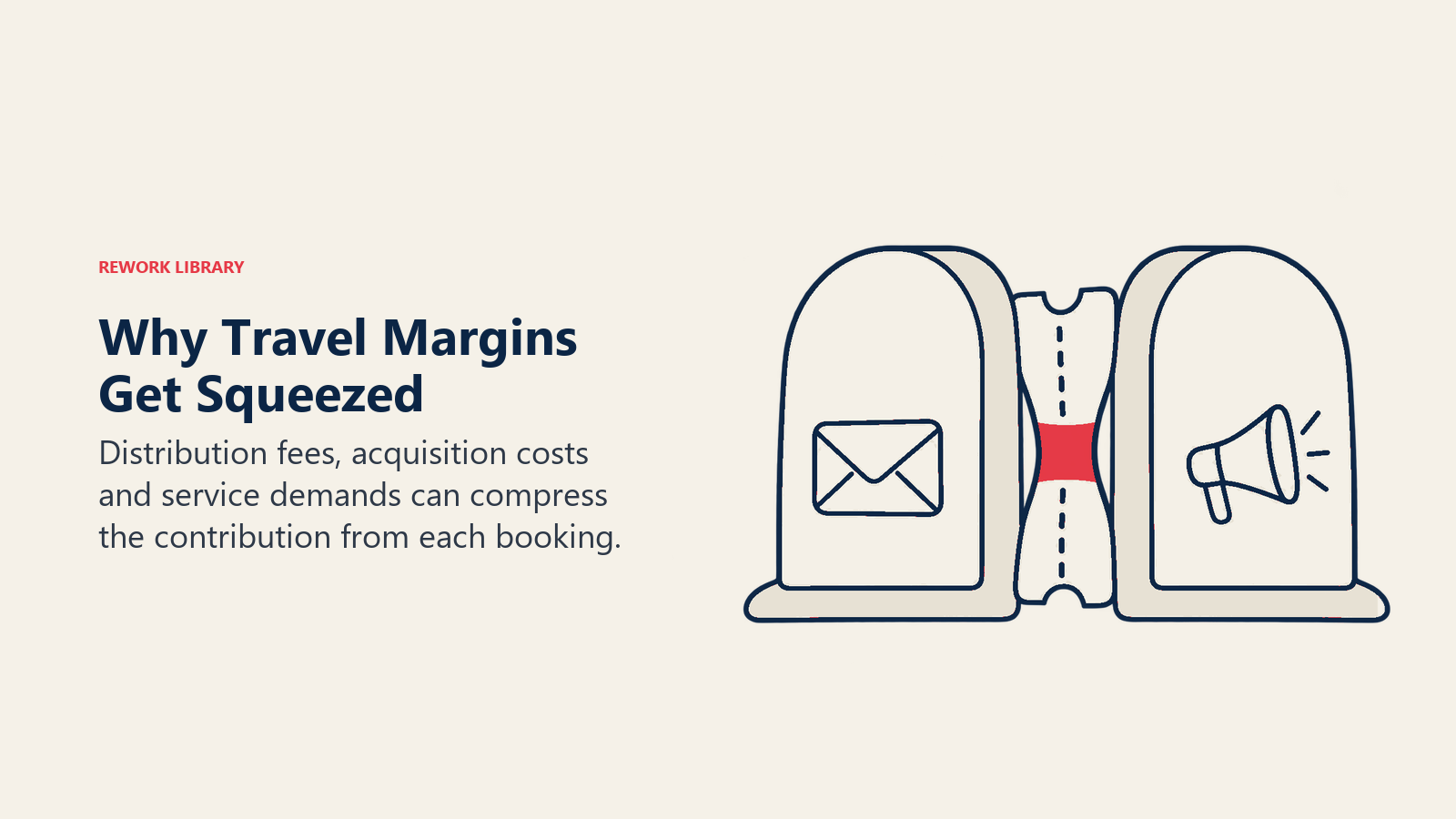
OTA Competition and Commission Pressure: Online travel agencies drive significant volume but demand 20-30% commissions. As they grow more powerful, they push for higher commissions, better rates, and favorable terms. You become dependent on their traffic but can't maintain margins.
Supplier Commission Reductions: Airlines have slashed commissions from 10% to 0-1%. Hotels are pushing direct booking programs that bypass agents. Suppliers want to own the customer relationship and reduce distribution costs, by cutting your commissions.
Rising Marketing Costs: Paid advertising gets more expensive every year. Google Ads, Facebook, Instagram, all have seen cost-per-click increases of 30-50% over five years. Organic reach on social media has collapsed. Acquiring customers costs more than it used to.
Labor Intensity Requirements: Travel is a people business. AI can't replace the consultation, customization, and service recovery your team provides. As labor costs rise, your fixed costs increase without corresponding margin expansion.
The squeeze forces operators to either find efficiencies, increase prices, or accept lower profitability. Most try to maintain volume by competing on price, which accelerates the race to the bottom.
Profitability Drivers
Given these pressures, what actually drives profitability?
Mix of Direct vs OTA Bookings: Direct bookings preserve 20-30% more margin than OTA bookings. If you can shift from 80% OTA to 50% OTA, you fundamentally change your economics. This requires investment in brand, SEO, and direct marketing, but pays off through higher lifetime profitability.
Upsell and Ancillary Revenue: The base trip might have thin margins, but add-ons often carry 50-70% margins. Travel insurance, airport transfers, upgraded experiences, and equipment rentals boost per-booking profitability without proportional cost increases.
Repeat Customer Economics: A repeat customer costs $100-$300 to reactivate versus $800-$2,500 to acquire. They book faster, require less hand-holding, and trust your recommendations. If you can increase repeat rate from 15% to 40%, your blended CAC drops dramatically and profitability soars.
Group vs Individual Booking Margins: Group bookings create economies of scale. One salesperson manages a 12-person group generating $60,000 in revenue. That same salesperson managing six individual couples generates the same revenue but with more complexity and customization requirements.
Understanding these drivers lets you make strategic decisions about where to focus effort and investment.
Break-Even Analysis
Every tour operator needs to know their break-even point, the revenue level where you stop losing money:
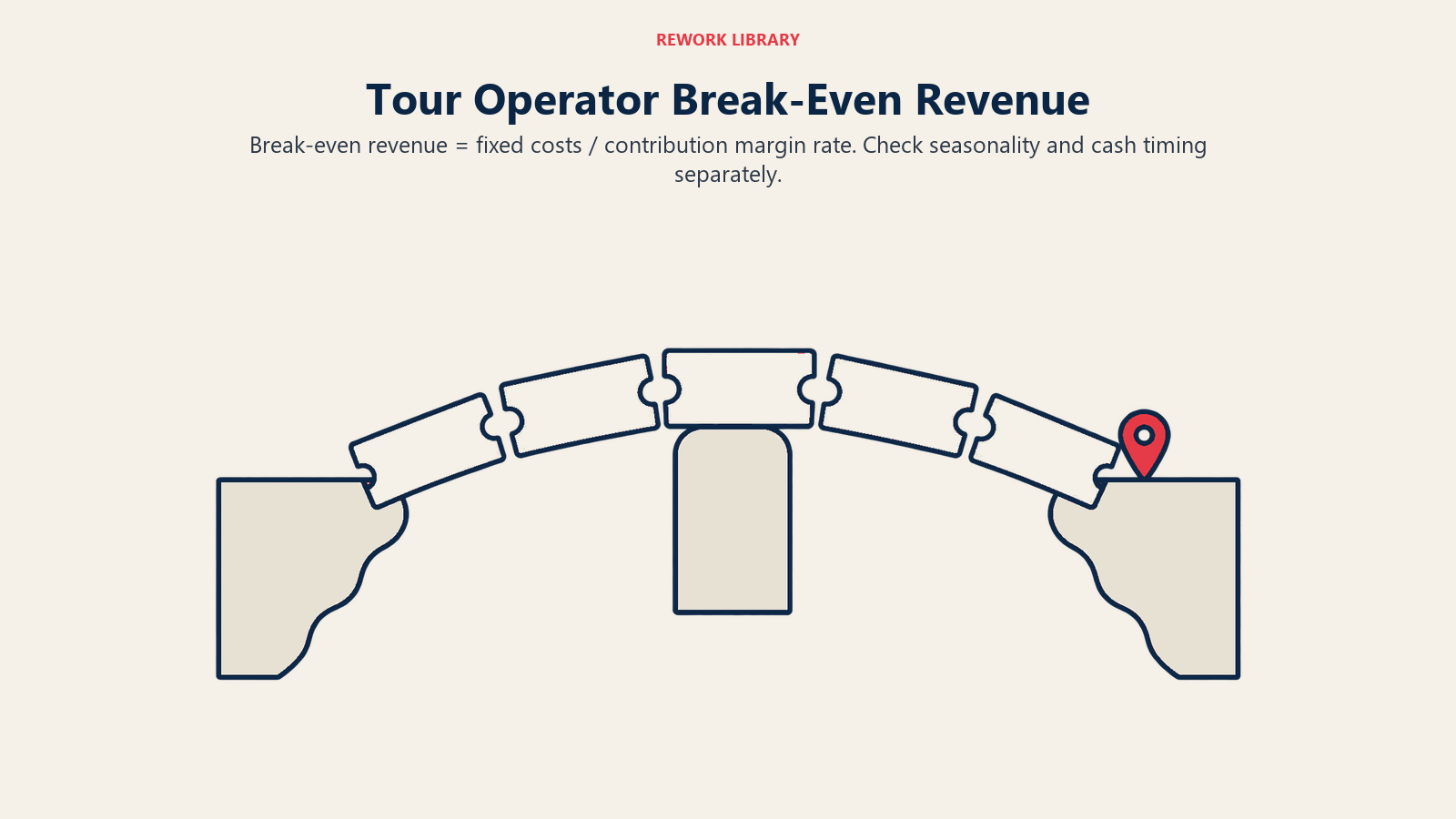
Break-Even Revenue = Fixed Costs / Gross Margin %
If your fixed costs are $500,000 and gross margin is 25%, you need $2,000,000 in revenue to break even.
But this is simplified. Real break-even analysis considers:
- Seasonal revenue distribution (if 70% of revenue comes in six months, you're losing money the other six months)
- Cash flow timing (you might break even on paper but run out of cash)
- Growth investment (if you're spending on marketing for future growth, current break-even doesn't matter)
Most tour operators should target revenue 1.5-2x their basic break-even to account for growth investment and provide cushion.
Scaling Economics
The economics change dramatically as you scale:
$500K-$2M: You're barely covering fixed costs. Every booking matters. You can't afford specialized roles. Profitability is elusive.
$2M-$5M: You're hitting initial profitability. You can invest in marketing and sales infrastructure. But you're still fragile, one bad season can wipe out profits.
$5M-$10M: Economics improve through operational leverage. Your fixed cost base is spread across more bookings. You have negotiating power with suppliers for better rates. Marketing efficiency improves as brand awareness grows.
$10M-$25M: You're achieving scale advantages. Supplier relationships yield better terms. Marketing ROI improves through accumulated content and SEO authority. Team specialization increases efficiency.
$25M+: You have significant buying power, market presence, and operational sophistication. Margins should expand unless you're trading margin for market share growth.
Many operators get stuck at $3-$5M because their economics don't yet support the infrastructure needed to reach $10M. You need to invest ahead of revenue, creating a profitability valley.
Cash Flow Management
Profitability and cash flow are different. You can be profitable on paper while running out of cash.
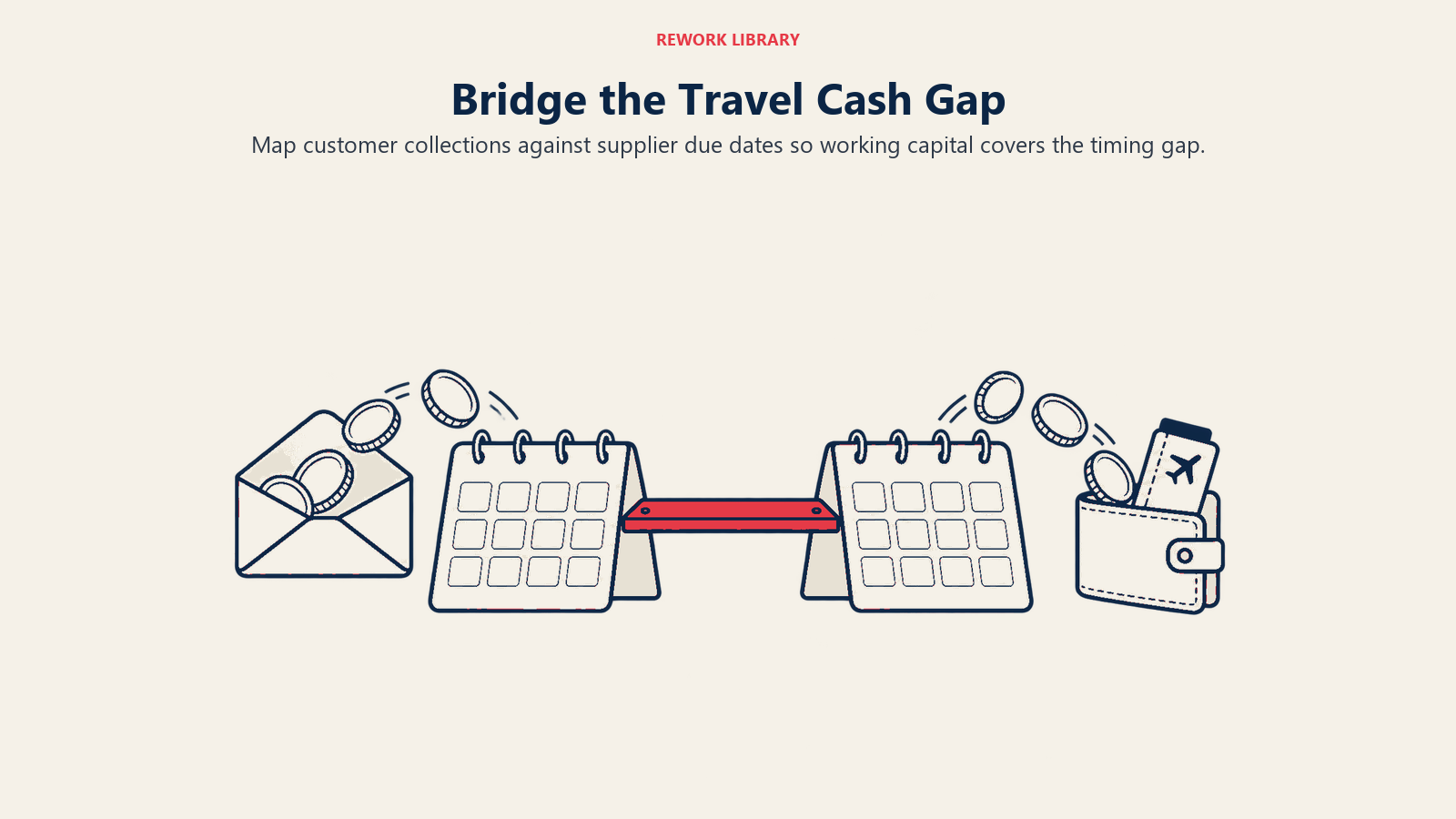
Deposit Timing: You collect customer deposits months before departure. This creates positive cash flow early in the customer lifecycle.
Supplier Payment Terms: Most suppliers require payment 30-90 days before travel. This means you're paying out before the customer's final payment is due.
Working Capital Needs: The gap between when you pay suppliers and when customers pay you requires working capital. At $5M in annual revenue with typical payment timing, you might need $500K-$1M in working capital.
Seasonal Fluctuations: If your high season is summer, you're collecting deposits in spring and paying suppliers in early summer. Your cash position varies wildly through the year. Many operators take seasonal credit lines to smooth cash flow.
Cash flow failure, not unprofitability, kills most travel businesses.
Benchmark Metrics for Healthy Travel Businesses
Here's what good looks like at different stages:
Gross Margin:
- Agencies: 10-15%
- Standard tour operators: 25-35%
- Luxury operators: 35-50%
Operating Margin (after all expenses):
- Startup ($0-$2M): Break-even to 5%
- Growth ($2M-$10M): 5-12%
- Scale ($10M+): 10-20%
Customer Acquisition Cost:
- Should be less than 30% of gross margin per booking
- Payback period should be less than 2 years
Repeat Customer Rate:
- Minimum acceptable: 15%
- Good: 30%
- Excellent: 50%+
LTV:CAC Ratio:
- Viable: 3:1
- Healthy: 5:1
- Excellent: 7:1+
Working Capital:
- 10-20% of annual revenue
- 3-6 months of operating expenses
If your metrics are far from these benchmarks, you have a structural problem that won't be solved by just working harder or booking more revenue.
Related Articles