Sales and Finance Credit Alignment: Closing More Solar Deals Without the Surprises
Turn this article into takeaways for your work.


Each assistant summarizes the article only for you and suggests best practices for your work.
A closer spends two and a half hours in a homeowner's kitchen. They run the savings analysis, build the proposal, handle three rounds of objections, and get the signature. The homeowner is excited. Then the credit application comes back declined three days later, and the deal is dead.
This happens dozens of times a month at solar companies that treat credit as finance's problem and sales as sales' problem. The two teams operate on different assumptions, use different language, and have no shared process for the critical handoff between "signed contract" and "funded deal."
Fixing that gap is one of the highest-leverage things a solar sales manager can do. The work is mostly process and communication, not technology.
Why Does Sales-Finance Alignment Break Down?
The friction between solar sales and finance credit teams usually comes from three structural mismatches:
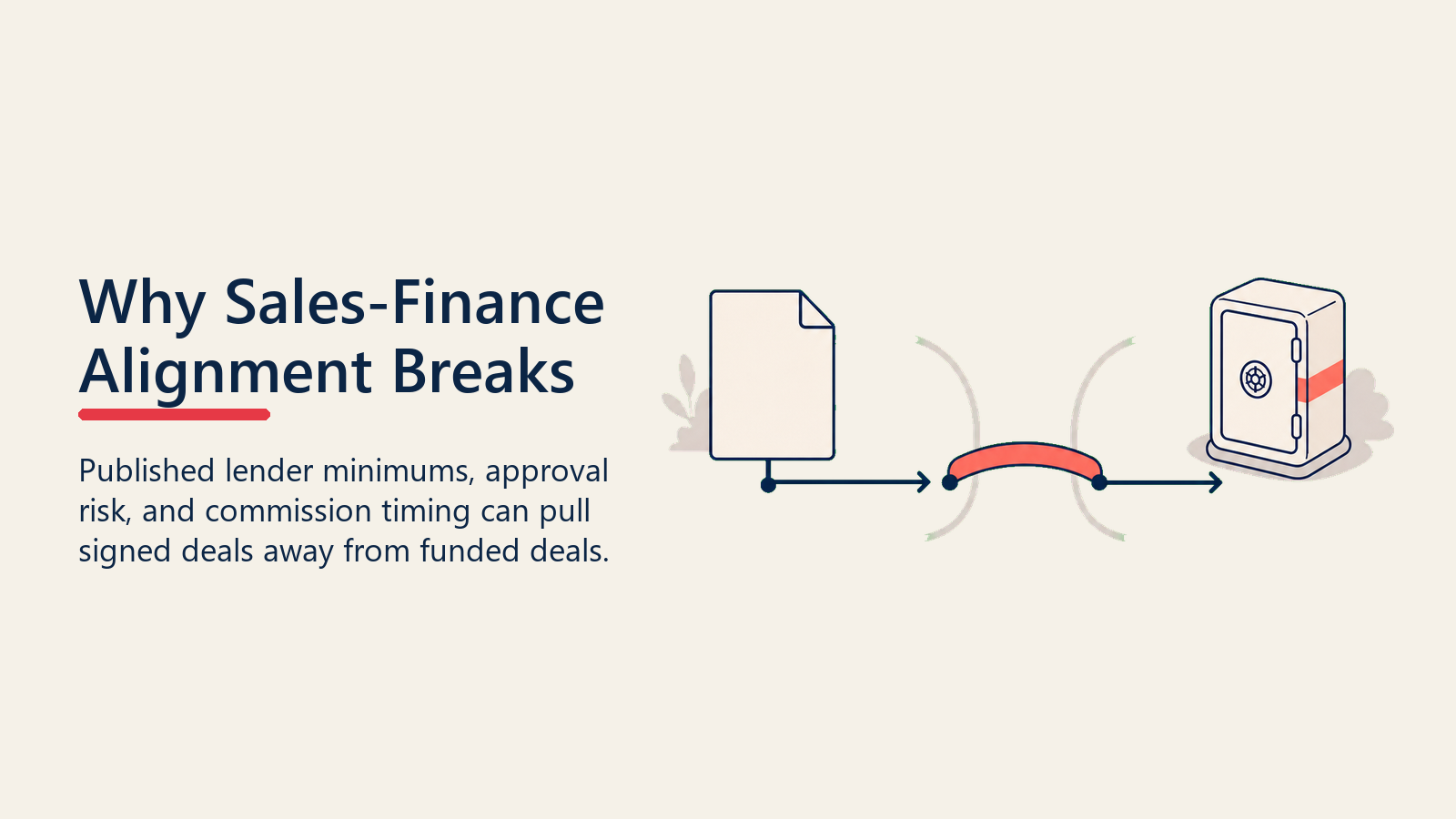
Mismatched qualification standards. Sales might present financing to a homeowner with a 620 credit score because the lender's published minimum is 620. But the finance team knows that 620 scores with recent late payments get declined far more often than the published minimum would suggest (industry experience puts it above 50 percent in many lender tiers). That information never made it into the setter's pre-screen script or the closer's qualification checklist.
Incentive misalignment. Closers are paid on signed contracts. Finance is responsible for funded deals. A closer who gets a contract signed with an unqualified borrower walks away with a partial commission in many structures, while the finance team burns hours processing a deal that was never fundable. Neither team blames themselves; they blame each other. Harvard Business Review's research on sales compensation design points out that outdated commission structures drive exactly this kind of misalignment, where individual incentives diverge from the company's actual revenue goals.
No shared language on deal status. "Signed" means the customer committed in sales. It can mean anything from "completely qualified and ready to fund" to "we got a signature from someone who might not pass credit." Without a shared definition of deal stages, the pipeline data misleads everyone.
See solar financing models and sales for an overview of the financing products themselves. This article focuses on the organizational process that makes those products work.
Key Facts
- The CFPB's August 2024 issue spotlight on solar financing found that dealer fees routinely increase the loan cost by 30% or more above the cash price of a solar project, yet lenders frequently do not disclose these fees transparently to homeowners. (CFPB Issue Spotlight: Solar Financing, August 2024)
- NREL research found that the median installer cancellation rate for residential solar contracts is 33%, with permitting delays and changes in customer finances ranked as the top two drivers. (NREL Technical Report 80626, 2022)
- McKinsey found that "smart revisions of compensation models have a 50% higher impact on sales than changes in advertising investments," a finding that applies directly to the sign-vs.-fund trigger decision. (McKinsey, "Sales Incentives That Boost Growth," 2018)
What Finance Actually Needs from Sales
Before a deal reaches credit submission, the finance team needs clean, consistent inputs. Here's what that looks like in practice:
| What finance needs | Why it matters | Who collects it |
|---|---|---|
| Homeowner name matches ID | Lender requirement for identity verification | Setter or closer |
| Co-borrower present and consenting | Many lenders require both decision-makers on the app | Closer, confirmed at appointment |
| Estimated credit score range | Determines which lender tier to submit to first | Setter (pre-screen question) |
| Income verification docs | Required by most solar lenders above $20K | Closer or post-sign follow-up |
| Property ownership confirmed | Solar loans are property-secured in many structures | Setter (pre-screen) |
| Utility bill or usage data | Required for accurate system sizing and savings projection | Closer (in-home) |
| Signed proposal with system specs | Finance needs exact system size for funding approval | Closer |
When sales delivers deals without these inputs, the finance team spends days chasing documents, submission timelines slip, and homeowners lose confidence in the company. Each day a deal sits in "pending documents" is a day the homeowner is more likely to cancel.
The simplest fix is a deal submission checklist that both teams co-own. Sales doesn't hand off to finance without the checklist complete. Finance doesn't start processing until it's clean.
The Pre-Screen Credit Conversation
Most solar companies under-train setters on the credit pre-screen. Setters are often coached to "not scare people off" by asking about credit, so they skip it or ask so softly that the answer is meaningless.
But a homeowner who won't qualify for any of your lenders isn't a prospect. Booking them an appointment wastes closer time and creates a bad customer experience when the deal falls through.
A direct pre-screen approach works better:
"Before we schedule, I want to make sure we can actually get you financing if the numbers make sense. Our solar lenders typically look for a credit score around 650 or better. Without getting into specifics, do you know if you're in that range?"
This phrasing:
- Frames it as protecting the homeowner's time, not screening them out
- Sets realistic expectations early
- Gives setters a natural exit for clearly unqualified leads
- Generates data the finance team can use to tier incoming leads
See solar lead qualification and prescreening for the full pre-screen framework. The credit conversation is one module in that broader qualification process.
Lender Tiering and the Submission Waterfall
Solar companies often work with three to six lenders at different credit tiers. A deal that gets declined by the primary lender shouldn't automatically die. It should flow to the next lender in the waterfall.
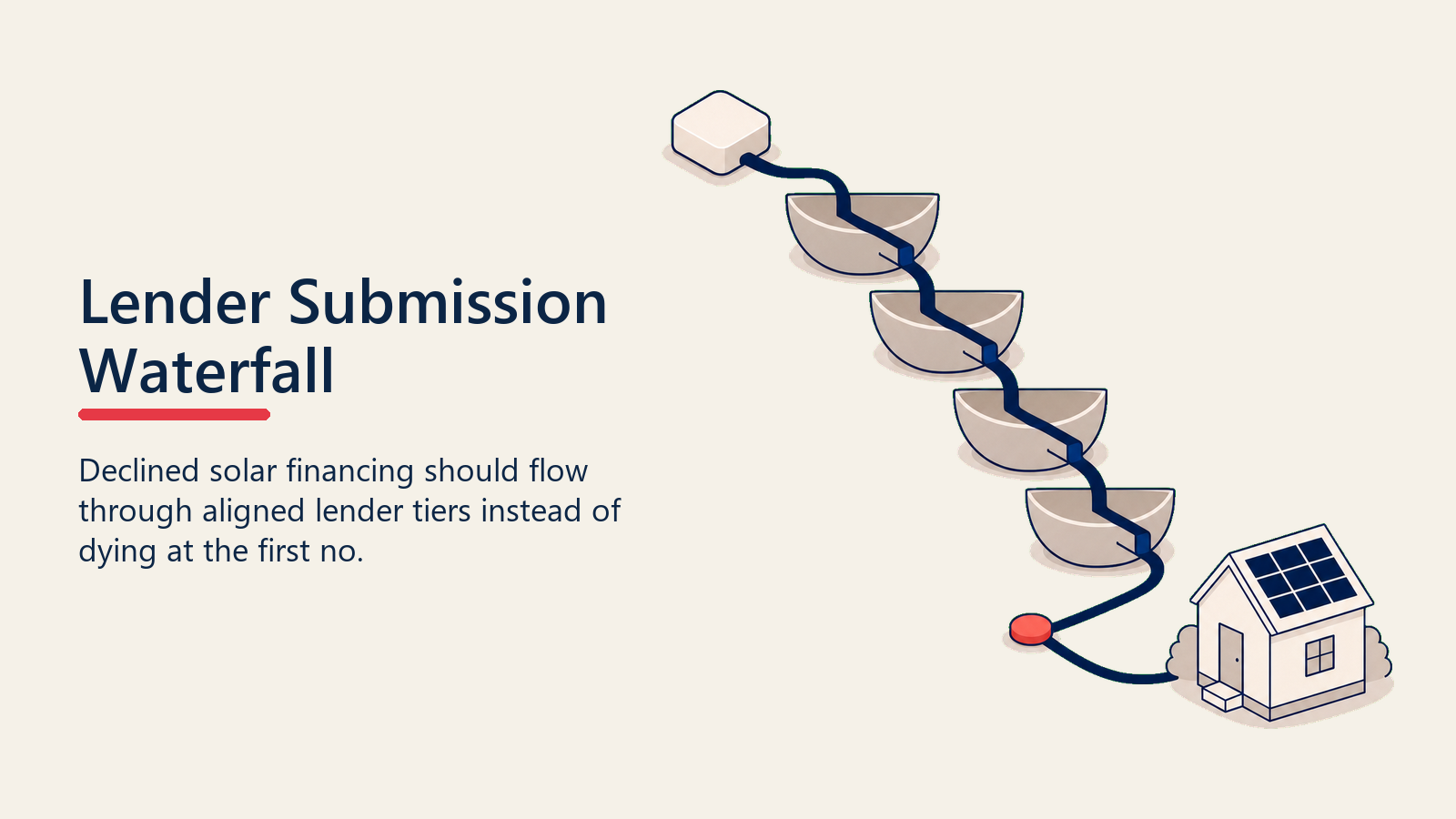
But without alignment between sales and finance on how that waterfall works, deals get stuck:
- Sales doesn't know there's a second or third lender option
- Finance submits to the wrong lender first because sales collected incomplete information
- The homeowner gets multiple credit pulls, which damages their score and creates frustration
- No one tells the customer what's happening, so they assume the deal is dead and start canceling
A lender waterfall that finance and sales understand jointly looks like this:
| Tier | Typical credit score | Rate range | Notes |
|---|---|---|---|
| Tier 1 (preferred) | 700+ | Lowest rates, longest terms | Submit first for strong borrowers |
| Tier 2 (mid) | 650-699 | Moderate rates | Default tier for most deals |
| Tier 3 (subprime) | 600-649 | Higher rates, shorter terms | Requires customer re-education on terms |
| Declined | Below 600 / recent bankruptcy | Not available | Closer needs cash or PPA fallback |
Sales training should cover this waterfall so closers can set accurate expectations during the consultation. If a homeowner has a 630 score, the closer should know before leaving the house that Tier 3 rates will apply and should have already addressed the payment difference.
See solar objection handling for how to handle the "I got approved but the rate is higher than you said" conversation, which is one of the most common post-approval trust problems.
The Handoff Protocol: What Needs to Happen in the First 24 Hours
The 24 hours after a contract is signed are the highest-risk window for deal attrition. The homeowner is excited but also second-guessing. Finance hasn't started processing. Nothing has happened to reinforce the decision.
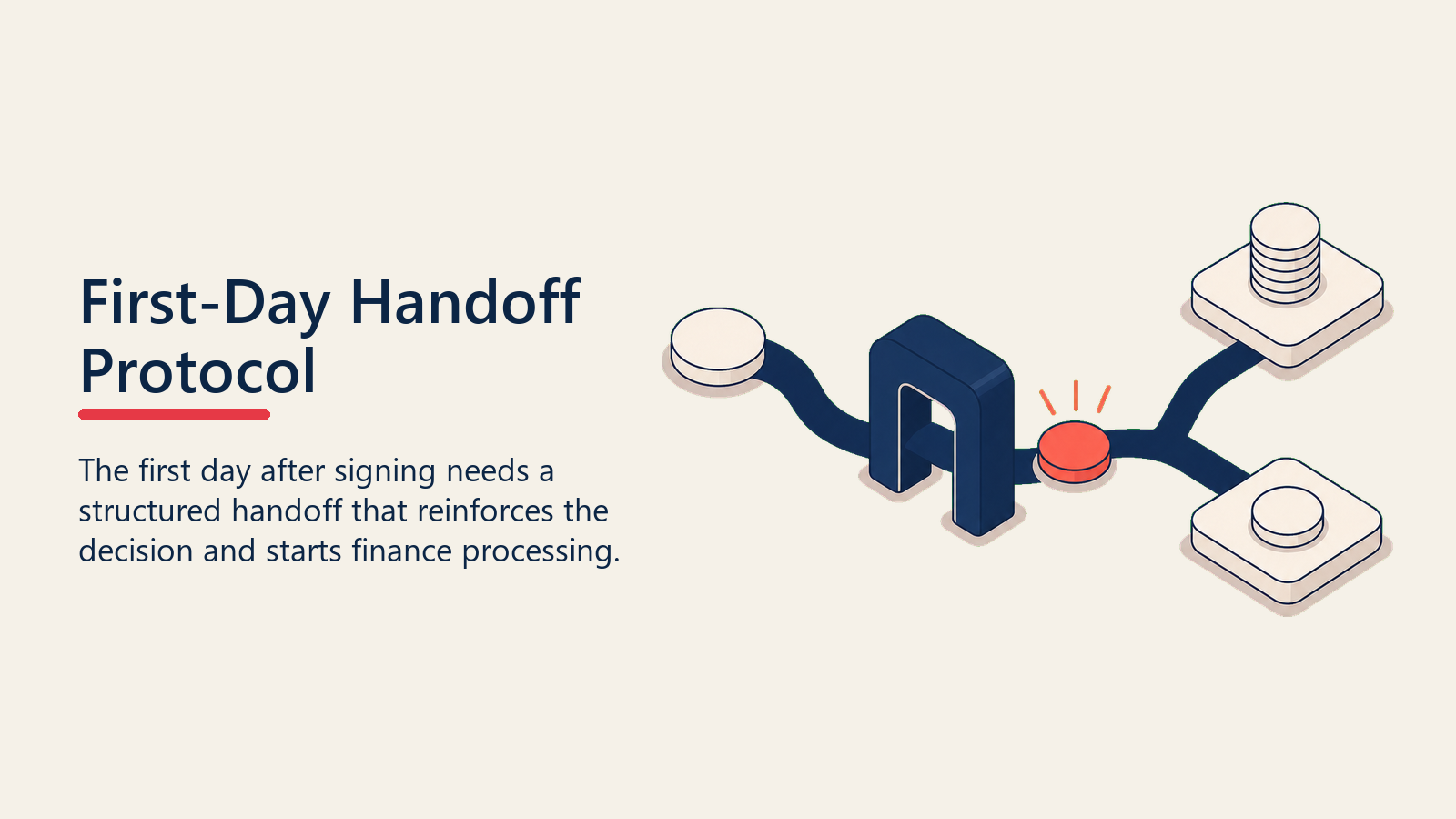
A structured handoff protocol closes this gap:
Within 2 hours of signing:
- Finance team receives the signed contract, checklist, and any collected docs
- Finance sends the homeowner a welcome email with next steps and a contact name
- Closer or setter sends a personal text to the homeowner: "Great meeting you today. Our finance team will reach out within 24 hours to get your paperwork started."
Within 24 hours:
- Finance contacts homeowner to begin credit application
- If any documents are missing, finance requests them directly (not through sales)
- Credit is submitted to the appropriate lender tier based on the pre-screen info
Within 48-72 hours:
- Credit decision is communicated to both sales and the homeowner simultaneously
- If approved: finance confirms terms and moves to site survey scheduling
- If declined at Tier 1: finance submits to Tier 2 immediately without waiting for sales to re-engage
- If declined across all tiers: sales is notified to offer alternative (cash, PPA (power purchase agreement), or re-qualify in 6 months)
This protocol requires finance to take an active role in customer communication rather than waiting for sales to push deals through. But it dramatically reduces the "we never heard back after we signed" cancellations that show up in post-mortem call reviews.
Shared KPIs Between Sales and Finance
Alignment without shared accountability is just a meeting. The teams need shared metrics that both track and both own:
| Metric | Target | Owned by |
|---|---|---|
| Application submission rate (signed to credit app submitted) | 95%+ within 48 hrs | Finance (with sales support) |
| Approval rate (submitted to approved) | 70-80% | Both teams |
| Funded rate (approved to funded) | 90%+ | Finance |
| Days from sign to funding decision | Under 5 business days | Finance |
| Deals lost to credit post-sign | Under 5% of signed volume | Both teams |
| Re-engagement rate after initial decline | 40%+ | Sales |
"Deals lost to credit post-sign" is the number worth watching most closely. When it creeps above 8 to 10 percent, it usually signals a qualification standards problem, a lender waterfall problem, or a closer who's signing deals they know are marginal because partial commission is still commission.
Review these metrics in a joint weekly meeting, not separate team meetings. The conversation changes when both teams see the same numbers at the same time.
Training Sales on Credit Reality
Closers don't need to become underwriters. But they need to know enough about credit to:
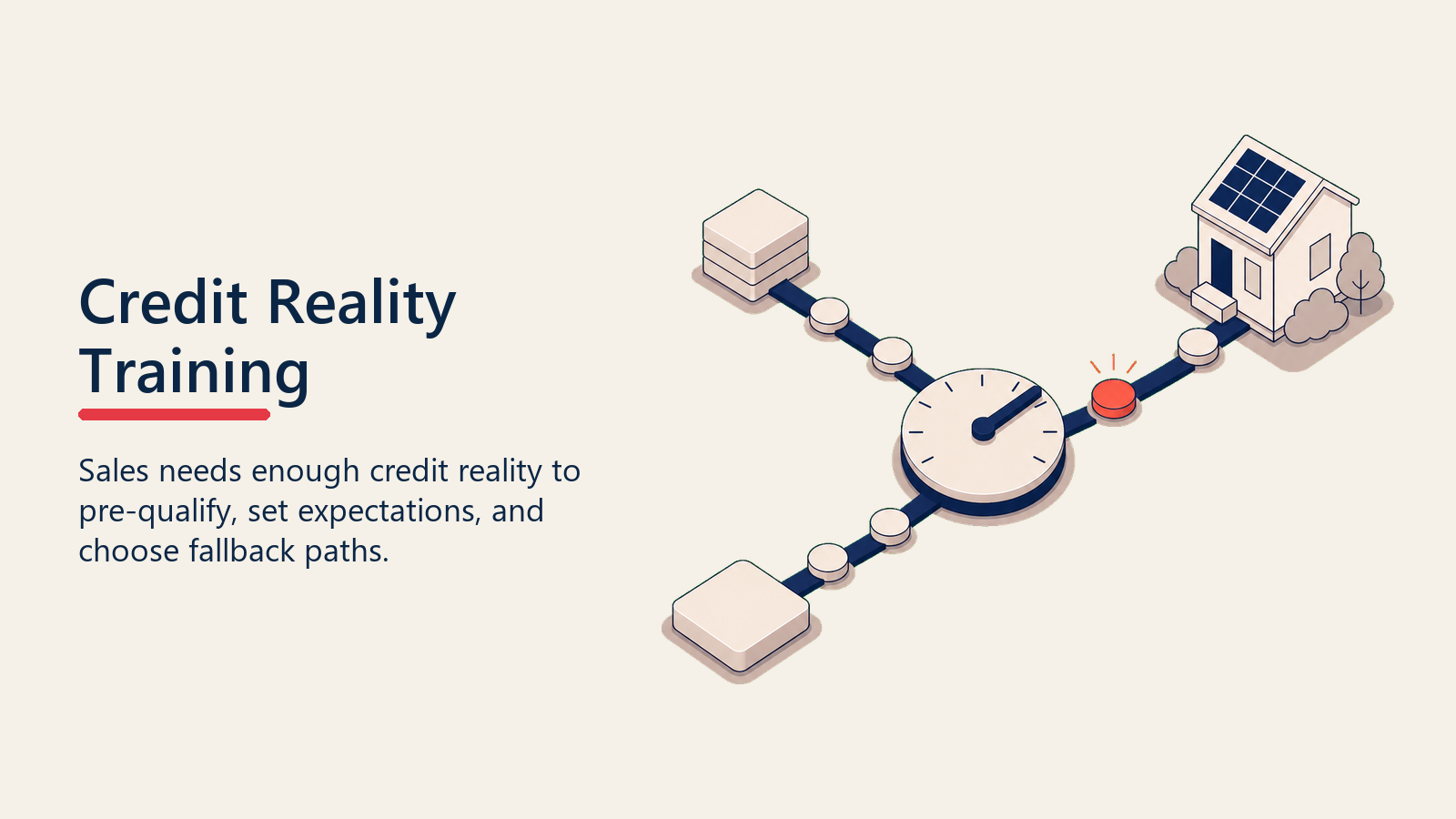
- Pre-qualify accurately without alienating prospects
- Set realistic rate expectations before submitting the application
- Present the Tier 3 option confidently if the borrower is likely to land there
- Know when to offer a cash path or a PPA as the financing fallback
- Understand what triggers a decline so they can address those factors at the consultation
A monthly "credit calibration" session where finance shares what they saw in the previous month's applications (what got approved at what tiers, what got declined and why, what mistakes kept showing up on applications) is more useful than any static training module.
Closers who understand credit dynamics close more deals. They don't oversell loan terms that won't get approved, they don't create situations where the homeowner feels misled after funding, and they handle the "I thought it would be cheaper" conversation with confidence because they set the expectation correctly in the first place.
See lead qualification frameworks for the broader qualification methodology that applies across the funnel, and negotiation fundamentals for handling the re-negotiation that sometimes happens when a borrower lands at a higher rate tier than expected.
When the Deal Falls Through: The Re-Qualification Path
Not every credit decline is a permanent loss. A homeowner who gets declined today with a 615 score, pays down a credit card, and cleans up a late payment might qualify at 650 in three months.
Companies that build a re-qualification follow-up process regularly recover a portion of initially declined deals over the following six to twelve months, with industry practitioners reporting recovery rates of 10 to 20 percent depending on deal mix and follow-up discipline. That's a meaningful volume lift with no additional lead generation cost.
The re-qualification path needs:
- A CRM tag for "declined, re-qualify" with a follow-up date set
- A 60-day and 90-day check-in sequence (text or email, not a hard sell)
- A quick re-pull of credit with permission when the homeowner says they've improved their score
- A note from finance on what specifically changed and whether it's enough
This only works if sales and finance have agreed on who owns the follow-up. Without that agreement, declined leads fall into a void where nobody calls and the homeowner eventually goes with a competitor.
Quotable Nuggets
"The closer's job ends at the signature. But if the deal never funds, it never happened. Paying on sign while holding finance accountable for funded deals is a structural conflict that no training can fix. Only comp design can." Principle grounded in McKinsey sales compensation research
"Companies that build a re-qualification follow-up process routinely recover declined deals over the next six to twelve months. Industry practitioners put the recovery rate at 10 to 20 percent depending on follow-up discipline. That's volume lift with no incremental lead cost."
The Sign-to-Fund Funnel: Track four sequential conversion rates between every phase: (1) signed contracts to credit applications submitted within 48 hours, (2) credit applications to approvals, (3) approvals to funded deals, and (4) funded deals to completed installs. When a rate at any stage drops below its historical baseline, that is the alignment gap to fix first. Reviewing this funnel weekly in a joint meeting, not in separate team reviews, gives both sales and finance the shared visibility to problem-solve in real time rather than assign blame after the fact.

Senior Implementation Consultant
On this page
- Why Does Sales-Finance Alignment Break Down?
- What Finance Actually Needs from Sales
- The Pre-Screen Credit Conversation
- Lender Tiering and the Submission Waterfall
- The Handoff Protocol: What Needs to Happen in the First 24 Hours
- Shared KPIs Between Sales and Finance
- Training Sales on Credit Reality
- When the Deal Falls Through: The Re-Qualification Path
- Quotable Nuggets