Canvassing and Door-to-Door Lead Generation for Solar
Turn this article into takeaways for your work.


Each assistant summarizes the article only for you and suggests best practices for your work.
Door-to-door is one of the few lead channels where a solar company can control volume on demand. Digital leads fluctuate with ad budgets and algorithm changes. Referrals depend on timing and how happy your installed base is feeling. But canvassing? Put trained setters on the right doors tomorrow and you get appointments tomorrow.
That directness is why canvassing remains the spine of most high-volume residential solar operations. It's also why it fails badly when companies treat it as an afterthought. Territory selection, training, metrics, and team culture all determine whether canvassing produces a pipeline or burns out reps.
This guide covers how to build a canvassing program that consistently delivers qualified in-home appointments.
Why Does Door-to-Door Still Work in Solar?
Homeowners don't seek out solar until something triggers the thought. That trigger is most often a neighbor's installation, a high utility bill, or a direct conversation. Canvassing creates that trigger at scale.
Unlike digital ads, a door conversation is immediate. A setter can qualify the homeowner in 60 seconds, handle the first objection in real time, and book an appointment before the homeowner has a chance to research and overthink. That immediacy is the channel's biggest advantage.
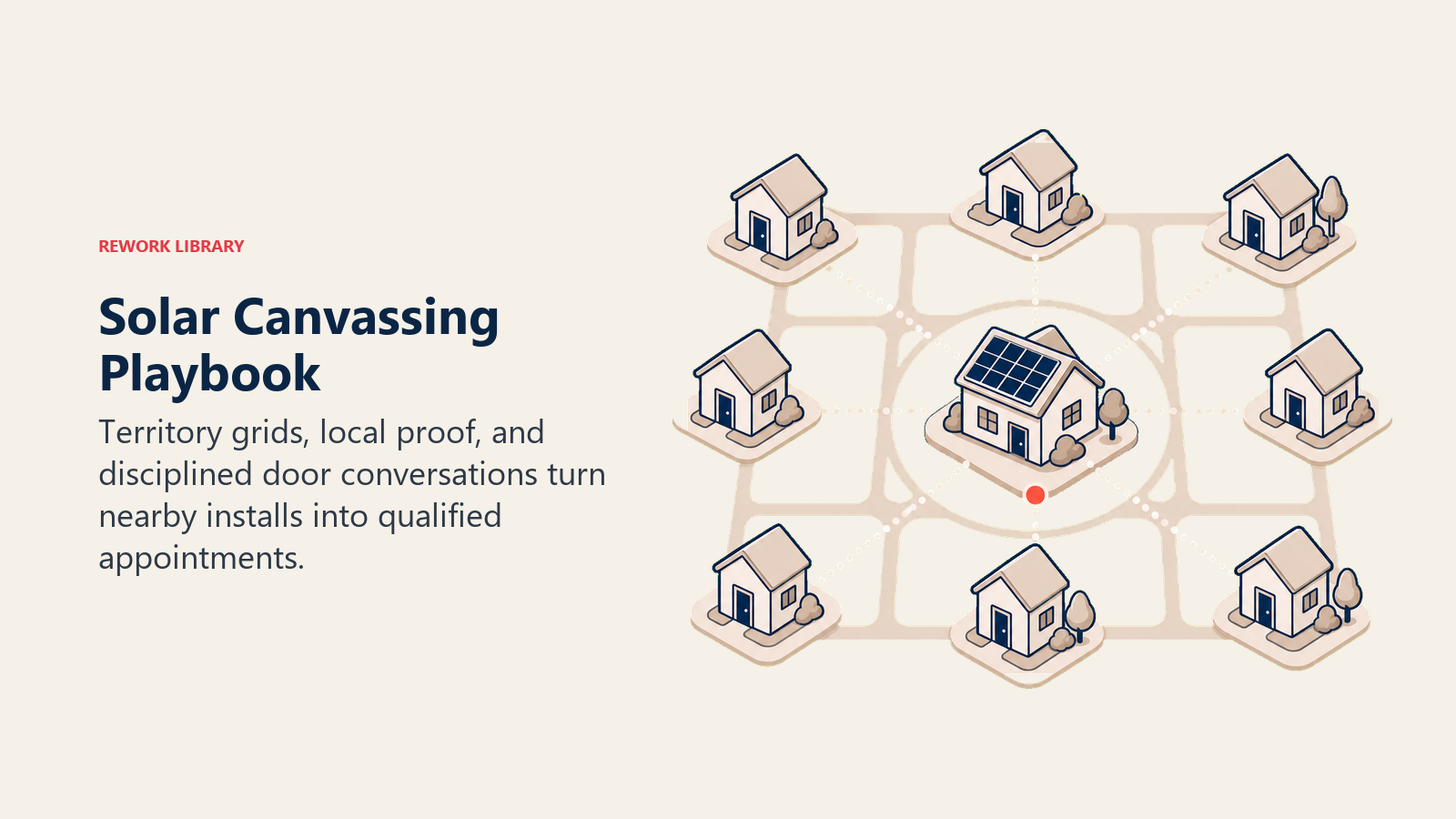
The other advantage is proximity. When a solar system goes in on a block, canvassing that block within 48 hours catches neighbors who noticed the installation crew, have questions, and are already primed. That's a conversion rate multiplier you can't replicate with a Facebook ad.
Key Facts
- The average US residential electricity rate was 16.5 cents per kWh in 2024. Source: EIA Electric Power Monthly. Higher state rates directly increase canvassing conversion in those markets because the financial case is stronger on every door.
- More than 5 million US homes now have solar, per SEIA. Canvassing "halo zones" around completed installs exploit the social proof of visible neighbor installations, which no digital channel can replicate.
- The FTC's Cooling-Off Rule gives buyers three business days to cancel any door-to-door sale of $25 or more. Sellers must provide written notice at the time of sale. Solar contracts signed at the kitchen table fall under this rule.
Territory Selection: Where You Knock Matters More Than How You Knock
No amount of pitch skill overcomes a bad territory. Before you deploy setters, answer these questions about the area:
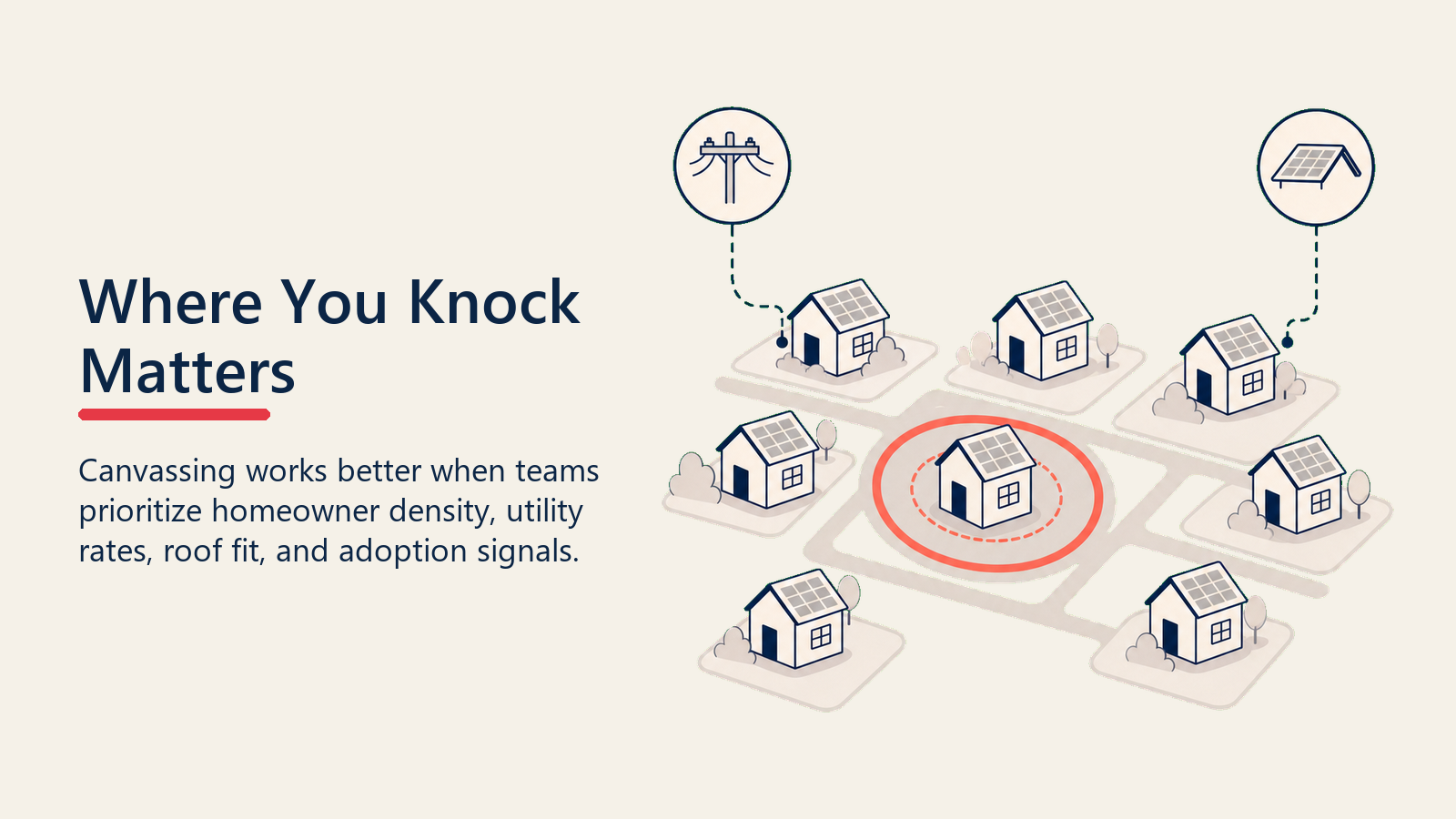
Ownership rate. You need homeowners. Census data by census tract gives you ownership percentages. Target areas above 70%. Apartment-heavy zones waste time.
Utility rates. High-rate utility territories convert at higher rates because the financial case is stronger. Know your local utility's residential rate schedule. Areas with rates above $0.15/kWh are your priority zones. The EIA's Electricity Monthly Update tracks average residential rates by state and is the fastest way to benchmark your territory against the national average.
Roof suitability. Flat areas with shade-heavy tree cover are harder. Suburban neighborhoods with south-facing roofs and clear sky exposure are ideal. Drive the territory before you knock it.
Income range. Loan qualification improves with income. Target median household incomes in the $65,000 to $200,000 range. Very high income homeowners can be cash buyers. Very low income may struggle with loan qualification, though there are low-income solar incentive programs worth knowing.
Existing solar saturation. If one in four homes already has solar, your density in that area is going to be low. Check permit data (many counties publish it) or use a tool like Scanifly or EagleView data.
Recent installs. Run your own install addresses through a mapping tool and build "halo zones" of two to three blocks around each completed job. Knock those zones within 30-60 days of job completion.
The Territory Grid System
Break your working area into manageable grids. Each grid should take a setter about two hours to fully knock at a reasonable pace (roughly 50-70 doors, accounting for no-answers).
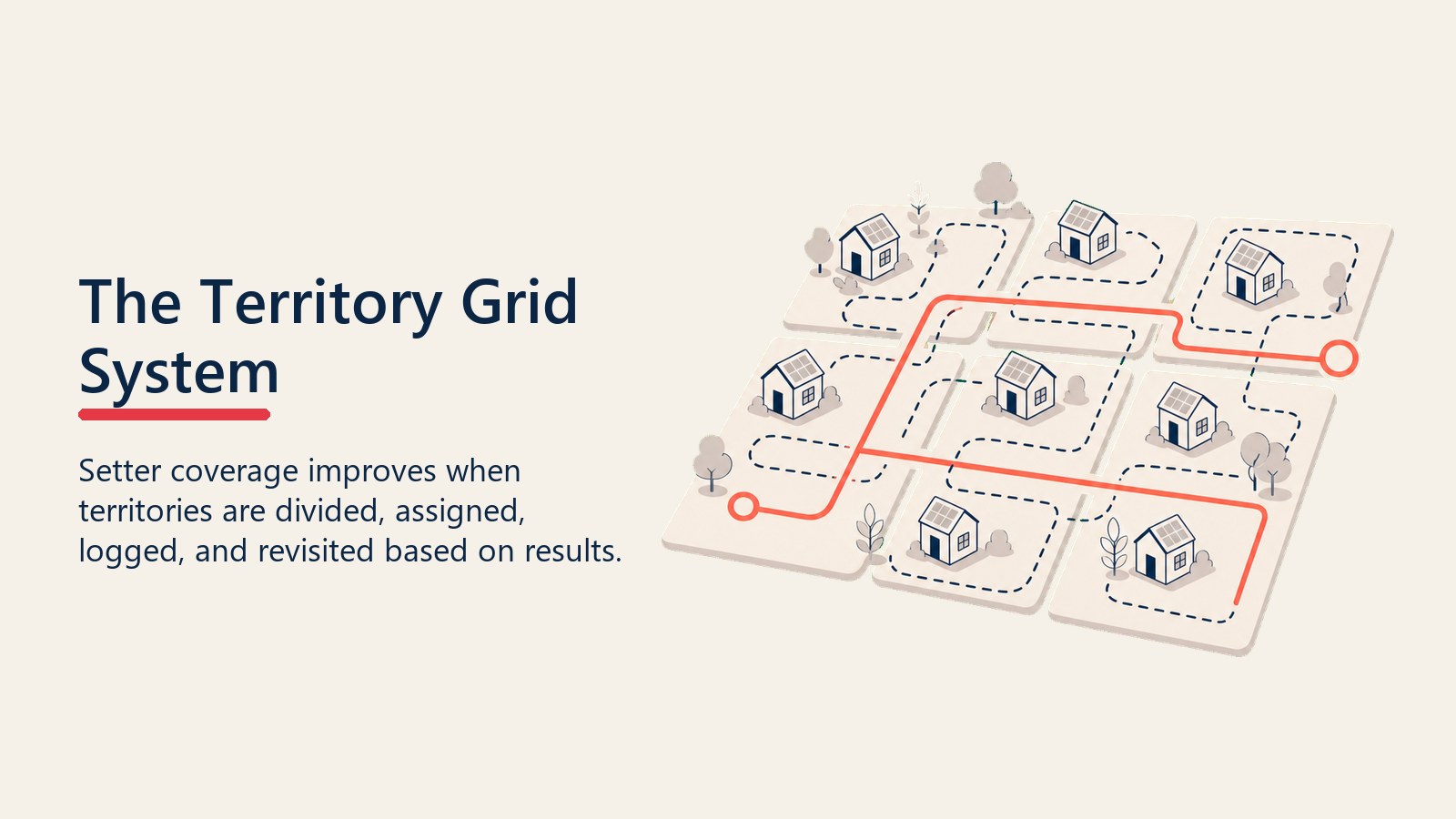
Assign grids to setters so you avoid duplication and build coverage data over time. Track which grids you've knocked, when, and what the results were. Grids that produce consistently are worth knocking again on a different day of week or time of day.
Daily setter workflow:
- Pick or receive assigned grid for the day
- Note any skip addresses (previous contacts, no-soliciting signs, known issues)
- Knock from 3 PM to 8 PM weekdays, 10 AM to 6 PM Saturdays (adjust for market)
- Log every contact in your CRM before leaving each block
The Door Pitch: What Works and What Gets the Door Closed
Setters fail at the door for one of three reasons: they over-explain, they sound scripted, or they open with something that triggers the homeowner's "I'm being sold to" reflex.
Here's a simple door structure that avoids all three:
Open with a reason to be there, not a pitch.
"Hi, I'm [Name] with [Company]. We just finished putting solar on the Smith house down on [Street]. I'm talking to a few neighbors to see if it makes sense for them too."
A local reference (an install, a community solar event, an active neighborhood project) creates immediate context and credibility. It signals you're not a stranger, you have a reason to be there.
Ask before you tell.
"Do you own your home here?" (Yes.) "And who handles the electric bill, is that you?" (Yes.) "What does that typically run for you in a month?"
These three questions take 20 seconds. If the homeowner owns the home, pays the bill, and has a bill worth addressing, you have a qualified prospect. If they rent or the bill is $60/month, you've saved yourself a 15-minute conversation that won't go anywhere.
Connect the reason and the value in one sentence.
"Based on what people in this neighborhood are saving, a system sized for your home would likely replace that bill with a smaller monthly payment. Worth taking 20 minutes to see the actual numbers?"
This is the appointment ask. It doesn't promise savings, it promises clarity. That's an easier yes.
Handle the first objection and close.
Most first-door objections are reflexive, not real. "Not interested" usually means "I haven't thought about it." "I've looked into it before" often means "someone pitched me and I didn't buy." "I need to talk to my spouse" at the door is a stall.
Your job is one real reframe, then a clean appointment ask. Don't fight through five objections. If it takes more than two real exchanges, log it as a revisit and move on.
Common Door Objections and Short Responses
| Objection | Response |
|---|---|
| "Not interested." | "Totally fair. Most people say that before they see the numbers. What's your electric bill usually run?" |
| "I already looked into solar." | "When was that? Prices have dropped a lot, and financing options have changed. Could be worth a fresh look at what the numbers look like now for your home." |
| "We rent." | "Got it. Do you know who owns this place? We sometimes work with landlords too." |
| "I need to talk to my husband/wife." | "Perfect. We like to meet with both of you together. What night works for both of you this week?" |
| "I'm too busy." | "It's just 20 minutes, and we come to you. Tuesday or Wednesday evening?" |
| "I don't believe it saves money." | "I get that. Can I show you the actual bill comparison for a house like yours before you decide? Takes 90 seconds." |
Setter Training: What Reps Need Before They Knock a Door
Don't send untrained setters into the field. A poor door interaction can poison a neighborhood for months, especially in tight suburban communities where neighbors talk.
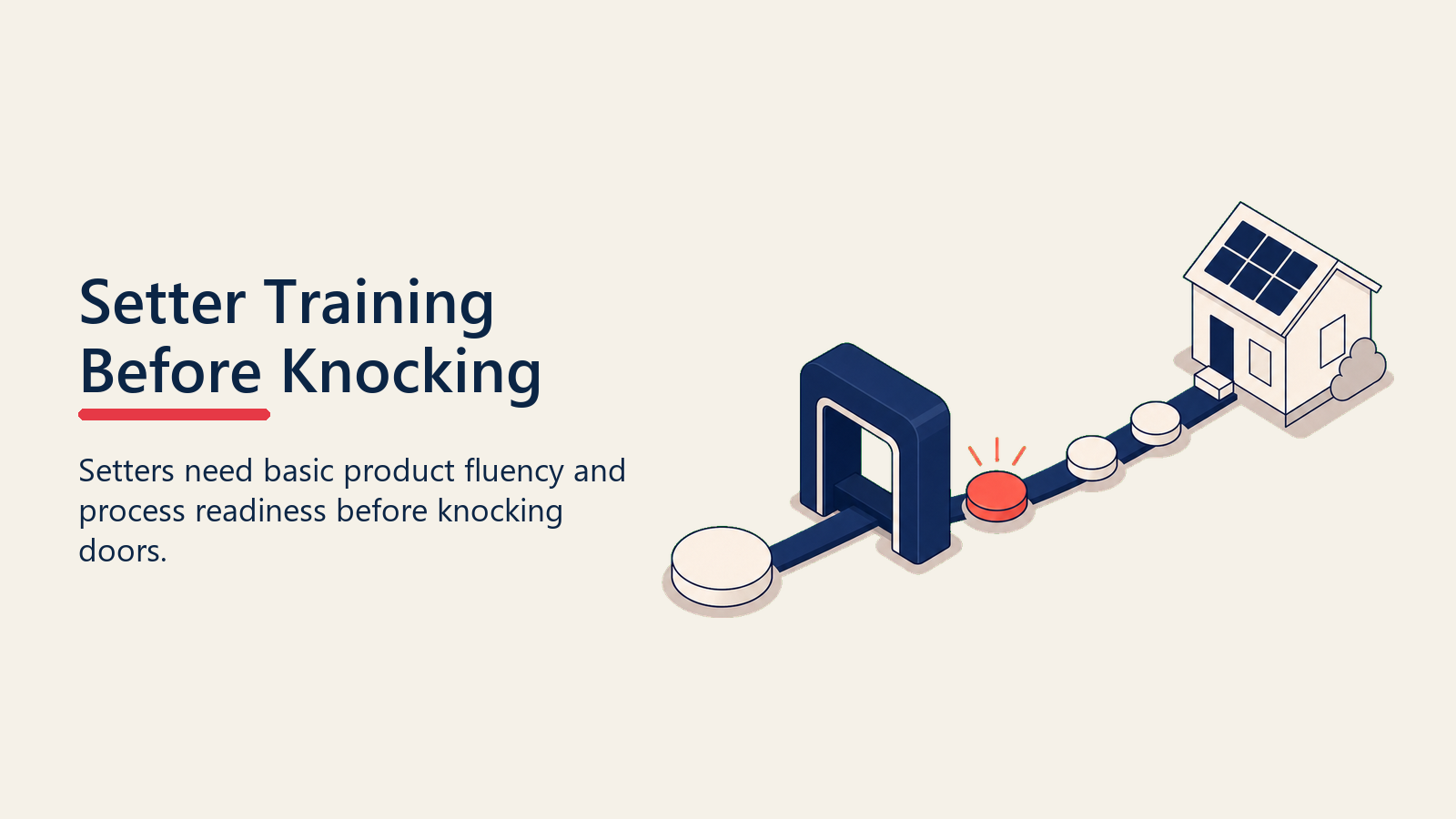
Product fluency basics: Setters don't need to know how to size a system, but they need to explain solar in plain terms and handle the most common objections. One week of classroom plus ride-alongs with a strong performer covers most of it.
Objection drilling: Record real objections from the field. Use them in daily role-play. The setter who has heard "not interested" 200 times in role-play doesn't flinch at it on the door.
Body language and presence: Setters should stand slightly to the side of the doorway (not dead center, which triggers a defensive posture), make eye contact, smile before the door opens, and avoid looking at a phone or clipboard while talking. These small things change the felt experience of a door conversation.
Logging discipline: Every door contact goes into the CRM. No exceptions. You can't manage what you don't track. If a setter isn't logging, you don't know your territory coverage, you can't revisit intelligently, and your metrics are worthless.
See appointment setting playbook for how setters should structure the booking conversation once the homeowner is interested. And see lead nurturing programs for how to stay in touch with prospects who were interested but not ready to book on first contact.
Daily and Weekly Metrics That Matter
| Metric | Description | Benchmark |
|---|---|---|
| Doors knocked | Raw contact attempts (answer + no-answer) | 50-80/shift |
| Contact rate | % of doors where someone answered | 35-50% |
| Pitch rate | % of contacts who heard the full pitch | 60-75% of contacts |
| Appointment set rate | Appointments per doors knocked | 5-12% |
| Sit rate | Appointments where closer actually arrived | 70-85% |
| Appointment-to-close rate | Sits that became sales | Varies, 15-35% typical |
Track these per setter, per territory, and per time period. Patterns tell you where to focus: a setter with a high contact rate but low pitch rate has a door-opening problem. A setter with a high pitch rate but low appointment rate has a close-the-appointment problem.
Quotable Nuggets
"Territory selection matters more than door pitch. No amount of scripting overcomes a neighborhood of renters, low utility rates, or shaded roofs. Get the territory right first."
"Halo conversion rates are often two to three times higher than cold territory. The neighbor's installation is visible from the street. The social proof is already there before a setter knocks. That's a channel advantage no digital ad can replicate."
"Canvassing is a system. When results drop, trace back to the inputs: territory saturation, seasonality, a product or pricing change, or setter quality drift. More often than not, the fix is a territory refresh or a retraining session, not a complete rebuild."
The Halo Strategy: Using Installs to Supercharge Door Results
When you complete an installation, you have a natural conversation starter for every neighbor on the block. Use it.
Within 48 hours of job completion, deploy a setter to knock every house within two blocks. The pitch almost writes itself:
"Hi, I'm with [Company]. We just finished the solar install for your neighbors at [address]. A few people on the block have already asked us about it. Do you own your home here?"
Halo conversion rates are often two to three times higher than cold territory. The social proof is visible. The neighbor's experience is fresh. Curiosity is already there.
Build the halo knock into your install coordination. When the install team wraps up, the setter team should already have the halo territory mapped. See solar and install operations alignment for how to build this coordination into your operations rhythm.
Running a High-Volume Canvassing Team
Scaling canvassing requires structure. A few things that separate high-volume canvassing teams from chaotic ones:
Morning huddles. Short, daily. Review yesterday's numbers, assign today's territories, run one objection drill. 15 minutes max.
Territory accountability. Each setter owns their territory map. They know what they've knocked and what's open. Managers review territory maps weekly.
Weekly ranking. Post appointment set numbers by setter. Peer accountability is a strong motivator when done with the right culture.
Rapid rehire cycle. Canvassing has turnover. Build your recruiting pipeline the same way you build your appointment pipeline. Always be sourcing. The Learn More section below links to the recruiting and ramping playbook.
Incentive structure tied to sits, not just sets. Pay setters for appointments that actually sit, not just appointments that get booked. This aligns setter incentives with quality. If setters only get paid for sets, they'll book anyone and your close rate tanks. The four gates every door setter should run: homeownership, bill size, credit fit, and decision-maker presence.
Canvassing Ethics and Legal Compliance
Door-to-door canvassing is regulated. Know your obligations before you deploy:
No-soliciting signs: In most states and municipalities, canvassers must honor posted no-soliciting signs. Train setters to skip these doors and log them.
Permits: Some cities require canvassing permits. Check local municipal codes for every territory you work. Fines for unpermitted canvassing can be significant.
State consumer protection laws: Some states have cooling-off period requirements for in-home sales contracts. These aren't a canvassing-specific issue, but they surface when door-generated leads become signed contracts. Federally, the FTC's Cooling-Off Rule gives buyers the right to cancel any door-to-door sale of $25 or more within three business days and receive a full refund. Sellers must provide written notice of this right at the time of sale. Solar contracts signed at the kitchen table fall squarely under this rule, so train your closers to deliver the cancellation form and receipt of cancellation rights every time.
Do Not Call: Canvassing is face-to-face and is generally not subject to DNC rules, but if your setters collect phone numbers at the door and call later, those calls are subject to TCPA and state-level telemarketing rules.
For how canvassing-generated leads connect to lead qualification and prescreening before the closer's appointment, build a clear handoff process. The setter's job ends at the booked appointment. Everything that happens between the set and the sit is a joint responsibility between ops and the closer.
What to Do When Canvassing Results Drop
Every canvassing program hits plateaus. When appointment-set rates drop below your baseline for more than two weeks, run this diagnostic:
- Saturation check. Has the territory been knocked too often? Pull your grid maps.
- Seasonality. Are homeowners home? Winter early darkness, summer heat waves, and holiday weeks all affect contact rates.
- Product or pricing change. Did a recent change in financing or equipment affect the value story setters are telling?
- Setter quality drift. Are the same setters performing, or has turnover changed the team?
Canvassing is a system. When the system underperforms, trace back to the inputs. More often than not, the fix is a territory refresh, a retraining session, or a compensation adjustment, not a complete rebuild.
Pair canvassing with digital lead generation and referral programs so you're never dependent on a single channel. The companies that win in residential solar run all three in parallel and balance the mix based on cost-per-appointment and quality metrics.
Learn More
The Territory Grid System (Named Model)
The Territory Grid System: a canvassing operations framework that divides a working market into manageable two-hour grid blocks (typically 50 to 70 doors each), assigns each block to a setter, tracks coverage and results over time, and builds "halo zones" of two to three blocks around every completed install. The system prevents duplication, enables intelligent revisit scheduling, and makes territory saturation visible before conversion rates collapse.
Frequently Asked Questions about Canvassing and Door-to-Door Lead Generation for Solar
What is door-to-door solar canvassing?
It is a direct lead generation method where trained setters knock on homeowner doors in targeted territories, qualify prospects in a brief conversation, and book in-home solar consultations. Canvassing gives companies direct control over appointment volume because more setters in more territories means more appointments, without dependence on ad algorithms or referral timing.
What territories should you prioritize for solar canvassing?
Target neighborhoods with homeownership rates above 70%, monthly utility bills that make the solar financial case compelling (typically $150 or more per month), roofs younger than 15 years with good sun exposure, median household incomes between $65,000 and $200,000, and low existing solar saturation. Halo zones around completed installs are the highest-priority secondary target because social proof is already visible on the street.
What is the halo strategy in solar canvassing?
The halo strategy means deploying setters to knock every home within two blocks of a recently completed solar installation, ideally within 48 hours of job completion. Halo conversion rates are often two to three times higher than cold territory because neighbors have already seen the installation crew, may have questions, and the social proof is physically visible.
What should a solar setter say at the door?
Open with a local reason to be there (a nearby install, a neighborhood solar event), not a product pitch. Ask three quick qualification questions: do they own the home, who handles the electric bill, and what does it typically run. If they qualify, connect the reason and value in one sentence and ask for a 20-minute appointment. Handle one real objection with a reframe, then close the appointment ask. Don't fight through five objections at the door.
What metrics should a canvassing team track daily?
Track doors knocked (50 to 80 per shift is the benchmark), contact rate (35 to 50 percent of doors answered), pitch rate (60 to 75 percent of contacts who heard the full pitch), appointment set rate (5 to 12 percent of doors knocked), and sit rate (70 to 85 percent of set appointments where the closer actually arrived). Track all of these per setter, per territory, and per time period.
What legal requirements apply to door-to-door solar canvassing?
Key requirements include honoring posted no-soliciting signs, obtaining canvassing permits where required by local municipal code, and providing written notice of the three-business-day cancellation right on all contracts signed in the home (the FTC Cooling-Off Rule applies to any door-to-door sale of $25 or more). If setters collect phone numbers at the door for follow-up calls, those calls are subject to TCPA and state telemarketing rules.
What should you do when canvassing results drop below baseline?
Run a four-point diagnostic: (1) check territory saturation by pulling grid maps for recent knock history; (2) review seasonality factors like weather, holidays, or daylight hours affecting contact rates; (3) check for product or pricing changes that altered the value story; (4) audit setter team composition for quality drift from turnover. Most performance drops trace back to one of these four inputs rather than a fundamental channel problem.

Senior Implementation Consultant
On this page
- Why Does Door-to-Door Still Work in Solar?
- Territory Selection: Where You Knock Matters More Than How You Knock
- The Territory Grid System
- The Door Pitch: What Works and What Gets the Door Closed
- Common Door Objections and Short Responses
- Setter Training: What Reps Need Before They Knock a Door
- Daily and Weekly Metrics That Matter
- Quotable Nuggets
- The Halo Strategy: Using Installs to Supercharge Door Results
- Running a High-Volume Canvassing Team
- Canvassing Ethics and Legal Compliance
- What to Do When Canvassing Results Drop
- Learn More
- The Territory Grid System (Named Model)