Recruiting and Ramping Solar Reps: The First 90 Days That Determine Everything
Turn this article into takeaways for your work.


Each assistant summarizes the article only for you and suggests best practices for your work.
Residential solar sales has one of the highest first-year attrition rates of any commission-based sales role. Most new hires are gone before month twelve. Many leave in the first 90 days.
Companies that lose reps at that rate don't just bleed recruiting cost. They lose the installs that would have generated referrals, the reviews that would have built local credibility, and the team momentum that makes good reps stay. High attrition is a compounding problem that gets more expensive every quarter you let it run.
The fix is in two places: who you hire and how you ramp them. Get both wrong and you'll churn reps indefinitely. Get both right and you build a team that grows on itself.
What Actually Predicts Success in Solar Sales
The instinct in solar recruiting is to look for sales experience, specifically "in-home" or "door-to-door" experience. That's not wrong, but it's incomplete. The candidates who consistently perform in residential solar share a more specific profile:
Coachable over cocky. Solar sales is process-heavy: a specific consultation arc, specific financing presentations, specific objection handling sequences. Reps who think they already know how to sell and resist the system underperform reps who are newer to sales but follow the process precisely. In ride-alongs, watch for the rep who adjusts after feedback versus the one who nods and then does it the same way anyway.
Tolerates delayed gratification. Most new solar closers won't have a funded deal in their first three weeks. The time from signed contract to funded to commission payment can be four to six weeks in many structures. Reps who expect quick wins get demoralized fast. Ask candidates directly: "It may take six to eight weeks before you see a commission payment. How do you plan to manage that financially and stay motivated?"
Comfortable with rejection at scale. Canvassing and in-home sales involve a lot of no before they get to yes. Reps who take rejection personally or who lose energy after a string of no-shows don't make it. Look for candidates who can describe a time they stayed persistent through a streak of failures without being coached to do so.
Physically active or high-stamina. Solar canvassing is physically demanding. Closers running three to four in-home appointments per day are on their feet, driving, carrying materials, and engaging for hours. Ask about their schedule, their physical health, and whether they've held roles with similar demands.
Strong communicator with non-technical background comfort. Solar proposals include savings projections, production estimates, financing amortization, and net metering explanations. The closer doesn't need to be an engineer, but they need to explain technical concepts in plain language without freezing. Role-play a savings explanation in the interview.
Key Facts
- Field sales rep turnover is steep: 41% of teams report annual turnover of 50% or higher, and only 16% keep turnover below 10%, according to the SPOTIO State of Field Sales 2026 report.
- The average sales rep tenure is 18 months, per HubSpot data citing Bridge Group research. But sales reps hit their peak performance between years two and three, meaning most reps leave before they ever reach full productivity. (Xactly, citing Bridge Group/HubSpot, 2018)
- The Bureau of Labor Statistics (BLS) projects 42% employment growth for solar PV installers from 2024 to 2034, far faster than average, a macro signal that competition for field solar talent will intensify and make retention and ramp efficiency a strategic priority. (BLS Occupational Outlook Handbook)
Where to Find Solar Sales Recruits
The best solar reps often come from adjacent roles, not from job boards:
| Source | Why it works | What to look for |
|---|---|---|
| Home improvement sales (windows, roofing, HVAC) | Already comfortable with big-ticket in-home close | Ask about their close rate and avg deal size |
| Door-to-door sales (any product) | Canvassing comfort, rejection tolerance already built | Volume numbers and why they want to move to solar |
| Insurance and financial services | Complex product explanation, trust-building sales | Commission-only comfort, process discipline |
| Fitness and wellness industries | Consultative sales, motivated by helping people | Career transition desire; must check sales comfort |
| Referrals from current team members | Cultural fit pre-vetted | Current rep incentive program required |
| Community college and trade school | Younger, coachable, growing in your market | Requires longer ramp; higher retention when it works |
The best single recruiting channel for most regional solar companies is internal referrals from existing reps. A rep who refers a friend who succeeds gets a bonus and feels pride. The referred candidate has realistic expectations because they heard it from someone living the role, not a recruiter. Build a referral bonus into your comp structure before you invest in job boards.
The Interview Process That Filters for Fit
Most solar companies interview badly. They pitch the opportunity, the candidate says it sounds great, and they hire. Then the candidate discovers the reality of door-knocking in July heat or sitting across from a homeowner for two hours without closing, and they're gone in six weeks.
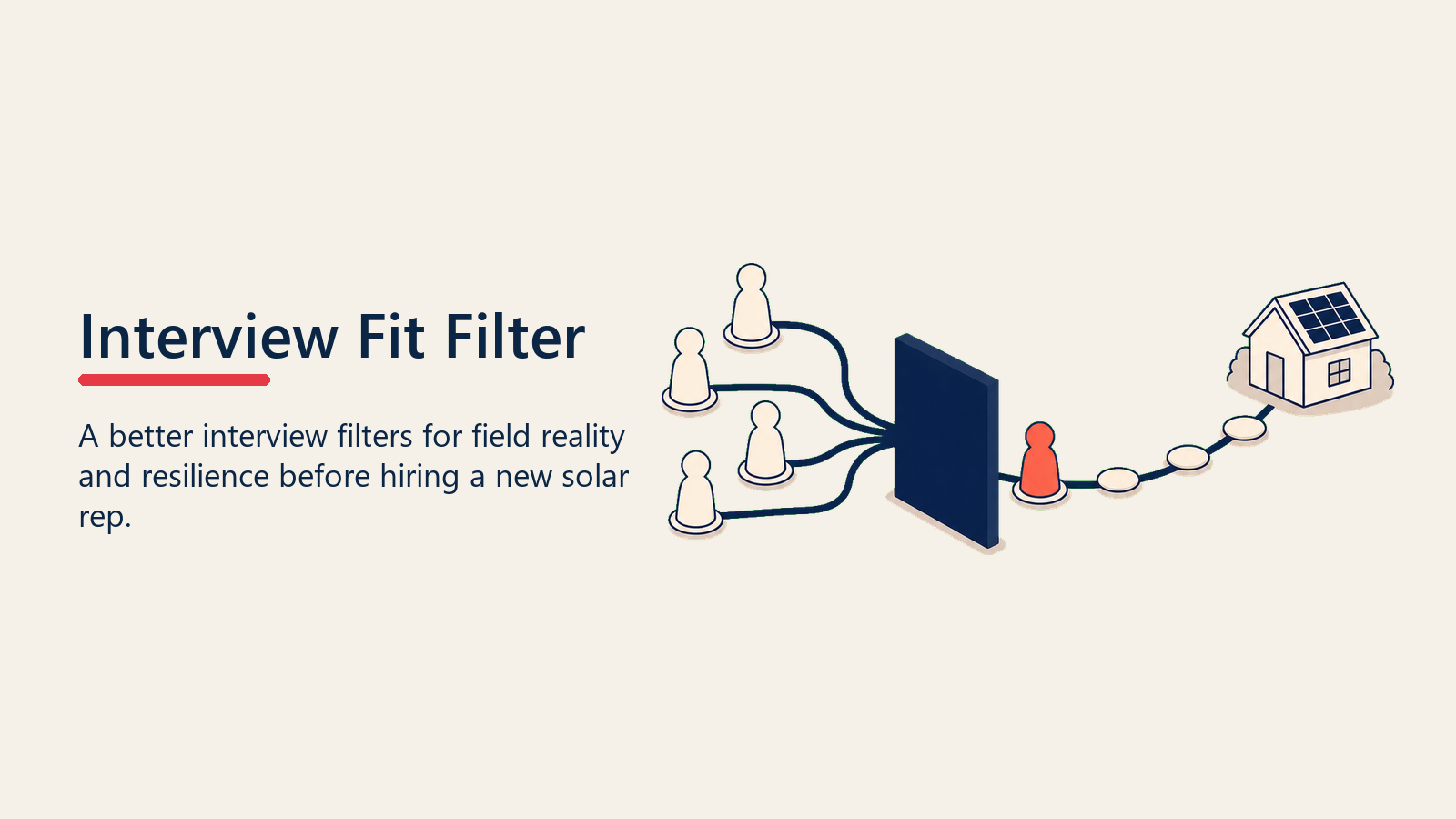
A better interview process surfaces those reality gaps early:
Round 1: Phone screen (15 min). Three questions only:
- "Walk me through the last three jobs you've had and why you left each one."
- "In commission-only or mostly-commission roles, what's the longest you've gone between paychecks and how did you handle it?"
- "What do you know about how residential solar sales actually works day to day?"
Poor answers to question two or complete ignorance on question three aren't disqualifiers, but they tell you what the candidate needs to hear in round two.
Round 2: In-person or video (45 min). Include a role-play. Give the candidate a brief scenario: "I'm a homeowner. You're at my door. You've already confirmed I own my home and my bill is about $180 a month. Get me to agree to an in-home appointment." Evaluate confidence, listening, and whether they try to close or just talk.
Round 3: Ride-along. Before making an offer, have the candidate shadow a closer for a full day. Not a half-day highlight reel, a full day including the no-shows, the awkward appointments, the drive time. Candidates who are still enthusiastic at the end of that day are real candidates. Those who go quiet after the third bad appointment would have quit in week four anyway.
This three-step process takes more time upfront, but it cuts bad hires significantly. A bad hire who leaves in week six costs recruiting time, trainer time, leads burned during their training period, and team morale.
The 90-Day Ramp Structure
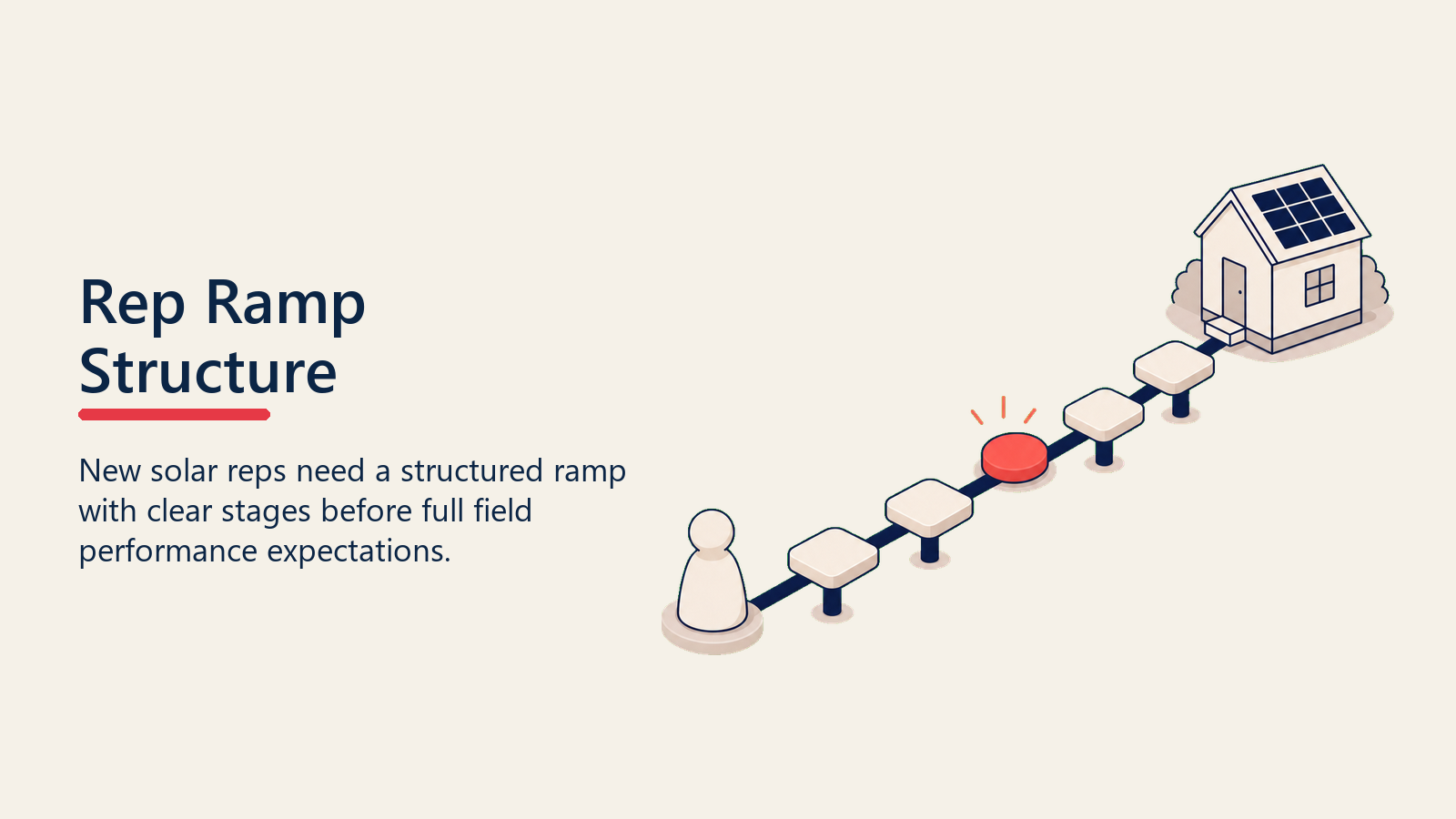
Even the best-fit hire needs a structured ramp. "Here's the script, go knock doors" produces attrition. A defined 90-day program with clear milestones produces producers.
Days 1-14: Foundation
The first two weeks are product and process knowledge, not performance expectations.
- Product certification: Every rep should be able to explain how solar works, what factors affect production, what the financing options are, and how the installation process works. Not expert depth, but enough to answer homeowner questions without freezing.
- CRM and tools basics: How to log calls, set appointments, use the proposal tool, and update deal status. If they can't use the CRM, they can't be managed.
- Script memorization and role-play: The appointment-setting script, the pre-screen questions, the opening door script. Role-play until it's natural, not recited.
- Shadow days: Two to three days observing a senior closer running real appointments. Not just the wins; the full range.
Milestone checkpoint at Day 14: Can they explain the product in plain language? Can they run the opening door sequence without reading from a script? If not, diagnose before moving forward.
Days 15-45: Supervised Production
Reps start working real leads under close supervision.
- Canvassing with manager or senior rep present for the first five to eight sessions. Manager observes, gives feedback after each door, not during.
- First appointments shadowed, then solo. Rep observes closer on first two appointments, co-runs the next two, then runs solo with closer listening from the kitchen.
- Daily check-ins: 10-minute end-of-day debrief on what went well and what to adjust. Keep it a coaching conversation, not a performance review.
- CRM discipline check: Every appointment is logged, every door knock tracked. Reps who log inconsistently usually also sell inconsistently.
Milestone checkpoint at Day 30: Has the rep set at least 8 appointments? Have they run at least 5 consultations? Have they closed or come close on at least one deal? If all three are no, the ramp is in trouble and you need to identify why.
Days 46-90: Independent Production with Coaching
By day 46, reps should be working independently. The question becomes whether they're hitting the targets that predict long-term success.
Month 2 targets (days 31-60):
- 15 or more appointments set
- 70% or higher show rate on their own appointments
- 2 or more closed and funded deals
Month 3 targets (days 61-90):
- 20 or more appointments set
- 2+ sold deals per week pace (8-10 for the month)
- CRM updated same day on all activity
Reps who hit month 2 targets almost always hit month 3 targets. Reps who miss month 2 targets by a large margin rarely recover without significant coaching intervention. That intervention should happen at day 45, not day 89.
See coaching and ride-alongs for the ongoing coaching structure that runs after the 90-day ramp. The ramp creates the foundation; coaching sustains and improves performance.
What Should a New Solar Rep Realistically Expect to Earn?
One of the biggest drivers of early attrition is a mismatch between what a rep expected to earn and what they actually earn in the first 60 days. HubSpot and Bridge Group research cited by Xactly's sales turnover analysis found that the average sales rep tenure is just 18 months and that reps hit peak performance between years two and three, which means most reps leave before they ever reach their earning potential. The expectation gap at offer is a primary driver of that early exit.
"Six-figure potential" recruiting language is accurate for strong performers but misleading for people in their first 60 days. A rep who expected $8,000 in their first month and earns $2,200 doesn't just feel disappointed. They start job searching.
The realistic earnings conversation should happen at offer:
- Month 1: Most new reps close 0-1 funded deals. With draws or a base, that's $1,500 to $3,000. Set this expectation clearly.
- Month 2: Reps who survived month 1 typically close 2-3 deals. That's $3,000 to $6,000 in most comp structures.
- Month 3 and beyond: Reps who hit their month 2 targets are on track for $6,000 to $10,000+ per month. Show them the earnings history of your top-third performers in their 3-12 month range, not just your stars.
Candidates who still want to come aboard after that honest conversation are the right candidates. The ones who needed to hear "first month six figures" to get excited would have been disillusioned by week six anyway.
See solar commission and comp design for how to structure compensation so the ramp period is survivable without destroying company margin, and solar sales KPIs and metrics for the metrics that tell you whether a ramping rep is on track.
What to Do When a Ramping Rep Is Struggling
Not every day 60 problem is a hiring mistake. Sometimes the right rep is stuck on a specific fixable issue.
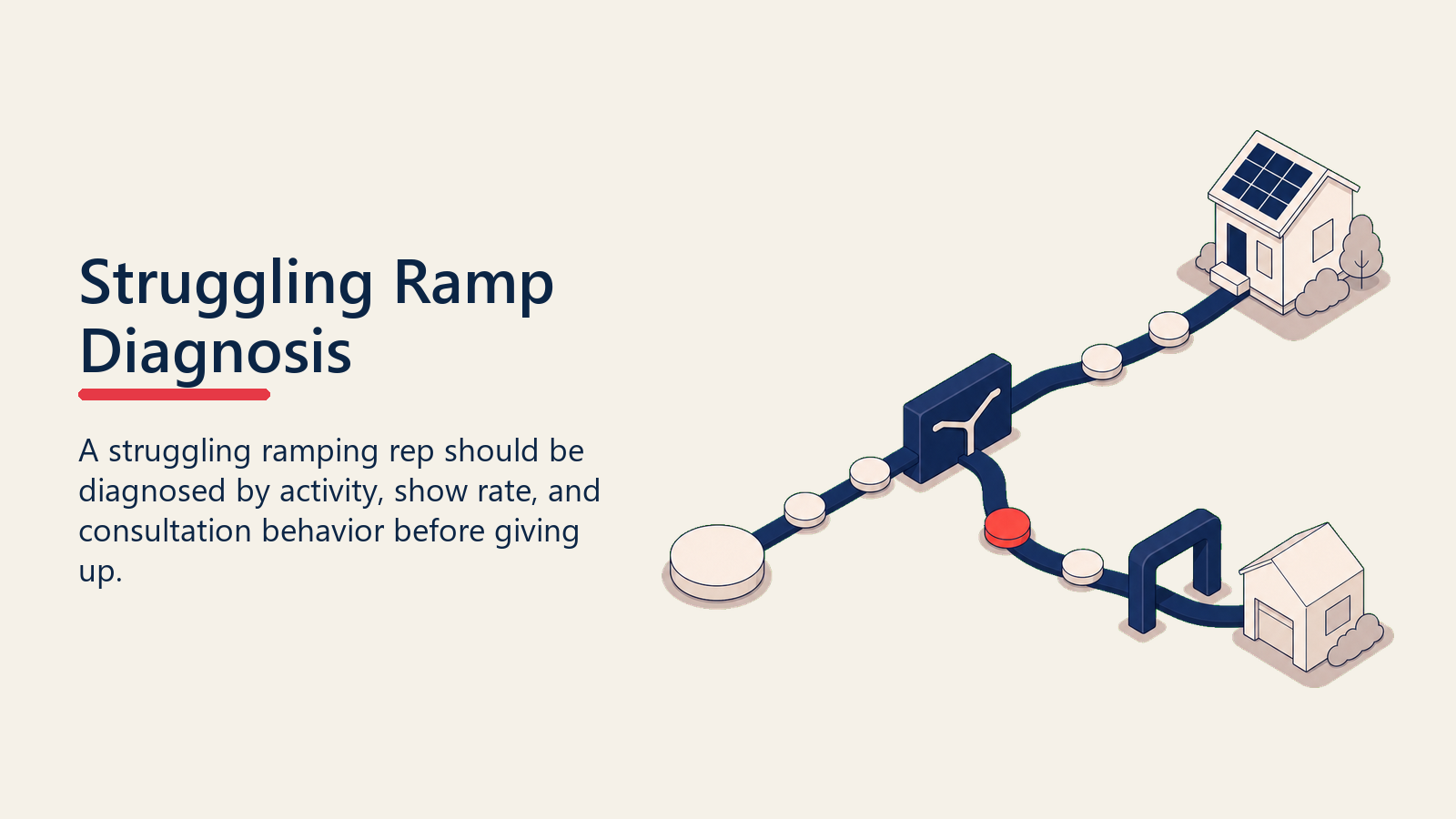
Diagnose before deciding. Pull their data and answer these questions:
- Are they setting enough appointments? If no, the problem is canvassing activity, canvassing skill, or motivation. Ride-along to observe and listen.
- Are their appointments showing? If show rate is below 50 percent, the pre-screen or confirmation sequence is broken. Check what they're saying at the door or on the phone.
- Are they running full consultations? Some struggling reps close the appointment early when they sense resistance instead of running the full framework. Review their CRM notes for "left early" dispositions.
- Are they closing but losing at financing? This is a credit knowledge gap or a hesitance to push through the paperwork. Watch them handle the financing presentation on a ride-along.
- Are they closing but losing to objections? Review which objections are killing deals and run targeted role-play on those specific scenarios.
Most ramping problems map to one of these five categories. Each has a specific remedy. "They're just not cutting it" is not a diagnosis; it's a performance management abdication.
See opportunity qualification for the framework that helps both managers and reps identify where in the funnel deals are being lost, which is the same diagnostic question you're answering with a struggling rep. And for the retention risk that comes when reps feel misled about earnings or unsupported through the ramp, see churn prevention strategy. The dynamics that cause customers to disengage are surprisingly similar to what drives rep attrition in months two and three.
Quotable Nuggets
"If you're losing reps at month six, you're paying all the ramp cost and capturing none of the return. The expectation gap at the offer stage is usually where that trajectory starts going wrong." Informed by Bridge Group / Xactly turnover research
"In a field sales environment where 41% of teams see annual turnover above 50%, the recruiter's job isn't to fill seats. It's to filter for candidates who will still be there at month four, when they finally start generating real revenue." Based on SPOTIO State of Field Sales 2026
"A bad hire who leaves in week six costs recruiting time, trainer time, leads burned during their training period, and team morale. The ride-along step in round three filters those candidates before they get hired."
The 30-45-90 Diagnostic Gate: At day 30, a ramping rep should have set at least 8 appointments, run at least 5 consultations, and closed or come close on at least one deal. At day 45, if they've missed the month-two targets by a large margin, that intervention should happen now, not at day 89. Diagnose against five root causes: (1) not setting enough appointments (canvassing activity or skill), (2) low show rate (pre-screen or confirmation gap), (3) closing consultations early under resistance (consultation discipline), (4) losing deals at financing (credit knowledge gap), (5) losing to specific objections (targeted role-play needed). Each root cause has a specific remedy. "They're just not cutting it" is a performance management abdication, not a diagnosis.
Keeping Reps Past 90 Days
A rep who hits month 3 producing has already cost you significant training investment. Keeping them past month 6 requires clear career progression, fair territory management, and reliable commission payments. Reps who trust their manager stay through bad weeks. Reps who don't trust their manager leave the first time another offer appears.
Building a solar sales team that grows is not primarily a recruiting challenge. It's a systems challenge. Companies that recruit well but ramp poorly lose reps. Companies that ramp well but hire poorly waste training investment. The ones that grow treat both as engineering problems, not luck.

Senior Implementation Consultant
On this page
- What Actually Predicts Success in Solar Sales
- Where to Find Solar Sales Recruits
- The Interview Process That Filters for Fit
- The 90-Day Ramp Structure
- Days 1-14: Foundation
- Days 15-45: Supervised Production
- Days 46-90: Independent Production with Coaching
- What Should a New Solar Rep Realistically Expect to Earn?
- What to Do When a Ramping Rep Is Struggling
- Quotable Nuggets
- Keeping Reps Past 90 Days