Urgency and Same-Day Close Ethics in Solar Sales

Turn this article into takeaways for your work.


Each assistant summarizes the article only for you and suggests best practices for your work.
Solar sales has a complicated history with urgency. For years, some companies trained reps to manufacture artificial pressure: "this deal is only good tonight," "I can only hold this price for the next hour," "my manager will never approve this discount again." Homeowners got burned. Cancellation rates went up. The industry's reputation took damage that still shows up in objections today.
But real urgency does exist in solar. The federal residential investment tax credit for owner-purchased systems already ended at close of 2025. State incentives expire without warning. Install queues are genuinely constrained. Rate structures change. When a rep fails to communicate these real conditions clearly, they're actually doing the homeowner a disservice.
The goal is to close more deals by being the most honest person in the room, not the most persistent.
The Difference Between Ethical and Manipulative Urgency
The line is simpler than most managers think:
Ethical urgency is grounded in real, verifiable deadlines or conditions that exist independent of the rep's desire to close the deal. The homeowner can confirm them on their own.
Manipulative urgency is invented or exaggerated to create discomfort that drives a decision the homeowner wouldn't otherwise make on that timeline.
| Ethical Urgency | Manipulative Urgency |
|---|---|
| "The federal residential solar credit ended at close of 2025. For new purchases, the payback period is longer and state incentives matter more" | "This deal is only good tonight" |
| "Our install queue is currently 10-12 weeks out, and it fills up fast" | "We only have one slot left in your area" |
| "Your utility is requesting a rate change in Q3" | "Prices are going up tomorrow" |
| "This financing rate is tied to current Fed benchmarks, not a permanent offer" | "My manager is only authorizing this discount until midnight" |
| "The incentive in your city requires installation before December 31" | "I don't know if this deal will be available when you call back" |
The Verifiability Test: could the homeowner look this up on their own and find it to be true? If yes, the urgency is real. If not, it is manipulation dressed up as helpfulness. Apply this test to every time-pressure statement before your reps are trained to use it.
Key Facts
- Solar installations typically take 60 to 120 days from signed contract to energized system, depending on permitting jurisdiction. A decision delayed by two weeks pushes the activation date back by the same amount. (Industry operations standard; see also managing install wait and cancellations)
- The FTC Cooling-Off Rule gives consumers the right to cancel in-home sales of $25 or more within three business days, no questions asked. Any urgency tactic designed to discourage a homeowner from exercising that right violates federal consumer protection law. (FTC Cooling-Off Rule)
- U.S. residential electricity rates rose roughly 13% between mid-2024 and April 2026, reaching 18.83 cents per kWh. Rate trajectory, not tax credit expiration, is now the most honest long-term urgency argument for new 2026+ purchases. (EIA Electricity Monthly Update, April 2026)
Why Manipulative Urgency Backfires
Beyond ethics, there's a practical reason to avoid manufactured pressure: it selects for regret.
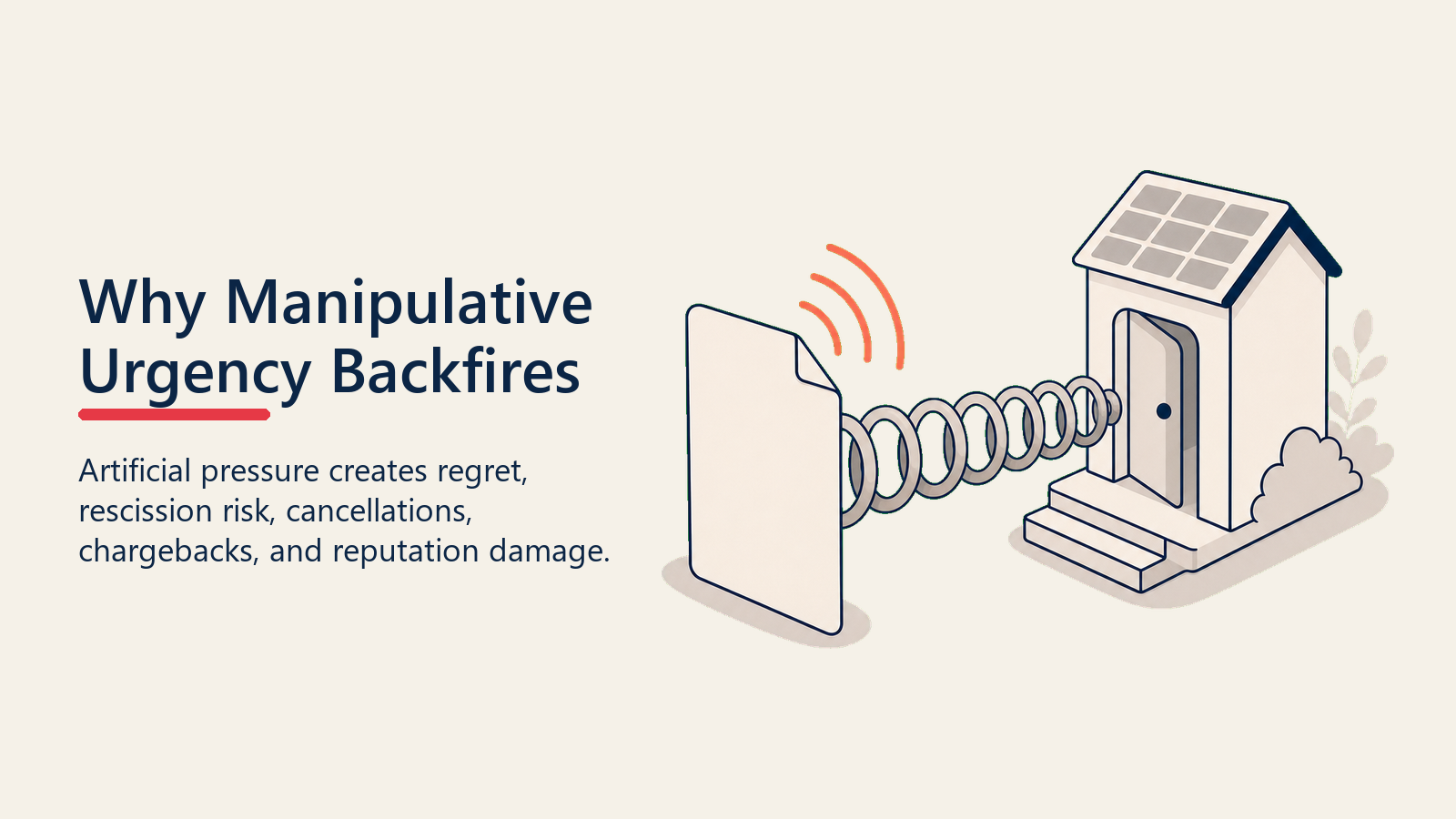
When a homeowner signs under artificial pressure, they often feel uneasy afterward. They google the company. They talk to a neighbor. They realize the "tonight-only deal" is still available six weeks later. The result is a cancellation, a chargeback, or a review that tells every future prospect exactly what happened.
Solar has a 3-day right of rescission in most states, and industry-wide, cancellation rates for in-home sales run higher than they should. A significant portion of those cancellations trace back to homeowners who felt pushed into a decision they weren't comfortable with. Under the FTC Cooling-Off Rule, consumers have the right to cancel sales made at their home within three business days (no questions asked) for purchases of $25 or more. Reps and managers should know this rule cold, because any closing tactic that discourages a homeowner from exercising that right crosses a legal line, not just an ethical one.
Ethical urgency builds commitment. Manufactured urgency builds buyer's remorse.
See one-call close vs. multi-visit approaches for a fuller discussion of when pushing for a same-day decision is genuinely appropriate versus when a second visit produces a stronger, more durable close.
Real Urgency Drivers in Solar: What You Can Honestly Say
Federal Investment Tax Credit (ITC)
This urgency driver changed materially in 2025. The One Big Beautiful Bill Act, signed July 4, 2025, ended the Section 25D residential clean energy credit for owner-purchased systems. Systems installed by December 31, 2025 qualified for the 30% credit. Systems installed on January 1, 2026 or later receive no federal residential tax credit, with no phase-down and no transition. The IRS FAQ on OBBBA modifications to Section 25D is the authoritative reference.
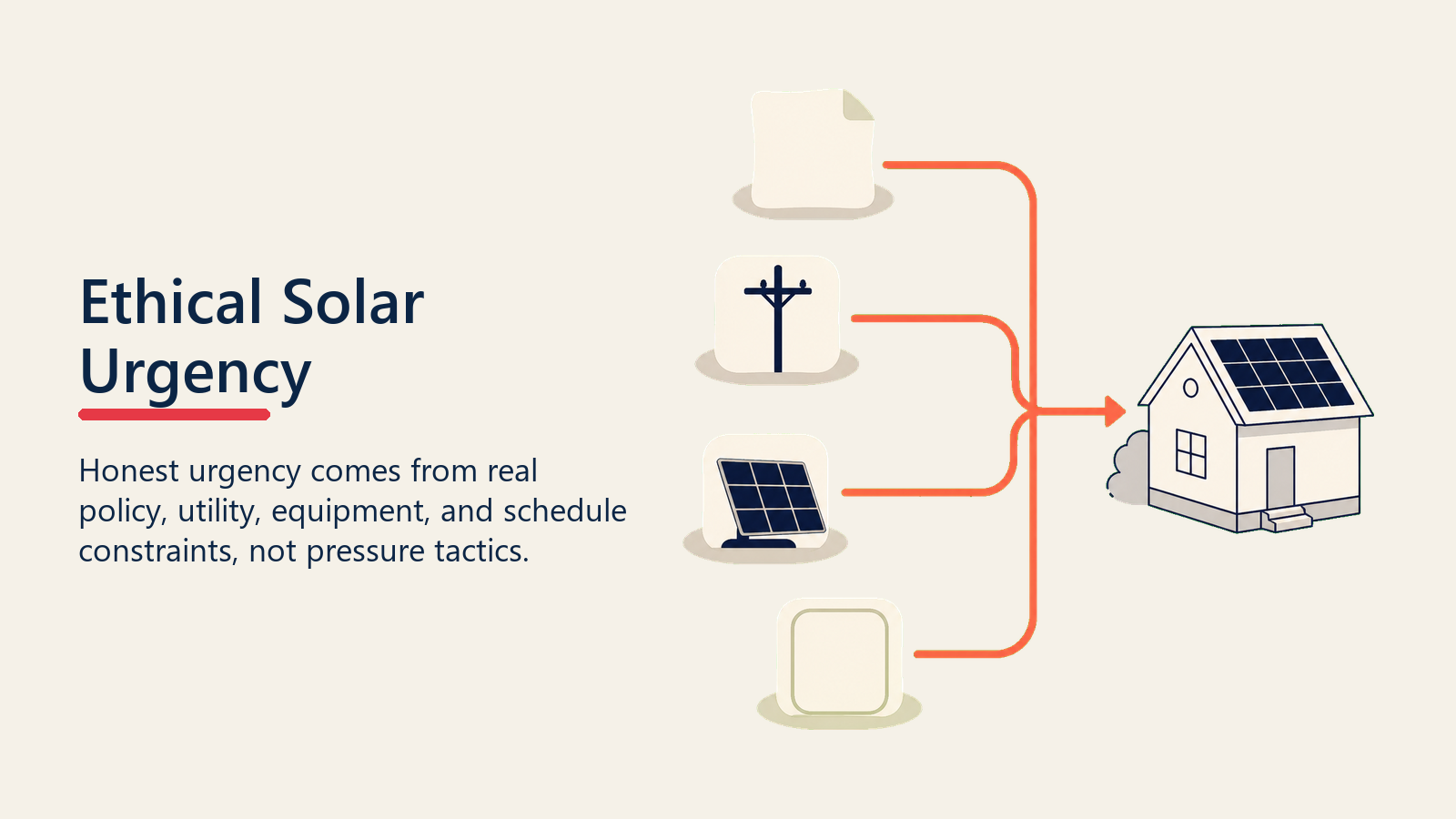
What this means for urgency conversations in 2026 and beyond: the ITC-based urgency argument is now a historical fact, not a current lever. For owner-purchased systems, the credit is gone. Do not tell homeowners "the 30% tax credit could step down" because it already has, all the way to zero for new purchases. Third-party-owned systems under leases or PPAs continue to earn a commercial credit under Section 48E through 2027, so that distinction is worth explaining accurately.
What you can honestly say about the ITC today: "For owner-purchased solar, the federal residential credit ended at the close of 2025. That doesn't change the savings math, but it does change the payback period. Let me show you how the numbers work without it."
What you cannot say: that a 30% federal credit is available for new owner-purchased solar installations in 2026 or later. That would be a material misrepresentation.
State and Local Incentives
Many states have incentives with actual expiration dates, funding caps, or enrollment limits. These are legitimate urgency drivers when they're real.
Examples of honest language: "California's SGIP battery incentive has a waitlist and limited funding. Once the current tranche is gone, it may not refund at the same level." Or: "Texas doesn't have a statewide solar incentive right now, so I won't pretend there's a deadline here."
Don't invent state incentives that don't exist just because they feel persuasive. Homeowners talk to each other, and a rep who fabricates a state program will get caught.
Utility Rate Changes
Utility rates have historically risen 3-5% annually on average. Net metering policy is under review in many states, and the value of credits exported to the grid can change.
What you can honestly say: "Your current rate from SCE is $0.32 per kilowatt-hour. Their filed rate case is requesting a 12% increase starting next year. We can lock in your effective rate now and protect you from that."
What you cannot say: "Rates are going up next week" if you don't have a filed rate case to point to.
Installation Queue and Timeline
This one is often under-used by reps who don't think of it as urgency, but it's both real and impactful.
Solar installations require permits, utility interconnection agreements, and inspections. From signed contract to energized system, the typical timeline is 60 to 120 days depending on jurisdiction. This isn't a manufactured limit. It's the actual pipeline.
What you can honestly say: "If you want your system producing power before the end of the year, I need to be honest with you about where we are in the install queue. We're currently booking out about 10 to 12 weeks for installs. That means if you sign today, you're looking at early October. If you wait two weeks to decide, you're pushing into November and risking weather delays on the installation."
See managing install wait and cancellations for how to communicate this timeline in a way that builds trust rather than pressure.
Financing Rates and Loan Terms
Interest rates on solar loans change. If your lending partners have adjusted their rates recently, that's a legitimate urgency driver.
"This 2.99% loan is a promotional rate we're currently offering through our financing partner. I can't guarantee it'll be available if you come back in three weeks, because rates have been moving. What I can do is lock in this rate for you today if we move forward."
That's honest. The rate genuinely might change.
Scripts for Communicating Urgency Without Pressure
The Honest Timeline Summary
Use this near the end of the consultation, after you've built value and addressed objections, before asking for the commitment:
"Before I ask you to make a decision, I want to give you an honest summary of the timing on your end. The financing rate I've quoted you is current but not guaranteed to hold. Our install queue right now means we'd be targeting [date] for your system to be producing power. And every month you delay is another month of utility bills at the current rate, which has been rising. None of that is me pushing you. It's just information you should have when you're deciding whether to move today or wait."
When They Want to Think About It
"I completely respect that. A lot of people want to sleep on a decision this size, and that makes sense. What I'd want you to know before I leave is the one real deadline on our end: I can hold this system design and this price for 72 hours, but after that I can't guarantee the same install slot or financing terms because both of those move. Is there anything specific you want to think through? Maybe I can help answer that before I go."
When They Bring Up a Specific Concern
"What's the main thing you want to sit with? Is it the financing structure, the company, the technology, or something else?" Then address that specific thing. You're not trying to bulldoze their thinking time. You're trying to help them arrive at clarity faster by removing the last unanswered question.
How Do You Train Reps to Recognize the Ethical Line?
The biggest risk with urgency language is reps who hear "use urgency" and apply it indiscriminately. Here's a practical training exercise:

Give reps a list of 20 urgency statements and ask them to categorize each one as real, exaggerated, or fabricated. Then debrief as a group. The goal is to build the instinct for the difference, not to memorize a script.
Also: have a clear policy on what your reps are and aren't allowed to say. "I can only hold this price tonight" is a phrase that should not be in your playbook at all. If managers catch it, address it immediately, because one rep using manipulative tactics generates reviews that affect every other rep's credibility. The FTC has made clear that deceptive urgency and false scarcity claims in consumer sales violate federal consumer protection law, the same framework that governs door-to-door and in-home transactions.
See solar sales KPIs and metrics for how to track cancellation rate by rep, which is often the clearest signal that urgency tactics are being misused.
The Assumptive Approach: Confident, Not Pushy
There's a difference between urgency and confidence. A rep who communicates the timeline clearly and then says "Let's get the paperwork started" isn't being pushy. They're assuming the close because the conversation has earned it.
The assumptive close works best when it follows a genuinely strong consultation where the homeowner has had all their questions answered and clearly understands the value. See assumptive close techniques for how to read the room and move forward with confidence when the conditions are right.
What makes the assumptive close ethical is that it only comes after the homeowner is informed, not as a shortcut to skip the part where they actually understand what they're agreeing to.
What to Do When a Homeowner Feels Pressured
If a homeowner signals that they feel pushed, stop immediately.
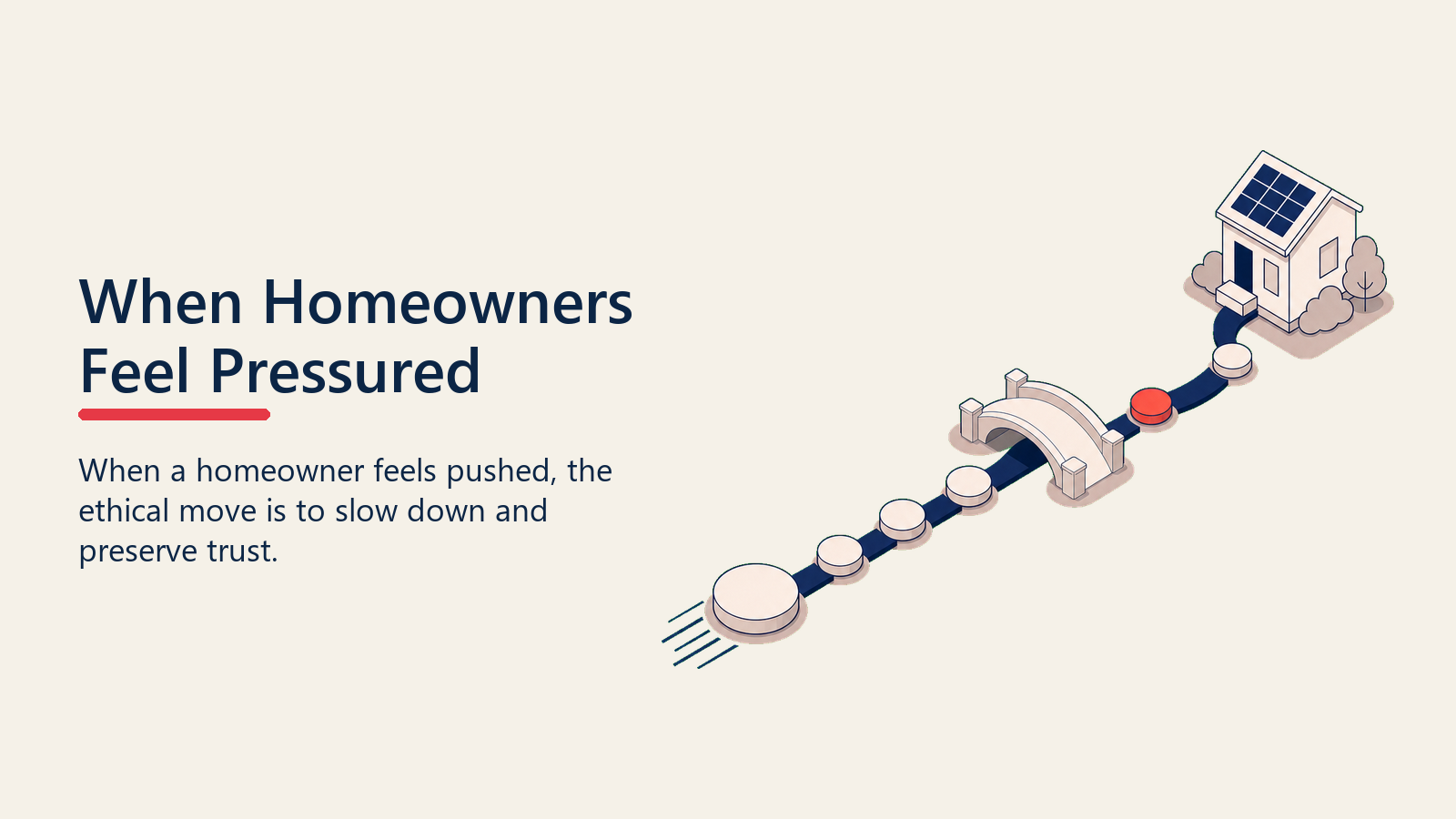
"I want to be clear: I'm not trying to pressure you into anything. That's not how I do business and it's not how our company operates. If you need more time, take it. I'd rather come back for a second conversation and have you feel good about this than have you feel rushed into something."
This response will occasionally cost you a same-day close. But it will far more often prevent a cancellation and generate a referral from a homeowner who appreciated that you treated them like an adult.
See retention fundamentals in post-sale management for how the trust built during the sale directly predicts long-term customer retention and referral generation.
Ethics as a Competitive Advantage
The solar companies that grow fastest over the long run aren't the ones with the most aggressive closing scripts. They're the ones homeowners recommend to their neighbors.
When a rep closes a homeowner who wasn't quite ready, the deal often survives the 3-day rescission window but cancels during the permit wait. When a rep closes a homeowner who was fully informed and genuinely decided, that homeowner becomes an asset: they give positive reviews, they refer friends, and they don't try to back out when an install delay comes up.
Ethical urgency isn't a soft strategy. It's the highest-conversion strategy over any reasonable time horizon, because it produces customers instead of just contracts.
Build that into your sales culture, train it into your reps, and measure it by tracking the gap between signed contracts and installed systems. That gap tells you everything about whether your urgency is working for your business or against it.
For how this connects to the broader close plan, see close plan development. And for the negotiation principles that let you hold your ground on price without fabricating pressure, negotiation fundamentals covers the same discipline applied to high-stakes residential deals.

Senior Implementation Consultant
On this page
- The Difference Between Ethical and Manipulative Urgency
- Why Manipulative Urgency Backfires
- Real Urgency Drivers in Solar: What You Can Honestly Say
- Federal Investment Tax Credit (ITC)
- State and Local Incentives
- Utility Rate Changes
- Installation Queue and Timeline
- Financing Rates and Loan Terms
- Scripts for Communicating Urgency Without Pressure
- The Honest Timeline Summary
- When They Want to Think About It
- When They Bring Up a Specific Concern
- How Do You Train Reps to Recognize the Ethical Line?
- The Assumptive Approach: Confident, Not Pushy
- What to Do When a Homeowner Feels Pressured
- Ethics as a Competitive Advantage