The In-Home Solar Consultation Framework: How to Run Every Appointment to Close
Turn this article into takeaways for your work.


Each assistant summarizes the article only for you and suggests best practices for your work.
A solar closer walks into a homeowner's living room with one job: to guide a complete stranger through a $25,000 to $50,000 decision in a single sitting. There's no follow-up presentation, no procurement team, no board meeting. It's one conversation, one household, and usually one shot at the close.
That's why the in-home consultation framework matters. Done well, it's not a pitch. It's a structured conversation that takes the homeowner from curious to convinced in a sequence they barely notice is happening. Done poorly, it's an unstructured hour that ends with "let us think about it," which usually means no.
This framework gives closers a repeatable structure to follow on every appointment, whether it's a warm referral in the suburbs or a cold canvass lead in a market they've never worked before.
The Five Phases of the In-Home Consultation
Key Facts:
- A typical residential solar system in 2024 is sized at roughly 8 kWdc, per NREL's 2024 Annual Technology Baseline, meaning the average closer is presenting a $24,000-$32,000 investment decision in a single sitting
- Residential electricity rates have risen roughly 3.3% per year in nominal terms over the past decade (from approximately 12 cents/kWh in 2013 to 16 cents/kWh in 2023), per EIA analysis, a documented trend the education phase can cite credibly
- Referral solar appointments carry a roughly 29% net close rate vs. roughly 15% for purchased leads, per Sunvoy's lead source data, with the difference driven largely by trust established before the appointment, which the consultation framework is designed to replicate for every lead type
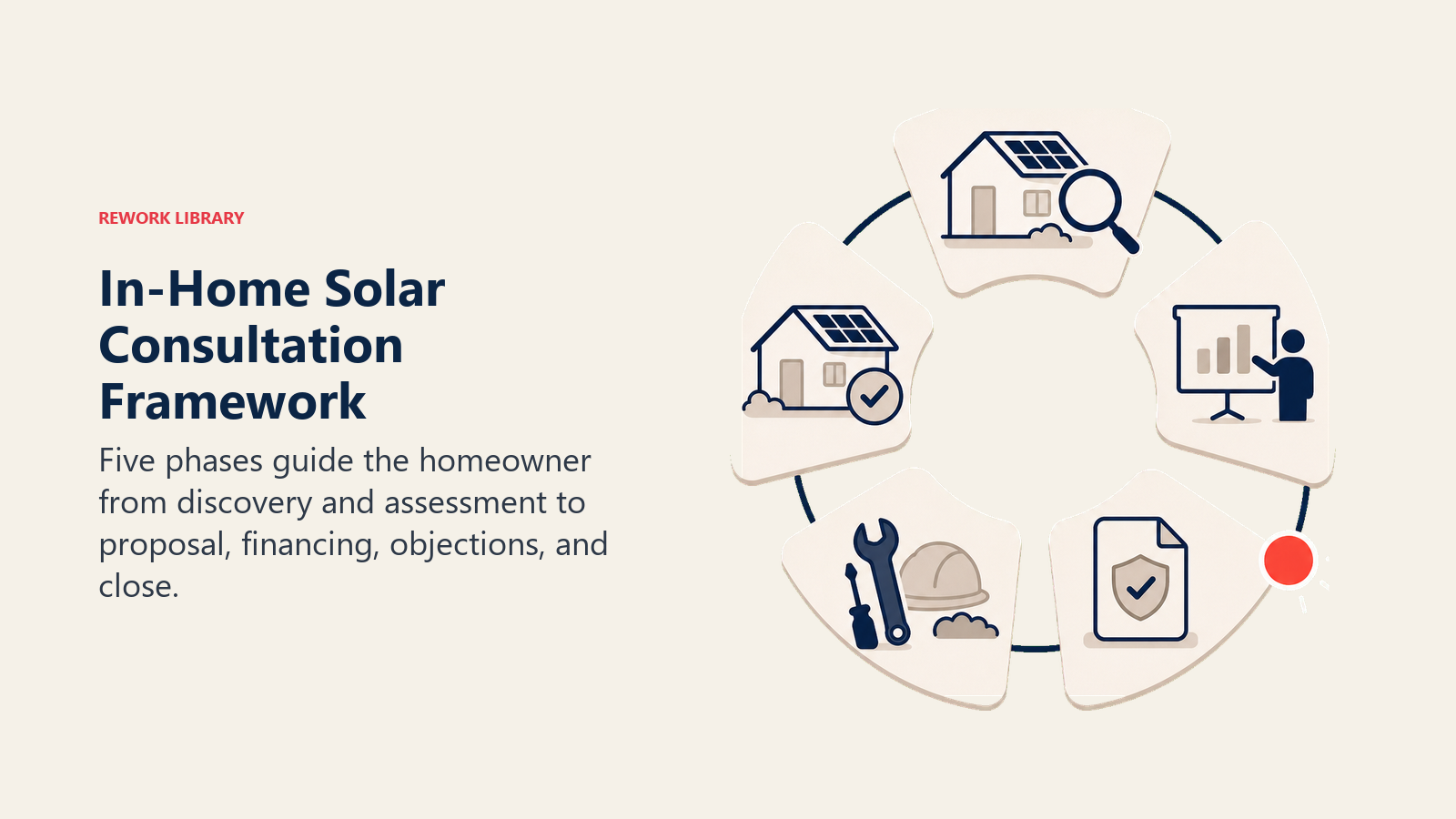
Every effective in-home solar consultation moves through five distinct phases:
- Rapport and discovery
- Home energy assessment
- Education and value framing
- Custom proposal presentation
- Financing, objections, and close
Each phase has a specific purpose and a natural transition into the next. The closer's job is to complete each phase fully before moving on. Rushing through discovery to get to the proposal, or skipping education to jump straight to price, almost always produces objections that could have been pre-empted.
Phase 1: Rapport and Discovery
The first 10 to 15 minutes of an in-home consultation aren't about solar. They're about the homeowner.
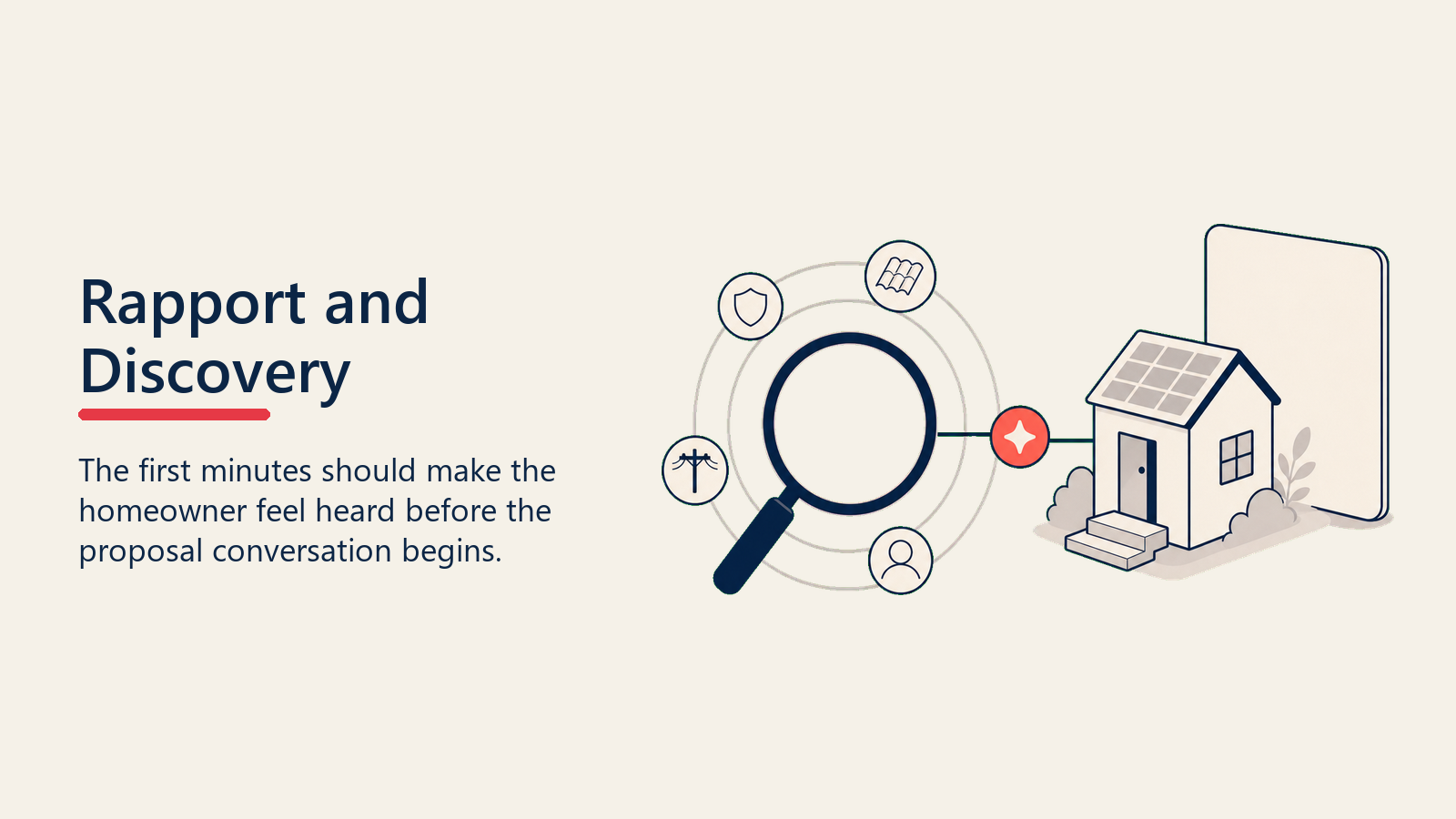
The close happens at the end of the visit, but the trust that makes the close possible gets built here. A homeowner who feels heard and understood in the first few minutes of a conversation is far more receptive when a closer reaches the proposal phase than one who felt like they were being moved along a script.
Start with a genuine opening. Reference something the setter shared in the handoff notes, something about the homeowner's situation that shows you've done your homework. "I heard your last bill was close to $350. That's a significant number. How long has it been running that high?" This opens a real conversation, not a pitch.
Let them talk. The best closers in solar are skilled listeners during discovery. They ask questions, stay quiet, and take notes (literally or mentally). What are this homeowner's priorities? Cost savings? Environmental impact? Energy independence? Protection from rate increases? The answer shapes everything that follows.
Establish the decision-making picture. Early in the conversation, confirm who else is involved in the decision. "Is your partner going to be joining us today?" If a key decision-maker isn't present, address it now. A one-legged appointment may still be worth running, but the close strategy changes. For more on how this affects the close, see One-Call Close vs. Multi-Visit.
Surface motivations without pushing. "What made you agree to the appointment today?" or "Have you looked into solar before this?" These questions surface the real motivation and reveal whether there are prior negative experiences (previous company, bad information, skeptical neighbor) that need to be addressed.
For qualification frameworks that help inform what to listen for in discovery, see Lead Qualification Frameworks.
Phase 2: Home Energy Assessment
After rapport, transition naturally into the assessment. "Before I show you any numbers, I'd like to take a few minutes to look at your home's setup. That's the only way I can give you an accurate picture."
The assessment has two parts: the utility side and the property side.
Utility review. Review the homeowner's utility bill together. Walk through what they're actually paying for: the rate per kWh, the fixed charges, any tiered pricing, and the trend over the past year. Most homeowners don't fully understand their bill. Taking five minutes to explain it clearly positions you as someone with expertise and creates a natural anchor for the value conversation that follows.
Ask about usage patterns too. Do they work from home? Have an electric vehicle (EV) or are they thinking about getting one? Run any appliances that draw significant load (pool pump, hot tub, heated floor)? These factors affect both system size and the proposal narrative.
Property walkthrough. Do a brief walkthrough of the home and exterior, including the roof. Note the roof condition, orientation, shading, and any visible issues. Check the electrical panel. Look for obvious obstructions. This doesn't need to be a formal inspection, but it signals competence and gathers the information you'll need for an accurate proposal.
Take notes visibly. Homeowners trust closers who are writing things down because it suggests the proposal they'll see is based on their actual home, not a template.
For a more detailed breakdown of the assessment process, see Home Energy Needs Assessment.
Phase 3: Education and Value Framing
Most homeowners don't understand how solar economics work. They've heard vague claims about "saving money" and "paying for itself," but they don't know how to evaluate them. Your job in this phase is to give them a clear mental model before you show them any numbers.
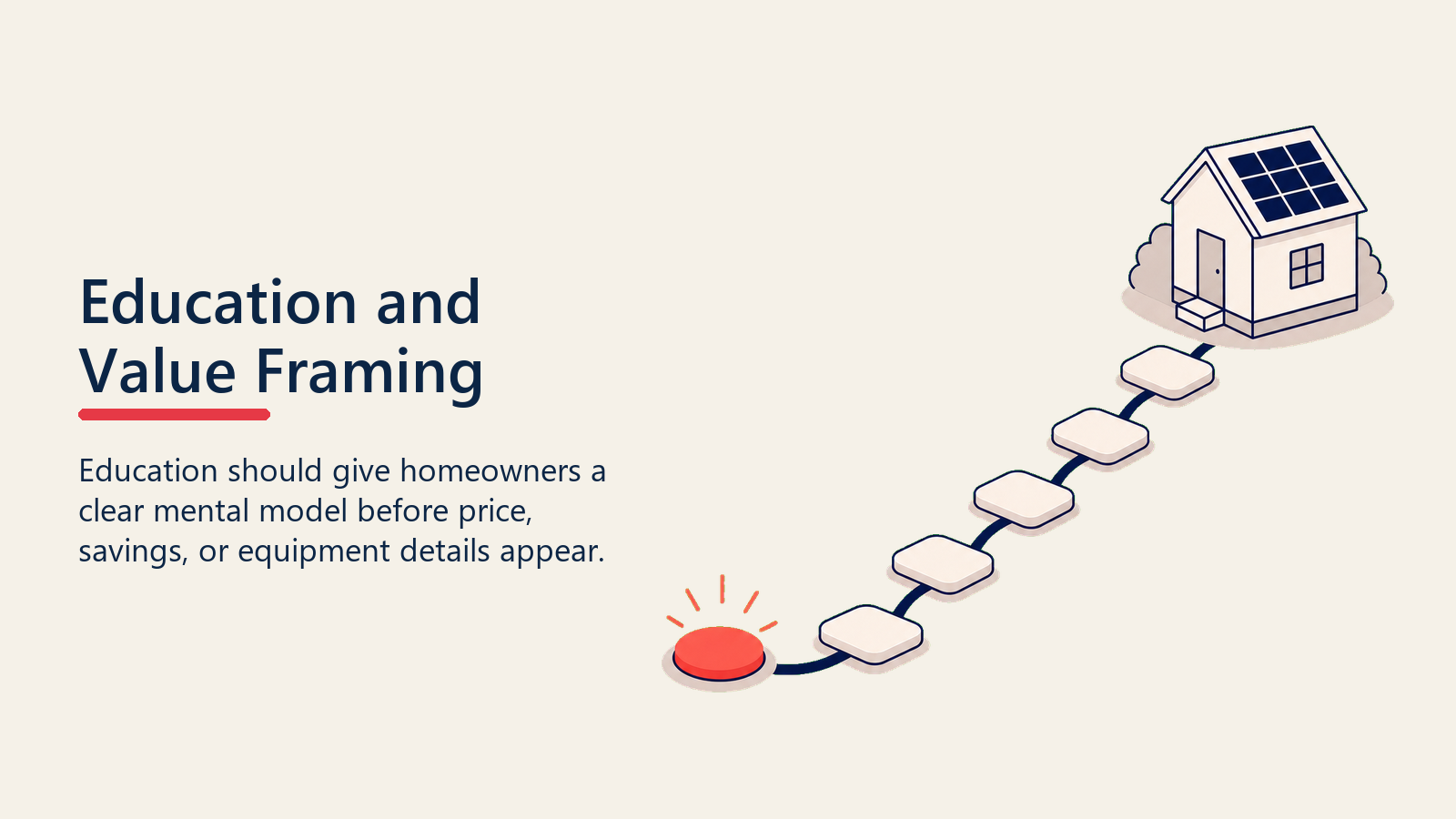
Explain the utility math first. "Here's the problem with paying a utility bill: you're paying for every kilowatt hour you use, and the rate goes up about 3% per year on average in nominal terms. Over 25 years, that adds up." EIA data on retail electricity prices shows residential rates rose from roughly 12 cents/kWh in 2013 to 16 cents/kWh in 2023, a verified trend closers can cite without inflating the number. Avoid claiming 5-7% annual escalation. The EIA historical record doesn't support it and skeptical homeowners will push back.
Introduce the ownership vs. rent framing. "Right now you're renting electricity from the utility. Every month, you pay and you get nothing back. A solar system turns that into something you own. The electricity your panels produce is yours."
Address the financing bridge. For most homeowners, solar is financed, not paid in cash. The critical concept to establish before showing the proposal is that the monthly payment replaces most of the utility bill. "The goal is for your new payment to be less than what you're paying the utility today, so you're not spending more, you're redirecting what you're already spending." For more on how to present financing clearly, see Solar Financing Models and Sales and Presenting Price and Financing.
Reference relevant incentives accurately. For appointments in 2026, do not present the federal Section 25D Residential Clean Energy Credit as available. The credit was terminated for owner-purchased systems with installation completed after December 31, 2025, under the One Big Beautiful Bill (P.L. 119-21), per IRS guidance. State incentives, net metering credits, and utility rebates remain in play and vary by location. State and local programs are searchable on the DSIRE database. If a homeowner asks about the federal credit, be direct: it applied at 30% for systems fully installed by year-end 2025 and is no longer available for 2026 owner purchases. Third-party ownership (lease/PPA) may still allow installers to capture a separate business credit through 2027. Know this option before the appointment if it's relevant to your market.
Phase 4: Custom Proposal Presentation
This is where you show the homeowner what solar looks like specifically for them. Not a generic example. Their home, their usage, their savings, their system.
A strong proposal presentation has a clear structure:
Start with their situation. Restate what you learned in discovery and the assessment. "Based on your usage, your bill averaging around [amount], and your south-facing roof, here's what I've put together for you."
Show the system. Size in kilowatts, number of panels, estimated annual production. Walk through how you arrived at the sizing and why it fits their home.
Show the economics. Year-one savings estimate, cumulative 25-year savings projection, payback period, and the month-over-month comparison of current utility bill versus new solar payment. Be specific and honest. Inflated projections might win the signature today and create a referral-destroying customer tomorrow.
Show what they get. Warranty terms, monitoring system, install process, company track record. The proposal isn't just numbers. It's the full picture of what they're buying.
Present the proposal as a conversation, not a monologue. Ask questions as you walk through it. "Does that production estimate seem right to you based on how you use electricity?" "Does the payback period line up with how long you plan to stay in the home?" These questions keep the homeowner engaged and surface objections early, when you can address them as part of the presentation.
For the full proposal-building process, see Building the Custom Solar Proposal.
Phase 5: Financing, Objections, and Close
The close phase is where everything you've built in the prior four phases either holds or doesn't. If you've done the work, this phase is about helping a homeowner who already wants to proceed figure out how to proceed. If you've skipped steps, this is where objections pile up.
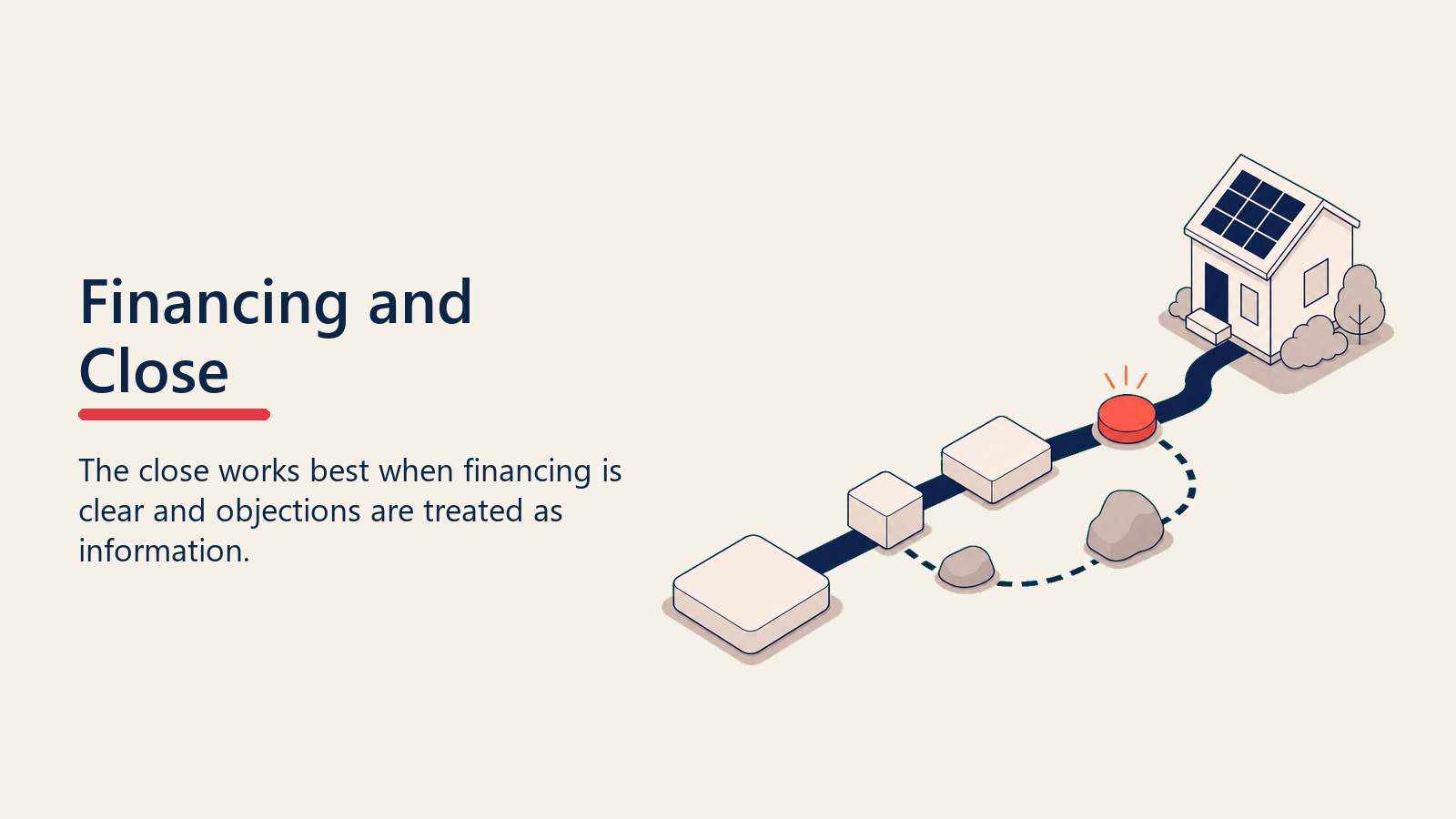
Present financing options clearly. Walk through the loan terms, payment options, and what happens at the end of the loan period. Answer questions before they're asked: "What happens if I sell my house?" "Is this tied to the home or to me?" "What's the interest rate?" The closer who has clean, confident answers to these questions builds trust. The one who stumbles through them loses it.
Handle objections as information, not obstacles. When a homeowner says "I need to talk to my husband," that's not a rejection. It's a signal that you haven't yet established why waiting is a risk. When they say "that's a lot of money," that's not a ceiling. It's an invitation to revisit the comparison between what they're paying now and what they'll pay under the solar plan. For a full objection-handling framework, see Solar Objection Handling.
Create urgency without manufacturing pressure. Real urgency in solar exists: incentive timelines, rate increases, financing promotional periods, installation backlogs. If you have something real to anchor to, use it. But don't fabricate it. Homeowners can tell, and it destroys trust at exactly the wrong moment. For more on the ethics of urgency in solar sales, see Urgency and Same-Day Close Ethics.
Ask for the decision directly. A lot of closers run excellent consultations and then drift into an ambiguous close. "So, what are you thinking?" isn't a close. "Based on everything you've seen today, does this make sense for your family?" is. The close needs to be direct without being aggressive. Ask clearly. Then be quiet.
Learn More: Assumptive Close · Close Plan Development · Value Selling · Opportunity Qualification
Quotable Nuggets
On why discovery isn't optional: "The closer who spends 20 minutes in genuine discovery builds a proposal that speaks to exactly what that homeowner cares about. The closer who spends 5 minutes in discovery and jumps to the pitch gives a generic presentation that doesn't land."
On the counterintuitive close: "The less it feels like a sales call, the more likely it ends with a signature." The five-phase framework exists precisely because the structure is invisible to the homeowner. They experience a conversation. The closer is running a process.
On the rate escalation stat: Cite what EIA actually documents. Nominal residential rates rose roughly 3.3% annually over the past decade, not the inflated 7-8% figures some reps use. A skeptical homeowner who checks the number and finds it overstated loses trust at the worst possible moment. (EIA retail electricity price analysis)
The Five-Phase Close Sequence
The Five-Phase Close Sequence: Rapport and discovery (15-20 min) builds the trust that makes everything else work. Home energy assessment (15-20 min) earns the right to present a proposal. Education and value framing (10-15 min) gives the homeowner the mental model to evaluate what they'll see. Custom proposal presentation (15-20 min) shows them their specific solution. Financing, objections, and close (15-25 min) helps someone who already wants to proceed figure out how. Skipping or reversing any phase produces objections that could have been pre-empted.
Common Framework Failures
Even experienced closers fall into patterns that undermine the consultation structure.
Rushing phase 1 to get to the proposal. Discovery feels like delay. It isn't. The closer who spends 20 minutes in genuine discovery builds a proposal that speaks to exactly what that homeowner cares about. The closer who spends 5 minutes in discovery and jumps to the pitch gives a generic presentation that doesn't land.
Skipping the education phase. When homeowners don't understand the economics, they can't evaluate the proposal. They compare a $180/month solar payment to zero (because they've stopped thinking about what they're currently paying) instead of comparing it to their $340 utility bill. Education makes the numbers make sense.
Reading the proposal instead of presenting it. A closer who scrolls through slides while narrating isn't presenting a proposal. They're presenting a deck. The homeowner should be engaged, asking questions, responding to what they see. The closer's job is to guide that conversation, not to deliver information at them.
Letting the appointment end without a decision. "I'll let you think about it" is a polite way for a homeowner to exit a conversation they're not sure about. The closer who accepts this without exploring the reason misses the close. Always ask what's holding them back, address it, and ask again.
Pacing the Consultation
A well-run in-home consultation takes 60 to 90 minutes. Here's a rough pacing guide:
| Phase | Target time |
|---|---|
| Rapport and discovery | 15-20 minutes |
| Home energy assessment | 15-20 minutes |
| Education and value framing | 10-15 minutes |
| Custom proposal presentation | 15-20 minutes |
| Financing, objections, and close | 15-25 minutes |
These times flex based on the homeowner. A couple with lots of questions about financing will spend more time in phase 5. A homeowner who is particularly curious about the technical side may extend the assessment phase. The framework is a guide, not a metronome.
What shouldn't flex is the sequence. Skipping or reversing the phases produces worse outcomes. The structure exists because it mirrors the natural arc of how people make high-stakes financial decisions: they need trust before they can evaluate, and they need understanding before they can decide.
A closer who follows this framework, adapts their pace to the homeowner, and brings genuine curiosity to the discovery phase will close at a higher rate than one who pitches harder. That's the counterintuitive truth of in-home solar sales: the less it feels like a sales call, the more likely it ends with a signature.

Senior Implementation Consultant
On this page
- The Five Phases of the In-Home Consultation
- Phase 1: Rapport and Discovery
- Phase 2: Home Energy Assessment
- Phase 3: Education and Value Framing
- Phase 4: Custom Proposal Presentation
- Phase 5: Financing, Objections, and Close
- Quotable Nuggets
- The Five-Phase Close Sequence
- Common Framework Failures
- Pacing the Consultation