Winning Solar Marketplace and Aggregator Leads
Turn this article into takeaways for your work.


Each assistant summarizes the article only for you and suggests best practices for your work.
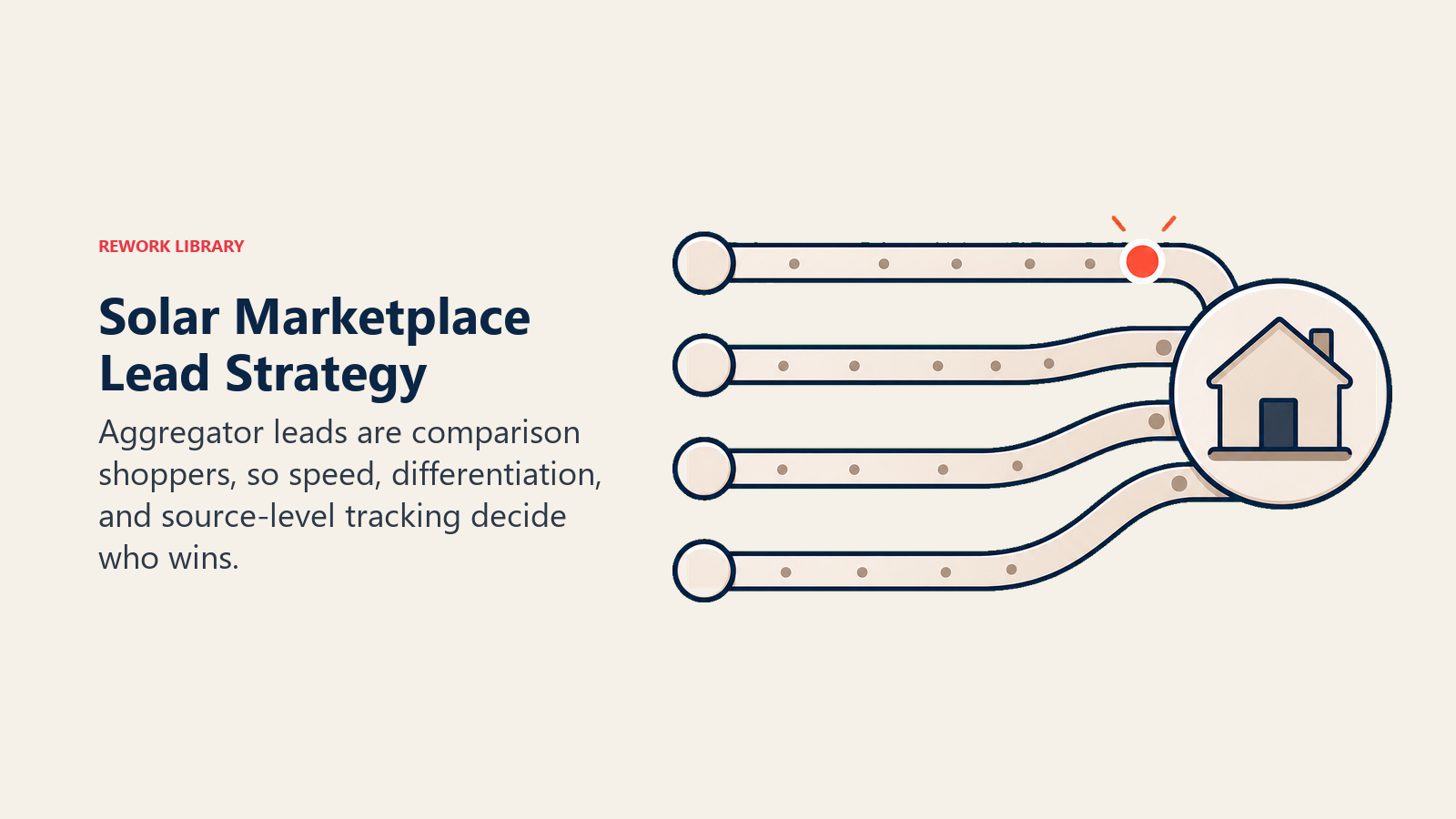
A homeowner fills out one form on a solar comparison-shopping marketplace. That single click puts your rep in a race. By the time anyone calls, three, four, or even five other companies may already be reaching out about the same project. This homeowner is fundamentally different from one who responds to your door knock or clicks your own ad. They've already decided to shop multiple companies before talking to anyone.
Treating a marketplace lead like a standard inbound lead is one of the fastest ways to lose a deal you were never really competing hard enough for. This guide covers how marketplace and aggregator leads behave differently, and what your sales process needs to do differently to win them.
What Makes Marketplace Leads Different From Direct Leads?
Marketplace and aggregator platforms are comparison-shopping sites where a homeowner submits one form and gets matched with multiple solar companies at once. Platforms like EnergySage publish semiannual marketplace reports built on millions of homeowner quote transactions, and they exist precisely because this comparison-shopping behavior is now mainstream. These platforms generate leads with a few defining traits:
They're actively comparison shopping by design. The entire premise of the platform is "get multiple quotes." A homeowner who fills out this kind of form has explicitly opted into a multi-vendor process, unlike someone who called your company directly.
Speed to contact matters even more than usual. Every solar sales team knows response time drives conversion, but with marketplace leads, you're not just racing the clock, you're racing named competitors who received the same lead simultaneously. See buying leads vs self-generation for how marketplace leads fit into your broader lead-mix strategy.
They often arrive with more pre-existing information. Many platforms collect utility provider, average bill, roof type, and homeownership status upfront. That's a head start for your setter or closer, if your CRM surfaces it clearly instead of burying it in a lead record nobody reads before the call.
They expect a real comparison, not a generic pitch. These homeowners have likely read at least one article about how to evaluate solar quotes. Generic scripts that don't acknowledge the comparison-shopping context read as tone-deaf.
Lead cost and quality vary significantly by platform. Some marketplaces produce highly qualified, motivated leads. Others produce high volume with lower intent. Industry-wide, residential solar demand has been resilient even as pricing shifts, per the SEIA (Solar Energy Industries Association) and Wood Mackenzie Solar Market Insight report, but that demand is not evenly distributed across every lead channel. Track cost and conversion by source in your solar pipeline and funnel analytics so you know which platforms are actually worth the spend.
Key Facts
- Marketplace and aggregator leads are explicitly multi-vendor by design, meaning a homeowner who submits one form is very likely being contacted by several competing companies at nearly the same time.
- Response speed has an outsized effect on marketplace lead conversion compared to other channels, because the homeowner is actively comparing who responds first and most usefully, not just who eventually calls back.
- Lead quality and cost vary meaningfully by platform and by market, which makes source-level tracking in your funnel analytics essential rather than optional for this channel.
Why Does Speed to Lead Matter More on Marketplace Leads?
On a standard inbound lead, calling within five minutes instead of thirty minutes matters. On a marketplace lead, it can be the entire game, because you know with certainty that other companies received the same contact information at the same moment.

Build your response process around this reality:
- Route marketplace leads to whichever qualified setter or closer is immediately available, not just whoever's next in a round-robin queue. Speed beats fairness in this specific channel.
- Set an internal response-time target measured in minutes, not hours, and track it separately from your other lead sources. Your lead and setter performance dashboards should break out marketplace response time as its own metric, because blending it with slower channels hides the problem.
- Use automated first-touch messaging (text or email) the instant a lead comes in, even before a human call connects. This isn't a substitute for a live call, but it establishes contact and sets an expectation while your team mobilizes.
- Train setters on a marketplace-specific opener that acknowledges the context honestly: "I know you're probably getting a few calls about your solar project today, so I'll keep this quick and useful." This builds credibility faster than pretending you're the only company they've heard from.
Teams that build all four steps into a single, repeatable sequence are running what we call the First-Contact Window method: treating the minutes immediately after a marketplace lead arrives as a distinct, measured stage of the pipeline, separate from and faster than the response-time standard applied to every other lead source. The First-Contact Window method works specifically because it assumes named competitors already have the same lead in hand, rather than treating fast response as a nice-to-have.
"On a marketplace lead, multiple named competitors receive the identical contact record at the same moment, which means response time is not a general best practice, it is a direct, one-to-one competition that a slower company simply loses regardless of how strong its pitch would have been."
Differentiating the Pitch When You Know You're Being Compared
Standard objection handling assumes the homeowner is deciding between solar and no solar, or solar and waiting. With marketplace leads, they're often deciding between you and a specific competitor they're also talking to. That requires a different conversational approach.
Ask directly, early, whether they're talking to other companies. Most homeowners will tell you honestly if you ask without defensiveness: "Since you came through [platform], I'm guessing you're getting a few other quotes too, is that right? That's smart, and it helps me know how to be useful to you today." This surfaces the competitive reality instead of pretending it doesn't exist.
Focus on what's genuinely comparable and what isn't. Panel brand, warranty terms, financing options, and company reputation vary by installer. Help the homeowner understand what to actually compare instead of assuming they know. A homeowner who understands the comparison better because of your explanation trusts you more, even if they end up choosing based on price.
Get specific about what makes your company different, without disparaging competitors by name. "A lot of companies will quote you a system size, but we walk every roof and adjust for actual shading before we finalize a number, so what you see in the proposal is closer to what you'll actually get" is a real differentiator. Vague claims like "we're the best in the area" aren't.
Move fast toward an in-home appointment or virtual consultation instead of trying to close over the phone. Marketplace leads often convert better once they're in a real conversation about their specific home, not comparing generic quotes side by side. Use solar lead qualification and pre-screening to confirm fit quickly, then prioritize getting the appointment booked.
How Do You Handle a Homeowner Who Says Another Company Quoted Lower?
Marketplace leads frequently come back with "another company quoted me lower." This deserves a real answer, not deflection.

Ask what's actually included in the other quote. System size, panel and inverter brand, warranty length, and financing terms all affect price. A lower number on a smaller system or lower-tier equipment isn't actually a lower price for the same thing.
Show your work. Break down your proposal line by line so the homeowner can see exactly what they're paying for. This is where a well-built custom solar proposal pays for itself, literally, because a transparent proposal survives a side-by-side comparison better than a vague one.
Know your real floor and don't manufacture discounts to win the comparison. If you're consistently losing marketplace deals purely on price, that's a signal to review with sales leadership, not a reason for individual reps to freelance discounts in the moment. See competing on value instead of price for a broader framework on holding your ground in a competitive comparison without racing to the bottom.
Qualifying and Scoring Marketplace Leads Differently
Because marketplace leads arrive with more upfront data than a typical inbound lead, use that data to score and prioritize instead of treating every lead identically. A lead scoring system applied to marketplace leads should weigh factors like:
- Homeownership status (renters generally can't move forward)
- Reported average monthly bill (very low bills usually mean weak economics for solar)
- Roof age and type, when the platform collects it
- Timeline stated by the homeowner (some platforms ask "how soon are you looking to move forward")
Leads that score well on these factors deserve the fastest possible response and your most experienced closer. Leads that score poorly still deserve a response, but shouldn't consume your best rep's time ahead of a stronger opportunity sitting in the queue.
Tracking Marketplace Performance by Platform
Not all marketplaces perform the same in every market. Track cost per lead, appointment set rate, show rate, and close rate separately for each platform you use, then review quarterly. A platform that produced great results a year ago might have changed its lead-matching algorithm, increased the number of companies per lead, or shifted its user base. Your solar pipeline and funnel analytics should make this breakdown easy to pull, not something someone has to reconstruct manually from spreadsheets every quarter.
Building a Marketplace-Ready Sales Motion
Winning consistently in this channel requires more than a good talk track. It requires operational readiness:
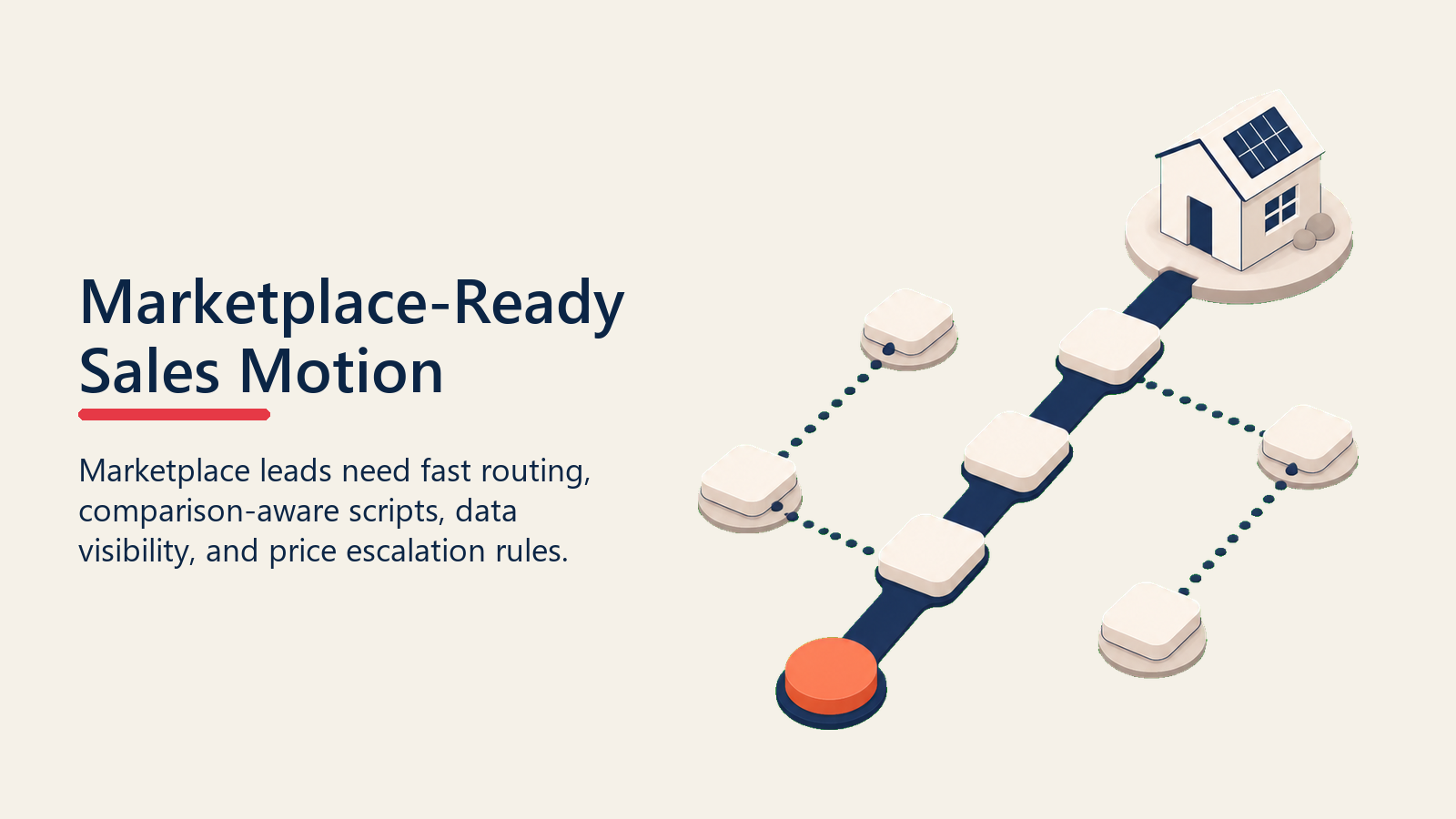
Fast, dedicated routing. Marketplace leads shouldn't sit in a generic queue behind other lead types. Route them to available capacity immediately.
A setter or closer script built specifically for the comparison-shopping context, distinct from your standard cold or warm lead scripts.
CRM visibility into whatever data the platform provides upfront, so the first conversation starts informed instead of repeating questions the homeowner already answered on the platform.
Clear escalation for price objections, so reps aren't freelancing discounts under competitive pressure without a defined process.
Companies that treat marketplace leads as just another inbound source usually see mediocre close rates and blame the lead quality. Companies that build a distinct, faster, more comparison-aware process for this specific channel tend to see it perform as well as or better than their other paid lead sources.
Frequently Asked Questions about Winning Solar Marketplace and Aggregator Leads
What's the difference between a marketplace lead and a standard digital lead?
A marketplace or aggregator lead comes through a comparison-shopping platform where the homeowner explicitly requests quotes from multiple companies at once. A standard digital lead, such as one from your own website or ad campaign, typically reaches only your company initially, even if the homeowner later shops around independently.
Why does response speed matter more for marketplace leads?
Because multiple competing companies receive the same lead information at nearly the same time. The homeowner is often taking calls from several companies within the same hour, so being first to respond with a useful, non-generic conversation gives a real competitive edge that's harder to recover once a competitor gets there first.
How should reps handle a homeowner who says another company quoted a lower price?
Ask what's included in that quote (system size, equipment tier, warranty, financing terms) before reacting. Many price differences reflect different scopes, not the same system at a genuinely lower price. Present your own proposal transparently, line by line, and avoid manufacturing an unplanned discount just to win the comparison.
Should marketplace leads be scored differently than other lead sources?
Yes. Marketplace platforms often collect useful qualifying data upfront, such as homeownership status, average bill, and timeline. Use that data to prioritize the strongest leads for your fastest response and most experienced closers, rather than treating every marketplace lead identically.
How do I know if a specific marketplace platform is worth the spend?
Track cost per lead, appointment set rate, show rate, and close rate separately for each platform over time. Performance varies by platform and can change as platforms adjust their algorithms or user base, so this needs ongoing review rather than a one-time evaluation.
Learn More

Senior Implementation Consultant
On this page
- What Makes Marketplace Leads Different From Direct Leads?
- Key Facts
- Why Does Speed to Lead Matter More on Marketplace Leads?
- Differentiating the Pitch When You Know You're Being Compared
- How Do You Handle a Homeowner Who Says Another Company Quoted Lower?
- Qualifying and Scoring Marketplace Leads Differently
- Tracking Marketplace Performance by Platform
- Building a Marketplace-Ready Sales Motion
- Learn More