Community and Event Marketing for Solar Companies: Turn Local Presence into Pipeline
Turn this article into takeaways for your work.


Each assistant summarizes the article only for you and suggests best practices for your work.
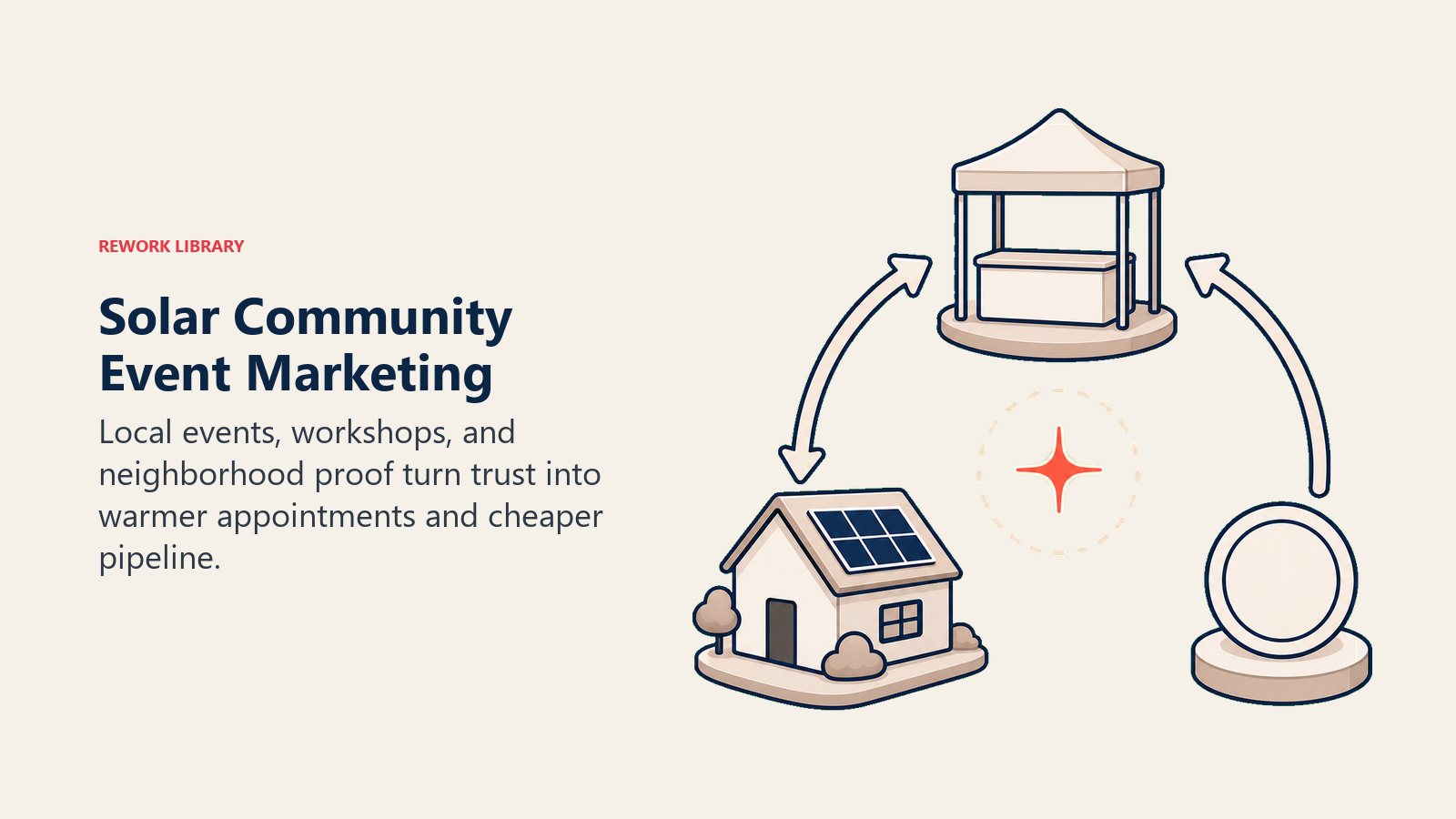
Digital ads get more expensive every year. Door-to-door canvassing faces increasing friction in many neighborhoods. But the solar company that shows up at the local farmers market, sponsors the youth soccer league, or runs a neighborhood energy savings workshop? That company earns something digital channels can't buy: trust.
Community and event marketing is one of the most underinvested channels in residential solar. Done right, it produces leads that close at significantly higher rates than paid digital leads. The reason is simple. The prospect has already met a real person from your company before they ever schedule a consultation.
This guide covers how to build a community marketing engine that feeds your appointment pipeline consistently, from choosing the right events to converting booth conversations into set appointments.
Why Community Leads Convert Better
Before diving into tactics, it helps to understand why event-sourced leads behave differently from other channels.
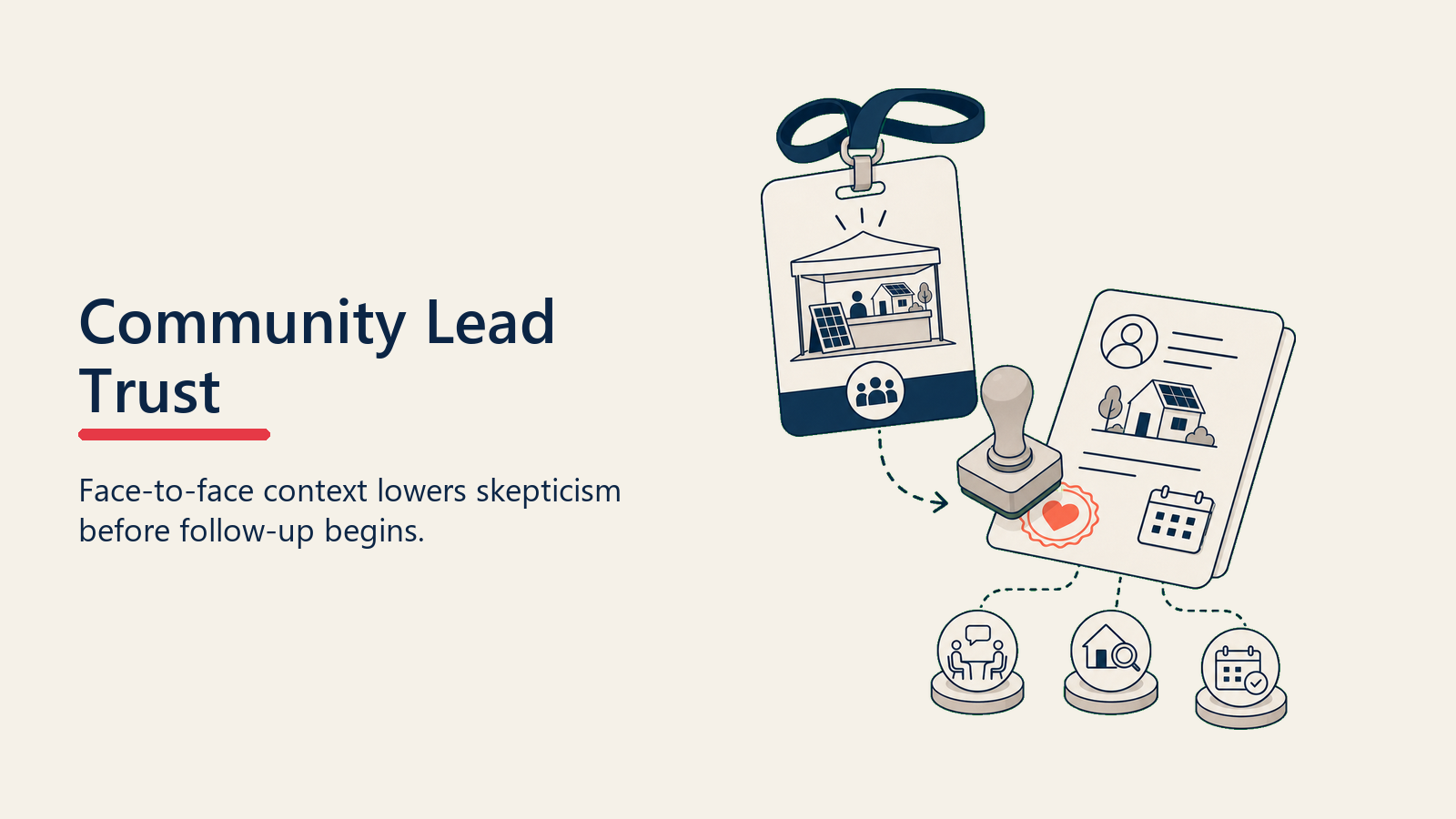
When a homeowner fills out a Facebook form, they're a name and a phone number. Your setter has to establish credibility from scratch on a cold call. The prospect may not remember what they clicked on. Skepticism is high.
When a homeowner meets your rep at a neighborhood HOA meeting, watches a presentation, shakes a hand, and takes a brochure home, the dynamic shifts completely. They've seen a real person. They've heard your pitch in a low-pressure context. By the time they answer your follow-up call, the relationship is already warm.
The numbers reflect this. In many solar markets, event-sourced leads show materially higher appointment show rates and shorter sales cycles compared to cold digital leads. The pre-qualification happens before your setter ever picks up the phone: high-intent homeowners who engage at community events are self-selecting. They're curious about solar, they own their home, and they're willing to have a conversation.
Key Facts: Solar Community Event Marketing
- Solarize campaigns (a community-based model where local nonprofits organize neighborhood group-buying for solar) produced the highest net close rate of any lead source (33%) in an independent analysis of one installer's full-funnel CRM data. (Sunvoy solar lead source analysis)
- The US residential solar installed base passed 5 million homes as of mid-2024, meaning most suburban markets already have visible solar neighbors who serve as social proof at local events. (SEIA, May 2024)
- Average US residential electricity bills reached $144 per month in 2024, up from $137 the prior year, giving community event presenters a strong financial hook for the energy savings conversation. (EIA, May 2025)
Choosing the Right Events and Venues
Not every community event is worth your time. The goal is to find gatherings where your target audience, homeowners with decent-sized roofs, decent income, and some interest in energy costs, actually shows up.
High-value event categories
Home improvement expos and trade shows. These are the obvious ones. Homeowners attend specifically because they're thinking about their homes. Bring proposal tools, show financing options, and capture contact info on tablets. ROI tends to be strong.
Farmers markets and neighborhood festivals. Foot traffic is high, but not everyone is in buying mode. Focus on brand awareness and light lead capture. A spin-the-wheel game, a raffle for a free energy audit, or a "calculate your bill savings" station works better here than a hard pitch.
HOA meetings and neighborhood association events. These are gold. You're speaking directly to homeowners who already organize as a community, which matters for referral programs later. Ask your current customers if they'll invite you to introduce yourself at their next HOA meeting. A 20-minute presentation to 40 homeowners in a single neighborhood is more efficient than most canvassing blitzes.
School fundraisers and youth sports sponsorships. The parent demographic at little league and youth soccer skews heavily toward homeowners in the 30 to 50 age range. Sponsoring a jersey or a scoreboard gets your name in front of hundreds of families. Pair it with a table at the game and you can collect contact info in a low-pressure setting.
Library and community center workshops. Offer to run a free "Home Energy Savings" or "Understanding Solar Incentives" workshop at the local library. The audience self-selects as curious and educated about energy. You're positioned as an expert, not a salesperson. These workshops consistently produce some of the highest-quality leads in the community channel. Walk attendees through DSIRE (the Database of State Incentives for Renewables and Efficiency) so they can see every state and local incentive available to them. Showing the full incentive stack in real time shifts the conversation from "is this affordable?" to "how soon can we start?"
Events to skip or approach carefully
Avoid events where homeownership rates are low, where income demographics don't fit your minimum roof and bill thresholds, or where the organizers have strict no-solicitation rules. Showing up and pitching aggressively at the wrong venue damages your local reputation fast.
Knowing which events to pick is only half the job. Your booth setup is what determines whether homeowners stop, engage, and hand over their contact information.
Setting Up Your Event Presence
Your booth or table setup communicates a lot before anyone reads a single word. Here's what works.
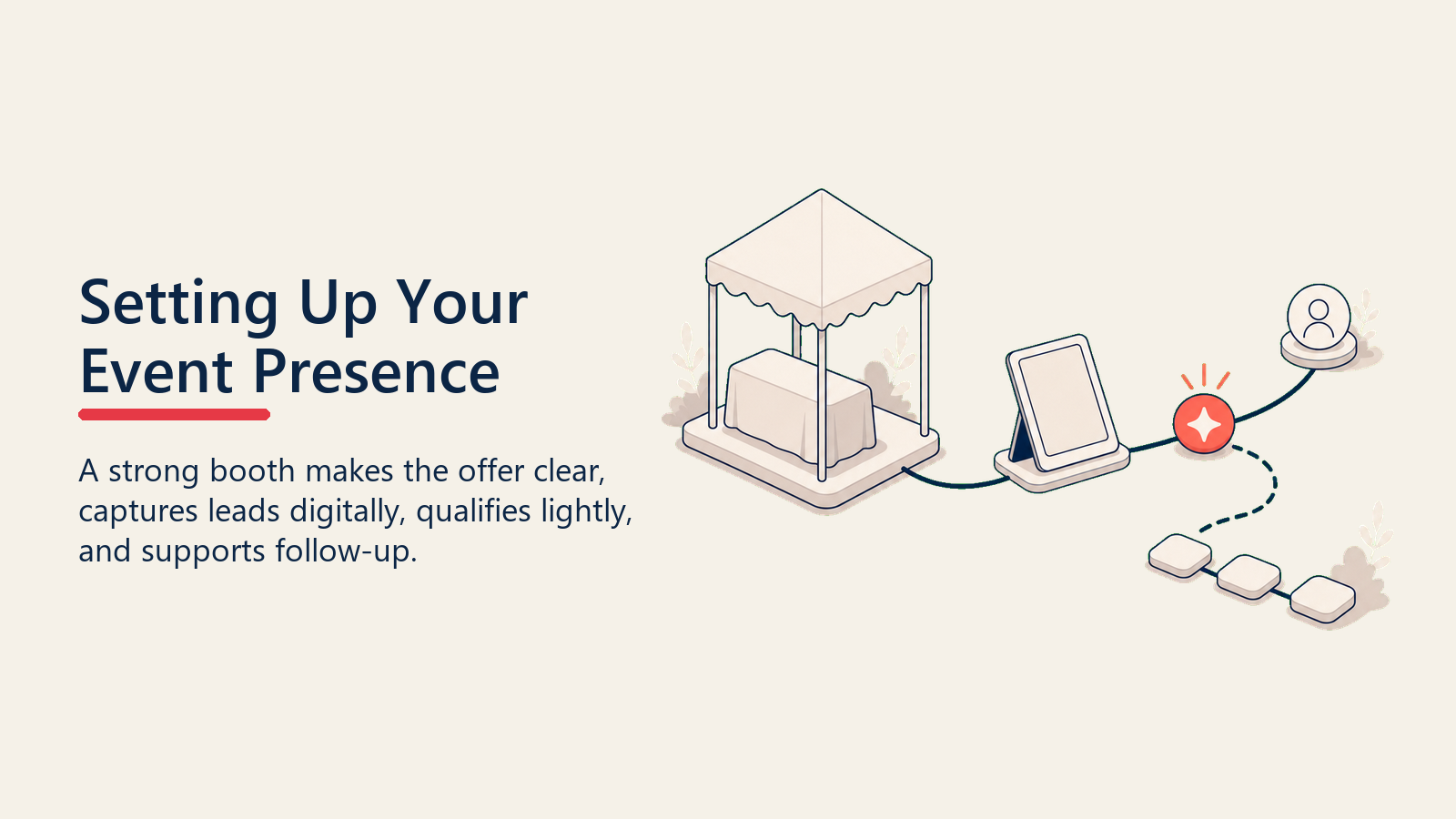
Branded materials that explain the offer simply. Most people don't understand how solar financing works. Your display should answer "what does this cost me?" in the first five seconds. A simple banner with something like "Pay less than your current electric bill, starting month one" does more work than ten paragraphs of technical detail.
A digital lead capture system. Paper sign-in sheets get lost and are slow to process. Use a tablet with a simple form that connects directly to your CRM. Collect name, phone, email, and address. Consider a brief pre-qualification question like "Is your average monthly electric bill over $150?"
A conversation starter, not a closer. Event environments are wrong for the full pitch. Your reps should be trained to have a brief, curious conversation, understand the homeowner's situation, and book the appointment. They're setters in this environment, not closers.
Social proof elements. Photos of local installs, a map showing neighbor installs in the area, testimonial cards from customers in the same zip code. Proximity matters. "We just installed on Oak Street last month" is more compelling than a national brand claim.
The Neighborhood Flywheel: Concentrate your event presence in zip codes where you already have installs. When you install in a neighborhood, canvass the surrounding block during install week. Use that neighborhood's install count as social proof at your next event in the area. Each install in a concentrated zone makes the next one cheaper to acquire because the social proof already exists on the streets.
NREL research on peer effects shows that proximity to an existing solar installation is one of the strongest predictors of a homeowner's decision to install. Geographic concentration is what makes your event marketing compound over time.
But the best booth setup in the world still fails if your event reps aren't trained for this specific environment.
Training Your Event Reps
The biggest mistake solar companies make at events is sending closers who've never worked an event environment. The skill set is different.
At a home show, your rep has 90 seconds with each passerby. The goal isn't to explain net metering or go through a savings analysis. The goal is to have a human interaction that leaves the prospect feeling heard, interested, and willing to share their contact info.
Train event reps on:
The opener. Something low-key and curious works better than a sales question. "Are you a homeowner in the area?" or "Do you guys know much about what solar costs now?" opens a conversation without pressure.
The qualification pivot. Once you've exchanged a few sentences, ask about their utility bill and home ownership. You need both to be viable, and you want to find out quickly rather than spending ten minutes with a renter.
The appointment offer. Don't describe solar. Offer the homeowner a free home energy assessment. "We'll come take a look at your roof and utility bill and show you exactly what a system would look like for your house, with real numbers. No pressure, takes about an hour." That's a much easier yes than "can we tell you about solar?"
The contact capture close. Get the phone number and confirm a follow-up plan before they walk away. "We'll have someone reach out tomorrow to get you scheduled. Does morning or afternoon work better for you?"
The Follow-Up Window Is Critical
Leads from community events have a short shelf life if you don't act on them. The homeowner's interest is fresh when they leave your booth. Forty-eight hours later, they've thought about a dozen other things.
Your setter team should receive event leads the same day they're collected and make first contact within 24 hours. Reference the specific event to trigger memory: "Hi, this is Jordan from Sunpath Energy. You stopped by our booth at the Riverside Farmers Market yesterday and signed up for a free home energy assessment."
If you can't reach them by phone, send a text that same evening. Something brief: "Thanks for chatting with us today at [event name]! We'll give you a call tomorrow to get your free energy assessment scheduled."
For leads that don't answer on first contact, build a follow-up sequence:
| Day | Contact type | Message angle |
|---|---|---|
| 1 | Call + voicemail | Introduction, reference event, schedule assessment |
| 2 | Text message | Quick follow-up, easy reply option |
| 4 | Call | Second attempt, mention current incentives |
| 7 | Value content, share a savings example | |
| 14 | Final call | Last outreach, respect their time |
After 14 days without engagement, move the lead to a slower nurture sequence. Don't burn your reps' time on cold event contacts when there are fresh ones coming in.
How Do You Build a Neighborhood Momentum Strategy?
One of the most powerful aspects of community marketing is the flywheel effect when you operate in a concentrated geographic area. Once you have three or four installs on the same street, every neighbor who noticed the crew and the panels becomes a warm prospect.
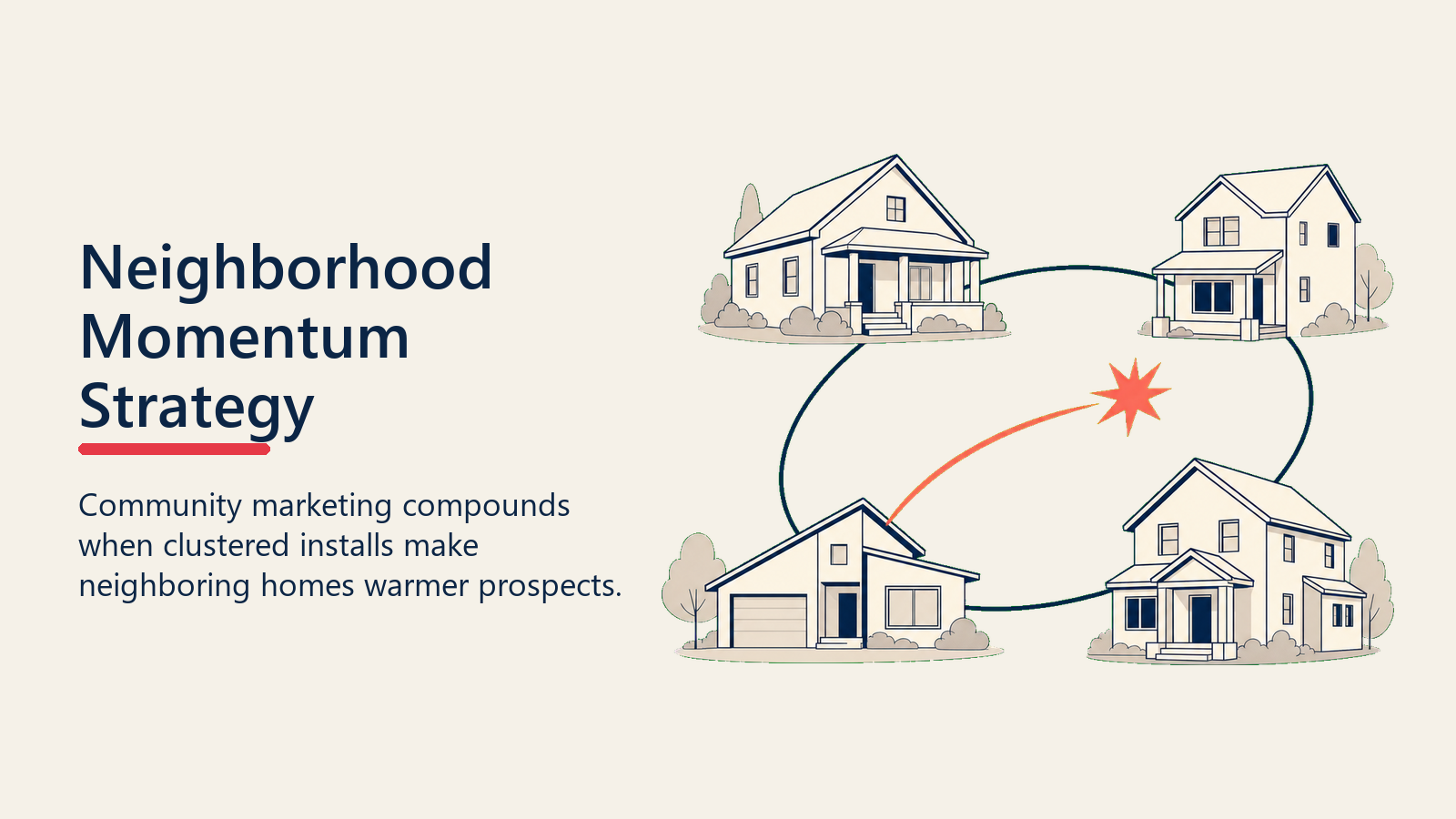
Be intentional about this. When you install in a neighborhood, knock a few doors on the same block the week of the install. "Hey, we're installing solar on the Smith house right now, and we wanted to see if you'd be curious about what it would cost for your home." That timing is perfect: the prospect can literally see the evidence of your work.
Then, when you're planning community events, prioritize zip codes where you already have installs. A map at your booth showing "12 homes in this neighborhood are already saving with us" closes the credibility gap fast.
This ties directly into a strong solar referral program. Your installed customers in a neighborhood become community marketing assets. They're the ones who will mention your company at the next block party or HOA meeting. Give them a reason to do so.
What Does Event Marketing ROI Actually Look Like?
Event marketing is easy to undervalue because the conversion happens later, in the home, not at the booth. Make sure your CRM and pipeline tracking connect event leads to eventual installs.
Track these metrics for each event:
Contacts collected: total leads captured at the event
Contact rate: what percentage were reachable within 48 hours
Appointment rate: of contacts reached, how many scheduled an in-home consultation (see solar appointment setting playbook)
Show rate: of appointments set, how many actually happened
Close rate: of appointments run, how many became signed contracts
Cost per installed watt from event channel: total event investment divided by watts installed from event-sourced leads
Compare these metrics across event types. You'll quickly discover which venues produce the best leads for your market, and which look busy but produce low-quality contacts.
Community Marketing as a Long-Term Brand Asset
The solar companies that win in a market over time aren't always the ones with the biggest ad budgets. They're the ones that local homeowners recognize, trust, and recommend to their neighbors.
Community marketing builds that recognition. It takes consistency: showing up at the same farmers market every month, sponsoring the same youth sports league every season, running the library workshop twice a year. The compounding effect isn't visible in a single month's numbers, but over 12 to 18 months, the brand equity translates directly into inbound calls and referrals that cost almost nothing to acquire.
Think of it as planting seeds alongside your more immediate lead channels. Your solar digital lead generation fills the pipe today. Community events build the reputation that makes every other channel more effective tomorrow. The SEIA Solar Market Insight data shows that community solar and residential adoption track closely with local trust signals, meaning companies with visible community presence consistently outperform those competing purely on price and digital spend.
For teams building out their residential solar sales growth model, community marketing deserves a dedicated budget line and a rep (or team) specifically assigned to manage events and partnerships. It's not a side project. It's a channel.
Community marketing rewards the solar company that treats it seriously. Solarize campaigns convert at the highest rate of any tracked lead source precisely because the nonprofit organizer's credibility pre-qualifies attendees before the first setter call.
Frequently Asked Questions about Community and Event Marketing for Solar Companies
What is community event marketing for solar companies?
Community event marketing is the practice of generating solar leads through in-person presence at local events: farmers markets, home shows, HOA meetings, library workshops, and sports sponsorships. Unlike digital ads, event marketing builds face-to-face trust before any follow-up call happens, which tends to produce higher appointment show rates and faster sales cycles.
Which community events work best for solar lead generation?
HOA meetings and neighborhood association events tend to produce the highest-quality leads because the audience is already organized as homeowners and the implied endorsement of the community association adds credibility. Library and community center energy workshops attract self-selected, research-oriented homeowners who convert at high rates. Home improvement expos work well for volume, while farmers markets and sports sponsorships are better for brand awareness than immediate lead capture.
How quickly should you follow up on event leads?
Within 24 hours of the event, ideally same-day or that evening via text. The homeowner's interest is freshest immediately after meeting your rep. Reference the specific event when you call: "You stopped by our booth at the Riverside Farmers Market yesterday." That trigger recreates the context and builds on the relationship that already started in person.
What is a Solarize program and why does it convert well?
A Solarize program is a community group-buying initiative organized by a local nonprofit or municipality that aggregates homeowners in a neighborhood or jurisdiction to get competitive solar pricing. Because the nonprofit organizer vets the installer and brings credibility to the offer, leads arrive already partially sold. Independent installer data shows Solarize campaigns producing a 33% net close rate, the highest of any lead source in that analysis. (Source: Sunvoy / Ipsun Solar)
How do you calculate ROI for community event marketing?
Track every event lead in your CRM with the event source tagged. Measure: contacts collected, contact rate within 48 hours, appointment set rate, show rate, and close rate. Then divide total event investment (booth fee, rep time, materials) by the number of installed watts attributable to that event to get cost per installed watt. Compare this to your paid digital and canvassing channels on the same basis. The comparison often surprises managers who assumed events were "branding only."
Should you walk doors near an install site during an active install?
Yes. The week of an install is one of the most productive canvassing windows you have. Neighbors see the crew, see the panels going up, and are naturally curious. A rep knocking doors and saying "We're installing solar on the Smith house right now, would you be curious what it would look like for your roof?" gets a much warmer response than a cold canvass in the same neighborhood three months later.
Practical Checklist for Your Next Community Event
Before every event, run through this:
- Lead capture tablets charged and CRM integration tested
- Branded display materials set up and readable from 20 feet
- Local install photos and testimonials printed or on screen
- Financing talking points practiced (what's the monthly payment for a median home in this zip?)
- Event reps briefed on opener, qualification questions, and appointment close
- CRM workflow ready to receive same-day leads and trigger 24-hour follow-up
- Setter team alerted that leads will arrive tonight
After every event:
- All contacts entered in CRM same day
- First follow-up contacts attempted within 24 hours
- Event tagged in CRM for ROI tracking
- Quick debrief with event reps: what worked, what questions came up, any location or timing notes
Community marketing rewards the solar company that treats it seriously. Show up consistently, engage genuinely, follow up fast, and track the results. The leads you generate won't be the cheapest per contact. But they'll be some of the best you'll ever work.
Related reading:

Senior Implementation Consultant
On this page
- Why Community Leads Convert Better
- Choosing the Right Events and Venues
- High-value event categories
- Events to skip or approach carefully
- Setting Up Your Event Presence
- Training Your Event Reps
- The Follow-Up Window Is Critical
- How Do You Build a Neighborhood Momentum Strategy?
- What Does Event Marketing ROI Actually Look Like?
- Community Marketing as a Long-Term Brand Asset
- Practical Checklist for Your Next Community Event