No-Show and Reschedule Reduction for Solar Sales Teams
Turn this article into takeaways for your work.


Each assistant summarizes the article only for you and suggests best practices for your work.
A solar closer who drives 35 minutes to a home and knocks on a locked door hasn't just lost an appointment. They've lost two to three hours of productive time, fuel, and the mental energy that comes with a reset. Run enough no-shows in a week and you'll watch a capable rep's numbers collapse, not because they can't close, but because they're never getting in the door.
Show rate is one of the most important metrics in solar sales and one of the least managed. Most companies track it in aggregate. They don't dig into which setters are booking weak appointments, which confirmation processes are leaking, or which appointment types (self-generated vs. bought leads, for example) have structurally different show rates.
The good news: no-show rates respond directly to process. Teams that run deliberate confirmation sequences consistently outperform those that rely on a single reminder text the morning of the appointment. SPOTIO's sales benchmark data confirms that responding to a new lead within five minutes increases engagement likelihood by 9x, and the same urgency principle applies to confirmation follow-through: the faster and more personal the outreach, the more likely the homeowner stays committed to the appointment.
What Drives No-Shows in Solar
Key Facts:
- SPOTIO's sales statistics document that responding to a new lead within five minutes increases engagement likelihood by 9x; that same urgency applies to confirmation follow-through
- Referral appointments book at roughly 80% and close at roughly 37.5%, giving a 29% net close rate, vs. purchased leads that run substantially lower, per Sunvoy's solar lead source data; show rate differences by lead source drive most of that gap
- The US had 4.71 GW of new residential solar installed in 2024, per SEIA's 2024 Year in Review, meaning a growing share of homeowners your setters call have a neighbor who went solar; peer familiarity lifts show rates on referral and event leads
Before building a reduction strategy, it helps to understand why homeowners don't show. The reasons cluster into a few categories.
Weak commitment at booking. Some homeowners agree to an appointment to end the call, not because they're genuinely interested. If the setter moved too fast and didn't establish real buy-in, the homeowner will "forget," reschedule indefinitely, or simply not answer the door. The appointment was never solid.
Appointment too far out. The further out an appointment is booked, the more likely life intervenes. A booking for three days from now is safer than a booking for nine days from now. Weekend appointments booked on Monday have high drop-off rates.
Decision-maker conflict. The homeowner agreed, but their spouse or partner is the actual decision-maker and doesn't know about the appointment, didn't agree to it, or isn't going to be home. These appointments often ghost without explanation.
No perceived value in the visit. The homeowner doesn't fully understand what they're getting. They think it's a sales pitch, not an energy assessment. When they get busy, it's easy to deprioritize something they weren't that excited about.
Life gets in the way. Kids get sick. Work runs late. These are genuinely unforeseeable and unavoidable. But a good confirmation process makes it easier for homeowners to reach out and reschedule proactively instead of just not answering.
The Confirmation Sequence That Works
A single confirmation text the morning of the appointment is not a sequence. It's a gesture. A real confirmation sequence starts at booking and runs through the day of the appointment with touchpoints that serve a purpose, not just noise.
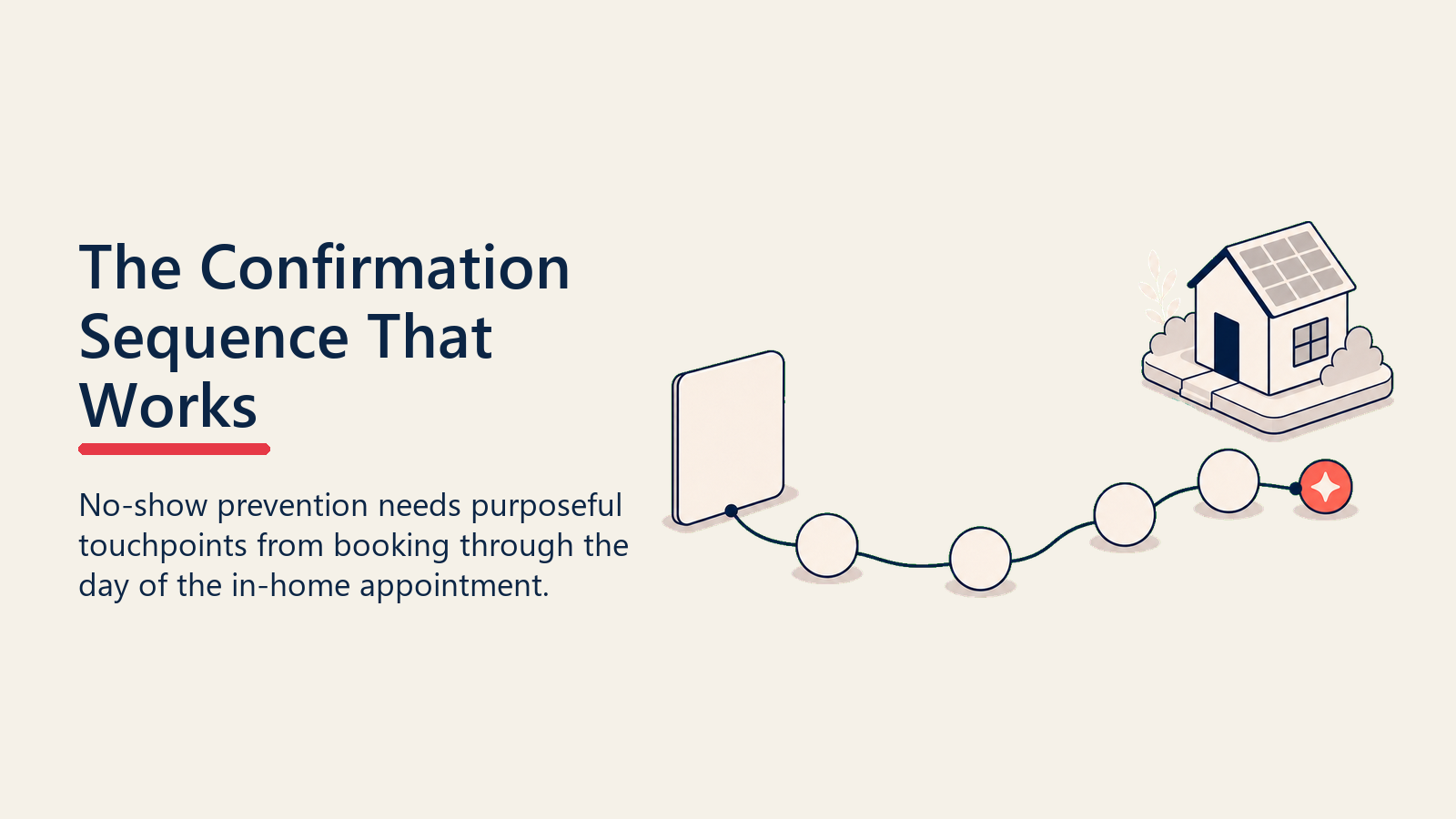
Here's a structure that works for most solar teams running in-home consultations:
At booking (immediately): Send a confirmation message that recaps what was agreed, introduces the closer by name, and sets a clear expectation for the visit. "You're confirmed for [day] at [time] with [closer's name]. He'll take about 60-90 minutes to walk through your energy use and build a custom proposal for your home." This also gives the homeowner something to reference if they have questions.
24 to 48 hours before: A personal outreach, ideally a call or voice message from the setter who booked the appointment. Not a generic text blast. Something like: "Hey [name], it's [setter] just reaching out to confirm we'll see you [day] at [time]. [Closer's name] is looking forward to it. Any questions before then? Just text or call me." The personal touch matters because it reminds the homeowner that a real person is involved and that someone is expecting to be there.
Morning of the appointment: A text from the setter or closer confirming they're still on and the closer's ETA window. Something like: "[Closer's name] is planning to be there around [time]. Does that still work for you?" Framing it as a question gives the homeowner an easy out if something came up, which is actually what you want. A proactive reschedule is infinitely better than a closer who drives out and finds no one home.
One hour before (for afternoon appointments): A brief reminder from the closer. "Hey [name], it's [closer's name], I'm looking forward to meeting you this afternoon. I'll be there around [time]." This is often what converts a wavering homeowner from "maybe I should cancel" to "okay, they're coming, I'll be here."
See also Confirming and Prepping the In-Home Appointment for the full prep protocol that goes alongside this confirmation sequence.
Qualifying Before You Confirm
A lot of no-show reduction work actually happens during the set call, not during the confirmation sequence. If a setter qualifies properly and establishes genuine commitment, the confirmation is reinforcing a strong foundation. If the setter booked a weak appointment to hit their numbers, no confirmation sequence can fully compensate.
The key qualification markers that predict show rate:
| Signal | What it means for show rate |
|---|---|
| All decision-makers confirmed present | Significantly higher show rate |
| Homeowner initiated or responded warmly | Higher show rate than cold-inbound bookings |
| Specific pain point identified (bill, neighbor, rates) | Higher motivation, better show rate |
| Appointment within 48-72 hours | Better retention than week-out bookings |
| Homeowner asked questions during set call | Genuine interest, lower no-show risk |
| Setter confidence rated "hot" | Closer should treat as priority |
For more on building a qualification framework that reduces no-shows upstream, see Solar Lead Qualification and Prescreening and Lead Qualification Frameworks.
Handling the Reschedule Request
When a homeowner reaches out to reschedule before the appointment, that's actually a positive signal. It means they're engaged enough to let you know. The risk is letting reschedules turn into endless deferrals.
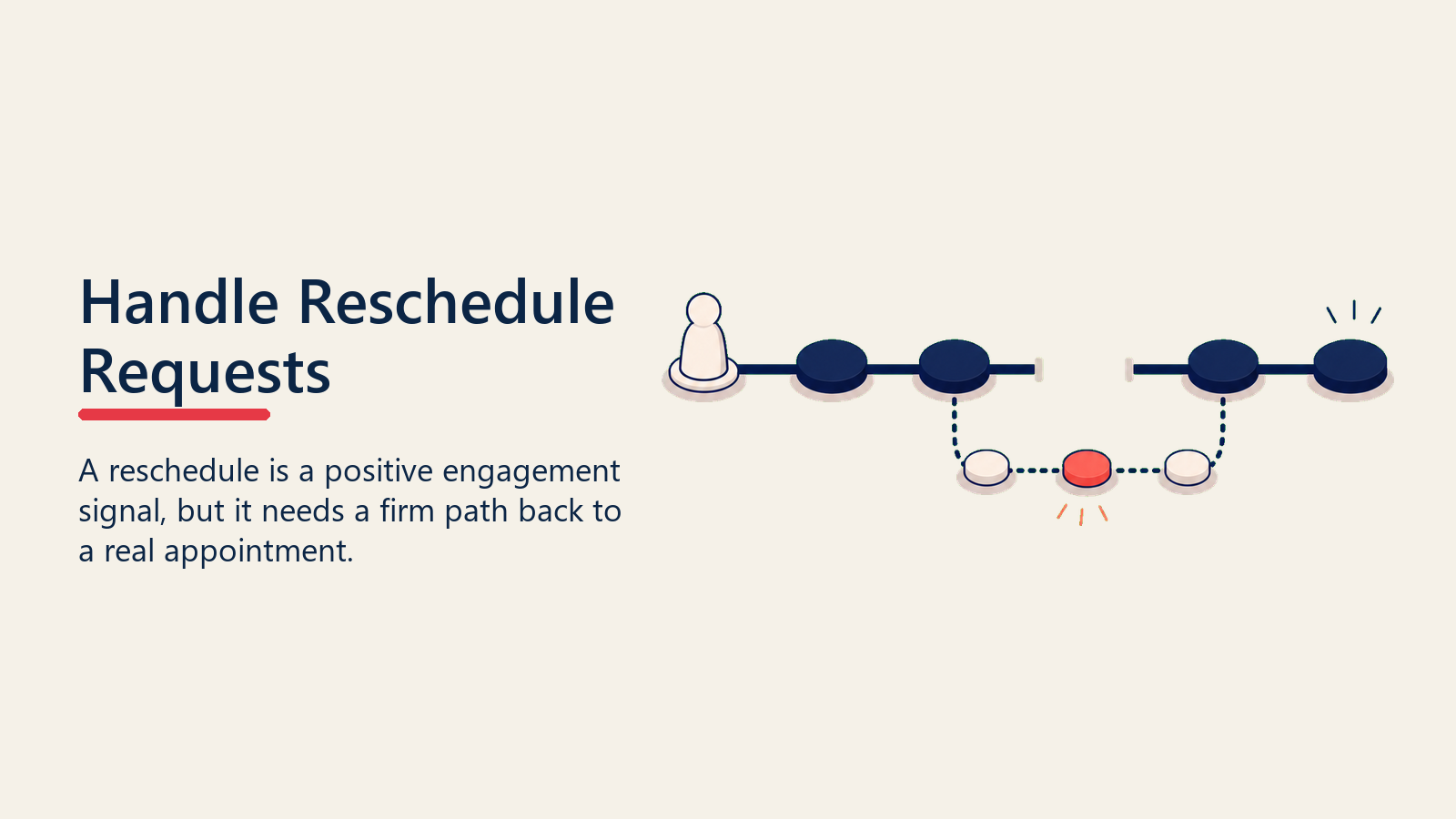
The script matters here. When a homeowner says they need to reschedule, the worst response is: "No problem, when works for you?" That puts the ball entirely in their court and they'll often say "I'll get back to you," which means you'll never hear from them again.
A better response: "Of course, life happens. I want to make sure we find a time that actually works for you and [partner's name] so [closer's name] isn't driving out again for nothing. I have two spots open this week, [option A] and [option B]. Which of those works?"
Offer two specific times, not an open calendar. Get a commitment before the call ends. And confirm the new appointment the same way you confirmed the original one.
If a homeowner has rescheduled twice, treat the third booking with heightened confirmation attention. Call the day before personally. Have the closer send a direct message. The pattern of double-rescheduling is a signal that commitment is weak, and you need to re-establish it.
When Should You Make the Recovery Call?
Sometimes you learn at the last minute that an appointment is going to be a no-show. The homeowner doesn't respond to the morning-of confirmation. They're not picking up. What do you do?
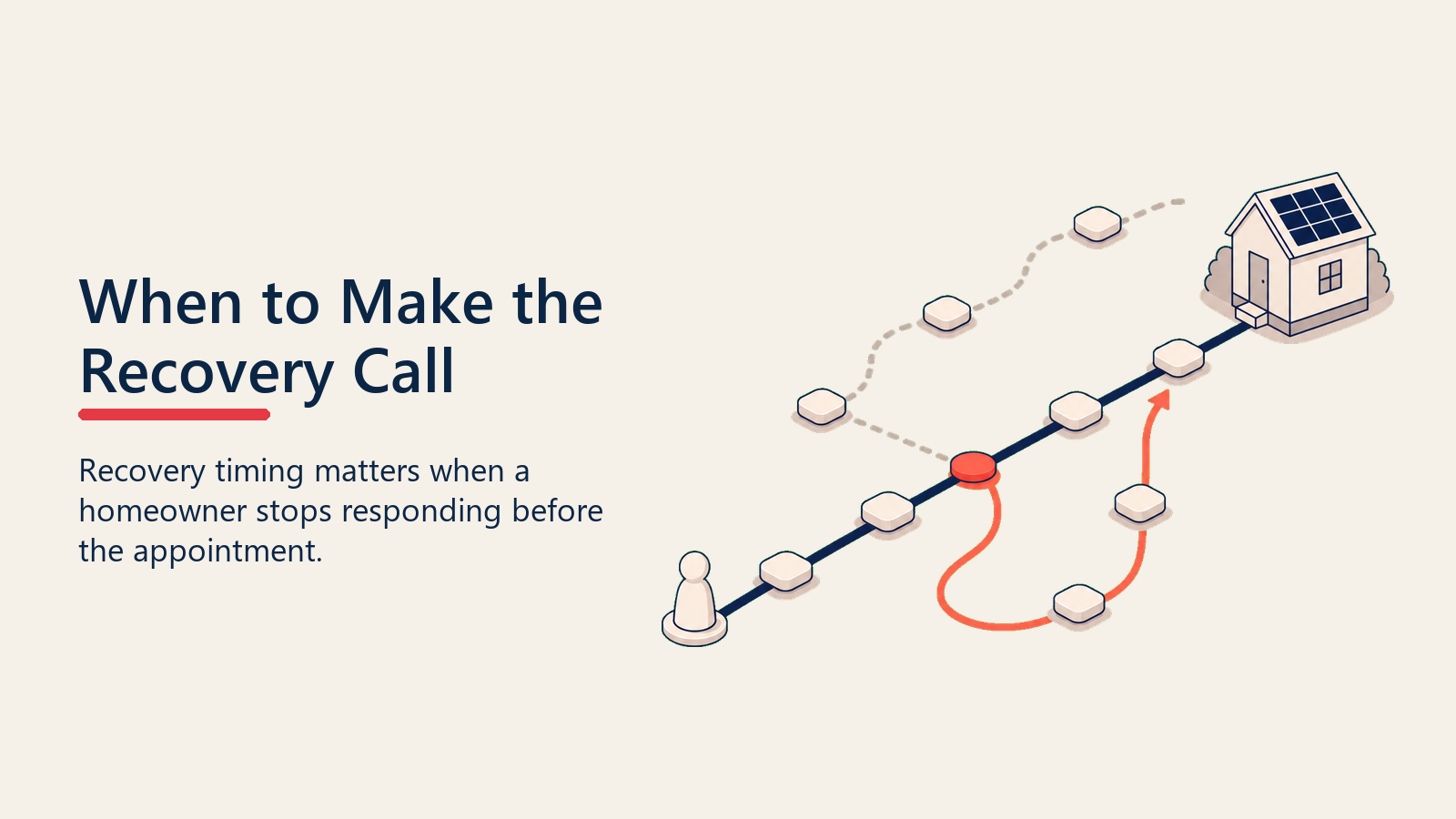
If you can't reach them within 90 minutes of the appointment, the setter should make a recovery call with a specific frame: "Hey [name], I'm trying to reach you before [closer's name] heads your way. He's got a full day and I want to make sure we're not sending him if something came up. Give me a quick call or text when you see this."
This frame achieves two things. It signals that someone is inconvenienced if they don't respond (which creates a social obligation to reply), and it gives the homeowner an easy, low-shame way to cancel or reschedule without feeling like they have to explain themselves.
If the closer is already in transit and you still can't reach the homeowner, have the closer knock once and leave a brief handwritten note. Something like: "Sorry I missed you today. I was here at [time] for our appointment. I'll have [setter's name] reach out to find a time that works better." That note keeps the lead alive and often triggers a callback.
Show Rate Benchmarks and What to Aim For
Show rates vary by lead source, geography, and season. But these are reasonable benchmarks to evaluate your team against.
| Lead type | Expected show rate |
|---|---|
| Self-generated (door-knock, event) | 75-85% |
| Inbound digital (website, paid search) | 60-75% |
| Purchased leads (aggregators) | 45-65% |
| Referrals | 80-90% |
| Community events | 65-75% |
If your show rates are running 10+ points below these benchmarks consistently, the problem is almost always in the confirmation process or the qualification happening during the set call. Start there before looking at other variables.
For tracking show rate by setter, lead source, and appointment type, see Solar Sales KPIs and Metrics and Lead Setter Performance Dashboards.
Quotable Nuggets
On the cost of a no-show: "A closer who drives 35 minutes to a home and knocks on a locked door hasn't just lost an appointment. They've lost two to three hours of productive time, fuel, and the mental energy that comes with a reset." Stack enough of those in a week and the rep's numbers collapse through no fault of their own selling ability.
On the proactive reschedule: "A proactive reschedule is infinitely better than a closer who drives out and finds no one home." The morning-of text with "does that still work for you?" isn't a liability. It's the safety valve that protects drive time and keeps the lead alive.
On the five-minute lead rule (SPOTIO): The same urgency that drives 9x engagement on a new lead applies to confirmation follow-through. The first confirmation message should go out the moment the appointment is booked, not the next morning. (SPOTIO sales statistics)
The Three-Touch Minimum Protocol
The Three-Touch Minimum Protocol: Any in-home appointment requires at least three confirmation touchpoints to hold a meaningful share of bookings: (1) immediate post-booking message with the closer's name and visit framing, (2) personal outreach from the setter 24-48 hours out, (3) a same-day ETA text from setter or closer. One text is a gesture. Three is a system. Teams running fewer than three touchpoints on every appointment are leaving show rate points on the table.
Common Confirmation Mistakes
A few patterns consistently hurt show rates even on teams that are trying to do the right thing.
Too much automation, not enough personal contact. Automated texts and emails are useful for the initial confirmation and the morning-of reminder. But the 24-48 hour touchpoint should be human. Homeowners who've heard a real voice are significantly less likely to ghost.
Confirmation messages that feel like spam. Generic texts that read like mass messages get treated like mass messages. Use the homeowner's name. Reference what the setter discussed. Make it clear this is a person reaching out, not a system.
Not using the appointment to build anticipation. The confirmation sequence is also a sales tool. The right message between booking and appointment day builds the homeowner's expectation of value. A well-crafted pre-appointment message that mentions what the closer will show them (custom proposal, savings estimates, financing options) primes them to want to be there.
Confirming only once. One confirmation text is almost never enough for an in-home appointment with a stranger. The sequence needs at least three touchpoints to hold a meaningful percentage of the bookings you've made.
The homeowners who no-show aren't always uninterested. Many of them just needed one more touchpoint to stay committed. Build the process that gives them that, and your closers will spend less time driving to empty driveways.
For a look at how the broader appointment setting process feeds into show rates, see Solar Appointment Setting Playbook.
Frequently Asked Questions about No-Show and Reschedule Reduction for Solar Sales Teams
What is a good show rate for solar in-home appointments?
It depends on lead source. Self-generated leads (door-knock, events) should run 75-85%. Referrals can reach 80-90%. Inbound digital typically lands at 60-75%. Purchased aggregator leads often run 45-65%. If your rates are running 10+ points below these benchmarks consistently, the issue is almost always in the confirmation sequence or the quality of the set call, not the closer.
How many confirmation touchpoints are needed to protect a solar appointment?
At minimum three: an immediate post-booking message, a personal 24-48 hour outreach from the setter, and a same-day ETA confirmation. A single reminder text is a gesture, not a system. Teams consistently running fewer than three touchpoints will see their show rates reflect it.
What should a solar appointment confirmation message include?
The closer's name, the visit time, a plain-English description of what will happen (not a "sales pitch" framing), and an invitation to respond if anything changes. The first message should go out immediately after booking, not the next day.
Why do appointments booked far in advance have worse show rates?
The further out an appointment is scheduled, the more likely life intervenes. A booking for 72 hours from now is substantially safer than a booking for 9 days out. Weekend appointments booked on Monday have particularly high drop-off. Aim to run appointments within 48-72 hours of booking when possible.
What is the right script when a homeowner wants to reschedule?
Don't hand them the calendar. Offer two specific times: "I have [option A] and [option B] this week. Which works for you?" Get a commitment before the call ends, then confirm the new appointment exactly as you confirmed the original. A homeowner who reschedules twice needs heightened attention before their third booking.
When should the closer reach out directly before an appointment?
For afternoon appointments, a brief text one hour before from the closer's own number converts wavering homeowners from "I should cancel" to "someone's on their way." It also establishes a direct line of communication that makes the door-knock feel less cold.
What should a closer do if they drive out and no one answers?
Knock once. Leave a brief handwritten note with the time you were there and that the setter will reach out to find a better time. That note keeps the lead alive, signals professionalism, and often triggers a callback within 24 hours. Don't just leave and forget it.

Senior Implementation Consultant