Solar Commission and Comp Design: Structures That Drive the Right Behaviors
Turn this article into takeaways for your work.


Each assistant summarizes the article only for you and suggests best practices for your work.
Solar sales compensation is one of the most consequential design decisions a sales manager makes, and most companies make it by copying what they heard at an industry event or what their first manager paid them. The result is often a comp plan that accidentally rewards the wrong things, creating behaviors that feel like a sales culture problem but are actually a comp design problem.
The closer who cherry-picks easy appointments and avoids difficult roofs is probably responding to a commission structure that doesn't reward deal difficulty. The setter who books 40 appointments a month and has a 45 percent show rate is probably on a flat-per-appointment structure. The rep who inflates savings projections to close deals that cancel during install is probably on a sign-to-commission structure with no clawback.
Every one of those problems is solvable with comp design. Research from McKinsey found that smart revisions to compensation models have a 50 percent higher impact on sales than equivalent changes in advertising investments. Here's how to apply that lever.
The Three Levers of Solar Comp
All solar sales compensation works through three levers, and the balance between them shapes everything:
Lever 1: When commissions are earned. Signed contract? Funded deal? Installed system? Each trigger creates different behavior. Pay on signed contracts and reps will sign marginal deals. Pay on funded deals and reps will care about credit qualification. Pay on installed systems and reps will stay engaged through the install wait period but will need income bridge support.
Lever 2: What the commission is calculated on. Contract value? System size (kW)? Margin per deal? A hybrid formula? Each base creates different optimization. Value-based comp rewards larger deals; kW-based comp rewards system size over margin; margin-based comp is most aligned with company profitability but is harder to communicate and can feel opaque to reps.
Lever 3: The floor and ceiling. Draws, minimums, clawbacks, caps. These protect both the company and the rep during ramp periods and volatility, but they also shape risk appetite and trust. A rep with no draw is trading security for upside. A rep under a recoverable draw is technically in debt to the company until they produce. Each has different implications for the ramp period.
Understanding which lever is causing a specific behavior problem is the first step in fixing it.
Key Facts
- McKinsey found that "smart revisions of compensation models have a 50% higher impact on sales than changes in advertising investments." (McKinsey, "Sales Incentives That Boost Growth," 2018)
- Sales reps hit peak performance between years two and three, yet the average sales rep tenure is just 18 months, meaning most reps leave before they produce at maximum capacity. Comp structures that feel unsustainable in months one and two are the primary early-exit trigger. (HubSpot/Bridge Group data via Xactly)
- Only 18% of field sales organizations have achieved sustainable success, defined as consistently hitting quota while keeping turnover under control, per the SPOTIO State of Field Sales 2026. Comp transparency and reliable payment administration are among the distinguishing factors.
Closer Comp Structures: The Four Common Models
Model 1: Per-Deal Flat Commission
The simplest structure. Closer earns a fixed dollar amount per funded deal, regardless of deal size.
Example: $1,200 per funded deal, paid within 10 business days of funding confirmation.
Behavior it drives: Volume over deal quality. Closers optimize for getting deals funded, not for maximizing system size or deal value. Works well when deal economics are consistent (most systems in your market are similar sizes and prices).
Best for: Companies with a narrow product offering and consistent deal economics. New teams where simplicity matters more than optimization.
Risk: No incentive to close larger or more complex deals. A $60,000 system and a $22,000 system pay the same.
Model 2: Percentage of Contract Value
Closer earns a percentage of the total contract value, usually between 2.5 and 5 percent depending on market, product, and team structure.
Example: 3.5 percent of funded contract value, paid at funding.
Behavior it drives: Upselling to larger systems, prioritizing premium financing products that show higher contract values. Reps focus on deals that will actually generate a large check.
Best for: Companies with variable system sizes and pricing, where the closer has meaningful influence over system design and financing selection.
Risk: Reps may avoid smaller homes or retirees on fixed incomes where system size is inherently limited. Can create cherry-picking if setters don't control appointment distribution.
Model 3: Per-Kilowatt Installed
Closer earns a flat rate per kW of installed system capacity.
Example: $200 per kW installed, paid at installation complete.
Behavior it drives: Right-sized systems. Closers are incentivized to install the appropriate system for the homeowner's usage, not to upsell beyond what makes financial sense. Triggers at installation, so closers stay engaged through the wait period.
Best for: Companies focused on customer satisfaction and referral generation, where oversold systems create cancel and complaint risk. Good for long-cycle markets where install waits are 3+ months.
Risk: Delayed payment trigger requires either a draw or strong rep cash management. Closers may push back on smaller systems for low-usage homes.
Model 4: Hybrid (Base Pay + Per-Deal Commission)
Closer earns a modest base salary plus a per-deal commission at a lower rate than a full-commission structure.
Example: $3,000 per month base + $600 per funded deal.
Behavior it drives: Stability and consistent prospecting activity. Reps with a base aren't desperate between deals, which can actually improve close rates because they don't project desperation to homeowners. Reduces the churn that happens when a new rep has two bad weeks in a row.
Best for: Markets where competition for reps is high and other employers offer base pay. Also useful for the ramp period before transitioning reps to full commission.
Risk: Base payroll raises company cost floor. Some high performers prefer full commission because they want the uncapped upside. Can attract reps who optimize for security over performance.
Commission Triggers and Clawbacks
The question of when commissions are earned is as important as how much.
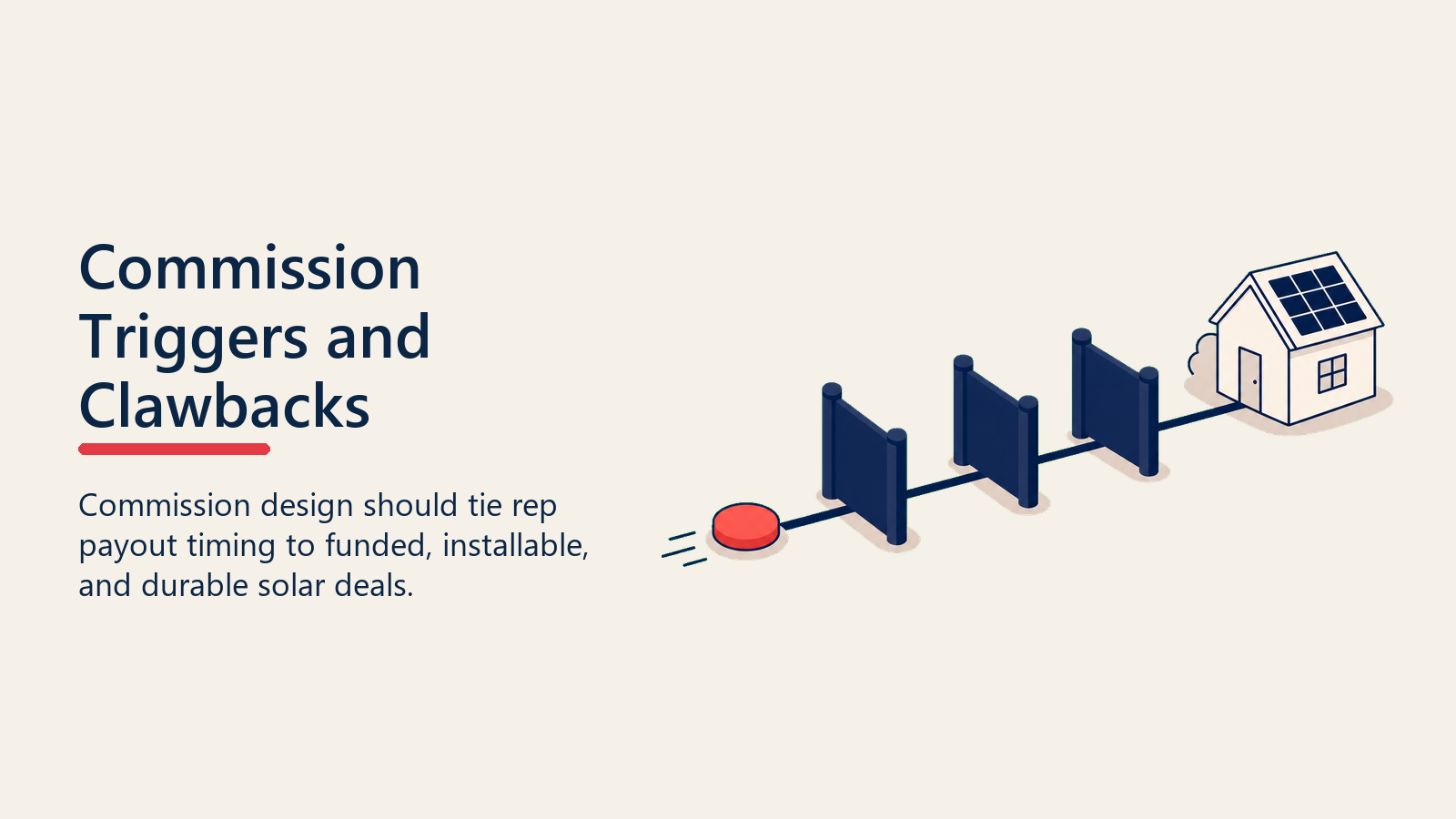
Sign as trigger (high risk). Paying on signed contracts is the most rep-friendly structure and the riskiest for the company. Reps have no financial stake in whether the deal funds, the credit qualifies, or the customer survives the install wait. Companies that pay on sign typically see:
- Higher cancellation tolerance among reps
- More marginal credit applications
- Less rep engagement during the install period
If you use sign as a trigger, a clawback provision is essential. A typical structure: full clawback if the deal cancels before funding, partial clawback (25-50 percent) if the deal cancels before install.
Fund as trigger (balanced). Paying on funded deals aligns rep interest with the credit and documentation process. Reps who understand the lender waterfall and pre-qualify homeowners accurately get paid more reliably than reps who sign anyone and hope. This is the most common trigger in well-run solar companies.
Install as trigger (rep-challenging). Paying on installed systems creates maximum alignment between sales and operations but puts reps in a cash-flow hole during long install cycles. A 4-month install backlog means a rep who closes 3 deals in January doesn't see commission until April, May, and June. Without a draw, that's unsustainable.
Most companies using install-as-trigger pair it with a recoverable draw: the company advances $1,000 to $1,500 per deal signed, which the rep "repays" from commission at installation. This bridges the gap while keeping alignment.
Clawback Design That Doesn't Destroy Trust
Clawbacks are necessary. A rep who signs a deal that cancels six months later and keeps their full commission is being paid for something that never generated revenue. But clawbacks designed carelessly destroy trust and drive attrition.
Principles for clawback design that reps can live with:
- Transparent upfront. Every rep should be able to explain the clawback exactly. If they can't, the policy isn't clear enough.
- Tied to controllable events. Clawback for credit failures should only apply if the rep bypassed the pre-screen process, not for install delays ops caused.
- Time-bounded. A 90-day window from sign is common and reasonable. An 18-month clawback window creates perpetual anxiety.
- Proportional. Full clawback on a week-two credit failure is reasonable. A deal that ran five months before a dispute is a different conversation.
- Clear appeals process. Reps need a way to contest without it feeling like career risk.
See retention fundamentals for the operational practices that reduce cancellation rates, which in turn reduces the frequency of clawbacks. Fewer cancellations mean fewer clawback conversations, and fewer clawback conversations mean reps trust the comp plan enough to stay.
Setter Compensation: Aligning Downstream Outcomes
Setter comp design is where many solar companies get it most wrong. Flat per-appointment pay drives volume; it doesn't drive quality. And appointment quality is the variable that most determines whether the closer's time is well spent.
The setter comp structure should have at least two components:
Component 1: Per-appointment-that-ran base. Setters earn a base payment for every appointment that shows and runs (closer knocks, homeowner is home, consultation occurs). This creates the incentive to confirm appointments properly and pre-qualify homeowners, since a no-show pays nothing.
Component 2: Closed-deal quality bonus. A monthly or quarterly bonus tied to the close rate on the setter's appointments. If the setter's appointments close at 30 percent vs. the team average of 22 percent, they earn a meaningful bonus. If they close below 15 percent, no bonus.
Example structure:
- $50 per appointment that ran
- $150 bonus per closed and funded deal from their appointments (paid at funding)
- Monthly quality bonus: $500 if close rate exceeds 28 percent, $250 if between 22-28 percent, $0 below 22 percent
This structure rewards volume (the $50 base), alignment with closers (the $150 deal bonus), and overall quality (the monthly quality bonus). Setters on this structure self-police their own appointment quality because bad appointments cost them money.
See setter and closer alignment for how comp design connects to the operational alignment between the two roles. Comp creates the incentive; process creates the behavior.
Designing for the Ramp Period
New reps need a comp structure that keeps them alive while they ramp. A rep who can't pay rent in month two quits in month two, regardless of how good they might have become in month four.
The ramp period comp options:
| Structure | How it works | Best for |
|---|---|---|
| Recoverable draw | Company advances $X per week against future commissions | Reps with low savings; creates debt obligation |
| Non-recoverable draw | Company guarantees minimum earnings per month regardless of production | Higher company cost; better retention in early ramp |
| Training salary | Fixed pay for the first 30-60 days, then transition to commission | Attracts candidates from salaried backgrounds |
| Milestone bonuses | Bonuses at 30/60/90 day milestones if targets are hit | Rewards progress; creates checkpoints for both parties |
The most common structure for regional solar companies is a non-recoverable draw of $2,000 to $3,500 per month for the first 60 days, then a 30-day transition window where the rep earns the greater of draw or commission, then full commission by month four.
Be explicit with candidates about this. A rep who thought they had a guaranteed base for 6 months and discovers the draw ends at day 60 feels misled. See recruiting and ramping solar reps for the full ramp program structure that these comp milestones plug into.
Bonuses, SPIFs, and Behavioral Incentives
Beyond base commission, short-term performance incentives (SPIFs) are a powerful tool for shaping specific behaviors over a defined period.
Common solar SPIFs that work:
- Same-day close bonus: Extra $200-300 for deals signed on the first visit. Drives one-call close discipline without requiring a comp plan redesign.
- Referral close bonus: Extra $300-500 for deals closed from customer referrals. Signals that referrals are valued and drives reps to ask for them.
- Monthly volume bonus: $500-1,000 for hitting a monthly deal threshold (e.g., 8+ funded deals). Drives consistent performance rather than feast-or-famine months.
- New-channel bonus: Extra $250 for each deal closed from a new lead source (event lead, digital inbound) during a specific period. Used when trying to diversify away from canvassing.
SPIFs should be simple enough to explain in one sentence, short-term (30 days works well), paid quickly, and tracked on a visible leaderboard. See solar sales KPIs and metrics to track whether a SPIF is actually moving behavior before you run it again.
Why Does Comp Transparency Matter as Much as the Rate Itself?
The fastest way to lose a producing rep is to pay them incorrectly or opaquely. Commission disputes that take three weeks to resolve and end with "trust us, the math is right" erode the relationship faster than a bad week of no-shows.
Comp administration best practices:
- Reps can see their deal status in the CRM. They shouldn't have to ask finance whether a deal funded. Real-time visibility on pipeline stage and funding status reduces comp anxiety.
- Commission statements are itemized. Each payment should show which deals are included, at what rate, and any clawbacks with the reason code.
- Payment timing is contractual, not discretionary. "Commission is paid within 7 business days of funding confirmation" is a policy. "We pay when we can" is a problem.
- Disputes have a 30-day window and a resolution process. Not email chains that go unanswered for two weeks.
- Comp plan changes have a 30-day notice period. Changing commission rates mid-month or retroactively is the kind of move that sends your best reps to a competitor.
The trust built by reliable, transparent commission administration is worth more than a 0.5 percent higher commission rate. Reps talk to each other about comp. If your payment process is a source of anxiety, your best performers start looking elsewhere. According to SPOTIO's State of Field Sales, only 18% of field sales organizations have achieved sustainable success, consistently hitting quota while keeping turnover under control, which underscores how much comp administration and team stability are intertwined.
For the broader context on how comp design fits into team performance, see the residential solar sales growth model and solar sales KPIs and metrics. And for the qualification side of the equation (because a well-compensated rep who cannot identify real opportunities is still a problem), see lead scoring systems to understand how your comp incentives should align with the quality signals your pipeline is already tracking.
Quotable Nuggets
"Fix the clawback policy before increasing your Google Ads budget. In solar, comp design moves the needle more than most marketing spend ever will." Informed by McKinsey, "Sales Incentives That Boost Growth"
"If setters are paid purely on appointments booked, they'll book appointments. The structure predicts the behavior. Changing the behavior without changing the structure is a management problem that has no management solution."
"Commission disputes that take three weeks to resolve and end with 'trust us, the math is right' erode the relationship faster than a bad month of no-shows. Transparent, reliable payment administration is one of the defining traits of field sales teams that consistently hit quota and keep turnover low."
The Behavior-First Comp Design Process: Before writing a comp plan, list the five or six specific behaviors you want to drive (e.g., pre-qualifying homeowners accurately, completing deals through funding, staying engaged through the install wait period, asking for referrals at activation). Then, for each behavior, identify which comp lever (when commissions are earned, what they are calculated on, or what the floor and ceiling are) could reinforce it. Build the plan from that behavior map. When a behavior problem surfaces later (closers signing marginal deals, setters booking unqualified appointments), trace it back to the lever that is creating the wrong incentive. That is the lever to adjust.
Frequently Asked Questions about Solar Commission and Comp Design
What is the most important question in solar comp design?
When are commissions earned? Pay on signed contracts and reps have no stake in whether deals fund or customers survive the install wait. Pay on funded deals and reps care about credit qualification. Pay on installed systems and reps stay engaged through long cycles but need draw support. The trigger decision shapes every other behavior downstream.
What is a clawback and how do we design one that doesn't destroy trust?
A clawback is the recovery of commissions paid on deals that later cancel or get declined. A trust-preserving clawback is: written in the contract from day one, tied only to events the rep could have controlled (not operational delays), time-bounded (90 days from sign is common and reasonable), proportional to when in the cycle the cancellation happens, and comes with a clear appeals process. Clawbacks designed carelessly are the fastest way to lose a producing rep.
How do we compensate setters in a way that improves appointment quality, not just volume?
A two-component structure: a base per-appointment-that-ran (rewarding confirmed shows rather than bookings) plus a quality bonus tied to close rate on the setter's appointments. Example: $50 per appointment that ran, $150 bonus per closed-and-funded deal from their appointments, and a monthly quality bonus ($500 at 28%+ close rate, $250 at 22-28%, $0 below 22%). Setters on this structure self-police their own appointment quality because bad appointments cost them money.
What is the most common comp trigger structure in well-run solar companies?
Pay on funded deals. It aligns rep interest with the credit and documentation process, is more company-protective than sign-as-trigger, and is more rep-friendly than install-as-trigger (which requires a draw bridge during long install cycles). Reps who understand the lender waterfall and pre-qualify accurately get paid more reliably than reps who sign anyone and hope.
How should ramp-period comp be structured to reduce early attrition?
A non-recoverable draw of $2,000 to $3,500 per month for the first 60 days, a 30-day transition window where the rep earns the greater of draw or commission, then full commission by month four. Be explicit about this timeline at the offer stage. A rep who thought they had a guaranteed base for six months and discovers the draw ends at day 60 feels misled, and that feeling tends to accelerate exit.
Why do SPIFs work for short-term behavior change but not long-term alignment?
SPIFs create urgency around a specific behavior for a defined window (30 days is ideal). They work because the incentive is immediate, visible, and simple enough to explain in one sentence. But they don't reset the underlying structure. Use SPIFs to drive specific near-term behaviors (same-day close discipline, referral requests, new-channel deals) while keeping your core comp plan aligned with the long-term behaviors you want.
What does transparent comp administration actually require?
Five things: reps can see their deal status in the CRM without asking anyone, commission statements are itemized by deal and rate, payment timing is contractual (not discretionary), disputes have a 30-day window and a documented resolution process, and comp plan changes require 30 days notice. The trust built by hitting those five consistently is worth more than a 0.5% higher commission rate.
What comp structure works best for the hybrid closer (base plus commission)?
A modest base of $2,500 to $3,500 per month plus $600 to $800 per funded deal works well in competitive markets where other employers offer base pay. It stabilizes early ramp performance, reduces desperation-driven behavior in consultations, and attracts candidates who would otherwise pass on a full-commission role. The tradeoff is a higher company cost floor and a risk of attracting reps who optimize for base security over performance. A well-designed comp plan doesn't guarantee great sales. But a poorly designed one almost guarantees the wrong behaviors, the wrong hires, and a revolving door that costs more than a full redesign. Start with the behaviors you want. Work backwards to the structure that makes those behaviors pay.

Senior Implementation Consultant
On this page
- The Three Levers of Solar Comp
- Closer Comp Structures: The Four Common Models
- Model 1: Per-Deal Flat Commission
- Model 2: Percentage of Contract Value
- Model 3: Per-Kilowatt Installed
- Model 4: Hybrid (Base Pay + Per-Deal Commission)
- Commission Triggers and Clawbacks
- Clawback Design That Doesn't Destroy Trust
- Setter Compensation: Aligning Downstream Outcomes
- Designing for the Ramp Period
- Bonuses, SPIFs, and Behavioral Incentives
- Why Does Comp Transparency Matter as Much as the Rate Itself?
- Quotable Nuggets