Presenting Price and Financing in Solar Sales: The Sequence That Protects Margin and Closes Deals
Turn this article into takeaways for your work.


Each assistant summarizes the article only for you and suggests best practices for your work.
Presenting price in solar is one of the highest-impact moments in the entire sales process. Done right, it feels inevitable. Done wrong, it opens a negotiation you probably won't win, or starts a "we'll think about it" stall that rarely converts.
The difference usually isn't the price itself. It's the sequence, the framing, and the confidence with which you walk through it. This guide covers the exact approach to presenting solar pricing and financing so customers understand what they're buying, why it's worth it, and how to say yes tonight.
The Core Principle: Value Before Price, Always
In most retail purchases, customers know the product and want the lowest price. Solar is different. Most customers don't fully understand what they're buying, what the savings will actually be, or how the system relates to their situation specifically.
Price without context lands as sticker shock. A $42,000 system cost mentioned before the customer understands what it produces, what it saves, and what the financed payment looks like is almost impossible to defend.
But a $42,000 system cost mentioned after the customer has seen:
- Their current 25-year utility trajectory ($120,000+ in payments)
- Their first-year savings ($2,800)
- Any federal or state tax credits that reduce net cost (see the incentives section below for current eligibility)
- A monthly payment that's less than their current utility bill
...lands completely differently. Same number, completely different reaction.
Key Facts
- The U.S. residential electricity rate averaged 16.61 cents per kWh in mid-2024 and rose to 18.83 cents per kWh by April 2026, a roughly 13% increase in under two years. (EIA Electricity Monthly Update, April 2026)
- Fifty-eight percent of residential solar projects were financed with a loan in 2023, making loans the dominant purchase method by a wide margin. (CFPB Solar Financing Issue Spotlight, August 2024)
- EnergySage data puts the average solar homeowner's 25-year savings at roughly $60,000, with a range of $37,000 to $154,000 depending on location, rate environment, and system size. (EnergySage, 2026)
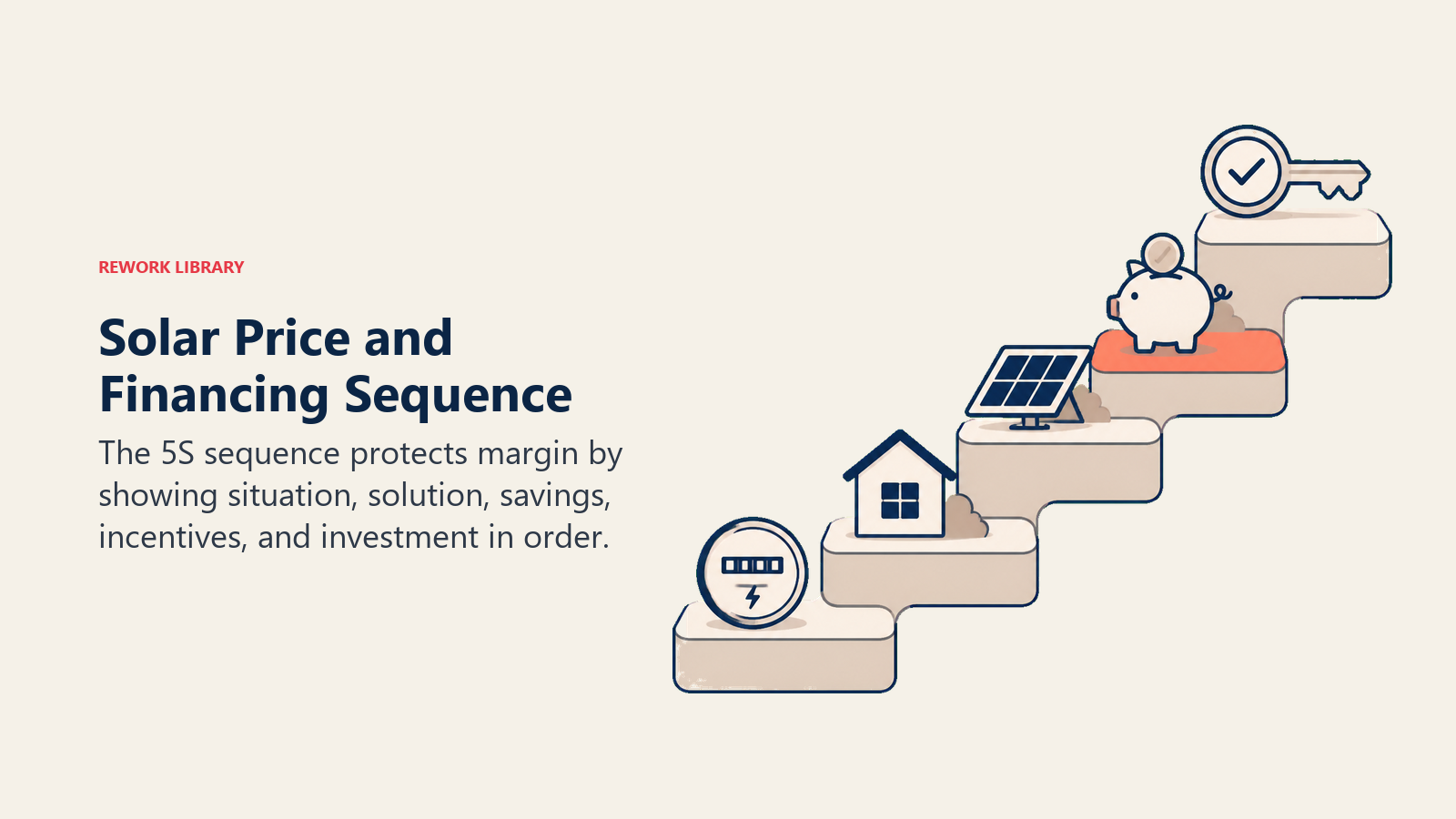
The 5S Sequence: situation, solution, savings, incentives, then investment. Price comes last, after the customer already understands the value. This named order matters because each step builds the mental anchor that makes the next one land. Skip situation and savings feel abstract. Skip savings and the investment number has no context to compete against. It's the same value-first principle described in value selling frameworks, and it works just as well in the living room as in a B2B boardroom.
The Presentation Sequence Step by Step
Step 1: Anchor to Their Current Trajectory (2-3 minutes)
Before showing anything about solar, show them what happens if they do nothing.
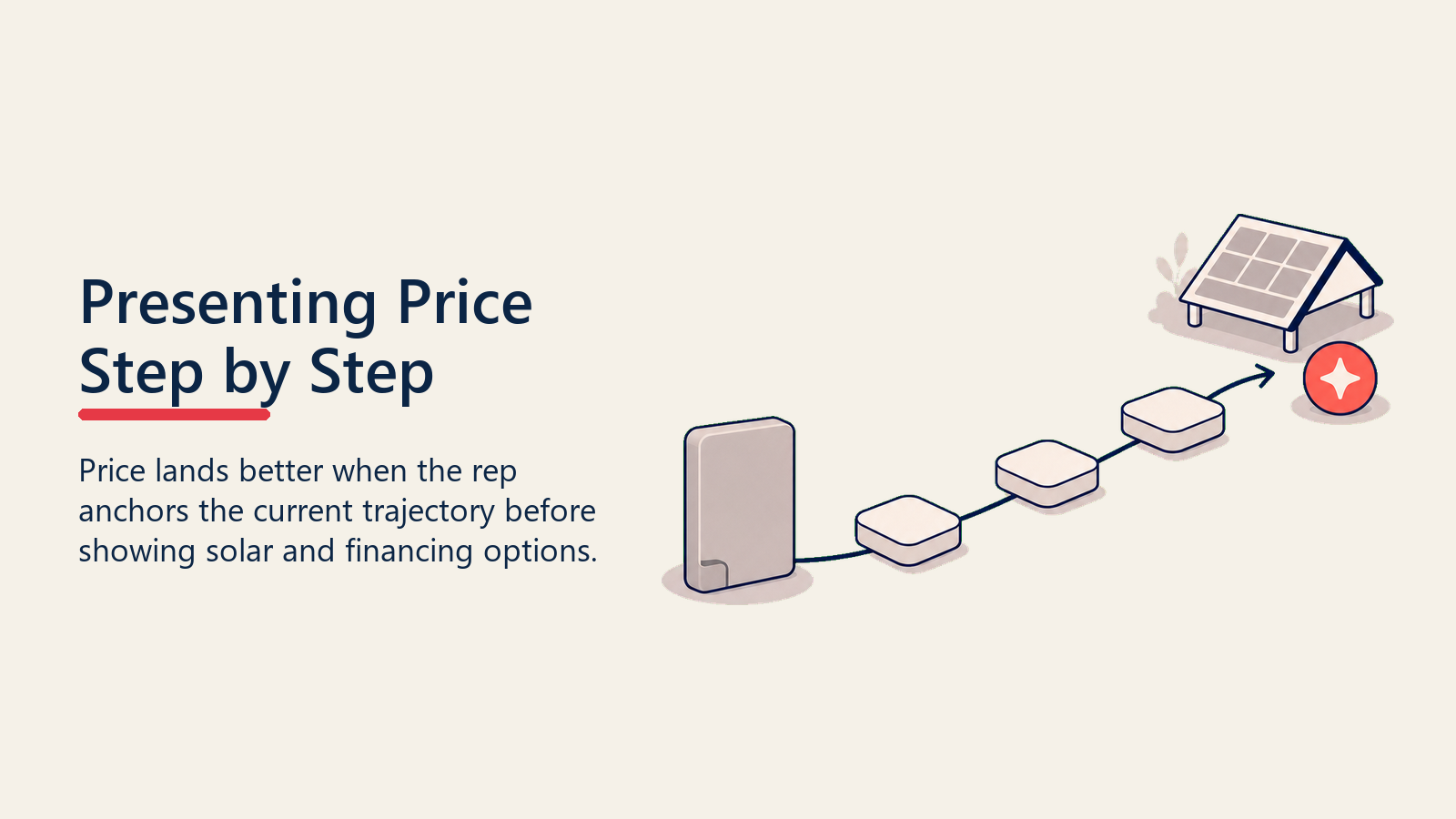
Pull up their current utility bill, or use the 12-month average you gathered during the home energy needs assessment. Then project it forward:
"Your average bill right now is $285/month. That's $3,420 this year. If utility rates go up at their historical average of about 3% per year, which is actually pretty conservative, by year 10 you're paying around $4,600 per year. Over 25 years, you'll pay somewhere between $115,000 and $125,000 to your utility company. And you own exactly nothing at the end." The EIA's tracking of retail electricity prices confirms this long-term upward trend, and in higher-rate states like California and New England the annual increase has averaged 2.6-2.8%, making the projection even more compelling.
Let that land. Don't rush past it. The "you own nothing" line matters. Utility payments are pure operating expense. Solar is an asset.
Step 2: Show the System and What It Does (5 minutes)
Walk them through the proposed system. Don't read off specs. Translate the specs into outcomes:
- "This is a 9.9 kilowatt system. What that means for you is it'll produce about 14,200 kilowatt hours per year, which covers essentially all of your current usage."
- "We're using [Brand] panels, which come with a 25-year production warranty. They'll still be producing at least 90% of their rated output in year 25."
- "The monitoring system lets you see in real time how much you're producing and what you're consuming. You'll actually know where your energy goes for the first time."
If you have a rendering of panels on their roof, show it now. Seeing their specific home with solar on it makes it real in a way a generic diagram doesn't.
Step 3: Walk Through the Savings (5-7 minutes)
This is the most important part of the presentation. Go line by line:
Monthly comparison:
| Current Monthly Cost | With Solar |
|---|---|
| Utility bill: $285/month | Solar loan: $192/month |
| Total annual: $3,420 | Remaining utility bill: ~$25/month |
| Annual solar cost: $2,604 | |
| Annual savings: ~$816 |
"In year one, you're saving about $820 compared to what you're paying now. But it gets better over time, because your loan payment is fixed and utility rates keep going up."
Year 10 comparison:
| Year 10 Current | Year 10 With Solar |
|---|---|
| Estimated utility: $4,600/year | Solar loan: same $192/month |
| Annual savings: ~$1,990/year |
25-year summary:
| 25-Year Current Cost | 25-Year With Solar |
|---|---|
| $120,000+ (rate escalation) | Total loan payments: ~$57,600 |
| Estimated savings vs. no solar: ~$62,000+ |
Let the customer do the math out loud with you. Ask: "Does that make sense?" and pause. You want them engaging with the numbers, not just watching you flip through slides.
Step 4: Walk Through Incentives (3-5 minutes)
Introduce incentives after savings, not before. If you introduce the federal tax credit too early, customers focus on the sticker price minus the credit as the "real" price before they've understood the savings story.
Federal Investment Tax Credit (ITC) current status: The One Big Beautiful Bill Act, signed July 4, 2025, ended the Section 25D residential clean energy credit for owner-purchased systems. Systems where installation was completed by December 31, 2025 qualify for the 30% credit on the owner's 2025 tax return. Systems installed on or after January 1, 2026 receive no federal residential tax credit under Section 25D, with no transition period or phase-down. The IRS FAQ on OBBBA modifications to Section 25D is the authoritative source. Third-party-owned systems (leases, PPAs) continue to earn a commercial credit under Section 48E through 2027, so that distinction matters when choosing a financing structure.
For customers whose system was installed in 2025 and who are claiming the credit: "This is a tax credit, not a rebate. If you owed $15,000 in federal taxes this year, the credit reduces that to $2,400. If you owed less than $12,600, you can carry the remainder forward to next year's taxes. Do you typically have federal tax liability each year?"
If the customer installed in 2025 and is on a very low tax bill, be honest about whether they can fully use the credit. Point them to the IRS Residential Clean Energy Credit and suggest they confirm with their tax preparer.
For customers installing in 2026 or later: the federal residential credit is no longer available for owner-purchased systems. Do not present a 30% ITC as part of the savings story. Focus the conversation on state incentives, utility rebates, net metering value, and long-term rate protection. The financing math still works in many markets, but it needs to stand on its own without the federal credit.
State and local incentives: Walk through any applicable state credits, utility rebates, or property tax exemptions. Use specific dollar amounts, not percentages. "$1,400 state rebate" lands better than "a 3% state credit." The DSIRE database is the most complete source for current state-level solar incentives, net metering rules, and property tax exemptions, and it's searchable by zip code.
Step 5: Present the Investment (3-5 minutes)
Now you show the number.
"Let me show you the full investment." Display the proposal page showing total system cost, then the incentive-adjusted cost based on what actually applies to this customer:
For 2025 installs (ITC-eligible):
- Total system: $42,000
- Less federal ITC (30%, Section 25D, for 2025 installs completed by Dec 31, 2025): -$12,600
- Effective cost after credit: $29,400
For 2026+ installs (no federal residential ITC):
- Total system: $42,000
- Less applicable state/local incentives: -$
- Net cost before financing: $42,000 (or reduced by state credits if applicable)
"Most of our customers finance this because the monthly payment is less than what they're paying to the utility right now. Let me show you the options."
Presenting Financing Options
Solar financing has multiple structures. Know which ones are available through your company's solar financing models and which ones fit this customer's situation.
Financing Structure Comparison
| Option | How It Works | Best For |
|---|---|---|
| Loan (secured) | Customer owns system, fixed payment | Best for ITC capture, lowest rate |
| Loan (unsecured) | No lien on home, slightly higher rate | Customers nervous about home liens |
| PPA | Pay per kWh produced, no ownership | Low-income households, tax-credit-ineligible |
| Lease | Fixed monthly payment, no ownership | Customers who prefer no system responsibility |
| Cash | Full payment upfront | High net worth customers, best long-term ROI |
For most customers who qualify for the ITC and want to maximize savings, a loan is the right recommendation. A well-structured solar loan:
- Has a fixed interest rate for the full term
- Monthly payment lower than current utility bill
- Customer owns the system and captures the ITC
- System adds to home value (and in most states, isn't taxed as such)
Presenting Multiple Options Without Creating Confusion
Most reps present too many options. Three financing options plus cash is four decisions, and four decisions produces paralysis.
A better approach: present two options. The primary recommendation and one alternative.
"Based on your situation, I'd recommend the 25-year loan at $192/month. That gives you the lowest monthly payment and the full loan term is covered by the production warranty. I can also show you a 15-year option at $267/month if you want to build equity faster and pay less in total interest. Which would you like to run the numbers on?"
Let them choose between two, not pick from a menu of five. For the psychology behind why fewer choices close better, the guidance on close plan development covers choice architecture in sales.
The "Effective Monthly Cost" Frame
Many customers anchor to the loan payment and compare it to zero, their mental model of what not having a loan costs. The correct comparison is to their utility bill.
Reframe the math: "You're not adding a $192 payment to your budget. You're replacing a $285 utility payment with a $192 solar payment plus a ~$25 true-up bill. Your actual monthly cost goes from $285 to $217. That's the comparison."
This shift from "new expense" to "replaced expense" is one of the most important reframes in solar financing conversations.
Handling Price Objections
Even with a well-sequenced presentation, price objections come up. The most common ones and how to handle them:
"That's more than I expected."
"I understand. Solar is a significant investment. But let's put it in context: you just saw that over 25 years you'll pay $120,000 to the utility with nothing to show for it. This system costs $42,000 and you own it outright. The comparison isn't $42,000 versus zero. It's $42,000 versus $120,000. And unlike utility payments, this one is fixed and ends. Does that reframe help?"
(If the customer installed in 2025 and qualifies for the Section 25D credit: "After the federal tax credit, your effective net cost is $29,400. The comparison gets even more favorable.")
"Can you do better on the price?"
Avoid discounting immediately. It signals the first price wasn't real, which destroys credibility.
"Our pricing is based on the equipment quality and installation standards we use. The system I've designed for you isn't a baseline system. But let me check something for you."
Then look at the proposal, pause, and come back with something small: "I can adjust [one specific thing, like an equipment choice or remove a non-critical add-on], but I want to be honest with you, the difference will be modest. The bigger lever is making sure you capture the full tax credit, which saves you $12,600 right there. Have you talked to your accountant about your tax situation this year?"
For customers who qualified for the 2025 Section 25D credit, the tax filing is where they recover a significant portion of the system cost. For 2026+ installs, redirect the conversation to state incentives and utility rebates rather than a federal credit that no longer applies.
"I want to get other quotes."
"Absolutely, and I'd encourage you to compare. What I'd suggest looking at when you get other quotes: make sure you're comparing the same panel and inverter specs, not just the price. A cheaper system often means lower-efficiency panels, which means less production and less savings over 25 years. I'll leave you this proposal so you have a baseline. But let me ask: is there something about this proposal that isn't working for you, or is it just wanting to do due diligence?"
The last question surfaces whether the objection is genuine comparison-shopping or a hesitation they haven't named yet.
The Moment After You Show the Price
When you reveal the effective monthly payment, the room will go quiet for a moment. This is normal. Do not fill the silence.
After showing the monthly payment, say: "Does that work for your budget?" and stop talking.
The customer will either say yes, ask a question, or raise an objection. All three are good. What kills deals is the rep who answers the silence with more talking, more features, more justification. Let the customer respond to what they see.
If they say "yes," move to paperwork immediately. Don't keep presenting. The sale is made.
If they ask a question, answer it and close again: "Good question. [Answer.] So given that, are you ready to move forward?"
If they object, handle the objection with the frameworks above and close again.
The whole presenting sequence connects directly to how you close. Whether you're going for a one-call close or a multi-visit process, the price presentation is the setup for the closing ask. A strong presentation makes the close dramatically easier.
What Are the Most Common Mistakes When Presenting Solar Price?
Don't apologize for the price. "I know this is a lot, but..." signals you don't believe in the value. Present with confidence.
Don't negotiate with yourself. Don't pre-emptively offer discounts before they ask. Let them respond first.
Don't rush the savings section to get to price faster. Customers who didn't absorb the value story will object on price. More time on savings means less time defending price.
Don't present financing options on paper only. Walk through the monthly comparison verbally, point at the numbers, ask questions. Passive reading of a proposal is very different from an active conversation about it.
Don't leave the room to "check something" and come back with a lower price. It signals fake urgency and manufactured negotiation. Make any adjustments right there at the table.

Senior Implementation Consultant
On this page
- The Core Principle: Value Before Price, Always
- The Presentation Sequence Step by Step
- Step 1: Anchor to Their Current Trajectory (2-3 minutes)
- Step 2: Show the System and What It Does (5 minutes)
- Step 3: Walk Through the Savings (5-7 minutes)
- Step 4: Walk Through Incentives (3-5 minutes)
- Step 5: Present the Investment (3-5 minutes)
- Presenting Financing Options
- Financing Structure Comparison
- Presenting Multiple Options Without Creating Confusion
- The "Effective Monthly Cost" Frame
- Handling Price Objections
- "That's more than I expected."
- "Can you do better on the price?"
- "I want to get other quotes."
- The Moment After You Show the Price
- What Are the Most Common Mistakes When Presenting Solar Price?