Solar Appointment Setting Playbook: How to Fill Your Closers' Calendars with Qualified Sits
Turn this article into takeaways for your work.


Each assistant summarizes the article only for you and suggests best practices for your work.
Appointment setting is the engine room of residential solar sales. Your closers might be excellent. Your financing products might be competitive. Your installs might be flawless. But if the appointment calendar is empty, or worse, filled with homeowners who don't show up, don't qualify, or aren't real decision makers, none of that matters.
The setter role is often treated as entry-level, a stepping stone to becoming a closer. That's a mistake. A great setter is a skilled communicator who can establish trust in 90 seconds, handle objections gracefully, pre-screen for real opportunity, and create enough commitment that the homeowner actually shows up and stays for the full consultation.
This playbook covers everything a solar appointment setter needs to perform at a high level: the core scripts, the objection handling framework, the follow-up cadence, and the metrics that tell you whether someone is on track or needs coaching.
What Makes Solar Appointment Setting Different
Solar appointment setting shares some DNA with other inside sales roles, but several things make it distinct:
The in-home dynamic. You're not booking a Zoom call. You're asking a homeowner to let a stranger into their house for an hour. The trust threshold is higher. The commitment they're making feels more real. This makes it harder to set the appointment, but it also means a homeowner who says yes is genuinely interested.
The large financial decision. Solar systems typically cost $25,000 to $60,000. According to the U.S. Department of Energy's 2024 cost benchmarks, the modeled market price for a standard residential rooftop system runs roughly $3.15 per watt DC before incentives, or around $25,000 for an 8 kW system. The federal Residential Clean Energy Credit (Section 25D) was terminated by the One Big Beautiful Bill signed July 4, 2025. The 30% credit does not apply to any system placed in service after December 31, 2025. Closers must walk homeowners through accurate net-cost math and direct them to state and utility incentives rather than relying on a federal credit that no longer applies to new installations. Even when financed, it's a significant monthly commitment. Homeowners think more carefully than they would about a small purchase. Your setter needs to make the appointment feel low-stakes while the homeowner knows the conversation will have financial substance.
The decision-maker dynamic. Most residential solar decisions involve two people. Getting one on the phone is the easy part. Getting both to commit to the same time slot is the hard part. Setters who skip the "is your spouse involved in this?" question have much lower close rates even when their appointment rates look fine.
The pre-qualification responsibility. Solar setters share responsibility for lead quality. A setter who books unqualified appointments to hit their numbers creates problems for the entire sales operation.
These differences shape everything: the opening script, the objection handling, and the confirmation process.
Key Facts: Solar Appointment Setting
- 80% of sales require five or more follow-up attempts, yet 44% of reps give up after just one contact. (SPOTIO, 2026: spotio.com/blog/sales-statistics)
- The odds of contacting a lead drop 100x when response time goes from 5 minutes to 30 minutes, according to the MIT/InsideSales.com Lead Response Management study by Dr. James Oldroyd.
- Solar no-show rates without active confirmation processes reach 30 to 40 percent in many markets, making confirmation calls a direct revenue lever. (industry planning benchmark)
What Is the Core Appointment Setting Script?
This isn't meant to be read robotically. It's a framework your setters should internalize and make their own. Adjust tone to match your brand and market.
First contact (inbound lead, within 5 minutes of form submission)
"Hi, is this [name]? Great, this is [setter name] with [company]. I'm calling because you just requested some information about solar for your home. Perfect timing, I caught you. Do you have just a couple of minutes?"
[If yes]: "Great. So I want to make sure I give you accurate information for your specific situation. Are you the homeowner at [address]?"
[After confirming homeownership]: "And do you have a sense of what your electric bill is running these days? Just ballpark."
[After bill confirmed above threshold]: "Okay, based on what you've shared, your home sounds like a really good candidate. What we'd want to do is have one of our energy consultants come out and take a look at your roof and give you a real proposal with actual numbers based on your usage and your home, not just an estimate. It takes about an hour, and there's no obligation. The whole point is just to give you the information you need to make a good decision."
[Booking]: "Does [specific day] or [specific day] work better for your schedule? And is [morning/afternoon] or [afternoon/evening] better for you?"
[Decision maker check]: "Quick question, is there a spouse or partner who'd want to be part of this conversation? The consultants always recommend having everyone there so they can answer all your questions at once."
[Confirm and close the appointment]: "Perfect. So we've got [day] at [time] at [address]. You'll hear from our consultant the day before to confirm. Is [phone number] still the best way to reach you?"
First contact (purchased lead, 24 to 72 hours old)
The opener changes because the homeowner may not remember the form, and your credibility window is shorter.
"Hi, is this [name]? This is [setter name] calling from [company]. You recently requested information about saving on your electric bill with solar. I wanted to reach out while you were still thinking about it. Do you have just a couple of minutes?"
[If they don't remember]: "Totally understandable, you may have filled out a few things online. Let me just ask you a quick question, are you a homeowner in [city]?"
From here, the script follows the same structure as above. The goal is to get them engaged in a conversation about their situation before they disengage.
Canvassing or referral lead
These are warm, but the opener needs to acknowledge the context.
"Hi, is this [name]? Great, this is [setter name] from [company]. [Your neighbor / your friend / you spoke with one of our reps] mentioned that you might be interested in hearing about your solar options. Is this a decent time for a quick conversation?"
Referral leads in particular should be acknowledged warmly. "You were referred by [name] who's one of our customers in your neighborhood. They had a great experience and thought you might like to hear what they saved." That social proof does half your work.
Handling the Five Most Common Objections
Every setter will hear these objections daily. The key isn't to have a perfect rebuttal. It's to acknowledge, relate, and redirect without pressure.
"I'm not interested."
"That's completely fair, a lot of people feel that way before they see the actual numbers for their home. Can I just ask, is it more that you don't think the timing is right, or is it that you've had a bad experience with solar companies before?"
This question tells you a lot. If they had a bad experience, you can differentiate. If timing is the issue, you can address that. If they're genuinely not interested, respect it and ask if you can follow up in a few months.
"I need to think about it."
"Of course, it's a big decision. What specifically would help you feel more comfortable moving forward? Because honestly, the appointment is really just about getting you better information. Our consultant isn't there to pressure you, they're there to show you real numbers so you can make a good decision either way."
Then go back to offering a specific date. "If you just want to see the numbers without any pressure, [specific day] at [specific time] works great. Our consultant will bring everything out and you can decide from there."
"We already have solar."
"Oh great, that means you already understand the value. A couple of things to ask: how old is the system? And are you happy with it? I ask because some homeowners with older systems are actually missing out on newer incentives and battery storage options. Would it ever make sense to chat about whether an upgrade or add-on makes sense?" If they're happy and recent, thank them and ask if they know any neighbors who'd be interested.
"Can you just send me something by email?"
"Absolutely, I can send you some general information. But I want to be honest with you, the numbers we send by email are pretty generic. The real value is when our consultant looks at your specific roof, your specific usage, and gives you actual numbers. That's when it gets interesting. What day this week could I put something on the calendar, even just tentatively?"
Offer the email AND try to book. Don't let the email request become an exit.
"My spouse/partner isn't on board."
"I totally get that. What's their main concern? Is it the cost, the process, or something else? I ask because our consultant is really good at addressing those specific questions. And honestly, having both of you there so they can ask their questions directly tends to make the whole thing go a lot smoother. What does their schedule typically look like in the evenings?"
Don't give up here. Probe what the concern is, because often it's addressable. And always try to find a time that works for both.
The Follow-Up Cadence That Actually Works
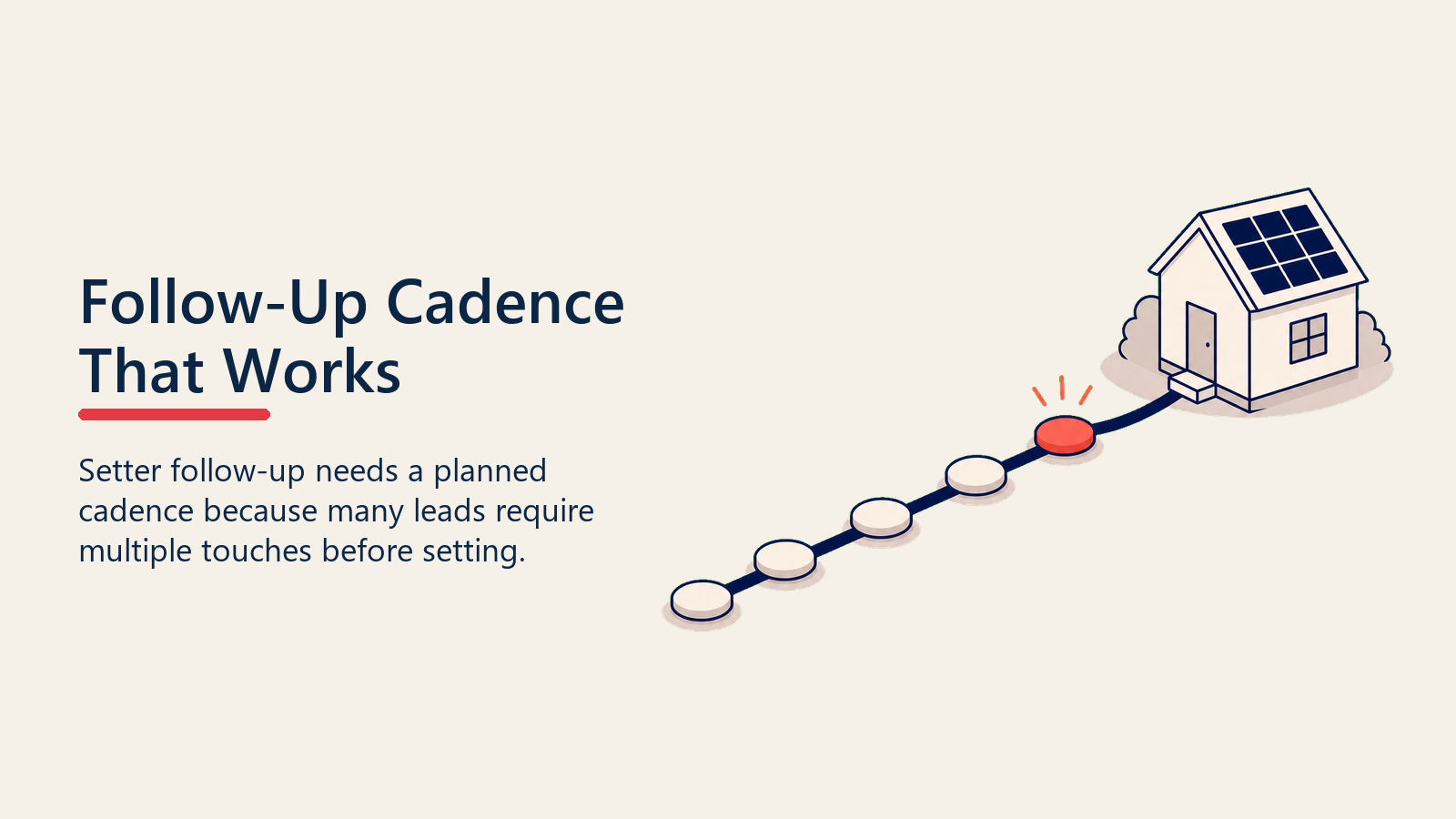
Most leads don't set on the first contact. SPOTIO's sales benchmark research confirms that only 2% of deals close on the first touch, yet 44% of reps give up after just one attempt. That gap is where well-run setter teams win.
| Attempt | Channel | Timing |
|---|---|---|
| 1 | Call | Within 5 minutes of lead arriving |
| 2 | Text | Same day if no answer, 1 hour later |
| 3 | Call | Day 2, different time of day |
| 4 | Voicemail | Day 3, structured message |
| 5 | Day 4, value-focused | |
| 6 | Call | Day 7, final high-effort attempt |
| 7 | Text | Day 10, low-pressure check-in |
| 8 | Day 14, last contact before nurture |
On voicemails, be specific: "Hi [name], this is [setter] from [company]. I've been trying to reach you because your home in [neighborhood] might qualify for a significant savings opportunity on your electric bill. If you'd like to find out, give me a call at [number], or if it's easier, just reply to the text I'll send right after this. Have a great day."
Text scripts should be short and conversational: "Hi [name], this is [setter] from [company]. I tried calling about your electric bill savings, but didn't want to leave a message. Would [day] or [day] work for a quick chat? Takes 2 min."
The goal of follow-up is to be persistent without being annoying. Vary the timing, the channel, and the message angle. After day 14 without response, move to a monthly nurture email rather than continuing active outreach.
The confirmation process is the other half of the equation. Setting the appointment is only a win if the homeowner actually shows up.
The 8-Touch Persistence Protocol: The follow-up cadence above is a named framework you can train to directly. It alternates channels (call, text, email), staggers timing across 14 days, and treats voicemails as standalone conversations. Setters who follow all eight touches consistently outperform those who call twice and stop, because the data says most decisions happen between touch 5 and touch 8.
Solar setter teams that respond to inbound leads within five minutes and sustain a full 8-touch follow-up sequence convert two to four times more leads into set appointments than teams that rely on a single call attempt. (Benchmark drawn from MIT/InsideSales.com Lead Response Management study and SPOTIO follow-up data.)
Appointment Confirmation and No-Show Reduction
Setting the appointment is only half the job. Getting the homeowner to actually show up is the other half. Solar no-show rates without confirmation processes can reach 30 to 40 percent in some markets.
A solid confirmation process:
Day before the appointment: Call to confirm. "Hi [name], this is [setter] from [company]. I'm reaching out because [consultant name] has your appointment tomorrow at [time]. Just want to confirm that still works and make sure both you and [spouse name] will be available."
If they confirm, ask: "Is there anything you'd like [consultant] to be prepared to answer when they come out?" This plants the seed that the consultation will be substantive and worth their time.
Morning of the appointment: Text reminder. "[Consultant name] is looking forward to seeing you today at [time]. See you then!" Short, warm, non-pressuring.
If they cancel or reschedule: Don't just accept the cancellation. "No problem at all, let's find another time. What does [next week] look like for you?" Rebook immediately. A cancelled appointment that's rebooked within the same call is not a lost opportunity.
See no-show and reschedule reduction for deeper coverage of confirmation scripts and rescheduling tactics.
What happens after the appointment is confirmed matters just as much. The setter-to-closer handoff is where context gets lost, and where sales teams leave money on the table.
Setter-to-Closer Handoff: What Information Actually Matters
One of the most common failure points in the setter-to-closer model is the handoff. The setter knows things about this homeowner that would help the closer tremendously, but if that information lives only in the setter's head, the closer walks in cold.
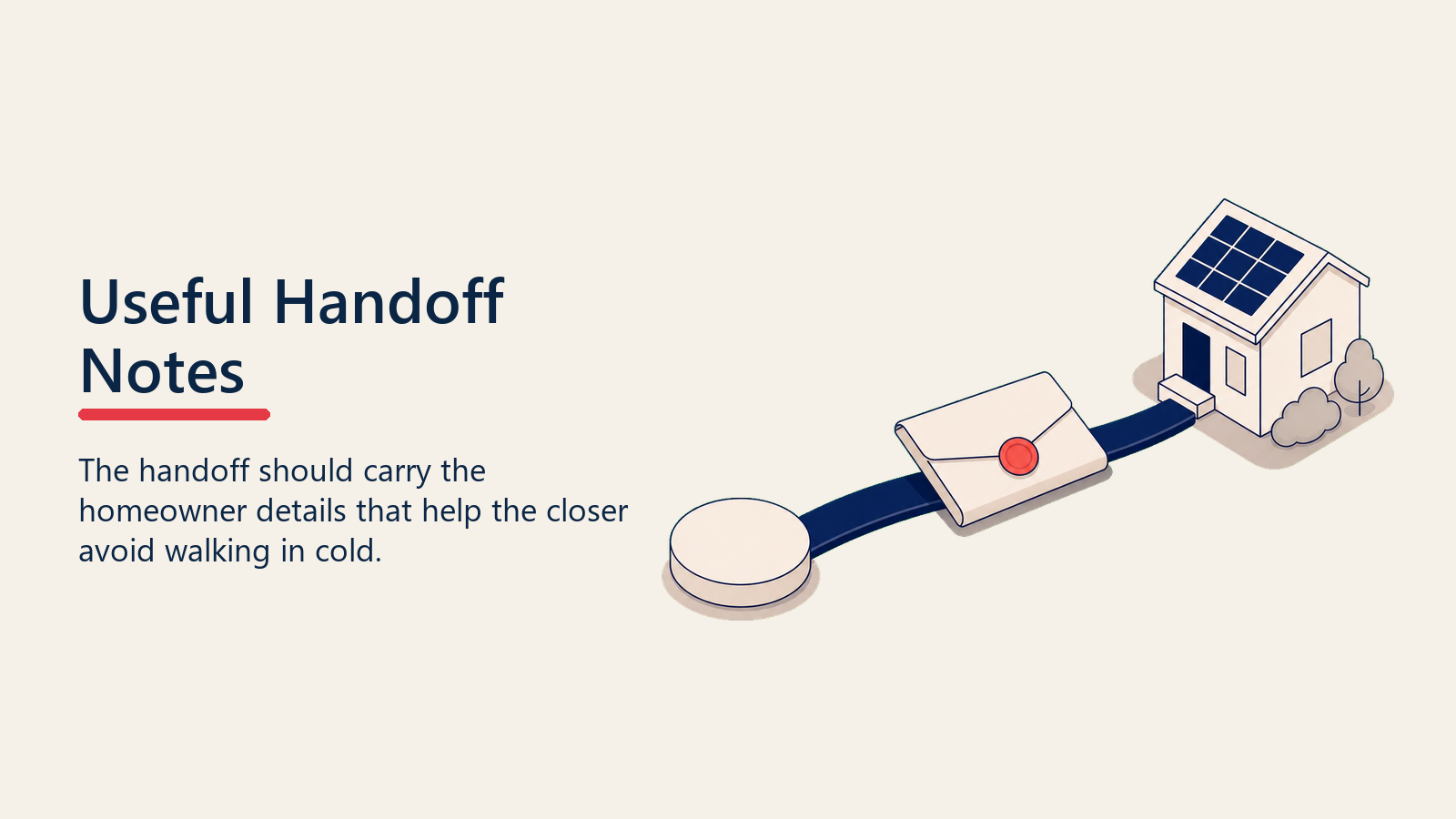
Your CRM handoff notes should include:
- Current monthly electric bill (exact if known, range if not)
- Number of people in the household
- Primary motivation expressed (saving money, environmental, self-sufficiency)
- Known objections or concerns raised during the set call
- Decision-maker situation (single, couple, who makes financial decisions)
- Any mention of other companies they're talking to
- Roof or property notes (shade concerns, age, HOA)
- Relationship context (referral source, event they attended, etc.)
The closer who walks into a house already knowing that the homeowner is primarily worried about what happens if they sell the house, and has a spouse who was skeptical but agreed to listen, runs a very different consultation from one who walks in blind. And a better one.
This handoff is part of the broader setter-to-closer handoff process that can make or break your sales conversion rates.
But metrics are what tell you whether the handoff is actually working, and where the team needs coaching.
What Setter Metrics Should You Track and Coach?
You can't manage what you don't measure. Here are the core setter metrics and what they tell you:
| Metric | Target range | What it signals |
|---|---|---|
| Dials per day | 80 to 120 | Enough activity to generate results |
| Contact rate | 35 to 55% | Quality of leads + call timing |
| Appointment set rate (of contacts) | 25 to 40% | Script quality + objection handling |
| Show rate | 70 to 85% | Quality of commitment in the set call |
| Qualified sit rate (of shows) | 80 to 90% | Pre-screening rigor |
When a setter's appointment rate is fine but show rate is low, the problem is usually that they're setting soft appointments: people who half-agreed to avoid the conversation. Coach on creating stronger commitment and doing better pre-qualification.
When contact rate is low, look at lead quality (are they reaching bad numbers?) and call timing (are they calling at the wrong hours?).
When appointment rate is low despite good contacts, the script or objection handling needs work. Listen to calls and identify where the conversation breaks down.
For alignment between setter and closer performance, look at the setter-closer alignment framework and the broader solar pipeline analytics your team should be running.
Building a Culture of Setter Excellence
The best solar companies treat their setter team as a genuine sales function, not a call center. That means:
Real training, not just a script. Setters should understand solar basics, financing products, and the in-home consultation process. When they can answer "but what does solar actually cost?" intelligently, their credibility goes up and so does their appointment rate.
Compensation tied to show rate, not just sets. If setters are compensated only on appointments set, they'll book anything. Tie a portion of their comp to show rate or to sits run by the closer. This aligns incentives correctly.
Regular call reviews. Listen to calls weekly, not just when problems arise. Celebrate wins. Identify patterns in where calls break down and address them systematically.
A clear path to closer. The best setters want to know what it takes to move up. Give them a roadmap. Setters who see themselves as temporary will phone it in. Setters who see this as building toward closing will invest in getting better.
Appointment setting is how your residential solar growth model converts lead volume into revenue. Treat it like the critical function it is, and the rest of your sales machine gets easier. Companies that tie setter compensation to show rate rather than raw appointment count consistently report higher close rates for their closers, because setters stop booking soft commitments and start creating genuine intent. (Planning benchmark based on comp structure analysis across high-performing setter teams.)
Related reading:

Senior Implementation Consultant
On this page
- What Makes Solar Appointment Setting Different
- What Is the Core Appointment Setting Script?
- First contact (inbound lead, within 5 minutes of form submission)
- First contact (purchased lead, 24 to 72 hours old)
- Canvassing or referral lead
- Handling the Five Most Common Objections
- "I'm not interested."
- "I need to think about it."
- "We already have solar."
- "Can you just send me something by email?"
- "My spouse/partner isn't on board."
- The Follow-Up Cadence That Actually Works
- Appointment Confirmation and No-Show Reduction
- Setter-to-Closer Handoff: What Information Actually Matters
- What Setter Metrics Should You Track and Coach?
- Building a Culture of Setter Excellence