Setter and Closer Alignment: The Handoff That Makes or Breaks Solar Sales
Turn this article into takeaways for your work.


Each assistant summarizes the article only for you and suggests best practices for your work.
Ask any solar sales manager what's killing their close rate and you'll usually hear one of two answers: "Our closers aren't closing" or "Our setters are booking garbage appointments." Both teams say it about each other, usually in separate rooms, and neither conversation gets them closer to solving the actual problem.
The actual problem is almost always the handoff. What the setter told the homeowner, what the closer expected to walk into, and what the homeowner thought the appointment was for are three different things. That gap is where solar revenue goes to die.
Setter-closer alignment isn't a culture initiative. It's a set of specific agreements, shared data points, and communication practices that make the handoff predictable.
The Two-Role Model and Why It Creates Friction
The setter-closer split made sense as a productivity improvement: let specialists set appointments at scale while closers focus on high-value consultation time. And it works when both roles operate off the same playbook.

The friction shows up when:
- Setters oversell to get appointments. They imply savings numbers they can't back up, or promise a "quick 30-minute overview" when the closer needs 90 minutes to run a proper consultation. The homeowner feels misled at the door.
- Closers don't trust setter notes. They assume setters booked a warm body and walk in blind, missing information that could have shaped the opening conversation.
- Qualification standards differ. The setter thought a $120 electric bill was fine. The closer knows below $150 is a hard sale. The appointment burns two hours and goes nowhere.
- No feedback loop exists. A closer runs a bad appointment, notes it in the CRM as "unqualified homeowner," and the setter who booked it never finds out. The same mistake repeats next week.
See solar appointment setting playbook for the setter's full process. This article is about what happens at and after the handoff point.
Key Facts
- The SPOTIO State of Field Sales 2026 report found that 41% of field sales teams report annual rep turnover of 50% or higher, and 42% of organizations need three or more months to fully onboard a new rep. That combination compounds the cost of every broken handoff.
- The Salesforce State of Sales report found that 81% of sales reps say team selling helps them close more deals, while 82% say aligning with other sellers is at least somewhat challenging. Setter-closer friction is a direct instance of that gap.
- NREL research on residential solar contract cancellations found a median installer cancellation rate of 33%. Permitting delays and changes in customer finances are the top two drivers, but post-sign silence and expectation mismatches from the setter-closer chain are contributing factors that companies can control. (NREL, 2022)
What Setters Must Capture and Communicate
The closer should never walk into a home for the first time without context. They should walk in already knowing:
| Information | Why the closer needs it | Where it should live |
|---|---|---|
| Homeowner name(s) and who will be present | Allows personal greeting, catches missing decision-makers at the door | CRM appointment notes |
| Estimated monthly electric bill | Sets savings projection range before the closer arrives | CRM + confirmation text |
| Homeownership confirmed | Prevents the "actually I rent" reveal mid-consultation | Setter checklist, noted in CRM |
| Credit pre-screen result | Tells closer which financing tier to lead with | CRM notes or flag |
| Homeowner's stated interest level | "Curious" vs "ready to go solar, just needs the numbers" changes the opening | CRM notes |
| Any objections already surfaced | If homeowner mentioned "I talked to SunRun last month," closer can plan for it | CRM notes |
| Best language or pain point | Some homeowners care about savings; others are motivated by energy independence or environment | CRM notes |
| Appointment confirmation method | Was this confirmed by phone, text, or both? How recently? | CRM timestamp |
This information should be standardized, not free-text. A CRM dropdown for electric bill range, a checkbox for homeownership confirmed, and a required notes field for key concerns takes about 90 seconds for a setter to complete and saves the closer 15 minutes of cold discovery.
The Pre-Appointment Closer Brief
The closer should review the appointment brief before driving to the home. Not during the drive. Before.
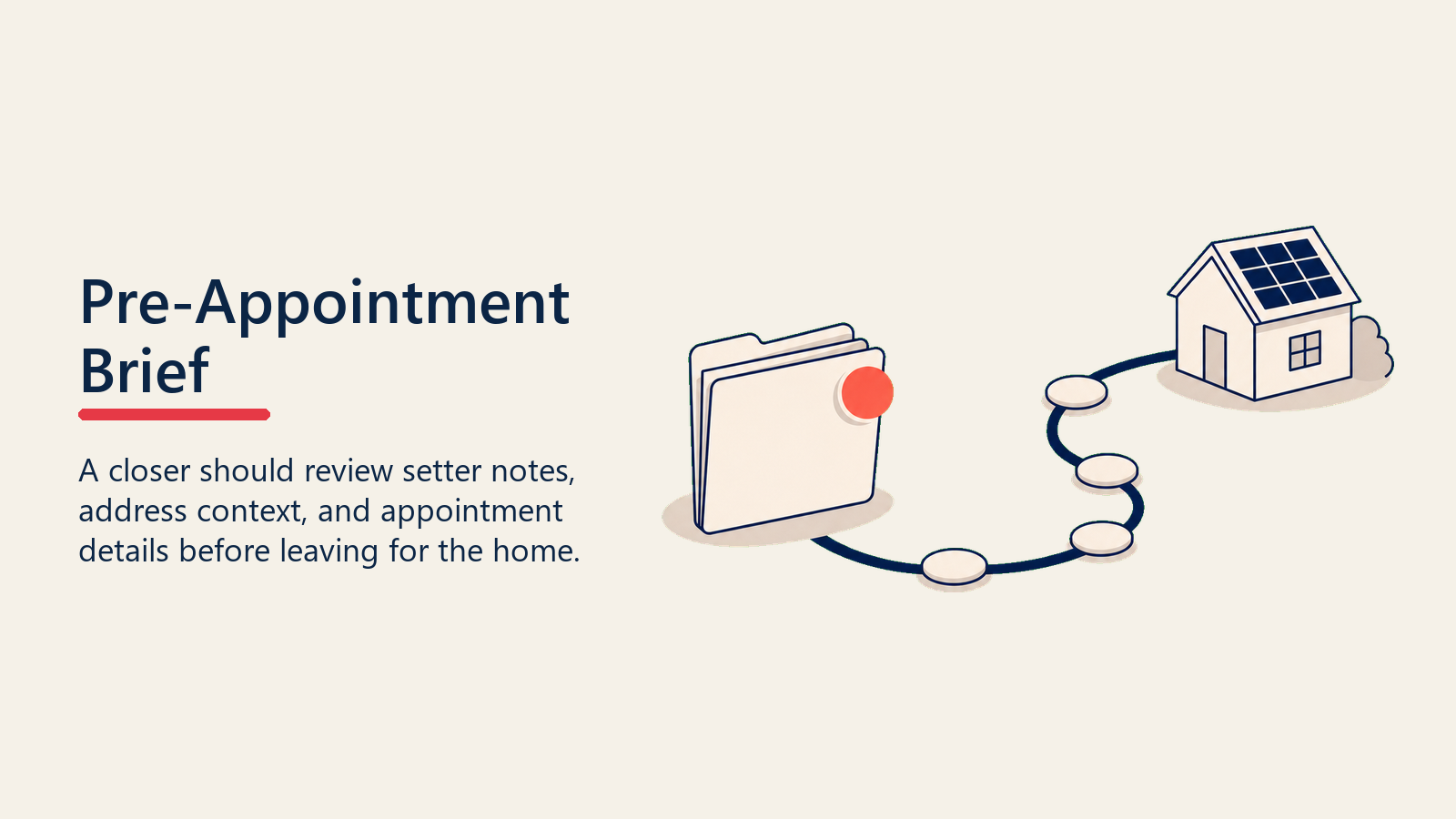
A good pre-appointment brief takes four minutes:
- Read the setter notes in the CRM. Note anything unusual.
- Check the address on satellite view. Is the roof visible, unshaded, and reasonably oriented? Are there obvious obstructions like large trees or adjacent structures?
- Confirm the appointment is still active. Has the CRM been updated in the last 24 hours? Any new notes from the setter or from confirmation calls?
- Prepare the financing opening. If the setter flagged a 650+ credit score pre-screen, the closer should mentally frame the Tier 1 financing offer. If the pre-screen was uncertain, the closer should be ready for a Tier 2 or Tier 3 conversation.
This brief takes almost no time, but it changes how closers walk in the door. Confident, prepared closers with specific knowledge about the homeowner build rapport faster and close at higher rates.
See confirming and prepping the appointment for the confirmation sequence that runs in the 48 to 72 hours before the appointment, which feeds into this brief.
What to Do When the Setter Missed Something
Setters make mistakes. A closer will occasionally walk into a home where the homeowner is a renter, the spouse is absent, or the electric bill is $80 a month. The question isn't how to prevent every miss; it's how to handle it without torching the closer's time or the homeowner's experience.
The door assessment: Before the closer even sits down, they should do a brief "warm-up and verify" in the first two minutes. They're checking for the fundamental qualifiers while building rapport:
- "So you've been in this home for a while, or are you newer to the area?" (catches renters without a direct accusation)
- "Is your spouse or partner home today, or is it just you?" (catches absent decision-makers)
- "Before I pull up everything, roughly what does your electric bill run? I want to make sure the numbers I show you are realistic for your usage." (catches sub-threshold bills)
If a red flag appears, the closer can gracefully reschedule or redirect rather than burning 90 minutes on a deal that was never going to close.
The feedback path: Whatever the closer finds, it needs to get back to the setter. Not blame, but specifics: "Here's what was on the appointment note, here's what I found at the door" gives the setter actionable feedback they can actually use.
Building the Feedback Loop
Setter-closer alignment deteriorates without a feedback loop. Closers who don't give feedback feel justified venting in the break room. Setters who don't receive feedback can't improve. Both groups blame the other and nothing changes.
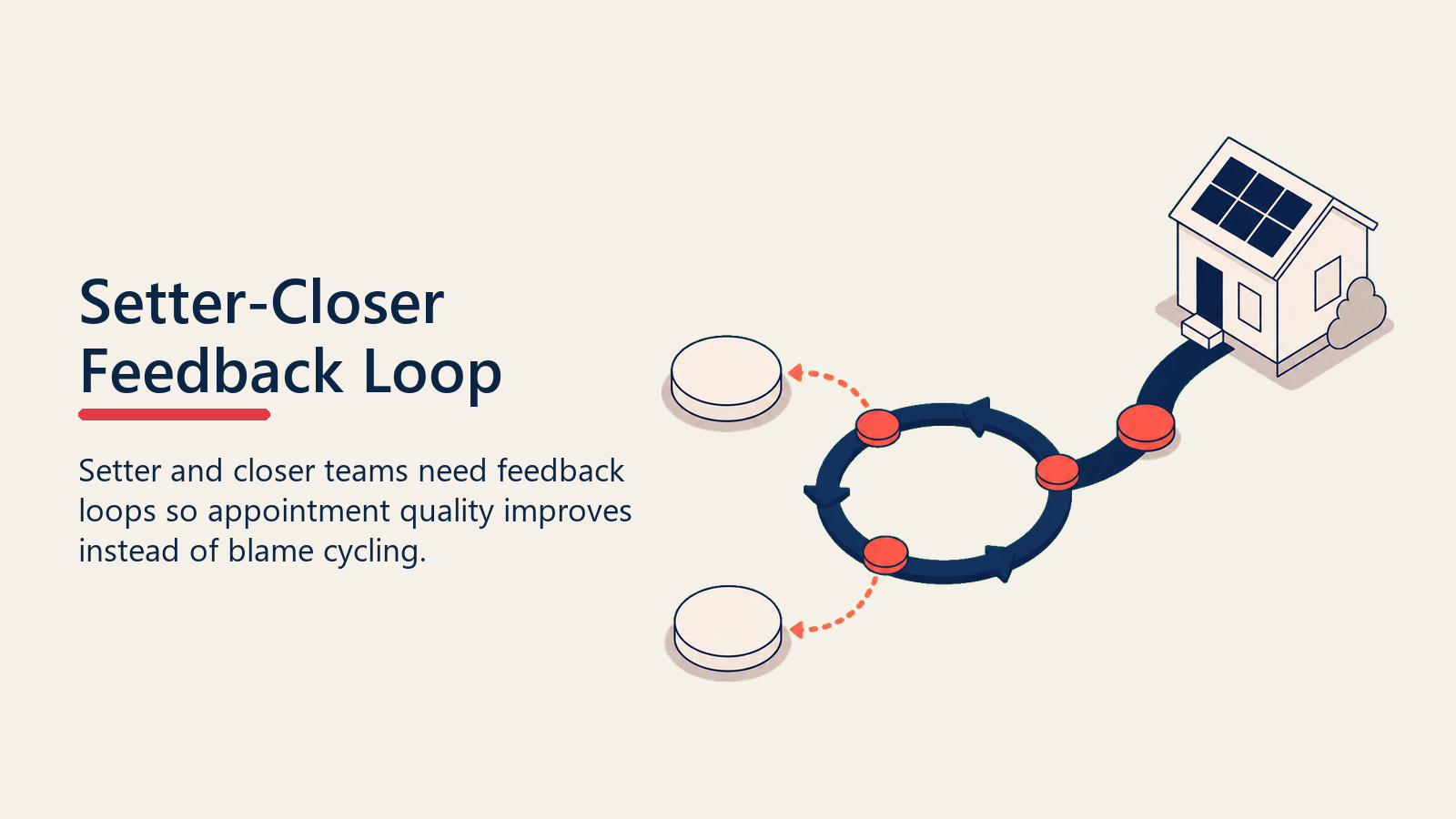
A functional feedback loop has these elements:
Post-appointment disposition codes that every closer completes within 30 minutes of leaving a home:
- Sold
- No show
- Rescheduled (with date)
- Ran but didn't close (specify reason: objection type, financing issue, spouse absent, etc.)
- Unqualified at door (specify: renter, low bill, credit, etc.)
- Cancelled by homeowner before arrival
These codes feed a weekly setter report that shows each setter's:
- Total appointments booked
- Show rate
- Percentage that ran vs. were unqualified at door
- Close rate on their appointments (not just team close rate)
When a setter sees that 25 percent of their appointments are being marked "unqualified at door" compared to 8 percent for the team, the coaching conversation becomes specific and data-backed instead of vague and defensive.
See lead setter performance dashboards for the full metrics framework. The disposition codes feed directly into that dashboard.
Who Owns the Show Rate When No One Shows Up?
No-show rates are owned by both setter and closer, but in practice neither team claims them. Setters say homeowners confirmed and closers say they didn't do a reminder call. Closers say they texted and homeowners didn't respond.
The show rate should be a shared number with shared responsibility:
| Activity | Owner | Timing |
|---|---|---|
| Initial booking + qualification | Setter | At booking |
| 48-hour confirmation call | Setter | 2 days before |
| Day-before text confirmation | Setter or CRM automation | 24 hours before |
| Morning-of reminder | Closer | Day of appointment |
| No-show rescue call | Setter (within 30 min of no-show) | Immediately |
| Reschedule attempt | Setter | Same day or next day |
When every step of this sequence is assigned to a specific role with a specific timing, "we don't know why our show rate is 52 percent" becomes "the day-before text isn't going out consistently." That's a solvable problem.
See no-show and reschedule reduction for the full confirmation sequence and rescue scripts. The setter-closer alignment piece is about making sure both teams know what they own in that sequence.
Incentive Structures That Align Behavior
Compensation design shapes behavior faster than any training. If setters are paid purely on appointments booked, they'll book appointments. If they're paid on appointments that ran to completion, they'll pre-qualify more carefully. If they're paid on sold deals from their appointments, they'll be selective about who they book.
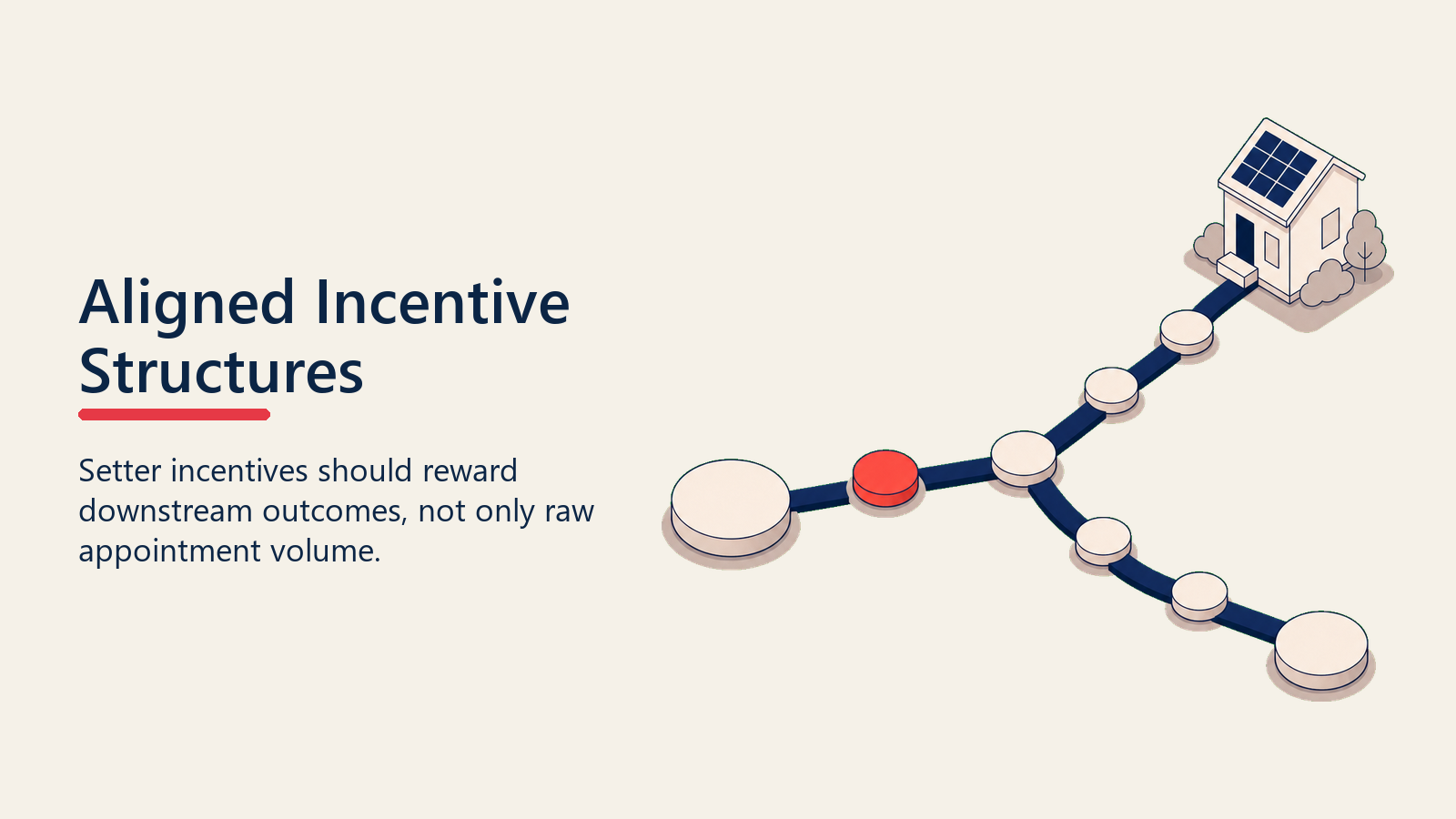
Most high-performing solar companies tie at least part of setter compensation to downstream outcomes. This approach is grounded in solid research: the Salesforce State of Sales report finds that 81% of sales reps say team selling helps them close more deals, but the same survey shows that aligning teams around shared outcomes remains one of the hardest operational challenges companies face.
| Comp structure | Behavior it drives | Risk |
|---|---|---|
| Flat per-appointment | High volume, low qualification | Closers get flooded with garbage |
| Per-appointment that ran (confirmed show) | Better show rates, some pre-screening | Setters may not push on qualification |
| Per-appointment that ran + quality bonus on close rate | Strong alignment on qualification | Requires clean data and trust |
| Percentage of closed deal value | Maximum alignment | Complex to administer, can create gaming |
The most common structure for aligned setter teams is a base per-appointment-that-ran plus a monthly bonus tied to close rate on their appointments. It rewards volume while creating a financial stake in quality. But comp alone isn't enough. The next lever is the communication rhythm that keeps both roles pointed in the same direction week to week.
See solar commission and comp design for how this setter comp structure fits into the broader compensation design for the whole sales team.
Joint Team Meetings and Communication Norms
Setters and closers who never sit in the same room together develop competing narratives. A weekly joint stand-up, even a 15-minute one, creates shared context that makes the handoff smoother.
Agenda for a 15-minute joint setter-closer stand-up:
- This week's show rate and close rate (2 min, shared scoreboard)
- One "this is what I walked into vs. what I expected" example from a closer (3 min)
- One "this is what I struggled to book" example from a setter (3 min)
- Any changes to lender tiers, incentives, or qualifying criteria coming this week (3 min)
- Shout-out for a well-prepped appointment that made the closer's job easier (2 min, culture-building)
- Next week's targets (2 min)
This meeting isn't a blame session. It's an information exchange that keeps both teams updated on the same reality. Closers start giving setters honest, specific feedback because it's the norm, not an exception. Setters start asking better qualifying questions because they hear what's happening at the door.
For the in-home process itself, the alignment work described here is what makes those processes run as designed, rather than as two separate teams doing their best with incomplete information.
The Alignment Audit
If you're not sure where your setter-closer alignment breaks down, run this audit:
Step 1: Pull 20 recent appointments that ran but didn't close. Review the setter's notes versus what the closer's disposition code says. Are there consistent gaps?
Step 2: Pull 10 no-shows from the last two weeks. For each one, trace the confirmation sequence. Which step was missed?
Step 3: Ask three closers: "What's the one thing you wish you knew before walking into an appointment that you usually don't get from the setter notes?" Ask three setters: "What feedback do you get from closers about your appointments?"
Step 4: Check whether show rate and close rate are tracked per setter. If they're not, that's the first fix.
Most teams find the same two or three root causes when they run this audit. Fix those specifically rather than trying to rebuild the entire process, and you'll see show rates and close rates respond within 30 to 60 days.
For the qualification logic that drives which leads setters should be booking in the first place, see lead qualification frameworks.
Learn More: in-home consultation framework | setter to closer handoff | churn prevention strategy
Quotable Nuggets
"A closer who doesn't trust setter notes walks into every appointment blind. A setter who never hears what happened at the door keeps making the same mistakes. The handoff only works when information moves in both directions." Operational principle grounded in Salesforce State of Sales alignment research
"Show rate is owned by both roles. When setters claim 100% confirmation and closers claim they texted, and the no-show rate is 35%, the problem is not bad homeowners. It's an accountability gap in the confirmation sequence."
"Teams with clear role accountability, including setter-closer protocols, retain better because reps trust the process instead of fighting their own colleagues for results." Based on SPOTIO State of Field Sales 2026 findings on role clarity and retention.
The Disposition-to-Coaching Loop: Every appointment outcome gets coded by the closer within 30 minutes (Sold, No-show, Rescheduled, Ran-didn't-close with objection type, Unqualified-at-door with reason). Those codes feed a weekly per-setter report showing each setter's show rate, unqualified-at-door rate, and close rate on their appointments. The manager reviews that report one-on-one with the setter each week. When a setter sees that 25% of their appointments are "unqualified at door" vs. 8% for the team, the coaching conversation becomes specific and data-backed instead of vague and defensive. The loop from appointment outcome to individual coaching is the mechanism that makes the setter-closer handoff improve over time instead of just being enforced.

Senior Implementation Consultant
On this page
- The Two-Role Model and Why It Creates Friction
- What Setters Must Capture and Communicate
- The Pre-Appointment Closer Brief
- What to Do When the Setter Missed Something
- Building the Feedback Loop
- Who Owns the Show Rate When No One Shows Up?
- Incentive Structures That Align Behavior
- Joint Team Meetings and Communication Norms
- The Alignment Audit
- Quotable Nuggets