Expanding from Residential to Commercial Solar Sales
Turn this article into takeaways for your work.


Each assistant summarizes the article only for you and suggests best practices for your work.
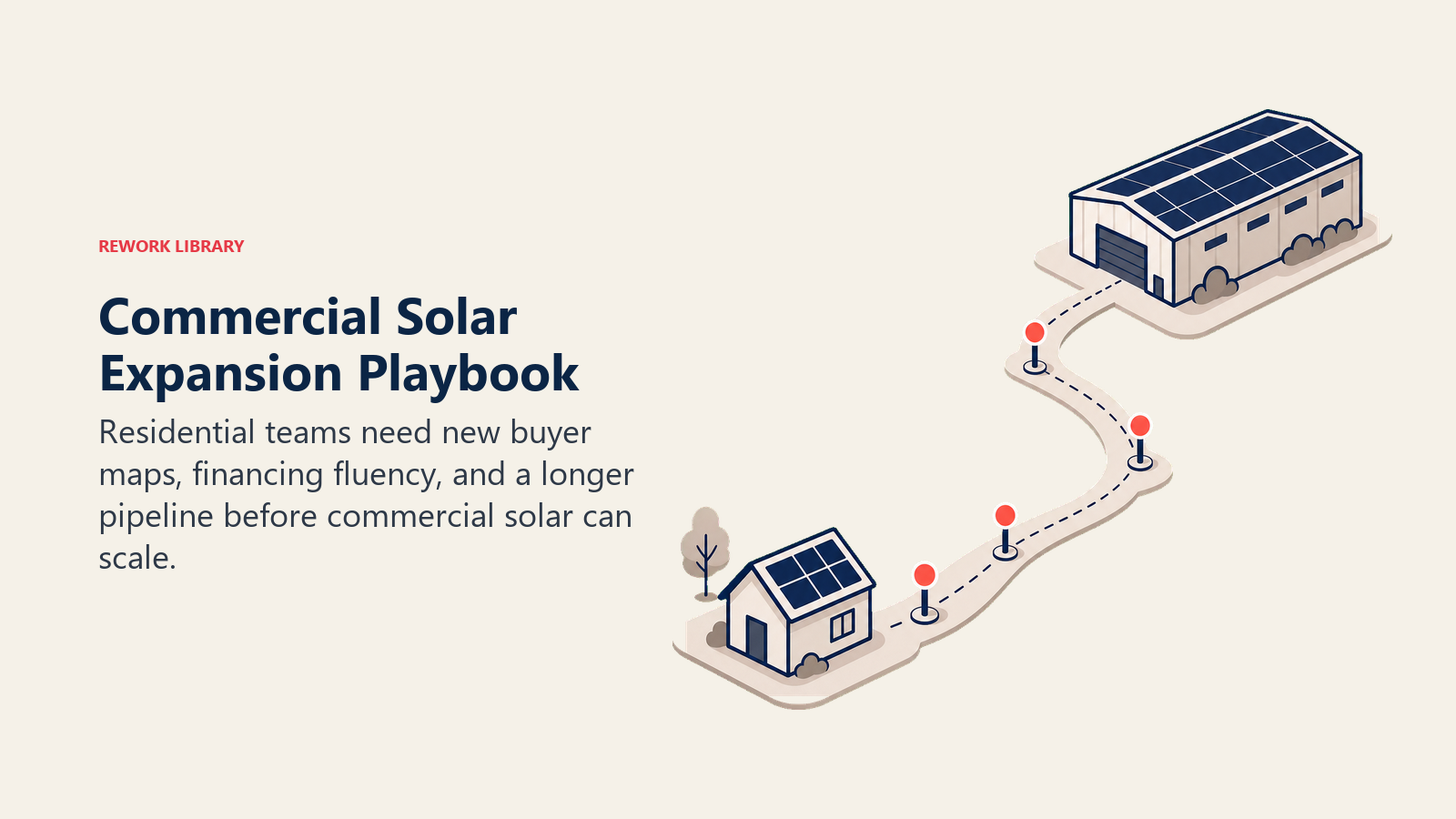
A lot of residential solar owners look at their install crews and their brand recognition and think: we could sell commercial too. The logic makes sense on paper. You already know solar. You already have relationships with lenders and installers. Why not chase the roofs on warehouses and office parks instead of just houses?
Then the first commercial deal takes nine months to close, the financing structure looks nothing like a residential loan, and the rep who crushed it in living rooms can't get a facilities director to return an email. Expansion stalls, and the leadership team starts wondering if commercial was ever worth the distraction.
It can absolutely be worth it. Commercial solar deals are bigger, stickier, and often less price-sensitive per watt than residential. But the sales motion is a different animal, and treating it like "residential with bigger checks" is the single most common reason expansions fail. Below is what actually changes, what a realistic first-year plan looks like, and how to protect your residential business while you build the new one.
Why Residential Solar Companies Want Into Commercial
Before getting into the differences, let's be honest about why commercial is attractive:
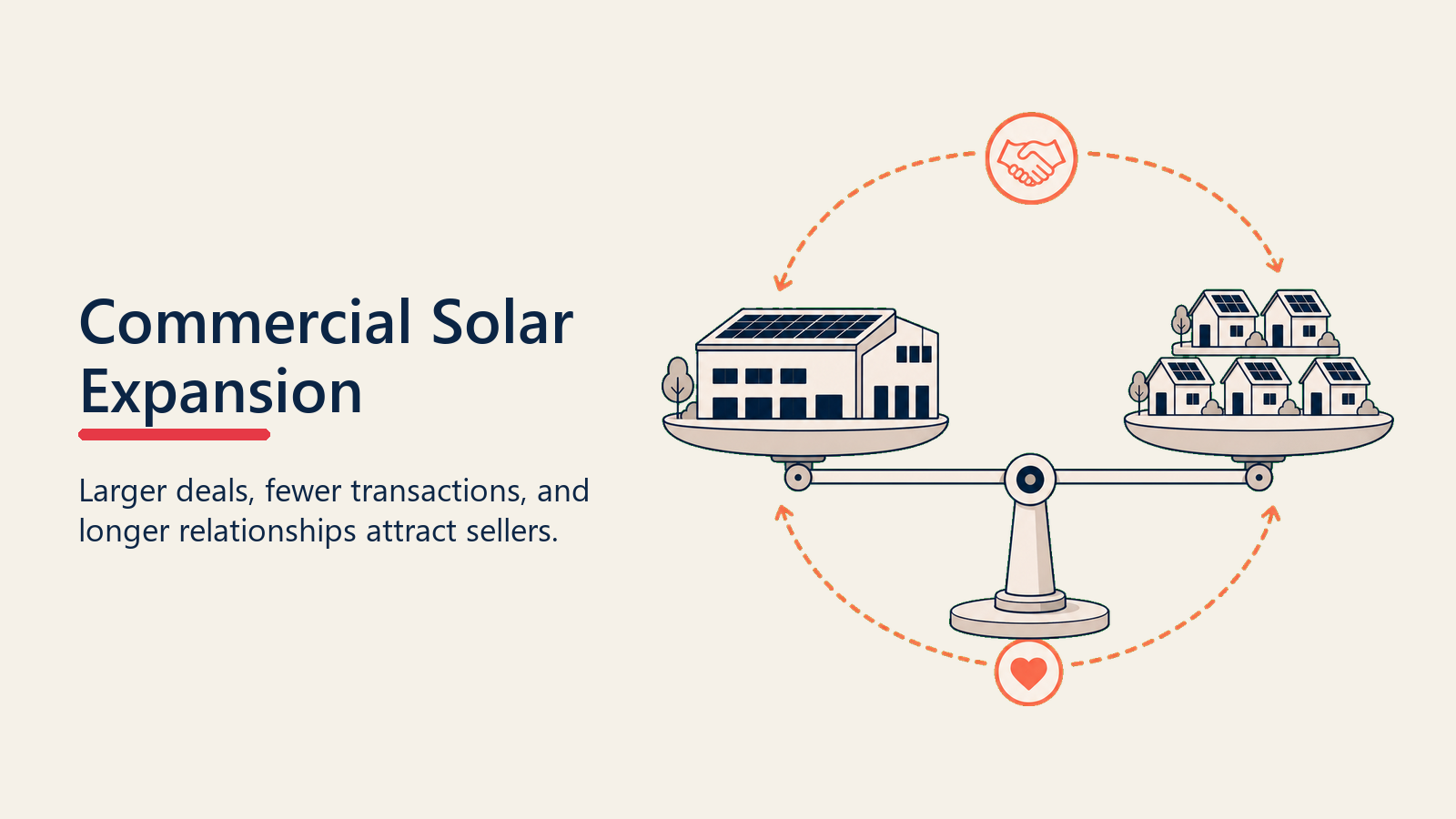
- Deal size. A single commercial rooftop or carport system can equal 20-50 residential installs in revenue.
- Fewer transactions per dollar of revenue. Less canvassing volume, less appointment-setting overhead per dollar closed, once the pipeline is built.
- Diversified revenue that isn't tied to residential incentive cycles. Commercial projects lean on different financing and depreciation mechanics than homeowner tax credits, which insulates revenue somewhat from residential policy swings.
- Longer-term relationships. A commercial client with multiple locations can become a repeat customer across a portfolio of buildings.
Those are real advantages, and the market data backs up the opportunity. SEIA's work with its Commercial Real Estate working group has long flagged commercial and industrial solar as an underserved market relative to residential and utility-scale, with financing structure, not customer demand, as the main barrier to faster growth. And every advantage comes with a corresponding cost: a longer sales cycle, more deal complexity, and more capital tied up carrying a pipeline through a much longer close.
Key Facts: Commercial Solar Expansion
- Commercial solar installations totaled 4,647 MWdc in 2025, a 2% decline from the prior year, according to SEIA's Solar Market Insight Report, 2025 Year in Review.
- The residential Section 25D federal tax credit for owner-purchased home solar systems ended for systems placed in service after December 31, 2025, under the One Big Beautiful Bill Act, while commercial solar continues to run through the separate Section 48E clean electricity investment credit, per IRS guidance on Section 48E.
- NREL classifies commercial-scale solar as roughly 50 kW to 3 MW in size, a distinct band from both small residential rooftop systems and utility-scale projects, according to NREL's program work on commercial-scale solar.
The Core Differences: Residential vs. Commercial Solar Sales
| Dimension | Residential | Commercial |
|---|---|---|
| Decision maker | Homeowner (often a couple, one visit) | Committee: facilities, finance, ownership, sometimes a board |
| Sales cycle | Days to a few weeks | 3-18 months |
| Deal structure | Loan, cash, PPA, lease | PPA, direct ownership with depreciation benefits, C-PACE, ground lease |
| Site complexity | Standard residential roof, single visit | Structural review, interconnection study, sometimes multiple buildings, in a size band NREL research defines as roughly 50 kW to 3 MW |
| Financing driver | Federal tax credit for owned systems (ended for new owner-purchased residential systems after Dec 31, 2025), monthly bill offset | Commercial Investment Tax Credit path (Section 48E), accelerated depreciation, utility rate structure |
| Rep skill set | Consultative, emotional, single-call or multi-visit close | Consultative + financial modeling + procurement navigation |
| Proposal | Standardized software output | Custom engineering-backed proposal, often RFP-driven |
The financing point deserves its own callout because it's where residential reps get tripped up first. The Section 25D 30% residential credit for owner-purchased home systems ended for systems placed in service after December 31, 2025, under the One Big Beautiful Bill Act. Commercial solar, however, runs through a different mechanism: Section 48E, the clean electricity investment tax credit for business and utility-scale generation assets, which has its own phase-down schedule and eligibility rules tied to placed-in-service dates and, for larger projects, prevailing wage and apprenticeship requirements. If you're quoting commercial ITC eligibility, verify current terms against the IRS guidance on Section 48E rather than assuming residential rules carry over. They don't.
The Buyer Is Fundamentally Different
In residential sales, you're managing one emotional decision made by one household, usually in a single evening or across two visits. In commercial, you're managing a group decision made across a much longer window. The emotional buy-in of one person, often a sustainability-minded facilities manager or owner, has to survive scrutiny from finance, legal, and sometimes a board or investment committee.
That means the skills that make someone a great residential closer, reading a room, building rapport fast, handling objections live, don't automatically transfer. A commercial deal requires:
- Patience across a long cycle. A rep used to closing in one visit will get frustrated or start pushing too hard in month four of a nine-month process.
- Financial fluency. You need to speak comfortably about payback period, internal rate of return, net present value, and how a PPA affects a company's balance sheet versus a direct-ownership purchase.
- Multi-threading. You're not selling to one household decision-maker. You're selling to a facilities director who has to convince a CFO who has to get sign-off from ownership or a board.
- Procurement navigation. Larger commercial accounts, especially public sector, healthcare, and enterprise retail, often require formal RFP responses, insurance documentation, and vendor onboarding processes that don't exist in residential.
This is a similar shift to what's described in value-selling frameworks: commercial buyers need the financial outcome connected to what each stakeholder in the room actually cares about, not a single pitch that plays to everyone at once. Reps who came up qualifying homeowners through a prescreening framework already have half the instinct. They just need to apply it to committees instead of couples.
Should You Hire New Reps or Retrain Residential Reps?
This is the first real strategic decision, and companies get it wrong in both directions.
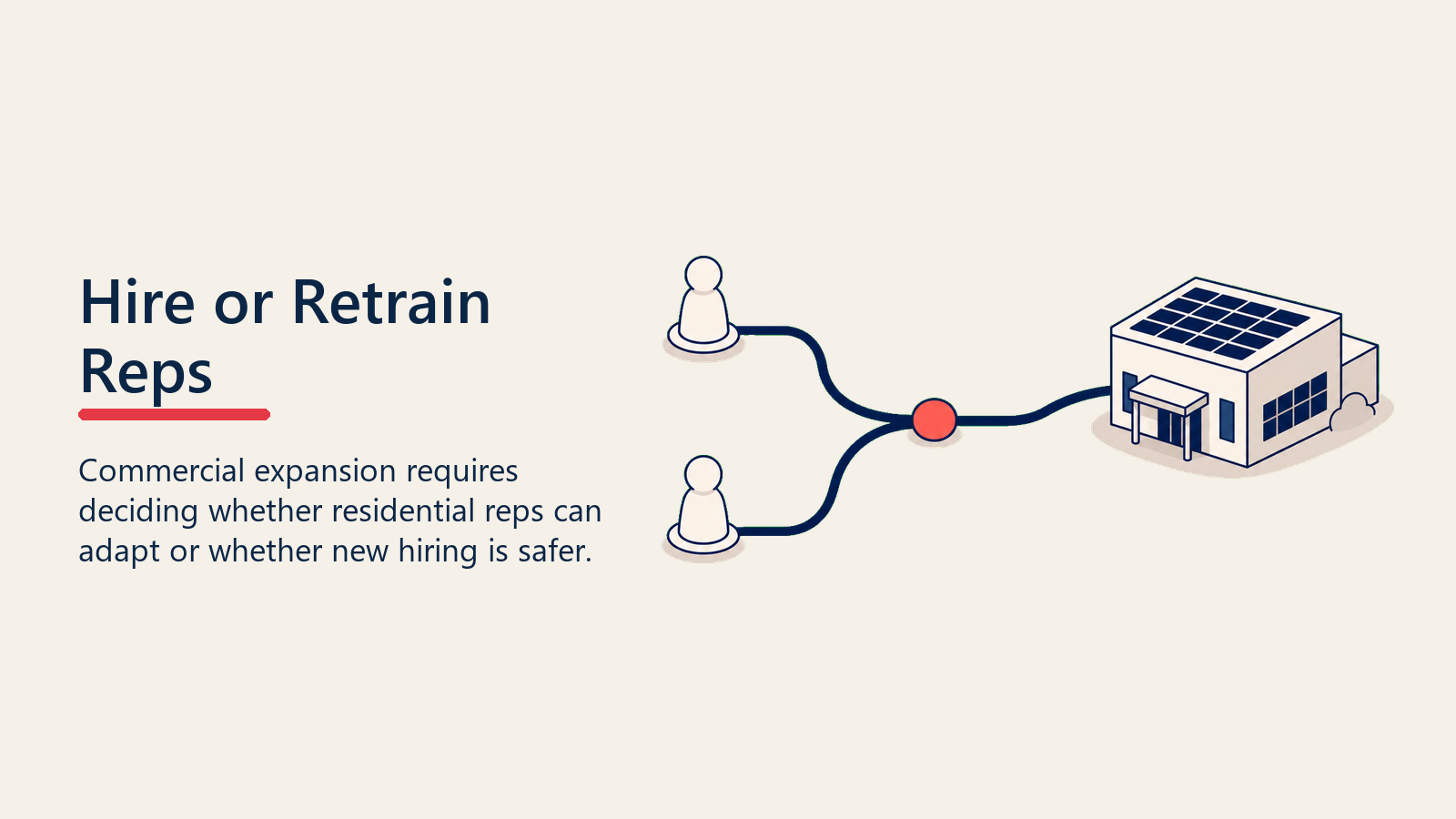
Promoting your best residential closer into commercial is a common mistake. Your top residential rep is often your worst commercial hire, not because they lack talent, but because the skills that made them elite (urgency, emotional read, fast close) actively work against them in a long-cycle B2B sale. They get impatient. They push too early. They take a slow-moving committee personally.
Hiring commercial solar veterans with no residential company context is the opposite mistake. Experienced commercial reps from EPCs (engineering, procurement, and construction firms) or other solar companies bring real skill, but they often don't understand your installation capacity, your existing vendor relationships, or your brand positioning. They also cost significantly more in base salary, since commercial sales comp structures skew toward salary plus smaller, later commissions rather than the aggressive commission-heavy structures common in residential.
What tends to work is a hybrid approach. Bring in one or two experienced commercial sales leaders to build the process and train internally, while identifying residential reps who show the right traits (patience, financial curiosity, comfort with ambiguity, and genuine interest in the mechanics of how deals get financed) as the first internal commercial hires. Don't force reps who thrive on fast residential energy into a role that will frustrate them and underperform.
The Lead-and-Learn Hybrid: bring in one or two experienced commercial sales leaders to build the process and coach internally, while promoting only the residential reps who show patience and financial curiosity into the first internal commercial seats, rather than either promoting your top closer by default or hiring an all-outside commercial team with no context on your operation.
How Should You Build the Commercial Pipeline in Year One?
A realistic commercial pipeline takes three phases across a year: build the foundation in months one through three, build the pipeline in months four through eight, and expect first closes in months nine through twelve. Here's a phased approach that avoids the common trap of expecting commercial revenue in quarter one.
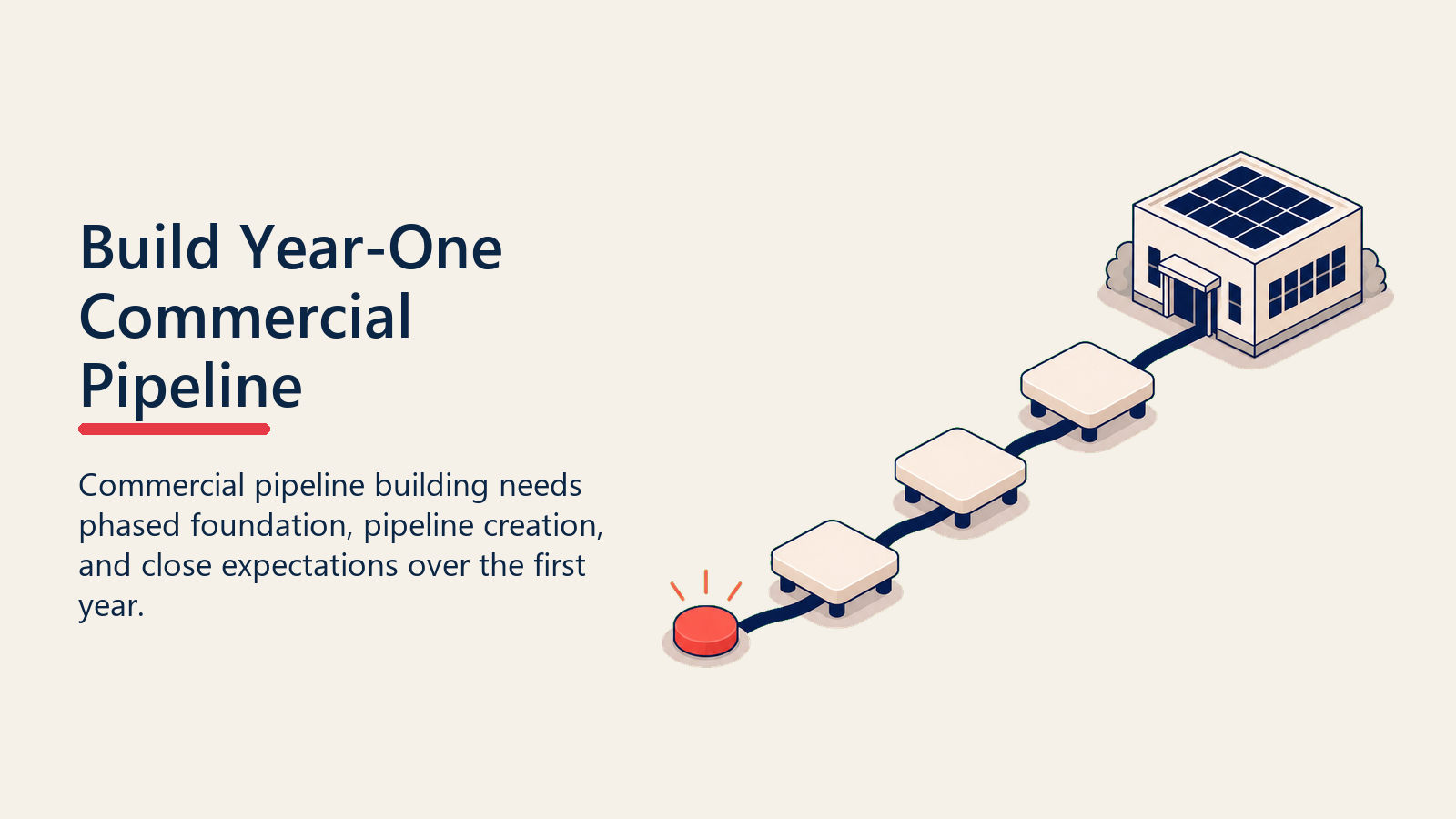
Months 1-3: Foundation
- Hire or designate 1-2 commercial-focused reps or a small team lead
- Build commercial-specific proposal templates and financial modeling tools (payback period, IRR, depreciation benefit calculators)
- Identify your target segments: which building types, which square footage range, which local utility rate structures make commercial solar most attractive in your service area
- Establish your commercial financing partnerships (PPA providers, C-PACE lenders, equipment finance companies)
Months 4-8: Pipeline Building
- Start outbound prospecting into target accounts: facilities directors, sustainability officers, property management companies, owner-operators of warehouses, manufacturing facilities, and multi-location retail or hospitality brands
- Expect a long qualification process. Not every interested prospect has the roof condition, structural capacity, or financial profile for a viable project
- Build relationships with commercial real estate brokers and property managers who touch multiple buildings and can become repeat referral sources
- Track pipeline the way opportunity qualification frameworks recommend: score deals on structural fit, financial readiness, and decision-maker access, not just interest level
Months 9-12: First Closes and Iteration
- Expect your first commercial closes in this window if the pipeline was built correctly in months 4-8
- Review what worked and what didn't in your proposal process, financing partnerships, and internal handoff to installation
- Start refining your ideal commercial customer profile based on which deals closed fastest and which stalled
A useful gut check throughout year one: if your commercial pipeline isn't generating real proposals by month six, the issue is almost always top-of-funnel targeting, not closing skill. Commercial deals fail more often because reps talked to the wrong buildings than because they lost a winnable one.
Protecting the Residential Engine While You Expand
The single biggest risk in a commercial expansion isn't that commercial fails. It's that commercial distracts leadership, capital, and installation capacity away from residential long enough that the core business slows down while the new line is still unprofitable.
A few guardrails help:
- Keep commercial and residential install crews separate, or clearly scheduled, so commercial project delays don't bump residential installs. Commercial jobs often slip due to permitting, structural engineering, or utility interconnection delays outside your control. Don't let that slippage cannibalize your residential sales-to-install-operations alignment.
- Fund commercial expansion out of a defined budget, not by quietly redirecting residential marketing spend. Track commercial as its own P&L line from day one so leadership can see true unit economics rather than a blended, misleading picture.
- Don't let residential lead-gen headcount get pulled into commercial prospecting unless you've explicitly restaffed for it. Commercial prospecting (outbound to facilities directors, RFP responses, broker relationships) is a different skill from residential canvassing and lead qualification.
- Set a clear timeline for when commercial needs to be self-sustaining. Twelve to eighteen months is a reasonable runway for a small commercial team to build a repeatable pipeline. If it's not generating qualified opportunities by then, revisit the strategy before sinking more capital in.
Commercial Financing Structures Your Team Needs to Know
Residential reps who move into commercial need a working vocabulary they've likely never used:
| Structure | How It Works | Best Fit |
|---|---|---|
| Commercial PPA | Third party owns system, business buys power at a set rate | Businesses that want savings with zero capital outlay |
| Direct ownership | Business buys the system outright or via commercial loan, claims depreciation and applicable credits | Businesses with tax appetite and available capital |
| C-PACE financing | Financing attached to the property tax bill, transfers with property sale | Owner-occupied commercial buildings, longer hold periods |
| Ground lease / rooftop lease | Business leases roof or land to a developer who owns and operates the system | Businesses that want revenue from unused space without capital outlay |
Direct ownership deals may be eligible for the Section 48E clean electricity investment credit, along with accelerated depreciation under MACRS in many cases. But these calculations are complex enough that most serious commercial solar sellers bring in a financial partner or in-house analyst to model exact numbers for each prospect rather than relying on a rep's back-of-envelope math. Getting this wrong in a proposal is one of the fastest ways to lose credibility with a CFO.
What a Strong Commercial Sales Conversation Looks Like
Unlike residential, where the first meeting is often the whole sale, commercial sales conversations build over several touchpoints:
- Discovery call: understand the building portfolio, current energy spend, decision-making structure, and timeline
- Site assessment: structural, electrical, and shading analysis, often involving an engineer
- Financial proposal: modeled savings, financing options, and payback across multiple structures
- Stakeholder presentation: often to a group including finance, facilities, and ownership
- Contract negotiation: terms, warranties, performance guarantees, and financing documentation
- Interconnection and permitting: typically longer and more involved than residential, especially for larger systems
Each stage can stall for reasons that have nothing to do with your pitch: a CFO delaying capital decisions until next fiscal year, a utility interconnection queue backlog, or a facilities director waiting on a roof replacement before adding solar load. Building realistic stage-based forecasting, rather than assuming every "interested" prospect closes on your timeline, keeps leadership expectations calibrated.
Common Mistakes When Expanding into Commercial
Underestimating the sales cycle in revenue projections is the most common one. If leadership expects commercial revenue to show up in quarter two of a launch, they'll pull the plug before the pipeline has had time to mature.
Using residential proposal software for commercial deals is another. Commercial financial modeling needs depreciation schedules, IRR calculations, and multi-year utility rate escalation that most residential proposal tools don't handle well.
Chasing deals too small to justify the sales cycle cost is a third. A tiny commercial roof that takes six months to close and generates thin margin isn't worth the same sales effort as a mid-size warehouse portfolio. Qualify for deal size early.
Ignoring the installation capacity conversation before selling. Selling a 500kW rooftop system before confirming your crews or subcontractors can actually execute it at that scale creates a delivery crisis that damages your brand with a much more vocal, well-connected commercial buyer than a residential homeowner. If you lean on outside crews for commercial jobs, the same vetting discipline covered in EPC and installer channel partnerships applies, only the stakes are higher because a single commercial account carries more revenue and more reputational risk than any single residential job.
Not building a referral engine into commercial from day one. Just like residential, commercial clients who are happy will refer other property owners, especially within the same management company or investor group. See referral generation after install for principles that apply just as much to commercial, if not more, since commercial referrals often come with pre-qualified budget and structural fit already known.
Quotable Nuggets
"Commercial and industrial solar remains an underserved segment relative to residential and utility-scale solar in the US, with financing structure rather than customer demand acting as the main barrier to faster growth, according to SEIA's Commercial Real Estate working group."

Senior Implementation Consultant
On this page
- Why Residential Solar Companies Want Into Commercial
- The Core Differences: Residential vs. Commercial Solar Sales
- The Buyer Is Fundamentally Different
- Should You Hire New Reps or Retrain Residential Reps?
- How Should You Build the Commercial Pipeline in Year One?
- Months 1-3: Foundation
- Months 4-8: Pipeline Building
- Months 9-12: First Closes and Iteration
- Protecting the Residential Engine While You Expand
- Commercial Financing Structures Your Team Needs to Know
- What a Strong Commercial Sales Conversation Looks Like
- Common Mistakes When Expanding into Commercial
- Quotable Nuggets